
Jim Pasco: Epstein Connection and Public Record
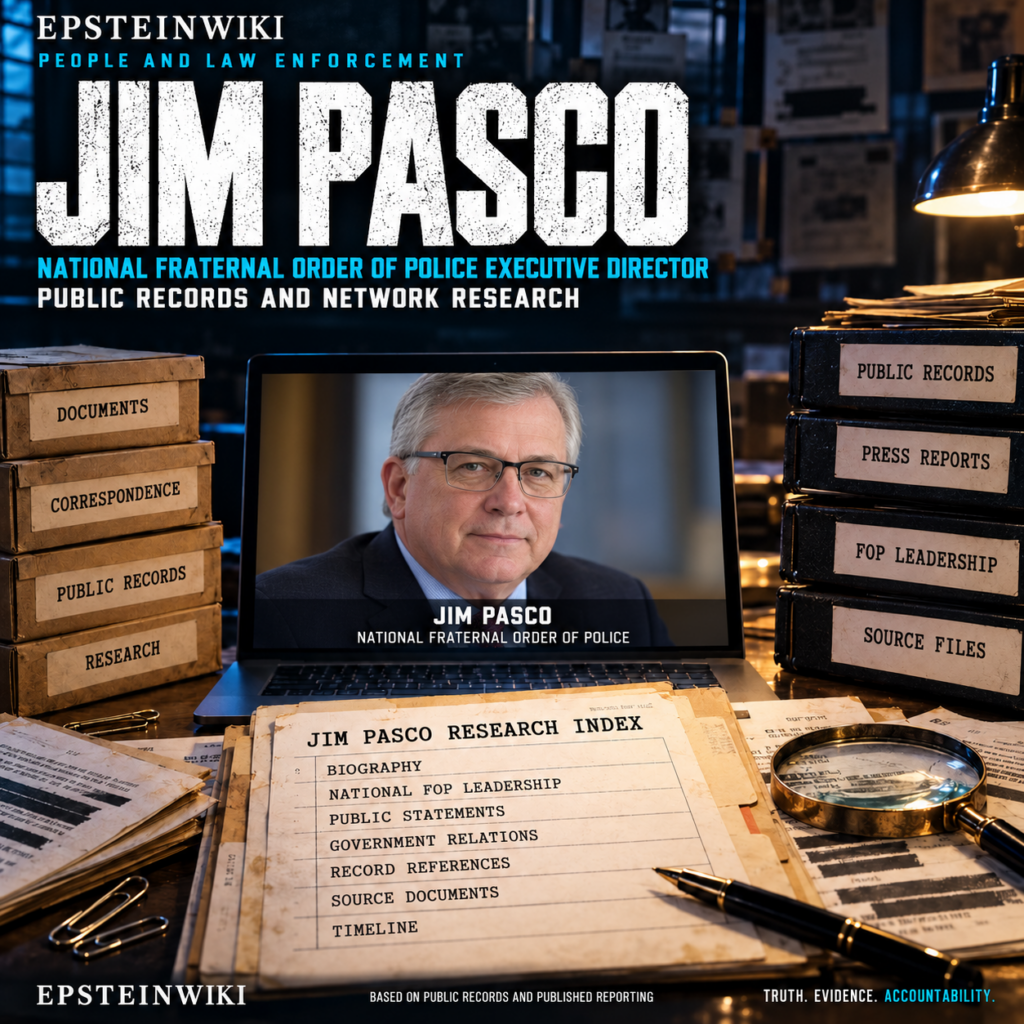
Snapshot
Jim Pasco, also identified as James O. Pasco Jr., is a longtime police union lobbyist and former federal official. Epstein’s legal expense ledger records a $75,000 bill for Jim Pasco and Associates, LLC as paid in full.
The entry appears on EFTA00727860, the ledger summary page, the fourth page of the five page EFTA00727857 record. The row shows $75,000 total billed, $75,000 revised total billed, $75,000 paid, and $0 outstanding. The source is an Epstein accounting record. It establishes that Epstein’s ledger recorded the firm’s bill as paid. It does not identify the services or independently document the transfer.
A separate record shows Attorney General William Barr greeting Pasco at a Fraternal Order of Police conference on August 12, 2019, before Barr addressed Epstein’s death in custody. The available records establish a financial connection through Pasco’s firm and a professional encounter with Barr. They do not establish that Pasco knew Epstein personally, worked on his criminal defense, or participated in Epstein’s crimes.
Pasco’s broader public record also includes documented questions about private corporate lobbying while leading the FOP, overlaps between some corporate clients’ interests and FOP positions, and an ethics investigation involving his wife’s federal work.
Key takeaways
• Epstein’s legal expense schedule lists Jim Pasco and Associates, LLC and records the company’s $75,000 bill as paid in full. The row reports a zero balance.
• The ledger does not say what Pasco’s company did for Epstein. It does not name the person who retained the firm, describe the work, or identify the source of the payment.
• A 2010 Washington Post investigation reported that Pasco earned $4.5 million from private corporate lobbying since 2000 while serving as the FOP’s chief lobbyist. It identified several instances in which FOP positions overlapped with the interests of companies he represented.
• Pasco and FOP leaders said his outside clients were permitted when there was no conflict and, according to FOP President Chuck Canterbury, with Canterbury’s permission. The Post reported that the arrangement raised conflict questions, while noting that it was not prohibited under the tax rules it examined.
• The public record supports serious questions about the $75,000 payment, transparency, and conflicts of interest. The records reviewed here do not establish that Pasco committed a crime.
The Epstein legal expense entry
The central record is EFTA00727857, titled “Jeffrey Epstein Outstanding Legal Invoices.” The U.S. Department of Justice has published the original five page PDF.
The entry is on page four of the PDF, bearing Bates number EFTA00727860. The summary table has separate columns for the original amount billed, reallocations, written off fees, revised total billed, total paid, balance outstanding, and outstanding balance as a percentage of paid.
The row for Jim Pasco and Associates, LLC reads:
• Total billed: $75,000
• Revised total billed: $75,000
• Total paid: $75,000
• Balance outstanding: $0
• Balance outstanding as a percentage of paid: 0.00%
The scan therefore records the firm’s $75,000 bill as paid in full. This is more specific than simply finding the company’s name beside an amount. It is evidence of a recorded payment in Epstein’s accounting schedule. api.epsteingraph.com
The same page reports total legal expenses as of July 21, 2010. The document lists total billed expenses of $42,192,448.31, revised total billed expenses of $39,822,913.24, total paid of $39,521,461.19, and an outstanding balance of $301,452.05. api.epsteingraph.com
What the $75,000 entry establishes
• Epstein’s legal expense schedule names Jim Pasco and Associates, LLC.
• The schedule records a $75,000 bill, a revised billed amount of $75,000, and the full $75,000 as paid.
• The row reports no outstanding balance.
• The firm appears among the expenses in a record titled “Jeffrey Epstein Outstanding Legal Invoices.”
What the entry leaves unanswered
• It does not describe the work performed.
• It does not identify who hired the firm or who requested the work.
• It does not say whether the work concerned Epstein’s criminal defense, civil litigation, public relations, lobbying, or another matter.
• It does not identify the individual who received the money or the account from which payment was made.
• It is an accounting record. The entry records the payment as paid, but the schedule itself is not a bank statement or a copy of the underlying transaction.
The $75,000 payment should be treated as a significant lead. The next evidentiary step is to locate the engagement letter, invoice, payment record, or correspondence that explains the services and identifies who arranged them.
Barr’s remarks at the FOP conference
A second relevant record is EFTA00023984, available as a DOJ PDF. It contains Attorney General William Barr’s prepared remarks for the FOP’s 64th National Biennial Conference in New Orleans on August 12, 2019.
Barr opened by thanking “Jim [Pasco]” for his work with the FOP. He then addressed the news that Epstein had died at the Manhattan Correctional Center over the weekend. Barr said the Justice Department was investigating the jail’s failures and that the case would continue against anyone complicit with Epstein. www.justice.gov
This establishes that Pasco was a senior FOP figure Barr addressed by name at the conference. It does not show that Pasco arranged the speech, discussed Epstein with Barr, or had any role in the investigation into Epstein’s death.
The speech is a record of the event and Barr’s remarks. It is not proof of an Epstein related relationship between Pasco and Barr beyond their documented professional contact there.
Pasco’s career and access
According to the FOP’s biography, Pasco served in the U.S. Army before joining the U.S. Customs Service in 1968. He joined the Bureau of Alcohol, Tobacco and Firearms in 1970, later becoming an assistant director responsible for congressional and media affairs. The FOP says he entered the Senior Executive Service in 1989 and left federal service in 1995. That year, he became the FOP’s first executive director. fop.net
The FOP maintains a full time legislative office on Capitol Hill. The organization says its professional staff lobbies Congress, federal departments, and the White House on policing and public safety issues. fop.net Pasco’s federal background and long FOP tenure placed him at the intersection of law enforcement, police union policy, and congressional lobbying.
Barr’s 2019 greeting is one documented example of Pasco’s access to senior officials. In January 2020, Barr also recognized Pasco and other law enforcement leaders for their work on the Presidential Commission on Law Enforcement and the Administration of Justice. The FOP said Barr publicly thanked Pasco for the organization’s role in developing the commission. www.justice.gov
These records document professional access and influence. They do not, on their own, show that Pasco used that access improperly.
Corporate lobbying while leading the FOP
A major part of Pasco’s public record is his private lobbying work. In a 2010 investigation, The Washington Post reported that his firm represented Philip Morris, MillerCoors, and Sony BMG while Pasco served as the FOP’s chief lobbyist. The paper reported that congressional disclosure filings showed $4.5 million in private lobbying earnings since 2000. It also reported that Pasco used FOP contact details for the corporate work. www.washingtonpost.com
Pasco told the newspaper that he could have private clients as long as there was no conflict with the FOP. FOP President Chuck Canterbury said Pasco could have outside clients with Canterbury’s permission. The Post quoted a tax law specialist who said the arrangement was unusual and raised questions about possible conflicts. The article also said the arrangement was not prohibited under the tax rules for fraternal organizations that the specialist discussed. www.washingtonpost.com
Philip Morris and tobacco policy
In 1998, the FOP opposed legislation that would have given the FDA authority to regulate tobacco and increased federal cigarette taxes. The FOP argued that the legislation could create a black market in cigarettes. The Post reported that Pasco was working for Philip Morris at the time and that the company had paid him $600,000 over the years.
Pasco said he saw no conflict. He also said he had secured federal money for police to combat black market cigarettes. www.washingtonpost.com
MillerCoors and alcohol regulation
The Post reported that Miller paid Pasco $1 million between 2002 and 2010 to lobby the Senate and ATF on alcohol labeling, advertising, marketing, and taxation. www.washingtonpost.com
A later Senate lobbying disclosure lists Jim Pasco and Associates as a self employed lobbying registrant. A 2015 filing names James Pasco as the lobbyist and describes work related to alcoholic beverage manufacture, labeling, advertising, marketing, sales, and taxation. The form uses an FOP office address and FOP email address. lda.senate.gov
This later filing confirms the firm’s alcohol policy work. It does not identify the client or explain the services behind the 2010 Epstein ledger entry.
Sony BMG and copyright policy
In 2005, while Pasco represented Sony, the FOP joined an amicus brief supporting the music industry in its Supreme Court case against Grokster. The Post reported that Sony paid Pasco $200,000 that year to lobby on internet intellectual property issues. Pasco said he did not remember the case. Canterbury said the FOP’s relationship with Sony had benefited the organization through work on piracy and trademark issues. www.washingtonpost.com
These examples document overlapping interests. They raise fair questions about disclosure and safeguards: when a lobbyist represents both a union and private corporations, how are conflicts identified, managed, and communicated to union members? The reporting does not prove that Pasco personally dictated FOP policy in exchange for corporate payments. In the airwaves dispute described below, Pasco said he did not make the decision.
Ethics questions involving Pasco’s wife
The 2010 Washington Post investigation also examined Pasco’s wife, Cybele Daley, who at the time worked in the Justice Department’s Office of Justice Programs.
The newspaper reported that the department’s Inspector General investigated Daley’s participation in a process involving grant awards to businesses represented by Pasco. The report, as described by the Post, did not find her participation substantial, but said she fell significantly short of government ethics standards. Daley said she was not involved in the grant decisions and did not know her husband represented the businesses. Pasco told the newspaper that he and his wife did not discuss business. www.washingtonpost.com
The Post also described a 2009 dispute over whether broadcast airwaves freed up by the transition to digital television should be reserved for public safety. The FOP and police chiefs initially supported giving the airwaves to public safety use. Daley was then a registered lobbyist for Motorola and AT&T, companies the newspaper said could benefit from the policy. Her firm said she was not paid to lobby on that issue.
The FOP later reversed its position. Pasco said he did not make the decision. Canterbury said he changed the FOP’s position after receiving a recommendation from a lobbyist on Pasco’s FOP staff. www.washingtonpost.com
These reports establish ethics concerns involving Daley’s government role and describe potential overlap among the couple’s professional interests. They do not establish that Pasco committed a crime or that Daley’s clients caused the FOP’s policy change.
FOP policy positions and public advocacy
Pasco’s public record also includes advocacy on firearms policy, police equipment, and civil liability.
In 2007, Pasco and the FOP supported the Tiahrt Amendment, which restricted public release of gun tracing data. The Post reported that Pasco joined NRA lobbyists in arguing that release of the data could compromise undercover investigations. The article does not show that Pasco was acting for a gun company on that issue. www.washingtonpost.com
In 2014, during debate about police militarization after the Ferguson protests, Pasco defended police access to surveillance, communications, and protective technologies. Vanity Fair, quoting an interview with The Hill, reported his argument that police were using technological advances that were also available to criminals. www.vanityfair.com
In 2020, the FOP opposed ending or curtailing qualified immunity, the legal doctrine that can shield government officials from damages in some civil rights cases. In a letter signed by Pasco, the FOP said it had not yet taken a position on the George Floyd Justice in Policing Act while emphasizing support for legal protections for officers. fop.net
These positions are part of Pasco’s public advocacy record. They show the policies he promoted as an FOP leader. They do not establish criminal conduct.
What the record supports
The evidence supports several clear findings:
• Epstein’s legal expense schedule lists Jim Pasco and Associates, LLC and records $75,000 paid in full, with $0 outstanding.
• The schedule does not disclose the work, the engagement terms, or the source of payment. Those details remain essential to understanding the transaction.
• Pasco had substantial influence as a former federal official and longtime police union lobbyist.
• According to a 2010 Washington Post investigation, his private lobbying generated $4.5 million since 2000 while he led FOP lobbying. Some FOP positions overlapped with interests of companies he represented.
• Pasco and FOP leaders gave explanations for the outside work and denied conflicts. The reporting documented overlaps and questions, but did not establish that corporate payments purchased FOP policy.
• Barr greeted Pasco at the 2019 FOP conference before addressing Epstein’s death. That establishes professional contact at the event, not involvement in Epstein’s case.
The paid ledger entry makes the Epstein connection more concrete than a mere name match. It is a recorded payment to Pasco’s firm in Epstein’s legal expense schedule. The work itself remains unidentified. The underlying invoice, engagement letter, payment record, and communications would show what the $75,000 purchased.
Further questions for investigation
• What invoice or engagement letter supports the $75,000 charge to Jim Pasco and Associates?
• Who retained the firm, and who approved the payment?
• What work did the firm perform for Epstein or his representatives?
• Was the work connected to Epstein’s legal defense, public relations, lobbying, or another matter?
• Which account funded the payment, and when did the funds move?
• Did Pasco, the FOP, Barr, or anyone in the Justice Department discuss Epstein or the payment?
• Are there additional records under Pasco’s name, his firm’s name, or a client or intermediary name that do not appear in text searches?
Sources and related reading
• EFTA00727860, the ledger summary page
• EFTA00727857, the full five page legal expense record
• EFTA00023984, Barr’s remarks at the FOP conference
• Barr’s August 12, 2019 FOP conference remarks
• Washington Post investigation of Pasco’s private lobbying and ethics questions
• 2015 Senate lobbying disclosure for Jim Pasco and Associates
• FOP Government and Media Affairs
• EpsteinWiki investigative standards
• Related EpsteinWiki sleuth report on Stephanie Thacker and the Epstein legal expense record