
Bradley J. Edwards and the Legal Fight Against Jeffrey Epstein
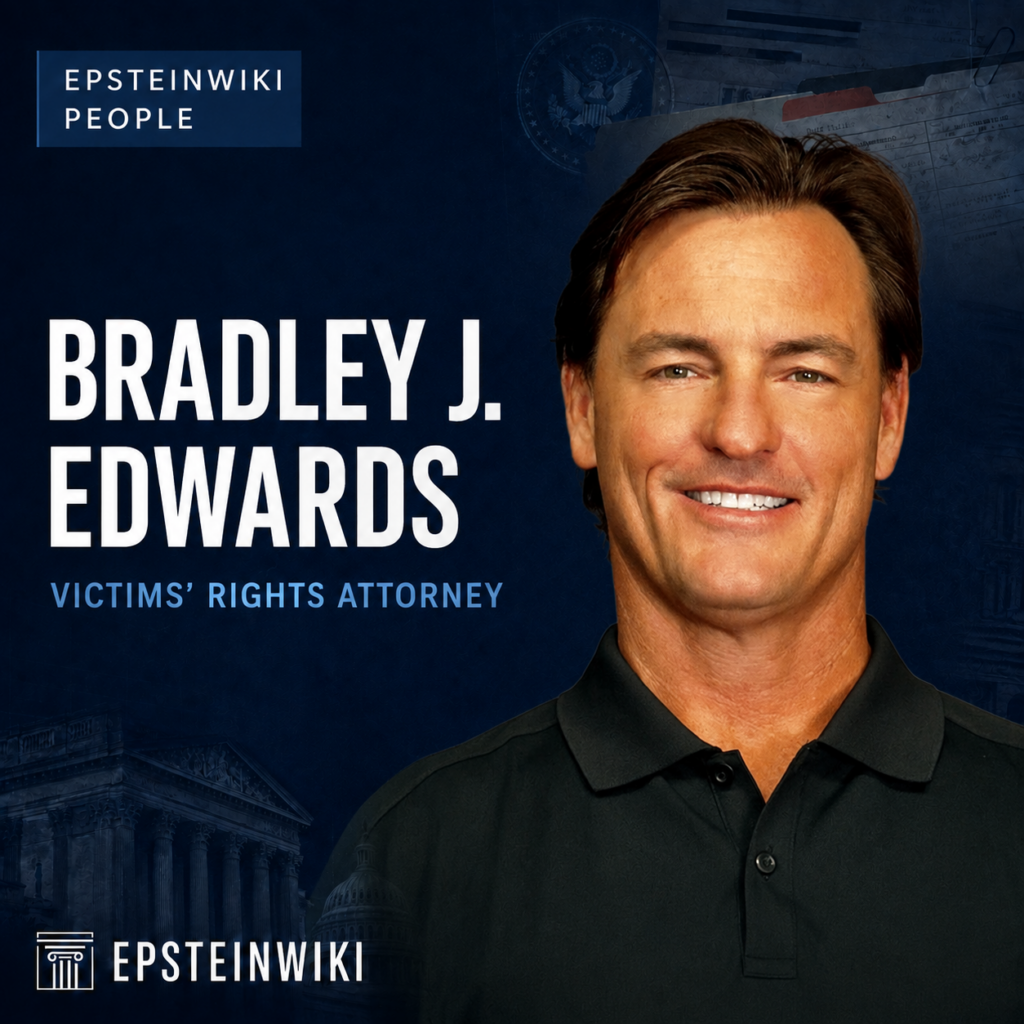
The Lawyer Epstein Tried to Destroy
Bradley J. Edwards entered the Jeffrey Epstein case in 2008 representing several young women who had been sexually abused as teenagers.
He soon discovered that federal prosecutors had already negotiated a secret agreement protecting Epstein from federal prosecution. The survivors had not been consulted. They had not even been told that the agreement existed.
Edwards responded with an emergency petition under the Crime Victims’ Rights Act. That filing began a legal battle that lasted more than thirteen years.
During that fight, Edwards represented dozens of survivors, challenged the United States government, sued Epstein, defended himself against Epstein’s retaliation, helped Virginia Giuffre sue Ghislaine Maxwell, confronted Alan Dershowitz in years of litigation, negotiated with Epstein’s estate, and pursued the financial institutions that sustained Epstein’s operation.
Epstein sued Edwards and accused him of participating in attorney Scott Rothstein’s criminal fraud. Edwards denied knowing about Rothstein’s scheme. Rothstein eventually exonerated him, and Epstein later issued a public apology acknowledging that he had tried to damage Edwards’s reputation and stop him from representing survivors.
The government’s response was less direct.
A federal judge ruled in 2019 that prosecutors had violated survivors’ rights by secretly negotiating Epstein’s nonprosecution agreement. The ruling arrived eleven years after Edwards filed the case and only months before Epstein died.
An appellate court later held that the Crime Victims’ Rights Act did not protect victims before federal charges were filed. The Supreme Court declined to review that decision.
The survivors proved that prosecutors had concealed the agreement. They still received no remedy capable of undoing it.
Who Is Bradley J. Edwards?
Bradley James Edwards is an American civil trial attorney based in Florida.
He graduated with honors from the University of Florida, where he played collegiate tennis, and earned his law degree from Florida State University College of Law.
Edwards became board certified in civil trial law and developed a practice representing:
- Survivors of sexual abuse
- Children subjected to exploitation
- Victims of violent crime
- Trafficking survivors
- Families in wrongful death cases
- People injured by institutional negligence
- Victims of fraud and privacy violations
He is a founding partner of Edwards Henderson, a law firm focused heavily on crime victims and sexual abuse litigation. His longtime legal partner Brittany Henderson has worked beside him in many of the Epstein cases.
According to Edwards Henderson’s professional biography, Edwards initially represented approximately sixty Epstein survivors. By 2025, media profiles described him as having represented more than 200 survivors through individual lawsuits, estate claims, compensation proceedings, and class actions.
Those totals describe different stages and forms of representation. They should not be treated as interchangeable counts of individual lawsuits filed personally by Edwards.
2008: The Case That Exposed the Secret Deal
In 2008, Edwards was retained by young women who said Epstein had sexually abused them while they were minors.
The Palm Beach Police Department and FBI had identified dozens of possible victims. Federal prosecutors had prepared a proposed indictment, yet no federal charges were filed.
Instead, on September 24, 2007, the United States Attorney’s Office for the Southern District of Florida signed a secret nonprosecution agreement with Epstein.
Under the agreement:
- Epstein would plead guilty to limited Florida state charges.
- Federal prosecutors would end their investigation.
- Epstein would not face federal charges in South Florida.
- Potential coconspirators would receive protection from federal prosecution in that district.
- The agreement would remain concealed from the victims while prosecutors continued sending communications that implied the investigation remained active.
The survivors were denied the opportunity to confer with prosecutors before the agreement was executed.
When Epstein pleaded guilty in state court on June 30, 2008, the full federal agreement was still being withheld from them.
The July 3 Letter Prosecutors Could Not Honestly Answer
On July 3, 2008, Edwards wrote to the United States Attorney’s Office conveying his clients’ desire for federal prosecution.
By then, Epstein had already entered his state plea pursuant to the secret federal agreement.
Prosecutors did not tell Edwards that federal prosecution had been abandoned months earlier.
The appellate record recounts that Edwards contacted Assistant United States Attorney A. Marie Villafaña and discussed whether federal charges might still be filed. Those conversations occurred after the government had already promised Epstein that it would not prosecute him.
A released record concerning Edwards’s victim communications is indexed as EFTA00014125.
The concealment was not merely an administrative failure. Prosecutors continued communicating with survivors in a manner that allowed them to believe federal action remained possible.
That deception became central to the litigation that followed.
July 7, 2008: The Emergency CVRA Petition
On July 7, 2008, Edwards filed an emergency petition in the United States District Court for the Southern District of Florida.
The case was filed as Doe v. United States, Case No. 9:08 cv 80736.
The original petitioner was identified as Jane Doe No. 1. A second survivor, Jane Doe No. 2, was added shortly afterward.
Jane Doe No. 1 later disclosed her identity as Courtney Wild, who was fifteen when Epstein began abusing her.
The petition alleged that federal prosecutors had violated rights guaranteed by the Crime Victims’ Rights Act, including:
- The right to confer with prosecutors
- The right to be treated with fairness
- The right to receive timely notice
- The right to receive information about restitution
- The right to have the government make its best efforts to protect those rights
The complete federal docket is available through CourtListener’s Doe v. United States record.
A transcript reflecting Edwards and Paul Cassell appearing for Jane Doe No. 1 and Jane Doe No. 2 is preserved as EFTA00204936 on Epstein Data.
Paul Cassell Joins the Fight
Edwards was joined by Paul G. Cassell, a former federal judge and University of Utah law professor who became a leading authority on crime victims’ rights.
Edwards brought extensive survivor representation and civil litigation experience. Cassell brought deep expertise in the Crime Victims’ Rights Act and federal appellate practice.
Together, they advanced a legal theory that was both simple and consequential: prosecutors could not evade victims’ rights by secretly resolving a federal investigation before filing charges.
If victims had no enforceable rights until after an indictment, prosecutors could permanently avoid the statute by negotiating a private nonprosecution agreement before any case reached court.
The Edwards and Cassell interpretation treated the CVRA as applying during the investigation and negotiation period. The government argued that the statute did not create enforceable rights until a federal criminal proceeding formally began.
That disagreement would divide judges for more than a decade.
The Government Finally Discloses the Agreement
The litigation forced disclosure of the nonprosecution agreement and the communications surrounding it.
The survivors learned that prosecutors had negotiated with Epstein’s large defense team while keeping the people harmed by him outside the room.
Epstein’s defense team included nationally prominent attorneys and former government officials. The survivors entered the process with far fewer resources and almost no institutional power.
Edwards’s petition changed that imbalance.
It created a legal proceeding in which the government had to explain:
- Why the agreement was hidden
- Why victims were not consulted
- Why prosecutors continued sending misleading correspondence
- Why potential coconspirators received protection
- Why the federal investigation ended without charges
- Whether the agreement violated federal victims’ rights law
The case preserved records that might otherwise have remained inaccessible.
A 2011 Victory on Precharge Rights
In 2011, District Judge Kenneth A. Marra ruled that the Crime Victims’ Rights Act could apply before federal charges were filed.
The ruling relied partly on language requiring officials engaged in the detection, investigation, or prosecution of crime to make their best efforts to provide victims with statutory rights.
The court also noted that the CVRA expressly provided a venue for a victim to seek relief when “no prosecution is underway.”
That ruling allowed Edwards and Cassell to continue litigating whether prosecutors had violated the survivors’ rights.
It did not resolve the case. Years of discovery and briefing followed.
The government continued defending the secrecy of the agreement while Epstein used civil litigation to attack the lawyers pursuing him.
The Civil Lawsuits Against Epstein
Alongside the CVRA case, Edwards represented survivors in civil lawsuits seeking compensation directly from Epstein.
These cases forced depositions, subpoenas, testimony, and document production concerning Epstein’s employees, pilots, recruiters, properties, and sexual abuse system.
The litigation involved or sought evidence from figures including:
- Ghislaine Maxwell
- Jean Luc Brunel
- Larry Visoski
- Epstein’s household employees
- Epstein’s assistants
- Members of Epstein’s legal and professional network
A 2015 filing signed by Edwards discusses an earlier effort to subpoena Brunel for a deposition. The filing is preserved as EFTA00191396 on Epstein Data.
Lisa Tait’s examination of Larry Visoski and the Epstein flight operation notes that Edwards deposed Visoski during the early survivor litigation.
These civil cases became important repositories of evidence because the federal government had chosen not to prosecute Epstein.
Scott Rothstein and the Theft of the Epstein Files
In spring 2009, Edwards joined the law firm Rothstein Rosenfeldt Adler.
The firm’s managing shareholder, Scott Rothstein, was running a massive Ponzi scheme involving fabricated legal settlements. Rothstein sold investors interests in supposedly confidential settlement agreements that often did not exist.
Edwards brought his active Epstein cases into the firm.
According to later court records, Rothstein treated the Epstein litigation as potentially valuable material for his fraudulent operation. He reportedly described the claims as being against an “extremely collectible pedophile” and told investors that Epstein might pay an enormous global settlement.
Rothstein also accessed confidential Epstein files from Edwards’s office. Evidence later indicated that he displayed or discussed those materials with potential investors.
Edwards denied knowing that Rothstein was using the cases in a fraudulent investment scheme.
When Rothstein’s operation collapsed in late 2009, Edwards had to recover client files from federal authorities and continue representing survivors amid the wreckage.
American Freakshow’s “Florida Men” reconstructs Rothstein’s interest in the Epstein litigation, his access to Edwards’s files, and the resulting questions.
Greg Conners examines the related litigation and evidentiary conflicts in “Many Hats: Dershowitz and Epstein’s Shrink”.
Epstein Sues Edwards
Epstein responded to the Rothstein scandal by suing Rothstein, Edwards, and others in Florida state court.
The case became known as Epstein v. Rothstein.
Epstein alleged that the survivor litigation had been used as part of Rothstein’s fraudulent enterprise. His claims included allegations involving fraud, conspiracy, abuse of process, and Florida racketeering law.
Edwards denied participating in Rothstein’s scheme and filed counterclaims.
The litigation gave Epstein an additional opportunity to seek discovery from the attorney representing his accusers. It also threatened to make the survivors’ legal work appear connected to Rothstein’s criminal operation.
An Epstein Data record concerning discovery directed at Edwards is EFTA00728258.
Additional materials from the litigation appear in Epstein Data’s search results for Bradley Edwards.
Rothstein Exonerates Edwards
Rothstein ultimately stated that Edwards had not known about the Ponzi scheme.
That distinction was critical.
Rothstein had exploited the perceived value of Edwards’s cases, but the available evidence did not establish that Edwards knowingly helped him sell fraudulent investments.
The fact that Rothstein accessed or misused survivor files did not make Edwards a participant in Rothstein’s fraud.
Epstein nevertheless continued litigating against Edwards for years.
The conflict became a second front in the Epstein case. Edwards was simultaneously representing survivors against Epstein and defending himself from Epstein’s claims.
Epstein’s Threat at Starbucks
Edwards has described an in person meeting with Epstein at a Starbucks in Boca Raton, Florida.
According to Edwards, Epstein warned him:
“If you keep prosecuting me this way, someone is going to get hurt.”
The statement is Edwards’s account of the meeting. No recording has been publicly identified.
The encounter became part of Edwards’s explanation for how Epstein used wealth, litigation, surveillance concerns, private investigators, and personal intimidation against adversaries.
It also illustrates the pressure placed on a lawyer whose clients lacked Epstein’s resources.
December 2018: Epstein Apologizes
The litigation between Epstein and Edwards was scheduled for trial in December 2018.
A trial would have exposed extensive testimony concerning Epstein’s abuse practices and his retaliation against Edwards. Jury selection was about to begin when the parties reached a settlement.
Epstein issued a public apology acknowledging that he had brought claims against Edwards in an attempt to damage his reputation and interfere with his representation of survivors.
Epstein stated that Edwards had not participated in Rothstein’s criminal conduct.
The settlement ended nearly a decade of retaliatory litigation.
Courthouse News documented the settlement and apology, which arrived as Julie K. Brown’s Perversion of Justice investigation was renewing national attention on Epstein’s plea agreement.
The timing mattered. Epstein avoided a public trial that could have placed survivors and detailed evidence before a jury.
Edwards obtained vindication, but the public lost another opportunity to hear the evidence tested in open court.
Virginia Giuffre Enters the CVRA Record
In December 2014, Edwards and Cassell filed papers seeking to add Virginia Giuffre, then widely known as Virginia Roberts, to the Crime Victims’ Rights Act litigation.
Giuffre alleged that Epstein and Maxwell had trafficked her to powerful men while she was a teenager.
The filing identified several people whom Giuffre accused of sexual misconduct. The allegations generated immediate international attention.
One of those people was Alan Dershowitz, who had represented Epstein and helped negotiate the nonprosecution arrangement.
Dershowitz categorically denied Giuffre’s allegation and accused Edwards and Cassell of professional misconduct. He publicly called for their disbarment.
Edwards and Cassell said they had investigated their client’s account and attempted to obtain testimony from Dershowitz.
A filing connected to the litigation is preserved as EFTA00191396.
The Edwards, Cassell, and Dershowitz Litigation
Edwards and Cassell sued Dershowitz for defamation after he accused them of unethical conduct.
Dershowitz countersued, alleging that the lawyers had defamed him by placing Giuffre’s accusation in court filings.
The litigation created complicated and sometimes conflicting roles:
- Giuffre was a witness and accuser.
- Edwards and Cassell were her former or current advocates in related matters.
- Dershowitz was both Epstein’s former attorney and a person accused by Giuffre.
- Each side alleged that the other had misused the legal process.
The case generated depositions and records now embedded throughout the Epstein archive.
One released record is EFTA01112352 on Epstein Data, which references Edwards, Cassell, and litigation involving Dershowitz.
The 2016 Dershowitz Settlement
In April 2016, Edwards, Cassell, and Dershowitz ended their defamation claims.
Under their joint statement:
- Dershowitz withdrew his allegations that Edwards and Cassell had acted unethically.
- Edwards and Cassell acknowledged that including accusations against Dershowitz in the earlier filing had been a mistake.
- All sides dismissed their claims.
The settlement did not adjudicate whether Giuffre’s allegation against Dershowitz was true.
In 2022, Giuffre and Dershowitz separately settled their own litigation. Giuffre stated that she recognized she might have made a mistake in identifying him. Dershowitz maintained that he had never met her or participated in Epstein’s abuse.
Those later developments must not be retroactively described as a court finding that Edwards knowingly filed a false allegation. The 2016 settlement resolved competing defamation claims without a trial.
Giuffre v. Maxwell
In September 2015, Edwards filed a federal defamation lawsuit on Giuffre’s behalf against Maxwell.
The case was Giuffre v. Maxwell, Case No. 1:15 cv 07433, in the Southern District of New York.
Giuffre alleged that Maxwell had defamed her by publicly calling her accounts of trafficking and abuse “obvious lies.”
The lawsuit became one of the most important sources of evidence in the entire Epstein investigation.
Discovery included:
- Giuffre’s deposition
- Maxwell’s deposition
- Testimony from Epstein employees and associates
- Emails
- Photographs
- Flight and travel records
- Household evidence
- Discussions of alleged perpetrators
- Records concerning Epstein and Maxwell’s relationship
The parties reached a confidential settlement in May 2017. The case was dismissed with prejudice.
The complete federal docket is available through CourtListener.
Although the underlying lawsuit ended, journalists and intervenors continued fighting to unseal its records. Those proceedings eventually placed thousands of pages into the public record and supplied evidence used during Maxwell’s criminal prosecution.
Why the Maxwell Case Changed the Record
The Maxwell litigation did something the original federal investigation had failed to do publicly.
It compelled testimony from Maxwell and created an evidentiary archive.
Maxwell denied recruiting or abusing girls and disputed Giuffre’s account. Portions of her deposition later became relevant to federal perjury charges, although those counts were separated from the criminal trial that resulted in her trafficking related convictions.
The civil discovery also allowed journalists, courts, survivors, and investigators to reconstruct parts of Epstein’s network.
Edwards did not perform this work alone. Giuffre’s later legal team included David Boies, Sigrid McCawley, and other attorneys from Boies Schiller Flexner.
The case’s significance resulted from the combined work of Giuffre, Edwards, the wider legal team, journalists seeking access, and courts ordering documents unsealed.
February 2019: The Federal Court Rules for the Survivors
On February 21, 2019, Judge Kenneth Marra ruled that federal prosecutors had violated the Crime Victims’ Rights Act.
The decision was Doe 1 v. United States, 359 F. Supp. 3d 1201.
The court found that prosecutors violated the survivors’ rights by negotiating and entering the nonprosecution agreement without conferring with them.
The court also concluded that the government misled victims while concealing the agreement.
The ruling vindicated the central claim Edwards had filed eleven years earlier.
The Cornell Legal Information Institute summary explains the court’s finding, while EFTA00204936 preserves a related proceeding in which Edwards and Cassell appeared for the petitioners.
The ruling did not immediately provide a remedy. The court requested additional briefing about what relief remained available.
The Victory Arrived Too Late
Epstein was arrested in New York on July 6, 2019, on federal sex trafficking charges.
His arrest occurred more than a decade after South Florida prosecutors had agreed not to charge him federally.
On August 10, 2019, Epstein died in federal custody.
Because Epstein was dead, Judge Marra dismissed the CVRA case as moot on September 16, 2019, before granting a remedy capable of undoing the nonprosecution agreement.
The survivors had proved that the government violated their rights. Epstein’s death prevented the district court from providing the relief they had sought.
This was the central cruelty of the case.
The government delayed, defended, and litigated for eleven years. By the time the survivors won, the man protected by the secret agreement was beyond prosecution.
The Eleventh Circuit Reverses the Legal Foundation
Courtney Wild, represented by Edwards and Cassell, asked the Eleventh Circuit Court of Appeals to review the denial of relief.
In April 2020, a divided panel ruled that the Crime Victims’ Rights Act did not create enforceable rights before federal charges were filed.
The panel acknowledged the severity of the government’s conduct, writing that the facts told “a tale of national disgrace.”
The court nevertheless concluded that because prosecutors never filed a federal complaint, information, or indictment against Epstein in South Florida, Wild’s CVRA rights had never legally attached.
The court reheard the matter with the full circuit.
In April 2021, the en banc court again rejected Wild’s petition in In re Wild, 994 F.3d 1244.
The Eleventh Circuit decision left victims without an enforceable CVRA remedy when prosecutors secretly dispose of an investigation before filing charges.
The decision did not find that prosecutors had treated Wild fairly. It held that the statute did not give her a judicial mechanism to challenge what they had done.
The Supreme Court Declines Review
Edwards and Cassell petitioned the United States Supreme Court to review the Eleventh Circuit decision.
The petition argued that prosecutors should not be able to defeat victims’ rights by secretly promising not to file charges.
The government expressed regret for failing to communicate more clearly and forthrightly but continued opposing Wild’s requested relief.
On February 22, 2022, the Supreme Court declined to hear the case. As usual when denying review, the Court did not explain its reasoning.
The denial allowed the Eleventh Circuit ruling to stand.
The result created a serious gap in federal victims’ rights law. If prosecutors file charges, victims may assert CVRA protections. If prosecutors privately agree never to file charges, the people harmed may have no enforceable right to participate.
Epstein’s 2019 Emails About Edwards
Released correspondence shows that Epstein was still discussing Edwards shortly before his arrest.
In March 2019, Epstein sent Michael Wolff messages attacking one of the CVRA petitioners and portraying Edwards as part of a government effort against him.
Epstein proposed using the survivor’s earlier statements to attack her credibility and suggested that the material could be used against the broader Me Too movement.
Ellie Leonard reproduces the exchange in “Michael Wolff’s Emails to Jeffrey Epstein, 2018 to 2019”.
The messages matter because they show Epstein still trying to convert a survivor’s complicated history into a public relations weapon.
A young person’s earlier defense of an abuser does not establish that later disclosures are false. Grooming, financial dependency, fear, loyalty, shame, and trauma can all shape how survivors describe abuse at different stages.
Epstein’s email treated those complexities as ammunition.
Epstein’s Effort to Discredit the Survivors
Epstein and his attorneys repeatedly emphasized inconsistencies in survivor statements.
Some survivors had initially denied abuse, praised Epstein, accepted money, used attorneys paid by him, or resisted law enforcement contact. Epstein argued that these facts destroyed their credibility.
The fuller context was more complicated.
Epstein often created dependency through:
- Cash payments
- Legal assistance
- Housing
- Education promises
- Employment promises
- Travel
- Immigration assistance
- Introductions to wealthy people
- Payments for recruiting other girls
- Attorneys whose services he funded
A survivor could defend Epstein at one point and later identify herself as abused. Those positions are psychologically inconsistent but not unusual within exploitative relationships.
Edwards’s litigation repeatedly forced courts to confront the difference between a survivor’s imperfect history and an abuser’s responsibility.
Epstein’s Estate and the Compensation Program
After Epstein’s death, his estate was valued at more than $570 million.
Survivors filed civil claims against the estate in New York and the United States Virgin Islands. Edwards represented numerous claimants.
The estate proposed an independent compensation program. Survivors’ lawyers and Virgin Islands Attorney General Denise George initially objected to elements of the proposal, particularly broad releases that might prevent claimants from suing other people connected to Epstein.
The final Epstein Victims’ Compensation Program began accepting claims in June 2020 under independent administrator Jordana Feldman.
The program ultimately:
- Received approximately 225 claims
- Approved about 150 claims
- Paid more than $121 million
- Allowed eligible survivors to choose whether to accept an award
- Required recipients to release claims against Epstein’s estate and certain related parties
Edwards represented more than fifty claimants and ultimately supported the program as a faster and less adversarial alternative to years of estate litigation.
The program did not determine criminal liability. It offered financial compensation based on an independent claims process.
ABC News documented the program’s completion.
The JPMorgan and Deutsche Bank Cases
Edwards later helped lead class actions alleging that major banks facilitated Epstein’s trafficking operation.
The cases argued that financial institutions continued servicing Epstein despite conspicuous warning signs, including:
- Epstein’s 2008 conviction
- Payments to numerous young women
- Large cash withdrawals
- Payments to recruiters and alleged coconspirators
- Internal compliance warnings
- Public reports about sexual abuse
- Transactions involving modeling and employment structures
- Epstein’s continued high risk financial activity
Edwards worked with Brittany Henderson, David Boies, Sigrid McCawley, and other lawyers representing survivor classes.
Both banks denied knowingly participating in Epstein’s trafficking.
In 2023:
- Deutsche Bank agreed to a $75 million survivor settlement.
- JPMorgan Chase agreed to a $290 million survivor settlement.
The banks did not admit liability.
The settlements established that institutions could face substantial civil exposure for allegedly providing financial infrastructure to a trafficking operation.
Reuters reported the court’s refusal to dismiss the central claims.
The Importance of the Bank Discovery
The bank litigation produced evidence that reached far beyond monetary settlements.
Discovery exposed:
- JPMorgan’s long relationship with Epstein
- Internal warnings about his accounts
- Cash activity that raised compliance concerns
- Communications involving Jes Staley
- Epstein’s value as a source of wealthy clients
- Debates within the bank about retaining him
- Payments connected to women in Epstein’s network
- The duration of institutional support after his conviction
The litigation also contributed evidence used in the United States Virgin Islands case against JPMorgan.
Edwards’s legal strategy had moved from suing the individual predator to examining the institutions that allowed the predation to continue.
Bank of America and BNY Mellon
In October 2025, survivor attorneys including Edwards, Brittany Henderson, David Boies, and Sigrid McCawley filed additional lawsuits against Bank of America and Bank of New York Mellon.
The complaints alleged that the banks processed or supported financial activity connected to Epstein’s trafficking infrastructure after his conviction.
The Bank of New York Mellon lawsuit alleged that the bank processed substantial payments connected to MC2 Model Management, the agency associated with Jean Luc Brunel.
The banks disputed the allegations.
A federal judge dismissed the BNY Mellon case. An appeal followed.
The Bank of America case continued and reached a $72.5 million class settlement in March 2026.
On August 27, 2026, Judge Jed Rakoff granted final approval to the settlement. Reuters reported the final approval.
Bank of America did not admit wrongdoing.
The settlement followed the $290 million JPMorgan agreement and the $75 million Deutsche Bank agreement.
How Much Compensation Did the Litigation Produce?
Settlement totals require careful accounting because different payments compensated different groups and resolved different claims.
Major recoveries connected to litigation led by Edwards and his co counsel include:
| Proceeding | Reported recovery | Important limitation |
|---|---|---|
| Epstein Victims’ Compensation Program | More than $121 million | Paid by Epstein’s estate through an independent claims program |
| Deutsche Bank survivor class action | $75 million | Bank denied liability |
| JPMorgan survivor class action | $290 million | Separate from the Virgin Islands government settlement |
| Bank of America survivor class action | $72.5 million | Final approval entered August 2026 |
| Individual Epstein civil cases | Undisclosed or varied | Many settlements remain confidential |
These figures should not simply be added and described as money personally “won by Edwards.” They involved multiple firms, lawyers, claim administrators, survivors, courts, and separate legal proceedings.
Edwards nevertheless played a leading role in developing and pursuing the claims.
Edwards and Virginia Giuffre
Edwards represented Giuffre during crucial stages of her public and legal fight.
His work included:
- Presenting her allegations in the CVRA litigation
- Filing her defamation lawsuit against Maxwell
- Defending the legal team against Dershowitz’s attacks
- Participating in discovery that preserved her testimony
- Helping create a record later unsealed for the public
- Supporting wider litigation against Epstein and his institutions
Giuffre later worked with additional attorneys, including David Boies and Sigrid McCawley.
Edwards should not be described as the sole lawyer responsible for every Giuffre case. Her legal representation evolved over time and involved several firms.
The historical importance of his role remains substantial. He helped place Giuffre’s allegations into proceedings that Epstein, Maxwell, and their lawyers could not completely suppress.
Edwards’s Public Statements About Other Powerful Men
Edwards has frequently been asked whether his investigation implicated celebrities, politicians, business leaders, or members of the royal family.
His answers have varied depending on the evidence and person involved.
In a sworn affidavit concerning Donald Trump, Edwards stated that he had no information indicating that Trump had spoken with Epstein about specific victims. Edwards also said publicly that Trump voluntarily spoke with him during his investigation.
Rye Howard Stone examines that affidavit and its evidentiary limits in “The Trump Epstein Record: What the FBI Collected and What’s Still Missing”.
Edwards has also said that confidential records contain allegations involving more than twenty men who may have participated in sexual exploitation or abuse.
American Freakshow discusses that statement in “The Ratking”.
An attorney’s statement that a person was named in confidential allegations is not equivalent to a criminal charge or proven finding. Each allegation requires its own evidentiary analysis.
Relentless Pursuit
In 2020, Edwards and Brittany Henderson published Relentless Pursuit: My Fight for the Victims of Jeffrey Epstein.
The book recounts:
- Edwards’s first survivor clients
- The discovery of the secret nonprosecution agreement
- The Crime Victims’ Rights Act litigation
- Epstein’s threats and retaliatory lawsuit
- Scott Rothstein’s fraud
- The representation of Virginia Giuffre
- Litigation involving Maxwell and Dershowitz
- The emotional demands of representing survivors
- The events preceding Epstein’s 2019 arrest
The book is written from Edwards’s perspective and should be treated as a first person account rather than an independent judicial record.
Its value lies in documenting decisions, conversations, threats, and litigation history from someone who remained involved in the case for more than a decade.
Its claims should be checked against court records, transcripts, correspondence, and other witnesses whenever those materials are available.
Criticisms and Complications
An exhaustive account must include the difficult parts of Edwards’s record.
The Rothstein firm
Edwards joined a firm whose managing shareholder was operating a major Ponzi scheme. Rothstein accessed or misused Epstein case materials.
Edwards denied knowledge of the scheme, Rothstein exonerated him, and Epstein eventually apologized for accusing him of complicity.
The episode nevertheless created serious confidentiality and case management risks for survivors.
The Dershowitz filing
Edwards and Cassell placed Giuffre’s accusation against Dershowitz into a filing and later acknowledged that including it in that particular filing was a mistake.
That acknowledgment did not resolve the truth of Giuffre’s underlying allegation, which Dershowitz denied.
Confidential settlements
Many civil resolutions remain sealed or confidential. This protected survivor privacy and produced compensation, but it also limited public access to testimony and evidence.
Attorney fees
Class action settlements involving hundreds of millions of dollars generated scrutiny over requested legal fees. Courts retained authority to review and approve those fees.
Public hero narratives
Edwards played an essential role, but the case was not solved by one lawyer. Survivors, local police, investigative journalists, additional attorneys, advocates, prosecutors in New York, and civil litigants all contributed.
Recognizing Edwards’s work should not erase the women whose persistence created the evidence.
Evidence Matrix
| Claim | Evidence | What it establishes | Limitation |
|---|---|---|---|
| Edwards represented Epstein survivors beginning in 2008 | Court dockets and CVRA filings | Early and sustained survivor representation | Exact client totals changed over time |
| Edwards filed the CVRA petition | Doe v. United States, No. 9:08 cv 80736 | Direct legal challenge to the secret agreement | Filing did not immediately produce relief |
| Prosecutors violated survivors’ rights | 2019 district court ruling | Government failed to confer and concealed the agreement | Later appellate ruling rejected precharge enforcement |
| Epstein sued Edwards | Epstein v. Rothstein records | Documented retaliation and related fraud allegations | Filing allegations were not proof Edwards participated in fraud |
| Rothstein accessed survivor files | Court records and investigative reporting | Confidential files were exposed within Rothstein’s firm | Full scope of access remains uncertain |
| Epstein apologized to Edwards | December 2018 settlement | Epstein withdrew the central accusations and acknowledged attempted interference | Settlement prevented a public trial |
| Edwards represented Giuffre against Maxwell | Giuffre v. Maxwell docket | Direct role in the landmark defamation case | Other attorneys later played major roles |
| Edwards litigated against Dershowitz | Florida defamation case | Competing professional misconduct and defamation claims | Settled without adjudication |
| Edwards represented estate claimants | Compensation program records | Participation in more than fifty survivor claims | Program awards were confidential |
| Edwards led bank litigation | JPMorgan, Deutsche Bank, and Bank of America dockets | Major role in institutional accountability cases | Settlements contained no admission of liability |
| Edwards has represented more than 200 survivors | 2025 public reporting | Cumulative representation across multiple proceedings | Not all were individual lawsuits against Epstein |
Documented Timeline
2008
Edwards begins representing young women who say Epstein abused them as minors.
July 3, 2008
Edwards writes to federal prosecutors communicating his clients’ desire for federal charges.
July 7, 2008
Edwards files an emergency Crime Victims’ Rights Act petition for Jane Doe No. 1.
July 11, 2008
Jane Doe No. 2 is added to the proceeding. The government acknowledges that both petitioners qualify as crime victims.
2009
Edwards joins Rothstein Rosenfeldt Adler and brings his Epstein cases to the firm.
Late 2009
Scott Rothstein’s Ponzi scheme collapses. Epstein sues Rothstein, Edwards, and others.
2011
Judge Kenneth Marra rules that the CVRA can apply before formal federal charges are filed.
December 2014
Edwards and Cassell submit Giuffre’s allegations in the CVRA litigation.
January 2015
Edwards and Cassell sue Dershowitz for defamation after he accuses them of professional misconduct.
September 2015
Edwards files Giuffre v. Maxwell in the Southern District of New York.
April 2016
Edwards, Cassell, and Dershowitz settle their competing defamation claims.
May 2017
Giuffre and Maxwell settle the defamation case.
December 4, 2018
Epstein settles the litigation with Edwards and issues a public apology before trial.
February 21, 2019
Judge Marra rules that federal prosecutors violated the Crime Victims’ Rights Act.
July 6, 2019
Epstein is arrested in New York on federal sex trafficking charges.
August 10, 2019
Epstein dies in federal custody.
September 16, 2019
The district court dismisses the CVRA case as moot.
March 2020
Edwards and Henderson publish Relentless Pursuit.
April 2020
A divided Eleventh Circuit panel rejects Wild’s CVRA petition.
June 2020
The Epstein Victims’ Compensation Program begins accepting claims.
April 2021
The en banc Eleventh Circuit rules that CVRA rights do not attach before formal federal charges.
August 2021
The compensation program concludes after paying more than $121 million.
February 2022
The Supreme Court declines to hear Wild’s appeal.
May 2023
Deutsche Bank agrees to a $75 million survivor class settlement.
June 2023
JPMorgan agrees to a $290 million survivor class settlement.
October 2025
Edwards and co counsel file lawsuits against Bank of America and BNY Mellon.
March 2026
Bank of America agrees to a $72.5 million settlement.
August 27, 2026
Judge Jed Rakoff grants final approval to the Bank of America settlement.
What Is Proven?
The record establishes that:
- Edwards began representing Epstein survivors in 2008.
- He filed the emergency CVRA petition days after Epstein’s state plea.
- The litigation exposed the secret federal nonprosecution agreement.
- A federal judge found that prosecutors violated the survivors’ rights.
- The Eleventh Circuit later ruled that the CVRA did not provide precharge enforcement.
- The Supreme Court declined review.
- Epstein sued Edwards after Scott Rothstein’s fraud became public.
- Edwards denied participating in Rothstein’s operation.
- Rothstein exonerated Edwards.
- Epstein later apologized and settled.
- Edwards filed Giuffre’s defamation case against Maxwell.
- Edwards and Cassell litigated against Dershowitz and later settled.
- Edwards represented survivors in Epstein estate proceedings.
- He helped lead class actions against Deutsche Bank, JPMorgan, and Bank of America.
- Those cases produced settlements totaling hundreds of millions of dollars.
- The banks did not admit liability.
What Remains Unknown?
The public record does not fully establish:
- Exactly how many survivors Edwards personally represented in each proceeding
- The complete contents of confidential individual settlements
- Every document Scott Rothstein accessed
- Whether any survivor information reached unidentified investors
- Whether Epstein’s Starbucks threat was witnessed or recorded
- Every person identified in confidential survivor allegations
- The full evidence supporting each unidentified allegation
- The complete terms of the 2018 Epstein and Edwards settlement
- The complete terms of the 2017 Giuffre and Maxwell settlement
- Whether all potential institutional defendants have been identified
- What evidence remains sealed in the CVRA and Maxwell cases
- Whether Congress will amend the CVRA to address the precharge gap exposed by Wild’s case
- The eventual result of litigation concerning BNY Mellon
Why Edwards’s Record Matters
Brad Edwards did not merely sue Jeffrey Epstein.
He challenged the legal architecture that protected him.
The Crime Victims’ Rights Act case revealed that federal prosecutors had privately negotiated away a major federal investigation while the survivors were left waiting for information. The Rothstein litigation showed how easily survivor cases could be converted into financial commodities. The Maxwell case preserved testimony that later transformed public understanding of Epstein’s network. The bank cases shifted attention from individual predators to the institutions that processed their money.
Edwards’s record also exposes the limits of civil justice.
Survivors obtained compensation, documents, apologies, and findings. They did not receive the federal trial that prosecutors abandoned in 2007. Courtney Wild proved that the government concealed the agreement, yet appellate law left her without an enforceable remedy. Epstein died before facing the 2019 charges.
The legal fight succeeded in preserving the truth while repeatedly failing to deliver complete accountability.
That contradiction defines the Epstein case.
Primary Epstein Data Receipts
- Bradley Edwards search across Epstein Data
- EFTA00014125: Edwards communication with the United States Attorney’s Office
- EFTA00204936: CVRA proceeding with Edwards and Cassell appearing for Jane Doe No. 1 and Jane Doe No. 2
- EFTA00191396: Filing signed by Edwards discussing survivor litigation and Jean Luc Brunel
- EFTA00728258: Motion concerning discovery directed at Edwards
- EFTA01112352: Edwards, Cassell, and Dershowitz litigation record
- HOUSE_OVERSIGHT_012021: Correspondence involving Edwards and the proposed Brunel deposition
- HOUSE_OVERSIGHT_014084: Record referencing Edwards, Cassell, and Giuffre
- Epstein Data full text corpus
- Epstein Data federal case database
Court Records and Government Sources
- Doe v. United States, No. 9:08 cv 80736, complete docket
- 2019 district court decision finding a CVRA violation
- 2021 en banc Eleventh Circuit decision in In re Wild
- Supreme Court reply brief for Courtney Wild
- Justice Department review of the Epstein nonprosecution agreement
- Giuffre v. Maxwell, No. 1:15 cv 07433, complete docket
- Florida appellate decision concerning the Edwards, Cassell, and Dershowitz litigation
EpsteinWiki Sleuth Reporting and Additional Sources
- American Freakshow: “Florida Men”
- American Freakshow: “The Ratking”
- Greg Conners: “Many Hats, Dershowitz and Epstein’s Shrink”
- Ellie Leonard: “Michael Wolff’s Emails to Jeffrey Epstein, 2018 to 2019”
- Rye Howard Stone: “The Trump Epstein Record”
- Lisa Tait: “Epstein Pilot Larry Visoski”
- Edwards Henderson biography
- Courthouse News report on Epstein’s 2018 apology
- ABC News interview with Edwards about the known and unknown Epstein record
- Reuters report on the JPMorgan and Deutsche Bank cases
- Reuters report on the Bank of America settlement
- ABC News report on the Epstein Victims’ Compensation Program
Related EpsteinWiki Articles
- Jeffrey Epstein
- Virginia Giuffre
- Courtney Wild
- Ghislaine Maxwell
- Paul G. Cassell
- Alan Dershowitz
- David Boies
- Sigrid McCawley
- Brittany Henderson
- A. Marie Villafaña
- R. Alexander Acosta
- 2007 Nonprosecution Agreement
- Crime Victims’ Rights Act Litigation
- Giuffre v. Maxwell
- Epstein Victims’ Compensation Program
- JPMorgan Chase and Jeffrey Epstein
- Deutsche Bank and Jeffrey Epstein
- Bank of America and Jeffrey Epstein
- Virgin Islands Government Litigation