
Courtney Wild
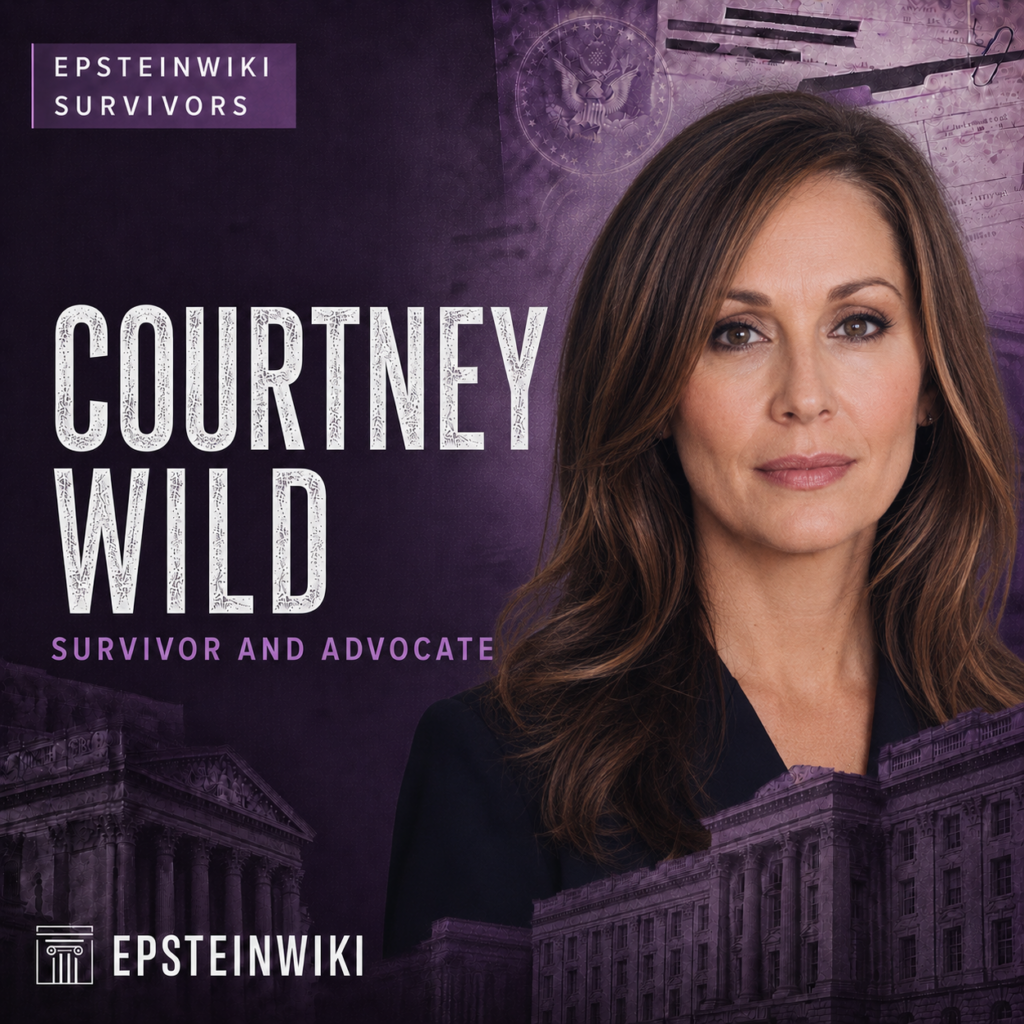
Classification: Survivor, litigant, and victims’ rights advocate
Primary relevance: Palm Beach abuse investigation, secret federal non prosecution agreement, Crime Victims’ Rights Act litigation, survivor advocacy, and federal transparency reform
Public legal identity: Jane Doe 1 in Doe v. United States and Courtney Wild in In re Wild
Key case: In re Wild, 994 F.3d 1244 (11th Cir. 2021)
Status: Publicly identified survivor and continuing advocate
Content warning: This article discusses child sexual abuse, grooming, trafficking, institutional betrayal, addiction, homelessness, and trauma. It avoids unnecessary graphic detail.
Snapshot
Courtney Wild is a publicly identified survivor of Jeffrey Epstein and the central litigant in the longest and most consequential court fight over the secret federal agreement that protected Epstein from prosecution in South Florida.
Wild has said that she was fourteen when a friend recruited her to give Epstein a massage at his Palm Beach residence in 2001. She has described being sexually abused and groomed over the following years. She has also explained that Epstein exploited her youth, instability, and need for money to persuade her to bring other girls to him. That history must be understood as part of Epstein’s recruitment system, not as adult criminal agency freely exercised by a child.
In July 2008, at nineteen, Wild filed an emergency petition under the federal Crime Victims’ Rights Act. She did so because federal prosecutors had excluded Epstein’s victims from negotiations and had not disclosed that they had already signed a non prosecution agreement with him. The filing forced the government to reveal the agreement. More than a decade later, a federal district judge found that prosecutors had violated Wild’s statutory rights by negotiating the agreement without conferring with her and by misleading victims about the status of the investigation.
That finding did not produce the remedy Wild sought. Epstein died in federal custody in August 2019. The district court then held that his death had made rescission of the agreement moot as to him and that the court lacked jurisdiction to invalidate it for people who were not parties to the case. In 2021, the full Eleventh Circuit ruled that the Crime Victims’ Rights Act did not authorize Wild to bring a freestanding civil enforcement action when no federal criminal proceeding existed. The Supreme Court declined review in 2022.
Wild’s case therefore produced two truths that must be reported together. A federal court found that prosecutors violated her rights. Yet the appellate process left her without a judicial remedy. No court rescinded the agreement.
Wild later spoke against Epstein’s release on bail, addressed the court after his death, delivered a victim impact statement at Ghislaine Maxwell’s sentencing, supported legislation bearing her name, and joined other survivors in pressing Congress to release the federal files. In May 2026, she returned to Palm Beach to testify at a congressional field hearing about both Epstein’s abuse and the government’s failures.
Why Courtney Wild Matters
Wild’s importance to the Epstein record extends far beyond a single survivor account. Her litigation exposed how prosecutors and Epstein’s lawyers negotiated a highly unusual agreement outside public view. It revealed that the government told victims they had federal rights while withholding the decision that had effectively ended the federal case. It also forced courts to confront whether those rights can be enforced before prosecutors file a charge.
The case presents a structural problem. Prosecutors can resolve an investigation before indictment. Victims may be harmed most directly by that resolution. Yet if judicial enforcement depends on an existing criminal case, a prosecutor can prevent the forum in which a victim would ask a judge to protect her rights simply by never opening that case in court.
Wild spent more than a decade litigating that problem. Her legal fight created a public record that later journalists, lawmakers, advocates, and courts used to understand the 2007 agreement. It also inspired repeated proposals to amend federal law so another victim would not face the same procedural trap.
Her public advocacy carries a second importance. Wild has consistently described both the original abuse and the institutional response as sources of lasting harm. She has spoken about poverty, unstable housing, family addiction, stigma, trauma, and the way authorities examined the behavior of teenage girls while a wealthy adult defendant received extraordinary consideration. Her account identifies the social vulnerabilities Epstein selected and the official choices that compounded them.
Recruitment at Fourteen
Wild has said that a friend introduced her to Epstein in 2001. She was fourteen. According to her public account, she was told that Epstein was a doctor or brain surgeon and that she could earn money by giving him a massage at his Palm Beach mansion.
Wild came from a sharply different economic world. During a May 2026 field hearing in Palm Beach, she described crossing into the wealthy enclave and immediately sensing the contrast between Epstein’s money and the instability she knew. She said she had experienced homelessness and that her parents had addiction problems. She told lawmakers that Epstein knew whom he was targeting and that his conduct was calculated.
The advertised massage became sexual. Wild has described a pattern in which Epstein normalized sexual conduct, paid cash, and used the initial encounter to draw girls back. Her public accounts and the federal litigation describe abuse that continued while she was a minor.
Some reporting has used the terms rape or sexual intercourse when describing Wild’s experience. Wild disputed those descriptions in a 2022 defamation complaint. According to that complaint and her attorney’s description of her account, she alleged sexualized massages and other abuse, but not intercourse with Epstein. EpsteinWiki therefore uses the broader and accurate terms sexual abuse and sexual exploitation unless directly describing a source’s language. This distinction respects Wild’s own account without minimizing the conduct.
Grooming, Payment, and the Recruitment System
Epstein’s Palm Beach operation used a referral structure. Girls were paid for massages and offered additional money to recruit other girls. The model turned exploited minors into pathways to new victims. It rewarded compliance, obscured the role of the adult organizer, and later exposed survivors to blame for conduct Epstein had cultivated.
Wild has spoken publicly about bringing many girls to Epstein. Her estimates have varied across interviews, with accounts commonly reporting approximately fifty to seventy and one later source summarizing seventy to eighty. The exact count is not established by a judicial finding. The essential point is consistent: Wild says Epstein groomed her as a child and persuaded her to recruit others.
That fact must not be stripped from its context. Wild was a minor with unstable housing and family circumstances. Epstein was an extraordinarily wealthy adult who created the payment system, selected vulnerable girls, controlled the setting, and benefited from the supply of new victims. The Eleventh Circuit itself described Epstein as paying bounties to some victims to recruit others into his ring.
Wild has described enduring guilt and shame about the girls she brought to the house. Modern trafficking analysis recognizes that a child can be both exploited and used in the exploitation of others. Treating recruitment as proof that the child was an equal participant reproduces the coercive framing that traffickers use.
The Palm Beach Investigation
The Palm Beach Police Department began investigating Epstein in 2005 after the parents of a fourteen year old girl reported that he had paid her for a massage that became sexual. Police identified a broader pattern involving teenage girls. The local department concluded that the state response did not reflect the full scope of the evidence and referred the matter to the FBI.
The FBI and the United States Attorney’s Office for the Southern District of Florida then developed a federal case. Investigators identified more victims, including Wild. A 2019 district court order states that the FBI determined that Jane Doe 1 and Jane Doe 2 had been sexually abused by Epstein while they were minors. Wild provided information to the FBI in August 2007.
By May 2007, federal prosecutors had prepared an eighty two page prosecution memorandum and a fifty three page draft indictment. The draft alleged numerous federal sex offenses. This was not a matter in which investigators had found no federal theory or no potential witnesses. The government had built a substantial case and was communicating with identified victims as victims of possible federal offenses.
Federal officials sent letters explaining the rights then provided by the Crime Victims’ Rights Act. Those rights included the reasonable right to confer with the government’s attorney and the right to fairness and respect for dignity and privacy. The letters mattered because they told the girls that the federal government recognized both their victim status and its responsibilities toward them.
The Federal Case That Was Prepared but Never Filed
Epstein assembled an elite defense team that included Alan Dershowitz, Kenneth Starr, Roy Black, Jay Lefkowitz, Martin Weinberg, and others. His lawyers made extensive presentations to the United States Attorney’s Office and argued against federal prosecution.
The record described in the Eleventh Circuit opinions shows that the defense and prosecutors negotiated for months. After a September 7, 2007 meeting, United States Attorney Alexander Acosta informed Epstein’s lawyers that the office had decided to proceed with an indictment. The office later changed course. A dissenting opinion in the en banc case observed that the reason for that reversal was not apparent from the record before the court.
No federal complaint, information, or indictment was filed in South Florida. Instead, the government signed a private agreement that conditioned federal non prosecution on Epstein’s resolution of state charges.
That choice later became decisive. Because prosecutors never filed a federal case, the en banc Eleventh Circuit held that Wild had no preexisting criminal proceeding in which to move for enforcement of her statutory rights.
The Secret 2007 Non Prosecution Agreement
On September 24, 2007, the Southern District of Florida signed a seven page non prosecution agreement with Epstein. The agreement is preserved in the federal release as EFTA00095871.
The agreement referred to possible federal offenses involving the enticement and transportation of minors and sex trafficking. Epstein agreed to plead guilty to two Florida offenses, accept an eighteen month county jail sentence, register as a sex offender, and resolve claims with identified victims under specified conditions.
In return, the United States Attorney’s Office agreed not to prosecute Epstein in the Southern District of Florida for the conduct under investigation. The agreement also extended protection to named employees and to any potential co conspirators. The named people were Sarah Kellen, Adriana Ross, Lesley Groff, and Nadia Marcinkova.
The agreement contained unusual secrecy provisions. It stated that the parties anticipated it would not become part of a public record. It also required the government to notify Epstein before disclosing the agreement in response to a Freedom of Information Act request or compulsory process.
The agreement also reached into victims’ potential civil claims. It contemplated a victims’ representative selected by the government in consultation with Epstein’s counsel and paid by Epstein. It set conditions under which Epstein would not contest liability or damages. The en banc majority later described this arrangement as odd and suggested it appeared designed to resolve claims quickly and quietly. That comment was judicial analysis, not a separate factual finding about every settlement.
The agreement did not itself adjudicate the criminal responsibility of every person covered by its broad language. A promise not to prosecute is not a conviction, and the phrase potential co conspirators does not prove that every protected person committed a crime. At the same time, the breadth of the provision is an established and central feature of the document.
Prosecutors Did Not Confer With the Victims
The district court found that federal prosecutors never conferred with Wild or the other identified victims about a non prosecution agreement before the government signed it. They did not tell the victims that such an agreement was under consideration.
The omission was not a brief administrative delay. Prosecutors and Epstein’s counsel continued discussing what the government could tell victims after the agreement had been executed. The court record shows that Assistant United States Attorney Marie Villafaña told the defense in December 2007 that federal law required notification and consultation. Epstein’s lawyers opposed victim notification. The office ultimately did not provide full disclosure before the state plea.
In January 2008, months after the agreement had been signed, the government sent Wild a letter saying the case was still under investigation, advising that the process could be lengthy, and asking for her continued patience. A similar letter went to another victim in May.
The Justice Department later argued that the investigation technically continued because the agreement remained contingent and because officials anticipated further action if Epstein failed to perform. The 2019 district court nevertheless concluded that the government had misled the victims into believing federal prosecution remained a possibility.
The distinction is important. The legal record does not merely show that the government failed to volunteer a detail. It shows that officials affirmatively communicated with victims in a way that concealed the operative agreement and sustained the impression that the federal charging decision was unresolved.
The June 2008 State Plea
Epstein pleaded guilty in Florida state court on June 30, 2008 to solicitation of prostitution and procuring a person under eighteen for prostitution. The court imposed an eighteen month county jail sentence, followed by home confinement and probation, and required sex offender registration.
Some victims received notice that a state plea would occur, but they were not told that the plea implemented the federal non prosecution agreement or that it would end the South Florida federal case. Wild did not receive a meaningful chance to appear and object to the federal resolution before it became effective.
Epstein served about thirteen months. He was housed in a private area of the Palm Beach County jail and received extensive work release privileges that allowed him to leave the jail for long periods. Those conditions intensified public scrutiny of the deal, but Wild’s federal claim addressed a separate wrong: prosecutors had resolved the federal investigation without honoring the participation rights they had told victims they possessed.
The July 2008 Emergency Petition
On July 3, 2008, Wild’s lawyer Bradley Edwards wrote to the United States Attorney’s Office and conveyed her wish that federal charges be filed. He did not know that the government had already signed the agreement.
On July 7, Wild filed an Emergency Victim’s Petition for Enforcement of Crime Victim’s Rights Act in the United States District Court for the Southern District of Florida. She was identified as Jane Doe 1. Because there was no federal prosecution on the court’s docket, the clerk opened the petition as a civil action, No. 9:08-cv-80736. Jane Doe 2 later joined.
Wild alleged violations of four rights: the right to confer with federal prosecutors, the right to be treated fairly, the right to timely notice of relevant proceedings, and the right to receive information about restitution.
The government’s July 9 response disclosed that the federal matter had been resolved through an agreement signed the previous September. Wild obtained a copy in August 2008. Her petition therefore did more than challenge the deal. It forced the government to reveal that the deal existed.
The timing disproves a common simplification. Wild did not wait until the agreement became controversial years later. She went to court almost immediately after Epstein’s state plea and before she knew the agreement’s full terms.
The Crime Victims’ Rights Act Question
Congress enacted the Crime Victims’ Rights Act in 2004. The version relevant to the 2006 through 2008 investigation listed eight rights, including reasonable protection, notice of public proceedings, attendance, an opportunity to be heard at specified proceedings, consultation with the government’s attorney, restitution, freedom from unreasonable delay, and fairness with respect for dignity and privacy.
The statute also directed federal officials engaged in detecting, investigating, or prosecuting crime to use their best efforts to ensure that victims were notified of and accorded those rights. Another provision said a victim could seek enforcement in the district where prosecution was occurring or, if no prosecution was underway, where the crime occurred.
Wild argued that these provisions necessarily covered at least some precharge activity. Otherwise, prosecutors could negotiate away a case before filing it and leave victims with no opportunity to exercise rights that were meant to influence plea and charging related decisions.
The government ultimately argued that judicially enforceable rights did not arise before a federal prosecution. That position created the central contradiction of the case. Federal officials had sent Wild a letter identifying her as a victim with statutory rights during the investigation, but they later argued that she could not enforce those rights because they had never filed a charge.
The 2011 and 2013 District Court Rulings
In 2011, District Judge Kenneth A. Marra held that the Crime Victims’ Rights Act could apply before formal federal charges. The court relied on the statute’s references to officials engaged in detection and investigation and its provision for filing in a district where no prosecution was underway. The decision is reported as Does v. United States, 817 F. Supp. 2d 1337.
The court did not then decide whether prosecutors had violated Wild’s rights. It allowed the parties to develop the factual record.
In 2013, the court addressed the right to confer more specifically. It concluded that the right applied in this matter after the United States Attorney’s Office had accepted the case for prosecution. That ruling is reported as Jane Doe No. 1 v. United States, 950 F. Supp. 2d 1262.
These decisions were significant but interlocutory. They established the legal framework for discovery and further litigation in the district court. They did not invalidate the agreement.
The 2014 Discovery Appeal
Wild and Jane Doe 2 sought communications between Epstein’s defense lawyers and the government concerning the agreement. Epstein and several of his attorneys intervened and asserted privilege.
In Doe No. 1 v. United States, 749 F.3d 999, the Eleventh Circuit affirmed the discovery order. The court held that the communications were not shielded from the victims on the theories presented. It reasoned that the government and Epstein remained adverse during the investigation and that disclosure of attorney work product to the government waived the claimed protection.
The ruling opened a documentary window into the negotiations. It allowed Wild’s team to establish the sequence of defense demands, government responses, secrecy discussions, and victim communications that supported the eventual 2019 decision.
This 2014 ruling did not decide whether the agreement was lawful under the Crime Victims’ Rights Act. It decided a discovery dispute that made the later merits ruling possible.
The 2019 Finding That the Government Violated Wild’s Rights
On February 21, 2019, Judge Marra issued the central merits decision in Doe 1 v. United States, 359 F. Supp. 3d 1201.
The court found that the government violated the Crime Victims’ Rights Act when it entered the agreement without conferring with Wild during negotiation and execution. The court explained that, if informed of the government’s intention to abandon federal prosecution in exchange for state pleas, Wild could have conferred with prosecutors and offered input.
The court also found that the government violated the right to fairness by concealing the agreement and sending communications that left victims believing federal prosecution remained possible.
This was a judicial finding, not merely an allegation by Wild or a conclusion reached by journalists. It remains a critical part of the historical record even though later appellate rulings prevented Wild from obtaining a remedy through the procedural vehicle she used.
The decision did not automatically rescind the agreement. Judge Marra ordered further briefing on remedies. Wild asked for several forms of relief, including rescission, an injunction against further violations, a victim impact hearing, a meeting with Acosta, access to additional records, training for prosecutors, sanctions, fees, restitution, and other relief.
Epstein’s 2019 Arrest and Wild’s Bail Statement
Federal prosecutors in the Southern District of New York charged Epstein in July 2019 with sex trafficking of minors and conspiracy. The charges concerned conduct in New York and Florida and were not the South Florida prosecution abandoned in 2007.
Wild spoke at Epstein’s bail proceedings. She urged the court to keep him detained and described the danger she believed he posed. Annie Farmer also addressed the court. When Judge Richard M. Berman denied bail, he described their testimony as compelling and concluded that the government had established danger to the community by clear and convincing evidence.
Wild also appeared publicly with her lawyers on July 16, 2019. She explained that she had never received a genuine opportunity to be heard before the old deal took effect and encouraged other survivors to come forward.
This was an important change in public identity. The litigant known for years as Jane Doe 1 placed her name and face beside the legal challenge she had begun as a teenager.
Epstein’s Death and the August 2019 Victim Hearing
Epstein died in federal custody on August 10, 2019 while awaiting trial. New York City’s medical examiner ruled the death a suicide. His death ended the criminal prosecution without a trial or verdict.
On August 27, Judge Berman held a hearing before dismissing the indictment. More than a dozen survivors spoke, including women whose abuse occurred in Florida. Wild told the court that Epstein had abused her for years and had taken her innocence and mental health. She also said his death had robbed survivors of the chance to confront him in court.
The hearing gave survivors a public voice, but it was not a trial and produced no adjudication of the charges in the 2019 indictment. It also did not revive the South Florida prosecution or resolve Wild’s pending remedies request.
The September 2019 Remedies Decision
On September 16, 2019, Judge Marra closed Wild’s case. The decision is reported as Doe 1 v. United States, 411 F. Supp. 3d 1321.
The court held that Epstein’s death made the continuing validity of the agreement moot as to him because he could no longer be prosecuted. It declined to decide whether the agreement protected alleged co conspirators because those people were not parties to Wild’s case and could not be bound by an advisory ruling.
The court rejected an injunction because Wild had not shown a current threat of another violation. It also denied a court ordered victim hearing and meeting with Acosta, noted the government’s agreement to confer about continuing investigations, and declined to order discovery, sanctions, fees, restitution, or other requested remedies. The government had agreed to provide relevant training, which affected the request for an educational remedy.
This order did not erase the February finding that prosecutors violated Wild’s rights. It held that the court could not or would not grant the requested relief after Epstein’s death.
The 2020 Eleventh Circuit Panel Decision
Wild petitioned the Eleventh Circuit for a writ of mandamus, the review mechanism specified by the Crime Victims’ Rights Act.
On April 14, 2020, a divided three judge panel denied relief in In re Wild, 955 F.3d 1196. The panel held that rights under the statute did not attach until the government initiated criminal proceedings by complaint, information, or indictment. Because South Florida prosecutors had filed none of those documents, the panel said the statute had never been triggered.
The panel repeatedly condemned the underlying facts. It called the history a national disgrace and said Wild had been left in the dark and apparently affirmatively misled. Nevertheless, it concluded that the statutory text compelled denial.
Judge Frank Hull dissented. She argued that the statute’s language, structure, purpose, and legislative history supported precharge rights and that the majority’s rule allowed prosecutors to defeat those rights by avoiding charges.
The Eleventh Circuit later granted rehearing en banc and vacated the panel opinion. For that reason, the panel’s attachment rule is part of the procedural history but is not the final precedential holding of the case.
The 2021 En Banc Decision
On April 15, 2021, the full Eleventh Circuit denied Wild’s petition in In re Wild, 994 F.3d 1244.
The en banc majority used a narrower ground than the vacated panel. It held that the Crime Victims’ Rights Act does not create a private right of action allowing a victim to seek judicial enforcement through a freestanding civil lawsuit outside an existing criminal proceeding. Because prosecutors had never filed a federal case against Epstein in South Florida, there was no criminal proceeding in which Wild could file a motion.
The majority expressly said it did not need to decide whether the rights to confer and to be treated fairly might attach before formal charges in some abstract or administrative sense. It also did not decide whether a victim could seek to vindicate a precharge violation later, after a criminal prosecution began.
This distinction is routinely lost in summaries. The vacated 2020 panel said rights do not attach before charges. The final 2021 en banc decision held that the statute did not authorize Wild’s standalone civil enforcement action. Both results denied her relief, but the legal reasoning is not identical.
The en banc majority also emphasized its profound sympathy for Wild, accepted the abuse allegations as true for purposes of the decision, described the facts as beyond scandalous, and said government lawyers appeared to have affirmatively misled survivors. The ruling was procedural, not a vindication of the prosecutors’ conduct.
The En Banc Dissents
Judge Branch, joined by Judges Martin, Jill Pryor, and Hull, dissented. The dissent argued that the statute gave Wild rights during the investigation and a mechanism to enforce them in the district where the crime occurred. It warned that the majority’s interpretation allowed the government to extinguish victims’ rights through a secret precharge agreement.
Judge Hull filed an additional dissent that reconstructed the record in detail. It emphasized that prosecutors themselves had repeatedly told Epstein’s lawyers that federal law required victim notification and consultation. It also described the government’s later litigation position as inconsistent with those contemporaneous statements.
The dissents did not control the judgment. Their factual chronology and statutory analysis are nevertheless important because they identify precisely how the majority’s rule can operate in practice.
Supreme Court Review
Wild filed a petition for a writ of certiorari on August 31, 2021. The case was docketed as No. 21-351, Courtney Wild v. United States District Court for the Southern District of Florida.
The petition asked the Supreme Court to decide whether the Crime Victims’ Rights Act permits victims to enforce their rights before an indictment and whether a victim can seek judicial relief when prosecutors use a secret precharge agreement to end a case. Victims’ rights organizations, lawmakers, and advocacy groups filed supporting briefs.
The United States opposed review. It defended the en banc result and argued that the statute did not authorize Wild’s freestanding action.
On February 22, 2022, the Supreme Court denied the petition without an opinion. A denial of certiorari does not endorse the reasoning below and does not decide the merits as a national rule. It left the Eleventh Circuit judgment in place.
No court rescinded the non prosecution agreement. No court granted Wild damages or restitution in the Crime Victims’ Rights Act case.
What Wild Won and What She Did Not
The outcome is best understood through a clear separation of findings and remedies.
| Question | Result |
|---|---|
| Did a federal district court find that prosecutors violated Wild’s Crime Victims’ Rights Act rights? | Yes. The February 2019 order found violations of the rights to confer and to fair treatment. |
| Did the district court invalidate the agreement in that order? | No. It requested separate briefing on remedies. |
| Did any later court rescind the agreement? | No. Epstein’s death made relief against him moot, and the court declined to adjudicate protection for nonparties. |
| Did the 2020 panel say statutory rights do not attach before charges? | Yes, but that panel opinion was vacated when rehearing en banc was granted. |
| What did the final 2021 en banc court hold? | The statute did not authorize Wild’s freestanding civil enforcement action outside a preexisting criminal proceeding. |
| Did the appellate court approve the government’s conduct? | No. The opinions condemned the conduct while denying a judicial remedy. |
| Did the Supreme Court issue a merits opinion? | No. It denied review without explanation. |
Wild won disclosure, discovery, public accountability, and a formal finding that the government violated her rights. She did not obtain the principal judicial remedy she sought.
The Justice Department’s 2020 Professional Responsibility Review
The Justice Department’s Office of Professional Responsibility released an executive summary of its Epstein review in November 2020. The review applied the office’s internal professional misconduct standard, which requires an intentional or reckless violation of a clear and unambiguous obligation.
OPR did not find professional misconduct by the five attorneys it examined. It said that no clear and unambiguous rule then required Acosta to bring federal charges or prohibited the state based resolution. It also said it found no evidence that wealth, status, associations, corruption, or other improper factors drove the charging decision.
OPR nevertheless concluded that Acosta exercised poor judgment. It described the agreement as a flawed mechanism, found his view of the federal interest too narrow, and criticized incomplete investigation, problematic terms, insufficient oversight, and weak coordination.
Regarding victims, OPR did not find professional misconduct under its internal standard. It did conclude that victims were not treated with the forthrightness and sensitivity expected by the Department. It found that inconsistent messages and lack of transparency created confusion, made victims feel ignored and ill treated, and undermined confidence in the agreement.
The OPR result and Judge Marra’s ruling answer different questions. Judge Marra determined whether the government violated Wild’s statutory rights. OPR assessed whether individual Department lawyers committed professional misconduct under a demanding internal definition. Reporting one conclusion as if it cancelled the other is inaccurate.
Maxwell’s Sentencing
A federal jury convicted Ghislaine Maxwell in December 2021 of offenses arising from her role in recruiting and grooming minor girls for Epstein. Judge Alison J. Nathan sentenced Maxwell to twenty years in prison on June 28, 2022.
Wild addressed the court at sentencing. She spoke about the lasting effects of Epstein’s abuse, the years of institutional failure, and the burden survivors carried into adulthood. She also emphasized that the people exploited by Epstein’s operation were children.
Wild was not one of the four trial witnesses whose testimony established Maxwell’s guilt. Her sentencing statement served a different legal function. It informed the court about harm and accountability after conviction. The court had established a process for people seeking recognition as victims under the Crime Victims’ Rights Act to submit written statements and request permission to speak.
Maxwell’s conviction is an adjudicated fact. Wild’s own experiences remain grounded in her survivor testimony, the FBI’s identification of her as a minor victim, and the findings in the South Florida litigation. Those evidence categories should not be merged.
The Courtney Wild Crime Victims’ Rights Legislation
Wild’s appellate loss prompted repeated attempts to amend federal law.
In October 2019, Representative Lois Frankel introduced a proposal commonly called the Courtney Wild Crime Victims’ Rights Reform Act. The bill sought to ensure that victims could assert rights during the investigative stage and receive notice of agreements that could end a case. It did not become law.
In September 2024, Representatives Debbie Wasserman Schultz and Burgess Owens introduced the Courtney Wild Reinforcing Crime Victims’ Rights Act. The proposal sought to clarify precharge rights, strengthen notice and consultation, support access to victims’ counsel, and require remedies when rights are violated. That Congress ended without enactment.
Wasserman Schultz and Representative Tim Burchett introduced the measure again in September 2025 as H.R. 5506. Wild endorsed it and said bipartisan meetings had made her hopeful. The bill sought to close the procedural gap exposed by In re Wild, including by making clear that victims must be informed about plea, deferred prosecution, and non prosecution agreements that could affect their ability to obtain justice.
As of this article’s September 2026 update, H.R. 5506 had not become law. It should not be confused with the separate Epstein Files Transparency Act, which did become law in November 2025.
Advocacy for the Epstein Files Transparency Act
Wild joined other survivors at the United States Capitol on September 3, 2025. She explained that her 2008 lawsuit was the reason the public learned that the government had already granted Epstein immunity through the agreement. She and other survivors urged Congress to force disclosure of the federal files.
The advocacy was survivor led and bipartisan in its legislative audience. Wild rejected efforts to reduce the issue to party politics and centered the government’s long history of secrecy and failure.
Congress passed H.R. 4405, the Epstein Files Transparency Act, in November 2025. The House vote was 427 to 1. The Senate agreed by unanimous consent, and the president signed the bill on November 19. It became Public Law 119-38.
The law required the Justice Department to release covered Epstein records in searchable and downloadable form, subject to protections including survivor privacy and specified legal restrictions. Wild described passage as a first step and connected transparency to accountability for the people and institutions that enabled the operation.
The law’s enactment did not resolve Wild’s Crime Victims’ Rights Act case and did not rescind the 2007 agreement. It addressed disclosure. H.R. 5506 addressed enforceable victim participation rights. The two measures respond to related but distinct failures.
The May 2026 Palm Beach Field Hearing
On May 12, 2026, Democrats on the House Committee on Oversight and Government Reform held a field hearing in Palm Beach as part of the continuing Epstein investigation. Wild testified alongside other survivors and witnesses.
Wild described meeting Epstein at fourteen, her experience of homelessness, her parents’ addiction, and the stark difference between her background and the wealth she encountered in Palm Beach. She said Epstein deliberately preyed on children from troubled circumstances.
She also challenged the language used against the girls. Wild recalled authorities reviewing teenage social media and treating survivors as if their attendance at parties or use of alcohol made them criminals. She objected to the framing of exploited minors as underage prostitutes and emphasized that Epstein selected children whose vulnerability could be used against them.
Her testimony joined personal history to policy. The point was not simply that one wealthy offender abused children. It was that poverty, unstable housing, family addiction, stigma, and official disbelief became tools within a system that protected him.
The event was a congressional field hearing led by committee Democrats. It was not a criminal trial, and statements by lawmakers or witnesses do not carry the same evidentiary status as a judicial finding. Wild’s own testimony remains a firsthand survivor account.
The 2022 Defamation Lawsuit Against Julie K. Brown
In February 2022, Wild and Haley Robson filed a defamation complaint in Miami Dade County against journalist Julie K. Brown concerning passages in Brown’s 2021 book, Perversion of Justice.
The complaint alleged that the book falsely described Wild as having been raped through intercourse by Epstein and later having sex with him. Wild alleged that those statements did not reflect her account. Her lawyer said she had described sexualized massages and being made to witness sexual conduct, but not intercourse with Epstein.
The complaint also alleged that Brown minimized or appropriated Wild’s role in exposing the agreement. Brown’s reporting for the Miami Herald separately remains a major and well documented contribution to renewed public scrutiny of Epstein and the prosecutors who resolved the South Florida investigation.
These are compatible facts. Wild’s litigation exposed the agreement in 2008 and developed its internal record over many years. Brown’s 2018 reporting brought that history to a far wider audience and helped renew institutional pressure.
The allegations in the 2022 complaint are claims by Wild and Robson, not adjudicated findings. No final merits disposition was located in the public sources reviewed for this update. The lawsuit should not be confused with a separate contract and arbitration dispute involving Brown and investigator Michael Fisten.
Evidence Appearances
The following records directly document Wild’s place in the Epstein history. An appearance in a file proves only what that file shows. It does not convert every statement within a filing into an adjudicated fact.
| Record | Identifier or citation | What it establishes | Evidentiary limit |
|---|---|---|---|
| Federal non prosecution agreement | EFTA00095871 | The agreement’s terms, secrecy provisions, state plea conditions, civil claim provisions, and protection for named and potential co conspirators | The agreement is a contract. Its terminology does not by itself convict any protected person |
| 2011 district court ruling | Does v. United States, 817 F. Supp. 2d 1337 | The court’s initial conclusion that the statute contemplated precharge proceedings | It deferred the ultimate violation question |
| 2013 district court ruling | Jane Doe No. 1 v. United States, 950 F. Supp. 2d 1262 | The precharge application of the right to confer in this investigation | It did not rescind the agreement |
| 2014 Eleventh Circuit opinion | Doe No. 1 v. United States, 749 F.3d 999 | The discovery dispute and disclosure of negotiation communications | It did not decide the final CVRA merits question |
| 2019 merits order | Doe 1 v. United States, 359 F. Supp. 3d 1201 | Judicial findings that prosecutors violated Wild’s rights to confer and to fair treatment | The order reserved remedies |
| 2019 remedies order | Doe 1 v. United States, 411 F. Supp. 3d 1321 | Denial of rescission and other relief after Epstein’s death | It did not vacate the earlier violation finding |
| 2020 panel opinion | In re Wild, 955 F.3d 1196 | The panel’s precharge attachment rule | Vacated upon rehearing en banc |
| 2021 en banc opinion | In re Wild, 994 F.3d 1244 | The final appellate holding that the statute did not authorize a freestanding civil action | It did not approve the government’s treatment of Wild |
| Supreme Court docket | No. 21-351 | Petition, supporting briefs, opposition, reply, and denial of review | Certiorari denial is not a merits ruling |
| Justice Department OPR summary | November 2020 executive summary | OPR findings about Acosta, the agreement, and victim communications | An internal professional responsibility review using its own misconduct standard |
| Maxwell sentencing record | United States v. Maxwell case page | Court procedures for victim statements and the June 2022 sentencing | Wild’s statement concerned harm. It was not trial testimony establishing Maxwell’s guilt |
| 2026 field hearing | House member hearing transcript | Wild’s firsthand account of poverty, grooming, stigma, and institutional harm | Congressional testimony is not a criminal judgment |
Legal Case Index
| Date | Proceeding | Outcome |
|---|---|---|
| July 7, 2008 | Emergency CVRA petition filed in the Southern District of Florida | Opened as No. 9:08-cv-80736 because no criminal case existed |
| 2011 | Does v. United States, 817 F. Supp. 2d 1337 | District court held that the statute contemplated precharge application |
| 2013 | Jane Doe No. 1 v. United States, 950 F. Supp. 2d 1262 | District court applied the right to confer after the office accepted the matter for prosecution |
| April 18, 2014 | Doe No. 1 v. United States, 749 F.3d 999 | Eleventh Circuit affirmed discovery of negotiation communications |
| February 21, 2019 | Doe 1 v. United States, 359 F. Supp. 3d 1201 | District court found CVRA violations |
| September 16, 2019 | Doe 1 v. United States, 411 F. Supp. 3d 1321 | District court denied requested remedies and closed the case |
| April 14, 2020 | In re Wild, 955 F.3d 1196 | Divided panel denied mandamus and adopted a postcharge attachment rule |
| August 7, 2020 | Rehearing en banc granted | Panel opinion vacated |
| April 15, 2021 | In re Wild, 994 F.3d 1244 | En banc court denied relief because the CVRA did not authorize the freestanding action |
| August 31, 2021 | Supreme Court petition filed | Case docketed as No. 21-351 |
| February 22, 2022 | Supreme Court order | Certiorari denied without opinion |
Chronology
| Year or date | Event |
|---|---|
| 2001 | Wild says a friend recruited her to Epstein’s Palm Beach residence when she was fourteen |
| 2005 | Palm Beach police begin investigating after a family reports abuse of a fourteen year old girl |
| 2006 | FBI opens a federal investigation after referral from Palm Beach police |
| May 2007 | Federal prosecutors complete an eighty two page memorandum and a fifty three page draft indictment |
| August 7, 2007 | Wild provides information to the FBI |
| September 7, 2007 | Acosta tells Epstein’s defense that the office has decided to proceed with indictment |
| September 24, 2007 | Federal prosecutors sign the non prosecution agreement |
| January 2008 | Government letter tells Wild the case remains under investigation |
| June 30, 2008 | Epstein pleads guilty to two Florida offenses and receives an eighteen month sentence |
| July 7, 2008 | Wild files her emergency federal petition |
| July 9, 2008 | Government response reveals the prior agreement |
| August 2008 | Wild obtains a copy of the agreement |
| 2011 | District court recognizes precharge application of the CVRA in the case |
| 2014 | Eleventh Circuit permits discovery of negotiation communications |
| November 2018 | Miami Herald investigation brings the deal and survivors’ accounts to renewed national attention |
| February 21, 2019 | District court finds that prosecutors violated Wild’s rights |
| July 2019 | Epstein is arrested in New York; Wild speaks against bail and publicly identifies herself |
| August 10, 2019 | Epstein dies in federal custody |
| August 27, 2019 | Wild speaks at the New York victim hearing |
| September 16, 2019 | District court denies remedies and closes the CVRA case |
| April 14, 2020 | Eleventh Circuit panel denies relief |
| August 7, 2020 | Full court grants rehearing and vacates the panel opinion |
| November 2020 | Justice Department OPR releases its executive summary |
| April 15, 2021 | En banc Eleventh Circuit denies Wild’s petition |
| February 22, 2022 | Supreme Court denies review |
| June 28, 2022 | Wild addresses the court at Maxwell’s sentencing |
| September 2024 | Bipartisan House members introduce legislation bearing Wild’s name |
| September 3, 2025 | Wild joins survivors at the Capitol to demand release of the files |
| September 2025 | H.R. 5506, the Courtney Wild Reinforcing Crime Victims’ Rights Act, is introduced |
| November 19, 2025 | Epstein Files Transparency Act becomes Public Law 119-38 |
| May 12, 2026 | Wild testifies at the Palm Beach congressional field hearing |
What the Record Establishes
The public record supports the following conclusions with strong documentary or judicial evidence.
- Wild was identified by the FBI and the federal courts as a victim of Epstein’s sexual abuse while she was a minor.
- She says she was fourteen when recruited to Epstein’s Palm Beach residence.
- Federal prosecutors prepared a substantial charging memorandum and draft indictment but never filed a South Florida federal case.
- The government signed the September 2007 agreement without consulting Wild or the other identified victims about it.
- Government communications after signing the agreement led victims to believe the federal investigation and charging decision remained open.
- Wild filed her emergency petition in July 2008 and learned of the agreement through that litigation.
- A federal district court found in 2019 that prosecutors violated her rights under the Crime Victims’ Rights Act.
- Wild received no rescission, damages, restitution, or comparable judicial remedy in that case.
- The final Eleventh Circuit decision rested on the absence of a preexisting criminal proceeding and the lack of a statutory private right to bring a freestanding action.
- The Supreme Court denied review without deciding the merits.
- Wild continued as a public advocate in criminal proceedings, legislative campaigns, and congressional hearings.
Common Misconceptions
Misconception: Wild first challenged the agreement after the press exposed it in 2018.
Wild filed in July 2008. Her case forced disclosure of the agreement and produced years of discovery before the later reporting boom.
Misconception: The government merely forgot to notify her.
The record shows extended negotiation over victim notification, post agreement letters describing an active investigation, and a failure to reveal that the state plea implemented a federal non prosecution agreement.
Misconception: Judge Marra rescinded the agreement in 2019.
He found statutory violations and ordered remedies briefing. He later denied the requested relief after Epstein’s death. The agreement was never rescinded.
Misconception: The Eleventh Circuit found that prosecutors acted lawfully.
The court denied Wild a procedural vehicle for judicial enforcement. It described the conduct in severe terms and did not approve the treatment of victims.
Misconception: The final appellate holding was simply that victims have no rights before charges.
That was the vacated panel’s rule. The en banc court declined to decide the abstract attachment question and instead rejected the freestanding civil action.
Misconception: The Supreme Court affirmed the agreement.
The Court denied certiorari without opinion. It issued no ruling on the agreement’s merits.
Misconception: Wild’s recruitment of other girls makes her equivalent to Epstein’s adult employees.
Wild describes being groomed and used as a minor within a payment and referral system designed by Epstein. The power, age, and coercion differences are fundamental.
Misconception: The bill bearing Wild’s name and the Epstein Files Transparency Act are the same law.
They are separate measures. Public Law 119-38 concerns disclosure of Epstein records. H.R. 5506 seeks to strengthen the enforceability of federal victims’ rights.
Legal and Historical Significance
Wild’s case is now a leading authority on the limits of the federal Crime Victims’ Rights Act. It exposes the difference between declaring that victims have rights and giving them a workable method to enforce those rights when prosecutors act before filing charges.
The litigation also provides an unusually detailed record of bargaining power. Epstein’s lawyers received sustained access to senior prosecutors. They negotiated the scope of immunity, secrecy, civil claim procedures, and victim notification. The girls whose experiences created the case were not given comparable access before the government committed itself.
Wild’s persistence changed what the public could know. Without her 2008 petition, the agreement might have remained hidden much longer. Without the discovery fight, much of the negotiation history would have remained inaccessible. Without the 2019 order, the record would lack a direct judicial finding that federal prosecutors violated victims’ rights.
Her case also demonstrates the limits of symbolic victory. A declaration of violation came eleven years after the filing. Epstein died while remedies were pending. The appellate court then held that the statute did not permit the type of action Wild had used from the start. Transparency arrived, but the remedy did not.
That unresolved contradiction is the foundation of the legislation bearing her name.
Questions That Remain
- Why did the Southern District of Florida reverse course after telling Epstein’s defense that it had decided to proceed with an indictment?
- Why did senior officials approve an agreement that protected any potential co conspirators without publicly identifying the full scope of that protection?
- Why did the government allow victim notification to become a subject of negotiation with the defense after the agreement had already been signed?
- Which officials reviewed the January and May 2008 victim communications, and what controls existed to prevent misleading status updates?
- What additional investigative steps remained unfinished when the federal case was resolved?
- What administrative remedies, if any, can meaningfully protect a victim before charges when courts cannot hear a freestanding enforcement action?
- Will Congress enact H.R. 5506 or a comparable measure that supplies a clear precharge enforcement mechanism and effective remedies?
- What became of the 2022 defamation case after the initial complaint, and is there a public final merits disposition?
- How will agencies protect survivor privacy while complying with the Epstein Files Transparency Act?
- Will the remaining public releases clarify who designed, reviewed, approved, and implemented the most unusual provisions of the 2007 agreement?
Primary Legal and Government Sources
- Federal non prosecution agreement, EFTA00095871
- Doe No. 1 v. United States, 749 F.3d 999, discovery appeal
- Doe 1 v. United States, 359 F. Supp. 3d 1201, February 2019 merits ruling
- In re Wild, 955 F.3d 1196, vacated 2020 panel opinion
- In re Wild, 994 F.3d 1244, 2021 en banc opinion
- Supreme Court docket No. 21-351
- United States brief in opposition
- Wild’s Supreme Court reply brief
- Justice Department OPR executive summary
- Justice Department statement on the OPR report
- United States v. Jeffrey Epstein victim and witness case page
- United States v. Ghislaine Maxwell victim and witness case page
- Justice Department announcement of Maxwell’s sentence
- Public Law 119-38, Epstein Files Transparency Act
- White House notice that H.R. 4405 was signed
- 2024 Courtney Wild Reinforcing Crime Victims’ Rights Act announcement
- 2025 H.R. 5506 announcement
- May 2026 Palm Beach field hearing transcript excerpt
Major Reporting and Survivor Interviews
- ABC News profile of Wild’s transparency and justice advocacy
- ABC News, Wild in her own words
- CBS News, Wild’s July 2019 public statement
- ABC News, Epstein bail denied after testimony from Wild and Annie Farmer
- CBS News, August 2019 survivor hearing
- WPBF, Wild on guilt, shame, trauma, and therapy
- CNN transcript of the September 2025 survivor press conference
- ABC News, September 2025 Capitol survivor event
- WUSF, May 2026 Palm Beach field hearing
- Business Insider, Wild and Robson’s 2022 defamation complaint
- Rolling Stone, initial report on the 2022 complaint
Research and Sleuth Sources
EpsteinWiki gives priority to primary records. Independent researchers are included when they surface relevant material, preserve searchable archives, or provide a useful path back to the documents.
- Epstein Data, survivor interview index
- Julie K. Brown, “The Real Heroes of the Epstein Story”
- Ellie Leonard, discussion of an Epstein project proposed in Wild’s name