
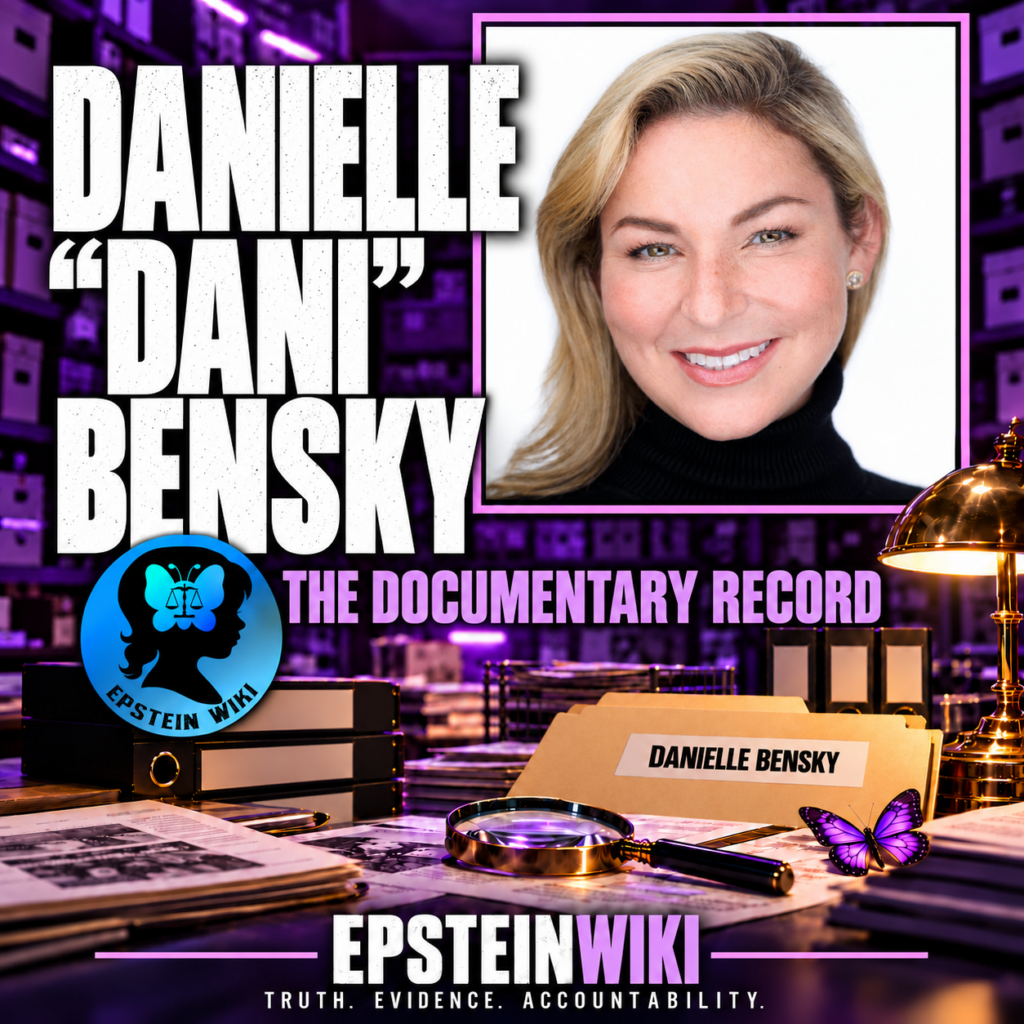
Danielle “Dani” Bensky
Snapshot
Danielle “Dani” Bensky is a dancer, choreographer, educator and survivor advocate who has publicly described being recruited into Jeffrey Epstein’s abuse when she was 17. Her account concerns abuse in Manhattan during 2004 and 2005, followed by encounters with investigators, civil litigation and a sustained campaign for accountability.
The central feature of her account is coercion through a family medical crisis. Bensky says Epstein used her mother’s brain tumor diagnosis to make her believe that refusing him could jeopardize her mother’s care. Years later, she became a public advocate for disclosure of investigative records while protecting survivors’ identities.
Her story also illustrates the limits of civil compensation. She helped initiate litigation against Epstein’s longtime lawyer and accountant, but a court dismissed her claims because of an earlier settlement release. The larger case continued. Its proposed 2026 settlement must be distinguished from her own legal position.
- Public names: Danielle Bensky and Dani Bensky.
- Professional work: Dance, choreography, performance and arts education.
- Reported abuse period: 2004 and 2005.
- Age at recruitment: 17, according to her public account.
- Relevant investigative records: A 2008 grand jury subpoena and FBI interview summaries.
- Civil litigation: An original named plaintiff in the 2024 action against Darren Indyke and Richard Kahn. Her claims were dismissed on August 5, 2024.
- Public advocacy: Records disclosure, survivor privacy, institutional accountability and prevention of sexual exploitation.
- Coverage date: October 10, 2026.
Key takeaways
- Bensky’s account connects promised work and artistic opportunity with financial vulnerability and threats involving her mother’s health.
- Her early FBI summaries and later public testimony are different kinds of evidence. The summaries should not be presented as a complete account of everything she later disclosed.
- The subpoena establishes that investigators sought her testimony and records. It does not establish what she said before a grand jury or whether she appeared.
- Danielle Bensky and Jane Doe 3 were separate plaintiffs. Jane Doe 3 is not an alias that can be assigned to Bensky.
- The dismissal of Bensky’s civil claims concerned the scope of a settlement release. It did not establish that the abuse she described never occurred.
- The proposed estate settlement is a separate development. It should not be described as a personal $35 million payment to Bensky.
- Her demand for transparency includes protection for survivors. Publicly sharing her own story does not authorize disclosure of another survivor’s identity or her own private records.
Life and work beyond the Epstein case
Bensky’s professional biography describes more than 13 years of performance and education work connected with Disney’s theatrical, cruise and creative events operations. It also identifies her as the original choreographer of Peace On Your Wings, a musical inspired by Sadako Sasaki that has been performed in Hawaii, on the West Coast, Off Broadway and in Japan.
Her arts education work includes Ohana Arts in Hawaii. These credits establish a professional life built around movement, storytelling and young performers, alongside her survivor advocacy.
Her July 2025 NPR interview connects choreography with reclaiming control of her body. She described difficulty returning to ballet after the abuse. Choreography offered a way to tell stories and support young performers.
NPR’s July 2026 profile places her public advocacy beside her life as an artist and parent. It describes friendships with other survivors, including Annie Farmer, and the practical demands of repeatedly returning to painful experiences in public. Those relationships and professional commitments are part of her biography, rather than incidental details surrounding the case.
Recruitment and the promise of paid work
Bensky’s July 24, 2025 ABC interview describes an approach while she was waiting to use a bathroom at a New York nightclub. A woman offered paid work massaging a wealthy financier. Bensky was then an aspiring ballerina taking odd jobs to support her training.
She says the first visits did not immediately involve the abuse that followed. The apparently legitimate opportunity became a pattern of visits and exploitation. Her account describes repeated contact over approximately a year.
Her congressional testimony adds her assessment of the dance environment in which she grew up. Hierarchy, body criticism and secrecy around private instruction had conditioned her to accept unequal relationships with adults. She said Epstein exploited her aspirations and body image concerns.
These are Bensky’s descriptions of how the recruitment worked. An offer of paid massage work does not establish that a teenager understood or agreed to the sexual exploitation that followed.
The medical crisis Epstein allegedly used against her
Bensky’s NPR account explains why she approached Epstein with her mother’s brain scans. A brain sculpture in his residence had led her to associate his wealth with neuroscience.
Her ABC account describes the resulting ultimatum: recruit other girls or submit to further abuse. She says she refused to recruit girls and endured the abuse because she feared for her mother.
The distinction between asserted power and actual power matters. Bensky says Epstein claimed he could secure exceptional care or make it unavailable. That account does not establish that he controlled the hospital or her mother’s doctors.
Her mother’s successful surgery in 2005 and subsequent recovery gave Bensky the confidence to end contact. She says Epstein did not provide the promised medical assistance.
The 2008 subpoena and FBI interviews
EFTA00193068 contains a subpoena addressed to Bensky on page EFTA00193081, the fourteenth page of the collection. Issued on March 12, 2008, it commanded an appearance before a federal grand jury in West Palm Beach on April 15, 2008.
The subpoena also sought communications, gifts, payments, photographs and other materials involving Epstein and specified people associated with him. It is evidence of an investigative demand. It is not a transcript of testimony, proof that the scheduled appearance occurred or a criminal charge against Bensky.
EFTA00225672 contains the relevant FBI interview material. The principal interview occurred on March 20, 2008. Its transcription date was March 24, 2008. A followup contact occurred on March 25 and was transcribed on March 26.
The collection stores these pages in a confusing order. The principal report’s first page is EFTA00225728. Its continuation pages run backward through the collection to EFTA00225723. The followup occupies EFTA00225721 and EFTA00225722. Reading only the first visible page can therefore obscure the sequence.
The initial summary records a more limited account of her visits, payments and fear of Epstein’s wealth and power. The followup adds an account of sexual conduct and a refusal to continue. It also records her recollection that she was 17 when the encounters began in summer 2004.
An FBI Form 302 is an agent’s written summary. It is not a recording or verbatim transcript. These documents preserve what investigators recorded at particular moments, rather than every detail of the witness’s experience.
Bensky’s later testimony describes entering the investigative process at 20 without a lawyer or victim advocate. She said Epstein had threatened that contact with law enforcement could lead to prostitution charges, leaving her frightened and ashamed.
Her March 2026 podcast discussion explains that she was not ready to disclose the full experience in 2008. The difference between early summaries and later disclosure should remain visible. Neither account should be silently rewritten to make them identical.
Evidence appearances and document locations
| Record | Relevant pages | What it establishes |
|---|---|---|
| EFTA00193068 | EFTA00193081. Collection page 14. | A March 12, 2008 subpoena seeking Bensky’s appearance and materials for an April 15 grand jury session. |
| EFTA00225672: principal interview | EFTA00225723 through EFTA00225728. Collection pages 52 through 57. | The FBI’s summary of the March 20, 2008 interview, transcribed March 24. The pages appear in reverse report order. |
| EFTA00225672: followup interview | EFTA00225721 and EFTA00225722. Collection pages 50 and 51. | The FBI’s summary of the March 25, 2008 followup, transcribed March 26. |
The collection identifier is the clickable file link. The individual page identifiers locate material inside that file. These entries describe three relevant record components within two collections, rather than three independent investigations.
Coming forward publicly
Bensky’s account on On with Kara Swisher places her public emergence in 2021, around Ghislaine Maxwell’s trial. She described leaving a court hearing after meeting attorney Sigrid McCawley and encountering reporters. She eventually chose to give her name.
She identified Maria Farmer’s story and Virginia Giuffre’s courage as influences on that decision. The podcast brought Bensky together with Jess Michaels and Elizabeth Stein to discuss survival, institutional failures and accountability.
Coming forward publicly was a decision about how to tell her own story. It did not make every detail in an investigative file appropriate for unrestricted publication, especially information about people who had not chosen public identification.
The lawsuit against Darren Indyke and Richard Kahn
The February 16, 2024 complaint named Danielle Bensky and Jane Doe 3 as separate plaintiffs in a proposed class action against Darren K. Indyke and Richard D. Kahn. The case was filed in the Southern District of New York under number 1:24cv01204.
Indyke was Epstein’s longtime lawyer. Kahn was his accountant. Both became executors of his estate. The complaint alleged that financial management, cash access, payments and corporate structures helped sustain the trafficking operation. It sought to hold the defendants responsible for allegedly enabling and benefiting from that operation.
Those assertions were allegations in civil litigation. They were not criminal convictions or findings after a trial. Reuters reported the defendants’ denial that they knew of or were complicit in Epstein’s misconduct.
The distinction between the two original plaintiffs is essential. Bensky’s public identity does not identify Jane Doe 3, and material concerning the anonymous plaintiff cannot automatically be assigned to Bensky.
Why Bensky’s claims were dismissed
Judge Arun Subramanian’s August 5, 2024 order dismissed Bensky’s claims because she had signed a broad release in January 2021 through the Epstein Victims’ Compensation Program.
The court concluded that the release covered Indyke and Kahn, including claims against them individually. It also covered unknown claims concerning Epstein’s sexual abuse. The clerk was directed to terminate Bensky as a plaintiff.
Other claims brought by Jane Doe 3 survived in part. The continuing litigation should therefore not be described as Bensky’s uninterrupted personal lawsuit.
This was a ruling about a contractual release. It did not decide that Bensky had not been abused or establish criminal innocence for everyone accused of enabling Epstein. The order also does not support assigning the compensation program’s total payments to Bensky personally.
The proposed 2026 settlement and its limits
The settlement administrator’s website, updated October 5, 2026, describes a proposed fund of $35 million if there are at least 40 eligible class members, or $25 million if there are fewer. Fees, costs and expenses are payable from the fund.
The current deadline for claims, exclusions and objections is November 23, 2026. The fairness hearing is scheduled for December 2, 2026, at 2 p.m. Eastern. The settlement remains subject to the court’s approval.
Eligibility excludes people who previously settled through the compensation program or privately released the estate. That restriction is important because Bensky’s own claims were dismissed on the basis of her earlier release. The proposed fund is not an established award to her.
The September 17, 2026 order uses the caption Allyson Ward v. Indyke and requires additional notice following the September hearing. Older docket pages retaining Bensky’s name do not establish that she remains the current class representative.
The 2025 campaign for disclosure
Bensky’s July 2025 interview argued that releasing grand jury material alone would leave substantial gaps. She wanted the wider investigative record to explain how the operation continued.
She emphasized accountability and closure across political divisions.
ABC News’s November 2025 report documents her participation with Elizabeth Stein in a survivor campaign ahead of the House disclosure vote. Childhood photographs were projected onto the National Gallery of Art to emphasize that the records concerned people who had been exploited as children.
EpsteinWiki’s World Without Exploitation article provides related context on the organization and survivor advocacy campaign.
Privacy failures after records were released
Bensky’s March 30, 2026 NPR interview described identifying information appearing in three document releases despite requests from her lawyer for protection. She reported increased unwanted messages and threats.
The interview discussed a proposed lawsuit brought by an anonymous survivor against the government and Google over publication and republication of identifying material. NPR explicitly stated that Bensky was not a party to that lawsuit at the time of the interview. Her support for accountability should not be converted into an unsupported claim that she filed it.
She expressed concern that repeated disclosure might be deliberate. That was her suspicion, rather than a judicial finding of intent. The repeated exposure she described remains distinct from any unresolved question about why it happened.
Her position is consistent across the disclosure campaign: investigate perpetrators and institutional conduct while protecting survivors’ personal information. Choosing to speak publicly does not remove the harm of releasing private contact details or identifying an anonymous person mentioned in the same records.
Congressional testimony and the costs of advocacy
House Oversight Democrats’ May 12, 2026 field hearing included Bensky among the survivor witnesses in Palm Beach. This was a hearing convened by committee Democrats, rather than a criminal trial.
The Congressional Record preserves her statement on page E490. Representative Summer Lee entered it on May 26. Bensky identified Epstein as the only person to whom she was trafficked and disclosed diagnosed PTSD.
Representative Ayanna Pressley’s hearing transcript records Bensky discussing the cost of therapy, healing and advocacy. She described time spent pursuing accountability as time taken away from paid work and family life.
The financial cost is part of the story. A survivor may secure a platform to speak while continuing to bear expenses and lost opportunities arising from the abuse and the subsequent fight over records.
The February 2026 State of the Union guest list also identifies Bensky as Senator Chuck Schumer’s guest. Attendance at that event was an advocacy appearance, not testimony before Congress.
The Senate hearing and meeting with Todd Blanche
The Senate Judiciary Democrats’ July 16, 2026 announcement identifies Bensky as an outside witness concerning Todd Blanche’s nomination to serve as attorney general.
Reporting on her Senate statement describes her criticism of the time Blanche had devoted to interviewing Maxwell compared with his engagement with survivors. Those remarks concerned his handling of the investigation and his priorities.
Bensky’s August 4 CNN interview confirms that she subsequently met with Blanche. She characterized that encounter as dismissive and said her concerns were redirected rather than meaningfully addressed.
The sequence matters. Her criticism of earlier access should not be repeated as a claim that no meeting ever occurred. The later meeting also does not erase her criticism of how it was conducted.
Restitution and continuing advocacy in 2026
The September 15, 2026 announcement of the Survivors’ Rights Restitution Act includes Bensky’s endorsement of privacy, dignity and restitution for survivors. The introduction announcement describes proposed remedies for violations of victims’ rights. It does not establish that Bensky received a payment under that proposal.
Manchester Ink Link’s October 9, 2026 report documents her participation in a traveling bookmobile campaign displaying volumes of released Epstein records. The campaign brought the dispute over transparency into a public setting outside Washington.
Her remarks emphasized accountability and the burden placed on survivors when records become a public spectacle. The display itself is an advocacy project. It is not a judicial finding about every person named in the underlying files.
Chronology
| Date | Event |
|---|---|
| 2004 and 2005 | The abuse period described in Bensky’s public account. |
| March 12, 2008 | Grand jury subpoena issued. |
| March 20 and 25, 2008 | FBI interview and followup contact. |
| January 2021 | Compensation program release later enforced by the court. |
| 2021 | Public identification around Maxwell’s trial, according to Bensky’s later account. |
| February 16, 2024 | Complaint filed with Jane Doe 3 against Indyke and Kahn. |
| August 5, 2024 | Bensky’s claims dismissed because of the earlier release. |
| July and November 2025 | Public interviews and campaigning for investigative disclosure. |
| March 30, 2026 | NPR interview about identifying information exposed in released files. |
| May 12, 2026 | Palm Beach testimony before House Oversight Democrats. |
| July 16, 2026 | Outside witness appearance concerning Blanche’s nomination. |
| August 4, 2026 | CNN interview describing her meeting with Blanche. |
| September and October 2026 | Restitution advocacy and participation in a traveling records display. |
What the public record establishes and what remains uncertain
- Investigative contact is documented: The subpoena and interview summaries establish that her account entered the investigative process in 2008.
- The summaries have limits: They do not reproduce every word spoken or establish the complete extent of her experience.
- Her public account is identifiable: Named interviews and congressional testimony allow readers to distinguish her statements from anonymous allegations.
- The civil ruling is specific: Her dismissal arose from a release. The surviving case and proposed settlement have different participants and eligibility rules.
- Private compensation is not established here: Aggregate compensation figures cannot be treated as her individual award.
- Other survivors remain distinct: Shared hearings, podcasts and litigation do not make their experiences interchangeable.
- Intent behind disclosure remains unresolved here: Her suspicion of deliberate exposure is a reported concern, not a proven finding.
- An archive match is not a criminal conclusion: Appearance in a file does not by itself establish participation in abuse or knowledge of it.
Independent Epstein research and commentary
Edith J. Kohn’s review of the March 2026 survivor podcast examines the discussion featuring Bensky, Michaels and Stein. It is useful for understanding the interview’s presentation and the reviewer’s reservations about the host’s approach. The original interview remains the source for what the survivors said.
Ellie Leonard’s analysis of Epstein redaction disputes provides broader context for disagreements over access to records. It is commentary on a related disclosure controversy, rather than independent verification of Bensky’s abuse or proof that her information was deliberately released.
The strongest reconstruction combines original documents, identifiable survivor statements and court orders. Commentary can explain connections and raise questions, but it should not replace those sources or turn unanswered questions into established facts.
Sources
- Epstein Data: EFTA00193068. Subpoena collection containing page EFTA00193081.
- Epstein Data: EFTA00225672. FBI interview collection containing the March 2008 reports.
- World Without Exploitation: Danielle Bensky biography. Professional background.
- ABC Australia: Bensky interview, July 24, 2025. Recruitment, coercion and departure.
- NPR through KNKX: Bensky interview, July 18, 2025. Medical coercion, disclosure and dance.
- On with Kara Swisher: Survivors Speak Out, March 9, 2026. Interview transcript.
- Original civil complaint filed February 16, 2024. Bensky and Jane Doe 3 against Indyke and Kahn.
- Southern District of New York: August 5, 2024 opinion and order. Release and dismissal.
- Reuters: August 5, 2024 litigation report. Defendants’ response and continuing claims.
- SDNY Settlement Fund 2026. Proposed terms, eligibility and current deadlines.
- Southern District of New York: September 17, 2026 order. Further settlement notice.
- ABC News: November 2025 disclosure campaign. Survivor photograph projection and advocacy.
- NPR through VPM: March 30, 2026 privacy interview. Repeated exposure and the proposed lawsuit.
- House Oversight Democrats: May 12, 2026 hearing. Witnesses and hearing context.
- Congressional Record: May 26, 2026, page E490. Bensky’s May 12 statement.
- Representative Pressley: May 12, 2026 hearing transcript. Financial and emotional costs.
- Democratic Women’s Caucus: February 2026 guest list. State of the Union appearance.
- Senate Judiciary Democrats: July 16, 2026 outside witness panel. Bensky’s Senate appearance.
- Mediaite: July 16, 2026 Senate statement report. Criticism of Blanche’s priorities.
- CNN: August 4, 2026 interview transcript. Bensky’s account of the subsequent meeting.
- NPR through KPBS: July 15, 2026 profile. Artist, parent and advocate.
- Representative Leger Fernández: September 15, 2026 restitution proposal. Bensky’s endorsement.
- Manchester Ink Link: October 9, 2026 bookmobile report. Continuing public advocacy.
- Edith J. Kohn: survivor podcast review. Independent commentary.
- Ellie Leonard: redaction dispute analysis. Wider records disclosure context.
- EpsteinWiki: World Without Exploitation. Related internal coverage.