
Matthew Menchel
Snapshot
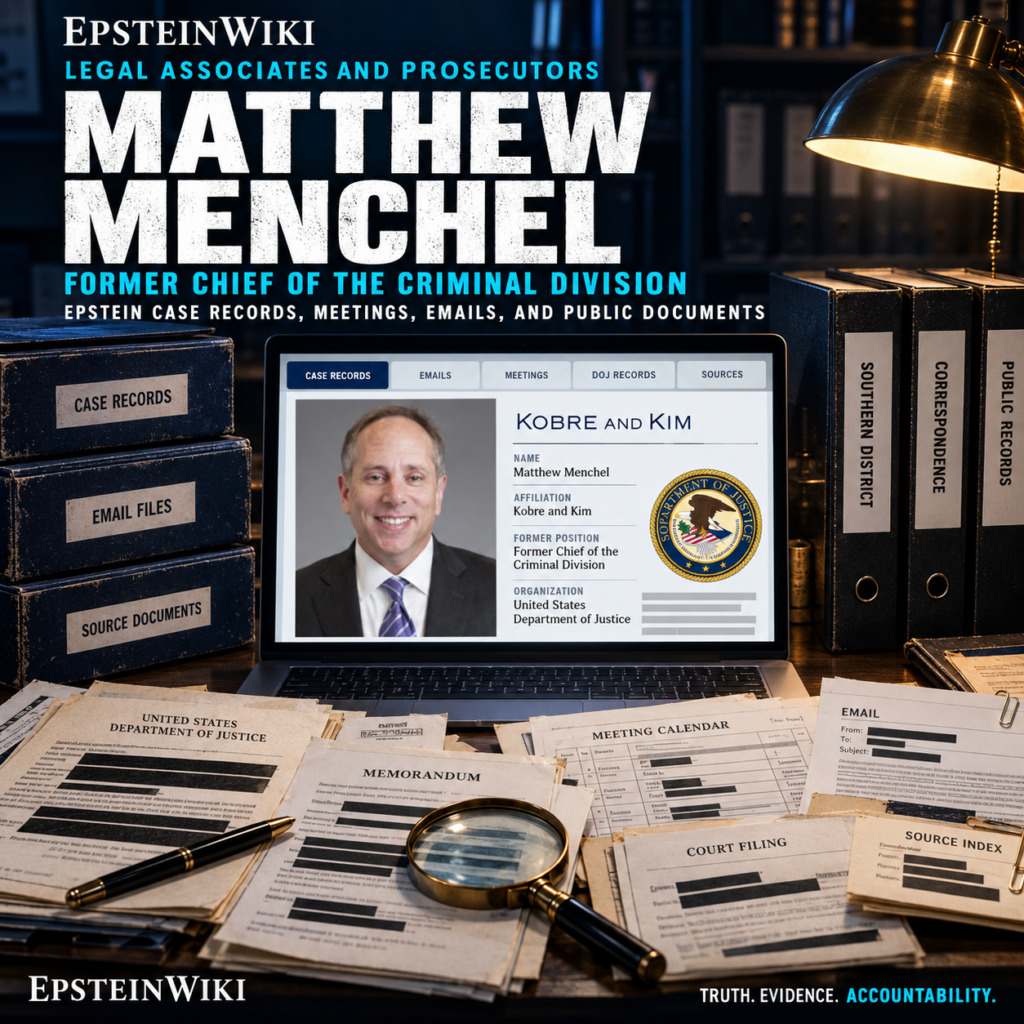
Matthew I. Menchel was chief of the Criminal Division in the United States Attorney’s Office for the Southern District of Florida during the federal investigation of Jeffrey Epstein. In 2007, he withheld approval for an immediate indictment, discussed a possible state plea with Epstein’s defense, and signed a letter insisting that Epstein serve at least two years in state custody.
Menchel left the prosecutor’s office on August 3, 2007, the day he sent that letter. The final federal nonprosecution agreement was signed on September 24, after his departure. It called for an 18 month county jail sentence. Menchel did not negotiate or sign that final agreement.
Records beginning in May 2010 document contact between Menchel and Epstein about possible legal work. Their correspondence and calendars also show a continuing social relationship. Menchel declined to participate in litigation concerning the federal Epstein case in 2013 because he believed his former government role could create a conflict.
The Justice Department’s professional responsibility investigation found no professional misconduct by the officials it examined in developing and approving Epstein’s agreement. It also concluded that Menchel should prudently have disclosed an earlier personal relationship with a member of Epstein’s defense team so his supervisors could assess its appearance. The records establish serious questions about judgment and access. They do not establish that Epstein retained or paid Menchel, or that their later relationship influenced the 2007 prosecution.
Key Takeaways
- Menchel had supervisory authority over prosecutors developing a proposed federal indictment against Epstein.
- On May 14, 2007, he told them they had no approval to seek an indictment or criminal complaint the next day while United States Attorney R. Alexander Acosta reviewed their work.
- Menchel discussed a state plea with defense lawyer Lilly Ann Sanchez. He said Acosta knew about the plea discussion. His supervisors did not know that Menchel had previously dated a member of the defense team.
- Menchel’s August 3 letter insisted on a two year state prison term. The final agreement, reached after he left government, specified an 18 month county jail recommendation.
- The first documented direct contact between Menchel and Epstein in the reviewed correspondence is in May 2010. Epstein was still subject to community control until July 2010, according to the Justice Department’s chronology.
- In a 2014 email, Menchel said he had waited until Epstein’s sentence was fully served before Sanchez introduced them. The May 2010 correspondence and July 2010 end date require that statement to be read carefully. The available record does not resolve whether Menchel meant the jail term rather than the entire sentence, which included community control.
- Epstein approached Menchel about Highbridge, a banker claim, other possible litigation, and later a Florida civil case. None of the reviewed records proves an engagement, payment, or appearance as Epstein’s lawyer.
- In 2013, Menchel expressly refused to work on a matter tied to the federal investigation because of his earlier involvement.
Menchel’s Career
Menchel spent approximately eleven years as a prosecutor in the Manhattan District Attorney’s Office. He joined the United States Attorney’s Office for the Southern District of Florida in 1998 and became its criminal chief in October 2006. The Justice Department report, EFTA02830776, page 31 describes his position and involvement in the Epstein investigation.
After leaving government in August 2007, Menchel entered private practice at Kobre & Kim. His firm biography describes his work in government enforcement defense and complex civil litigation. It lists a law degree from the City University of New York Law School at Queens College and a bachelor’s degree from the State University of New York at Binghamton. He has trained trial lawyers and taught in the University of Miami School of Law’s litigation skills program.
The firm identifies Menchel’s work in the successful defense of former UBS executive Raoul Weil and in a Commodity Futures Trading Commission case against DRW Investments. Those examples establish a substantial practice outside the Epstein matter. They do not establish that Menchel represented Epstein.
The Federal Case Menchel Supervised
Palm Beach police investigated Epstein after a complaint concerning a 14 year old girl. Investigators referred the matter to the FBI when they concluded that the state prosecution did not address the full scope of the conduct they had uncovered. Federal investigators identified additional victims.
By May 2007, federal prosecutor A. Marie Villafaña had submitted a prosecution memorandum and a proposed 60 count indictment for supervisory review. The Justice Department’s investigative summary confirms the proposed charges and describes the subsequent review by office leadership.
Menchel’s supervisory decisions therefore mattered. They affected whether prosecutors could proceed immediately with federal charges and how the office would discuss a possible resolution with Epstein’s lawyers. Acosta retained ultimate authority over the office’s decision.
May 2007: Approval for Immediate Charges Withheld
In a May 14 email preserved in EFTA00191148, page 9, Menchel told Villafaña and Andrew Lourie that they lacked approval to seek an indictment the following day or proceed by criminal complaint. He said Acosta had the prosecution memorandum and was out of the district.
This email documents a specific decision to stop an immediate charging step. It does not establish that Menchel independently made the final decision to forgo federal prosecution. The distinction matters because Acosta and other supervisors continued reviewing the case, and negotiations followed.
June and July 2007: Defense Contact and an Internal Dispute
A June 21 email in EFTA00191148, page 13 shows Menchel discussing who would attend a meeting with Epstein’s defense. It also records his direct communication with defense lawyer Lilly Ann Sanchez about a proposed written presentation.
Villafaña objected to Menchel’s discussions about a state plea. In a July 5 exchange in EFTA00191148, pages 18 and 19, Menchel asserted that he, as criminal chief, had authority to assess proposed pleas. He told Villafaña that she had not received authorization to seek an indictment. He also stated that his discussion with Sanchez had Acosta’s knowledge.
The disagreement was substantive. Villafaña had developed the federal case and opposed the emerging state resolution. Menchel believed the supervisory chain controlled charging and plea decisions. The emails document their disagreement and the sharp tone of the exchange. They do not prove an improper motive by either prosecutor.
A later government privilege log, EFTA01325051, pages 4 and 5 identifies additional withheld correspondence about Menchel’s plea negotiations, Villafaña’s request for a meeting between management and victims, and a July 31 summary of proposed terms described as Menchel’s recommendation. The log establishes that these records were identified and withheld on asserted grounds. Its short descriptions cannot substitute for the underlying emails or prove every detail of their contents.
For the larger sequence, EpsteinWiki’s investigation timeline follows the underlying EFTA00224943 chronology.
The State Proposal and Menchel’s August 3 Letter
At a July 31, 2007 meeting, the prosecutor’s office proposed ending its federal investigation if Epstein pleaded guilty to state charges, served a minimum of two years, registered as a sex offender, and provided a means for victims to obtain compensation. The Justice Department’s executive summary describes those proposed conditions.
On August 3, Menchel signed a letter to Sanchez preserved in EFTA02756477, pages 2 and 3. It conveyed the office’s position that two years of state imprisonment was the minimum needed to satisfy the federal interest. The letter requested a response by August 17. A later government filing identifies Menchel as its author in EFTA00191148, page 41.
August 3 was Menchel’s final day at the prosecutor’s office, according to the Justice Department chronology in EFTA02830776, page 38. The chronology establishes that the letter and departure occurred on the same day. It does not explain why he left or connect his departure to the plea proposal.
What Changed After Menchel Left
The federal nonprosecution agreement was signed on September 24, 2007. It required Epstein to plead guilty in Florida state court and recommend 18 months in county jail followed by 12 months of community control. In exchange, the Southern District of Florida agreed to forgo federal prosecution of Epstein, four named potential coconspirators, and any other potential coconspirators covered by its language.
These were the final terms. They differed from the minimum two year state prison term in Menchel’s August letter. Menchel had already left the office before the final negotiations and did not sign the agreement. Acosta approved the federal resolution.
Epstein pleaded guilty in state court on June 30, 2008. He later received work release and served less than 13 months in custody. The Justice Department summary separates the 2007 proposal, the final agreement, the 2008 plea, the work release decision, and the subsequent period of community control. Menchel’s role in the first proposal should not be expanded into responsibility for every later change or for the sheriff’s administration of the sentence.
Victims were not consulted before the agreement was signed. In 2019, a federal district court ruled that the government had violated victims’ rights by failing to advise them of its intention to enter the agreement. That finding concerns the government’s treatment of victims. It is not a finding that Menchel personally committed misconduct.
The Undisclosed Prior Personal Relationship
The full Justice Department report in EFTA02830776, page 180 addresses Menchel’s earlier personal relationship with a member of Epstein’s defense team. Menchel told investigators the relationship involved a handful of dates and did not affect his handling of the case. Acosta and other supervisors told investigators they had not known about it.
The report concluded that it would have been prudent for Menchel to disclose the relationship so his supervisors could independently assess whether his continued participation created an appearance of lost impartiality. A Department professional responsibility official said he probably would have advised Menchel to step back, given the matter’s sensitivity.
The relevant passage of the Department report redacts the lawyer’s name. Miami Herald reporting identifies her as Sanchez. The newspaper also identifies Sanchez as the defense attorney with whom Menchel discussed a possible state plea.
Two points must remain separate. Menchel said Acosta knew about his plea discussion with Sanchez. The Department found that supervisors did not know about the prior personal relationship. It did not find that Menchel offered the state proposal as a favor to her.
The First Documented Contact With Epstein After Government Service
In EFTA00758769, page 2, a May 18, 2010 email shows Menchel telling Epstein that Kobre & Kim had no conflict concerning a possible Highbridge matter. He proposed a meeting that could include firm cofounder Michael Kim. Related correspondence in EFTA00734547 documents the meeting arrangements and follow up.
Epstein sleuth Kait Justice has drawn attention to this Highbridge email in her examination of Epstein’s financial relationships. The email establishes a conflict check and prospective discussion. It does not establish the precise legal matter, an accepted engagement, or the wider conclusions proposed in that investigation.
This date also exposes a limitation in Menchel’s later account. The Justice Department summary states that Epstein’s term of community control continued until July 2010. Yet in a November 6, 2014 email preserved in EFTA02516914, Menchel said he had intentionally waited to be introduced until Epstein’s sentence was fully served.
The May correspondence predates the reported end of community control. Menchel may have been referring to Epstein’s completed jail term, rather than the entire sentence, but the email does not make that distinction. The article cannot simply repeat his account as an established chronology. Nor does the date conflict establish that they met while Menchel was in government.
Possible Legal Work in 2010
An October 2010 exchange in EFTA00027873 shows cordial contact and Menchel’s interest in the possibility of working together. Later that month, Epstein raised a dispute involving bankers and a possible lawsuit against victims’ lawyer Brad Edwards. Menchel requested a statement of claim and followed up, as shown in EFTA01981242, pages 1, 3 and 4.
These emails are evidence of proposed matters. They are not proof that a suit was filed, a retainer was signed, or a fee was paid. The distinction also applies to subsequent discussions of possible representation.
Continuing Contact and Other Former Prosecutors
Epstein’s schedules include planned meals with Menchel, including an entry in EFTA02028019. The Miami Herald’s review of more than 100 emails describes recurring meetings and correspondence from 2010 through 2017. Calendar entries show what was scheduled. They do not establish every conversation or guarantee that each event took place.
The Herald also reports that Epstein sought contact with other former prosecutors. In February 2011, Epstein told Menchel of a hoped for lunch with Acosta and asked to speak beforehand. Menchel agreed to a call. Acosta’s lawyer and Alan Dershowitz said the proposed lunch with Acosta did not occur.
Epstein later asked about meeting former prosecutor Jeffrey Sloman. Menchel discussed the possibility, but Sloman told the Herald he never met Epstein. These messages support the conclusion that Epstein sought access to former members of the office. They do not establish that either proposed meeting happened or that Menchel supplied confidential government information.
In December 2012, Epstein emailed Menchel about the Jerry Sandusky case and questioned whether the trial evidence established Sandusky’s guilt beyond a reasonable doubt. Associated Press reporting on the released correspondence says Menchel replied without discussing Sandusky. The exchange illustrates the breadth of Epstein’s contact with Menchel; it does not show Menchel agreeing with Epstein’s view.
Menchel’s Express Refusal in 2013
The July 22, 2013 email in EFTA00718286 is essential to the record. When asked to become involved in litigation concerning Epstein’s dispute with the federal prosecutor’s office, Menchel declined. He explained that his involvement as criminal chief could still create a conflict.
That refusal is direct evidence that Menchel recognized a boundary around the matter he had supervised. It does not answer every question about his other contacts or possible unrelated work. It does prevent the broader correspondence from being described as proof that he undertook Epstein’s challenge to the federal case.
The 2014 Email and Later Matters
The November 2014 correspondence in EFTA02516914 also shows Epstein congratulating Menchel on the UBS trial result. Menchel responded to concerns about their association and said they had not met until years after he left government. The assertion about waiting until the sentence was fully served must be evaluated alongside the May and July 2010 dates.
The Miami Herald reports that Epstein later referred possible clients to Menchel, including banker Jes Staley, and considered Menchel for other potential disputes. The newspaper also describes discussion of a possible lawsuit against Virginia Giuffre. It found no record that the contemplated Giuffre lawsuit materialized. A referral or discussion of a proposed claim does not establish representation of the referred person or the filing of a case.
On September 28, 2017, EFTA00459419 records arrangements for Menchel to meet Epstein at his New York house. In EFTA02602713, Epstein told Kathy Ruemmler that evening that he was considering hiring Menchel for a Florida civil case. Epstein also expressed concern about the publicity and said he had first met Menchel years after his release. The message documents contemplated hiring, not a completed engagement.
What Menchel and His Lawyer Have Said
Menchel told Justice Department investigators that his earlier personal relationship with the defense lawyer did not affect his work. In the 2014 email, he said he had waited to be introduced to Epstein to avoid an appearance of impropriety. Those are his accounts and should be identified as such.
Menchel’s lawyer Erica Wolff told the Miami Herald that the correspondence involved possible representation and referrals, none of which became business for Menchel or Kobre & Kim. She said there was nothing inappropriate about his conduct.
The reviewed evidence establishes possible matters and repeated contact. It does not establish a Menchel engagement letter, invoice, payment, or court appearance as Epstein’s counsel. Absence of a located document cannot prove the content of every private discussion, but the available record cannot support an assertion that Epstein paid Menchel.
What the Justice Department Found
The Office of Professional Responsibility executive summary found that the five officials it examined did not commit professional misconduct in developing, negotiating, or approving the nonprosecution agreement. It concluded that Acosta had authority to resolve the case but exercised poor judgment in choosing the agreement and in failing to ensure victims were informed about the state plea hearing.
The full report in EFTA02830776 adds the assessment that Menchel should have disclosed his prior personal relationship with a defense attorney. Its conclusion on that disclosure issue should not be erased by the broader finding that the investigated officials did not commit professional misconduct in developing the agreement.
Victims’ lawyers also raised a suspicion that Menchel may have had a business or social relationship with Epstein during or after government service. Their letter is preserved in EFTA01099834, page 58. It is an allegation and request for scrutiny, not proof of a relationship during 2007. The reviewed correspondence first documents direct contact in 2010.
Chronology
- 1998: Menchel joins the United States Attorney’s Office for the Southern District of Florida.
- October 2006: He becomes chief of its Criminal Division.
- May 14, 2007: He withholds approval for an immediate Epstein indictment or complaint while Acosta reviews the case.
- June and July 2007: Menchel communicates with defense counsel and disputes Villafaña’s objections to the state plea discussion.
- July 31, 2007: The office proposes a state resolution with at least two years of incarceration.
- August 3, 2007: Menchel signs the two year minimum letter and leaves the office.
- September 24, 2007: The office signs the final federal nonprosecution agreement without Menchel.
- June 30, 2008: Epstein pleads guilty in Florida state court.
- May 2010: Menchel and Epstein arrange a meeting about a possible Highbridge matter.
- July 2010: Epstein’s community control ends, according to the Justice Department’s chronology.
- October 2010: Epstein raises additional possible legal matters with Menchel.
- December 2012: Epstein emails Menchel his views about the Sandusky case.
- July 22, 2013: Menchel declines to work on litigation involving his former office’s Epstein case.
- November 2014: Menchel gives his account of when and why he was introduced to Epstein.
- September 28, 2017: A meeting is arranged, and Epstein says he is considering Menchel for a Florida civil case.
- 2020: The Justice Department releases its professional responsibility findings.
Evidence Appearances
- EFTA00191148, page 9: May 14 instruction withholding approval for immediate federal charges.
- EFTA00191148, page 13: June meeting arrangements and defense contact.
- EFTA00191148, pages 18 and 19: July supervisory dispute and state plea discussion.
- EFTA00191148, page 41: Government identification of Menchel as author of the August letter.
- EFTA01325051, pages 4 and 5: Privilege log descriptions of additional 2007 discussions and proposed terms.
- EFTA02756477, pages 2 and 3: Menchel’s signed August 3 letter.
- EFTA02830776, pages 31, 38 and 180: Justice Department findings on Menchel’s role, departure and disclosure issue.
- EFTA00224943: Federal investigation chronology.
- EFTA00758769, page 2: May 2010 Highbridge conflict check and proposed meeting.
- EFTA00734547: Related May 2010 meeting correspondence.
- EFTA00027873: October 2010 discussion of possible work.
- EFTA01981242, pages 1, 3 and 4: Banker claim and other proposed litigation.
- EFTA02028019: A scheduled meal in Epstein’s calendar.
- EFTA00718286: Menchel’s July 2013 refusal on conflict grounds.
- EFTA02516914: November 2014 correspondence about the timing of their introduction.
- EFTA00459419: September 2017 meeting arrangements.
- EFTA02602713: Epstein’s September 2017 message about possible hiring.
- EFTA01099834, page 58: Victims’ lawyers’ questions concerning a possible relationship.
Questions Raised by the Records
- What work concerning Highbridge did Epstein seek in May 2010? The conflict check does not identify the complete proposed assignment.
- What did Menchel mean in 2014 when he said Epstein’s sentence had been fully served before their introduction? The documented May contact preceded the Justice Department’s reported July end of community control.
- Why did the office move from the two year minimum Menchel communicated to the 18 month recommendation in the final agreement? The change occurred during negotiations after Menchel left.
- What was said during Menchel’s meals and other private conversations with Epstein? The calendars and emails cannot provide a complete account.
- Did any proposed legal matter become an engagement? Menchel’s lawyer says none did, and the reviewed evidence does not establish one.
- How would supervisors have handled Menchel’s prior personal relationship with a defense lawyer had he disclosed it during the federal investigation? The Justice Department said disclosure would have allowed an independent assessment, but that assessment did not happen at the time.
Source List
- United States Department of Justice, Office of Professional Responsibility executive summary.
- United States Department of Justice, full professional responsibility report, EFTA02830776.
- Epstein Data, Matthew Menchel document guide.
- Miami Herald, investigation of Epstein’s contacts with former prosecutors.
- Kobre & Kim, Matthew I. Menchel biography and selected engagements.
- Kait Justice, investigation discussing the Highbridge correspondence.
- Associated Press, reporting on the Sandusky email exchange.
- EpsteinWiki, EFTA00224943 complete investigation timeline.
- EpsteinWiki, Justice Department professional responsibility executive summary.