
Sigrid S McCawley
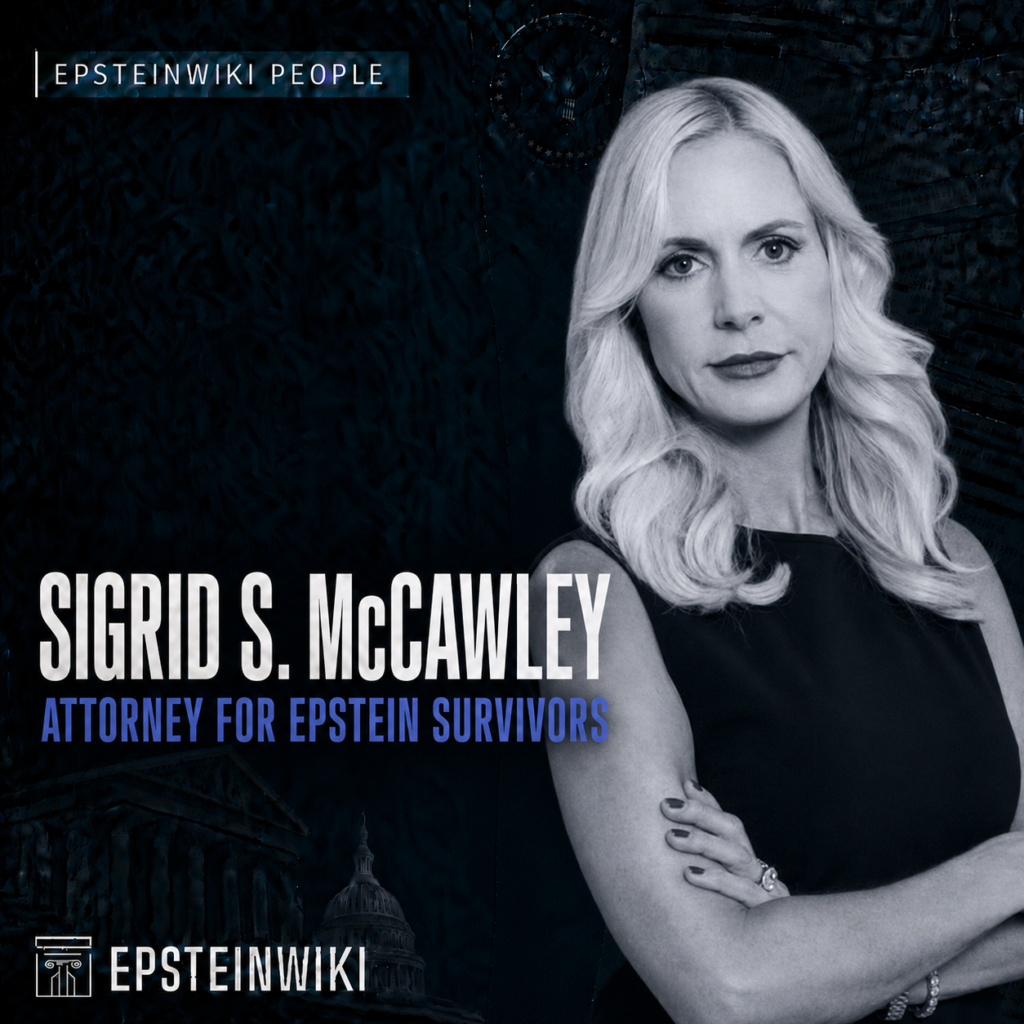
The Boies Schiller Flexner managing partner spent more than a decade representing Virginia Giuffre and other Epstein survivors, litigating against Ghislaine Maxwell, Prince Andrew, major banks, and Epstein’s estate advisers while pressing investigators and Congress to treat survivor testimony as evidence rather than an inconvenience.
Sigrid S. McCawley does not appear in the Jeffrey Epstein record as a friend, employee, business partner, passenger, or social guest.
She appears as an adversary.
Court dockets identify her as counsel for Virginia Giuffre. Released federal records show her arranging survivor interviews with prosecutors, connecting possible witnesses to investigators, accompanying clients to FBI victim services meetings, and objecting when a criminal defendant sought private compensation records. Appellate opinions identify her in a years long effort to unseal judicial documents from Giuffre v. Maxwell. Later cases placed her among the lawyers who obtained settlements totaling hundreds of millions of dollars from financial institutions accused of enabling Epstein.
That distinction is essential. A name appearing repeatedly in the Epstein files can indicate complicity, proximity, opposition, investigation, representation, or simple administrative contact. In McCawley’s case, the documented role is legal representation and survivor advocacy.
This profile examines what the public record establishes about that work, what remains protected by attorney client privilege, which outcomes were settlements rather than findings of liability, and why her litigation record matters to the unfinished public accounting of the Epstein system.
Content Warning
This profile discusses sexual abuse, trafficking, coercion, suicide, and institutional failures affecting survivors. It avoids unnecessary graphic detail and does not identify people whose names remain properly redacted.
Executive Snapshot
| Field | Finding |
|---|---|
| Full name | Sigrid S. McCawley |
| Profession | Attorney and managing partner of Boies Schiller Flexner LLP |
| Epstein related role | Counsel for Virginia Giuffre and other survivors; civil litigator; liaison with investigators and victim services personnel; public advocate |
| First clearly documented Epstein related representation | Late 2014, when her firm began representing Virginia Giuffre |
| Major matters | Giuffre v. Maxwell; Giuffre v. Prince Andrew; Giuffre v. Dershowitz before firm disqualification; survivor class actions involving JPMorgan Chase, Deutsche Bank, Bank of America, and Epstein estate advisers Darren Indyke and Richard Kahn |
| Government interaction | Documented communications with the FBI and the U.S. Attorney’s Office for the Southern District of New York concerning survivors, witnesses, interviews, victim services, and the Maxwell prosecution |
| Public record role | Adversarial to Epstein, Maxwell, and alleged institutional enablers |
| Criminal charge or allegation against McCawley in the reviewed record | None found |
| Connection rating | 4 of 5 for sustained, direct, adversarial engagement with the Epstein record |
| Rating warning | This scale measures depth of documented connection, not culpability. McCawley’s connection is professional and oppositional. |
| Verification status | Substantially verified through court opinions, dockets, released federal records, official biographies, settlement materials, and attributed reporting |
| Last checked | September 3, 2026 |
Overview
McCawley’s significance is difficult to reduce to one lawsuit. Her work sits at the intersection of four parts of the Epstein story that are often discussed separately.
First, she helped Virginia Giuffre pursue civil claims when criminal accountability appeared remote. The 2015 defamation action against Ghislaine Maxwell created a large discovery record and compelled testimony that later became important to journalists, prosecutors, courts, and the public.
Second, she participated in the legal fight over whether that record should remain sealed. The resulting appellate decisions clarified that courts cannot hide judicial documents through broad, undifferentiated sealing orders. They also emphasized that privacy protection must be specific and carefully tailored, especially where survivors and uninvolved third parties are concerned.
Third, released federal communications document McCawley acting as a bridge between survivors and the government. The records show scheduling, attorney proffers, witness referrals, interview preparation, victim services coordination, and discussions connected to the prosecution of Maxwell.
Fourth, she helped move civil accountability beyond individual perpetrators to institutions and professional gatekeepers. Settlements with JPMorgan Chase, Deutsche Bank, Bank of America, and Epstein estate related defendants did not create criminal convictions or universal findings of liability. They did, however, direct substantial funds toward survivor compensation and force public examination of how financial systems can sustain abuse.
McCawley’s record is therefore most accurately understood as long term survivor representation across civil litigation, public access disputes, government cooperation, institutional accountability, and legislative reform.
Identity Verification
McCawley’s identity is confirmed by her official Boies Schiller Flexner profile, federal court opinions, court dockets, and released documents bearing her name and law firm signature block.
The firm identifies her as a managing partner based in Fort Lauderdale. It lists bar admissions in Florida, the District of Columbia, and New York. The same biography says she earned a history degree with highest honors from the University of Florida and a law degree with honors from the University of Florida College of Law.
Court filings in Giuffre v. Maxwell identify her as a Boies Schiller Flexner partner admitted for that case. A March 23, 2016 declaration bears her electronic signature and states that she represented Giuffre in opposing Maxwell’s request for a protective order concerning Maxwell’s deposition. The released version is available as EFTA02780992.
These records distinguish Sigrid S. McCawley from other people with the surname McCawley and tie the public biography to the attorney appearing in the Epstein related cases.
Education and Legal Career
McCawley graduated from the University of Florida and its law school. Her firm biography reports that she participated in the trial team and International Law Journal while in law school. She later clerked for Judge Jose A. Gonzalez Jr. of the U.S. District Court for the Southern District of Florida.
Before joining Boies Schiller Flexner, she practiced at Morgan, Lewis & Bockius in Washington. She joined Boies Schiller Flexner’s Fort Lauderdale office in 2001 and eventually became one of the firm’s managing partners.
Her work has not been limited to sexual abuse litigation. The official biography credits her with major commercial, securities, class action, arbitration, employment, intellectual property, and trust disputes. Among the reported outcomes are a $150 million settlement in litigation involving Amway and a $100 million settlement in the Halliburton securities case after the matter reached the U.S. Supreme Court twice.
That commercial background matters because the later Epstein litigation required more than public advocacy. It involved discovery against sophisticated institutions, battles over privilege and sealing, class certification, banking records, international witnesses, and defendants with extensive legal resources.
From Commercial Litigation to Survivor Advocacy
McCawley has said that her work with children in the foster care system influenced her willingness to take on abuse related matters. Her firm also describes much of her early Epstein work as pro bono.
According to a 2020 Lawdragon interview, Virginia Giuffre approached Boies Schiller Flexner in late 2014. By then, Epstein had already received the extraordinary 2007 federal nonprosecution agreement and pleaded guilty to Florida state charges in 2008. Many possible civil and criminal claims faced severe time barriers.
The legal strategy that followed did not reopen every expired claim. Instead, it used live disputes, particularly defamation, to challenge public attacks on Giuffre and to obtain evidence through discovery.
This was not a conventional path to accountability. It required a survivor to withstand repeated attacks on her credibility while lawyers sought evidence in forums where the underlying trafficking allegations were sometimes technically collateral to the claim being litigated.
Representing Virginia Giuffre
Virginia Giuffre became one of the most prominent public survivors of Epstein and Maxwell. She alleged that Maxwell recruited her while she was a teenager and that Epstein and Maxwell trafficked her to other men. Those allegations generated litigation in Florida, New York, and elsewhere, along with years of public scrutiny.
McCawley became one of Giuffre’s principal lawyers. Their attorney client relationship lasted roughly a decade and included the Maxwell defamation action, unsealing litigation, the Prince Andrew case, public advocacy, and later legislative work honoring Giuffre.
The relationship also required McCawley to operate across different forms of accountability. Civil cases can compensate a survivor, obtain discovery, resolve a specific dispute, or produce public records. They cannot themselves convict a defendant. Criminal prosecutors decide whether to charge. Courts determine what evidence is admissible. Journalists decide what to publish. Legislatures determine whether time limits and jurisdictional rules should change.
McCawley’s role touched all of those systems without controlling any one of them.
Giuffre v. Maxwell
On September 21, 2015, Giuffre filed a defamation action against Ghislaine Maxwell in the Southern District of New York. The public CourtListener docket identifies the case as Giuffre v. Maxwell, No. 1:15 cv 07433.
The suit followed public statements in which Maxwell denied Giuffre’s allegations and characterized them as lies. Giuffre alleged that those statements were defamatory.
The case produced extensive discovery. Lawyers took depositions, fought over documents, sought testimony from Epstein, and litigated what material could be used at trial. The docket eventually included hundreds of sealed filings.
McCawley signed multiple declarations during that process. In EFTA02801157, filed October 14, 2016, she supported a motion seeking data from an email account that the plaintiff contended Maxwell had not disclosed. In EFTA02801168, she supported Giuffre’s response to a motion concerning compelled testimony from Epstein.
These filings establish that McCawley was not a peripheral name on the case. She was involved in its contested discovery and evidentiary disputes.
The parties settled in May 2017. The terms were confidential at the time. Because the case ended by settlement, there was no trial verdict resolving every factual allegation. Any account of the case must preserve that distinction.
The Maxwell Deposition
One of the most consequential products of the civil case was Maxwell’s deposition testimony. McCawley questioned Maxwell under oath during discovery.
The deposition did not itself convict Maxwell. It was testimony in a civil action governed by discovery rules and a protective order. Parts of the record later became public through unsealing litigation, and Maxwell’s statements drew close attention after federal prosecutors charged her in 2020.
McCawley has described the encounter in later interviews as combative and revealing. Her assessment is an advocate’s interpretation, not an independent judicial finding. The transcript is more probative than any later characterization because readers can evaluate questions, answers, objections, and context directly.
The broader significance is procedural. Giuffre’s civil case placed Maxwell under oath years before Maxwell faced a federal criminal trial. It also created a preserved record at a time when many institutions had failed to produce a full public accounting.
Seeking Epstein’s Testimony
Released court exhibits show that Giuffre’s lawyers also sought testimony from Epstein in the Maxwell case.
In correspondence reproduced in EFTA01080461, McCawley told Epstein attorney Martin Weinberg in April 2016 that the plaintiff intended to take Epstein’s videotaped deposition for possible use at trial. Earlier correspondence discussed whether Epstein would invoke the Fifth Amendment rather than answer substantive questions.
The record establishes an attempt to compel or arrange sworn testimony. It does not establish that Epstein ultimately provided substantive testimony about the trafficking allegations. An invocation of the Fifth Amendment is not proof of guilt, and civil discovery correspondence should not be converted into a criminal finding.
Still, the effort is important. It demonstrates that McCawley’s team was attempting to put both Maxwell and Epstein under oath within the same civil record.
The Fight to Unseal the Record
The settlement did not end the public importance of Giuffre v. Maxwell. Journalists and other intervenors sought access to filings that had accumulated under seal.
In Brown v. Maxwell, the U.S. Court of Appeals for the Second Circuit ruled in 2019 that the district court had not conducted the required document by document review. The court ordered the summary judgment record unsealed with limited redactions and remanded the remaining material for individualized consideration.
McCawley appeared on the appellate brief for Giuffre. The opinion did not adopt a rule of indiscriminate disclosure. It recognized both a strong public right of access to judicial documents and legitimate privacy interests, especially for survivors, minors, and uninvolved third parties.
That balance became central to the years of review that followed. Public access required work, but so did protection. A responsible archive must preserve both values.
The 2025 Appellate Decision
The unsealing litigation continued long after the first appellate ruling. On July 23, 2025, the Second Circuit issued another decision in Giuffre v. Maxwell, No. 24 182.
McCawley represented Giuffre in that appeal. The court held that a motion can remain a judicial document even if settlement later makes the motion moot. It also held that a court’s failure to rely on a document does not automatically reduce the public access interest to almost nothing. The panel vacated some sealing rulings, remanded for further individualized review, and affirmed other privacy based decisions.
The decision is a partial victory, not a blanket order to release every name or page. It reinforces a principle that should guide all Epstein document projects: transparency must be reasoned, specific, and compatible with survivor privacy.
Cooperation With Federal Investigators Before the 2019 Arrest
The released federal record places McCawley in direct contact with investigators before Epstein’s July 2019 federal arrest.
A March 20, 2019 email chain, EFTA00100310, shows an Assistant U.S. Attorney thanking McCawley for helping coordinate meetings at her law firm’s office. The prosecutor asked for contact information for Anthony Figueroa and other potential witnesses or their counsel. McCawley supplied contact information and offered context about the likelihood of cooperation.
The same document establishes that federal personnel planned to use Boies Schiller Flexner’s office for meetings. It does not reveal every subject discussed, and it does not establish that McCawley controlled the investigation.
What it does show is material: months before the arrest, McCawley was assisting federal investigators with access to people believed to possess relevant information.
The July 2019 Arrest Communications
In EFTA00030241, an Assistant U.S. Attorney wrote to McCawley on July 6, 2019, shortly before news of Epstein’s arrest became public. The prosecutor thanked her and her clients for their assistance and said the investigation was expected to expand.
McCawley responded that a survivor had become emotional upon learning of the arrest and thanked the prosecutor for pursuing justice.
This exchange is among the clearest records connecting McCawley’s clients to the federal investigation that preceded Epstein’s 2019 prosecution. It supports the conclusion that survivors represented by her had provided assistance.
It does not prove the firm’s broader promotional claim that McCawley’s work caused the arrest. Criminal investigations draw on many witnesses, agents, prosecutors, records, and prior reporting. The cautious conclusion is that McCawley and her clients assisted the investigation and that prosecutors expressly acknowledged that help.
Attorney Proffers and Survivor Interviews
After Epstein’s death in August 2019, prosecutors continued investigating his conduct and associates.
In EFTA00080143, an Assistant U.S. Attorney told McCawley that prosecutors remained interested in information from each of several clients. The prosecutor proposed an attorney proffer followed, where appropriate, by in person meetings. The email also directed survivors toward FBI counseling and victim services resources.
In EFTA00025125, McCawley arranged a March 2020 interview between a client and federal prosecutors in New York. In EFTA00025501, she coordinated a follow up interview, asked how much time the client should reserve, and stated that she wanted to join the call.
These records establish a continuing representative function. McCawley was not merely forwarding names. She was preparing logistics, protecting the attorney client relationship, and remaining present while survivors engaged with law enforcement.
The redactions must be respected. They should not be reverse engineered to identify clients whose names the public record withholds.
FBI Victim Services Coordination
The files also document work that was less dramatic than courtroom litigation but central to survivor treatment.
In September 2019, the FBI invited Epstein survivors to briefings with victim services personnel, agents, and prosecutors. EFTA01649957 shows McCawley confirming that a client wished to attend and that McCawley would accompany her. The correspondence describes separate meetings in Florida and New York and permits a survivor to bring a support person.
An FBI administrative list, EFTA01649798, places McCawley’s name beside multiple redacted survivor entries. The document appears to have been used to route invitations through attorneys. It demonstrates that she represented several people in the government’s victim notification process. It should not be used to infer the identities behind the redactions.
In October 2020, EFTA01651441 shows McCawley asking whether an overseas client could attend a Justice Department meeting remotely during travel restrictions. When remote attendance was unavailable, she said she would attend and obtain the materials for the client.
This is a significant form of advocacy. Victim rights are not satisfied merely by prosecuting a defendant. Survivors must receive notice, access, information, and a meaningful chance to participate.
The Maxwell Prosecution
Federal prosecutors charged Maxwell in July 2020. A jury convicted her in December 2021 of five federal offenses connected to recruiting and grooming girls for Epstein. She was later sentenced to 20 years in prison.
McCawley’s role was not that of prosecutor. She represented survivors whose interests overlapped with, but were not identical to, the government’s case.
Released correspondence in EFTA00098160 shows discussions with Southern District of New York prosecutors in May 2021 concerning trial scheduling in United States v. Maxwell. McCawley conveyed a client’s preference for the earliest possible trial date.
In EFTA00032594, prosecutors informed McCawley in November 2021 that Maxwell’s lawyers had sought a Rule 17(c) subpoena for information from the Epstein Victims’ Compensation Program concerning a redacted person. The government said it intended to move to quash the subpoena and offered to discuss scheduling and questions with her.
The exchange shows prosecutors treating McCawley as counsel for a person whose privacy and participation could be affected by trial subpoenas. It does not reveal the redacted person’s identity and should not be used to guess it.
Maria Farmer, Annie Farmer, and Other Survivors
Public reporting and McCawley’s firm identify her as counsel for multiple Epstein survivors, including members of the Farmer family. Annie Farmer testified at Maxwell’s criminal trial about abuse she experienced as a teenager. Maria Farmer had reported Epstein and Maxwell to authorities years earlier and became an important public witness to institutional failure.
McCawley’s released communications show that her representation extended well beyond Giuffre, but the exact client roster is not fully public. Attorney client privilege and survivor choice limit what can responsibly be cataloged.
The proper approach is to identify publicly acknowledged representation while leaving redacted names redacted. A lawyer’s administrative email is not permission to expose a survivor.
Giuffre v. Prince Andrew
On August 9, 2021, Giuffre sued Prince Andrew in the Southern District of New York. She alleged that he sexually assaulted her when she was seventeen after Epstein and Maxwell trafficked her to him. Andrew denied the allegations.
McCawley and David Boies represented Giuffre. The public CourtListener docket identifies the case as No. 1:21 cv 06702.
Andrew moved to dismiss, relying in part on a 2009 settlement between Giuffre and Epstein. On January 12, 2022, Judge Lewis Kaplan denied the motion in all respects. The judge expressly warned that the ruling did not decide whether either side’s factual allegations were true.
The denial meant the case could proceed into discovery. Andrew faced the prospect of sworn testimony and document production.
The Prince Andrew Settlement
Giuffre and Andrew announced an out of court settlement in February 2022. The amount was not disclosed in the filed statement.
Andrew agreed to make a substantial donation to Giuffre’s charity, expressed regret for his association with Epstein, and accepted that Giuffre had suffered as an established victim of abuse and from unfair public attacks. He did not admit liability for her allegations against him.
The case was dismissed before trial. That means no jury determined whether Andrew committed the alleged assaults. It is equally inaccurate to call the settlement a criminal exoneration or a trial verdict for Giuffre.
The result nevertheless had practical significance. Giuffre overcame a dismissal attempt, forced the dispute into a federal court with discovery approaching, and obtained a public statement recognizing her victimization and the harm of attacks on her character.
Giuffre v. Dershowitz and the Firm’s Disqualification
In 2019, Giuffre sued attorney Alan Dershowitz for defamation after he denied her allegation that Epstein had trafficked her to him. Dershowitz denied the underlying allegation and countersued.
Judge Loretta Preska denied Dershowitz’s motion to dismiss but disqualified Boies Schiller Flexner from representing Giuffre in that case. The court concluded that lawyers from the firm, including McCawley, were likely to be necessary witnesses because of their prior involvement in related disputes.
Disqualification was a procedural and professional responsibility ruling. It was not a finding that McCawley committed a crime or participated in Epstein’s abuse. It did restrict her firm from continuing as Giuffre’s trial counsel in that particular action.
In November 2022, Giuffre and Dershowitz dismissed their claims with prejudice. Giuffre stated that she recognized she may have made a mistake in identifying him. The resolution involved no monetary payment. Dershowitz maintained his denial and acknowledged that Giuffre had been victimized by Epstein. Reuters reported the settlement and joint statements.
Any profile of McCawley’s Epstein work should include this outcome. It is a material limitation on one accusation advanced during the broader litigation history.
JPMorgan Chase and Deutsche Bank Litigation
In November 2022, a survivor identified as Jane Doe 1 filed proposed class actions against JPMorgan Chase and Deutsche Bank. The complaints alleged that the banks knowingly benefited from or facilitated Epstein’s trafficking by continuing to provide financial services despite warning signs.
McCawley served on the plaintiffs’ legal team with lawyers from Boies Schiller Flexner and other firms. The public dockets are available for Doe 1 v. JPMorgan Chase & Co. and Doe 1 v. Deutsche Bank Aktiengesellschaft.
JPMorgan agreed to a $290 million class settlement. Deutsche Bank agreed to a $75 million settlement. Judge Jed Rakoff gave final approval to both in 2023. Boies Schiller Flexner’s settlement summary identifies McCawley as a member of the plaintiffs’ team.
The settlements created funds for eligible survivors and ended the class claims. They did not constitute criminal judgments. Settlement also does not necessarily equal an admission of every allegation. The banks’ conduct should therefore be described through the complaints, rulings, discovery record, and settlement terms rather than through assumptions.
The cases were nonetheless a major expansion of accountability. They treated financial access, compliance warnings, cash withdrawals, and relationship management as potential components of an enabling structure rather than background details.
Bank of America Litigation
In October 2025, another survivor filed a proposed class action against Bank of America. The case alleged that the bank ignored suspicious activity and provided services that helped Epstein maintain control over victims and move money connected to his operations. The public docket identifies the case as Doe v. Bank of America, N.A., No. 1:25 cv 08520.
Bank of America denied facilitating trafficking. The case moved quickly through dismissal arguments, amendment, discovery, and settlement negotiations.
The parties reached a settlement in principle in March 2026. Judge Rakoff gave preliminary approval to a $72.5 million fund in April and final approval on August 27, 2026. Reuters reported the final approval.
McCawley publicly described the result as economic justice for survivors. That is an advocate’s characterization, but the amount and final approval are independently verifiable.
The settlement is especially current to this profile. It was approved only one week before the September 3, 2026 verification date.
Litigation Against Darren Indyke and Richard Kahn
McCawley also represents plaintiffs in class litigation against Darren Indyke, Epstein’s longtime lawyer, and Richard Kahn, his accountant. The complaints allege that the two professional advisers helped construct and operate financial systems that enabled Epstein’s trafficking and concealment. Both men deny wrongdoing.
The related cases include Danielle Bensky and Jane Doe 3 v. Indyke and Kahn, Nos. 1:24 cv 01204 and 1:24 cv 02192. A 2024 district court opinion addresses both matters.
In February 2026, the parties proposed a class settlement funded at $25 million if fewer than forty eligible people qualify and $35 million if forty or more qualify. Judge Arun Subramanian gave preliminary approval on March 3, 2026. Reuters reported that a final approval hearing was scheduled for September 16, 2026.
As of this profile’s verification date, final approval has not yet occurred. The settlement should therefore be described as proposed and preliminarily approved, not completed.
Virginia’s Law
McCawley’s advocacy moved from litigation into legislation after Giuffre’s death in 2025.
In February 2026, Representative Teresa Leger Fernández and Senate Democratic Leader Chuck Schumer introduced Virginia’s Law, also identified as H.R. 7467. The proposal would eliminate or expand federal time limits for specified civil sexual abuse and trafficking claims and create a one year window for certain older claims.
The official House announcement says the bill was named for Giuffre and developed with advocates and her family. McCawley’s firm states that she helped draft and introduce it.
As of September 3, 2026, Virginia’s Law is proposed legislation, not enacted law. Its introduction demonstrates how the barriers encountered in Giuffre’s own cases shaped a broader reform effort, but readers should not assume that its provisions are currently available to litigants.
Public Advocacy and Media Statements
McCawley has become a prominent public critic of secrecy and delay in the Epstein investigations. She has appeared in television interviews, documentaries, legal panels, and print profiles.
Her public themes are consistent: survivors should be believed enough to have their evidence investigated; files should be released with meaningful privacy protections; prosecutors should follow evidence toward facilitators and institutions; and civil time limits should not reward perpetrators who rely on trauma induced delay.
In 2025 and 2026, she criticized government descriptions of the remaining Epstein investigation as effectively closed. She also challenged public narratives that reduce the files to a single supposed client list. Her position has been that evidence is distributed across financial records, witness accounts, communications, travel, property operations, and institutional responses.
Those statements are advocacy. They deserve attribution and should be evaluated alongside court records and investigative findings. They are not substitutes for proof.
Remembering Virginia Giuffre
Virginia Giuffre died in April 2025. Her family described her as a fierce advocate for survivors. McCawley and her colleagues published a May 2025 remembrance emphasizing her courage and the public changes produced by her decision to speak.
Giuffre’s death should not be used as an invitation for speculation. The relevant public fact for this profile is that McCawley’s principal client did not live to see the full record released or the legislative proposal bearing her name enacted.
The legal record Giuffre created remains active. Courts were still deciding unsealing questions in 2025. Congress introduced reform legislation in 2026. Financial and estate related settlements continued after her death.
That continuing effect belongs first to Giuffre and the other survivors who supplied testimony, records, and years of personal risk. Lawyers helped convert that courage into legal process, but they did not create it.
Selected Evidence Appearances
| Identifier | Date | Record type | McCawley’s documented role | What it establishes | What it does not establish |
|---|---|---|---|---|---|
| EFTA00100310 | March 20, 2019 | Email chain with federal prosecutors | Coordinated meeting space and supplied contact information for potential witnesses, including Anthony Figueroa | Active assistance to federal investigators before Epstein’s 2019 arrest | That every referred person was interviewed or that McCawley directed the investigation |
| EFTA00030241 | July 6 and 7, 2019 | Email chain with an Assistant U.S. Attorney | Received thanks for her and her clients’ assistance after news of Epstein’s arrest | Prosecutors credited McCawley and clients with helping the investigation | That their assistance was the sole or decisive cause of the arrest |
| EFTA00080143 | August 2019 | Prosecutor correspondence | Arranged an attorney proffer concerning several clients | Continuing cooperation and government interest after Epstein’s death | The identity of redacted clients or the truth of every anticipated allegation |
| EFTA01649798 | September 27, 2019 | FBI victim services administrative list | Listed as attorney for multiple redacted survivors | Representation of multiple survivors in victim notification procedures | Permission to identify redacted people |
| EFTA01649957 | September 2019 | FBI Victim Services correspondence | Confirmed attendance with a client at a survivor briefing | Direct victim services coordination | The client’s identity or testimony |
| EFTA00025125 | February and March 2020 | Prosecutor interview scheduling | Arranged and planned to attend a client’s interview | Ongoing cooperation with the Southern District of New York | The substance or outcome of the interview |
| EFTA00025501 | January and May 2020 | Follow up interview correspondence | Coordinated timing and planned to join a follow up interview | Continued representation during investigative interviews | That the client was any particular publicly known survivor |
| EFTA01651441 | October 2020 | FBI and Justice Department meeting correspondence | Sought remote access for an overseas client and planned to obtain materials | Advocacy for survivor access during travel restrictions | The identity of the overseas client |
| EFTA00098160 | May 2021 | Email chain concerning United States v. Maxwell | Discussed trial scheduling and relayed a client’s preference | Representation of a person affected by the Maxwell prosecution | That McCawley acted as a prosecutor |
| EFTA00032594 | November 2021 | Rule 17(c) subpoena correspondence | Consulted with prosecutors regarding a defense subpoena aimed at compensation program material | Protection of a client’s interests and privacy in the criminal case | The identity of the person or the contents of compensation records |
| EFTA02780992 | March 23, 2016 | Sworn declaration in Giuffre v. Maxwell | Supported opposition to a protective order concerning Maxwell’s deposition | Direct litigation role in the Maxwell defamation action | A judicial finding on all underlying allegations |
| EFTA01080461 | March and April 2016 | Counsel correspondence filed as an exhibit | Sought a videotaped deposition of Epstein | Attempt to obtain Epstein’s sworn testimony | That Epstein gave substantive testimony |
| EFTA02801157 | October 14, 2016 | Sworn declaration | Supported a motion concerning an undisclosed Maxwell email account | Active role in disputed discovery | That the motion proved criminal conduct |
What the Evidence Establishes
The reviewed evidence supports several firm conclusions.
McCawley represented Virginia Giuffre and multiple other Epstein survivors over a sustained period.
She personally participated in contested civil litigation against Maxwell and Prince Andrew.
She sought evidence from Epstein and Maxwell through civil discovery.
She helped connect potential witnesses and survivors with federal investigators before and after Epstein’s 2019 arrest.
She coordinated interviews, attorney proffers, victim services access, trial related communication, and privacy concerns.
She helped litigate major survivor class actions against financial institutions and professional advisers.
She continued seeking access to sealed judicial records while recognizing the need for tailored privacy protection.
She helped advance proposed federal legislation designed to remove time barriers that affected adult survivors.
What the Evidence Does Not Establish
The evidence does not establish that McCawley had a personal, social, or business relationship with Epstein.
It does not place her inside his trafficking operation.
It does not make her responsible for prosecutorial decisions or prove that her work alone caused any arrest or conviction.
It does not reveal the identities of redacted clients, and readers should not attempt to infer them.
It does not convert allegations in civil complaints into adjudicated facts.
It does not convert settlements into admissions of liability where the agreements or defendants state otherwise.
It does not show that every sealed document should be released. Courts have repeatedly recognized legitimate privacy interests.
It does not eliminate legitimate scrutiny of litigation strategy, attorney conflicts, fees, publicity, or the consequences of particular settlements.
Criticism, Conflicts, and Responses
Powerful litigation produces criticism, and McCawley’s record is not exempt from it.
The most concrete judicial criticism is the 2019 disqualification of Boies Schiller Flexner from Giuffre v. Dershowitz. The court found that firm lawyers were likely to be witnesses. The ruling protected the integrity of the proceeding by separating advocacy from testimony. It should be reported directly rather than inflated into a broader accusation of wrongdoing.
Some critics argue that confidential settlements prevent full public fact finding. That concern applies to the Maxwell and Prince Andrew resolutions, as well as to institutional cases. Settlement can compensate survivors and end punishing litigation, but it can also prevent a trial record. The competing interests are real and cannot be resolved by assuming that every survivor should endure trial for the public’s benefit.
Class settlements also generate debate about legal fees. Judge Rakoff approved thirty percent fee awards in the 2023 bank cases, totaling $87 million in the JPMorgan matter and $22.5 million in the Deutsche Bank matter. Those fees were judicially reviewed, but their size remains a legitimate subject for public examination.
McCawley’s firm describes her pro bono work as contributing to the arrests of Epstein, Maxwell, and Jean Luc Brunel. The released record substantiates meaningful cooperation, but causation should be stated carefully. Multiple survivors, investigators, prosecutors, journalists, and earlier lawyers contributed to the accountability process.
Finally, advocacy can create pressure to state allegations more confidently than adjudicated evidence permits. The appropriate safeguard is disciplined attribution. A complaint alleges. A witness states. A defendant denies. A judge rules. A jury finds. A settlement resolves. Those verbs are not interchangeable.
Survivor Centered Analysis
McCawley’s work demonstrates why survivor representation is more than filing lawsuits.
Survivors may need help communicating with investigators, preserving privacy, arranging travel, obtaining support services, responding to subpoenas, and deciding whether public disclosure advances or harms their interests. They may want accountability while rejecting exposure. They may cooperate with prosecutors without surrendering control over every personal record.
The released emails show McCawley operating in that space. She accompanies clients. She asks about remote access. She schedules around work and health obligations. She requests clarity about interview length. She communicates preferences about trial timing. Those details can look administrative, but they determine whether a survivor can participate without being treated as evidence inventory.
This perspective also complicates calls to release every Epstein related document without restriction. Transparency is necessary to understand institutional failure. Uncontrolled disclosure can expose survivors, witnesses, and uninvolved people. The Second Circuit’s individualized review requirement offers a better model than either total secrecy or indiscriminate publication.
Detailed Timeline
| Date | Event |
|---|---|
| Late 2014 | Boies Schiller Flexner begins representing Virginia Giuffre |
| September 21, 2015 | Giuffre files her federal defamation action against Ghislaine Maxwell |
| March and April 2016 | McCawley litigates deposition issues and seeks Epstein’s videotaped testimony |
| October 14, 2016 | McCawley files a declaration supporting a motion concerning a Maxwell email account |
| May 24, 2017 | Giuffre and Maxwell execute a settlement agreement |
| April 6, 2018 | The Miami Herald and reporter Julie Brown move to unseal the Maxwell case record |
| March 20, 2019 | Released emails show McCawley helping federal investigators reach potential witnesses |
| July 3, 2019 | The Second Circuit orders summary judgment materials unsealed and remands other records for individualized review |
| July 6, 2019 | A federal prosecutor thanks McCawley and her clients for assistance as news of Epstein’s arrest emerges |
| August 2019 | McCawley discusses attorney proffers and possible survivor interviews with prosecutors |
| September and October 2019 | McCawley coordinates FBI victim services briefings for clients |
| October 16, 2019 | Boies Schiller Flexner is disqualified from representing Giuffre in the Dershowitz action |
| February to May 2020 | McCawley coordinates survivor interviews and follow up interviews with prosecutors |
| October and November 2020 | She works with FBI and Justice Department personnel on survivor access to a meeting concerning the earlier investigation |
| May 2021 | She communicates with Maxwell prosecutors about trial scheduling |
| August 9, 2021 | Giuffre files suit against Prince Andrew |
| November 2021 | McCawley discusses a Maxwell defense subpoena aimed at compensation program information with prosecutors |
| December 29, 2021 | A jury convicts Maxwell on five federal counts |
| January 12, 2022 | Judge Kaplan denies Prince Andrew’s motion to dismiss |
| February 15, 2022 | Giuffre and Andrew announce a settlement |
| November 8, 2022 | Giuffre and Dershowitz dismiss their litigation with no monetary payment |
| November 24, 2022 | Survivor class actions are filed against JPMorgan and Deutsche Bank |
| 2023 | Courts approve $290 million and $75 million class settlements with the two banks |
| March 2024 | A survivor class action is filed against Indyke and Kahn, following a related February complaint |
| April 2025 | Virginia Giuffre dies |
| July 23, 2025 | The Second Circuit issues another partial unsealing victory and remand |
| October 15, 2025 | A proposed survivor class action is filed against Bank of America |
| February 10, 2026 | Members of Congress introduce Virginia’s Law |
| March 3, 2026 | A court preliminarily approves the Indyke and Kahn settlement framework |
| August 27, 2026 | Judge Rakoff gives final approval to the $72.5 million Bank of America settlement |
| September 16, 2026 | Scheduled final approval hearing for the Indyke and Kahn settlement, after this profile’s verification date |
Reliability and Limitations
This profile gives greatest weight to court opinions, dockets, filed declarations, and released government communications. Firm biographies and lawyer interviews are used for career details and the advocate’s own account, not as independent proof of disputed allegations.
The EFTA records are often partial, redacted, duplicated, or removed from their original investigative context. An email can establish that a meeting was planned without establishing what was said. A recipient list can establish communication without proving agreement. A redaction cannot responsibly be filled by speculation.
Civil complaints describe plaintiffs’ allegations. Motions describe contested legal positions. Settlements end disputes without necessarily resolving all facts. Criminal convictions establish only the offenses on which the jury returned guilty verdicts and that survived post trial proceedings.
McCawley’s attorney client communications are also substantially protected. The public record cannot show every decision, warning, or disagreement. That gap is a legal feature, not proof of concealment.
Fact Check
| Claim | Status | Basis |
|---|---|---|
| McCawley is a managing partner of Boies Schiller Flexner | Verified | Current official firm biography |
| She represented Virginia Giuffre beginning around late 2014 | Verified | Firm materials, interviews, and court record |
| She litigated Giuffre v. Maxwell | Verified | Docket, filed declarations, and appellate opinions |
| The Maxwell civil case settled in May 2017 | Verified | Second Circuit opinions and docket |
| She assisted federal investigators before Epstein’s July 2019 arrest | Verified | EFTA00100310 and EFTA00030241 |
| She represented multiple survivors in FBI victim services processes | Verified | EFTA01649798, EFTA01649957, and related records |
| Her work alone caused Epstein’s arrest | Not established | Prosecutors acknowledged assistance, but causation was collective and investigative |
| Her firm was disqualified from the Dershowitz case | Verified | October 16, 2019 federal opinion |
| The disqualification found McCawley criminally culpable | False | It was a conflict and witness related professional responsibility ruling |
| Giuffre later said she may have misidentified Dershowitz | Verified | November 2022 joint resolution and reporting |
| Prince Andrew’s dismissal motion was denied | Verified | January 2022 federal opinion |
| Prince Andrew admitted liability in settlement | False | The filed settlement included no admission of liability |
| JPMorgan and Deutsche Bank settlements totaled $365 million | Verified | Final approval records and firm settlement summary |
| Bank of America settlement received final approval for $72.5 million | Verified | August 27, 2026 court reporting |
| Indyke and Kahn settlement has final approval | Not yet verified | Preliminary approval granted; final hearing scheduled September 16, 2026 |
| Virginia’s Law is enacted federal law | False as of September 3, 2026 | It remains proposed legislation |
| Released files show a social relationship between McCawley and Epstein | No evidence found | Reviewed appearances concern adversarial litigation and survivor representation |
Verification status: Substantially verified, with pending matters clearly identified.
Last checked: September 3, 2026.
Related People and Organizations
Virginia Giuffre: Survivor, advocate, and McCawley’s principal publicly identified Epstein related client.
Ghislaine Maxwell: Defendant in Giuffre’s civil defamation case and later convicted federal defendant.
Jeffrey Epstein: The convicted sex offender whose conduct and network were the subject of McCawley’s survivor representation.
Prince Andrew: Defendant in Giuffre’s 2021 civil action, which ended in settlement without an admission of liability.
Alan Dershowitz: Defendant and counterclaimant in litigation with Giuffre that ended in 2022 after Giuffre said she may have misidentified him.
Maria Farmer and Annie Farmer: Publicly identified survivors connected to McCawley’s advocacy and the Maxwell prosecution.
David Boies: Boies Schiller Flexner founder and McCawley’s colleague in major Epstein related matters.
Brad Edwards, Brittany Henderson, and Paul Cassell: Lawyers who represented survivors and worked with McCawley in institutional litigation.
Julie K. Brown and the Miami Herald: Journalist and newspaper that intervened to unseal records from Giuffre v. Maxwell.
Southern District of New York: Federal prosecutor’s office that investigated Epstein, prosecuted Maxwell, and communicated with McCawley concerning survivors and witnesses.
FBI Victim Services Division: Government unit that coordinated briefings and services for survivors through McCawley and other counsel.
Epstein Victims’ Compensation Program: Private claims program whose records became the subject of a subpoena dispute before Maxwell’s trial.
JPMorgan Chase, Deutsche Bank, and Bank of America: Financial institutions sued in survivor class actions and later parties to substantial settlements without criminal judgments in those cases.
Darren Indyke and Richard Kahn: Epstein’s longtime lawyer and accountant, respectively, who deny the civil allegations against them and entered a proposed class settlement without admitting wrongdoing.
Teresa Leger Fernández and Chuck Schumer: Members of Congress who introduced Virginia’s Law in 2026.
Questions for the House Oversight Committee
Survivor participation and protection
- How many Epstein survivors or their attorneys have been interviewed by the Committee?
- What trauma informed procedures govern those interviews?
- May survivors bring counsel and a support person?
- What notice does the Committee provide before using a survivor’s records publicly?
- Does the Committee consult survivors before unredacting identifying information?
- What appeal process exists when a survivor believes a proposed disclosure creates danger?
- Has the Committee retained an independent victim services specialist?
- How are foreign survivors able to participate without traveling to Washington?
- Are translation and interpretation services available?
- How does the Committee prevent repeated interviews from becoming unnecessarily retraumatizing?
- Will the Committee publish a survivor bill of rights for its Epstein investigation?
- How will it distinguish privacy requested by survivors from secrecy requested by institutions?
The 2006 to 2008 investigation
- Has the Committee obtained every FBI and Justice Department record concerning the first federal investigation?
- Who decided which survivors were notified before the nonprosecution agreement?
- Why were known survivors excluded from negotiations?
- Which officials approved protections for possible coconspirators?
- What communications occurred between Epstein’s lawyers and senior Justice Department officials?
- Did professional or political relationships influence the agreement?
- What victim services were offered before and after the 2008 plea?
- Were survivor attorneys given accurate information about federal charging decisions?
- Which investigative leads were closed, deferred, or never pursued?
- What became of evidence collected in Palm Beach and by the FBI?
- Did any official instruct agents not to interview particular witnesses?
- What reforms are needed to prevent secret resolutions that violate victim rights?
The 2019 investigation
- How many survivors represented by McCawley or other counsel assisted the 2019 investigation?
- Which preexisting civil discovery materials did prosecutors obtain?
- Did prosecutors review the full Maxwell deposition before charging decisions?
- Which witnesses referred through survivor attorneys were interviewed?
- Were any referrals declined, and why?
- What investigative steps continued after Epstein’s death?
- Which potential facilitators were treated as subjects, targets, or witnesses?
- Did prosecutors prepare a written declination analysis for uncharged individuals?
- Who authorized closure or narrowing of those investigations?
- Were survivors informed when investigative decisions changed?
- Did the government preserve every record provided by survivor counsel?
- Has the Committee compared the survivor supplied evidence with the later EFTA production?
Ghislaine Maxwell and related evidence
- Did the Maxwell prosecution team receive the complete civil discovery record?
- Which civil depositions were used to develop criminal witnesses?
- How did prosecutors protect compensation program information from unnecessary disclosure?
- Did the government identify inconsistencies between Maxwell’s civil deposition and criminal case evidence?
- Were possible false statement or perjury referrals evaluated?
- What records remain sealed solely because the civil case settled?
- Has the Committee asked the court to use individualized review rather than categorical sealing?
- How many unnamed third parties have received notice before possible disclosure?
- What process distinguishes an alleged victim, witness, employee, and accused participant?
- Will the Committee publish contextual descriptions with any newly released deposition excerpts?
- Has Maxwell provided any verifiable new information since her conviction?
- What corroboration standard will the Committee apply to any statement she makes?
Financial institutions and professional gatekeepers
- Has the Committee obtained the discovery produced in the JPMorgan and Deutsche Bank cases?
- What red flags did the banks identify internally, and when?
- Which compliance employees escalated concerns about Epstein?
- Which executives decided to retain or terminate his business?
- What suspicious activity reports were filed, delayed, or omitted?
- How did cash withdrawals, wires, tuition, rent, payroll, and immigration related payments intersect with reported abuse?
- Has the Committee obtained the Bank of America case discovery subject to court protections?
- What did Bank of America know about transfers involving Leon Black and Epstein?
- Did any bank provide Epstein special treatment after his 2008 conviction?
- Which accountants, lawyers, trust officers, and family office employees managed the relevant entities?
- What services did Indyke and Kahn perform for Epstein’s companies and estate?
- Which professional privilege claims prevent production, and have courts reviewed them individually?
Transparency, legislation, and accountability
- Does the Committee support eliminating federal civil time limits for adult trafficking survivors?
- Will it hold hearings on Virginia’s Law?
- Which survivor groups have been invited to testify about the proposal?
- Should a federal lookback window cover claims already barred by time?
- What safeguards should prevent releases from exposing survivor identities?
- How many EFTA records were withheld, removed, duplicated, or later restored?
- Who made redaction decisions, and what written standard governed them?
- Will the Committee publish an index explaining each withheld category?
- Can Congress require financial institutions to preserve records connected to known trafficking investigations for longer periods?
- Should banks face enhanced duties when a convicted sex offender maintains high risk cash activity?
- What penalties should apply when institutions ignore repeated trafficking indicators?
- Will the Committee distinguish a person’s mere appearance in a file from evidence of misconduct?
- How will it correct public misidentifications caused by decontextualized releases?
- Will it publish a final report identifying both substantiated findings and unresolved questions?
- What mechanism will ensure that survivors receive the report before political messaging begins?
Conclusion
Sigrid S. McCawley’s Epstein record is the record of a lawyer pressing institutions that had repeatedly failed survivors.
She helped Virginia Giuffre turn public denials into a litigated defamation case. She questioned Ghislaine Maxwell under oath. She sought testimony from Epstein. She helped preserve and later unseal a civil record that would otherwise have remained largely hidden. She connected survivors and witnesses with prosecutors, accompanied clients through victim services processes, and protected private compensation information from a criminal subpoena.
She also participated in settlements that delivered more than $400 million through the JPMorgan, Deutsche Bank, and Bank of America matters, with another estate related settlement still awaiting final approval. Those outcomes do not replace criminal accountability, and settlements do not answer every factual question. They demonstrate that civil litigation can expose structures and transfer resources even when prosecution is incomplete.
Her record also contains necessary complications: a firm disqualification, confidential resolutions, substantial class counsel fees, and public claims about causation that require careful attribution. A credible profile must include those limitations.
The clearest conclusion remains straightforward. McCawley is in the Epstein files because survivors needed a lawyer in the room.
The more important unanswered question is why they had to fight so long to get the government, the courts, the banks, and the public to listen.
Sources
- Boies Schiller Flexner official biography of Sigrid S. McCawley
- Giuffre v. Maxwell docket
- Brown v. Maxwell, Second Circuit opinion, 2019
- Giuffre v. Maxwell, Second Circuit opinion, 2025
- Giuffre v. Prince Andrew docket
- Opinion denying Prince Andrew’s motion to dismiss
- Giuffre v. Dershowitz docket
- Opinion disqualifying Boies Schiller Flexner in Giuffre v. Dershowitz
- Reuters report on the Giuffre and Dershowitz resolution
- Doe 1 v. JPMorgan Chase & Co. docket
- Doe 1 v. Deutsche Bank Aktiengesellschaft docket
- Boies Schiller Flexner summary of final bank settlement approvals
- Doe v. Bank of America, N.A. docket
- Reuters report on final approval of the Bank of America settlement
- Jane Doe 3 v. Indyke docket
- 2024 opinion in the related Indyke and Kahn cases
- Reuters report on preliminary approval of the Indyke and Kahn settlement
- Official House announcement of Virginia’s Law
- Lawdragon interview with McCawley
- Boies Schiller Flexner remembrance of Virginia Giuffre
- Original Jurisdiction on the Prince Andrew settlement
- Original Jurisdiction on the JPMorgan and Deutsche Bank settlements
- EFTA00100310: March 2019 federal investigator coordination
- EFTA00030241: July 2019 arrest communication
- EFTA00080143: August 2019 attorney proffer discussion
- EFTA01649798: FBI victim services attorney list
- EFTA01649957: FBI victim services briefing correspondence
- EFTA00025125: March 2020 interview scheduling
- EFTA00025501: 2020 follow up interview correspondence
- EFTA01651441: 2020 Justice Department victim meeting correspondence
- EFTA00098160: Maxwell trial scheduling correspondence
- EFTA00032594: Maxwell Rule 17(c) subpoena correspondence
- EFTA02780992: March 2016 McCawley declaration
- EFTA01080461: Correspondence seeking Epstein’s deposition
- EFTA02801157: October 2016 McCawley declaration