
Lanna Belohlavek: The Palm Beach Prosecutor Who Presented the Epstein Grand Jury Case
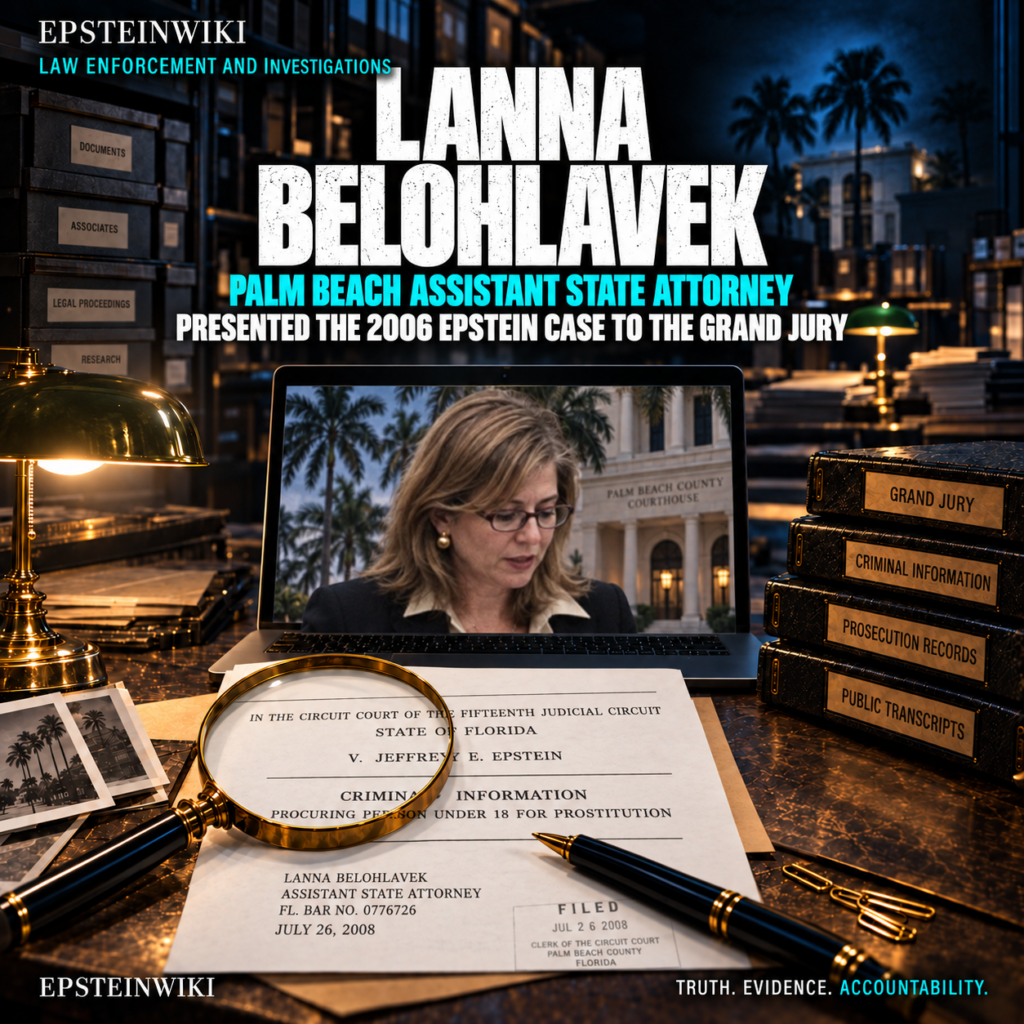
Snapshot
Full name: Lanna Leigh Belohlavek
Professional role: Florida prosecutor
Role in the Epstein case: Assistant State Attorney in Florida’s Fifteenth Judicial Circuit, chief of its Crimes Against Children Unit, line prosecutor in the 2005 to 2008 Palm Beach case, and one of the prosecutors who presented evidence to the 2006 grand jury
Supervising official: Palm Beach County State Attorney Barry Krischer
Primary EpsteinWiki category: Legal Associates
Secondary category: People
Known criminal charges connected to Epstein: None
Known disciplinary finding connected to Epstein: None identified
Why she matters: Belohlavek was one of the public officials closest to the crucial charging decisions that transformed a police investigation involving numerous underage girls into a single grand jury count of solicitation of prostitution. She later represented the state when Epstein entered his 2008 guilty plea.
The surviving record places Lanna Belohlavek at several decisive points in the first Jeffrey Epstein prosecution. She assessed the Palm Beach Police Department’s evidence, disagreed with detectives about which offenses could ethically be charged, offered an early state plea, participated in meetings where the defense attacked the credibility of teenage witnesses, examined witnesses before the grand jury, and spoke for the state at Epstein’s plea and sentencing.
The record also demands precision. Belohlavek did not control the State Attorney’s Office. Barry Krischer did. She did not negotiate the later federal non prosecution agreement. Federal prosecutors in the Southern District of Florida did. No public finding establishes that she accepted money, gifts, or favors from Epstein or his representatives. A Florida Department of Law Enforcement review found no evidence that she or Krischer committed a crime or acted improperly in their handling of the case.
Those limits do not make her conduct unimportant. The grand jury transcript shows prosecutors asking teenage witnesses whether they understood that they had committed prostitution, while exploring their drinking, drug use, shoplifting, social media pages, and sexual presentation. That record has become central to questions about how the justice system treated girls whom police regarded as victims of an organized sexual exploitation scheme.
Content Note
This article discusses child sexual abuse, commercial sexual exploitation, victim blaming, and prosecutorial treatment of minors. It does not identify survivors who have not chosen to identify themselves publicly.
Who Is Lanna Belohlavek?
Lanna Leigh Belohlavek is a Florida lawyer and career prosecutor. Public professional profiles state that she earned a bachelor’s degree from Florida State University in 1985, received her law degree from Loyola University in 1988, and was admitted to the Florida Bar that year. Her stated practice area is criminal law.
During the original Palm Beach investigation of Jeffrey Epstein, Belohlavek served as an Assistant State Attorney in Florida’s Fifteenth Judicial Circuit. She headed the office’s Crimes Against Children Unit and worked as a line prosecutor on the Epstein matter under elected State Attorney Barry Krischer.
That position gave her substantial influence over the evaluation and presentation of the case. It did not give her final institutional authority. Krischer ran the office and possessed the ultimate charging authority. Any fair assessment must therefore examine Belohlavek’s documented decisions without treating her as the sole author of the state prosecution.
The Florida Bar currently lists Lanna Leigh Belohlavek as a member in good standing and eligible to practice law. A public professional profile identifies her as an Assistant State Attorney in Florida’s Twentieth Judicial Circuit. Neither fact answers the historical questions raised by the Epstein case, but both help distinguish professional status from public accountability for a past prosecution.
The Palm Beach Police Investigation
Palm Beach police opened their investigation in 2005 after the family of a 14 year old girl reported that she had been paid to massage Epstein at his Palm Beach residence. Detectives soon identified a recurring recruitment system. Girls were paid for massages, sexual conduct was introduced during some appointments, and girls could receive additional money for recruiting other girls.
Detective Joseph Recarey became the lead investigator. Police Chief Michael Reiter supported the investigation. Police identified numerous girls and young women, including minors. The evidence described a system in which money, recruitment, and access to a wealthy adult were used to draw young people into Epstein’s home.
Belohlavek later told the United States Department of Justice’s Office of Professional Responsibility that her office took the matter seriously because “it was an organized scheme to involve young girls by offering them money.” She said she would not describe the girls as prostitutes, but believed there had been solicitation. She also described Epstein’s behavior as reprehensible.
Those statements matter because they show that Belohlavek recognized the organized character of the conduct. The central disagreement was not whether Epstein’s behavior was disturbing. It was which Florida charges the available evidence could lawfully and ethically support.
The Charging Dispute
According to the Justice Department’s later review, Belohlavek and another experienced assistant state attorney disagreed with Palm Beach police over the appropriate charges. She said the prosecutors and police were “at a disagreement” about what the state could ethically file.
Belohlavek did not believe the evidence supported a charge of unlawful sexual activity with a minor under Florida Statute section 794.05(1). She also did not believe it supported lewd or lascivious molestation under section 800.04(5). The police disagreed and were unhappy with the office’s assessment.
The prosecutors cited evidentiary problems. Some witnesses gave inconsistent accounts. The original complainant recanted an allegation of sexual contact. Defense lawyers assembled material attacking the girls’ credibility, including information about social media, prior conduct, and alleged inconsistencies.
Credibility problems are relevant to prosecutors. They have an ethical duty not to file charges unsupported by probable cause, and they must consider whether admissible evidence can prove a case beyond a reasonable doubt. At the same time, inconsistency, trauma, fear, shame, and delayed disclosure are common in sexual abuse cases. A credibility analysis can become distorted when the system examines the behavior of exploited children more aggressively than the conduct of the adult who paid and recruited them.
The later grand jury transcript makes that tension visible. It does not merely record a private charging assessment. It shows how the state presented teenage witnesses to citizens deciding whether Epstein should face serious charges.
Belohlavek’s Initial Plea Offer
Before the grand jury presentation, Belohlavek offered Epstein a state resolution involving a third degree felony. According to her later account, the proposal included an adjudication withheld, five years of probation, and a prohibition on unsupervised contact with minors. Epstein rejected it.
This early offer is significant for two reasons. First, it confirms that the State Attorney’s Office contemplated resolving the investigation without a trial even before the grand jury returned an indictment. Second, the offer would have avoided a formal felony adjudication if accepted, despite the office’s understanding that Epstein operated an organized system involving young girls.
The available record does not show that Belohlavek possessed all of the information later developed by federal investigators. A December 2007 letter from federal prosecutor Marie Villafana suggested that Epstein’s defense did not want the federal office to tell the state prosecutor about facts supporting an additional charge or about victims’ contacts with Belohlavek. Villafana wrote that Belohlavek’s opinion might change if she knew the full scope of the conduct.
That letter does not erase the choices made in 2006. It does show why the scope of Belohlavek’s knowledge at each stage must be separated from the larger body of evidence now publicly associated with Epstein.
Defense Pressure and the Credibility Campaign
Epstein assembled a powerful defense team. His attorneys submitted extensive material to the State Attorney’s Office and pressed prosecutors to view the teenage witnesses as unreliable. The defense focused on inconsistent statements, social media posts, substance use, prior arrests, sexualized photographs, and other material intended to weaken the girls’ credibility.
Receiving defense submissions is not itself misconduct. Prosecutors are expected to evaluate exculpatory information and arguments against filing charges. The harder question is how much of that defense framing entered the prosecution’s own presentation.
Detective Recarey testified in a 2010 deposition that the State Attorney’s Office initially appeared enthusiastic about the case but changed direction after a meeting involving defense lawyer Alan Dershowitz and State Attorney Barry Krischer. Recarey believed Belohlavek also attended. He recalled discussion of MySpace material and attacks on witness credibility.
This account is sworn testimony from the lead detective. It is not an adjudicated finding about the participants’ motives, and it does not prove that the meeting caused the charging outcome. It is nevertheless important because the grand jury transcript later showed prosecutors pursuing several of the same credibility themes before the grand jurors.
Why the Case Went to a Grand Jury
Krischer’s office presented the case to a Palm Beach County grand jury in July 2006. In Florida, a prosecutor can file many felony charges by information without asking a grand jury to indict. The decision to use a grand jury placed the evidence before citizens meeting in secret, but the prosecution still controlled which witnesses appeared, what questions were asked, and how the evidence was organized.
The grand jury met on July 19, 2006. The proceeding lasted less than four hours. Witnesses included Detective Recarey, two teenage girls, another police officer, and an investigator from the State Attorney’s Office. Belohlavek and a second prosecutor conducted the examinations. Across the released record, Belohlavek appears repeatedly and was one of the principal voices through which jurors encountered the case.
The grand jury returned only one count of solicitation of prostitution. The count did not identify a minor as the person solicited. That result fell far short of the felony charges Palm Beach police had urged.
What the Grand Jury Heard
The 2006 transcript remained sealed for nearly 18 years. Florida enacted legislation permitting release, and a judge unsealed the record in 2024. Its publication allowed the public to see not only what witnesses said, but how prosecutors framed the girls and their conduct.
The record shows evidence of Epstein’s recruitment system. It also shows prosecutors repeatedly asking teenage witnesses about behavior that could damage their credibility or imply that they shared criminal responsibility.
One girl described beginning massages for Epstein at 14. By the time she testified, she was 15. The questioning explored alcohol, drugs, body piercings, shoplifting, statements about her age, and her MySpace page. Belohlavek asked whether the girl was aware that she had committed a crime. The girl said she understood that now but did not know it at the time, referring to “prostitution or something.”
This was not a stray question from a defense lawyer at trial. It came from a state prosecutor presenting the government’s case in a secret grand jury room. The girl was a potential victim and witness. The framing invited jurors to consider her as a possible offender.
The transcript also shows Belohlavek questioning Detective Recarey about the amount of money one victim received and what she did with it. When Recarey said the subject was personal, Belohlavek noted that the girl had described sexual acts. The exchange placed the girl’s spending and credibility beside evidence about Epstein’s conduct.
A second girl testified that she began visiting Epstein at 16. Prosecutors asked whether she understood that she had been committing prostitution. The proceeding therefore applied a prostitution frame to more than one underage witness.
The State Attorney’s Office investigator then walked the grand jury through background material concerning witnesses. The subjects included arrests, shoplifting, drinking, drugs, MySpace, and sexually suggestive images. Much of that material originated with Epstein’s defense.
The transcript does not prove the prosecutors intended to sabotage their case. Motive cannot be read directly from questions alone. It does establish that the state presented credibility attacks and potential criminality by the girls alongside the evidence against Epstein. Critics, including victims’ attorney Spencer Kuvin, have described that presentation as atrocious and argued that the prosecution undermined its own witnesses.
A Survivor Centered Reading of the Transcript
The girls’ conduct should not be allowed to obscure the power structure. Epstein was a wealthy adult. He controlled the house, the payments, and the escalation from massage to sexual conduct. The recruitment payments expanded his access to additional girls. Some participants may have recruited others, accepted money, concealed facts, or engaged in risky behavior. Those facts do not eliminate their vulnerability or convert adult exploitation into equal dealing.
The criminal justice system of 2006 did not always use today’s language of child commercial sexual exploitation. Florida prosecutors could view minors involved in paid sexual conduct as offenders as well as possible victims. Historical law explains part of the questioning. It does not require the public to treat that approach as sound or humane.
A survivor centered analysis asks several questions at once. What evidence could be proved? How did trauma affect disclosure? Why did prosecutors adopt defense generated credibility themes? What message did the questioning send to teenagers deciding whether to cooperate? And why was the adult organizer’s conduct reduced to a generic prostitution count?
The transcript matters because institutional choices become concrete when the questions are visible. The issue is not simply that the prosecution lost an argument. It is that prosecutors chose how the state would describe the girls to the grand jury.
The Charge Belohlavek Said She Never Considered
Belohlavek later said that she did not consider charging procurement of a minor for prostitution because Palm Beach police had not presented that offense to her. That statement is striking because Epstein ultimately pleaded guilty to procuring a person under 18 for prostitution, along with solicitation of prostitution.
The distinction does not automatically establish fault. Prosecutors ordinarily evaluate evidence and statutes rather than wait for police to select charges. Police recommendations can still shape the review, especially where the office believes other offenses are difficult to prove.
The unanswered question is why a prosecutor who recognized an organized payment and recruitment scheme involving young girls did not independently identify procurement as a possible charge during the initial state investigation. The fact that the offense later became part of the final plea makes that omission central to the history of the case.
Palm Beach Police Sought Federal Intervention
Police Chief Michael Reiter believed the state response was inadequate. After the grand jury returned its single count, he asked federal authorities to investigate. The Federal Bureau of Investigation and federal prosecutors then developed a broader case involving additional victims and potential federal offenses.
The referral widened the factual record. It also created an unusual divide between local police and the local prosecutor’s office. Police believed the conduct warranted a stronger case. State prosecutors defended their assessment of evidentiary weakness. Federal investigators later gathered information that some federal officials believed had not been fully shared with Belohlavek.
This sequence helps explain why responsibility cannot be assigned through a single decision. The state evaluation, grand jury presentation, federal investigation, secret federal agreement, and final state plea were separate stages involving different officials. Belohlavek was directly involved in the state stages, but she was not the author of every later action.
The Federal Non Prosecution Agreement Was Not Belohlavek’s Deal
Federal prosecutors in the Southern District of Florida negotiated a secret non prosecution agreement with Epstein’s lawyers in 2007. United States Attorney Alexander Acosta led the office. Assistant United States Attorney Marie Villafana worked on the case. The agreement ended the threatened federal prosecution in exchange for Epstein’s state guilty plea and included protection for named and potential co-conspirators.
Belohlavek did not negotiate or sign that federal agreement. Describing it as her deal would be inaccurate.
Her role remained important because the federal resolution depended on a state plea, and she appeared for Florida when that plea occurred. The state courtroom became the place where the broader federal compromise was implemented.
The Justice Department’s Office of Professional Responsibility later concluded that Acosta exercised poor judgment in resolving the federal investigation through the agreement and in failing to ensure that victims were notified. It did not find professional misconduct under the standards it applied. The review focused on federal prosecutors. It was not a disciplinary investigation of Belohlavek.
The June 2008 Plea and Sentencing
On June 30, 2008, Epstein pleaded guilty in Palm Beach County to solicitation of prostitution and procurement of a person under 18 for prostitution. Judge Deborah Dale Pucillo accepted the plea. Epstein received an 18 month county jail sentence followed by community control and probation. He ultimately served about 13 months and obtained unusually permissive work release privileges.
Belohlavek appeared for the state and spoke extensively during the hearing. When the judge asked about victim agreement, Belohlavek said she had spoken with several victims and believed they agreed with the resolution.
That assertion later became difficult to verify. The Office of Professional Responsibility could not determine which victims she had contacted, and Belohlavek did not recall the details years later. The available record therefore supports only a limited conclusion: she represented to the judge that she had spoken with several victims and believed they agreed. It does not establish that every known victim was consulted, informed, or supportive.
The judge also asked whether Epstein’s residence was a place where children congregated, a question relevant to restrictions. Belohlavek replied that she personally did not know. The judge then asked whether that issue had been investigated. The exchange underscores the narrow information placed before the court at a hearing meant to finalize a case involving the recruitment of minors to Epstein’s home.
A contemporary Palm Beach Post report quoted Belohlavek explaining that the additional procurement charge exposed Epstein to probation through 15 years in prison, while the sentencing guidelines recommended about 21 months. Her statement described the formal sentencing range. It did not anticipate the extraordinary work release treatment Epstein later received from the Palm Beach County Sheriff’s Office.
Victim Notification and an Unsettled Record
Victim notification was one of the most consequential failures in the federal resolution. Belohlavek’s role in state notification is less clear.
In her Office of Professional Responsibility interview, she questioned whether the girls were technically victims entitled to notification because the filed charges involved prostitution. That reasoning is disturbing when applied to minors recruited into paid sexual activity by an adult. It also reflects the legal framing that shaped the case from its earliest state stage.
The federal review included an important limitation. Investigators could not determine exactly which victims Belohlavek contacted, and her comments may have referred only to victims of the specific crimes formally charged. The report therefore does not establish that she personally made every notification decision or intentionally excluded every victim.
Marie Villafana’s December 2007 letter adds another complication. She told Epstein lawyer Jay Lefkowitz that the defense did not want federal prosecutors to inform the state office about facts supporting an additional charge or about victim contacts with Belohlavek. Villafana wrote that Belohlavek’s view might change if she understood the full scope.
The letter is evidence of what a federal prosecutor believed and communicated during negotiations. It is not a neutral judicial finding. It nevertheless raises a serious question: was the state prosecutor asked to implement a resolution while the defense was attempting to limit what she knew?
Fact Check: “There Are No Real Victims Here”
One of the most damaging statements attributed to Belohlavek is the phrase “there are no real victims here.” The public evidence does not justify presenting that quotation as her established words.
The phrase appears in a 2011 New York sex offender registration hearing. Epstein’s lawyer told the court that Detective Recarey had testified that Belohlavek made the statement. This is double hearsay: a defense lawyer characterizing a detective’s account of what a prosecutor allegedly said.
The exact phrase does not appear in Recarey’s released deposition. Searches of the Epstein files locate repeated copies of the 2011 hearing transcript, not an independent recording, email, memorandum, or sworn statement by Belohlavek containing those words.
The accurate formulation is therefore narrow. An Epstein defense lawyer attributed the statement to Belohlavek through Recarey during a later hearing. The available primary record does not confirm that she said it.
This correction does not soften the documented grand jury questions. It strengthens the article by separating a provable record from an inflammatory but unverified attribution.
The 2019 to 2021 Florida Review
Florida Governor Ron DeSantis directed the Florida Department of Law Enforcement to review the handling of Epstein’s incarceration and work release. The inquiry also examined allegations surrounding the earlier prosecution.
In May 2021, authorities announced that the review found no evidence that Barry Krischer or Lanna Belohlavek committed crimes, accepted bribes or gifts, or did anything improper in handling the case. Investigators identified differential treatment of Epstein while he was in custody but did not find evidence supporting criminal charges against officials.
That conclusion must be included prominently. There is no responsible basis to claim that Belohlavek was bribed, corrupted, or criminally involved with Epstein.
The review does not settle every question of judgment, institutional failure, or treatment of survivors. A finding that evidence does not establish criminal wrongdoing is different from a conclusion that the charging strategy and grand jury presentation were optimal, fair, or survivor centered.
The 2024 Grand Jury Release
For years, public debate relied on partial accounts from police, prosecutors, lawyers, and journalists. The 2024 release of the grand jury transcript materially changed the evidentiary record.
The transcript confirmed that the grand jury heard about an organized recruitment system. It also confirmed that prosecutors questioned underage witnesses about whether they had committed prostitution and presented extensive credibility material. These were no longer secondhand claims about what happened in the room.
News organizations and victims’ attorneys focused on the contrast between the evidence of exploitation and the state’s posture toward the girls. Julie K. Brown, whose Perversion of Justice reporting renewed national scrutiny of Epstein’s plea deal, highlighted Belohlavek’s question telling a teenage witness that she had committed a crime.
The release did not establish secret motives. It did something more useful: it gave the public the words, sequence, and institutional setting needed to evaluate the presentation for itself.
Priority Sleuth Reporting
R. Howard Stone’s Epstein Data profile of Lanna Belohlavek is the primary sleuth reference for this article. It connects Belohlavek’s role to specific pages in the EFTA release, distinguishes firsthand evidence from repeated claims, and carefully traces the origin of the “no real victims” quotation. That source work is especially valuable because Belohlavek’s name appears across hundreds of pages, sometimes with misspellings and sometimes in duplicate productions.
Julie K. Brown’s reporting provides essential public interest context. Her work exposed how Epstein received an unusually favorable resolution and how survivors were kept outside critical decisions. Her response to the released grand jury record emphasized the prosecution’s treatment of the teenage witnesses.
Sleuth work is most valuable when it points readers back to evidence. This article therefore links the principal EFTA records directly and states what each document can and cannot prove.
Direct Evidence Guide
| Evidence | What it establishes | Important limit |
|---|---|---|
| EFTA02830776 | The Justice Department review records Belohlavek’s account of the charging disagreement, organized scheme, plea discussions, victim contact, and notification issues | The review focused on federal prosecutors and does not independently resolve every dispute about the state case |
| EFTA02737038 | The released 2006 Palm Beach grand jury record shows the witnesses, questions, credibility material, and prosecution framing | A transcript establishes what was said, not every speaker’s private motive |
| EFTA00027591 | The June 30, 2008 plea and sentencing transcript records Belohlavek’s appearance, her victim agreement representation, and the court’s questions | It does not identify every victim she contacted or establish that all victims agreed |
| EFTA00298293 | Detective Recarey’s 2010 sworn deposition describes the state office’s change in posture and his recollection of defense meetings | It is one witness’s recollection, not a judicial finding about motive or causation |
| EFTA01659864 | Marie Villafana’s December 2007 letter says the defense resisted sharing certain facts and contacts with Belohlavek | It records a federal prosecutor’s position during adversarial negotiations |
| EFTA01659328 | A 2011 hearing transcript contains a defense lawyer’s attribution of “there are no real victims here” | It is not direct evidence that Belohlavek used those words |
| EFTA01689527 | A contemporaneous report records Belohlavek’s description of the sentencing exposure | It does not establish her role in later work release decisions |
| EFTA01247983 | A defense submission describes material provided to the State Attorney’s Office and its purpose | A defense characterization is advocacy, not an independent fact finding |
Timeline
| Date | Event |
|---|---|
| 2005 | Palm Beach police begin investigating Epstein after a report involving a 14 year old girl |
| 2005 to 2006 | Belohlavek evaluates the case as a prosecutor and disagrees with police about available charges |
| Before July 2006 | She offers an early third degree felony resolution with probation and no unsupervised contact with minors; Epstein rejects it |
| July 19, 2006 | Belohlavek and another prosecutor present witnesses to the Palm Beach County grand jury |
| July 2006 | Grand jury returns one count of solicitation of prostitution |
| 2006 | Police Chief Michael Reiter asks federal authorities to investigate |
| 2007 | Federal prosecutors negotiate a non prosecution agreement with Epstein’s defense |
| December 11, 2007 | Villafana writes that the defense resisted sharing certain facts and contacts with the state prosecutor |
| June 30, 2008 | Epstein pleads guilty to solicitation and procurement of a person under 18 for prostitution; Belohlavek appears for the state |
| 2010 | Detective Recarey gives sworn deposition testimony about the state prosecution and defense meetings |
| 2011 | Epstein’s lawyer attributes the “no real victims” phrase to Belohlavek through Recarey at a New York hearing |
| 2019 | Florida orders a review of Epstein’s custody and official handling |
| 2020 | The Justice Department releases its review of the federal non prosecution agreement |
| May 2021 | Florida authorities report no evidence that Belohlavek or Krischer committed crimes, took bribes or gifts, or acted improperly |
| July 2024 | Florida releases the 2006 grand jury transcript |
| 2026 | Survivors and advocates renew demands for testimony from officials involved in the original Palm Beach case |
What the Evidence Establishes
The public record establishes that Belohlavek was a senior line prosecutor with direct responsibility for the Epstein state case. She evaluated evidence, disagreed with police about charges, made an early plea offer, participated in the grand jury presentation, and represented the state at the final plea hearing.
It establishes that she recognized an organized scheme involving money and young girls. It also establishes that she believed available evidence did not support some of the serious sexual offense charges urged by police.
The grand jury transcript establishes that she asked a teenage witness whether the girl knew she had committed a crime and that the prosecution framed underage participation as prostitution. It shows a substantial focus on witness credibility, personal conduct, and defense supplied information.
The plea transcript establishes that Belohlavek told the judge she had spoken with several victims and believed they agreed with the resolution. The later review could not determine exactly which victims she meant.
The record establishes that federal prosecutor Marie Villafana believed Belohlavek may not have known the full scope of the federal evidence and that her opinion might change if she did.
What the Evidence Does Not Establish
No public evidence establishes that Belohlavek was part of Epstein’s social circle or had a personal relationship with him.
No public evidence establishes that she accepted a bribe, gift, favor, or other improper benefit. The Florida review specifically reported finding no such evidence.
No public evidence establishes that she alone decided to use a grand jury or alone controlled the charges. Barry Krischer was the elected State Attorney with final authority.
No public evidence establishes that she negotiated the federal non prosecution agreement. That agreement belonged to the Southern District of Florida and Epstein’s federal defense team.
No reliable primary record confirms that she said, “there are no real victims here.” The phrase survives as a later defense lawyer’s double hearsay attribution.
No transcript can establish with certainty why she asked each question before the grand jury. The questions themselves are documented. Her private intent is not.
No identified criminal charge or professional disciplinary finding arose from her role in the Epstein prosecution.
Accountability Assessment
Belohlavek’s record sits between two inadequate extremes. One extreme treats her as a corrupt Epstein associate without evidence. The other treats the absence of criminal wrongdoing as the end of all legitimate inquiry.
The more accurate assessment is institutional and evidence based. Belohlavek was a public prosecutor with meaningful responsibility. Her office had evidence of an organized payment and recruitment scheme involving minors. Yet the grand jury presentation placed teenage witnesses under scrutiny for prostitution, drinking, drugs, shoplifting, sexualized images, and social media behavior. The grand jury returned a single generic solicitation count.
Belohlavek may have faced real evidentiary problems. She may also have lacked information later gathered federally. Those facts deserve weight. They do not answer why prosecutors adopted so much of the defense’s credibility framing, why procurement of a minor was not initially considered, why victim consultation remains uncertain, or why a Crimes Against Children prosecutor presented minors in a way that could invite jurors to see them as offenders.
Accountability does not require inventing bribery or repeating an unverified quotation. It requires public officials to explain documented choices. A complete sworn account from Belohlavek could clarify what she knew, who directed the strategy, why particular witnesses and questions were selected, how defense material was vetted, and how the state understood the girls’ legal status.
Questions That Remain
- Who made the final decision to present the case to a grand jury instead of filing stronger charges by information?
- What written charging memoranda did Belohlavek prepare, and have all of them been released?
- Which statutes did she analyze beyond the two offenses she later said were unsupported?
- Why was procurement of a minor for prostitution not considered during the original charging review?
- Did Belohlavek independently review every police report and recorded witness interview?
- What evidence did Palm Beach police possess that the State Attorney’s Office never received?
- What evidence did federal investigators later develop that could have changed her assessment?
- Who authorized the initial plea offer with adjudication withheld?
- What factual and legal analysis supported that offer?
- Which defense lawyers met or communicated directly with Belohlavek?
- Was Belohlavek present at the meeting Detective Recarey associated with the office’s change in posture?
- What was discussed during that meeting?
- Who selected the two teenage witnesses who appeared before the grand jury?
- Why was at least one additional victim unable to appear on short notice?
- Who drafted or approved the questions asking minors whether they had committed prostitution?
- What purpose did prosecutors believe those questions served?
- Why did the state present extensive material about MySpace, drinking, drugs, shoplifting, and sexualized photographs?
- How much of that material came directly from Epstein’s defense?
- What steps did prosecutors take to verify defense supplied credibility claims?
- Did anyone in the office object to the way the girls were questioned?
- What instructions did the grand jurors receive about minors, prostitution, consent, and exploitation?
- Did prosecutors explain the recruitment payments as evidence of grooming or organized exploitation?
- Why did the indictment omit the age of the person Epstein solicited?
- Which victims did Belohlavek contact before the 2008 plea hearing?
- What exactly did those victims understand and agree to?
- Were any victims opposed to the plea, and was the court told?
- Why could the later federal review not reconstruct those contacts?
- What did Belohlavek know about the federal non prosecution agreement before she appeared in state court?
- Did she know that the agreement protected potential co-conspirators?
- Did federal officials withhold facts from her at the defense’s request?
- What did she understand about victim notification obligations at the time?
- Why did she question whether girls connected to prostitution charges were legally victims?
- Did she investigate whether Epstein’s residence was a place where children congregated before sentencing?
- What role, if any, did she play in discussions about jail placement or work release?
- Has she ever given a complete public or sworn account addressing the released grand jury transcript?
- Will legislative investigators seek testimony from her, Krischer, and other officials involved in the state case?
- Are additional state prosecution files still sealed, withheld, or missing from the public record?
Sources
Primary Records
- EFTA02830776, United States Department of Justice Office of Professional Responsibility materials
- EFTA02737038, 2006 Palm Beach County grand jury record
- EFTA00027591, June 30, 2008 plea and sentencing transcript
- EFTA00298293, Detective Joseph Recarey deposition
- EFTA01659864, Marie Villafana letter to Jay Lefkowitz
- EFTA01659328, 2011 New York sex offender registration hearing
- EFTA01689527, contemporaneous Palm Beach Post material
- United States Department of Justice Office of Professional Responsibility report
- DocumentCloud copy of the released Epstein grand jury transcripts
Sleuth and Investigative Sources
- R. Howard Stone, Epstein Data profile of Lanna Belohlavek
- Julie K. Brown on the released grand jury testimony
- Julie K. Brown, Perversion of Justice, Miami Herald investigative series
Reporting and Professional Records
- ABC News, newly released grand jury documents reveal the handling of the Epstein case
- CBS12, grand jury transcripts reveal criticism of the prosecution
- CBS12, FDLE clears prosecutors of criminal wrongdoing
- WPBF, renewed calls for testimony from officials involved in the case
- Florida Bar profile for Lanna Leigh Belohlavek
- Martindale profile for Lanna Leigh Belohlavek