
Joseph Recarey: The Detective Who Built the First Major Case Against Jeffrey Epstein
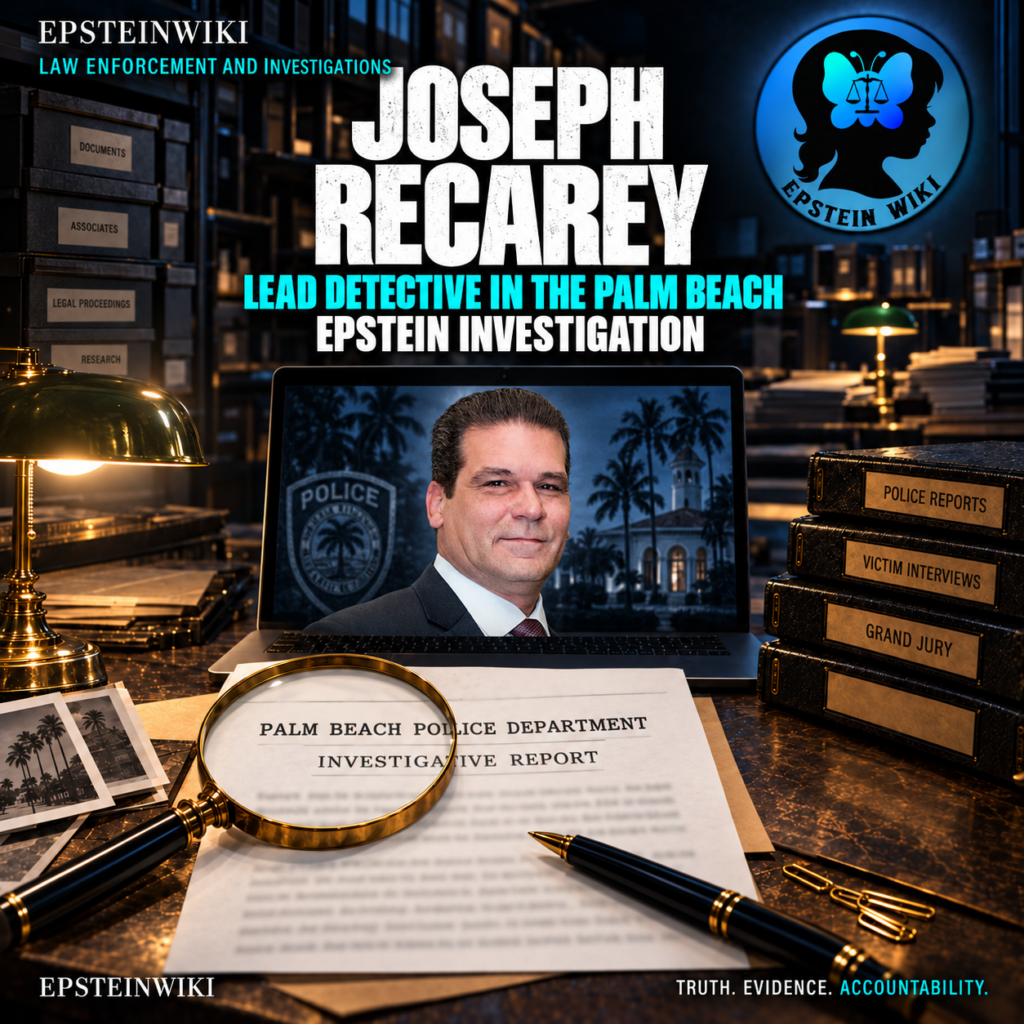
Joseph “Joe” Recarey was the Palm Beach police detective who turned one family’s 2005 complaint into the first major criminal investigation of Jeffrey Epstein. After inheriting the case from Officer Michele Pagan, Recarey interviewed survivors, witnesses, employees, and massage providers; organized surveillance and trash collections; helped execute the search of Epstein’s Palm Beach mansion; prepared probable cause affidavits; testified before a state grand jury; and helped refer the case to the FBI when local prosecutors pursued a charge that police believed did not reflect the evidence.
Recarey did not control the charging decisions that followed. His importance lies in the evidentiary record he assembled and preserved. That record documented a recruitment system involving teenage girls, cash payments, referrals, assistants, message pads, school schedules, household employees, surveillance evidence, and repeated sexualized massages. It later became a foundation for federal investigation, survivor litigation, public reporting, and renewed scrutiny of Epstein’s 2007 non prosecution agreement.
Snapshot
| Field | Information |
|---|---|
| Full name | Joseph Recarey |
| Common name | Joe Recarey |
| Born | June 5, 1967, in New York City |
| Died | May 25, 2018, in Palm Beach County, Florida, age 50 |
| Police agency | Palm Beach Police Department |
| Joined department | 1991 |
| Promoted to detective | 1994 |
| Epstein case role | Lead Palm Beach police detective |
| Assigned to case | September 2005 |
| Principal investigation period | 2005 through 2006, with later testimony and civil discovery |
| Primary property searched | 358 El Brillo Way, Palm Beach |
| Major sworn appearances | 2006 Florida grand jury, 2010 survivor civil cases, and 2016 Giuffre v. Maxwell deposition |
| Police recommendation | Multiple felony sex crime charges based on conduct involving minors |
| State grand jury result | One count of felony solicitation of prostitution against Epstein |
| Later recognition | Palm Beach Police Foundation Officer of the Year in 2012 |
Background and Police Career
Recarey was born in New York City and moved to Florida in 1980. Before becoming a police officer, he worked for the Palm Beach County State Attorney’s Office as a process server for approximately five years. He attended the police academy in 1990 and joined the Palm Beach Police Department in 1991.
He worked as a patrol officer for approximately three years and became a detective in 1994. His later assignments included the detective bureau, the Organized Crime, Vice, and Narcotics Unit, special investigations, internet crimes against children work, and the Palm Beach County State Attorney’s Public Integrity Unit. A defense filing in United States v. Maxwell, drawing on his employment history and obituary, stated that he received more than 150 commendations during his career and trained law enforcement officers and members of the public on criminal and narcotics investigations.
Recarey also worked with security camera systems. In later sworn testimony, he acknowledged entering Epstein’s residence in 2002 in connection with security cameras installed after a theft. That earlier visit became an issue when Epstein’s lawyers challenged how police described covert cameras found during the 2005 search. A limited security visit in 2002 was not a sexual abuse investigation, and Recarey said he did not see illegal material during it.
Recarey retired from the department in 2013 after more than two decades of service. He had received the first Officer of the Year award presented by the Palm Beach Police Foundation in 2012.
Investigation and Testimony Timeline
| Date | Event |
|---|---|
| March 14, 2005 | A survivor’s stepmother contacts Palm Beach police, and Officer Michele Pagan opens the investigation. |
| September 2005 | The case is transferred to Recarey, who reviews the existing interviews and becomes lead detective. |
| September and October 2005 | Police conduct interviews, surveillance, telephone research, and trash collections. |
| October 20, 2005 | Police execute a search warrant at Epstein’s Palm Beach residence. |
| November 2005 through early 2006 | Recarey interviews former household employees and additional witnesses while tracing the referral network. |
| May 1, 2006 | Recarey swears probable cause affidavits seeking serious sex crime charges. |
| July 19, 2006 | Recarey testifies before the Palm Beach County grand jury, which returns one felony solicitation count. |
| July 2006 | Palm Beach police refer the matter to the FBI for possible federal prosecution. |
| September 24, 2007 | Federal prosecutors sign the non prosecution agreement with Epstein. Recarey is not a party to the agreement. |
| June 30, 2008 | Epstein pleads guilty to two state offenses and begins serving his county jail sentence. |
| March and April 2010 | Recarey gives extensive depositions in survivor civil litigation. |
| June 21, 2016 | Recarey is deposed in Giuffre v. Maxwell. |
| May 25, 2018 | Recarey dies at age 50 after what his family described as a brief illness. |
| July 1, 2024 | A Florida court releases the 2006 grand jury transcript under a newly amended state law. |
How the Epstein Investigation Began
The investigation began before Recarey became its lead detective.
On March 14, 2005, the Palm Beach Police Department received a call from the stepmother of a fourteen year old girl. School officials had found $300 in the girl’s possession after a fight and learned that the money came from a man in Palm Beach. Officer Michele Pagan opened the case and conducted the initial interviews.
The survivor described being taken to Epstein’s house after being told she could earn $200 by giving a massage. The person arranging the visit told Epstein’s assistant that the girl was eighteen. According to the survivor’s later grand jury testimony, she had been instructed to invent an older identity before entering the house. She was actually fourteen and in ninth grade.
Pagan continued the investigation until she was transferred to patrol. Recarey testified that the file was formally assigned to him around September 19, 2005. He reviewed Pagan’s reports, listened to recorded interviews, and examined the evidence already collected. He then began expanding the inquiry through additional interviews, telephone research, surveillance, trash collections, and witness identification.
This distinction matters. Recarey did not receive the first complaint and should not be credited with opening the case. He became the lead investigator after Pagan developed the initial evidence.
The Recruitment Pattern Recarey Documented
The accounts gathered by police described a referral system rather than isolated massage appointments.
A teenage girl would be offered cash to provide a massage at Epstein’s residence. A friend or recruiter might drive her there. An assistant would record her name and telephone number, take her upstairs, prepare a massage table, and provide oils or lotions. Epstein would then escalate an ordinary massage into sexual conduct. The visitor would receive cash afterward and could earn additional money by bringing other girls.
The police evidence indicated that the referrals spread through overlapping school and social networks. Recarey described a chain in which one girl introduced another, who then introduced several more. He told the 2006 grand jury that all five survivors discussed in that presentation had been in high school when their visits began. He also testified that none had formal massage training. By contrast, licensed adult massage therapists whom police located charged less and described providing ordinary therapeutic massages.
One witness told Recarey that Epstein rejected a twenty three year old prospective massage provider as too old. Recarey testified that “the younger the better” was the phrase reported to him. That evidence, combined with school schedules, high school references in telephone messages, the ages of identified visitors, and Epstein’s repeated requests for referrals, was important to police assessment of knowledge and intent.
The number of people in the record requires careful handling. In a 2016 deposition, Recarey estimated that he had interviewed approximately thirty to thirty three people who had been sought to give or had given massages at Epstein’s home. He said only one or two appeared to have massage experience. That testimony does not establish that every person in the estimate was under eighteen.
Separately, the Miami Herald reported from an unredacted police report that investigators had identified twenty one possible victims by the October 2005 search. By the time police believed they had enough evidence to arrest Epstein, the department had identified approximately thirty five possible underage victims and was trying to locate at least a dozen more. Those figures describe different stages and categories and should not be collapsed into a single total.
Interviews With Survivors and Witnesses
Recarey’s investigation depended heavily on recorded interviews. Survivors described similar entry procedures, payments, escalation during massages, and requests to recruit friends. Some initially minimized what occurred, withheld information in front of parents, or continued communicating with Epstein’s household. Those reactions are not unusual in investigations involving grooming, money, shame, fear, and unequal power.
The police also interviewed household employees. Former house manager Juan Alessi described an increasing flow of young massage providers, his role in household transportation and cleanup, and sexual objects left in massage areas. Former butler Alfredo Rodriguez told Recarey that girls too young to be professional massage therapists regularly entered the residence. Rodriguez preserved notes and message information from the household and described being required to carry cash to pay visitors.
The employees did not provide identical evidence. Their employment periods, duties, and access differed. Their accounts were valuable because they corroborated the setting and routine around the survivors’ reports, not because either man claimed to have witnessed every assault.
Recarey also distinguished between sexualized encounters and legitimate massage work. His grand jury testimony described two trained adult massage therapists. One told police she provided an ordinary deep tissue massage for $100 and left. The comparison helped show that Epstein’s larger payment system involving untrained teenagers was not simply an unconventional version of professional massage therapy.
Surveillance, Trash Collections, and Telephone Evidence
Palm Beach police used physical surveillance to corroborate visits to the mansion. Officers observed young women arriving in their own cars and in vehicles belonging to parents. Recarey told the grand jury that outside surveillance could establish presence at the property but could not establish what happened behind closed doors.
Investigators also arranged lawful collections of trash placed out from Epstein’s residence. The recovered material included notes and messages bearing girls’ names and telephone numbers. Recarey compared the numbers with information from people he had interviewed. The records included messages that referred to school, soccer practice, and availability to visit.
Telephone research added another layer. Police compared calls and messages with Epstein’s travel and presence in Palm Beach. Recarey later testified that the repeated match between the household records and identified visitors corroborated the broader pattern.
This evidence was circumstantial. A name, message, or telephone call does not prove abuse. Its value came from the convergence of multiple sources: survivor accounts, employee statements, observed visits, payment descriptions, school references, household records, and the physical layout of the residence.
The October 2005 Search of 358 El Brillo Way
Police obtained a search warrant and executed it at 358 El Brillo Way on October 20, 2005. Recarey participated with detectives, evidence specialists, a photographer, and a crime scene manager.
The search confirmed many details survivors had supplied about the interior of the house and the route to the upstairs massage area. Investigators collected message pads, computers, storage media, photographs, and other evidence. They documented massage tables and sexual objects in the residence.
Recarey told the 2006 grand jury that police located two covert cameras connected to a computer. He reviewed grainy images that appeared to show girls he had previously interviewed, but he could not make every identification with certainty. He explained that he had avoided showing all images to potential witnesses because information from the investigation appeared to be reaching Epstein’s household.
The evidentiary description must remain precise. Recarey later told the Miami Herald that police found nude photographs of underage girls in Epstein’s closet. His sworn testimony and related filings also described nude photographs that appeared to depict young women or people police had interviewed. Not every person’s identity or age was conclusively established from an image alone.
The search also had limitations. Police found a sexual device in a different bedroom, but Recarey testified that they did not find a device in the principal massage area matching every survivor’s description. Investigators and later reporters stated that hard drives, surveillance equipment, and videos appeared to have been removed before the search, leaving loose wires. The remaining evidence was significant, but the search did not recover every item police believed might once have been present.
The May 2006 Probable Cause Case
On May 1, 2006, Recarey swore probable cause affidavits based on the accumulated investigation. He later testified that police believed there was probable cause to seek Epstein’s arrest for four counts of unlawful sexual activity with a minor and one count of lewd and lascivious molestation.
The affidavits summarized sworn interviews with survivors and witnesses, cash payments, recruitment, massage routines, sexual conduct, employees’ observations, telephone messages, and the physical evidence found at the residence. The police investigation also examined potential criminal exposure for assistants and a recruiter.
Probable cause is not a conviction. It is the legal threshold for arrest or further judicial action. Recarey’s affidavit stated the evidence as police understood it, while Epstein’s lawyers later attacked omissions, characterizations, and inconsistencies in the reports. Some witnesses had given changing or incomplete accounts, and one described an encounter as consensual despite being below Florida’s age of consent. Consent from a minor did not necessarily eliminate possible statutory offenses, but the exact wording and surrounding facts remained important to charging analysis.
The defense criticism should be part of the record without being treated as a neutral finding. Epstein’s attorneys accused Recarey of steering witnesses, exaggerating evidence, omitting exculpatory details, and mishandling the description of the covert cameras. They submitted a lengthy complaint seeking an investigation of him. Those allegations came from the target’s defense team and were contested. No public record reviewed for this article establishes that Recarey was disciplined or found to have fabricated the Epstein case.
Conflict With the Palm Beach State Attorney’s Office
Police Chief Michael Reiter and Recarey believed the evidence supported serious felony charges. EpsteinWiki’s Palm Beach County investigation article covers the larger institutional record. State Attorney Barry Krischer’s office took a different path.
Recarey testified that the proposed procedure changed repeatedly. He was first told the case would go to a grand jury, then that prosecutors wanted a probable cause affidavit, and then that it would return to a grand jury. He and Reiter said prosecutors became difficult to reach, delayed investigative requests, and expressed doubt about the survivors’ credibility.
Epstein’s lawyers presented prosecutors with attacks on the teenagers’ conduct and backgrounds. Recarey rejected the idea that underage drinking, social media photographs, family problems, or other imperfections made someone incapable of being a crime victim. His recorded response captured a central conflict in the case: police focused on Epstein’s conduct, while the defense sought to shift attention toward the credibility and private lives of teenage witnesses.
Reiter eventually wrote to Krischer asking him to remove himself from the case. The disagreement was not a routine personality dispute. It concerned which charges the evidence supported, how the survivors were being treated, and whether a state grand jury would receive the full case developed by police.
Recarey’s 2006 Grand Jury Testimony
Recarey testified before the Palm Beach County grand jury on July 19, 2006. The transcript remained secret until a Florida law change enabled its release in 2024.
The grand jury heard from Recarey twice, two teenage survivors, crime scene investigator Gregory Parkinson, and an investigator from the State Attorney’s Office. The proceeding lasted less than four hours. Police had identified many more potential witnesses, but only two survivors testified.
Recarey explained the initial complaint, the referral chain, the ages of the identified girls, the role of Epstein’s assistants, cash payments, the “younger the better” statement, surveillance, household employees, the search, covert cameras, computer images, and the distinction between untrained teenage visitors and licensed massage therapists.
The questioning of the survivors drew renewed criticism after the transcript became public. Prosecutors asked detailed questions about payments, recruiting, and whether a survivor considered herself a prostitute. The structure risked treating manipulated teenagers as participants responsible for Epstein’s system rather than as children exploited by an adult man in his fifties.
The grand jury returned one count of felony solicitation of prostitution. That result was far narrower than the charges the Palm Beach Police Department sought. It did not declare the remainder of the police evidence false. A grand jury returns charges based on the evidence and instructions prosecutors present to it, and the proceedings did not include the full group of identified survivors and witnesses.
Referral to the FBI and the Federal Case
Reiter and Recarey were dissatisfied with the state result and believed the single charge did not address the totality of Epstein’s conduct. The Palm Beach police referred the matter to the FBI in West Palm Beach.
The DOJ Office of Professional Responsibility executive summary confirms that the police chief and lead detective made the federal referral because of their dissatisfaction with the State Attorney’s handling of the case. The FBI opened its investigation in July 2006 and worked with Assistant United States Attorney A. Marie Villafaña.
Recarey’s files, interviews, recordings, message pads, and seized evidence were transferred to federal investigators, in some instances through grand jury subpoenas. The federal inquiry found additional survivors. By May 2007, Villafaña had prepared a draft sixty count indictment and a prosecution memorandum.
No federal indictment followed. On September 24, 2007, the United States Attorney’s Office signed a non prosecution agreement that ended the federal investigation in exchange for a state resolution. Epstein pleaded guilty on June 30, 2008, to felony solicitation of prostitution and procuring a person under eighteen for prostitution. He received an eighteen month county jail sentence, served less than thirteen months, and was permitted extensive work release.
The agreement protected Epstein, four named potential co conspirators, and any potential co conspirators from federal prosecution in the Southern District of Florida. Survivors were not told about or consulted on the agreement before it was signed.
Recarey did not negotiate or approve that agreement. His role was investigative. The decision to end the federal case belonged to federal prosecutors.
Pressure, Surveillance, and Witness Intimidation Concerns
The police record contains repeated concerns about pressure on survivors and investigators.
One incident report states that Recarey served grand jury subpoenas and investigated an allegation that a person associated with Epstein offered a witness money not to testify. Police records and later reporting also described private investigators following survivors or their families, presenting themselves in ways that caused confusion about whether they were police, and gathering personal material for defense dossiers.
Recarey told the Miami Herald that he believed he was being followed. He changed routes and vehicles and worried about his children. Reiter reported that his household trash disappeared and that investigators hired for Epstein searched for material that could discredit him.
These accounts do not prove that Epstein personally ordered every act described by police or reporters. They do show why investigators became cautious about disclosure, why some witnesses were afraid, and why Recarey limited the information he shared when he believed details were reaching the defense.
Later Depositions and the Maxwell Question
Recarey gave extensive sworn testimony in survivor civil cases on March 19, 2010. He returned for additional examination in April 2010 and was deposed in Giuffre v. Maxwell on June 21, 2016. Those transcripts preserve details omitted from shorter police summaries and also expose areas where lawyers disputed his conclusions.
The Maxwell evidence requires particular care.
In the 2016 deposition, Recarey said he wanted to interview everyone connected to the Palm Beach house, including Ghislaine Maxwell. He said an attorney initially indicated that household figures would be available, but later no one was made available and each had counsel. Recarey testified that his research identified Maxwell as Epstein’s longtime friend and that interviews indicated she was involved in seeking girls to give massages or work at the residence.
That testimony has often been overstated. Some media summaries claimed that Recarey interviewed thirty underage girls who said Maxwell recruited them. The cited transcript does not say that. His estimate of thirty to thirty three concerned people interviewed about massage work. A Maxwell defense filing later cited other portions of his deposition in which he agreed that the underage Palm Beach survivors he investigated had not identified Maxwell as the person who recruited or paid them.
The two propositions can coexist if his information about Maxwell came from adult women, employees, other witnesses, or research rather than from the specific underage survivors in the original Palm Beach group. The available excerpt does not justify claiming that all thirty to thirty three were minors recruited by Maxwell.
Maxwell’s later federal conviction establishes her criminal liability for the conduct proved in her 2021 trial. It does not retroactively make every broad claim in civil briefing or press coverage accurate.
Assessing Recarey’s Evidence
Recarey’s work is strongest when several independent forms of evidence converge.
Strongly Supported Findings
- A fourteen year old survivor’s family initiated the case in March 2005.
- Multiple teenagers described being paid to provide massages that became sexual.
- Epstein’s system paid girls for bringing additional girls.
- Household staff, message pads, telephone records, school references, surveillance, and physical evidence corroborated major parts of the accounts.
- Investigators identified a far larger group than the two survivors who appeared before the state grand jury.
- Police believed the evidence supported multiple felony sex crime charges.
- Reiter and Recarey referred the case to the FBI because they considered the state result inadequate.
Limitations and Contested Areas
- Recarey often summarized what witnesses told him. His testimony is direct evidence of the investigation, but the underlying survivor interview is the better source for a survivor’s exact words.
- Some witnesses changed details, minimized conduct, or gave incomplete accounts.
- Police could not identify every person in surveillance images or photographs with certainty.
- The search did not recover every object described by survivors and employees.
- Epstein’s defense challenged omissions and wording in the probable cause affidavits.
- The approximate thirty to thirty three interview figure is not a count of confirmed minor victims.
- Recarey’s evidence about Maxwell has been compressed into claims broader than his available testimony supports.
Those limitations do not erase the investigation. They define what each piece of evidence can and cannot prove.
Death and Unsupported Conspiracy Claims
Recarey died on May 25, 2018, eleven days before his fifty first birthday. His family’s obituary said he died after a brief illness. He was survived by his wife and children.
His death occurred months before the Miami Herald published its major Perversion of Justice investigation and more than a year before Epstein’s 2019 federal arrest. Because Recarey was a central investigator and died relatively young, unsupported online theories have attempted to connect his death to the Epstein case.
No credible public evidence reviewed for this article supports a claim that Recarey was killed because of the investigation. A responsible account should not convert the absence of a publicly detailed medical diagnosis into evidence of foul play.
Why Joseph Recarey Matters
Recarey matters because his investigation shows both what local police uncovered and where the justice system failed to carry that evidence forward.
The Palm Beach case began with one child and expanded through ordinary investigative work. Police listened to recorded accounts, followed referrals, checked telephone numbers, watched the house, recovered discarded records, interviewed employees, executed a search warrant, and assembled a probable cause case. The pattern they documented later appeared again in federal evidence and survivor testimony.
The same record also demonstrates that uncovering evidence does not guarantee accountability. Prosecutors decide what a grand jury hears, which charges to pursue, how to negotiate, and whether victims are informed. Recarey built an investigative foundation. State and federal officials narrowed, delayed, and ultimately resolved the case without a federal trial.
His work should not be mythologized as flawless, and defense challenges should not be ignored. The historical record is stronger when it recognizes both the corroborated core and the disputed edges. What remains clear is that Recarey and his colleagues identified a system of exploitation years before Epstein’s 2019 arrest, and they sought charges substantially more serious than the outcome Epstein received.
Evidence Appearances
- EFTA02737038: Unsealed July 19, 2006 Palm Beach County grand jury transcript, including Recarey’s testimony, survivor testimony, and crime scene evidence.
- EFTA00298259: Volume I of Recarey’s March 19, 2010 deposition in consolidated survivor civil cases. It covers his background, assignment to the Epstein case, the probable cause process, witnesses, and early investigative steps.
- EFTA00298293: Volume II of the March 19, 2010 deposition. It addresses evidence seized from the residence, the grand jury, witness accounts, messages, defense pressure, and relations with the State Attorney’s Office.
- EFTA02794155: Excerpts from Recarey’s June 21, 2016 Giuffre v. Maxwell deposition, including the approximately thirty to thirty three interview estimate and his testimony about Maxwell.
- EFTA00231917: Production containing the May 1, 2006 Recarey probable cause affidavits and related Florida case records.
- EFTA00180509: Palm Beach police incident reporting that includes Recarey’s trash collection, interview, surveillance, and follow up narratives.
- EFTA01308890: Recarey’s June 2006 report concerning discussions with Assistant State Attorney Lanna Belohlavek about the arrest warrant request and grand jury process.
- EFTA00798522: Archived Miami Herald Perversion of Justice reporting based on police records, depositions, and interviews with Recarey and Reiter.
- EFTA02856805: Epstein defense complaint seeking an investigation of Recarey. It is advocacy by the defense and should not be treated as an adjudicated finding.
- EFTA02830359: Maxwell defense filing summarizing Recarey’s career and arguing that his death prejudiced her defense. Its factual claims and adversarial arguments must be distinguished.
- EFTA00225378: Federal review material describing Recarey’s briefing of FBI and federal personnel about the Palm Beach investigation.
Sources
- Palm Beach County grand jury transcript, July 19, 2006, released by order of the Fifteenth Judicial Circuit on July 1, 2024.
- Joseph Recarey deposition, consolidated Epstein survivor civil cases, March 19, 2010, Volumes I and II.
- Joseph Recarey deposition, Giuffre v. Maxwell, June 21, 2016.
- Palm Beach Police Department incident report and probable cause affidavits, case 05 368.
- United States Department of Justice, Office of Professional Responsibility, Executive Summary of Report on the Southern District of Florida’s Resolution of the Epstein Investigation, November 2020.
- Julie K. Brown, Perversion of Justice, Miami Herald, November 2018.
- ABC News report on the unsealed 2006 grand jury transcript, July 2, 2024.
- Joseph “Joe” Recarey obituary, Palm Beach Post and Legacy.com, May 31, 2018.
- United States v. Maxwell, defense memorandum concerning preindictment delay, February 4, 2021.
- Giuffre v. Maxwell unsealed appellate record and related party submissions.
Questions That Remain
- Which complete Recarey interview recordings and notes remain publicly unavailable?
- What findings, if any, resulted from the defense complaint seeking an investigation of Recarey?
- Which physical evidence collected during the 2005 search was later transferred to the FBI, and what is its present status?
- Why were only two survivors called before the 2006 state grand jury when police had identified many more potential victims and witnesses?
- Which officials decided not to present the felony charges sought in Recarey’s probable cause case?
- What evidence supported or contradicted Recarey’s 2016 statement that Maxwell was involved in seeking girls for massage or household work?
- Which people included in the thirty to thirty three interview estimate were minors, adult massage providers, employees, recruiters, or other witnesses?
- What surveillance media or computer images from the Palm Beach residence still exist, and which identifications were ever confirmed?