
5025 East Dublin Granville Road: Jeffrey Epstein’s Mansion Inside the Wexner Estate
Snapshot
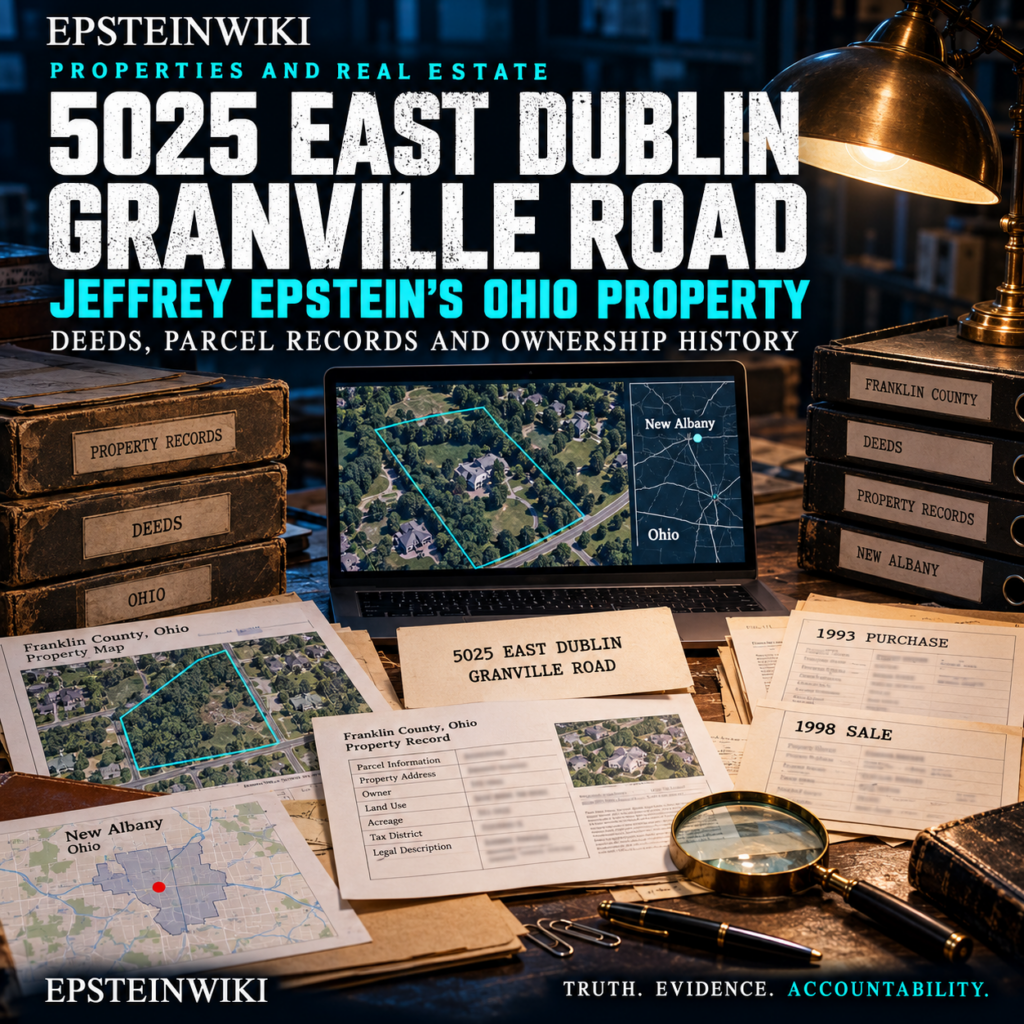
5025 East Dublin Granville Road was Jeffrey Epstein’s large residence in New Albany, Ohio, near Leslie Wexner’s main home. Its significance rests on three overlapping histories: Epstein’s property dealings with Wexner’s business circle, Maria Farmer’s account of sexual assault and confinement in 1996, and later efforts to obtain records about the property.
The phrase “inside the Wexner estate” describes a disputed relationship between the houses, surrounding land, and security arrangements. Epstein’s house was a separate residence. Wexner’s representatives disputed that it stood on Wexner owned land. Ownership, surrounding acreage, and control over access therefore require separate consideration.
The property belongs within the wider New Albany property network. It should not be confused with Epstein’s other documented Ohio home at 7558 King George Drive.
Key Takeaways
- Epstein’s residence and Wexner’s main mansion were different buildings.
- Published accounts place Epstein’s acquisition in either 1992 or 1993. The exact date remains a deed verification issue.
- Reporting identifies substantial financial transactions involving the house before Epstein’s death.
- Maria Farmer alleged that Epstein and Ghislaine Maxwell sexually assaulted her during an Ohio art residency in 1996.
- Farmer also alleged that Wexner’s security personnel prevented her departure. The Wexners disputed knowledge of her and her account of contact with Abigail Wexner.
- A 1996 FBI complaint later became public. It confirms an early warning about Epstein, but does not itself establish every detail of the Ohio allegations.
- Congress expressly sought property management records and images concerning this address in 2025.
- A request for surveillance footage does not establish that footage existed, survived, or recorded a crime.
Property Identity and Reported Features
| Feature | Reported information | Qualification |
|---|---|---|
| Address | 5025 East Dublin Granville Road, New Albany, Ohio | Historical Epstein residence |
| House size | Approximately 10,600 square feet | Figure reported in the 2019 investigation |
| Bedrooms | Four | Reported by Forbes |
| Relationship to Wexner’s home | Approximately half a mile away | Separate houses |
| Acquisition | $3.5 million, reported as 1992 or 1993 | Published chronology differs |
| Sale | $8 million in 1998 | Reported buyer was HHD & B LLC |
| Later ownership | Forbes reported HHD & B LLC still held it in July 2025 | Not a certification of present ownership |
Forbes’ property investigation supplies the bedroom count and transaction figures. The 2019 investigation by Sarah Ellison and Jonathan O’Connell supplies the size and more detailed account of the grounds.
What “Inside the Wexner Estate” Means
The 2019 investigation described the house as surrounded by Wexner land. An unnamed security officer called it “effectively the guesthouse” and said Wexner personnel guarded it.
Wexner spokesman Thomas Davies disputed the estate description. He said the house was not on Wexner owned land and had a separate entrance. Farmer said that entrance was locked and unavailable to her.
The disagreement concerns operational control as well as geography. A separately owned parcel can share surrounding security arrangements without becoming part of another owner’s legal title. Conversely, nearby ownership alone does not establish who controlled an occupant’s movements.
The strongest reconstruction would combine historical parcel boundaries with security contracts, access records, and testimony. A current aerial image cannot establish access rules in 1996.
Acquisition, Sale, and the Financial Questions
Regional reporting identifies the seller to Epstein as JW & CPK & Co., a company associated with Wexner and developer Jack Kessler. The regional report is available here.
Forbes dates the acquisition to 1993. The 2019 property reporting places the transfer four years before Farmer’s 1996 stay, implying 1992. Neither date should be silently treated as settled without the recorded instrument.
Regional coverage in 614NOW, citing Forbes, also reports that the buyer shared a mailing address with the New Albany Company. A common address establishes an administrative connection. It does not, by itself, identify every beneficial owner or prove who supplied the purchase money.
The reported prices imply a nominal increase of $4.5 million, approximately 129 percent of the acquisition price. This calculation is not a measure of net profit. It excludes improvements, borrowing, transaction costs, taxes, and any other consideration.
The financial questions are specific:
- What property and improvements were included in each transaction?
- Were the transactions supported by independent appraisals?
- Who financed the acquisition and the later purchase?
- Did the settlement statements contain credits, debt assumptions, or other adjustments?
- Who owned and controlled the purchasing company at the time?
The price increase warrants documentation. It does not establish a concealed payment, fraud, or an improper valuation.
Maria Farmer’s Ohio Residency
Farmer was an artist who worked for Epstein. In her affidavit, she described an employment relationship that included recording visitors to his New York home. She said Epstein subsequently arranged for her to work on an art project in Ohio during the summer of 1996.
Her account matters because it describes access through employment and promised professional opportunity. The house served as both accommodation and workspace in her narrative.
The affidavit identifies the setting as Wexner’s Ohio mansion without supplying this street address. The connection to 5025 East Dublin Granville Road comes from the property reporting. These are complementary sources, not identical forms of evidence.
The relevant affidavit pages are available through Epstein Data, HOUSE_OVERSIGHT_018027 and HOUSE_OVERSIGHT_018028. The complete affidavit was filed in April 2019.
The Alleged Assault and Confinement
Farmer alleged that Epstein and Maxwell called her into a bedroom and sexually assaulted her. She said she escaped, sought help from the sheriff’s office, and was prevented from leaving by Wexner’s security staff. Her father traveled from Kentucky, and she said she was finally allowed to depart with him after approximately twelve hours.
She also alleged subsequent threats and interference with her art career. These are Farmer’s sworn allegations, rather than findings from a trial deciding the Ohio incident.
Her account presents separate questions:
- What happened inside the bedroom?
- Who received her requests for help?
- Which personnel were present at the property?
- Who gave any instructions concerning her departure?
- What did each person know at the time?
Evidence concerning one question does not automatically resolve the others. In particular, an allegation about security personnel does not by itself establish that Leslie or Abigail Wexner ordered confinement.
Corroboration, Contradictions, and the Wexners’ Response
The 2019 investigation reported that Farmer’s relatives and a friend recalled disclosures she made in 1996. Her father recalled retrieving her. These accounts support the existence of contemporary disclosures, but are not eyewitness accounts of the alleged assault.
The Wexners’ spokesman denied that either spouse knew Farmer or had spoken with her. This directly disputed her claim of telephone contact with Abigail Wexner.
The sheriff’s office reported no record of her call. The investigation also noted that its retention policy did not preserve that category of record beyond two years. An absent record decades later therefore cannot settle whether a call occurred.
In February 2026, Wexner again denied knowing of or participating in Epstein’s abuse. Associated Press coverage records his position. His denial and Farmer’s allegations remain distinct parts of the public record.
The 1996 FBI Complaint
In December 2025, the government released an FBI complaint dated September 3, 1996. Farmer and her lawyers identified it as hers.
The released summary records allegations that Epstein stole photographs and negatives of her younger sisters, may have sold the photographs, requested pictures of young girls at swimming pools, and threatened to burn her house if she disclosed the matter. ABC’s coverage reproduces the recorded allegations.
The document is important evidence that authorities received an early complaint. However, that short summary does not contain the full Ohio assault narrative. It should not be described as a comprehensive FBI finding about the house or the Wexners.
Farmer’s lawyers say her reports covered more conduct than the released intake summary records. Their December 2025 statement connects those assertions to her later lawsuit against the federal government. The statement presents her legal team’s position, not a judicial ruling that the government was liable.
Maxwell’s Account of the Ohio House
In her July 24, 2025 interview with Deputy Attorney General Todd Blanche, Maxwell said Epstein had an Ohio house because of his business relationship with Wexner. She said she helped decorate and prepare it.
Ellie Leonard’s published transcript preserves this exchange at approximately 22 minutes into the substantive interview.
That passage supports Maxwell’s own acknowledgment of involvement with an Ohio residence. It does not give the street address, determine legal ownership, or resolve Farmer’s allegations. It also does not establish that every reference Maxwell made to Ohio concerned this particular house.
Why Congress Requested Records About This Address
The House Oversight Committee’s August 25, 2025 subpoena to Epstein’s estate expressly names 5025 East Dublin Granville Road.
Request 13 sought documents concerning maintenance, property management, and services. Request 14 sought video, including security footage, and still photographs taken at listed properties. Both requests separately listed 7558 King George Drive.
This establishes that Congress treated the two Ohio addresses as distinct records targets. The requests could encompass evidence about staffing, contractors, visitors, and the operation of the homes.
However, the subpoena does not establish that responsive footage existed or that the estate produced a complete collection. It is a demand for evidence, not a finding about what that evidence proves.
The committee subsequently released Wexner’s deposition video following his February 18, 2026 testimony in Ohio.
The Other Ohio House Was a Separate Property
7558 King George Drive has a different transaction history and must be researched under its own address.
That transfer must not be substituted for the sale of 5025 East Dublin Granville Road.
Neither Ohio property remained among the homes sold by Epstein’s estate after his death, according to Forbes. Consequently, later reporting about estate property sales and survivor compensation should not automatically be applied to this address.
Timeline
| Period | Event | Evidence status |
|---|---|---|
| 1992 or 1993 | Epstein acquires the residence | Published acquisition year differs |
| Summer 1996 | Farmer stays in Ohio and later alleges assault and confinement | Her sworn account and property reporting |
| September 1996 | FBI complaint recorded | Released intake summary covers photographs and threats |
| 1998 | Residence sold to HHD & B LLC | Reported property transaction |
| April 2019 | Farmer’s affidavit enters the public court record | Sworn allegations |
| July 2025 | Maxwell discusses an Ohio house in her government interview | Her account, without an address in the cited exchange |
| August 2025 | Congress subpoenas records concerning this address | Official investigative request |
| December 2025 | Farmer’s early FBI complaint becomes public | Confirmation of a recorded warning |
| February 2026 | Wexner gives congressional testimony | Testimony and public denials |
Evidence Files and What They Establish
| Evidence | Relevance | Limit |
|---|---|---|
| HOUSE_OVERSIGHT_018027 | Farmer’s employment and observations in her affidavit | Witness account, not a verdict |
| HOUSE_OVERSIGHT_018028 | Ohio residency and assault allegations | Does not supply a deed or parcel boundary |
| HOUSE_OVERSIGHT_018029 | Affidavit signature and notarization page | Authentication of the sworn statement does not independently prove its allegations |
| DOJ OGR 00010663 | Collection containing Farmer’s written victim impact statement, pages 10 and 11 | Sentencing submission, not an Ohio trial judgment |
| Estate subpoena | Explicit requests about both Ohio addresses | Does not show what was ultimately produced |
The Epstein Data source index for Farmer provides the document cross references. Archive summaries are finding aids. The underlying filings remain the evidence.
What Remains Unresolved
- Exact acquisition date: The recorded deed and filing date would resolve the conflicting published years.
- Historical boundaries: A survey from the relevant period would distinguish Epstein’s parcel from surrounding Wexner land.
- Security authority: Contracts, payroll records, duty rosters, and instructions would clarify who controlled access.
- Financial consideration: Closing records and appraisals would explain the reported change in price.
- Contemporary communications: Surviving telephone records, correspondence, and incident reports could test parts of the competing accounts.
- Investigative follow through: The intake record alone does not reconstruct every action authorities took or failed to take.
- Congressional production: The subpoena does not establish which requested records were preserved and delivered.
- Present title: A 2025 ownership report should not be represented as a current deed search.
The property’s importance lies in the intersection of a documented residence, financial dealings, disputed security arrangements, and a survivor’s early allegations. Those strands require their own evidence and should remain distinguishable throughout any investigation.
Sources
- EpsteinWiki: New Albany Property Network.
- Forbes: The selloff of Jeffrey Epstein’s homes, July 22, 2025.
- Sarah Ellison and Jonathan O’Connell: Investigation of Farmer’s New Albany allegations, October 5, 2019.
- Regional reporting: Epstein’s connection to New Albany’s transformation.
- Maria Farmer: Complete April 2019 affidavit.
- Epstein Data: Farmer affidavit, substantive Ohio page.
- Epstein Data: Victim impact statement collection.
- ABC: December 2025 release and the 1996 FBI complaint.
- Marsh Law Firm: Farmer’s response and legal allegations.
- Ellie Leonard: Maxwell interview transcript, July 24, 2025.
- House Oversight: August 25, 2025 estate subpoena.
- House Oversight: Wexner deposition video release.
- Associated Press: Wexner’s February 2026 testimony and denials.