
Kathleen Hawk Sawyer
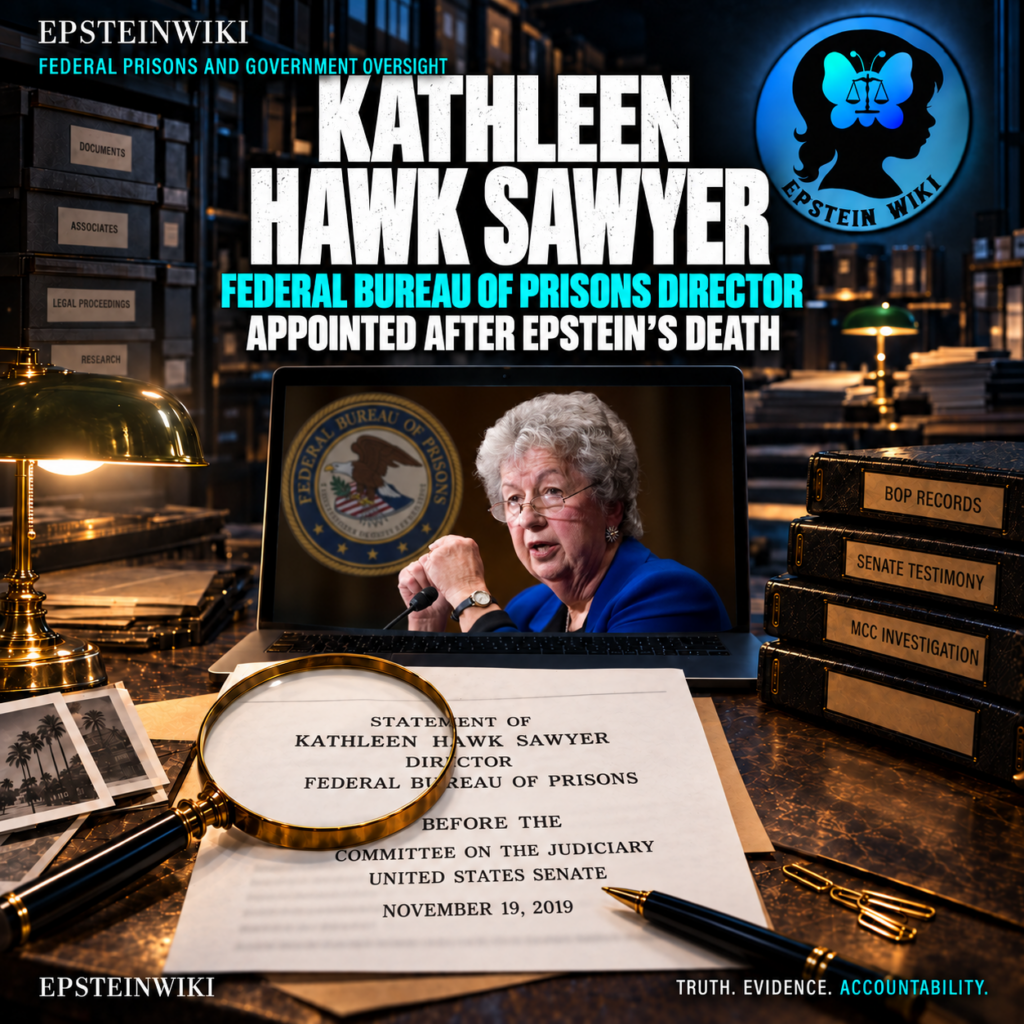
Snapshot
| Field | Detail |
|---|---|
| Full name | Kathleen Hawk Sawyer |
| Profession | Psychologist and federal corrections administrator |
| Principal public office | Director of the Federal Bureau of Prisons |
| First BOP directorship | 1992 to 2003, as the agency’s sixth director |
| Second BOP directorship | August 19, 2019 to February 25, 2020, as the agency’s tenth director |
| Historical distinctions | First woman to direct the BOP and first person to serve two separate terms as director |
| Appointing official in both terms | Attorney General William P. Barr |
| Epstein connection | Barr returned her to BOP leadership nine days after Jeffrey Epstein died in federal custody. She directed the agency during the immediate institutional response and testified to Congress about the failures surrounding his death. |
| Direct personal relationship with Epstein | None established in the reviewed record |
| Role when Epstein died | None. Sawyer was retired and did not become director until August 19, 2019. |
| Evidentiary classification | Post-death government official and accountability witness, not an Epstein associate |
Kathleen Hawk Sawyer belongs in EpsteinWiki because she became the federal official responsible for leading the Bureau of Prisons during the immediate aftermath of Jeffrey Epstein’s death at the Metropolitan Correctional Center in New York. Her relevance is institutional. The public record does not establish that she knew Epstein, communicated with him, supervised his detention before his death, or participated in the conduct that left him alone and unmonitored.
The essential chronology is decisive: Epstein died on August 10, 2019. Attorney General William Barr appointed Sawyer on August 19. She therefore inherited the crisis but did not preside over the events that caused it.
Key Findings
- Sawyer was a veteran BOP official and psychologist who first led the agency from 1992 to 2003.
- Barr appointed her to a second term nine days after Epstein’s death, replacing acting director Hugh Hurwitz in a widely reported agency shakeup.
- The Justice Department’s appointment announcement did not expressly say that Epstein’s death was the reason for the change. Contemporaneous reporting consistently placed the appointment in that context.
- Sawyer testified before the Senate Judiciary Committee on November 19, 2019, the same day federal prosecutors announced charges against two MCC employees accused of falsifying records concerning required checks on Epstein.
- She told senators that she had no evidence contradicting the medical examiner’s conclusion that Epstein died by suicide.
- Her answer agreeing that the FBI was examining a possible “criminal enterprise” was widely reported without sufficient context. BOP later clarified that she was responding to Senator Lindsey Graham’s wording and referring to possible criminal conduct by prison staff, not announcing evidence of an outside murder plot.
- Sawyer described chronic understaffing, excessive reliance on overtime and augmentation, obsolete camera systems, and failures by individual employees. She called the Epstein incident a “black eye” on the BOP.
- The 2023 Justice Department inspector general report documented grave BOP and MCC failures. It did not identify Sawyer as a participant in those failures and does not name her.
- The record reviewed for this article contains no evidence that Sawyer had a social, financial, professional, travel, or communications relationship with Epstein before his death.
- EFTA-produced records that name Sawyer mainly contain BOP policy material, public correspondence, news coverage, and government media summaries. Their presence in the production does not establish an Epstein relationship.
Identity and Education
Sawyer is an American psychologist and corrections administrator. West Virginia University states that she earned a bachelor’s degree in psychology from Wheeling Jesuit College, a master’s degree in counseling and rehabilitation from West Virginia University in 1973, and a doctoral degree in the same field from West Virginia University in 1978.
Public biographies commonly call her “Dr. Kathleen Hawk Sawyer” or “Kathleen Hawk Sawyer, Ph.D.” The Senate Judiciary Committee listed her as Kathleen Hawk Sawyer, Ph.D. when she appeared as BOP director in November 2019.
Reliable public sources reviewed for this article do not provide a date of birth. This article does not infer one.
Career Before Her First Directorship
Sawyer began her Bureau of Prisons career in 1976 as a psychologist at the Federal Correctional Institution in Morgantown, West Virginia. The Justice Department and BOP identify the following positions in her rise through the agency:
| Position | Institution or unit | Significance |
|---|---|---|
| Psychologist | FCI Morgantown | Entry into the BOP in 1976 |
| Chief of Psychology Services | FCI Morgantown | Early clinical leadership role |
| Senior instructor | BOP Staff Training Academy, Glynco, Georgia | Staff education and training |
| Associate warden | FCI Fort Worth, Texas | Facility management |
| Chief of staff training | BOP Staff Training Academy | Agency-wide training responsibility |
| Warden | FCI Butner, North Carolina | Institutional command |
| Assistant director | Program Review Division, BOP Central Office | Responsibility for developing and implementing internal controls across BOP operations |
Her May 1989 appointment to lead the Program Review Division is especially relevant to later scrutiny of BOP failures. The agency describes that division’s function as developing and implementing a system of internal controls for all BOP operations. This background made Sawyer an experienced institutional reviewer, but it does not establish that she had contemporaneous knowledge of conditions at MCC New York in August 2019 while she was retired.
First Term as BOP Director, 1992 to 2003
Attorney General William Barr appointed Sawyer as the sixth director of the Bureau of Prisons in 1992, during the George H. W. Bush administration. She remained director through the Clinton administration and into the George W. Bush administration, retiring in 2003 after approximately 27 years with the agency.
The BOP identifies Sawyer as its first female director. Its historical materials credit her tenure with the Forward Thinking Initiative, an effort to study technology, economic and scientific developments, demographic patterns, and other trends in planning for future correctional needs. The Justice Department also states that she implemented reengineering initiatives intended to eliminate unnecessary or duplicative work, direct more staff attention toward incarcerated people, and reduce costs.
Her first tenure coincided with major changes in the federal prison system. The 1994 crime legislation affected BOP operations, the 1997 National Capital Revitalization and Self-Government Improvement Act required the BOP to absorb the District of Columbia felony population, and the agency created its first residential multifaith Life Connections Program in 2002. These events form the institutional setting of her leadership. They should not be represented as policies devised by Sawyer unless a source specifically makes that attribution.
Her tenure also included the federal government’s resumption of executions in 2001. As director, she led the agency responsible for carrying out federal death sentences. That role is part of her administrative record but has no demonstrated connection to Epstein.
Official and university biographies list the following honors:
| Year | Honor |
|---|---|
| 1992 | Attorney General’s Award for Excellence in Management |
| 1994 | Presidential Rank Award for Meritorious Service |
| 1997 | Presidential Distinguished Executive Award |
| 1997 | Surgeon General’s Medallion |
| 1997 | American Correctional Association E. R. Cass Correctional Achievement Award |
| 1998 | Association of State Correctional Administrators’ Michael Francke Award |
| 2000 | Presidential Rank Award for Meritorious Service |
| 2001 | Edmund Randolph Award for outstanding service to the Department of Justice |
| 2003 | Eastern Kentucky University College of Justice and Safety Distinguished Professional Award |
WVU also identifies Sawyer as a member of its Academy of Distinguished Alumni and a Hall of Fame honoree.
Retirement and Return to Government
Sawyer retired as director in 2003. The reviewed record does not establish that she held a BOP operational role between that retirement and August 2019.
On August 19, 2019, Barr appointed Sawyer as director and Thomas R. Kane as deputy director. Barr said the agency was at a “critical juncture” and described the two as experienced prison administrators. Hugh Hurwitz, who had been serving as acting director, returned to his prior role as assistant director of the Reentry Services Division.
The formal Justice Department announcement emphasized leadership, prison management, and implementation of the First Step Act. It did not name Epstein. The timing and surrounding official actions, however, explain why major news organizations described the change as a response to Epstein’s death. Barr had already ordered investigations, reassigned the MCC warden, and placed the two employees assigned to the relevant overnight post on administrative leave.
The strongest accurate formulation is therefore:
Confirmed: Barr appointed Sawyer nine days after Epstein’s death and replaced the acting BOP director amid an agency crisis.
Reported: Contemporary news organizations described the leadership change as a shakeup following Epstein’s death.
Not established: The public appointment release does not state that Barr removed Hurwitz for causing or mishandling Epstein’s death, and no reviewed record establishes that Sawyer was brought back solely for the Epstein investigation.
Why Her Appointment Matters to the Epstein Record
Epstein died while awaiting trial on federal sex trafficking charges. His death ended the criminal prosecution against him personally and denied survivors the possibility of seeing that case reach a verdict and sentence. It also created an immediate crisis of confidence in federal detention, evidence preservation, institutional integrity, and public accountability.
Sawyer’s second appointment placed her at the head of the agency responsible for:
- preserving and producing BOP records;
- cooperating with the FBI and Department of Justice Office of the Inspector General;
- reviewing staff conduct and facility operations;
- addressing staffing and camera failures;
- briefing Congress and the public within investigative limits;
- maintaining the safety of other incarcerated people;
- implementing broader reforms, including the First Step Act; and
- helping identify longer-term BOP leadership.
This was responsibility for the response, not responsibility for the precipitating events.
Chronology
| Date | Event | Sawyer’s status |
|---|---|---|
| 1976 | Began at FCI Morgantown as a psychologist | BOP employee |
| May 1989 | Became assistant director for the Program Review Division | Senior BOP official |
| 1992 | Barr appointed her sixth BOP director | Director |
| 2003 | Retired after approximately 27 years at BOP | Retired |
| July 6, 2019 | Epstein was arrested and detained at MCC New York | Retired, no BOP role established |
| July 23, 2019 | Epstein was found injured in his cell and placed on suicide watch | Retired |
| July 30, 2019 | Epstein returned to the Special Housing Unit after psychological observation | Retired |
| August 9, 2019 | Epstein’s cellmate was transferred and not replaced | Retired |
| August 10, 2019 | Epstein was found hanged in his cell | Retired |
| August 19, 2019 | Barr appointed Sawyer director and Kane deputy director | Began second term |
| October 17, 2019 | Appeared at a House Judiciary oversight hearing on BOP and First Step Act implementation | Director |
| November 19, 2019 | Testified before Senate Judiciary; Noel and Thomas were charged the same day | Director |
| February 10, 2020 | Sawyer and Kane met Barr concerning the leadership transition | Director |
| February 25, 2020 | Barr named Michael Carvajal director | Transitioned to senior adviser |
| December 13, 2021 | Charges against Noel and Thomas were dismissed after completion of deferred prosecution agreements | No longer director |
| June 27, 2023 | DOJ OIG issued its final Epstein custody report | No longer director |
Institutional Responsibility Map
| Actor or body | Role in the record | Relationship to Sawyer |
|---|---|---|
| Metropolitan Correctional Center New York staff | Direct custody, rounds, counts, cell searches, housing, and supervision | Facility personnel within BOP, but the critical conduct occurred before Sawyer’s appointment |
| MCC warden and supervisors | Local management and oversight | BOP chain of command; warden was reassigned before Sawyer took office |
| Bureau of Prisons | Operated MCC and established national policy | Agency Sawyer led after August 19, 2019 |
| William P. Barr | Attorney general overseeing DOJ and BOP | Appointed Sawyer in 1992 and again in 2019 |
| FBI | Investigated whether criminality was involved in how Epstein died | Separate DOJ component; Sawyer did not direct the FBI |
| DOJ Office of the Inspector General | Investigated BOP personnel and reviewed custody failures | Independent oversight body; Sawyer’s BOP was expected to cooperate |
| New York City Office of Chief Medical Examiner | Determined cause and manner of death | Outside BOP; ruled death a suicide by hanging |
| Senate and House Judiciary Committees | Conducted BOP oversight | Received testimony from Sawyer |
| Tova Noel and Michael Thomas | Employees assigned to the SHU overnight; later charged with falsifying records | Their alleged conduct occurred before Sawyer’s appointment |
The map prevents a common category error. A cabinet department, an agency headquarters, a prison, its local command, an investigative body, and a medical examiner perform different functions. Sawyer led one of those institutions after the death. She did not control all of them.
What Happened at MCC Before Sawyer Took Office
The 2023 DOJ OIG report provides the most detailed official reconstruction. Its core findings include:
- Epstein was assigned to MCC’s Special Housing Unit after his July 2019 arrest.
- After the July 23 incident in which he was found with cloth around his neck, he was placed on suicide watch and then psychological observation.
- Psychology personnel determined that he should have an appropriate cellmate after leaving observation.
- His cellmate was transferred on August 9. No replacement was assigned.
- Staff permitted Epstein to make an unrecorded and unmonitored telephone call on August 9 in violation of policy.
- Required inmate counts and 30 minute rounds were not conducted for hours overnight.
- Records were falsified to make it appear that required checks had occurred.
- Epstein’s cell contained excess linens and clothing, and required searches had not revealed or removed them.
- A digital video recorder failure meant that about half of MCC’s cameras were not recording, although one relevant camera recorded part of the SHU common area and the approaches to Epstein’s tier.
- The available video did not show anyone entering Epstein’s tier between approximately 10:40 p.m. and 6:30 a.m.
- The medical examiner found death by hanging and ruled the manner of death suicide.
- The FBI found no criminality in how Epstein died, and the OIG reported finding no evidence contradicting that conclusion.
- The OIG concluded that staff negligence, misconduct, and performance failures left Epstein alone and unmonitored with excess linens, providing the opportunity for suicide.
Every listed operational failure occurred before Sawyer’s August 19 appointment. Later statements made while she was director should be evaluated as explanations or responses, not firsthand accounts from the official who commanded BOP on August 9 and 10.
Congressional Testimony
Sawyer appeared before the Senate Judiciary Committee on November 19, 2019 for an oversight hearing on the BOP. Her prepared statement addressed the agency’s mission, staffing, prison operations, and implementation of the First Step Act. It described an organization responsible at the time for 122 prisons, more than 170,000 incarcerated people, and more than 35,000 employees.
Her written statement acknowledged decades of population growth, crowding, understaffing, strained budgets, and instability caused by years without permanent leadership. It did not provide a detailed narrative of Epstein’s death because the FBI and OIG investigations were active.
The live questioning focused heavily on Epstein. Sawyer made several distinct points that are sometimes collapsed in later summaries:
| Issue | Sawyer’s position at the hearing | Evidentiary caution |
|---|---|---|
| Cause and manner of death | She acknowledged the medical examiner’s suicide finding and said she had no evidence suggesting otherwise. | She was not offering an independent autopsy opinion. |
| Active investigations | She said the FBI and OIG investigations limited what she could disclose. | An inability to discuss details is not proof that undisclosed evidence supports any particular theory. |
| Staff conduct | She condemned employees who failed to perform their duties and said the agency wanted such employees prosecuted or terminated as appropriate. | Formal findings and due process remained the responsibility of investigators, prosecutors, and agency procedures. |
| Sleeping on duty | She told Senator Ben Sasse that BOP had found a small number of additional instances and referred them to the inspector general. | This was an agency-wide personnel problem, not evidence about how Epstein died. |
| Cameras | She described aging analog systems and an ongoing effort to modernize cameras. | The later OIG report supplies the authoritative technical findings for MCC. |
| Staffing | She described severe shortages, population growth, vacancies, overtime, and augmentation. | The OIG later stressed that staffing pressure did not excuse employees’ failure to perform required duties. |
| Institutional impact | She agreed that the Epstein incident was a “black eye” on BOP. | This was an accountability statement, not a finding of personal culpability. |
Senator Sasse explicitly invoked Epstein’s victims and challenged Sawyer to explain what procedures had changed. His intervention matters because institutional secrecy and personnel constraints cannot erase the public interest created when government failures end a prosecution and foreclose a criminal trial.
The “Criminal Enterprise” Exchange
The most sensational line from Sawyer’s testimony arose from a question by Judiciary Committee chairman Lindsey Graham. Graham proposed two possible explanations for the failure to protect such a high-profile prisoner: a major system malfunction or a criminal enterprise. When he asked whether the FBI was looking at both, Sawyer answered that the FBI was involved and was looking at “criminal enterprise.”
Read alone, the phrase can sound like confirmation that investigators had uncovered a coordinated outside plot. The broader record does not support that interpretation.
BOP later clarified that Sawyer used Graham’s terminology and was referring to the investigation of possible criminal conduct by staff. The same day, federal prosecutors charged two employees with conspiracy and falsification of records. Sawyer also told the committee that she knew of no evidence showing that Epstein’s death was anything other than suicide.
The accurate conclusion is narrow:
- Sawyer confirmed that the FBI was investigating possible criminal conduct.
- She did not publicly identify an outside organization, co-conspirator, homicide suspect, or murder mechanism.
- She did not say that investigators had concluded a criminal enterprise caused Epstein’s death.
- The later OIG report found no evidence contradicting the FBI’s conclusion that there was no criminality in how he died.
Staffing, Augmentation, and Cameras
Sawyer framed the BOP’s problems as a combination of structural strain and individual misconduct. She told senators that federal prison growth had outpaced staffing and that BOP increasingly used overtime and “augmentation,” in which employees whose ordinary assignments were outside correctional custody filled officer posts.
Augmentation was controversial because it could place teachers, nurses, case managers, and other workers into security assignments while pulling them away from their regular duties. Sawyer defended the fact that BOP employees received correctional training but acknowledged that the agency relied on augmentation more than was desirable.
She also described the BOP’s aging camera infrastructure and efforts to replace analog equipment. The later OIG report documented a more specific MCC failure: the institution’s recording system malfunctioned on July 29, 2019, the problem went undetected for days, and approximately half the cameras were not recording. The available recording covered a substantial portion of the SHU common area and approaches to Epstein’s tier, but not his cell door.
These systemic conditions help explain institutional vulnerability. They do not erase the duty to conduct rounds, counts, searches, and housing assignments, and they do not establish that any camera was deliberately disabled to facilitate a homicide.
Charges Against Tova Noel and Michael Thomas
On November 19, 2019, the U.S. Attorney’s Office for the Southern District of New York announced charges against correctional officer Tova Noel and material handler Michael Thomas. Prosecutors alleged that they failed to perform required counts and rounds, spent portions of the night asleep or using the internet, and falsified official records to conceal their conduct.
The charges were allegations, not convictions. In May 2021, prosecutors entered deferred prosecution agreements with both employees. The OIG report states that each admitted falsely certifying that counts and rounds had been performed. The agreements required cooperation, 100 hours of community service, compliance with pretrial supervision, and lawful conduct. On December 13, 2021, after prosecutors determined that the conditions had been fulfilled, the court dismissed the charges.
Sawyer did not charge, prosecute, or adjudicate Noel or Thomas. Their indictment was announced while she was director, and her testimony addressed the institutional implications.
Second-Term Agenda Beyond Epstein
Sawyer’s second term lasted approximately six months. The BOP states that she led the start of agency implementation of the First Step Act, including initial risk assessments for all federal prisoners, and supported the transition to permanent leadership.
Her Senate testimony addressed recidivism reduction, programming, staffing, restrictive housing, mental health care, and the First Step Act’s risk and needs assessment system. Members of Congress challenged possible racial disparities in the assessment tool. Separate correspondence preserved in EFTA-produced records shows that federal defenders pressed Sawyer about residential reentry center closures and shrinking community placement capacity.
These issues matter for a complete assessment of her tenure because her return was not limited to the Epstein investigation. BOP was simultaneously facing operational instability and a statutory reform mandate.
Departure and Transition
On February 25, 2020, Barr named career BOP official Michael Carvajal as director. The Justice Department said Sawyer would remain as a senior adviser to assist the transition.
BOP’s account says Sawyer and deputy director Kane had returned with two goals: restoring the attorney general’s confidence in the agency and identifying a career BOP leader for the permanent role. Sawyer stated that a February 10 meeting with Barr confirmed those goals had been met.
The public record reviewed here does not show that she was dismissed for wrongdoing or that her departure resulted from an adverse finding about the Epstein matter. Her tenure was presented as temporary stabilization and succession work.
MCC New York was later closed in 2021 because of deteriorating conditions. That closure occurred after Sawyer’s tenure and should not be attributed to her.
The 2023 Inspector General Report
The Department of Justice Office of the Inspector General released its final report on June 27, 2023. The report is the most authoritative public government account of BOP’s custody, care, and supervision of Epstein.
The OIG found numerous serious failures by MCC staff, widespread disregard of policy, false records, insufficient supervision, defects in suicide-risk procedures, staffing problems, and longstanding camera deficiencies. It made eight recommendations concerning:
- assigning cellmates after suicide watch or psychological observation;
- maintaining and documenting cellmate requirements for people at heightened suicide risk;
- approvals for visits during suicide watch or psychological observation;
- methods for accounting for prisoners’ whereabouts and wellbeing;
- requirements for lieutenant rounds;
- plans to address staffing shortages;
- cell-search procedures; and
- recording capacity and regular functionality checks for security cameras.
The BOP agreed with all eight recommendations.
The report does not name Sawyer. Its factual investigation concerns events from Epstein’s detention on July 6 through his death on August 10, before her appointment. Appendix A contains BOP’s 2023 response signed by then-director Colette S. Peters, not Sawyer.
It would therefore be inaccurate to use the OIG findings as evidence that Sawyer personally caused the failures. It is fair to ask what remedial measures began during her tenure, what records document those measures, and whether the agency moved quickly enough after August 2019. The published OIG report does not provide a Sawyer-specific performance assessment.
EFTA Evidence Index
The Epstein Files Transparency Act production contains records that mention Sawyer. These documents vary sharply in evidentiary value. A Bates-numbered appearance proves that a document was included in the production, not that every statement in it is true and not that every named person had a relationship with Epstein.
| EFTA record | Document type and relevant content | What it establishes | What it does not establish |
|---|---|---|---|
| EFTA00020787 | News article preserved in the production reporting Barr’s post-death response and decision to ask Sawyer to return | Contemporaneous reporting linked her appointment to the institutional crisis after Epstein’s death | A personal relationship between Sawyer and Epstein |
| EFTA00164501 | Government media summary dated November 20, 2019 collecting coverage of the guards’ indictment and Sawyer’s Senate testimony | The government monitored coverage of her statements, including her acceptance of the suicide finding and the disputed “criminal enterprise” exchange | Independent proof of claims merely summarized from news reports |
| EFTA01653163 | Another government news-clips compilation containing broadcast and press summaries of the November 19 hearing | Corroborates how her testimony was publicly reported | Firsthand evidence of events inside Epstein’s cell |
| EFTA00068394 | Later correspondence that embeds or quotes a description of Sawyer’s hearing remarks alongside claims made by a correspondent | Shows later circulation of the public hearing description | Verification of the correspondent’s separate allegations |
| EFTA00070926 | A related correspondence production containing the same or similar hearing description and additional unverified claims | Shows republication of the hearing account in later correspondence | Proof of homicide, deliberate camera disabling, or any claim by the correspondent |
| EFTA00028723 | A March 2000 BOP policy document bearing Sawyer’s signature as director and addressing Boards of Inquiry | Confirms her authority over BOP policy and internal inquiry procedures during her first term | Involvement in the 2019 Epstein matter |
| EFTA00100180 | A multi-page October 14, 2019 letter from federal defenders to Sawyer about residential reentry center closures | Documents an issue presented to her during her second term and the broader BOP policy environment | A connection to Epstein’s custody or death |
| EFTA00056410 | Large news-alert and media compilation containing articles on her appointment and Senate testimony | Demonstrates contemporary press coverage and agency media monitoring | That all collected articles were independently verified by the producing agency |
Search results may return duplicate copies, overlapping news-clips collections, OCR variants, and records where the name appears only in an attached article. Researchers should cite the page text and document context, not a search-result hit alone.
Evidence Assessment
| Claim | Status | Basis |
|---|---|---|
| Sawyer was BOP director when Epstein died | False | She was appointed on August 19, 2019, nine days after his death. |
| Barr returned Sawyer to BOP leadership in the aftermath of Epstein’s death | Confirmed chronology and strongly supported context | DOJ appointment date and extensive contemporaneous reporting |
| Sawyer had prior corrections and internal-controls experience | Confirmed | DOJ, BOP, and WVU biographies |
| Sawyer knew Epstein personally | No evidence found | No reviewed communication, travel, financial, contact, or witness record establishes it. |
| Sawyer supervised Epstein’s detention | False on the public chronology | Epstein’s detention and death preceded her appointment. |
| Sawyer said there was evidence Epstein was murdered | False | She said she knew of no evidence contradicting suicide. |
| Sawyer said the FBI was examining possible criminal conduct | Confirmed | Senate hearing and contemporaneous accounts |
| The phrase “criminal enterprise” proved an outside conspiracy | Unsupported | It arose from Graham’s question and was clarified as possible staff criminal conduct. |
| Sawyer’s BOP faced staffing and camera problems | Confirmed | Her testimony and later OIG findings |
| The OIG blamed Sawyer personally | False | The 2023 report does not name her. |
| The OIG found no BOP failures | False | It documented numerous grave failures and made eight recommendations. |
| The OIG found evidence contradicting the FBI’s no-criminality conclusion | False | It expressly reported that it did not. |
Accountability Analysis
Sawyer’s position involved three different forms of accountability that should not be confused.
Causal accountability: The reviewed evidence does not place her in office when the failures occurred. There is no basis to attribute the missed rounds, false records, cellmate decision, excess linens, or failed camera recording to her personal command.
Successor accountability: Once appointed, she became responsible for directing the agency’s response, cooperating with investigations, preserving institutional capacity, briefing Congress, and pursuing corrective action. Her temporary tenure can therefore be evaluated on transparency, urgency, and reform, even though she did not cause the triggering event.
Systemic accountability: Sawyer described long-term resource and staffing pressures, while the OIG later identified repeated agency-wide failures. Structural problems and individual dereliction can coexist. Resource shortages may increase risk, but they do not make falsified records or skipped safety checks acceptable.
The public record supports a measured conclusion. Sawyer was a post-crisis institutional leader with substantial corrections experience. She acknowledged serious problems but was constrained, or said she was constrained, by active investigations. The available official record does not provide a complete audit of every corrective action taken during her six months, so claims that she either solved the crisis or obstructed accountability would exceed the evidence.
Survivor-Centered Significance
Epstein’s death was not merely an administrative scandal. It terminated the federal prosecution against him and denied survivors the opportunity to see the charges resolved through trial or plea. The OIG expressly recognized that BOP’s failures deprived numerous victims, many of whom were minors when abused, of the ability to pursue justice through the criminal process.
That consequence should govern how Sawyer’s role is described. The core public-interest questions are not celebrity proximity or insinuation. They are whether the federal government protected the integrity of a major sex-trafficking prosecution, whether it preserved evidence and accountability after the defendant’s death, whether responsible employees and managers faced appropriate consequences, and whether reforms protected other people in custody.
Sawyer’s testimony became one of the earliest high-level public explanations from BOP leadership. Its value lies both in what it disclosed and in what remained unanswered at the time. Survivors and the public were entitled to a reliable account free from institutional minimization and unsupported conspiracy claims.
What the Record Establishes
- Sawyer was a career BOP psychologist and administrator with experience in facility management, staff training, program review, and internal controls.
- She served as BOP director from 1992 to 2003 and became the first woman to lead the agency.
- Barr appointed her again on August 19, 2019, making her the first BOP director to serve two separate terms.
- Her second appointment followed Epstein’s death by nine days and was publicly understood as part of the federal response to the crisis.
- She had no established operational authority over MCC when Epstein was detained or died.
- She led BOP while the FBI and OIG investigations were underway and while prosecutors charged two MCC employees.
- She testified that she had no evidence contradicting the suicide determination.
- She acknowledged institutional damage, staffing stress, employee misconduct, and camera modernization needs.
- Her second term also centered on First Step Act implementation and leadership transition.
- She left the directorship in February 2020 and assisted the transition to Michael Carvajal.
What the Record Does Not Establish
The reviewed record does not establish that Sawyer:
- met or communicated with Epstein;
- appeared in his address books, calendars, flight records, financial records, or personal correspondence;
- participated in his arrest, detention classification, suicide-watch decisions, cellmate assignment, attorney visits, final telephone call, cell searches, rounds, counts, or medical care;
- ordered any camera turned off or failed to record;
- directed anyone to falsify BOP records;
- possessed advance knowledge that Epstein would die;
- suppressed evidence of homicide;
- announced that the FBI had found a murder conspiracy;
- was accused of wrongdoing by the 2023 OIG report; or
- was removed from office because of an Epstein-related finding.
Absence of evidence in the reviewed public record is not proof that no unreleased record exists. It is a limit on what can responsibly be claimed now.
Common Errors and Corrections
| Error | Correction |
|---|---|
| “Sawyer was in charge when Epstein died.” | Hugh Hurwitz was acting BOP director. Sawyer took office nine days later. |
| “Sawyer confirmed a criminal enterprise killed Epstein.” | She adopted wording from Graham’s question while discussing an FBI investigation, then stated she knew of no evidence against suicide. BOP clarified that the reference concerned possible staff criminal conduct. |
| “The guards were convicted.” | They were charged, entered deferred prosecution agreements, admitted false certifications, completed conditions, and had the charges dismissed. |
| “All cameras near Epstein’s cell were off.” | The recording system failed for many cameras. One camera recorded a substantial part of the SHU common area and approaches to the tier, but not the cell door. |
| “The OIG cleared the BOP.” | The OIG found serious misconduct, negligence, management failures, and policy violations while finding no evidence contradicting the FBI’s no-criminality conclusion about how Epstein died. |
| “An EFTA mention proves association with Epstein.” | The relevant mentions are mainly government news clips, policy records, and public correspondence. Inclusion in the production is not evidence of a personal relationship. |
Questions for Further Research
- What directives, memoranda, or after-action orders did Sawyer issue between August 19, 2019 and February 25, 2020 concerning MCC New York?
- Did BOP create a formal corrective-action plan during her tenure, and which elements were completed before she left?
- What did Sawyer learn in briefings from the FBI, OIG, BOP Office of Internal Affairs, and MCC leadership, and what portions can lawfully be released?
- What records document preservation and collection of logs, video, email, staffing schedules, medical files, telephone data, and housing records after her appointment?
- Which camera modernization projects were approved, funded, contracted, or completed during her six month tenure?
- What changes, if any, did BOP make during her tenure to cellmate requirements after suicide watch or psychological observation?
- What personnel or management reviews did she authorize, apart from the criminal cases against Noel and Thomas?
- Did she receive or answer the October 2019 federal-defender letter about residential reentry centers?
- What did Sawyer mean in full context when she discussed a possible “criminal enterprise,” and does an official verbatim hearing transcript resolve every ambiguity?
- What transition materials did Sawyer provide to Michael Carvajal concerning the Epstein investigations and MCC deficiencies?
- Which of the reforms BOP cited in its 2023 OIG response originated during Sawyer’s tenure, and which began later?
- Are there additional EFTA-produced records in non-searchable images, handwritten material, attachments, or OCR-defective files that name Sawyer?
Related EpsteinWiki Pages
- Jeffrey Epstein
- William P. Barr
- Hugh Hurwitz
- Michael Carvajal
- Metropolitan Correctional Center New York
- Tova Noel
- Michael Thomas
- Lamine N’Diaye
- Jeffrey Epstein’s Death in Federal Custody
- DOJ Office of the Inspector General Report on Epstein’s Custody
- Federal Bureau of Prisons
- Epstein Files Transparency Act
Source List
- U.S. Department of Justice, Attorney General William P. Barr Appoints New Leadership Team at the Bureau of Prisons, August 19, 2019
- Federal Bureau of Prisons, AG Appoints Agency Director and Deputy Director, August 20, 2019
- Federal Bureau of Prisons, Past Directors
- Federal Bureau of Prisons, Historical Timeline
- West Virginia University, Hall of Fame Inductee: Kathleen Hawk Sawyer
- U.S. Senate Committee on the Judiciary, Oversight of the Federal Bureau of Prisons, November 19, 2019
- Kathleen Hawk Sawyer, Written Statement to the Senate Judiciary Committee, November 19, 2019
- C-SPAN, Senate Judiciary Committee Hearing on Federal Prison System, November 19, 2019
- Federal Bureau of Prisons, Director Testifies Before Senate Judiciary Committee, November 21, 2019
- U.S. Attorney’s Office for the Southern District of New York, Correctional Officers Charged With Falsifying Records on August 9th and 10th at the Metropolitan Correctional Center, November 19, 2019
- DOJ Office of the Inspector General, Investigation and Review of the BOP’s Custody, Care, and Supervision of Jeffrey Epstein at MCC New York, June 2023
- DOJ Office of the Inspector General, Release Announcing the Epstein Custody Report, June 27, 2023
- U.S. Department of Justice, Attorney General William P. Barr Names Michael Carvajal Director of the Bureau of Prisons, February 25, 2020
- ABC News, AG Barr Appoints New Bureau of Prisons Director Amid Controversy Over Suicide Death of Jeffrey Epstein, August 19, 2019
- Reuters, U.S. Attorney General Shakes Up Prison Bureau After Epstein Death, August 19, 2019
- Courthouse News Service, Senators Grill Head of Prisons Over Epstein Death, November 19, 2019
- Roll Call, Prisons Chief Critical of Guards Sleeping on the Job, November 19, 2019
- Government Executive, Lack of Staff and Resources Continue to Strain the Federal Bureau of Prisons, November 19, 2019
- EFTA00020787
- EFTA00164501
- EFTA01653163
- EFTA00068394
- EFTA00070926
- EFTA00028723
- EFTA00100180
- EFTA00056410