
Epstein Review Records: March 2025 Interim Correspondence
Snapshot
| Record | Investigative Holdings Epstein: Interim |
|---|---|
| Events and correspondence | March 18–27, 2025 |
| Length | 41 PDF pages; a selective, redacted production |
| Identifiers | Bates Number_25-cv-3200_001 through _070, with gaps |
| Contents | Briefing calendar, email chains and a classified-material status summary |
| Scope | DOJ/FBI preparation, review instructions, victim protection and release logistics |
Key Takeaways
- Shannon Parry’s March 22 email reports 97% completion under an earlier review scope before a relaunch with additional redaction categories. It does not report final public-release completeness.
- The March 23 correspondence calls for contemporaneous review of public figures. The named spreadsheet is a review aid, not evidence of misconduct by anyone on it.
- The revised disclosure-list email removes two victims and affiliated individuals from that list and treats them like other victims, even though they had spoken publicly.
- An unclassified status summary describes six serials and different classification outcomes. It does not disclose the underlying classified content.
- The OIP review thread records practical answers about sealed records, yearbooks, victim identifiers, video references and attorney review.
What this file contains
The preserved interim PDF assembles Department of Justice (DOJ) and Federal Bureau of Investigation (FBI) administrative records about reviewing Epstein-related material. Its 41 physical pages carry discontinuous Bates labels running from 001 to 070. PDF page numbers and Bates numbers therefore diverge after page 16. The Evidence Appearances table below maps every included page.
Attachment names in the emails identify processing guidance, disclosure spreadsheets and a draft memorandum, but naming an attachment does not establish that its full contents are reproduced in this PDF. Several passages are withheld or replaced by duplicate-reference notices. The contents of the gaps cannot be reconstructed from this file alone.
Briefing and initial scope decisions
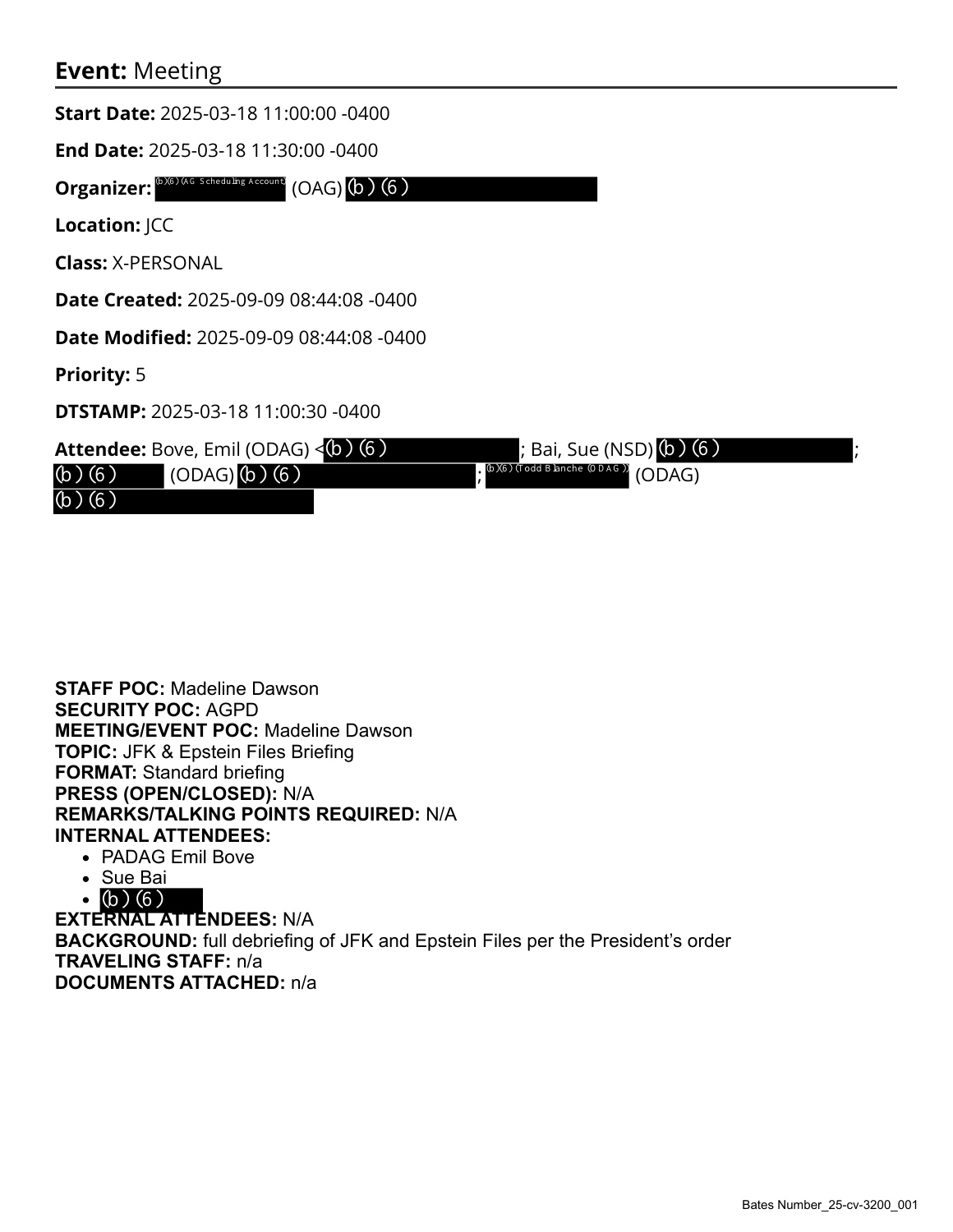
The first page is a calendar record for a half-hour JFK and Epstein files briefing scheduled for March 18, 2025. It lists Emil Bove and Sue Bai among the internal participants and describes a full debriefing under the President’s order. A scheduled briefing is evidence of the calendar entry; the page contains no minutes or account of what participants actually said.
The March 21 scope-review email says the sender had spoken with “Todd/Emil” and sets out decisions and follow-up tasks. Most substantive numbered items are withheld. The visible continuation asks for Washington-area locations and points of contact where DOJ attorneys could work alongside reviewers. The redacted sender’s identity and the withheld decisions are not established here.
The March 22 relaunch and the 97% figure
Parry’s March 22, 11:52 a.m. request seeks DOJ approval for a revised project scope and additional redaction categories. She reports that, before this relaunch, the team had completed 97% of the redaction, initial-review and final-quality-assurance phases for investigative case material, with victim information and FBI/DOJ personnel names redacted. She says completed disks would otherwise have been delivered that day. The figure is her status report at that moment under the previous scope.
The late-night approval chain identifies a DOJ-approved plan and edits to processing guidance. Most of the revised plan is withheld under markings labeled (b)(5). Earlier and later versions appear within the chain, so the sequence shows a developing plan rather than several independent completed releases.
The staffing correspondence discusses Winchester, Washington, New York and other processing locations, remote attorney support and training before an intended March 23 restart. Germano supplies preliminary staffing counts for Clarksburg and Patriots Plaza, with counts from other locations still pending. The emails document preparations; they do not independently confirm the exact restart time or final staffing total.
Public-figure flags and the disclosure list
The March 23, 8:14 a.m. email transmits a time-stamped public-release spreadsheet and calls it a starting point. Reviewers are asked to flag other potential public figures for contemporaneous review, and an earlier message anticipates adding names as questions arise. The spreadsheet’s contents are not printed in this production.
The later March 23 update says privacy staff removed two victims and affiliated individuals from the disclosure list. Although those victims had spoken publicly, the instruction was to treat them the same as other victims out of caution. This does not identify those people or establish that exactly two individual names were removed.
The same email chain also answers questions about yearbooks and subpoena numbers. It tells reviewers to flag yearbooks because context matters, leave defendants’ names and pictures visible where applicable, redact other names and images by line or block, and redact subpoena numbers. These are recorded review instructions, not determinations that any particular person committed wrongdoing.
Victim protection and questions from reviewers
The Office of Information Policy (OIP) email thread proposes a shared first-level questions document to preserve issues and advice for a later attorney review. The following pages record instructions to redact sealed court documents completely while leaving a clear indication that they are sealed.
The training questions and answers distinguish a victim’s place of birth from another third party’s information, require redaction of specified law-enforcement identifiers, and direct use of a supplied personnel list. On video references, reviewers may continue processing but must not close and return the work product until the DOJ consultation is complete.
The victim-protection discussion covers names, indirect identifying descriptions and sexual details, and refers to a sample redacted victim-interview FD-302 as a model. It says victim names on the “1114 list” should be redacted, including deceased victims. The document does not explain that list label, so it should not be converted into a count of victims.
A later email asks whether information about other deceased third parties should be released. It repeats the earlier victim instruction, but the visible page supplies no final answer to the broader question.
The witness-list correspondence identifies an additional protected person missing from the current list and requests that the name and related identifiers be added. No identity needs to be recovered to understand the instruction. The following pages explain that family names were retained in the comprehensive redaction list because releasing them could identify victims.
The compilation account describes inputs from witness and victim lists, case-system exports, VNS exports, CACHTU victim lists, existing FBI lists and names encountered during review. Exact matching names were deduplicated, while variations remained. This is a protection list assembled from mixed sources, not a verified count of distinct victims or a list of offenders.
Videos, training files and the Attorney General memo
The March 22 logistics exchange says no videos were included in this document-processing project, while reviewers should note references they encounter. Other messages ask that any video encountered be flagged to a DOJ attorney. These statements describe that project’s workflow; they do not establish that no videos existed elsewhere in the investigative holdings.
The later training exchange records the video flags being incorporated into training preparation and an encrypted transmission. The encrypted transmission’s contents are not reproduced. The processing-guidance attachment is separately referenced in multiple cover messages, including one explicitly labeled draft, predecisional and deliberative.
The March 25 cover email identifies a fourth-version disclosure memorandum intended to describe and analyze release issues for the Attorney General. The memorandum itself is not present in the included pages. Its title and version number should not be treated as its substantive contents or proof of final approval.
The classified-material status summary
The one-page summary is marked UNCLASSIFIED//FOR OFFICIAL USE ONLY. It reports the status of six serials at that point in the review:
- 31E-MM-108062-1A_Box 611_Folder 002 and 50D-NY-3027571 Serial 178 1A are described as originating with another government agency and awaiting referral for classification review.
- 50D-NY-3027571 Serial 539 remains classified in its see-through form. The summary says its currently redacted version may be treated as unclassified once the redactions are sealed and no longer see-through.
- 50D-NY-3027571 Serials 407, 538 and 684 are listed as declassified after a classification review.
The March 27 transfer email says the pages removed the previous evening before transfer to JCON were accurate; further discussion is withheld. That short confirmation does not identify all removed pages, establish their public release, or update the status of every underlying record. The summary’s historical classifications should not be presented as verified current classifications.
Limits of the record
- A staff progress estimate does not measure how much of the complete Epstein archive was publicly released.
- Review flags, disclosure-list entries and protection-list entries serve different purposes. None independently proves misconduct.
- Visible redaction labels show that material is withheld in this copy. They do not reveal the missing content or independently settle whether each withholding was legally justified.
- Duplicate notices and missing Bates numbers prevent treating the production as a consecutive chronology or a complete attachment set.
- The March 2025 correspondence predates the January 2026 review protocol discussed in the related Sleuth Report. The two records should retain their separate dates and scope.
Evidence Appearances
| Bates suffix / identifier | PDF pages | Contents |
|---|---|---|
| 25-cv-3200_001 | PDF 1 | Scheduled JFK/Epstein briefing |
| 25-cv-3200_002–005 | PDF 2–5 | Public-figure flags, training, staffing and video-reference logistics |
| 25-cv-3200_006–014 | PDF 6–14 | Revised plan, approvals and substantial withheld passages |
| 25-cv-3200_015–016 | PDF 15–16 | 97% status statement and revised-scope request |
| 25-cv-3200_023–024 | PDF 17–18 | March 26 cover email and classified-material summary |
| 25-cv-3200_025 | PDF 19 | Draft processing-guidance cover email |
| 25-cv-3200_029–030 | PDF 20–21 | Disclosure-list revision, yearbooks and subpoena numbers |
| 25-cv-3200_036–039 | PDF 22–25 | OIP review questions, sealed records and victim protections |
| 25-cv-3200_040 | PDF 26 | Duplicate-reference processing-guidance email |
| 25-cv-3200_044–047 | PDF 27–30 | Earlier scope discussion, withheld plan and duplicate notice |
| 25-cv-3200_048–049 | PDF 31–32 | Training/video flags and encrypted transmission |
| 25-cv-3200_050 | PDF 33 | Draft Attorney General memorandum cover email |
| 25-cv-3200_061 | PDF 34 | Question about deceased third parties |
| 25-cv-3200_062–063 | PDF 35–36 | March 21 scope decisions and attorney colocation |
| 25-cv-3200_064–066 | PDF 37–39 | Protected-person list additions and compilation |
| 25-cv-3200_067 | PDF 40 | March 27 transfer/removal confirmation |
| 25-cv-3200_070 | PDF 41 | Scope-review acknowledgment and duplicate notice |
Each identifier above follows the printed prefix Bates Number_. Ranges describe the included labels, not additional unproduced pages. Duplicate references appear on PDF pages 21, 26, 30, 32 and 41. No EFTA identifier has been verified for this exact interim PDF.
Related Background
Rye’s review-protocol report examines the separate January 2026 protocol and later legal record. This guide remains confined to the 41-page March 2025 correspondence production.
Original Document
Sources
- Investigative Holdings Epstein: Interim, preserved PDF, 41 pages, Bates Number_25-cv-3200_001–070 with gaps. The page map above covers every included page.