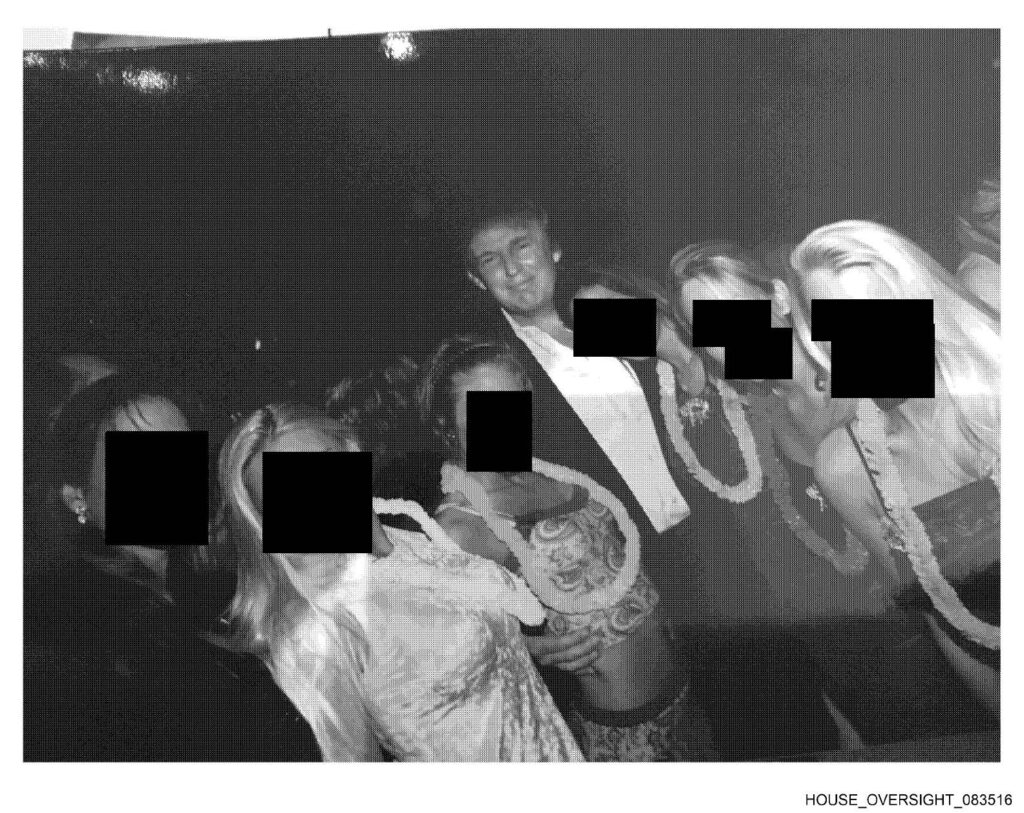
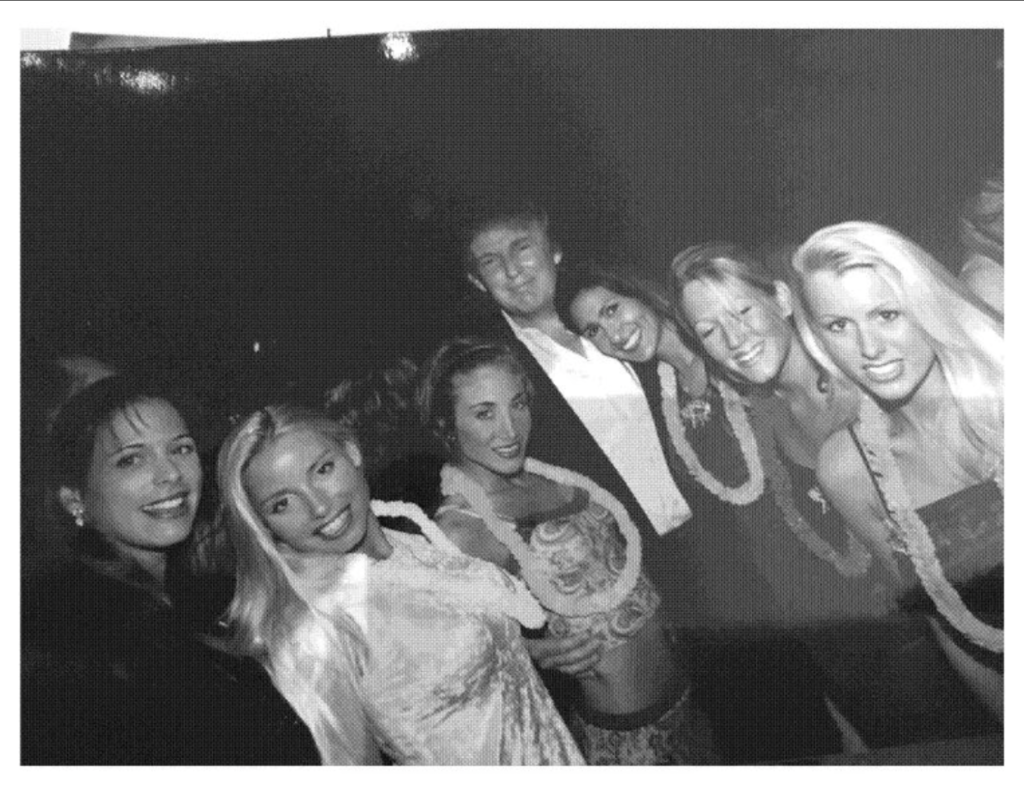
Redacted and Unredacted Group Photograph Linked to Hawaiian Tropic Promotional Events 083516
Snapshot
| Field | Finding |
|---|---|
| Record identifier | House Oversight 083516 |
| Common file label | HOUSE_OVERSIGHT_083516_Redacted2 |
| Record type | Black and white group photograph, released in a redacted form, with an unredacted version later reported by news organizations |
| Public release date | December 12, 2025 |
| Producing source | The estate of Jeffrey Epstein |
| Receiving body | United States House Committee on Oversight and Government Reform |
| Public publisher | Democrats serving on the House Oversight Committee |
| Principal public figure visible | Donald Trump |
| Other people visible | Six women whose faces were obscured in the congressional release |
| Reported event context | An event involving adult Hawaiian Tropic promotional models, reportedly at Mar a Lago |
| Reported approximate date | 1998, not established by the image or the official release |
| Epstein visible | No |
| Criminal conduct depicted | No |
| Core evidentiary value | Documents that Epstein retained or possessed a photograph of Trump posing with a group of women and provides a lead for reconstructing the social and promotional event context |
| Main limitation | The official release supplied no date, photographer credit, original caption, event program, or complete chain of custody |
House Oversight 083516 is a black and white group photograph showing Donald Trump standing among six women wearing floral leis. The version released by House Oversight Democrats obscured the women’s faces. News organizations subsequently reported that an unredacted version showed adult promotional models associated with Hawaiian Tropic. One woman told the New York Post that she had been twenty two years old at the time. The Telegraph reported that the women represented Hawaiian Tropic at an event at Trump’s Mar a Lago property and that the photograph was thought to date to 1998.
Those later reports provide useful context, but they do not convert every reported detail into a fact established by the official file. The House Oversight Democrats release described a production of more than 95,000 photographs from Epstein’s estate. The Associated Press reported that the selected images were issued without captions or context. Accordingly, the safest description is that 083516 is an undated photograph from Epstein’s personal collection that shows Trump with six women wearing leis. Hawaiian Tropic, Mar a Lago, and 1998 are reported identifications that remain dependent on outside sourcing rather than embedded metadata visible in the public image.
This distinction is central. The photograph is evidence of possession and social imagery. It is not, standing alone, proof that Epstein attended the pictured event, took the photograph, arranged the gathering, knew every person shown, or participated in any misconduct there. It also does not establish that any woman pictured was a survivor of Epstein’s abuse. The later identification of the group as adult models directly cautions against inferring age or victim status from the initial redactions.
What Is This Record?
House Oversight 083516 is one image within a much larger photographic production made by Epstein’s estate to the House Committee on Oversight and Government Reform. Committee Democrats publicly selected a small group of images on December 12, 2025. The released file name, reproduced by multiple news galleries, is commonly rendered as HOUSE_OVERSIGHT_083516_Redacted2. The number 083516 appears to be an archival or production identifier. It should not be read as a date.
The picture is monochrome. Trump occupies the center of a posed group. Six women stand around him, and floral leis are visible. In the official public version, solid black shapes conceal the women’s faces. Trump’s face remains visible. Epstein is not visible in the frame. The composition resembles a promotional or commemorative event photograph rather than a candid image, but that is a visual interpretation and not a documented photographer’s caption.
The record exists in at least two publicly discussed forms:
| Version | Provenance | What can be established | Evidentiary caution |
|---|---|---|---|
| Congressional redacted version | Released by House Oversight Democrats from the estate production | Trump is visible with six women wearing leis; the women’s faces are concealed | The release provides no original date, place, photographer, or caption |
| Reported unredacted version | Obtained and described by the New York Post and the Telegraph | The women appear to be adults; a woman reportedly confirmed she was twenty two at the time | The public reporting does not provide the complete transfer history from the original negative or print |
| Artificially altered versions online | Social media reposts and generative image edits | Nothing about concealed faces can be established from synthetic reconstruction | Generated faces are inventions and must never be used for identification |
The title links the image to Hawaiian Tropic promotional events because two publications identified the women as Hawaiian Tropic models. That connection is plausible and specific, but the underlying official release did not itself publish an event card or caption that says Hawaiian Tropic. A responsible archive therefore preserves both layers: the original observable facts and the later reported identification.
The word “unredacted” also requires care. A genuine unredacted print or scan can reveal the faces that were present in the original photograph. It does not automatically disclose names, ages, employment status, or relationship to Epstein. Those facts need independent corroboration. Conversely, an image created by filling blacked out regions with artificial intelligence is not an unredacted document. It is a new synthetic image with no evidentiary value regarding the hidden content.
Source and Provenance
The strongest provenance statement comes from the official House Oversight Democrats announcement. It says the committee received more than 95,000 photographs from Epstein’s estate and that the production included images of prominent men, thousands of women, and Epstein properties. It also links to nineteen selected photographs. The committee stated that it was reviewing the larger set and intended to protect survivor identities.
The Associated Press report carried by WCCB identifies the first gallery image as “House Oversight 083516 Redacted2 Copy.” It states that the photographs came from Epstein’s estate, that the selected images were released without captions or context, and that the Trump group photograph showed six women whose faces were blacked out. The same gallery preserves the released file label, making it useful for matching the image to its production number.
The provenance chain that can presently be stated is:
| Stage | Custodian or publisher | Status |
|---|---|---|
| Original creation | Unknown photographer or event photography service | Not publicly documented |
| Original print, negative, or scan | Unknown | Not publicly documented |
| Copy retained in Epstein’s collection | Epstein or an Epstein controlled repository | Established by estate production description, though acquisition method is unknown |
| Estate custody | Epstein estate | Established by committee statement |
| Congressional production | House Committee on Oversight and Government Reform | Established by committee statement |
| Redacted public copy | House Oversight Democrats | Established |
| News copy and gallery republication | Associated Press affiliates and other news organizations | Established for the redacted image |
| Reported unredacted copy | New York Post and Telegraph reporting | Reported, but complete source history is not public |
This chain has an important gap. There is no public account showing when Epstein acquired the photograph, whether it was given to him by Trump, an event organizer, a model, a photographer, or another person, or whether it was copied from a larger album. Possession is meaningful, but the route of possession is unknown.
No public photographer credit has been securely matched to 083516. Getty Images contains extensive editorial photography of Trump, Epstein, and Mar a Lago social events. Those photographs can help establish that professional and society photographers documented the same social world. They should not be presented as the source of 083516 unless an exact frame, original caption, photographer name, agency accession number, and date can be matched. At present, no such exact Getty match has been verified.
Likewise, the photograph should not be attributed to House Oversight. The committee released the copy but did not create the original image. “House Oversight Democrats, handout” accurately describes the public distribution source. It does not identify the original photographer.
What the Record Contains
The photograph contains a posed group of seven people. Trump stands near the center, wearing formal or evening attire. Six women flank him. Floral leis appear around several or all of the women’s necks. The background suggests an indoor social venue, though the publicly distributed image alone does not establish which room or property appears behind them.
The redacted version contains several editorial interventions:
| Element | Visible status | Interpretation limit |
|---|---|---|
| Trump’s face | Visible | Supports identification of Trump |
| Six women’s faces | Covered with black masks | Does not establish why each individual was redacted |
| Clothing and body posture | Largely visible | Supports a posed group setting, not a relationship finding |
| Floral leis | Visible | Supports a themed or promotional event inference |
| Location markers | Indistinct | Cannot independently prove Mar a Lago |
| Date markers | None visible | Cannot independently prove 1998 |
| Photographer credit | None visible | Photographer remains unknown |
| Epstein | Not visible | Image does not show his attendance |
The reported unredacted version adds facial information. According to the New York Post report on the unredacted photographs, the women were adult models. The report says one woman confirmed that she was twenty two at the time and remembered Trump as courteous. The Telegraph separately described the group as Hawaiian Tropic representatives at an event at Mar a Lago and said the image was believed to have been taken in 1998.
These reports are relevant because the initial black boxes prompted speculation that the women were minors or survivors. The unredacted reporting undermines that assumption. Yet it does not answer every identity question, and an archive should not publish private names merely because faces became available. Names should be included only when a person identifies herself publicly or when a reliable contemporaneous caption establishes identity and publication serves a clear evidentiary purpose.
The photograph contains no visible sexual act, coercion, physical restraint, exchange of money, trafficking conduct, or criminal behavior. It depicts a social pose. Its significance comes from the collection in which it was found and the broader history of Trump and Epstein’s documented social acquaintance, not from criminal content within the frame.
Key Evidence Points
First, the image was in a collection produced by Epstein’s estate. This is the clearest documentary fact. The estate origin distinguishes it from an unrelated internet photograph merely tagged with Epstein’s name.
Second, the image shows Trump. His identity is not reasonably disputed in the public reporting or the official release.
Third, the image shows six women wearing leis. Their faces were obscured in the official copy. The redactions are part of the released derivative, not part of the original photographic scene.
Fourth, the official public release did not identify the women as victims. The Associated Press reported that Representative Robert Garcia did not say whether any woman in the images was a victim. His stated policy was to prevent harm to survivors. A precautionary redaction policy is not an identity finding.
Fifth, outside reporting identifies the women as adult Hawaiian Tropic promotional models. That reporting supplies a more ordinary event context and rebuts unsupported claims that the black boxes necessarily concealed minors.
Sixth, Mar a Lago and 1998 are reported context, not details visible in the file. The official image is undated. A date estimate may ultimately be confirmed by event calendars, contact sheets, photographer logs, model rosters, press coverage, or architectural comparison, but those materials have not been publicly tied to the file with a complete chain.
Seventh, Epstein does not appear in the photograph. The image therefore cannot prove he attended the event. It proves only that his estate possessed a copy at the time of production.
Eighth, a separate House Oversight photograph of Trump seated beside a woman on an aircraft is a different record. It should not be merged with 083516. Similar release timing and facial redaction do not make two images part of the same event.
Ninth, an artificial intelligence restoration cannot reveal a redacted face. Any version in which software has generated facial features under the black masks is fabricated content. Only a separately sourced original or earlier generation copy can qualify as authentic unredacted evidence.
Tenth, no exact photographer or Getty Images record has been verified for this frame. A generic Getty search result showing Trump at another Mar a Lago event is contextual material, not image provenance.
What the Record Does and Does Not Prove
| Claim | Assessment | Reason |
|---|---|---|
| Trump appears in the photograph | Supported | He is visibly identifiable and named in consistent reporting |
| Six women appear with him | Supported | Visible in the official image |
| The women wore floral leis | Supported | Visible in the photograph |
| Epstein’s estate possessed a copy | Supported | Official committee provenance |
| Epstein took the photograph | Not supported | No photographer credit or creation record |
| Epstein attended the event | Not supported by this image | Epstein is not visible and no event record accompanies the file |
| The women were Hawaiian Tropic models | Reported with substantial support | New York Post and Telegraph reporting, including contact with one woman |
| The location was Mar a Lago | Reported, not independently established by the official file | Location is supplied by news reporting, not visible metadata |
| The date was 1998 | Probable report, not confirmed | Described as believed or thought to date from 1998 |
| The women were adults | Supported by unredacted reporting | One woman reportedly confirmed she was twenty two, and the group was described as adult models |
| The redactions prove victim status | False | Redaction was precautionary and does not identify victim status |
| The image depicts wrongdoing | False | It shows a posed social photograph |
| Trump knew of Epstein’s crimes because Epstein owned the image | Not supported | Possession of a social photograph cannot establish knowledge |
| Every online unredacted version is genuine | False | Synthetic face restoration versions have circulated |
The image supports a narrow but real historical conclusion: Epstein maintained a photograph connecting his personal archive to Trump’s promotional social environment. That conclusion fits other evidence showing that Trump and Epstein moved within overlapping Palm Beach and New York social circles during the 1990s. It does not establish criminal participation by Trump or any woman pictured.
The difference between association and culpability is not a technicality. Epstein collected photographs of many public figures, acquaintances, guests, and social settings. Some images may illuminate access, chronology, or network proximity. None should be treated as proof of abuse without evidence of conduct, knowledge, facilitation, or participation.
The same restraint applies in the opposite direction. Because the frame does not show a crime, it should not be dismissed as meaningless. Archival photographs can corroborate social proximity, identify venues, connect event networks, and generate leads. The correct response is calibrated inquiry, not sensational accusation and not reflexive minimization.
People and Entities Appearing in the Record
| Person or entity | Role in this record | Confidence | Notes |
|---|---|---|---|
| Donald Trump | Central visible subject | High | Publicly identified by the committee release and news organizations |
| Six women | Visible group members | High as to presence | Faces redacted in official copy; reported as adult Hawaiian Tropic models |
| Jeffrey Epstein | Collector or possessor, not visible | High as to estate provenance | No basis from this image alone to say he attended |
| Epstein estate | Producing custodian | High | Supplied the larger photographic collection to Congress |
| House Committee on Oversight and Government Reform | Congressional recipient | High | Received more than 95,000 estate photographs |
| House Oversight Democrats | Public release source | High | Published a selected redacted group |
| Hawaiian Tropic | Reported promotional affiliation | Medium to high | Identified by press reports, not by the official file caption |
| Mar a Lago | Reported venue | Medium | Reported by the Telegraph; not independently proven by the image alone |
| Original photographer | Creator | Unknown | No verified credit found |
| Getty Images or another photo agency | Possible distributor of related event imagery | Unknown for this frame | No exact matching accession has been established |
Donald Trump and Jeffrey Epstein had a publicly documented social acquaintance in the 1990s and early 2000s. That broader history supplies context for why a Trump photograph might appear in Epstein’s collection. It does not identify the source of this particular print.
Hawaiian Tropic was a consumer sun care brand that used models, pageants, and promotional appearances as part of its marketing. The leis in the picture are consistent with that theme. Consistency is not the same as documentary proof, which is why the brand identification remains attributed to reporting.
The women should be treated as private individuals unless they voluntarily identify themselves or reliable contemporaneous records make their public role clear. Appearing in an Epstein held photograph does not make a person complicit, a witness, or a survivor. It may mean no more than that a copy of a public event photograph entered his collection.
Timeline Significance
| Date or period | Event | Evidentiary status |
|---|---|---|
| 1990s | Trump and Epstein moved in overlapping Palm Beach and New York social circles | Established by photographs, video, and reporting |
| Approximately 1998 | Reported date of the Hawaiian Tropic group photograph | Not confirmed by official image metadata |
| 2019 | Epstein died in federal custody while awaiting trial | Established public record |
| 2025 | Epstein’s estate produced more than 95,000 photographs to the House Oversight Committee | Established by official committee statement |
| December 12, 2025 | House Oversight Democrats released selected images including 083516 | Established |
| December 12, 2025 | News outlets reported an unredacted version and Hawaiian Tropic event context | Established as publication history |
If the 1998 estimate is correct, the image belongs to a period when Trump and Epstein’s social overlap was publicly visible. Other photographs from this era show them at events, including a widely published image from a 1997 Victoria’s Secret party. Those separately credited images help establish the general social chronology. They do not prove that Epstein was present for 083516.
The image’s 2025 release date is also significant. It was not issued as part of a contemporaneous criminal investigative exhibit. It emerged from a congressional production decades after its reported creation. The elapsed time increases the importance of original captions, negative sleeves, contact sheets, digital timestamps, and custodial logs. None accompanied the public copy.
The release also occurred amid intense political pressure for broader disclosure of Epstein related records. That environment increased public attention but also encouraged rapid, partisan interpretations. Archival analysis should separate the image’s content from the political framing around its publication.
Related Evidence
House Oversight 083516 should be compared with other records only through clearly stated relationships.
The most direct related item is the official nineteen image release. That batch establishes the immediate custodial and publication context. It shows that committee staff selected images of numerous prominent people from a far larger estate collection. The selection process itself is not fully explained.
A second category is separately authenticated event photography of Trump and Epstein. Getty distributed photographs credited to professional photographers showing the men at social events. Those images corroborate a broader acquaintance. They should retain their own photographer credits, dates, captions, and agency accession details. They are not substitute copies of 083516.
A third category is EFTA00000468, a later public file described in major reporting as an image of photographs stored among Epstein’s belongings, including a Trump image. That record concerns the physical retention of social photographs and can be analytically related to Epstein’s collecting practices. It is not the same group photograph and should not be used to supply missing details about 083516.
A fourth category is the separate House Oversight image labeled 083517, which shows Trump in another setting with a woman whose face was redacted in the public release. Sequential file numbers may indicate nearby storage or processing order, but they do not prove the same date, trip, or event.
A fifth category is documentary reporting about Trump and Epstein’s Palm Beach social relationship. That evidence explains why researchers examine photographs from Mar a Lago and promotional events. Each claim in that wider history must still stand on its own source.
| Related material | Proper use | Improper use |
|---|---|---|
| Official estate photo batch | Establish release provenance and selection context | Assume every image documents a crime |
| Exact credited press photographs | Corroborate a specific dated public event | Treat a similar scene as the same event |
| EFTA00000468 | Study how social photographs were retained | Claim it proves who took 083516 |
| House Oversight 083517 | Compare redaction and release practices | Merge it with 083516 without evidence |
| Event rosters and press archives | Test Hawaiian Tropic, location, and date claims | Use uncited recollection as final proof |
Sleuth and Independent Reporting
Independent researchers are valuable when they preserve source links, compare image generations, locate contemporaneous event notices, and clearly label inference. The best sleuth work on 083516 will focus on provenance questions rather than facial speculation.
Michael Wolff’s Substack discussion of the released Epstein pictures offers a skeptical reading of the congressional selection. Wolff argues that the selected photographs often show already known associations in uneventful settings and asks why those particular images were chosen from such a large cache. That is commentary, not a substitute for the primary record, but it raises a legitimate archival question about selection bias and context.
All Rise News reporting on Epstein and Trump references discusses a separate Epstein email that mentioned a “Hawaiian Tropic girl.” The reference may help researchers identify names, event networks, or recurring language, but it should not be used to identify any woman in 083516 without a direct evidentiary bridge. Shared brand language does not prove shared identity.
Ellie Leonard’s Substack discussion contains reader speculation that recently released House images may relate to Hawaiian Tropic references in emails. Such discussion is best treated as a research lead. It is not confirmation of event date, location, or participants.
Michael Wolff’s later Substack on absent or expected Epstein photographs is relevant to the broader problem of comparing known photographic material with official releases. Its claims should be evaluated against original images and custody records before entering a factual timeline.
Sleuth reporting becomes strongest when it produces testable documentation:
| Research method | Strong output | Weak output |
|---|---|---|
| Reverse image comparison | Exact pixel or crop match with an earlier publication | Similar clothing or room impression |
| Event archive search | Dated program, guest list, press clipping, or photographer caption | Unsourced social media assertion |
| Identity confirmation | Voluntary public identification plus corroborating event evidence | Facial recognition guess |
| Getty or agency research | Exact accession number and original photographer credit | Generic search results for the same celebrity |
| Metadata review | Preserved original metadata with custody explanation | Metadata from a recent repost |
| Redaction analysis | Comparison with a genuine earlier generation copy | Artificial intelligence face generation |
Independent archives and Substacks should be linked as secondary research layers, not presented as authorities equal to the primary congressional release. Their value lies in discoverability, cross reference, and transparent hypothesis testing.
Reliability and Limitations
The official redacted version has high reliability as evidence that House Oversight Democrats publicly released a copy received from Epstein’s estate. It has high reliability for basic visible content. It has low reliability for date, place, event identity, and participant names because those fields were not supplied.
The reported unredacted version has moderate to high reliability as press evidence that an earlier generation copy exists and shows adult women. Its reliability would improve if the source publication released the complete high resolution file, documented its source, supplied original metadata, or matched it to a dated agency archive.
The Hawaiian Tropic and Mar a Lago identifications are plausible and consistently reported, but the public evidentiary basis is not fully visible. One participant’s reported recollection supports adult age and event context. It does not necessarily establish every detail for every person.
The exact date remains uncertain. “Thought to have been taken in 1998” is an estimate, not a verified date. Researchers should avoid converting it into a precise assertion in timelines.
The original photographer is unknown. A handout credit names the distributor, not the creator. Getty and other agencies may hold related material, but no exact match has been confirmed. Photographer credit should remain “unknown” until an exact source is found.
The image may have been cropped, rescanned, converted to black and white, compressed, or otherwise processed before public release. Without the original file or print, image forensics can reveal only limited information.
Finally, the selection is incomplete. Nineteen images represented only a minute portion of a production exceeding 95,000 photographs. The public cannot determine from the selected set how often a person appears, how images were organized, or what adjacent frames and captions might show.
Survivor Safety and Privacy Review
The women pictured should not be labeled survivors, victims, escorts, employees of Epstein, or participants in wrongdoing without evidence. The available reporting instead identifies them as adult promotional models. Their presence in an Epstein held photograph does not erase their privacy rights.
Redaction must not be treated as a coded accusation. Institutions often redact faces broadly because they cannot immediately determine identity, age, consent, or victim status. Representative Garcia described a policy aimed at preventing harm. That policy explains caution, not culpability.
Publishing an authentic unredacted image may be newsworthy, but repeating private names adds a separate burden. A survivor centered archive should ask whether naming advances verification, accountability, or historical understanding. If it merely fuels attention toward private women while the powerful figure remains obvious, names should be withheld.
Artificially reconstructing concealed faces is especially harmful. It creates false identities, may implicate uninvolved people, and frustrates genuine source tracing. Synthetic versions should be labeled and excluded from evidentiary comparison.
The article therefore centers the verifiable public figure and institutional custody while describing the women collectively. This approach preserves the evidentiary content without manufacturing identities or victim narratives.
Why This Record Matters
The photograph matters because archives of social imagery can reveal how Epstein documented, collected, and preserved access to public figures. His possession of a Trump group photograph is a tangible archival fact within a larger documented social relationship.
It also matters as a lesson in redaction literacy. The blacked out faces quickly became a canvas for assumptions. Later reporting indicated that the women were adult models. That sequence shows why redaction cannot be treated as proof of age, victim status, or criminal context.
The image matters for event reconstruction. If the Hawaiian Tropic and Mar a Lago identifications are confirmed by contemporaneous records, 083516 may help map the overlap between promotional modeling events and the Palm Beach social environment shared by Trump and Epstein. That inquiry is legitimate, but it requires documents beyond the photograph.
It matters for provenance. The difference between an original photographer, an agency distributor, an estate custodian, and a congressional publisher is often collapsed in online captions. Keeping those roles separate protects the historical record.
Finally, it matters because responsible accountability depends on precision. Overclaiming a social photograph can discredit serious evidence and harm uninvolved women. Underclaiming it can obscure a documented connection within Epstein’s personal archive. The accurate middle is both more credible and more useful.
Fact Check
| Statement | Rating | Explanation |
|---|---|---|
| 083516 came from Epstein’s estate production to Congress | True | Confirmed by the official release |
| Trump is shown with six women | True | Visible and reported by AP |
| Epstein appears in the picture | False | He is not visible |
| The official release proves the location was Mar a Lago | False | Location came from later reporting |
| The image was definitely taken in 1998 | Unconfirmed | 1998 is a reported estimate |
| The women were minors | Unsupported and contradicted by reporting | News reports identify adult models; one woman said she was twenty two |
| The women were Epstein survivors | Unsupported | The committee did not make that identification |
| Redaction proves victim status | False | Redaction was a precautionary privacy measure |
| The women represented Hawaiian Tropic | Reported | Supported by press accounts, not by the official caption |
| The image depicts criminal behavior | False | It is a posed group photograph |
| Epstein took the photograph | Unsupported | Photographer is unknown |
| Getty Images is the original source | Unsupported | No exact Getty match or accession has been verified |
| Software can recover the concealed faces | False | Generative software invents pixels and identities |
| An authentic unredacted version was reported | True as a publication fact | News organizations published descriptions and imagery said to be unredacted |
Questions Still Unanswered
- What is the original date of the photograph?
- Was the location Mar a Lago, and if so, which room and event?
- What contemporaneous document identifies the gathering as a Hawaiian Tropic promotion?
- Who organized the event and maintained its guest list?
- Who took the original photograph?
- Does a photo agency hold the original negative, transparency, or digital file?
- Did Epstein attend the event, or did he acquire the image later?
- How did the photograph enter Epstein’s collection?
- Is 083516 part of a contact sheet, album, envelope, or sequential event series?
- What do the immediately adjacent estate files show?
- Who requested each facial redaction, and what criteria were applied?
- What is the complete provenance of the unredacted copy obtained by the press?
- Can a participant, photographer, event organizer, or dated publication independently confirm 1998?
- Does Getty Images or another archive hold an exact matching frame with an original caption?
- Are there contemporaneous Hawaiian Tropic press releases, pageant programs, or model rosters that identify the event without exposing private individuals unnecessarily?
- Why was this image selected from more than 95,000 estate photographs?
- Will Congress release contextual metadata, folder structure, or neighboring frames while protecting survivor privacy?
Related EpsteinWiki Pages
- Jeffrey Epstein
- Donald Trump
- Hawaiian Tropic Events
- Photographic Evidence
- Mar a Lago
- House Oversight Records
- EFTA00000468
- Epstein Files Dataset
Source List
Primary and official sources
- House Oversight Democrats announcement of the estate photograph production
- House Oversight 083516 image page preserved by WCCB
- EFTA00000468 at Epstein Data
News reporting and image context
- Associated Press report and released image gallery carried by WCCB
- New York Post report on the unredacted photographs and adult models
- Telegraph report connecting the group to Hawaiian Tropic and Mar a Lago
- CBS News report on the House release
- Washington Post report on photographs from Epstein’s estate
- Getty Images search collection for Trump and Epstein
Sleuth and independent reporting
- Michael Wolff, What’s Actually in the Epstein Pictures?
- Michael Wolff, I’ve Seen Epstein Pictures That Could Hang Trump
- All Rise News discussion of Trump and Hawaiian Tropic references
- Ellie Leonard Substack discussion of Epstein emails and Hawaiian Tropic image leads