
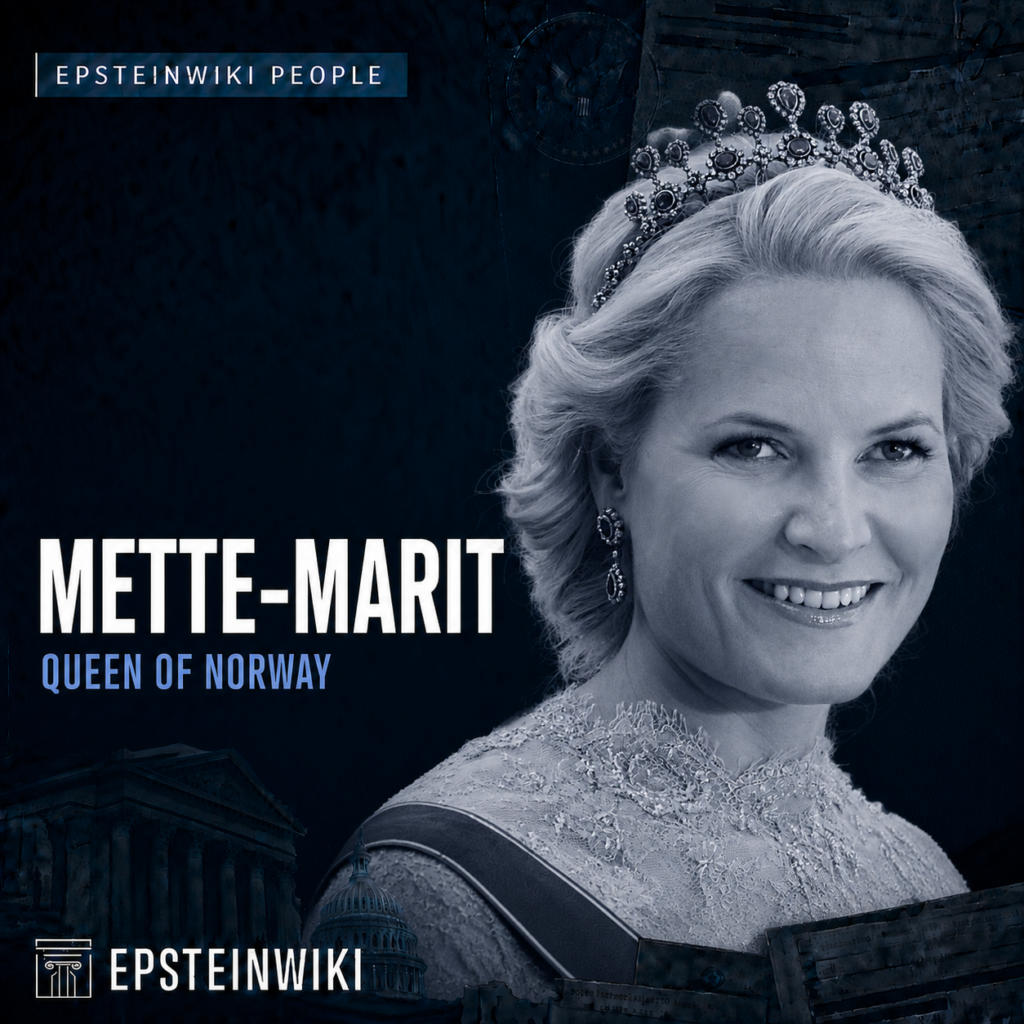
Queen Mette-Marit of Norway
Snapshot
Queen Mette-Marit of Norway, formerly Crown Princess Mette-Marit, maintained a personal relationship with Jeffrey Epstein between 2011 and 2014.
The relationship began approximately three years after Epstein pleaded guilty in Florida to offenses involving a minor and became a registered sex offender. Released correspondence shows hundreds of messages concerning meetings, travel, books, royal duties, relationships, Epstein’s search for women, personal health, cosmetic procedures, and social plans.
Mette-Marit acknowledged in an October 2011 email that she had searched Epstein’s name online and that the results did not look good. She nevertheless continued corresponding with him for approximately three more years.
She met Epstein on multiple occasions, stayed for several days at his Palm Beach residence, discussed visits to New York and Saint Barthélemy, and introduced him to her husband, then Crown Prince Haakon. She has said Haakon met Epstein only once.
The Norwegian Royal Court first publicly acknowledged the relationship in 2019. It said Mette-Marit met Epstein on several occasions between 2011 and 2013 and ended contact after believing he was attempting to use the royal association.
The 2026 United States Department of Justice releases demonstrated that written contact continued into 2014. The palace acknowledged that its earlier ending date had been incorrect.
Mette-Marit apologized repeatedly. She said she had shown poor judgment, had been manipulated and deceived, regretted the friendship, and never witnessed illegal activity. She also said everyone she met around Epstein was an adult.
The records do not establish that Mette-Marit participated in Epstein’s trafficking operation, recruited a victim, sexually abused anyone, or witnessed abuse.
They do establish that a senior European royal maintained friendly and sometimes intimate correspondence with Epstein after his conviction, despite having discovered information suggesting that his background was troubling.
Mette-Marit became Queen of Norway on August 28, 2026, when her husband succeeded King Harald V as King Haakon VIII.
As of September 1, 2026, Queen Mette-Marit was not publicly known to have been charged with or convicted of an Epstein related offense.
Identity and Royal Role
Mette-Marit Tjessem Høiby was born in Kristiansand, Norway, on August 19, 1973.
She met Haakon, then Crown Prince of Norway, in 1999. They married on August 25, 2001.
Mette-Marit had a son, Marius Borg Høiby, from an earlier relationship. She and Haakon later had two children, Ingrid Alexandra and Sverre Magnus.
As Crown Princess, Mette-Marit represented Norway at cultural, humanitarian, diplomatic, and charitable events. She promoted literacy, women’s health, international development, HIV awareness, and access to education.
Her international health work placed her in networks containing philanthropists, donors, academics, business executives, international officials, and wealthy social intermediaries.
King Harald V died on August 28, 2026. Haakon immediately succeeded him as King Haakon VIII, making Mette-Marit Queen of Norway.
Reuters documented Mette-Marit’s background and accession as queen. The Norwegian Royal Court confirmed King Harald’s death.
The Epstein relationship occurred while Mette-Marit was Crown Princess. Her current title does not change the evidentiary character of the earlier communications.
Epstein’s Criminal Status When the Relationship Began
Palm Beach police began investigating Epstein in 2005 after receiving a report concerning a fourteen year old girl.
Epstein pleaded guilty in Florida in June 2008 to procuring a person under eighteen for prostitution and soliciting prostitution. He served approximately thirteen months of an eighteen month sentence under unusually generous work release conditions.
He was required to register as a sex offender.
Mette-Marit’s direct correspondence with Epstein began in 2011, after the conviction and sentence were public.
This timing matters. The relationship was not confined to a period before Epstein’s criminal conduct became publicly documented.
Mette-Marit has said she did not understand that Epstein was a sexual offender and abuser during the years they communicated. She later said she could not remember the precise results of her 2011 online search and did not believe she had seen information that made the nature of his crimes clear to her.
The released email records must therefore be considered alongside her later explanation.
The Davos Introduction
The available record places the beginning of the relationship around the World Economic Forum in Davos in January 2011.
In EFTA00648375, physicist Lawrence Krauss told Epstein that the Crown Princess of Norway wished Epstein were present.
Krauss was part of the scientific and philanthropic environment through which Epstein cultivated academics, donors, and prominent international figures.
Biotechnology investor Boris Nikolic also appears to have served as a central intermediary.
In EFTA02021990, Nikolic directed Epstein toward online images of Mette-Marit and described her as unusual for a royal.
Nikolic later appeared repeatedly in communications involving Epstein, Mette-Marit, and members of the Norwegian royal household.
The records support the conclusion that Epstein’s access did not arise from a random meeting. It was facilitated through people already operating within international philanthropy, science, technology, and elite conference networks.
The Scale of the Released Record
Mette-Marit appears more than one thousand times in broader searches of the 2026 Epstein releases.
Different databases produce different totals because some count complete documents, individual pages, email copies, quoted threads, attachments, or every textual mention.
One independent database identified approximately 471 email messages associated with the relationship. Duplicate messages and repeated quoted text may affect that number.
The exact count should not be treated as fixed until the complete release has been deduplicated.
The important point is the documentary pattern. Mette-Marit was not merely named by someone else. The archive contains direct messages from an address identifying the sender as “H.K.H. Kronprinsessen,” meaning Her Royal Highness the Crown Princess.
The correspondence extends from 2011 into 2014 and includes repeated personal exchanges, proposed meetings, travel planning, invitations, and communication through intermediaries.
Epstein Exposed assembled fourteen central records from the correspondence. Its document counts and interpretations are independent research rather than judicial findings.
The October 2011 Online Search
One of the most consequential messages concerns Mette-Marit’s decision to search Epstein’s name online.
In an October 2011 exchange, Mette-Marit told Epstein that she had searched for him and agreed that the results did not look good. She added a smiling symbol to the message.
The exchange is preserved within the released correspondence associated with EFTA01772124.
By 2011, ordinary online search results concerning Epstein included information about his Florida conviction and sex offender status.
The record establishes that Mette-Marit discovered negative information concerning Epstein at the beginning of their correspondence.
It does not conclusively establish which search results she opened, how much she read, whether she understood the offenses involved a minor, or what explanation Epstein supplied.
In her March 2026 interview, Mette-Marit said she did not remember the search and was confident that she did not discover information that made her understand he was an abuser.
The Norwegian Royal Court’s consolidated response records this explanation.
The conflict is therefore between a contemporaneous message recognizing troubling information and a later statement that she did not understand the criminal reality.
Early Personal Correspondence
The correspondence quickly became personal.
On October 23 and 24, 2011, Mette-Marit and Epstein exchanged more than a dozen messages.
In EFTA00922805, Mette-Marit shared an introspective description of emotional struggle. Epstein responded by discussing her search for inner peace.
The tone went beyond formal philanthropy or a ceremonial royal contact. The messages show both participants discussing personal thoughts, emotional states, books, relationships, and how they viewed other people.
The transcript of an email proves what the sender wrote. It does not establish that every personal statement was sincere or that Epstein and Mette-Marit understood the relationship in identical ways.
Epstein’s correspondence with other contacts shows that he frequently adapted his language to the interests, insecurities, and ambitions of the person he was cultivating.
“You Tickle My Brain”
Mette-Marit repeatedly described Epstein as intellectually stimulating.
In EFTA01887288, she proposed meeting for tea so that Epstein could “tickle my brain.”
EFTA00947189 contains a related message in which she said Epstein made her smile because he stimulated her mind.
The phrase indicates that Mette-Marit viewed Epstein as an intellectual companion or source of escape.
Epstein cultivated similar relationships with academics, scientists, authors, public officials, and wealthy patrons. He frequently presented himself as someone who could offer unconventional ideas, provocative conversation, books, introductions, and private access.
The messages do not establish that Epstein possessed special expertise or that every claim he made was credible. They show how Mette-Marit described his value to her.
Complaints About Royal Duties
Some messages show Mette-Marit complaining about official functions.
In EFTA02030674, she sent a message from an event describing it as boring.
Related correspondence in EFTA01886833 asked Epstein to rescue her from boredom. Epstein offered to send reading material.
In EFTA01764867, Mette-Marit complained about a European royal wedding she was attending.
These messages are not evidence of a criminal offense. They are relevant because they show that Mette-Marit used Epstein as a private outlet while performing public royal duties.
They also demonstrate that Epstein received candid commentary from inside European royal environments.
A private complaint about an event should not automatically be interpreted as a rejection of constitutional duties. The larger pattern nevertheless shows that Mette-Marit treated Epstein as a trusted personal correspondent rather than a casual acquaintance.
Women, Marriage, and Infidelity
Some exchanges concerned Epstein’s interest in women.
In EFTA02033693, Epstein said he was searching for a wife and expressed a preference for Scandinavian women.
Mette-Marit replied with a joke distinguishing Paris as a place for adultery and Scandinavian women as better marriage partners.
The exchange demonstrates that discussions of women and sexual relationships formed part of their communication.
It does not establish that Mette-Marit recruited women for Epstein, identified a particular person for him, or knew that any woman discussed was being exploited.
Researchers should avoid converting suggestive social language into a trafficking allegation without evidence involving a specific person, act, or arrangement.
The messages remain significant because Epstein was already a convicted sex offender when the conversation occurred.
The Message About Nude Wallpaper
In November 2012, Mette-Marit asked Epstein whether it would be inappropriate for a mother to suggest an image of two nude women carrying a surfboard as wallpaper for her fifteen year old son.
The exchange appears in EFTA01977816.
Epstein replied that the young people should decide and that the mother should remain outside the choice.
The message is crude and unusual in context. It establishes that Mette-Marit discussed an image of nude women with Epstein in relation to her teenage son.
It does not establish that the image involved minors, that the proposed wallpaper was used, or that the exchange was connected to Epstein’s trafficking activity.
The son’s later criminal case is legally separate and should not be used to retroactively change the meaning of the 2012 email.
Books and Literary References
Books appear frequently in the correspondence.
Mette-Marit promoted literature as part of her royal work and regularly discussed authors with Epstein.
Their communications included references to Vladimir Nabokov and Lolita. The presence of a reference to Lolita is not proof of sexual misconduct. The novel is widely discussed within literary and cultural settings.
The context remains noteworthy because Epstein’s crimes involved the sexual exploitation of underage girls and because he sometimes used intellectual discussion to normalize provocative subjects.
A responsible analysis must distinguish the existence of a literary reference from evidence of criminal knowledge.
Saint Barthélemy
The correspondence contains discussions about meeting in Saint Barthélemy.
In EFTA01763958, Epstein checked on Mette-Marit’s health and referred to Saint Barthélemy as a destination they might enjoy.
Mette-Marit and Epstein later met there. Then Crown Prince Haakon reportedly encountered Epstein during the trip.
The Royal Court initially characterized the Haakon meeting as incidental. Later scrutiny questioned whether the encounter had been planned through prior communications.
Mette-Marit has said Haakon met Epstein only once.
The available record supports the existence of at least one social encounter involving Haakon. It does not establish that Haakon developed an independent friendship with Epstein or knew the complete extent of the correspondence.
Proposed travel should also be distinguished from confirmed travel. Emails can document intention without proving that every planned meeting occurred.
The January 2013 Emotional Message
A January 2013 message demonstrates the personal depth of the relationship.
In EFTA00951170, Mette-Marit told Epstein that one of his messages had produced an emotional reaction. She discussed smoking, personal vulnerability, and a relationship involving another man.
The subject line indicated that the exchange followed a recent meeting.
The unnamed man discussed in the message should not automatically be identified as Epstein. The surviving text indicates that Mette-Marit was confiding in Epstein about someone else.
The record establishes emotional intimacy within the correspondence. It does not establish a sexual relationship between Mette-Marit and Epstein.
No publicly identified record reviewed for this article proves that the two had a romantic or sexual relationship.
The Palm Beach Stay
Mette-Marit stayed at Epstein’s Palm Beach residence for several days in January 2013.
Reporting based on the released files places the visit at approximately four days. Epstein was reportedly absent for part or all of the stay.
The property was the same residence where Palm Beach police had investigated allegations involving underage girls and where survivors described sexual abuse.
Mette-Marit brought a spiritual adviser or personal “guru” during the visit.
The fact that Epstein was absent does not make the location historically insignificant. It also does not prove that Mette-Marit knew what had occurred inside the house.
Mette-Marit said in her March 2026 interview that she felt unsafe during an encounter connected with the Palm Beach visit and called Haakon. She described Epstein as manipulative and said the experience contributed to her eventual decision to end contact.
Associated Press reported her account of feeling unsafe.
She nevertheless continued corresponding with Epstein after the visit.
That continuation became one of the central unresolved questions surrounding her explanation.
Photographs From the Palm Beach Property
Released material includes photographs associated with Mette-Marit’s Palm Beach stay.
One reported image shows her seated near an adult woman wearing a bikini. The photograph has circulated in discussions of the visit.
A photograph establishes presence at a location and the appearance of the people shown. It does not establish their ages beyond what can be independently documented, the complete circumstances, or the nature of their relationships.
The image should not be described as proof that Mette-Marit witnessed trafficking or abuse.
The photograph is evidentially useful when combined with the emails confirming the visit. It corroborates that her relationship with Epstein extended into private residential settings.
Cosmetic and Medical Assistance
The correspondence shows Epstein offering assistance with health or cosmetic services.
Reports based on released emails describe discussions of dental whitening and possible cosmetic procedures in Florida.
Epstein frequently offered contacts access to physicians, specialists, scientists, travel, accommodation, and other services.
An offer to arrange a procedure is evidence of personal access and favor exchange. It is not proof that the procedure occurred or that public money was used.
No released evidence reviewed for this article establishes that Mette-Marit received an illegal financial benefit from Epstein.
Questions about gifts, travel costs, accommodation, and services remain legitimate because she occupied a publicly funded royal role. However, suspicion should not be converted into a claim of payment without documentary support.
Boris Nikolic as an Intermediary
Boris Nikolic appears repeatedly within the relationship.
He helped connect Epstein with Mette-Marit and remained in communication with members of the royal household.
In EFTA02373909, Nikolic forwarded Epstein information concerning Mette-Marit’s 2013 neck surgery. He said he was communicating frequently with Haakon and would provide updates.
The message demonstrates that Epstein continued receiving private information through an intermediary even when direct contact may have been becoming less frequent.
It does not establish that Haakon authorized Nikolic to send medical information to Epstein.
Nikolic later appeared in Epstein’s estate planning as a proposed successor executor. Nikolic has said he was surprised to be named and did not accept the role.
The intermediary structure matters because a relationship can continue through mutual contacts even when direct email frequency declines.
Contact Through 2014
The Royal Court originally said Mette-Marit ended contact with Epstein in 2013.
The 2026 document release revealed correspondence continuing into 2014.
In a June 2014 exchange, Epstein proposed meeting in New York. Mette-Marit replied that a particular Tuesday might work.
The palace subsequently corrected its timeline. It said the last written contact occurred in 2014 and that officials had remembered the date incorrectly during the 2019 response.
The correction appears in the Royal Court’s consolidated Epstein statement.
A discussion about meeting does not conclusively prove that the meeting occurred.
It does establish that the communication channel remained open after the date originally supplied to the public.
Why Mette-Marit Says She Ended the Relationship
Mette-Marit has said she ended contact after concluding that Epstein was attempting to use his association with her.
Elite association was valuable to Epstein.
Contact with royalty, political leaders, university officials, scientists, philanthropists, and prominent business figures helped him present himself as socially legitimate after his conviction.
Royal historian Trond Norén Isaksen argued that Mette-Marit gave Epstein royal legitimacy. That is an analytical conclusion rather than a court finding.
The documentary record supports the underlying concern. Epstein retained messages, photographs, schedules, and information demonstrating access to Mette-Marit.
The available evidence does not establish the precise moment she decided to end the relationship or whether one particular misuse of her name caused the break.
The 2019 Disclosure
Norwegian media first brought broad public attention to the relationship in December 2019.
The Royal Court said Mette-Marit had met Epstein several times between 2011 and 2013. It acknowledged that some meetings occurred socially and that she had stayed at one of his properties.
Mette-Marit said she should have investigated Epstein’s background more thoroughly. She expressed sympathy for his victims and regret over the association.
The palace said contact ended because she believed Epstein was using the royal connection.
The statement was important because it publicly admitted the relationship. It was incomplete in at least one material respect because written contact continued into 2014.
The 2019 statement also did not communicate the scale and personal tone later visible in hundreds of released messages.
Incomplete disclosure is not automatically a deliberate lie. Establishing deliberate deception requires evidence about what Mette-Marit and palace officials knew when the statement was prepared.
The January 2026 Release
The United States Department of Justice released millions of Epstein related pages on January 30, 2026.
The release contained hundreds of Mette-Marit messages and more than one thousand broader references to her name.
The files demonstrated:
- Direct correspondence beginning in 2011.
- Mette-Marit’s acknowledgment that an online search of Epstein did not look good.
- Personal and emotionally intimate exchanges.
- Discussions about royal duties and European royal events.
- Conversations about women, marriage, and infidelity.
- Proposed travel and meetings.
- A multiday stay at Epstein’s Palm Beach residence.
- Contact involving Boris Nikolic.
- Communication continuing into 2014.
- A substantially closer relationship than the public understood from the 2019 description.
The release did not constitute a Justice Department finding that Mette-Marit committed an offense.
Documents in the library must still be identified according to their original form. An email establishes that a message was sent or retained. It does not prove every event discussed occurred.
The January and February 2026 Apologies
Mette-Marit issued a statement on January 30, 2026 acknowledging poor judgment.
She said Epstein was responsible for his own actions but accepted responsibility for failing to examine his background properly and for not recognizing his character sooner.
She described the association as embarrassing and expressed solidarity with survivors.
On February 6, she issued a deeper apology to people she had disappointed and to the Royal House, particularly King Harald and Queen Sonja.
She said some messages did not represent the person she wanted to be.
The complete official response is available through the Norwegian Royal Court’s Epstein statement archive.
An apology acknowledges error and harm. It does not independently resolve factual conflicts concerning what Mette-Marit knew in 2011 or why communication continued after the Palm Beach visit.
Prime Minister Jonas Gahr Støre’s Response
Norwegian Prime Minister Jonas Gahr Støre said Mette-Marit had demonstrated poor judgment.
He also said prominent Norwegians appearing in the Epstein records should disclose the full nature of their relationships.
Reuters reported Støre’s response.
The Prime Minister’s criticism was a political and institutional judgment. It was not a declaration that Mette-Marit committed a crime.
The response reflected the constitutional importance of public trust in a monarchy that represents Norway but does not exercise ordinary political power.
The March 2026 Interview
Mette-Marit and Haakon gave a joint interview to Norwegian public broadcaster NRK in March 2026.
Mette-Marit said Epstein manipulated and deceived her. She said she regretted meeting him and wished the relationship had never occurred.
She described feeling unsafe in Palm Beach and contacting Haakon. She said the later contact became sporadic and continued partly because of a mutual friend.
Mette-Marit said she never witnessed illegal conduct and that everyone she encountered around Epstein was an adult.
She said she did not remember the 2011 online search and did not understand during the relationship that Epstein was a sexual abuser.
She also said survivors deserved justice and emphasized that she was not the victim in the situation.
Associated Press summarized the interview and its evidentiary limits.
The interview supplied important context but did not answer every question about the search results, the Palm Beach visit, possible gifts, the continuation of contact, or differences between the 2019 statement and the 2026 files.
Public and Institutional Consequences
Several organizations reconsidered Mette-Marit’s patronage after the 2026 disclosures.
Sex og Samfunn, a Norwegian sexual and reproductive health organization, ended its relationship with her.
Other organizations suspended cooperation, sought clarification, or reviewed whether her patronage remained appropriate. These included organizations connected with mental health, libraries, culture, development, and youth activities.
A patronage decision is an institutional response to reputational risk. It is not a finding of criminal responsibility.
Polling during the controversy showed declining personal support for Mette-Marit and substantial opposition to her becoming queen.
The constitutional succession was not determined by opinion polling. She became queen when Haakon became king following Harald’s death.
The Norwegian Parliamentary Inquiry
The Epstein releases exposed connections involving several prominent Norwegians, including Mette-Marit, former Prime Minister Thorbjørn Jagland, diplomat Terje Rød-Larsen, diplomat Mona Juul, and other officials.
Norway’s Parliament moved toward an independent investigation and public scrutiny of government and foreign affairs connections to Epstein.
The inquiry focused principally on state institutions, foreign policy networks, diplomatic conduct, financial benefits, and possible corruption.
The Guardian reported Parliament’s unanimous support for an independent investigation.
The establishment of an inquiry does not mean every named person is suspected of the same conduct.
Mette-Marit’s relationship raises questions of judgment, transparency, royal security, and institutional oversight. Other Norwegian figures faced separate allegations involving loans, gifts, official positions, or corruption.
Those matters should not be merged into a single accusation.
The Wider Norwegian Network
Epstein cultivated a significant network of Norwegian political, diplomatic, academic, and philanthropic contacts.
Terje Rød-Larsen had extensive financial and institutional dealings with Epstein. Mona Juul also appeared in the documentary record.
Former Prime Minister and Council of Europe Secretary General Thorbjørn Jagland exchanged messages and received scrutiny concerning benefits and contacts.
Børge Brende, a former Norwegian foreign minister and later president of the World Economic Forum, also appeared in records concerning meetings with Epstein.
Mette-Marit’s relationship overlapped with this environment through Davos, international health work, Boris Nikolic, and other elite intermediaries.
The existence of a Norwegian network does not establish that all participants coordinated their Epstein relationships or knew the same information.
Its importance lies in demonstrating how Epstein moved through connected institutions rather than relying on isolated personal friendships.
Royal Security and Staff Oversight
The relationship created questions about royal security procedures.
Mette-Marit communicated directly with a convicted sex offender, stayed at his residence, discussed travel, and apparently shared personal and royal information.
The record raises questions about:
- Whether royal staff conducted background checks.
- Whether security personnel knew about the Palm Beach stay.
- Whether Mette-Marit used official communications or privately maintained accounts.
- Whether Epstein received information about royal schedules.
- Whether staff advised Mette-Marit after learning about the relationship.
- Whether Haakon or senior palace officials knew its complete scale.
- Why the 2019 statement supplied an inaccurate ending date.
The public record does not answer all these questions.
A failure of protective oversight would not necessarily mean Mette-Marit committed a criminal offense. It could indicate weaknesses in institutional advice, recordkeeping, or risk management.
Health and the 2026 Succession
Mette-Marit was diagnosed with pulmonary fibrosis in 2018.
Her condition later worsened, reducing her ability to perform public duties. The Royal Court announced that she underwent a successful lung transplant in June 2026.
She was recovering when King Harald died in August 2026.
Mette-Marit participated in the procession transferring Harald’s coffin to the Royal Chapel but missed Haakon’s September 1 parliamentary oath because of transplant related complications.
Health information provides context for her public absences and the timing of interviews.
It should not be used either to excuse documented judgment failures or to portray medical treatment as evidence of concealment without proof.
Evidence Concerning Criminal or Sexual Misconduct
The released correspondence demonstrates that Mette-Marit maintained a friendship with Epstein after his conviction.
It does not establish that she recruited a minor, transported a trafficking victim, participated in sexual abuse, received proceeds from trafficking, or helped conceal Epstein’s crimes.
Mette-Marit has said she never witnessed illegal activity and only encountered adults in Epstein’s presence.
No publicly identified survivor allegation reviewed for this article accuses Mette-Marit of sexual abuse or trafficking.
No publicly identified law enforcement agency has charged her with an Epstein related offense.
Her presence at Epstein’s Palm Beach property does not by itself establish knowledge of the abuse that occurred there.
The strongest documented concerns are poor judgment, incomplete public disclosure, royal legitimacy supplied to Epstein, and continued contact after she encountered negative information about him.
The Royal Legitimacy Question
Epstein sought relationships with people whose names could create credibility.
A sitting Crown Princess carried symbolic value far beyond an ordinary social contact. Her presence could suggest that Epstein remained acceptable within European elite circles despite his conviction.
The record does not establish that Mette-Marit consciously agreed to rehabilitate Epstein’s reputation.
It does establish that Epstein could privately claim access to her, retain their correspondence, arrange meetings, host her at his residence, and receive information through mutual associates.
Mette-Marit acknowledged in 2026 that the possibility she had given Epstein legitimacy was deeply troubling.
That concern is central to understanding the relationship’s institutional importance.
Independent Investigative Assessment
The independent Epstein Exposed review of Mette-Marit’s correspondence identifies a group of direct EFTA records documenting the introduction, personal messages, discussion of women, complaints about royal duties, and communication through Boris Nikolic.
The investigation describes the correspondence as intimate and argues that it contradicts the limited relationship originally presented in 2019.
Its conclusions should be treated as independent research rather than a judicial finding.
The most reliable method is to use the investigation as an index and then review each linked EFTA record independently.
The primary documents support the broad conclusion that Mette-Marit was a recurring Epstein correspondent from 2011 through 2014.
Claims concerning her private motives, romantic feelings, or knowledge of individual victims require greater caution.
What the Evidence Establishes
The available evidence establishes that:
- Mette-Marit was introduced into Epstein’s network in 2011.
- Lawrence Krauss and Boris Nikolic participated in the early connection.
- Direct correspondence began after Epstein’s 2008 conviction.
- Mette-Marit searched Epstein’s name online in 2011.
- She told Epstein that the results did not look good.
- She continued corresponding with him afterward.
- The archive contains hundreds of messages and more than one thousand broader references.
- The messages included personal and emotional subjects.
- Mette-Marit described Epstein as intellectually stimulating.
- She complained to him about royal events and duties.
- They discussed women, marriage, and infidelity.
- They discussed travel and possible meetings in New York and Saint Barthélemy.
- Mette-Marit stayed at Epstein’s Palm Beach residence for several days in 2013.
- Epstein offered assistance involving health or cosmetic services.
- Boris Nikolic continued serving as an intermediary.
- Haakon met Epstein at least once.
- Written contact continued into 2014.
- The palace originally supplied 2013 as the ending date.
- The palace corrected that timeline in 2026.
- Mette-Marit repeatedly apologized for the friendship.
- She said she was manipulated and deceived.
- She said she never witnessed illegal activity.
- Norwegian institutions reconsidered several royal patronage relationships.
- Parliament approved wider scrutiny of Norwegian Epstein connections.
- Mette-Marit became Queen of Norway on August 28, 2026.
- She is not publicly known to have been charged with an Epstein related offense.
What the Evidence Does Not Establish
The available evidence does not establish that:
- Mette-Marit participated in Epstein’s trafficking operation.
- She recruited a minor or adult woman for Epstein.
- She sexually abused anyone.
- She witnessed Epstein abusing a victim.
- Every person she encountered at an Epstein property was connected with trafficking.
- She knew the complete history of the Palm Beach residence.
- Every proposed meeting occurred.
- Every travel plan resulted in travel.
- The discussion of Scandinavian women constituted recruitment.
- The wallpaper message involved images of minors.
- The discussion of Lolita proves criminal knowledge.
- Mette-Marit and Epstein had a sexual relationship.
- Haakon maintained an independent friendship with Epstein.
- Haakon knew the full contents of the correspondence.
- Boris Nikolic acted under instructions from the Royal Court.
- Mette-Marit received an illegal financial payment from Epstein.
- Epstein paid for every service or visit discussed.
- The inaccurate 2019 date was necessarily a deliberate lie.
- A parliamentary inquiry represents a finding of guilt.
- A loss of patronage constitutes a criminal judgment.
- Queen Mette-Marit has been convicted of any Epstein related offense.
Investigative Assessment
Queen Mette-Marit was substantially more than an incidental name in Epstein’s files.
The archive documents a recurring personal relationship lasting approximately three years. It included hundreds of messages, private emotional discussion, proposed travel, in person meetings, a stay at Epstein’s Palm Beach residence, and communication through well connected intermediaries.
The most consequential record is the 2011 message acknowledging that an online search of Epstein did not look good. It demonstrates awareness of troubling information near the beginning of the relationship.
It does not conclusively establish how much Mette-Marit learned or understood. Her later explanation is that she did not know he was a sexual offender and abuser.
The correspondence supplies grounds to question that failure of understanding, particularly because Epstein’s conviction and sex offender status were publicly available.
The relationship also gave Epstein something valuable: access to a serving European Crown Princess and the legitimacy associated with royalty.
The strongest defensible classification is that Mette-Marit was a recurring post conviction Epstein associate whose relationship reflected serious failures of judgment, due diligence, royal security, and public transparency.
The present evidence does not support describing her as a participant in Epstein’s trafficking operation or as a person convicted of criminal conduct.
Key Takeaways
- Mette-Marit and Epstein corresponded from 2011 into 2014.
- Their relationship began after Epstein became a registered sex offender.
- She acknowledged searching his name and finding troubling results.
- She nevertheless continued communicating with him for approximately three years.
- The correspondence was personal, emotionally intimate, and sometimes provocative.
- She described Epstein as someone who stimulated her intellectually.
- She stayed at his Palm Beach residence for several days.
- She said she felt unsafe during a Palm Beach encounter.
- She continued some contact after that experience.
- Boris Nikolic served as an important intermediary.
- Haakon met Epstein once, according to the Royal Court.
- The palace originally said contact ended in 2013.
- Released records showed contact continuing in 2014.
- The palace corrected its earlier timeline.
- Mette-Marit apologized and said she had been manipulated and deceived.
- She said she never witnessed illegal activity.
- Several organizations reconsidered or ended her patronage.
- Norwegian authorities approved wider scrutiny of Epstein’s national network.
- She became Queen of Norway in August 2026.
- The public record does not establish that she participated in trafficking or sexual abuse.
Related EpsteinWiki Articles
- Jeffrey Epstein
- Ghislaine Maxwell
- Lawrence Krauss
- Terje Rød-Larsen
- Mona Juul
- Thorbjørn Jagland
- Børge Brende
- World Economic Forum
- Witness Statements and Depositions Litigation
- How to Read an Epstein Document
- Epstein’s Palm Beach Residence
- Epstein’s International Political Network
Primary Royal and Government Sources
- Norwegian Royal Court consolidated response concerning Epstein
- Official announcement of King Harald V’s death
- Official announcement of Mette-Marit’s lung transplant
- Norwegian Royal Court press archive
- United States Department of Justice Epstein Library
Primary Epstein Data Evidence
- EFTA00648375 contains Lawrence Krauss’s 2011 message concerning the Crown Princess of Norway.
- EFTA02021990 contains Boris Nikolic’s early message directing Epstein toward Mette-Marit.
- EFTA01772124 contains early direct correspondence and material associated with Mette-Marit’s online search of Epstein.
- EFTA00922805 contains personal correspondence from October 2011.
- EFTA02033693 contains the October 2012 exchange concerning marriage, infidelity, and Scandinavian women.
- EFTA01764867 contains Mette-Marit’s comments from a European royal wedding.
- EFTA01977816 contains the message concerning wallpaper depicting nude women.
- EFTA01763958 contains correspondence concerning Mette-Marit’s health and Saint Barthélemy.
- EFTA02030674 contains correspondence from an official event Mette-Marit described as boring.
- EFTA01886833 contains related correspondence concerning books and relief from boredom.
- EFTA01887288 contains Mette-Marit’s proposal to meet so Epstein could stimulate her intellectually.
- EFTA00947189 contains another message describing Epstein as intellectually stimulating.
- EFTA00951170 contains Mette-Marit’s emotional January 2013 message following a meeting.
- EFTA02373909 contains Boris Nikolic’s update to Epstein concerning Mette-Marit’s surgery and Haakon.
Each EFTA document should be read in full. Quoted threads may reproduce earlier messages, and some records have multiple copies within the larger release.
Reporting and Investigative Sources
- Reuters profile of Queen Mette-Marit following the succession
- Reuters report on the Prime Minister’s response
- Reuters report on Mette-Marit’s apology to King Harald and Queen Sonja
- Associated Press report on Mette-Marit’s March 2026 interview
- The Guardian report on the 2026 correspondence release
- The Guardian report on Norway’s independent inquiry
- VG report on the scale of the released records
- VG report documenting contact in 2014
- VG report on continued contact after the Palm Beach experience
- Epstein Exposed analysis of 471 emails and fourteen primary documents
The Epstein Exposed report provides independent synthesis. Its conclusions should be checked against the linked EFTA documents before publication.
Verified Image Links
- Wikimedia Commons collection for Queen Mette-Marit contains reusable images with individual licensing information.
- Wikimedia Commons category for Mette-Marit contains photographs organized by year and event.
- Mette-Marit at Eurovision 2010 is available under a Creative Commons attribution and share alike license.
- Mette-Marit at the 2013 Swedish royal wedding includes source and licensing information.
- Additional Eurovision image of Mette-Marit is licensed under Creative Commons Attribution Share Alike 2.0.
- Norwegian Royal Court press resources provide official royal photographs subject to the Court’s stated conditions.