
Nicholas Ribis
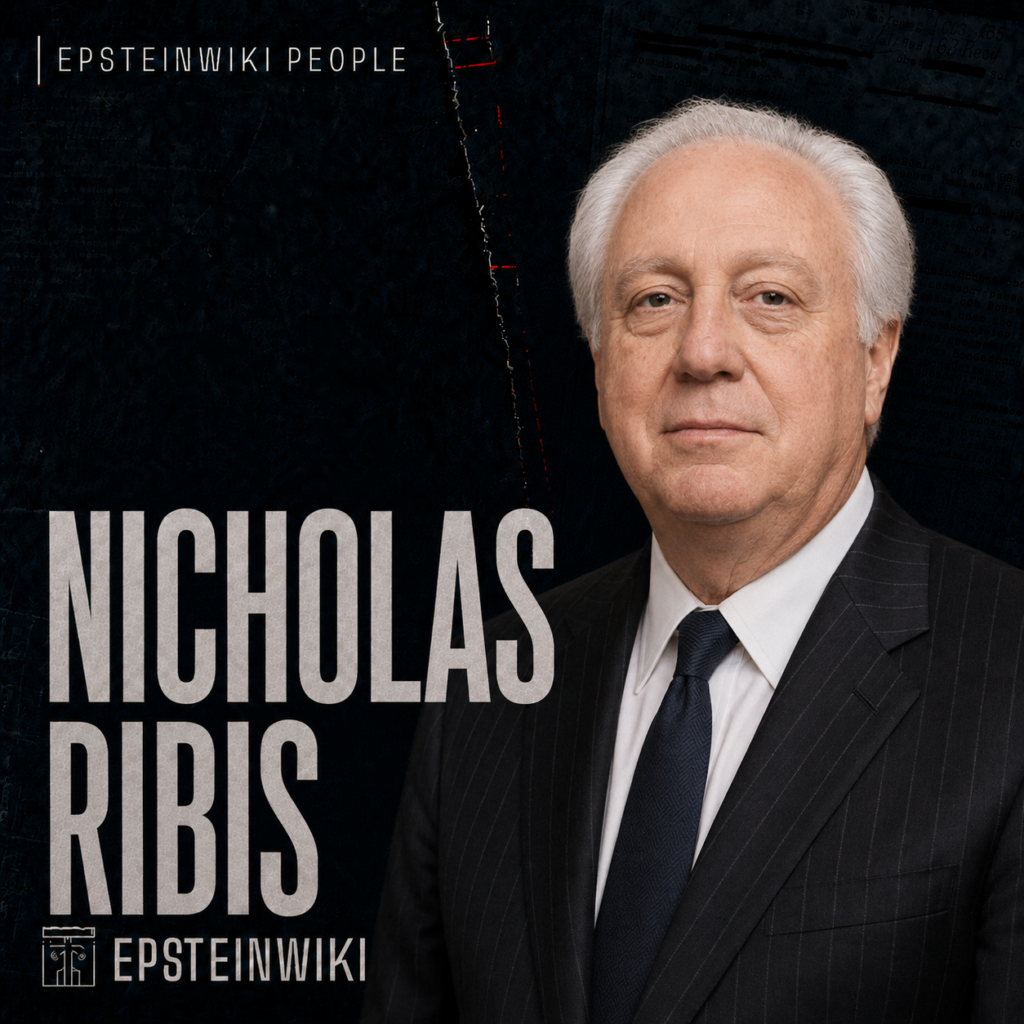
Snapshot
Nicholas L. Ribis is an American lawyer and casino executive who held senior positions in Donald Trump’s Atlantic City gambling businesses before becoming a partner of Colony Capital founder Thomas Barrack in several casino investments.
Ribis served as president and chief executive officer of Trump Hotels & Casino Resorts from 1995 until 2000. He later became a senior executive and investor in Resorts International and Colony casino ventures, including the acquisition of the Las Vegas Hilton.
Released records document a sustained relationship between Ribis and Jeffrey Epstein. The evidence extends from at least 2007 through June 2019 and includes a prospective JPMorgan client referral, meetings at Epstein’s Manhattan residence, discussions involving casino restructurings, contact with investors David Tepper and Leon Black, inquiries concerning Thomas Barrack, political commentary, and a significant financial obligation to Epstein.
The most important financial records show Epstein directing that jewelry and paintings valued at approximately $200,000 be delivered to his accountant, Richard Kahn, and returned upon payment. Later messages document partial wire payments, requests for the remaining balance, and a $158,025.02 check from Ribis that Epstein’s bank recorded as stopped.
The records establish that Ribis and Epstein had a recurring professional and financial relationship. They do not disclose the original purpose or complete legal terms of the financial arrangement. They also do not establish that Ribis participated in Epstein’s sexual abuse or trafficking operation.
Ribis is not publicly known to have been charged with an Epstein related criminal offense.
Identity and Legal Background
Nicholas L. Ribis is a lawyer and business executive whose career was concentrated in casino finance, ownership, restructuring, and management.
Professional directories identify Ribis as a graduate of Seton Hall University and St. Mary’s University School of Law. He received his law degree in 1969 and was admitted to practice in several states. Martindale’s professional listing records admissions in New Jersey, Texas, and New York.
Describing Ribis only as a legal or financial professional understates his public role. He was a prominent executive in the American casino industry and occupied senior positions in businesses controlling major properties in Atlantic City and Las Vegas.
His experience in highly leveraged casino companies also made him familiar with creditors, bondholders, secured debt, asset sales, regulatory approvals, and corporate restructuring.
Those skills are relevant to the Epstein correspondence because several messages concern investments, workouts, creditors, and introductions to wealthy financiers.
Trump Hotels and Casino Resorts
Ribis worked with Donald Trump for approximately twenty five years and became one of the most important executives in Trump’s Atlantic City casino organization.
He served as president and chief executive officer of Trump Hotels & Casino Resorts from 1995 until 2000. The publicly traded company controlled Trump Plaza, Trump Marina, Trump Taj Mahal, and an Indiana riverboat casino.
During Ribis’s tenure, the company faced substantial debt. In 1997, Ribis announced that Trump Hotels had retained an investment banker to explore the sale of a New Jersey casino. Contemporary Bloomberg reporting published by The Journal Record stated that the company had more than $1 billion in debt.
Ribis had also participated in earlier negotiations with Trump’s lenders. A Fortune account of Trump’s financial restructuring described Ribis working with Stephen Bollenbach and Trump on a strategy involving real estate, cash, casino liens, and creditor concessions.
Ribis left Trump Hotels in 2000. Contemporary New York Post reporting identified him as the company’s president and chief executive officer and reported that he had worked with Trump for twenty five years.
The evidence establishes a long professional relationship between Ribis and Trump. It does not establish that Ribis continued to represent Trump personally during the period covered by the Epstein correspondence.
The 1999 Earnings Release
In 2002, the Securities and Exchange Commission brought an administrative proceeding against Trump Hotels concerning a 1999 earnings release issued while Ribis was chief executive officer.
The SEC concluded that the release presented adjusted financial results without adequately disclosing that the reported improvement depended substantially on an unusual $17.2 million gain. The company agreed to a cease and desist order without admitting or denying the findings. No monetary penalty was imposed.
The SEC investigative record identified the conduct of senior company officers, including the chief executive officer, chief financial officer, and treasurer. Contemporary Washington Post reporting identified Ribis as the chief executive officer when the release was issued.
The order was directed at the company. It should not be represented as a criminal conviction or as proof that Ribis personally received a financial penalty.
This history remains relevant because it places Ribis within the upper management of a heavily indebted public casino company, rather than within the administrative periphery suggested by earlier descriptions of him.
Resorts International and Colony Capital
After leaving Trump Hotels, Ribis entered a partnership with Colony Capital, the investment firm led by Thomas Barrack.
In 2000, Colony Capital and Ribis acquired Resorts Atlantic City for approximately $140 million. The transaction was reported at the time by The Daily Record.
Ribis subsequently served in senior positions connected with Resorts International Holdings and Colony’s casino investments.
In December 2003, Colony agreed to purchase the Las Vegas Hilton for approximately $280 million. An SEC filed announcement identified Ribis as vice chairman of Resorts and a partner in the acquisition.
A later SEC filing identified Ribis and Barrack as managers of the acquiring company. Barrack served as chairman and Ribis as vice chairman. Entities controlled by the two men held voting interests in the business.
This was not a nominal association. Ribis and Barrack were documented partners in regulated casino investments involving hundreds of millions of dollars.
That relationship supplies important context for Epstein’s later questions about whether Ribis had spoken with “Barrack.” The surviving message strongly suggests Thomas Barrack, although the brief email does not spell out his full name.
Casino Restructuring Experience
Ribis built a reputation for acquiring, operating, and restructuring troubled casino properties.
Casino businesses frequently depend on large secured loans, bond financing, real estate values, gaming licenses, and negotiations with multiple creditor classes. Ribis’s experience therefore included many of the issues later discussed in his emails with Epstein.
Some Ribis and Colony properties experienced financial distress. Resorts Atlantic City was transferred to creditors after its ownership group could not continue making mortgage payments. Other properties were sold, restructured, or entered bankruptcy proceedings.
A corporate bankruptcy does not automatically establish personal misconduct by a company executive. The records must distinguish business failure, negotiated creditor transfers, civil allegations, regulatory findings, and criminal conduct.
The available Epstein documents show Ribis presenting himself as someone with experience in workouts, asset sales, and negotiations with second lien creditors. They do not show that Epstein employed him formally as a casino executive or restructuring adviser.
The Epstein Record at Scale
Ribis appears repeatedly in the released Epstein archive.
The Epstein Data entity index reports approximately 1,951 mentions associated with his name. That total should not be treated as 1,951 unique communications. Search indexes can count duplicate pages, quoted email chains, attachments, repeated names, and copied recipients.
The significance lies in the pattern rather than the raw count.
The archive contains:
- A 2007 introduction to JPMorgan as a possible wealthy client
- Calendar and scheduling records
- Meetings at Epstein’s Manhattan residence
- Discussions about investors and casino restructurings
- References to David Tepper, Leon Black, and Thomas Barrack
- A financial obligation involving jewelry and paintings
- Wire payment and repayment messages
- A stopped check for $158,025.02
- Political commentary concerning Trump administration figures
- Direct correspondence continuing until June 2019
This evidence establishes a recurring relationship extending across finance, business, and politics.
Epstein’s 2007 JPMorgan Referral
One of the earliest publicly reported connections involved Epstein referring Ribis to JPMorgan Chase.
An unredacted filing from the United States Virgin Islands litigation against JPMorgan described a January 2007 bank email stating that Epstein had asked two prospective clients in the “200M range” to contact the bank. The two names were Nick Ribis and Ben Jacobson.
Another bank employee reported receiving a call from Ribis, described him as a Colony Capital executive specializing in casino ownership, and arranged a meeting at Ribis’s Manhattan office.
The Daily Beast reported the referral from the unredacted court record.
The notation does not establish that Ribis personally possessed $200 million. It may have referred to potential assets, business relationships, transactions, or accounts associated with a prospective client.
It does establish that Epstein presented Ribis to JPMorgan as a potentially valuable banking relationship and that Ribis responded to the introduction.
The referral occurred in January 2007, while Epstein was under investigation in Florida. The record does not establish what Ribis knew about that investigation at the time.
Meetings After Epstein’s Conviction
Epstein pleaded guilty in Florida in 2008 to offenses involving prostitution and a minor. His relationship with Ribis nevertheless continued afterward.
Reporting based on Epstein’s schedules identified a proposed April 2011 meeting with Ribis on a day when Epstein also had appointments involving Bill Gates, Lawrence Summers, and JPMorgan executive Jes Staley.
Later Epstein Data records provide direct evidence of repeated contact.
EFTA02375743 contains August 2015 arrangements for a telephone call.
EFTA00838700 documents a December 2015 meeting scheduled at Epstein’s residence at 9 East 71st Street in Manhattan.
EFTA00333129 and EFTA02066417 preserve related calls and appointment coordination.
EFTA00324718 documents another meeting scheduled for May 18, 2016.
Calendar and scheduling records establish that appointments were planned. A calendar entry alone does not prove that every meeting occurred. In this instance, however, Ribis’s subsequent messages referring to conversations and asking for follow up support the conclusion that at least some substantive discussions took place.
David Tepper and the 2013 Deal
A January 22, 2013 message establishes that Ribis was discussing a prospective transaction involving hedge fund manager David Tepper.
In EFTA00692601, Ribis asked Epstein whether he knew Tepper. Ribis said he knew Tepper, was close to a deal with him, and wanted to talk.
The message is significant for several reasons.
First, it demonstrates direct Ribis and Epstein business communication years before the better documented 2015 through 2019 period.
Second, it shows Ribis treating Epstein as someone worth consulting about a transaction involving a prominent distressed debt investor.
Third, it provides context for a later message in which Ribis discussed dealing with second lien creditors such as Tepper.
The document does not identify the company, assets, investment amount, or final outcome. It also does not establish that Epstein participated in the deal.
A WCCB investigation later identified the January 2013 exchange as an early Epstein record involving Tepper.
The December 2015 Restructuring Proposal
After a December 2015 meeting with Epstein, Ribis sent a message describing how his experience could assist a person identified as “Leon.”
In EFTA01804370, Ribis referred to providing a different perspective on a workout strategy, selling assets, and dealing with second lien holders such as David Tepper. He also emphasized his restructuring experience.
The surrounding network makes Leon Black a plausible identification, but the message as presented uses only the name Leon. A responsible account should therefore distinguish the text of the record from the inference about identity.
The email establishes that Ribis and Epstein discussed a potentially significant financial restructuring and that Ribis wanted to offer his experience.
It does not establish that Leon retained Ribis, that Epstein formally represented either party, or that a transaction was completed.
Questions About Thomas Barrack
Ribis’s long business partnership with Thomas Barrack also entered the Epstein correspondence.
In EFTA02654041, Epstein asked Ribis whether he had spoken with “Barrack.”
Given Ribis’s documented partnership with Thomas Barrack in Colony casino ventures, the message appears to refer to him. The limited text does not identify the subject of the proposed discussion.
The record demonstrates Epstein’s awareness of Ribis’s access to Barrack. It does not establish that Barrack authorized Epstein to act as an intermediary or that a resulting conversation occurred.
Ribis’s relationship with Barrack was independently documented years earlier in SEC filings concerning the Las Vegas Hilton acquisition.
Recurring Requests for Epstein’s Help
The correspondence contains repeated messages in which Ribis sought Epstein’s response, advice, or intervention.
In EFTA02367128, Ribis asked Epstein whether he had any thoughts about the previous day’s conversation.
In EFTA01803806, Ribis asked whether there was anything new from a discussion with a person identified only by the initial “L.”
In EFTA01738857, Ribis asked Epstein to call him.
In EFTA01059424, Epstein responded “Always” after Ribis thanked him.
In EFTA02657670, Ribis asked whether he could visit Epstein, and Epstein welcomed the proposed meeting.
The messages are brief, but their frequency demonstrates familiarity and continuing access. Ribis did not appear to be an incidental name copied into unrelated correspondence.
The May and June 2017 Communications
Contact intensified during May and June 2017.
EFTA02647389, EFTA02647452, and HOUSE_OVERSIGHT_026103 contain repeated efforts to arrange calls and visits during the final days of May.
In EFTA02647064, Ribis asked Epstein not to forget him and requested access to documents.
EFTA00644457 contains another request concerning how Ribis could reach Epstein.
These communications show that Ribis was actively pursuing Epstein’s attention in connection with an unresolved matter. The available excerpts do not fully identify that matter.
Short scheduling messages should not be used to invent a transaction. Their value comes from documenting the continuity and intensity of the relationship.
Jewelry, Paintings, and the $200,000 Arrangement
A June 24, 2017 email provides the clearest evidence of a financial arrangement between Epstein and Ribis.
In EFTA01042670, Epstein instructed Ribis and Richard Kahn to deliver approximately $200,000 in jewelry and paintings to Kahn. Epstein stated that the property was to be returned upon payment. Ribis replied that he understood.
The instruction strongly suggests that the jewelry and paintings were being held as security or collateral for an obligation owed to Epstein.
The document does not identify:
- The original amount advanced
- The date of the advance
- The purpose of the arrangement
- The owner of every object
- Whether a written loan agreement existed
- The interest rate, if any
- The complete repayment schedule
- Whether the objects were ever delivered
It is therefore more accurate to describe the exchange as a financial arrangement or obligation than to state conclusively that it was a conventional loan.
Partial Payments and the Remaining Balance
Later correspondence shows Ribis attempting to make payments.
In EFTA01014493, Ribis stated on December 20, 2017, that a $50,000 wire would be sent that day.
In EFTA01014684, Epstein asked whether the remaining balance would be paid before the end of the year as promised.
In EFTA00910768, Ribis said in January 2018 that a wire would be sent that day.
EFTA00906783 contains a follow up question asking whether the wire had arrived.
EFTA01036328 preserves another message stating that a wire would be sent the following day.
The records establish that Ribis acknowledged an outstanding obligation and discussed partial payment. They do not provide a complete accounting showing how much Epstein originally transferred or how the remaining balance was calculated.
The Missed March 2018 Deadline
By April 2018, Epstein was pressing Ribis for full repayment.
In EFTA02484596, Epstein stated that full payment had been due by March 31 and asked for the status.
In EFTA02486765, Ribis said he was in a meeting and would call.
In EFTA00833627, Ribis said he was attempting to obtain payment while meeting with a chief executive officer.
EFTA00824541 contains a request from Richard Kahn for an update regarding the expected funds.
In EFTA02640360, Ribis warned that a check should not be deposited because anticipated funds had not arrived.
This sequence shows that repayment depended, at least in part, on Ribis receiving money from another source.
The documents do not identify that source or explain whether it involved a casino transaction, consulting payment, asset sale, investment, or unrelated business matter.
The $158,025.02 Stopped Check
The financial dispute continued into July 2018.
EFTA01598061 contains an image associated with check number 1148.
More significantly, EFTA01431829 is a dishonored items record identifying Jeffrey Epstein as the depositor and Nicholas Ribis as the maker. It lists check number 1148 in the amount of $158,025.02 and records the reason as payment stopped.
In EFTA01041007, Epstein asked Ribis why the bank reported that he had stopped payment on the check.
In EFTA01041319, Ribis expressed surprise and said he would investigate.
Other June 2018 messages, including EFTA00890738, EFTA01038301, EFTA01038398, EFTA00890394, and EFTA02529762, document the continuing outstanding balance and requests concerning the timing of deposits.
The $158,025.02 check was not merely an unexplained payment sent to Epstein. The surrounding correspondence indicates that it was connected with an existing obligation and attempted repayment.
The record does not establish whether the payment was ultimately completed.
What the Financial Records Mean
The financial evidence is substantial but incomplete.
It establishes that Epstein provided Ribis with something of value or otherwise held a claim requiring repayment. It also establishes that jewelry and paintings worth approximately $200,000 were associated with the arrangement, that Ribis sent or proposed partial payments, and that Epstein attempted to deposit a $158,025.02 check.
The evidence does not disclose the entire transaction.
It would be inaccurate to describe the stopped check as proof of bribery, trafficking proceeds, political funding, or a casino investment without additional evidence.
It would also be inaccurate to omit the surrounding repayment correspondence and describe the check as a spontaneous transfer from a former Trump executive to Epstein.
The safest conclusion is that Ribis owed Epstein money under a financial arrangement whose original purpose and complete terms remain unidentified in the public record reviewed for this article.
Epstein as a Financial Intermediary
The Ribis correspondence illustrates Epstein’s role as an intermediary among executives, investors, banks, and wealthy individuals.
Epstein referred Ribis to JPMorgan. Ribis later consulted him about David Tepper, proposed using his restructuring experience for Leon, discussed contact with Barrack, and sought Epstein’s help with unspecified business matters.
The relationship was therefore not limited to personal social contact.
Epstein could offer:
- Introductions to banks and wealthy clients
- Access to investors and financial executives
- Informal advice about negotiations
- Private meetings at his Manhattan residence
- Financial assistance or credit
- Communication with people in Ribis’s existing business network
The records do not show that Epstein held a professional license as an investment banker, attorney, or restructuring adviser during this period. His influence rested heavily on personal access and private relationships.
Trump and White House Commentary
Ribis and Epstein also exchanged political news and commentary.
In EFTA02544263, Ribis forwarded material concerning Michael Wolff’s book about the Trump White House.
In EFTA02625174, Ribis forwarded an August 2018 article concerning Stormy Daniels and Trump.
HOUSE_OVERSIGHT_027095 contains a December 2018 exchange referring to “DJT” and Mick Mulvaney. EpsteinWiki has separately indexed this record as Nicholas Ribis Email Referencing DJT and Mick Mulvaney.
HOUSE_OVERSIGHT_030651 contains Epstein’s question about whether Trump would turn against Steve Bannon as Bannon attracted greater attention and power.
HOUSE_OVERSIGHT_032840 contains a June 2019 exchange referring to Kellyanne Conway and departures from the White House.
The messages demonstrate that Ribis and Epstein discussed Trump administration personalities and political developments.
They do not establish that Ribis was speaking for Trump, that he possessed official White House information, or that Trump knew about the conversations.
Contact Shortly Before Epstein’s Arrest
The correspondence continued close to Epstein’s July 2019 arrest.
HOUSE_OVERSIGHT_031787 preserves a May 29, 2019 message from Ribis to Epstein.
HOUSE_OVERSIGHT_032840 contains the June 1, 2019 exchange involving Kellyanne Conway and White House departures.
These records show that Ribis remained in direct communication with Epstein approximately one month before Epstein was arrested on federal sex trafficking charges.
Continued contact after Epstein’s conviction is relevant to understanding the durability of the relationship. It does not by itself establish that Ribis knew about Epstein’s continuing abuse.
No Documented Sexual Misconduct Allegation
The reviewed records principally concern banking, casino business, investments, political commentary, meetings, and a private financial obligation.
They do not establish that Ribis recruited women or girls for Epstein, participated in sexual activity at Epstein’s properties, or knowingly assisted a trafficking operation.
No publicly identified survivor statement reviewed for this article accuses Ribis of sexual abuse.
No publicly identified criminal indictment or civil judgment reviewed for this article finds that Ribis participated in Epstein’s sexual offenses.
That absence must be stated clearly. Financial and professional proximity to Epstein is a legitimate subject of investigation, but it is not equivalent to evidence of sexual misconduct.
What the Evidence Establishes
The available evidence establishes that:
- Nicholas Ribis was a senior casino executive and lawyer.
- Ribis worked with Donald Trump for approximately twenty five years.
- He served as president and chief executive officer of Trump Hotels & Casino Resorts from 1995 until 2000.
- He later partnered with Thomas Barrack and Colony Capital in major casino investments.
- Ribis was a partner in the acquisition of the Las Vegas Hilton.
- Epstein referred Ribis to JPMorgan as a prospective high value client in 2007.
- Ribis remained in contact with Epstein after Epstein’s 2008 conviction.
- Epstein’s records contain repeated calls, meetings, and scheduling involving Ribis.
- Ribis consulted Epstein about a prospective 2013 deal involving David Tepper.
- Ribis discussed using his restructuring experience in a matter involving a person identified as Leon.
- Epstein asked Ribis whether he had spoken with Barrack.
- Ribis repeatedly sought Epstein’s advice, assistance, or response.
- Epstein directed that approximately $200,000 in jewelry and paintings be held and returned upon payment.
- Ribis discussed multiple wire payments toward an outstanding obligation.
- Epstein stated that full repayment had been due by March 31, 2018.
- A $158,025.02 check from Ribis to Epstein was recorded as stopped.
- The financial correspondence continued for more than a year.
- Ribis and Epstein exchanged political news and commentary concerning Trump administration figures.
- Their direct communications continued until at least June 2019.
- Ribis is not publicly known to have been convicted of an Epstein related offense.
What the Evidence Does Not Establish
The available evidence does not establish that:
- Ribis participated in Epstein’s sexual abuse or trafficking operation.
- Ribis recruited women or girls for Epstein.
- Ribis knew the full extent of Epstein’s criminal conduct.
- Every scheduled meeting with Epstein occurred.
- Epstein formally represented Ribis as an investment banker or attorney.
- The 2007 JPMorgan description proves that Ribis personally controlled $200 million.
- Epstein participated in the completion of Ribis’s proposed deal with David Tepper.
- Leon Black formally hired Ribis.
- Thomas Barrack authorized Epstein to arrange business on his behalf.
- The jewelry and paintings were definitively pledged under a written loan agreement.
- The public record discloses the original purpose of Ribis’s financial obligation.
- The $158,025.02 check was a bribe, political payment, casino investment, or trafficking related transfer.
- Ribis intentionally stopped the check himself.
- Epstein ultimately collected the entire balance.
- Ribis spoke for Donald Trump or the Trump White House.
- Political commentary in private email was based on confidential government information.
- A corporate bankruptcy or creditor transfer proves personal fraud by an executive.
- The SEC imposed a criminal penalty on Ribis.
- Every indexed reference to Ribis represents a unique document.
- Appearance in Epstein’s records establishes criminal conduct.
Investigative Assessment
Nicholas Ribis was not a minor administrative figure in Epstein’s professional environment.
He was an experienced casino executive with long standing access to Donald Trump, Thomas Barrack, creditors, banks, investors, and regulated gambling businesses. Epstein appears to have valued that access and expertise.
The relationship was reciprocal.
Epstein introduced Ribis to JPMorgan and appears to have offered financial assistance, contacts, and access. Ribis brought decades of experience in casino debt, asset sales, workouts, and negotiations with investors such as David Tepper. He also maintained a direct connection to Barrack and continued discussing Trump related political developments with Epstein.
The strongest evidence concerns their financial arrangement. The combination of property valued at approximately $200,000, partial wires, repayment deadlines, an outstanding balance, and a stopped check establishes more than casual acquaintance.
The exact purpose of the arrangement remains unresolved. The public documents reviewed here do not provide the original agreement or a complete accounting.
The most defensible classification is that Ribis was a recurring Epstein business contact, financial counterparty, and source of access to casino, investment, and Trump related networks.
Any allegation that he participated in Epstein’s sexual crimes would require separate evidence that is not present in the records reviewed for this article.
Key Takeaways
- Ribis was a major casino executive, not a nonpublic administrative professional.
- He led Trump Hotels & Casino Resorts during a period of substantial debt and restructuring.
- He later partnered with Thomas Barrack and Colony Capital.
- Epstein referred him to JPMorgan as a prospective valuable client in 2007.
- Their relationship continued after Epstein’s Florida conviction.
- Ribis discussed David Tepper, Leon, Barrack, restructuring, and creditor negotiations with Epstein.
- Repeated scheduling records place Ribis within Epstein’s active business network.
- Epstein and Ribis had a documented financial arrangement involving jewelry, paintings, wires, and repayment obligations.
- The $158,025.02 stopped check appears within a longer repayment sequence.
- The original purpose and complete terms of the financial arrangement remain undisclosed.
- Ribis and Epstein exchanged political commentary about Trump administration figures.
- Their correspondence continued until June 2019.
- The reviewed evidence does not establish sexual misconduct by Ribis.
- The financial and professional relationship warrants scrutiny without converting association into an unsupported criminal allegation.
Related EpsteinWiki Articles
- Jeffrey Epstein
- Donald Trump
- Thomas Barrack
- Leon Black
- David Tepper
- Steve Bannon
- JPMorgan Chase and Jeffrey Epstein
- Government of the United States Virgin Islands v. JPMorgan Chase
- Epstein Financial Networks
- Nicholas Ribis Email Referencing DJT and Mick Mulvaney
- How to Read an Epstein Document
- Witness Statements and Depositions Litigation
Primary Corporate, Court, and Government Sources
- SEC investigative record concerning Trump Hotels & Casino Resorts
- SEC filing documenting the Las Vegas Hilton acquisition
- SEC filed announcement identifying Ribis as a Las Vegas Hilton acquisition partner
- USVI v. JPMorgan Chase federal docket
- Bloomberg report on Trump Hotels debt and proposed casino sale
- New York Post report on Ribis leaving Trump Hotels
- Washington Post report on the Trump Hotels SEC proceeding
- Daily Record report on the Resorts Atlantic City acquisition
- Daily Beast report on Epstein’s JPMorgan referral of Ribis
- WCCB report on the David Tepper correspondence
- Nicholas Ribis professional education and admission record
Primary Epstein Data Evidence
- Nicholas Ribis entity index collects indexed references to Ribis. Its mention count includes repeated and duplicated material and should not be treated as a count of unique communications.
- EFTA00692601 contains Ribis’s January 2013 message concerning a prospective deal with David Tepper.
- EFTA02375743 documents telephone coordination in August 2015.
- EFTA00838700 records a December 2015 meeting scheduled at Epstein’s Manhattan residence.
- EFTA01804370 contains Ribis’s restructuring proposal involving Leon, asset sales, workout strategy, and second lien holders such as David Tepper.
- EFTA00333129 contains follow up communication and scheduling.
- EFTA02066417 contains additional appointment coordination.
- EFTA00324718 documents a May 2016 meeting.
- EFTA02367128 contains Ribis’s request for Epstein’s thoughts following a conversation.
- EFTA01803806 contains Ribis’s question about a discussion with a person identified as “L.”
- EFTA01738857 contains Ribis’s November 2016 request for a telephone call.
- EFTA01059424 preserves Epstein’s response after Ribis thanked him.
- EFTA02657670 documents a proposed March 2017 visit.
- EFTA02654041 contains Epstein’s question about whether Ribis had spoken with Barrack.
- EFTA02647389 contains May 2017 call and visit coordination.
- EFTA02647452 contains related May 2017 scheduling.
- HOUSE_OVERSIGHT_026103 preserves additional communication from the same period.
- EFTA02647064 contains Ribis’s request that Epstein not forget him and his request to see documents.
- EFTA00644457 contains a request about reaching Epstein.
- EFTA01042670 documents Epstein’s instruction concerning approximately $200,000 in jewelry and paintings to be returned upon payment.
- EFTA01014493 contains Ribis’s December 2017 statement that a $50,000 wire would be sent.
- EFTA01014684 contains Epstein’s question about payment of the remaining balance.
- EFTA00910768 contains Ribis’s January 2018 statement that a wire would be sent.
- EFTA00906783 contains a question about whether the wire arrived.
- EFTA01036328 contains another promised wire payment.
- EFTA02484596 records Epstein’s assertion that full repayment was due by March 31, 2018.
- EFTA02486765 contains Ribis’s response that he would call.
- EFTA00833627 contains Ribis’s statement that he was attempting to obtain payment.
- EFTA00824541 contains Richard Kahn’s request for an update on expected funds.
- EFTA02640360 contains Ribis’s warning not to deposit a check because anticipated funds had not arrived.
- EFTA00890738 contains June 2018 correspondence about the outstanding obligation.
- EFTA01038301 contains additional repayment correspondence.
- EFTA01038398 preserves further discussion of the expected payment.
- EFTA00890394 contains a request concerning the timing of a deposit.
- EFTA02529762 contains another communication about the outstanding funds.
- EFTA01598061 contains an image associated with Ribis check number 1148.
- EFTA01431829 identifies a stopped $158,025.02 check from Nicholas Ribis deposited by Jeffrey Epstein.
- EFTA01041007 contains Epstein’s question about the stopped payment.
- EFTA01041319 contains Ribis’s response that he would investigate.
- EFTA02544263 contains political material concerning Michael Wolff’s account of the Trump White House.
- EFTA02625174 contains an article forwarded by Ribis concerning Stormy Daniels and Trump.
- HOUSE_OVERSIGHT_027095 contains December 2018 commentary referring to DJT and Mick Mulvaney.
- HOUSE_OVERSIGHT_030651 contains Epstein’s question concerning Trump and Steve Bannon.
- HOUSE_OVERSIGHT_031787 contains a May 29, 2019 communication from Ribis to Epstein.
- HOUSE_OVERSIGHT_032840 contains the June 2019 exchange referring to Kellyanne Conway and White House departures.