
5025 East Dublin Granville Road: Jeffrey Epstein’s Mansion Inside the Wexner Estate
Snapshot
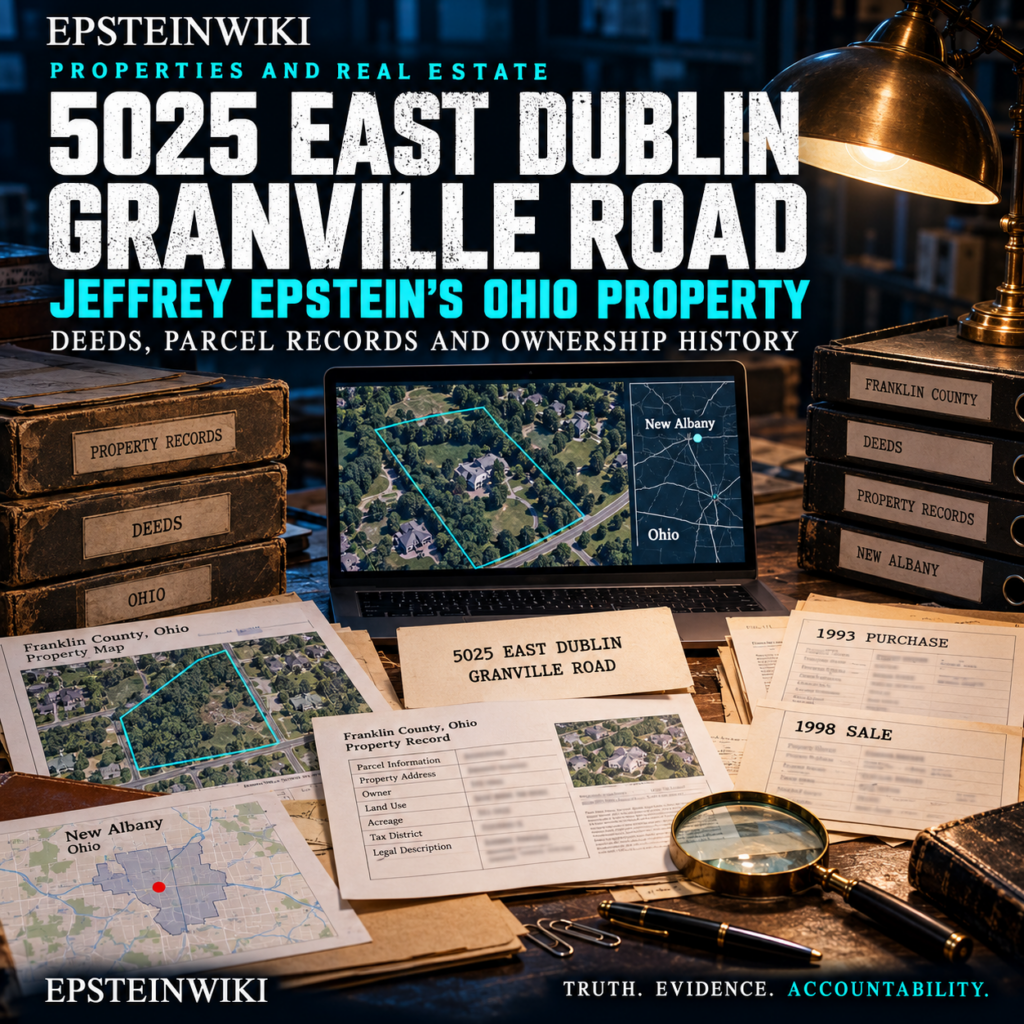
5025 East Dublin Granville Road was Jeffrey Epstein’s large residence in New Albany, Ohio, near Leslie Wexner’s main home. Its significance rests on three overlapping histories: Epstein’s property dealings with Wexner’s business circle, Maria Farmer’s account of sexual assault and confinement in 1996, and later efforts to obtain records about the property.
The phrase “inside the Wexner estate” describes a disputed relationship between the houses, surrounding land, and security arrangements. Epstein’s house was a separate residence. Wexner’s representatives disputed that it stood on Wexner owned land. Ownership, surrounding acreage, and control over access therefore require separate consideration.
The wider New Albany property network includes this property. It should not be confused with Epstein’s other documented Ohio home at 7558 King George Drive.
Key Takeaways
- Epstein’s residence and Wexner’s main mansion were different buildings.
- Published accounts place Epstein’s acquisition in either 1992 or 1993. The exact date remains a deed verification issue.
- Epstein reportedly bought the house for $3.5 million from JW & CPK & Co., a Kessler and Wexner company, and sold it in 1998 for $8 million to HHD & B LLC.
- Maria Farmer alleged that Epstein and Ghislaine Maxwell sexually assaulted her during an Ohio art residency in 1996.
- Farmer also alleged that Wexner’s security personnel prevented her departure. The Wexners disputed knowledge of her and her account of contact with Abigail Wexner.
- A 1996 FBI complaint later became public. It confirms an early warning about Epstein, but does not itself establish every detail of the Ohio allegations.
- Wexner told House investigators in 2026 that the house Epstein stayed at had been Jack Kessler’s, about half a mile from his home. He said he never met the woman at the center of the guest house questions, whose name is blacked out in the official transcript, and did not know she was there.
- Wexner’s lawyers told federal prosecutors in 2019 that the Wexner security team was not aware of any inappropriate incident on the Wexner property. These are statements made on Wexner’s behalf, not findings.
- Farmer’s 2020 civil complaint calls the house a 30,000 square foot guest house, while 2019 reporting gave about 10,600 square feet. The difference is unresolved.
- Congress expressly sought property management records and images concerning this address in 2025.
- A request for surveillance footage does not establish that footage existed, survived, or recorded a crime.
Property Identity and Reported Features
| Feature | Reported information | Qualification |
|---|---|---|
| Address | 5025 East Dublin Granville Road, New Albany, Ohio | Historical Epstein residence |
| House size | Approximately 10,600 square feet | Figure reported in the 2019 investigation |
| Size in Farmer’s 2020 complaint | 30,000 square foot guest house | Farmer’s pleading; conflicts with property reporting |
| Bedrooms | Four | Reported by Forbes |
| Relationship to Wexner’s home | Approximately half a mile away | Separate houses |
| Acquisition | $3.5 million, reported as 1992 or 1993 | Published chronology differs; NBC4 names the seller as JW & CPK & Co. |
| Sale | $8 million in 1998 | Reported buyer was HHD & B LLC |
| Later ownership | Forbes reported HHD & B LLC still held it in July 2025 | Not a certification of present ownership |
Forbes’ property investigation supplies the bedroom count and transaction figures. The 2019 Washington Post investigation by Sarah Ellison and Jonathan O’Connell supplies the size and more detailed account of the grounds.
What “Inside the Wexner Estate” Means
The 2019 investigation described the house as surrounded by Wexner land. An unnamed security officer described it as “effectively the guesthouse” for the main Wexner estate and said anyone coming onto the property “had to be announced and allowed in by the Wexners.”
Wexner spokesman Thomas Davies disputed the estate description. He said the house was not on Wexner owned land and had a separate entrance. Farmer said that entrance was locked and unavailable to her.
A December 19, 2019 memo by federal prosecutors in Manhattan records a similar position from Wexner’s lawyers. They said that at the time, Epstein owned a property adjacent to the Wexners about half a mile away, and that the Wexner security team was not aware of any inappropriate incident on the Wexner property. In the official transcript of Wexner’s 2026 deposition, page 26, he said, “The house he stayed at was Jack Kessler’s house, which is an adjacent property. It’s about a half mile away.”
Farmer’s March 2020 amended complaint tells it differently. It alleges that Wexner’s security personnel guarded Epstein’s guest house at all times and that staff discouraged her from going outside without Abigail Wexner’s permission. These are Farmer’s allegations, and the Wexners deny knowing her.
The disagreement concerns operational control as well as geography. A separately owned parcel can share surrounding security arrangements without becoming part of another owner’s legal title. Conversely, nearby ownership alone does not establish who controlled an occupant’s movements.
The strongest reconstruction would combine historical parcel boundaries with security contracts, access records, and testimony. A current aerial image cannot establish access rules in 1996.
Acquisition, Sale, and the Financial Questions
NBC4 reporting based on Franklin County Auditor records identifies the seller to Epstein as JW & CPK & Co., a company associated with Wexner and developer Jack Kessler. In the official transcript of his 2026 deposition, pages 101 to 103, Wexner said, “I know he bought a house from Jack Kessler,” and said Kessler had come to him with financial problems. When a questioner said records showed Wexner signed the deed to Epstein, he called that “shocking” and asked whether such documents could be forgeries. He answered “No” when asked whether he knew JW and CPK & Company.
Forbes dates the acquisition to 1993. The 2019 property reporting places the transfer four years before Farmer’s 1996 stay, implying 1992. Neither date should be silently treated as settled without the recorded instrument.
Regional coverage in 614NOW, citing Forbes, also reports that the buyer shared a mailing address with the New Albany Company. A common address establishes an administrative connection. It does not, by itself, identify every beneficial owner or prove who supplied the purchase money.
The reported prices imply a nominal increase of $4.5 million, approximately 129 percent of the acquisition price. This calculation is not a measure of net profit. It excludes improvements, borrowing, transaction costs, taxes, and any other consideration.
The financial questions are specific:
- What property and improvements were included in each transaction?
- Were the transactions supported by independent appraisals?
- Who financed the acquisition and the later purchase?
- Did the settlement statements contain credits, debt assumptions, or other adjustments?
- Who owned and controlled the purchasing company at the time?
The price increase warrants documentation. It does not establish a concealed payment, fraud, or an improper valuation.
Maria Farmer’s Ohio Residency
Farmer was an artist who worked for Epstein. In her affidavit, she described an employment relationship that included recording visitors to his New York home. She said Epstein subsequently arranged for her to work on an art project in Ohio during the summer of 1996.
Her account matters because it describes access through employment and promised professional opportunity. The house served as both accommodation and workspace in her narrative.
The affidavit identifies the setting as Wexner’s Ohio mansion without supplying this street address. The connection to 5025 East Dublin Granville Road comes from the property reporting. These are complementary sources, not identical forms of evidence.
Farmer’s 2023 Federal Tort Claims Act claim describes Epstein’s residence in New Albany as adjacent to property owned by Wexner. It says Epstein had her get an Ohio driver’s license using his Ohio address so she could pick him and Maxwell up from the airport. Her March 2020 amended complaint calls the place Epstein’s guest house on Wexner’s estate and says she worked there for two months in the summer of 1996. Wexner’s lawyers and Wexner himself have described Epstein’s Ohio house as adjacent and about half a mile from the Wexner home, which is consistent with the reported location of this address.
HOUSE_OVERSIGHT_018027 and HOUSE_OVERSIGHT_018028 on Epstein Data hold the relevant affidavit pages. The complete affidavit was filed in April 2019.
The Alleged Assault and Confinement
Farmer alleged in her 2019 affidavit that Epstein and Maxwell called her into a bedroom and sexually assaulted her. She said she escaped, sought help from the sheriff’s office, and was prevented from leaving by Wexner’s security staff. Her father traveled from Kentucky, and she said she was finally allowed to depart with him after approximately twelve hours.
She also alleged subsequent threats and interference with her art career. These are Farmer’s sworn allegations, rather than findings from a trial deciding the Ohio incident.
Her account presents separate questions:
- What happened inside the bedroom?
- Who received her requests for help?
- Which personnel were present at the property?
- Who gave any instructions concerning her departure?
- What did each person know at the time?
Evidence concerning one question does not automatically resolve the others. In particular, an allegation about security personnel does not by itself establish that Leslie or Abigail Wexner ordered confinement.
Corroboration, Contradictions, and the Wexners’ Response
The 2019 investigation reported that Farmer’s relatives and a friend recalled disclosures she made in 1996. Her father recalled retrieving her. These accounts support the existence of contemporary disclosures, but are not eyewitness accounts of the alleged assault.
The Wexners’ spokesman, Thomas Davies, said, “Mr. and Mrs. Wexner had no knowledge of her, never met her, never spoke with her.” This directly disputed her claim of telephone contact with Abigail Wexner.
Farmer told the Post she called 911 and the Franklin County sheriff’s office and recalled a person on the phone saying, “We work for Wexner.” A sheriff’s spokesman said deputies were contracted for Wexner’s security detail but that the office had no record of her call. The investigation also noted that its retention policy did not preserve that category of record beyond two years. An absent record decades later therefore cannot settle whether a call occurred.
In February 2026, Wexner again denied knowing of or participating in Epstein’s abuse. Associated Press coverage records his position. His denial and Farmer’s allegations remain distinct parts of the public record.
In the official deposition transcript, page 27, Wexner was asked about the survivor at the center of the guest house questions, whose name is blacked out. He said, “I never met her, didn’t know she was here, didn’t know she was abused.”
On transcript pages 141 and 142, Wexner was asked whether his security staff guarded the house while Kessler and then Epstein owned it. He said, “I have no knowledge,” and called it “impossible.” Asked about the sheriff’s office contract, he said part time police were used for special events and that “it wouldn’t have been employees of ours.” Asked about the survivor’s account that she had to call the main house for Abigail Wexner’s permission, he said, “I doubt that it’s accurate, and I have no knowledge.” These are his answers under oath, and they conflict with her allegations.
The 1996 FBI Complaint
In December 2025, the government released an FBI complaint form stamped September 3, 1996, now indexed as EFTA00006107. Farmer and her lawyers identified it as hers.
The released summary records allegations that Epstein stole photographs and negatives of her younger sisters, may have sold the photographs, requested pictures of young girls at swimming pools, and threatened to burn her house if she disclosed the matter. ABC’s coverage reproduces the recorded allegations.
The document is important evidence that authorities received an early complaint. However, that short summary does not contain the full Ohio assault narrative. It should not be described as a comprehensive FBI finding about the house or the Wexners.
Farmer’s lawyers say her reports covered more conduct than the released intake summary records. Their December 2025 statement connects those assertions to the negligence lawsuit she filed against the federal government on May 29, 2025. The statement presents her legal team’s position, not a judicial ruling that the government was liable.
Maxwell’s Account of the Ohio House
In her July 24, 2025 interview with Deputy Attorney General Todd Blanche, Maxwell said Epstein had an Ohio house because of his business relationship with Wexner. She said she helped decorate and prepare it.
Ellie Leonard’s published transcript preserves this exchange at approximately 22 minutes into the substantive interview. In the July 25 session, Maxwell also said Epstein “ran New Albany,” which she described as including a country club and a golf club.
That passage supports Maxwell’s own acknowledgment of involvement with an Ohio residence. It does not give the street address, determine legal ownership, or resolve Farmer’s allegations. It also does not establish that every reference Maxwell made to Ohio concerned this particular house.
Why Congress Requested Records About This Address
The House Oversight Committee’s August 25, 2025 subpoena to Epstein’s estate expressly names 5025 East Dublin Granville Road.
Request 13 sought documents concerning maintenance, property management, and services. Request 14 sought video, including security footage, and still photographs taken at listed properties. Both requests separately listed 7558 King George Drive.
This establishes that Congress treated the two Ohio addresses as distinct records targets. The requests could encompass evidence about staffing, contractors, visitors, and the operation of the homes.
However, the subpoena does not establish that responsive footage existed or that the estate produced a complete collection. It is a demand for evidence, not a finding about what that evidence proves.
The committee subsequently released Wexner’s deposition video following his February 18, 2026 testimony in Ohio.
The Other Ohio House Was a Separate Property
7558 King George Drive has a different transaction history and must be researched under its own address. Forbes reported that Epstein bought it in 1994 and transferred it for $0 in 2007 to a trust for Abigail Wexner.
That transfer must not be substituted for the sale of 5025 East Dublin Granville Road.
Neither Ohio property remained among the homes sold by Epstein’s estate after his death, according to Forbes. Consequently, later reporting about estate property sales and survivor compensation should not automatically be applied to this address.
Timeline
| Period | Event | Evidence status |
|---|---|---|
| 1992 or 1993 | Epstein acquires the residence | Published acquisition year differs |
| Summer 1996 | Farmer stays in Ohio and later alleges assault and confinement | Her sworn account and property reporting |
| September 3, 1996 | FBI complaint form stamped | Released intake summary covers photographs and threats |
| 1998 | Residence sold to HHD & B LLC | Reported property transaction |
| April 2019 | Farmer’s affidavit enters the public court record | Sworn allegations |
| July 25, 2019 | Wexner’s lawyers give federal prosecutors an attorney proffer | Wexner’s account as summarized in a prosecutors’ memo |
| March 9, 2020 | Farmer files an amended complaint against Epstein’s estate describing the Ohio residency | Allegations in a civil pleading |
| October 26, 2023 | Farmer signs her Federal Tort Claims Act claim | Allegations in an administrative claim |
| May 29, 2025 | Farmer files a negligence lawsuit against the United States, according to her lawyers | Allegations; no ruling cited here |
| July 24 and 25, 2025 | Maxwell discusses an Ohio house in her government interview | Her account, without an address in the cited exchange |
| August 2025 | Congress subpoenas records concerning this address | Official investigative request |
| December 19, 2025 | Farmer’s early FBI complaint becomes public | Confirmation of a recorded warning |
| February 18, 2026 | Wexner gives congressional testimony in Ohio | Testimony and public denials |
Evidence Files and What They Establish
| Evidence | Relevance | Limit |
|---|---|---|
| HOUSE_OVERSIGHT_018027 | Farmer’s employment and observations in her affidavit | Witness account, not a verdict |
| HOUSE_OVERSIGHT_018028 | Ohio residency and assault allegations | Does not supply a deed or parcel boundary |
| HOUSE_OVERSIGHT_018029 | Affidavit signature and notarization page | Authentication of the sworn statement does not independently prove its allegations |
| DOJ OGR 00010663 | Collection containing Farmer’s written victim impact statement, pages 10 and 11 | Sentencing submission, not an Ohio trial judgment |
| EFTA00006107 | FBI complaint form stamped September 3, 1996 recording allegations about stolen photographs of Farmer’s sisters and threats | Short intake summary; does not contain the full Ohio assault narrative |
| EFTA02777624, pages 11 to 13 | Farmer’s March 9, 2020 amended complaint describing the Ohio stay, alleged assault, and confinement | Civil pleading, not a finding |
| EFTA02731082, page 66 | Prosecutors’ summary of Wexner’s lawyers saying Epstein owned an adjacent property about half a mile away and that security knew of no incident | Statements made on Wexner’s behalf |
| DOJ-OGR-00022393 | Maxwell says she decorated and put together Epstein’s Ohio house | No street address given |
| Farmer Federal Tort Claims Act claim | Residence adjacent to Wexner property, Ohio license instruction, alleged assault, and 1996 reports | Administrative claim, not a ruling |
| Estate subpoena | Explicit requests about both Ohio addresses | Does not show what was ultimately produced |
The Epstein Data source index for Farmer provides the document cross references. Archive summaries are finding aids. The underlying filings remain the evidence.
What Remains Unresolved
- Exact acquisition date: The recorded deed and filing date would resolve the conflicting published years.
- Historical boundaries: A survey from the relevant period would distinguish Epstein’s parcel from surrounding Wexner land.
- Security authority: Contracts, payroll records, duty rosters, and instructions would clarify who controlled access.
- Financial consideration: Closing records and appraisals would explain the reported change in price.
- Contemporary communications: Surviving telephone records, correspondence, and incident reports could test parts of the competing accounts.
- Investigative follow through: The intake record alone does not reconstruct every action authorities took or failed to take.
- Congressional production: The subpoena does not establish which requested records were preserved and delivered.
- Size: Farmer’s 2020 complaint and the 2019 property reporting give very different square footage.
- Present title: A 2025 ownership report should not be represented as a current deed search.
The property’s importance lies in the intersection of a documented residence, financial dealings, disputed security arrangements, and a survivor’s early allegations. Those strands require their own evidence and should remain distinguishable throughout any investigation.
Sources
- EpsteinWiki: New Albany Property Network.
- Forbes: The selloff of Jeffrey Epstein’s homes, July 22, 2025.
- Sarah Ellison and Jonathan O’Connell: Investigation of Farmer’s New Albany allegations, October 5, 2019.
- NBC4: Jeffrey Epstein’s connection to New Albany’s transformation.
- Maria Farmer: Complete April 2019 affidavit.
- Epstein Data: Farmer affidavit, substantive Ohio page.
- Epstein Data: Victim impact statement collection.
- ABC: December 2025 release and the 1996 FBI complaint.
- Marsh Law Firm: Farmer’s response and legal allegations.
- Ellie Leonard: Maxwell interview transcript, July 24, 2025.
- House Oversight: August 25, 2025 estate subpoena.
- House Oversight: Wexner deposition video release.
- Associated Press: Wexner’s February 2026 testimony and denials.
- Epstein Data: EFTA00006107, FBI complaint form stamped September 3, 1996.
- Epstein Data: EFTA02777624, Farmer amended complaint, March 9, 2020.
- Epstein Data: EFTA02731082, federal prosecutors’ memo, December 19, 2019.
- Epstein Data: DOJ-OGR-00022393, Maxwell interview transcript, July 24, 2025.
- Epstein Data: DOJ-OGR-00022759, Maxwell interview transcript, July 25, 2025.
- Maria Farmer: 2023 Federal Tort Claims Act claim.
- House Oversight Committee: official Wexner deposition transcript, released November 10, 2026.