
Ben Goertzel
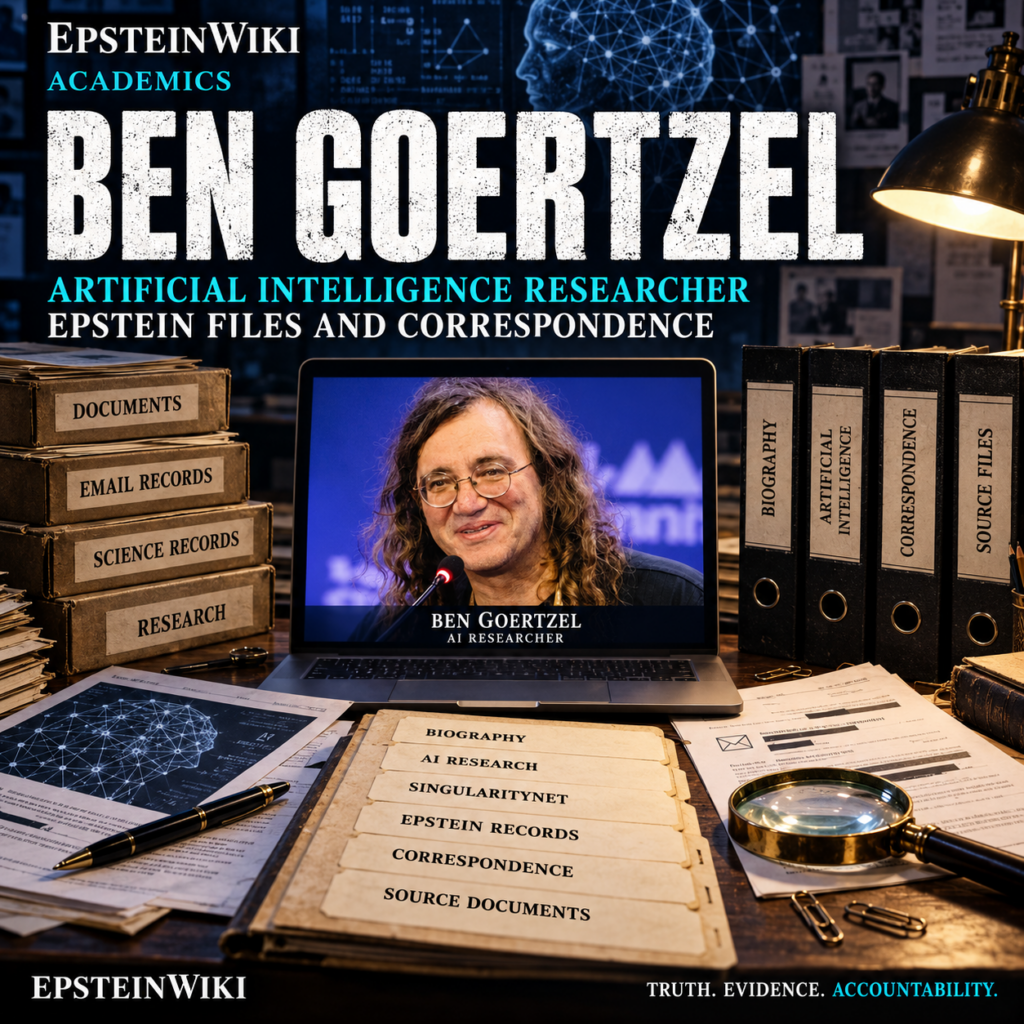
Snapshot
Ben Goertzel is a mathematician and artificial intelligence researcher associated with OpenCog, the Artificial General Intelligence conference series, Hanson Robotics and SingularityNET. He says Jeffrey Epstein funded a university research fellowship for him in 2001. Released correspondence documents their continuing relationship from 2009 through 2018, including research proposals, donations, meetings and introductions after Epstein’s 2008 conviction for offenses that included soliciting prostitution from a minor.
Goertzel estimated in a February 2026 public statement that Epstein provided approximately $360,000 toward his projects over roughly seventeen years. Epstein’s support included private contributions associated with OpenCog research in Hong Kong. The South China Morning Post reported that Epstein committed at least $113,000 toward work that qualified for at least HK$8.9 million in Hong Kong government grants.
The financial record needs careful separation. A proposed $300,000 gift in 2014 was stopped. A later $150,000 approval involving Humanity+ concerned a visa arrangement for another researcher, Joscha Bach. Neither figure can simply be added to the amount Goertzel received for his own projects.
Goertzel says he did not know about Epstein’s abuse, did not visit his island or fly on his aircraft, and now regrets accepting his support. The released records document an extended funding relationship and Goertzel’s contemporary responses to allegations against Epstein. They do not establish that Goertzel participated in Epstein’s sexual crimes.
Key Takeaways
- Goertzel says Epstein funded an approximately $100,000 fellowship at the University of New Mexico in 2001 and 2002. Goertzel’s published résumé also identifies a 2001 Epstein grant.
- After Epstein’s conviction, Goertzel continued corresponding with him and seeking research funding. A September 2009 exchange records Epstein agreeing to provide $50,000 for Goertzel’s artificial intelligence book work.
- Goertzel’s 2014 book Engineering General Intelligence publicly thanked Epstein for supporting his research and said Epstein was helping the OpenCog Hong Kong project. The acknowledgment appears in a copy preserved in the Epstein files, EFTA00623759.
- Goertzel said Epstein supplied private matching contributions for Hong Kong research every year beginning in 2010, usually through Humanity+. The Hong Kong government grants were public funding, not donations from Epstein.
- In January 2015, Goertzel dismissed reports concerning Epstein’s conduct and speculated that any conduct that occurred involved consenting adults. In 2026, he said he had believed Epstein’s misleading account and should have investigated.
- The $300,000 gift proposed in December 2014 did not proceed according to Epstein’s accountant. A draft letter involving Leon Black was unsigned and does not establish a completed payment.
- The $150,000 approved in 2016 for Humanity+ arose from discussions about sponsoring Joscha Bach’s visa and salary. It was not a personal grant to Goertzel.
- Goertzel proposed a SingularityNET opportunity to Epstein in 2017. The identified records do not establish that Epstein invested in the venture.
- Goertzel’s 2026 statement contains an unresolved arithmetic discrepancy: it says about $100,000 of his funding came after the 2008 conviction, while its itemized list places approximately $260,000 in later years.
Goertzel’s Research and Organizations
Goertzel earned a doctorate in mathematics from Temple University in 1989. His professional biography describes a career spanning cognitive science, artificial intelligence and software development. He founded or led research efforts aimed at artificial general intelligence, a field concerned with building systems capable of learning and reasoning across many kinds of tasks.
His work includes OpenCog, an open source artificial intelligence project, and the Artificial General Intelligence conference series. He later worked with Hanson Robotics on the software associated with Sophia and founded SingularityNET, which connects artificial intelligence work with decentralized technology. His later OpenCog Hyperon research reflects the continuation of those interests.
Goertzel’s organizations had different structures and purposes. Humanity+ was a nonprofit funding route in some Epstein correspondence. Novamente was a commercial artificial intelligence company. OpenCog was a research project. SingularityNET emerged later. Evidence of Epstein support for one project does not establish that he financed every organization or later product connected to Goertzel.
The 2001 University Fellowship
In his February 2026 account, Goertzel said mutual acquaintances introduced him to Epstein in New York in 2001. He described Epstein funding a research fellowship at the University of New Mexico for 2001 and 2002, at approximately $100,000 including university overhead.
A résumé published on Goertzel’s website separately lists a 2001 grant of $100,000 from an Epstein foundation for artificial intelligence research. These are two statements from Goertzel supporting the early fellowship. They should not be confused with an additional $100,000 claim about salary that appeared in later news reporting. The released emails examined below primarily cover the relationship from 2009 onward and do not provide a complete university accounting for the 2001 award.
Goertzel says contact became intermittent and later resumed. He told Business Insider that Epstein portrayed the prosecution that led to his 2008 conviction as politically motivated and involving a consenting adult. Goertzel says he accepted that account and was wrong to do so.
Correspondence During Epstein’s Sentence
An Epstein office list, EFTA00306074, names Goertzel among people given instructions for sending Epstein mail, including research papers, while he was incarcerated. The list establishes that his name appeared in the mailing arrangements. It does not establish a prison visit.
An April 2009 message, EFTA00748681, discusses Goertzel’s artificial intelligence research while Epstein was serving his sentence. A July 2009 message, EFTA00772950, congratulates Epstein after his release to home detention. In September 2010 correspondence, EFTA00756577, Goertzel again referred positively to Epstein’s release.
The documents are significant because the relationship continued after the conviction. They do not, by themselves, establish what Goertzel knew about any later crimes.
The 2009 Research and Book Funding
Goertzel sought Epstein’s help with relatively small research expenses as well as larger projects. An April 2009 request, EFTA00774433, asked for $2,000 to record artificial intelligence lectures. A related message, EFTA00774429, identified the Singularity Institute for AI as the proposed recipient.
A September 11, 2009 email chain, EFTA00770109, shows Goertzel describing his need for several months to write a book on artificial general intelligence. Epstein asked whether he could give $50,000 through a nonprofit and said he would send the money. In a February 2010 update, EFTA00763967, Goertzel referred back to Epstein having funded the book work with that sum.
Goertzel also traveled to meet Epstein. An October 2009 travel exchange, EFTA00771045, concerns a Palm Beach visit with researcher Itamar Arel. A followup message, EFTA02437895, thanked Epstein for discussing their artificial intelligence systems.
An October 2009 civil deposition, EFTA01158522, contains a question to Epstein about whether he knew Goertzel. Epstein invoked constitutional protections in response, as he did for several other names in the same sequence. That response is not evidence of misconduct by Goertzel.
The Published Book Acknowledgment
The earlier article omitted a direct, public record of how Goertzel described the funding at the time. In the acknowledgments of Engineering General Intelligence, Part 1, Goertzel thanked Epstein for what he called “visionary funding” that had helped his artificial intelligence research through difficult periods. He also stated that Epstein was supporting OpenCog work in Hong Kong when the acknowledgment was written.
The book is preserved in the release as EFTA00623759. The acknowledgment matters for two reasons. It confirms that Goertzel openly credited Epstein’s support, and it connects that support to the Hong Kong project in Goertzel’s own words. It is an acknowledgment, rather than a dedication of the book to Epstein.
Hong Kong Grants and Private Matching Funds
Goertzel’s OpenCog research at Hong Kong Polytechnic University relied on projects that required private contributions alongside public support. A November 2013 message, EFTA00678495, describes a structure in which the Hong Kong government supplied 90 percent and a private sponsor supplied 10 percent. In a January 2015 exchange, EFTA02372877, Goertzel said Epstein had provided the private portion every year since 2010, usually by donating through Humanity+.
The South China Morning Post investigation reported at least $113,000 in Epstein commitments associated with OpenCog over at least five years. It reported that the arrangement helped qualify projects for at least HK$8.9 million in Hong Kong public grants. These figures describe different sources of money. Epstein did not personally donate the HK$8.9 million.
The released emails show particular requests and followups:
- A December 2013 message, EFTA00978432, describes $45,000 sought for a Hong Kong matching contribution.
- A January 2014 followup, EFTA00633984, says that the $45,000 had been due by the end of 2013.
- A January 2015 request, EFTA02372877, asks whether Epstein could still supply $25,000 for the Hong Kong project after a larger proposal was paused.
A request, an approval, a grant award and a bank transfer are different records. Goertzel’s statement and investigative reporting describe the overall arrangement, but the emails alone should not be treated as a complete ledger of every completed payment.
Humanity+ and the Funding Route
In a January 2013 chain, EFTA00683473, Epstein instructed accountant Richard Kahn to send $30,000 to Humanity+ in connection with Goertzel. Goertzel thanked him, discussed the organization’s role in receiving the contribution, and later supplied payment details in EFTA00952303. That chain contains an instruction and an acknowledgment; it is not itself a bank confirmation.
A forwarded copy, EFTA02565159, bears the subject “Funneling money.” Joscha Bach wrote the forwarding subject line, so it must not be attributed to Goertzel. The underlying discussion concerned the Humanity+ payment route.
In an August 2014 correction, EFTA00995144, Goertzel told a writer preparing Epstein foundation publicity that the money had supported the OpenCog Hong Kong effort and its required private match. He said it had not directly funded every OpenCog researcher or iCog Labs. That contemporary correction narrows the claims that can be made about which project received Epstein support.
Sue Selle’s Feral America investigation argues that the route through Humanity+ and a commercial sponsor raises nonprofit and grant compliance concerns. Selle said she referred those concerns to the Internal Revenue Service. Her article presents an allegation and an investigator’s interpretation. It is not an IRS ruling or court finding of money laundering. Goertzel told Business Insider that the funds supported research within Humanity+’s charitable purpose.
The 2011 Humanity+ Figure
Goertzel’s 2026 funding list assigns $10,000 through Humanity+ in 2011 to his artificial intelligence work. A 2019 New York Times report preserved in EFTA00018466 describes a $20,000 gift in 2011 from an Epstein charity to the organization then known as the World Transhumanist Association, later Humanity+.
Those amounts cannot simply be treated as identical. They may refer to different transactions, or to a gift to the organization of which Goertzel attributed only a portion to his project. The cited material does not reconcile them. The $20,000 organizational figure should not silently replace Goertzel’s $10,000 project figure, and both should not automatically be added as separate personal payments.
The Proposed $300,000 Gift That Did Not Proceed
In December 2014 correspondence, EFTA00714872, Epstein referred to a proposed $300,000 contribution for Goertzel. Goertzel and Kahn then discussed possible recipient organizations and payment instructions.
A draft gift letter, EFTA00587395, contemplated Leon Black or his foundation making a $300,000 gift to Humanity+ for research associated with Goertzel. Its date was blank. The related research proposal, EFTA00597456, named Goertzel, Bach and Cosmo Harrigan and described testing an integrated cognitive architecture with virtual animals.
The proposal was stopped. An Epstein instruction, EFTA00654115, told his office to abandon the Goertzel idea. A December 31 message from Kahn, EFTA00659029, explicitly said Epstein had changed his mind about the $300,000 and that Goertzel had not yet been informed. No completed $300,000 gift is established. Counting it as money Goertzel received would be a factual error.
The January 2015 Allegations and Goertzel’s Reply
On January 6, 2015, Kahn told Goertzel that funding would be paused amid damaging publicity. In his reply preserved in EFTA02372877, Goertzel dismissed the coverage. He suggested the accusations might be invented and, alternatively, speculated that any conduct had involved people he assumed were mature and consenting. He also asked whether Epstein could still help with $25,000 for the Hong Kong project.
A subsequent message, EFTA00673959, thanked Epstein and suggested resuming a larger discussion involving Bach when the publicity subsided. These are Goertzel’s contemporary words. They show how he responded to allegations while still seeking support.
In his 2026 statement, Goertzel acknowledged that the emails were wrongheaded. He said he had believed Epstein’s misleading description of his legal trouble and regretted failing to investigate. His later explanation is part of the record, but it does not change the meaning of the 2015 messages.
Epstein’s Research Suggestions and Technical Access
Epstein did more than approve or reject funding. A 2011 proposal, EFTA00628447, sought a much larger artificial intelligence program involving software and robotics. It was a proposal, not a record of millions in completed funding.
Goertzel also shared material concerning artificial intelligence and trading. A 2014 message, EFTA01201795, provided results connected with Aidyia’s trading research. A January 2015 exchange, EFTA02514271, concerned a possible trading algorithm for Epstein. Goertzel later said the trading collaboration did not proceed.
A February 2013 exchange, EFTA02565964, discussed whether an artificial intelligence system might be evaluated using tests designed for children. A September 2015 exchange, EFTA00846898, shows Epstein complaining that he had not seen research deliverables. Goertzel says Epstein did not determine his research direction. The emails show that the funder nevertheless proposed ideas and pressed for results.
A June 2015 message, EFTA00655735, discusses trouble configuring remote access to equipment in the Virgin Islands. A June 2016 administrator message, EFTA00825568, identifies an artificial intelligence server associated with Goertzel’s work on the Southern Trust Company network. The documents do not establish that both messages concern the same machine or disclose what data the later server held.
Goertzel’s 2026 account says his team was offered servers at a Virgin Islands school but did not use them because of configuration problems. The administrator’s 2016 bandwidth report complicates a blanket statement that no server associated with his work operated in Epstein’s environment. The relationship between the school equipment and the Southern Trust server remains unresolved.
The July 2016 Research Meeting
An Epstein office invitation, EFTA00322180, arranged a July 21, 2016 gathering for Goertzel and a group of artificial intelligence researchers. A guest list, EFTA00322050, named Alexey Potapov, Linas Vepstas, David Weinbaum, Richard Mallah, James Babcock and Cosmo Harrigan, among others. Bach appeared in related correspondence. A proposed guest list is evidence of planning, not proof of every person’s attendance.
A sponsorship exchange, EFTA00671311, shows Goertzel asking whether to credit Enhanced Education for conference refreshments. Epstein indicated that using his own name was sufficient. In a message after the meeting, EFTA00639566, Goertzel said the expected refreshments money had not yet arrived. His later public list identifies a $3,000 conference sponsorship in 2016.
A long July 2016 email chain, EFTA00823659, also discussed music, patterns, anticipation and sexual arousal. Goertzel used an explicit example to explain a theory of timing and pleasure. This exchange is relevant to the substance and familiarity of their correspondence. It does not establish that Goertzel knew Epstein abused minors.
Humanity+ and Joscha Bach’s Visa
Goertzel helped introduce Bach into Epstein’s scientific circle, according to Bach’s account. The two researchers also appeared together in funding proposals and correspondence.
In the August and September 2016 visa chain, EFTA00630075, immigration lawyers discussed Humanity+ serving as a sponsor for Bach. They asked whether Epstein could place $300,000 to $400,000 with the organization. Goertzel said Humanity+ could accept a genuine contribution for work within its mission, but objected to any arrangement that merely placed money in its account and returned some to Epstein after the visa was approved.
The same chain records Epstein discussing a salary near $50,000 a year with $150,000 in backing. Kahn wrote that Epstein had approved $150,000 from Enhanced Education to Humanity+. A later legal invoice, EFTA00622172, concerns work on the immigration petition.
The proposed larger deposit, the $150,000 approval and any completed transfer are distinct. The correspondence reviewed by Epstein Data does not itself supply a confirmation for the full $150,000 wire. The arrangement concerned Bach’s sponsorship and proposed salary. It was not a $150,000 personal grant to Goertzel.
SingularityNET and the Last Identified Emails
A November 2017 message, EFTA02571001, presented Epstein with a SingularityNET opportunity involving artificial intelligence and blockchain technology. Related correspondence, EFTA00715243, arranged further discussion. Messages including EFTA02570929 addressed legal issues surrounding a token sale. A pitch and legal discussion do not establish that Epstein bought tokens or invested.
Epstein’s office also proposed introducing Goertzel to venture capitalist Masha Drokova while he was in Lisbon. An introduction, EFTA02228623, and office reminder, EFTA02229740, document plans for contact. They do not confirm that a meeting occurred.
The latest message from Goertzel identified in Epstein Data’s correspondence review is a December 5, 2018 invitation, EFTA01014313, concerning a New York event with SingularityNET colleagues. Epstein’s reply, EFTA02610870, did not confirm attendance. Goertzel remained willing to meet after the Miami Herald’s renewed reporting on Epstein became public.
Epstein’s Publicity Campaign
Epstein’s staff drafted promotional material portraying him as a supporter of artificial intelligence. The released material includes EFTA00583732, a draft about emotional software, EFTA01130113, a draft about robots, and EFTA01139627, a draft concerning artificial intelligence in Ethiopia.
Goertzel acknowledged the publicity in a November 2013 message, EFTA02373594. His later correction of a funding description, EFTA00995144, shows that he did not accept every claim Epstein’s publicity operation made about which projects received money.
These documents illustrate how Epstein could use scientific funding to promote his own reputation. They are Epstein related promotional drafts, not independent verification that all advertised work was completed.
Goertzel’s $360,000 Estimate and Its Internal Discrepancy
Goertzel’s 2026 statement estimates $360,000 in total funding toward his projects. Its itemized list assigns approximately $100,000 to 2001, followed by $62,000 in 2009, $10,000 in 2011, $50,000 in 2013, $70,000 in 2014, $65,000 in 2015 and $3,000 in 2016. Those rounded entries add to approximately $360,000.
The years after Epstein’s 2008 conviction add to approximately $260,000 in the same list. Yet Goertzel’s summary says that about $100,000 came after Epstein’s sentencing and the remainder before it. Both claims cannot describe the itemized chronology as written. His statement does not reconcile the difference.
A separate 2019 news account preserved in EFTA00018466 described a $100,000 salary related figure attributed to Goertzel’s résumé. That report alone does not establish an additional, separate $100,000 payment. The stopped 2014 gift and the 2016 Bach visa approval likewise must not be added to Goertzel’s receipts.
Goertzel’s Response and the Limits of the Record
In a 2019 statement reported by The New York Times and preserved in EFTA00018466, Goertzel said emerging accounts of Epstein’s conduct went far beyond what he had believed. In February 2026, he said he regretted the funding relationship, had failed to investigate Epstein’s conviction, and had helped provide the appearance of legitimacy that Epstein gained from prominent scientific contacts.
Those statements should be read alongside his 2015 dismissal of allegations. The evidence establishes what he said at both times. It does not permit a reliable finding about everything he privately knew.
The document review at Epstein Data found no record placing Goertzel on Epstein’s aircraft or island and no allegation that he participated in sexual abuse. His documented connection concerns research funding, introductions, correspondence and the organizations through which contributions were discussed.
Questions Raised by the Records
- How much money reached each Hong Kong project in each year, and which payments were completed rather than proposed?
- Why does Goertzel’s 2026 summary place about $100,000 after the conviction when his itemized list places approximately $260,000 in later years?
- Do the $10,000 that Goertzel attributed to his 2011 project and the $20,000 organizational gift described in 2019 reporting represent parts of the same transaction or different gifts?
- Was the full $150,000 approved for Humanity+ in the Bach visa arrangement transferred, and how was any completed payment used?
- How did the server described on Southern Trust’s network relate to the equipment Goertzel says his team could not use?
- Did any regulator make findings about the Humanity+ funding route? An investigator’s IRS referral does not answer that question.
Evidence Appearances
- EFTA00306074: Epstein jail mailing list naming Goertzel.
- EFTA00748681: April 2009 artificial intelligence research update.
- EFTA00774433: Request for lecture recording costs.
- EFTA00772950: July 2009 congratulations message.
- EFTA00770109: September 2009 discussion of $50,000 for book work.
- EFTA00771045: October 2009 Palm Beach travel correspondence.
- EFTA01158522: Epstein deposition containing a question about Goertzel.
- EFTA00623759: Engineering General Intelligence and its Epstein funding acknowledgment.
- EFTA00683473: January 2013 instruction concerning $30,000 for Humanity+.
- EFTA02565159: Bach’s forwarded Humanity+ payment correspondence.
- EFTA00678495: Description of the Hong Kong research funding structure.
- EFTA00978432: Request concerning a $45,000 Hong Kong contribution.
- EFTA00995144: Goertzel’s correction of Epstein foundation publicity.
- EFTA00587395: Unsigned draft letter for a proposed $300,000 Humanity+ gift.
- EFTA00597456: Artificial intelligence proposal naming Goertzel, Bach and Harrigan.
- EFTA00654115: Epstein’s instruction to abandon the Goertzel gift.
- EFTA00659029: Kahn’s message confirming Epstein changed his mind.
- EFTA02372877: January 2015 response to allegations and funding request.
- EFTA00825568: Administrator’s report on an artificial intelligence server.
- EFTA00322180: July 2016 gathering arrangements.
- EFTA00823659: Correspondence about music, cognition and sexual arousal.
- EFTA00630075: Humanity+ and Bach visa funding correspondence.
- EFTA02571001: SingularityNET opportunity sent to Epstein.
- EFTA01014313: December 2018 invitation to a New York event.
- EFTA00018466: 2019 news compilation containing Goertzel’s response.
Sources
- Epstein Data, document based profile of Ben Goertzel.
- Ben Goertzel, February 2026 statement on Epstein funding.
- Ben Goertzel, professional biography.
- Ben Goertzel, published résumé listing the 2001 grant.
- South China Morning Post, investigation of Epstein funding and Hong Kong grants.
- Business Insider, review of correspondence and Goertzel’s response.
- Sue Selle, Feral America investigation of Humanity+ and the grant funding route.
- S. Martha Wedner, analysis of Goertzel’s July 2016 correspondence.
- Goertzel and collaborators, OpenCog Hyperon research paper.