
Château de Chantilly and the Epstein Evidence Photo Investigation
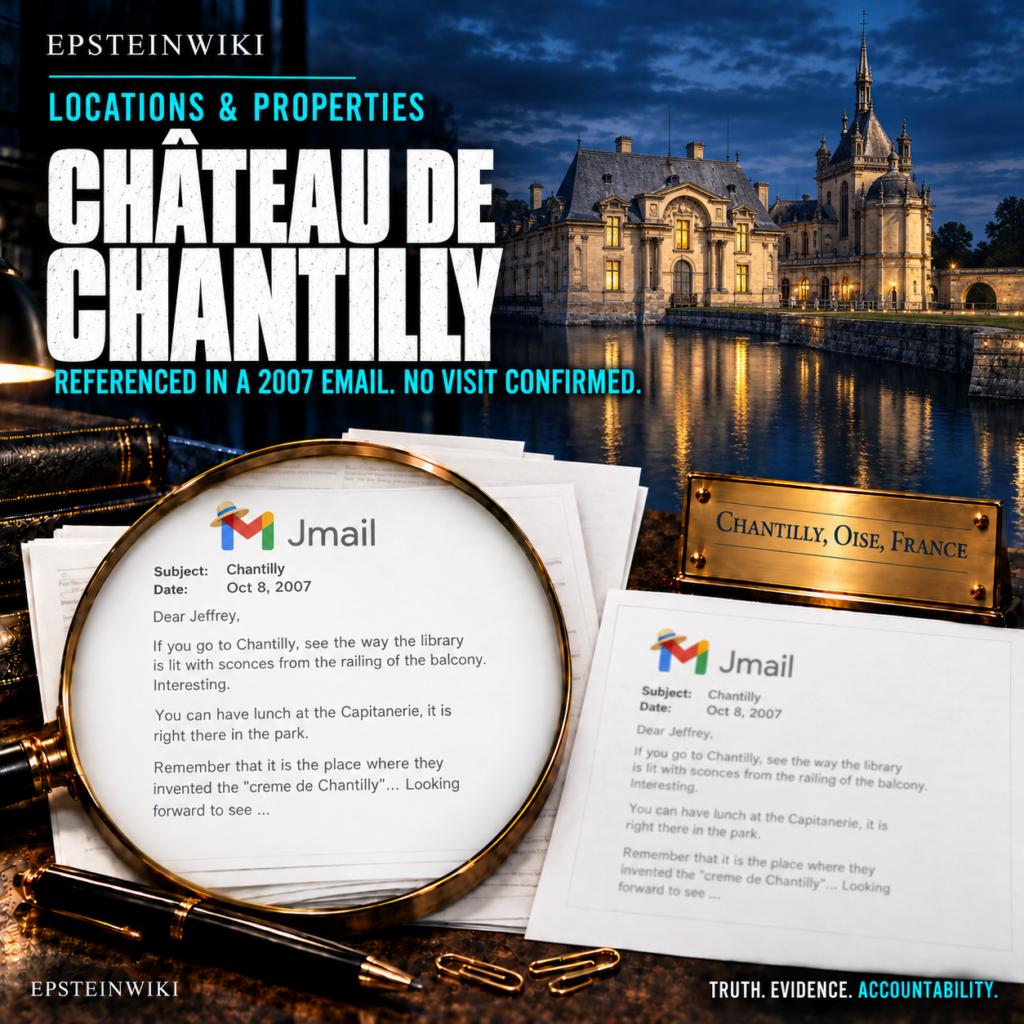
Snapshot
Château de Chantilly is a historic French estate and museum about 50 kilometers north of Paris. It entered an EpsteinWiki investigation because two Department of Justice evidence photographs, EFTA01068906 and EFTA01068907, show people inside an exceptionally ornate white and gold salon that resembles a European palace or château.
The photographs are connected to the Epstein evidence archive. They are not proof that Jeffrey Epstein visited, owned, rented, or held an event at Château de Chantilly. A detailed comparison found that the photographed room is visually inconsistent with Chantilly’s documented interiors. Later evidence pages, EFTA01624257 through EFTA01624260, reproduce the same room inside an iMessage export associated with jeeitunes@gmail.com, an address created for or on behalf of Epstein. Those pages confirm the photographs belong to the same interior, but they still do not identify its location.
The responsible conclusion is therefore precise: Château de Chantilly was a legitimate visual lead, but the available evidence does not establish an Epstein connection to the château.
Key Takeaways
- Château de Chantilly was investigated because the room in EFTA01068906 and EFTA01068907 appears palatial and French.
- The evidence photographs do not contain a caption, address, landmark, file path, or readable sign identifying Chantilly.
- Chantilly’s known rooms do not match the photographed salon’s wall plan, paintings, furnishings, chandeliers, clocks, or decorative program.
- EFTA01624257 through EFTA01624260 show the same salon from additional angles, confirming the earlier photographs depict one coherent location.
- The later images appear in a December 2015 iMessage export involving
jeeitunes@gmail.com, an account created for or on behalf of Epstein. - A court filing by Epstein’s estate cautions that only two other listed accounts were known to have been actively used by Epstein himself. The author of each
jeeitunes@gmail.commessage therefore cannot be assumed without additional device evidence. - The message sequence also contains promotional images of Cuixmala in Mexico. This proves that images in the thread were not necessarily live photographs of the sender’s current location.
- “office in st thomas” appears shortly before the image sequence. It creates a United States Virgin Islands lead but does not identify the ornate room as an Epstein property in St. Thomas.
- Epstein’s confirmed apartment at 22 Avenue Foch remains a possible Paris lead, but no conclusive visual match has been established.
- No reviewed source documents a visit by Epstein to Château de Chantilly or a formal relationship between him and the institution.
Place Profile Chart
| Field | Information |
|---|---|
| Name | Château de Chantilly |
| Location | Chantilly, Oise, France |
| Distance from Paris | About 50 kilometers north of central Paris |
| Main structures | Petit Château and Grand Château |
| Grand Château reconstruction | Rebuilt during the 1870s for Henri d’Orléans, Duke of Aumale |
| Present owner | Institut de France |
| Museum | Musée Condé |
| Public status | Historic estate and museum open to visitors |
| Epstein status | Investigated visual lead only |
| Verified Epstein visit | None established in the reviewed evidence |
| Verified Epstein ownership or control | None |
| Evidence photographs | EFTA01068906, EFTA01068907, and matching room images in EFTA01624257 through EFTA01624260 |
| Current finding | The photographed salon is unlikely to be inside Château de Chantilly |
Château de Chantilly
Château de Chantilly consists of two connected buildings. The Petit Château dates to the sixteenth century. The Grand Château was destroyed during the French Revolution and reconstructed between 1875 and 1882 for Henri d’Orléans, Duke of Aumale.
The Duke of Aumale left the estate and its collections to the Institut de France. The château opened as the Musée Condé after his death. Its holdings include major European paintings, manuscripts, decorative art, historic apartments, and the library known as the Cabinet des Livres.
This institutional history matters to the identification question. Chantilly is not an obscure private house whose interiors are undocumented. Its public rooms, collections, architectural plans, and decorative schemes have been extensively photographed and cataloged. That creates a substantial visual record against which the EFTA room can be tested.
Why Chantilly Became a Lead
The room in EFTA01068907 initially invites a château identification. Its visible features include white painted wall panels, extensive gilded ornament, a large crystal chandelier, monumental portraits, carved doors, antique clocks, candle sconces, and salon furniture.
The scene contains several adults. Some areas and people are concealed by black evidence redactions. The photograph appears informal rather than institutional. People sit on sofas, stand with drinks, and face different directions. EFTA01068906 shows a closer view of the same gathering and room.
Those features made a French royal or aristocratic interior a reasonable first hypothesis. Château de Chantilly was considered because it is near Paris, possesses ornate historic apartments, and has rooms with white and gold decoration. Visual resemblance at the level of style, however, is not the same as an architectural match.
Evidence Appearance Chart
| Evidence | Material | What it establishes | What it does not establish |
|---|---|---|---|
| EFTA01068906 | One redacted gathering photograph in a gilded salon | People were photographed inside the ornate room | The room’s address, owner, country, date, or event |
| EFTA01068907 | A wider redacted photograph of the same gathering | Shows the chandelier, portraits, wall panels, doorways, furniture, and additional occupants | That the gathering occurred at Chantilly or any Epstein property |
| EFTA01624249 | Opening page of a December 2015 iMessage export | Begins the conversation containing the later matching photographs | The identity of the unnamed second participant |
| EFTA01624253 | Message reading “office in st thomas” | Places the account writer in or referring to an office in St. Thomas | That subsequent images show that office or any St. Thomas property |
| EFTA01624254 | Three bright resort photographs | Begins a sequence of luxury property images | That the sender took the images or visited the property |
| EFTA01624255 | Cuixmala exterior and interior photographs | Shows recognizable images of the Cuixmala resort in Mexico | An Epstein visit to Cuixmala |
| EFTA01624256 | More Cuixmala photographs | Confirms the thread contains property imagery from outside St. Thomas | That every following image has the same source |
| EFTA01624257 | Empty ornate salon photograph | Shows the same wall panels, portrait, clock, cabinet, lamps, and sofa found in EFTA01068906 | The room’s location |
| EFTA01624258 | Wide empty salon photograph | Provides the clearest room layout and chandelier view | Ownership, date of construction, or address |
| EFTA01624259 | Close view of silver objects and window treatment | Documents another side of the same ornate interior | Whether the objects belong to Epstein or the sender |
| EFTA01624260 | Another room angle followed by “Are u ok?” | Extends the matching interior sequence and returns to conversation | Whether the question concerned the photographs |
The Exact Match Across Two Evidence Groups
The relationship between the early photographs and the later iMessage export is not merely stylistic. The same room can be identified through repeated fixed features.
| Fixed feature | EFTA01068906 and EFTA01068907 | EFTA01624257 through EFTA01624260 | Finding |
|---|---|---|---|
| White and gold wall panels | Visible behind the gathering | Visible without people | Exact layout match |
| Large dark portrait | Behind the sofa and redacted figure | Above an ornate cabinet | Same portrait and position |
| Wall clock | Left of the large portrait | Left of the same portrait | Same clock and mounting position |
| Black and gold cabinet | Partly obscured in gathering image | Fully visible in EFTA01624257 | Same furniture |
| Crystal chandelier | Dominates EFTA01068907 | Fully visible in EFTA01624258 | Same chandelier |
| Fireplace and mirror | Visible at the left side | Clearly visible in the empty room image | Same architectural arrangement |
| Gold upholstered sofas | Used by the gathering | Shown empty from a wider angle | Same upholstery and placement |
| Door opening | Visible behind the seated man | Visible in the room overview | Same molded doorway |
| Portrait wall opposite the fireplace | Partly visible in EFTA01068907 | Clear in EFTA01624260 | Same portrait arrangement |
This match establishes that EFTA01068906, EFTA01068907, and EFTA01624257 through EFTA01624260 document one location. It does not reveal where that location is.
Why the Chantilly Identification Fails
The Château de Chantilly hypothesis weakens when fixed architectural features are compared rather than general opulence.
| Comparison point | Evidence room | Château de Chantilly interiors | Assessment |
|---|---|---|---|
| Wall organization | Dense rectangular panels arranged around large portraits | Chantilly rooms use several distinct decorative programs, including gallery hanging, tapestries, painted panels, and historic apartment schemes | No verified room match |
| Portrait placement | Monumental paintings appear integrated into a private salon arrangement | Chantilly’s paintings are displayed according to the Musée Condé’s preserved collection plan | Visually inconsistent |
| Furniture | Deep gold sectional seating and heavily layered private furnishings | Chantilly’s documented rooms emphasize museum display and historic suites rather than this seating arrangement | Inconsistent |
| Decorative objects | Repeated clocks, lamps, silver objects, cabinets, busts, and modern lighting coexist | Chantilly rooms preserve institutionally cataloged historic arrangements | No matching ensemble found |
| Chandelier | One very large chandelier hangs low over the gathering space | Chantilly chandeliers vary by room, but no matching chandelier and ceiling arrangement was located | No match |
| Room use | Casual social gathering with drinks and relaxed seating | Public museum and heritage property with controlled institutional use | Does not fit an ordinary museum visit |
| Photographic identifiers | No Chantilly label, collection sign, barrier, placard, or recognizable vista | Chantilly’s public rooms contain identifiable museum context | No affirmative identifier |
White walls, gilded moldings, chandeliers, portraits, and antique furniture are common across French palaces, diplomatic residences, historic hotels, private mansions, and residences decorated in revival styles. Those shared features cannot identify Chantilly by themselves.
The absence of a match is especially important because the evidence set offers multiple angles. A genuine Chantilly identification should produce a correspondence in panel geometry, doorway placement, ceiling design, portrait positions, fireplace structure, or furniture arrangement. No such correspondence has been established.
The Epstein Account Connection
The later room photographs appear in an iMessage export that visibly labels one side jeeitunes@gmail.com. The address is widely associated with the Epstein evidence corpus. The strongest available account evidence requires a careful formulation.
A 2020 estate filing in Doe 1000 v. Indyke states that jeeitunes@gmail.com was among the addresses created for or on behalf of Jeffrey Epstein. The estate’s coexecutors separately stated that only jeevacation@gmail.com and jeeproject@yahoo.com were known to have been actively used by Epstein himself. Their response left open the possibility that employees or agents operated other listed accounts.
That distinction means the iMessage export is linked to Epstein’s communications environment, but the visible account label alone does not prove that Epstein personally authored every message or selected every photograph.
The unnamed participant’s identity also remains concealed in this export. Statements such as “thank you for the nice day” establish a personal interaction between the participants, but they do not identify the people at the gathering or the location of the room.
The Cuixmala Images and Why They Matter
Pages EFTA01624254 through EFTA01624256 show a domed coastal estate with white vaulted rooms, orange and red cushions, a pool, tropical vegetation, and an ocean view. These images match published photographs of Cuixmala, a luxury estate and resort on Mexico’s Pacific coast.
The Cuixmala photographs appear polished and promotional. Several correspond closely with images circulated by travel and architecture publications. Their presence demonstrates that this message thread contains externally sourced property pictures, not only casual photographs captured during the conversation.
That finding changes how the later ornate room pictures must be interpreted. They may document a place visited by one participant. They may also have been saved, forwarded, copied from a website, or sent as a property reference. The export does not preserve enough metadata to choose among those possibilities.
No conclusion about an Epstein visit to Cuixmala should be drawn from this sequence alone.
The St. Thomas Reference
On December 17, 2015, one participant asks, “Where are you ?!” The jeeitunes@gmail.com side answers, “office in st thomas” in EFTA01624253.
Jeffrey Epstein maintained extensive property and business operations in the United States Virgin Islands, including offices and residences on St. Thomas and nearby islands. The phrase is therefore consistent with Epstein’s known geographic network.
The message does not say that the subsequent images show the St. Thomas office. The intervening Cuixmala photographs demonstrate why chronological proximity cannot be treated as location metadata. The ornate salon could be in St. Thomas, Paris, another city, or an entirely unrelated property whose pictures were being exchanged.
The 22 Avenue Foch Alternative
Epstein owned a large apartment at 22 Avenue Foch in Paris. EFTA00808501 reproduces a New York sex offender registry page listing the Paris address as one of his residences. French authorities searched the apartment after Epstein’s 2019 arrest, and later reporting documented its role within his Paris network.
The confirmed Paris residence made Avenue Foch a logical alternative when the Chantilly hypothesis failed. The ornate room could fit the general category of a lavish Parisian private residence. That possibility is not enough to identify it.
Published sale photographs of the Avenue Foch apartment show ornate moldings and large reception spaces, but the photographed rooms do not provide a conclusive match to the salon in the EFTA images. Renovation, staging, removed furnishings, or incomplete public photography could explain differences. Until a fixed feature matches, the Avenue Foch identification must remain unconfirmed.
Identification Confidence Chart
| Proposition | Status | Confidence |
|---|---|---|
| EFTA01068906 and EFTA01068907 show the same room | Confirmed by fixed visual features | Very high |
| EFTA01624257 through EFTA01624260 show that same room | Confirmed by furniture and architectural correspondence | Very high |
| The later images occur in an Epstein associated account export | Confirmed by the visible jeeitunes@gmail.com label and estate account evidence | High |
| Epstein personally authored the messages | Not established | Low |
| The room is inside Château de Chantilly | Visual comparison does not support the claim | Very low |
| Epstein visited Château de Chantilly | No supporting record identified | Unestablished |
| The room is Epstein’s Avenue Foch apartment | Possible but not visually confirmed | Low to moderate |
| The room is in St. Thomas | Suggested only by a nearby message | Low |
| The Cuixmala images prove an Epstein visit | The images appear promotional and do not prove travel | Very low |
| The ornate room remains unidentified | Supported by the present evidence review | High |
What the Evidence Establishes
- A social gathering took place inside an ornate salon shown in EFTA01068906 and EFTA01068907.
- Black evidence redactions conceal people or sensitive areas in both gathering photographs.
- Later evidence pages reproduce the same room without the gathering.
- The later pages belong to a December 2015 iMessage export involving an Epstein associated email account.
- The account side states that it is in an “office in st thomas.”
- The thread includes promotional or externally sourced photographs of Cuixmala.
- The photographed salon does not match the known interior record of Château de Chantilly closely enough to support identification.
What the Evidence Does Not Establish
- That Jeffrey Epstein ever visited Château de Chantilly.
- That Château de Chantilly hosted Epstein, his staff, or anyone pictured in the evidence.
- That the salon is located in France.
- That Epstein personally wrote every message from
jeeitunes@gmail.com. - The identity of the unnamed iMessage participant.
- The identities of the unredacted or redacted people in the gathering photographs.
- When the gathering photographs were taken.
- Who took or transmitted the original photographs.
- Whether the ornate room was a residence, hotel, embassy, club, museum, event venue, or staged property.
- Whether the room was at 22 Avenue Foch, in St. Thomas, or at another Epstein connected location.
- Any visit by Epstein to Cuixmala.
Investigative Significance
This evidence sequence is a useful example of why architectural identification requires more than visual resemblance. An ornate French style room may resemble Chantilly, Versailles, a Ritz salon, an embassy, or a private Paris mansion. Only fixed architectural correspondences, original file metadata, contemporaneous messages, or reliable witness evidence can move a location from possible to confirmed.
The sequence also shows the danger of assuming that pictures inside a message thread were taken by the sender at that moment. Cuixmala’s recognizable promotional photographs appear immediately after a St. Thomas location message. The export therefore contains mixed source imagery. Every image must be assessed independently.
Château de Chantilly remains relevant to EpsteinWiki as a documented rejected lead. Recording why an identification failed prevents the same attractive but unsupported theory from circulating later as fact.
Questions for Further Investigation
- Do the original files behind EFTA01068906 and EFTA01068907 retain EXIF data, creation dates, device identifiers, or geographic coordinates?
- Are the two gathering photographs stored elsewhere in the evidence corpus with filenames or attachment metadata?
- Who is the unnamed participant in the EFTA01624249 iMessage export?
- Who controlled
jeeitunes@gmail.comon December 17, 2015? - Were EFTA01624257 through EFTA01624260 sent, received, or imported from another photo library?
- Can the large monogram, inscription, portraits, clocks, chandelier, or silver collection identify the room?
- Does the room appear in historic hotel archives, embassy residence photography, property listings, museum catalogs, or event photographs?
- Can surviving plans or police photographs of 22 Avenue Foch confirm or exclude the room?
- Did Epstein own or use a St. Thomas office decorated in this style?
- Why were Cuixmala images being exchanged in the same conversation?
- Do travel calendars, flight logs, visitor records, or staff schedules place either participant near Chantilly, Paris, St. Thomas, or Cuixmala in December 2015?
- Can the people visible in EFTA01068906 and EFTA01068907 be identified through adjacent photographs without exposing protected individuals?
- What do the black redactions conceal, and were they applied by investigators or during public release review?
Related EpsteinWiki Evidence
- EFTA01068906
- EFTA01068907
- EFTA01624249
- EFTA01624253
- EFTA01624254
- EFTA01624255
- EFTA01624256
- EFTA01624257
- EFTA01624258
- EFTA01624259
- EFTA01624260
- EFTA00808501
Sources
- United States Department of Justice Epstein Library
- United States Department of Justice Data Set 10
- Doe 1000 v. Indyke estate interrogatory response concerning Epstein related email accounts
- Château de Chantilly overview and institutional history
- Musée Condé collection overview
- Cuixmala official accommodation description
- Le Figaro property report and photographs of Epstein’s Avenue Foch apartment