
Fact Check: Clinton Foundation Island Purchase Story Came From Satire
Snapshot
| Field | Details |
|---|---|
| Claim checked | The Clinton Foundation bought Little St. James to accommodate children displaced from Haiti. |
| Verdict | False as a news report. The claim circulated as satire. |
| Time period | The claim published in March 2024 and the preceding island-sale announcement. |
| Decisive evidence | Publisher context, a buyer-issued release and an official settlement announcement. |
| Scope | This check addresses the alleged purchase and housing project. It makes no finding about unrelated conduct by the Clintons. |
Key takeaways
- The publisher expressly identifies its output as fabricated entertainment.
- The buyer’s own announcement identifies SD Investments LLC and Stephen Deckoff.
- The government’s settlement announcement explains the estate’s obligation to sell the properties and direct specified proceeds toward victim services.
- A later screenshot cannot turn a fictional announcement into evidence of a real estate transaction.
What the claim actually says
The assertion requires evidence of a purchase and of the proposed use. Neither a recognizable organization’s name nor the island’s history establishes either element.
This distinction keeps the check bounded. Whether a person traveled on an aircraft, knew Epstein, or appeared in a separate record is a different question from whether an organization bought a particular property.
The story’s traceable publication context
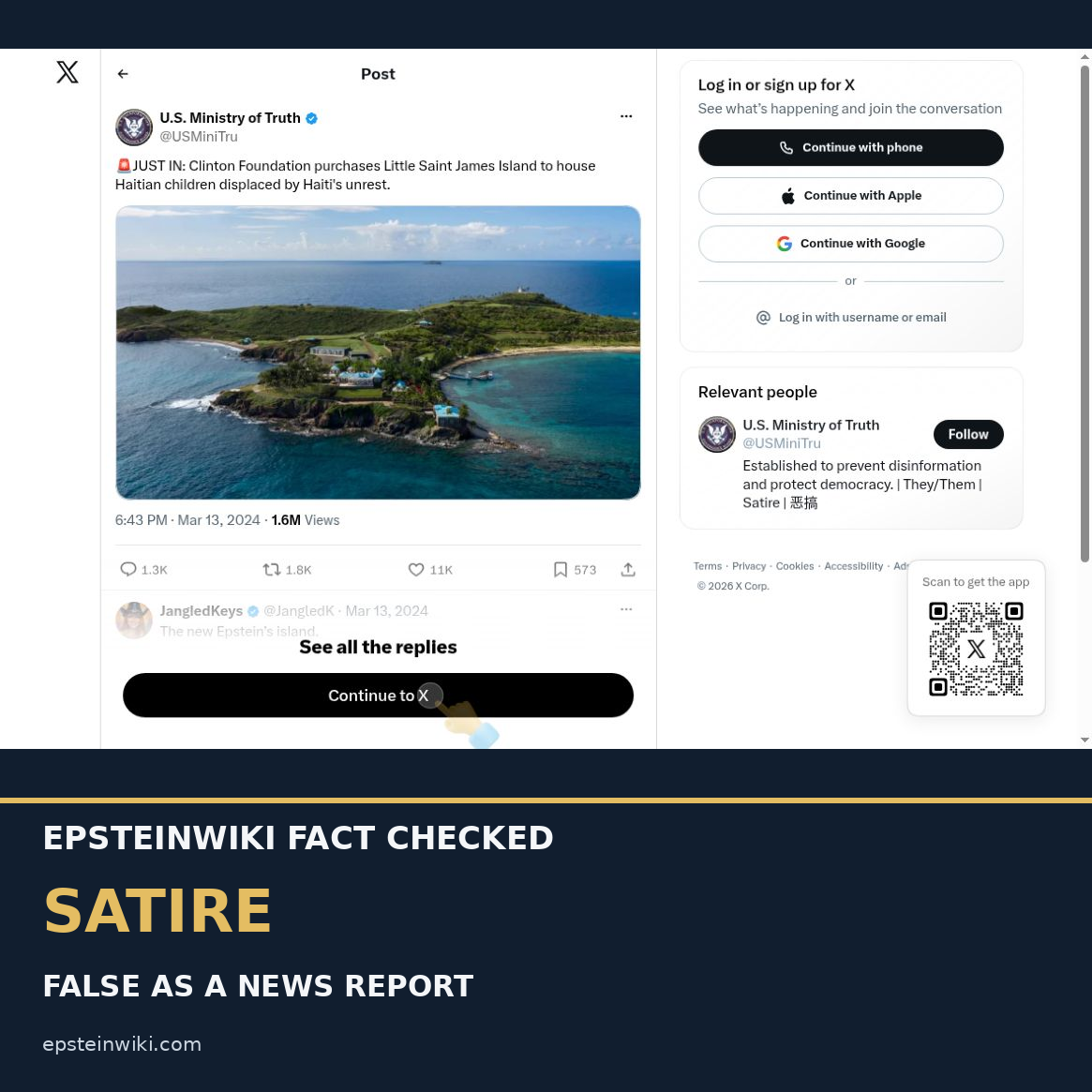
A Genesius Times page dated March 14, 2024 carries the claim under the name US Ministry of Truth. It embeds a same-day post attributed to @USMiniTru. The site’s masthead calls its material fake news, and its footer describes an entertainment purpose. Those disclosures are part of the source’s context, even when absent from a cropped screenshot.
The page is primary evidence that the story was published in that setting. It is not primary evidence that a purchase occurred. Its attribution of statements to real people should likewise not be treated as an authenticated statement from their offices.
What the acquisition announcement establishes
On May 3, 2023, SD Investments announced that it had acquired Great St. James and Little St. James. The release identifies the firm as led by Stephen Deckoff and describes plans for a 25-room luxury resort. It is a purchaser-issued statement distributed through PR Newswire, rather than an independently authored news article.
NPR reported a $60 million price for both islands.
The release’s anticipated 2025 opening was a development target, not proof that a resort subsequently opened. This fact-check does not establish the project’s later construction status or provide a current title search.
How the estate settlement fits the record
The U.S. Virgin Islands Department of Justice’s settlement announcement, posted December 1, 2022, says the estate would sell both islands to independent third parties. It also identifies a $105 million cash payment and a requirement to pay the government half the proceeds from Little St. James.
According to that announcement, the government’s island-sale proceeds were to support a trust serving Virgin Islands victims of sexual assault, trafficking and related abuse. This is a specified use of sale proceeds. It does not describe a Clinton Foundation purchase or a housing program on the property.
The release describes the government’s settlement and its enforcement position. It should not be substituted for a deed, a complete accounting of disbursements, or a judgment against anyone outside the settled case.
Evidence lineage and conclusion
- Claim artifact: the entertainment publisher’s page preserves the allegation and an embedded social post.
- Transaction account: the purchaser identifies the acquiring business and its intended development.
- Official context: the territorial government explains why the estate was to sell the islands and how designated proceeds were to be used.
These sources answer different questions. Read together, they support rejecting the March 2024 story as factual news. The conclusion does not depend solely on failing to find a foundation announcement; it rests on the story’s disclosed fictional context and a separately documented acquisition.
Limits of this finding
No registry-certified deed or complete ownership history was examined here. An announcement of one transaction cannot, by itself, exclude every hypothetical later transfer. The finding concerns this identifiable viral story, not an open-ended assertion about all subsequent property dealings. The social post’s attribution is preserved in the publisher’s embedded version.
Sources
- Genesius Times claim page and satire disclosures, March 14, 2024. Claim artifact, not a factual acquisition report.
- SD Investments acquisition release, May 3, 2023. Primary statement by the purchaser.
- NPR, May 4, 2023.
- USVI Department of Justice settlement announcement, posted December 1, 2022. Primary government source.
- Reuters coverage of the island-purchase claim, March 19, 2024. Further contemporary coverage.