
Fact Check: Fake Crooks Instagram Account Carried an Epstein Message
Snapshot
| Field | Details |
|---|---|
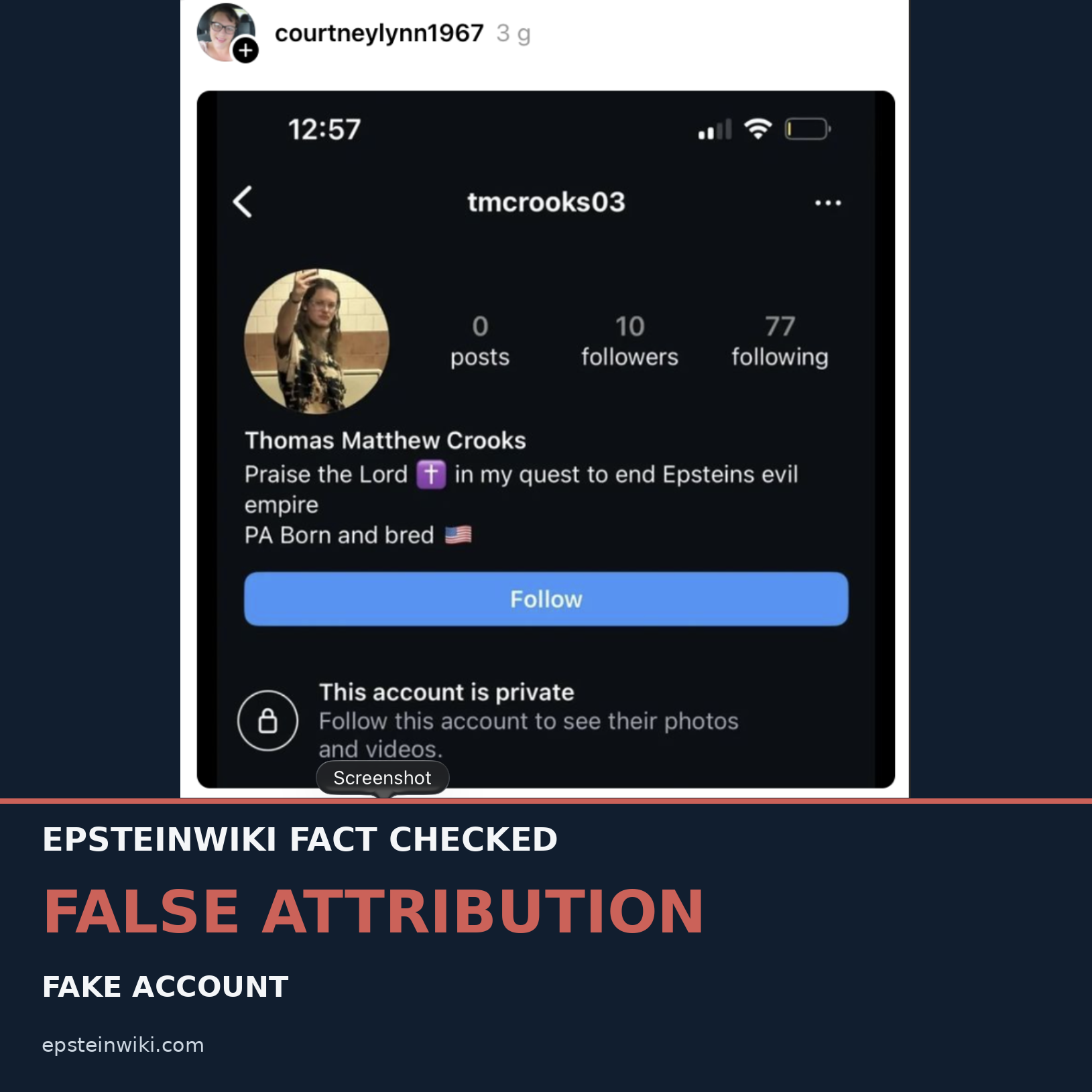
| Claim checked | An Instagram profile bearing Thomas Matthew Crooks’ name and an Epstein-related biography was his authentic account. |
| Verdict | False attribution. Meta identified the profile as a fake. |
| Relevant period | The claim circulated after the July 13, 2024 shooting at Donald Trump’s rally in Butler, Pennsylvania. |
| Evidence basis | Platform responses reported by PolitiFact and Lead Stories, photo-provenance reporting, and dated FBI statements. |
| Scope | This particular profile. It cannot establish Crooks’ motive, nor does its falsity mean he had no other online accounts. |
Key takeaways
- The platform told PolitiFact it removed the profile as an impersonation.
- The profile photograph was linked to another social-media user.
- The date an image appeared elsewhere is not the creation date of an Instagram account using it.
- Attribution of an account and determination of a criminal motive are separate evidentiary steps.
The claim and why it matters
The disputed screenshot used Crooks’ name and included the biography text “in my quest to end Epsteins evil empire.” Treating it as his own writing could make it appear to explain the attack. That inference first requires authenticating the account. A display name, profile photo and biographical statement are not sufficient proof of who controlled it.
The narrow verdict concerns the profile described in the cited fact-check, not every image or account that may later be circulated under the same name.
What Meta actually confirmed
In its July 15, 2024 report, PolitiFact identifies Meta spokesperson Dave Arnold as its source. It reports that Meta classified the account as a copycat and removed it. This is an attributed platform response, not an inference drawn solely from the account’s disappearance.
A separate Lead Stories inquiry produced a July 18 response from Meta spokesperson Erica Sackin confirming the account was inauthentic. Its article records a July 19 update adding that response. This supplies a second reported contact with the platform.
The underlying emails are not publicly inspectable exhibits in those articles. Readers therefore have the publishers’ accounts of Meta’s responses, rather than direct access to the platform’s internal account records. The distinction matters because a missing page alone would not establish whether an account was fake, deleted by its owner, or unavailable for some other reason.
The photograph and the timeline trap
Lead Stories traces the profile picture to a July 10 X post by another user. Separately, Lead Stories’ July 14 examination documents a photo and video from an X user who impersonated the shooter after the attack. This supports treating the circulated lookalike material cautiously.
July 10 is a photograph-publication date in the cited reporting. It is not an established creation date for the disputed Instagram profile. An older photograph can be copied into a later account. The age of one component does not date the combined profile or show that its creator anticipated the shooting.
The available sources do not supply the fake account’s complete registration history. They also do not establish the identity of every person who created, edited or redistributed versions of the screenshot.
What the official investigation said at the time
The FBI’s July 14 statement says investigators had not identified a motive. Its July 15 update records access to Crooks’ phone and continuing analysis of electronic devices. These were statements about an active investigation, not confirmation of the viral biography.
In a later August 28, 2024 opening statement, the FBI again said it had not identified a motive, co-conspirators or associates with advance knowledge of the attack. These dated statements define what the bureau said then. They should not be silently presented as the current status of every investigative question.
What follows from the evidence
The false profile cannot serve as Crooks’ manifesto, an admission by him, or evidence of a specific Epstein-related motive. A claim about motive would require material reliably linked to him and an explanation of what that material actually establishes.
Two distinctions prevent overstatement. First, falsifying this account does not prove the absence of genuine accounts elsewhere. Second, an unresolved motive does not give equal evidentiary weight to every proposed explanation. A hypothesis drawn from misattributed material loses that purported support even when the broader question remains unanswered.
Likewise, removing an impersonation does not demonstrate concealment of the real shooter’s writings. That additional allegation would need its own evidence of authentic content and deliberate suppression.
Evidence lineage and limits
- Claim artifact: PolitiFact preserves and describes the circulated profile screenshot.
- Account attribution: two outlets report responses from named Meta representatives.
- Image context: photo-provenance reporting identifies reused lookalike material.
- Investigative context: the FBI’s own dated releases address the state of its motive inquiry.
This finding relies on publisher-reported platform responses and the official statements identified above. It does not claim access to Instagram registration data, forensic device extractions or a complete investigative case file.
Sources
- PolitiFact’s account-authenticity investigation, July 15, 2024. Includes its attributed Meta response.
- Lead Stories’ profile check and Meta response, July 18, updated July 19, 2024.
- Lead Stories’ lookalike-photo examination, July 14, 2024. Supporting provenance reporting.
- FBI investigation update, July 14, updated July 15, 2024. Primary government source.
- FBI opening statement, August 28, 2024. Primary government source.
- Reuters reference on the disputed profile, July 19, 2024. Further contemporary coverage.