
Fact Check: Jake Shields’s Epstein Email Redaction Claim Is Misleading
Snapshot
| Verdict | Misleading interpretation of a real released document. The record does not substantiate the murder allegation. |
|---|---|
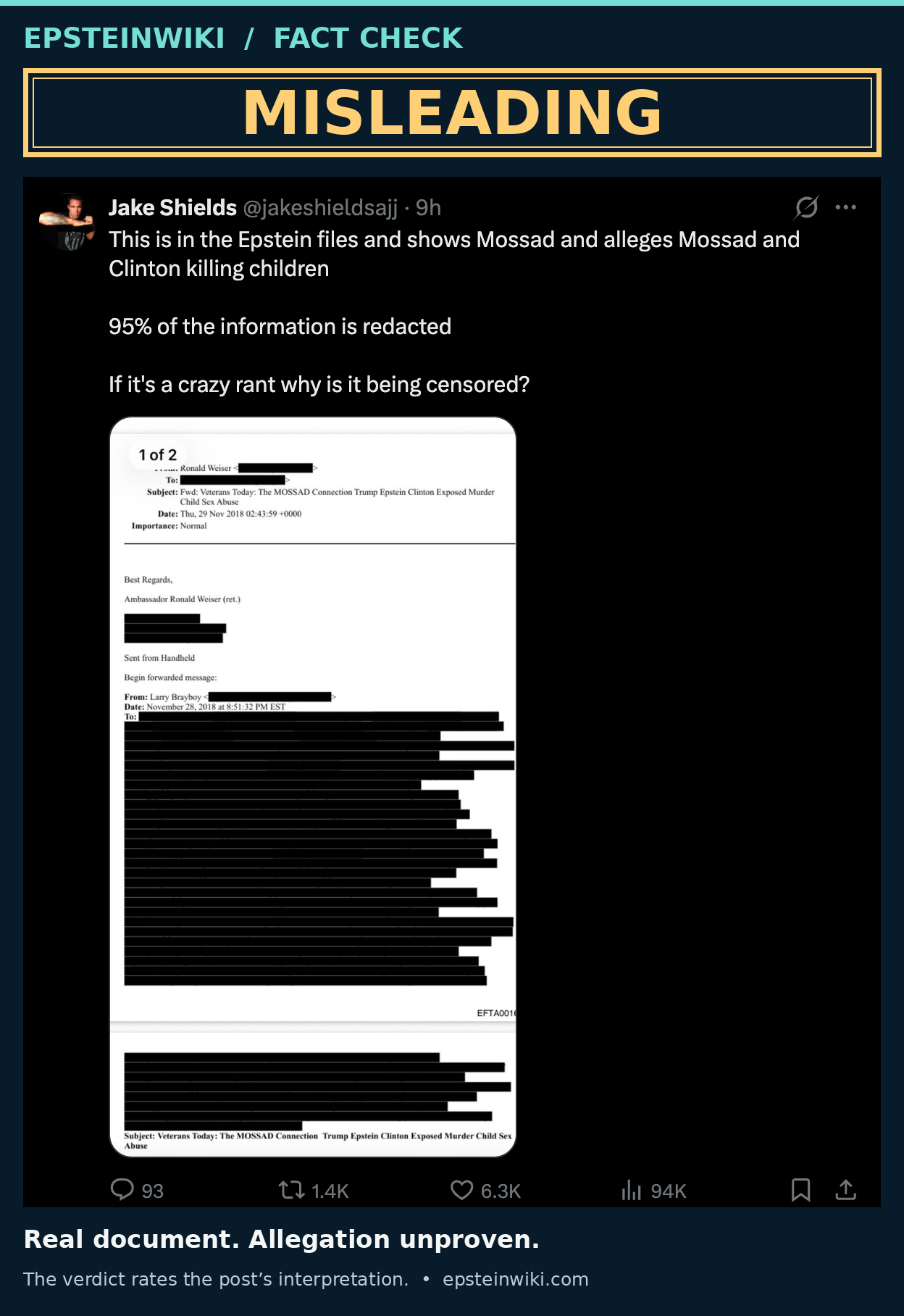
| Claim examined | Jake Shields’s post describes an allegation involving Mossad and Clinton, claims 95% of the information is redacted, and asks why it is being censored. |
| Actual record | EFTA00162911.pdf, a two-page forwarded email dated November 29, 2018, with Bates stamps EFTA00162911 and EFTA00162912. |
| Key distinction | The second page leaves the article reference visible. The largest text-redaction block sits between the forwarded email’s To and Subject labels, consistent with recipient information. |
| Limits | The released copy does not reveal the concealed text or explain each redaction. The 95% figure has no demonstrated method in the supplied screenshot. |
Key Takeaways
- The DOJ-hosted PDF matches the document shown in the supplied screenshot. Calling that file fake would be inaccurate.
- Shields uses the word “alleges.” The problem assessed here is the implication drawn from redaction, rather than a claim that he explicitly called the accusation proven.
- The visible article title and preview identify a public article. The redacted preview image is separate from the long email-header redaction.
- DOJ’s review protocol instructs reviewers to redact email addresses. A privacy redaction does not establish whether an accusation is true.
- The linked Veterans Today article is still readable. It supplies no corroboration for its child-sacrifice assertions.
The Claim Being Checked
The post attributed to Jake Shields is preserved in the screenshot submitted for this check. It says:
This is in the Epstein files and shows Mossad and alleges Mossad and Clinton killing children
95% of the information is redacted
If it’s a crazy rant why is it being censored?
The supplied post screenshot displays an attachment indicator of “1 of 2.” This check covers that screenshot, the complete two-page DOJ file it depicts, and the linked article. The other social-media attachment was not independently inspected. The rating is not a blanket judgment on every attachment or every possible Epstein-related intelligence claim.
What the Two-Page File Contains
Page 1 of EFTA00162911.pdf is headed as an email from Ronald Weiser at 02:43:59 UTC on November 29, 2018. Below his signature is a forwarded message from Larry Brayboy, dated November 28 at 8:51:32 p.m. EST. These timestamps use different time zones; they are not evidence of a date inconsistency.
Page 2, stamped EFTA00162912, finishes the concealed email-header material and displays the forwarded subject, an article link label and a preview card. The subject references Mossad, Trump, Epstein, Clinton, murder and child sex abuse. The document records the circulation of an article; it is not an interview report, sworn witness statement or judicial finding about those accusations.
The released email establishes what this record contains. Its presence in a government collection does not authenticate every assertion in the material it forwards, identify the redacted recipients, or establish their agreement with the article.
What the Redactions Do and Do Not Show
The largest text-redaction block starts immediately after Brayboy’s To label on page 1 and continues onto page 2, ending just before Subject. That layout is consistent with a long recipient list. Because the underlying text is concealed, this is a contextual inference, not a reconstruction of its contents.
The second page also contains a separately blacked-out preview image. Smaller bars cover portions of the first page’s email header and signature. It would therefore be inaccurate to say that every redaction in the file is an email address, or to infer the hidden image’s contents from the black box.
DOJ’s January 4, 2026 review protocol expressly lists email addresses among personal information to redact. Its instructions provide an ordinary privacy-related reason for withholding addresses, even when an email forwards an unsupported story. They do not identify the exact basis used for each bar in this particular file.
The “95%” statement in the screenshot provides neither a calculation nor a definition of “information.” Counting black pixels, lines, words or factual propositions would produce different measures. The concealed text is unavailable for a word-based comparison. The precise percentage is unverified, and this check does not substitute a guessed percentage.
The visible title and article reference are an important limit on the censorship suggestion: readers can identify the source being circulated. Redaction alone cannot show that the concealed material corroborates murder, nor can it establish why a particular reviewer withheld it.
What the Linked Article Establishes
The November 28, 2018 Veterans Today article carries Gordon Duff’s byline and credits an introduction by Duff and Preston James. That introduction alleges Mossad blackmail and child sacrifice without providing corroborating records or attributable witness testimony for those assertions. It then reproduces an excerpt credited to Julie K. Brown of the Miami Herald.
In that article’s main text, Clinton appears in the reproduced excerpt as an Epstein friend. The article does not specifically substantiate an accusation that Clinton killed children. Its public availability also undermines the suggestion that this email’s black bars conceal an otherwise inaccessible article.
Brown’s original Miami Herald reporting concerns Epstein’s non-prosecution deal. The added Mossad and sacrifice assertions belong to the Veterans Today introduction, not a verified finding established by that attribution.
Evidence Appearances
| Record | Date | Appearance | What it does not establish |
|---|---|---|---|
| EFTA00162911 | November 29, 2018, 02:43:59 UTC | First page of Weiser’s forwarded email; includes Brayboy’s prior message and the start of its redacted To field. | Shows article circulation and visible headers. Does not identify concealed recipients or establish the accusation. |
| EFTA00162912 | Continuation of the same email | Second page; end of header redactions, subject, article reference and preview. | The article reference is visible. Its preview image is separately redacted. |
| DOJ review protocol, p. 8 | January 4, 2026 | General instructions identifying email addresses as information to redact. | Provides redaction context; not a document-specific explanation or a finding about the allegations. |
Finding and Remaining Limits
The actual released record supports a narrow finding: a sensational article was forwarded by email and later appeared in DOJ’s released files. It does not substantiate the murder allegation. The concealed header, separately hidden image and unverified percentage do not supply the missing corroboration.
DOJ’s January 30, 2026 release notice separately warns that responsive material received from the public may include false or fabricated submissions. That general warning is not a finding that this particular email is fabricated. Here, the email’s official availability and its limited evidentiary meaning are both important.
The post’s use of “alleges” accurately signals an accusation rather than a proven crime. The MISLEADING rating addresses the implication that heavy redaction gives that accusation added credibility and the unsupported precision of the 95% claim. It does not declare that all redactions were justified, that the broader archive has been exhaustively examined, or that every separate allegation has been disproved.
Sources
- Jake Shields post on X. Claim source, examined through the supplied screenshot. The second attachment was not independently inspected.
- Department of Justice: EFTA00162911.pdf. Two pages, Bates EFTA00162911 and EFTA00162912. Email dated November 29, 2018. Both pages inspected in the official released PDF.
- Veterans Today: original November 28, 2018 article. Source of the circulated allegations; used to examine what the article says, not as corroboration of its accusations.
- Julie K. Brown, Miami Herald: original reporting on Epstein’s deal. The reporting linked and excerpted by Veterans Today.
- Department of Justice: Attorney Review Protocol for Epstein Files. January 4, 2026. Page 8 lists email addresses among information to redact.
- Department of Justice: January 30, 2026 release announcement. General context about the breadth and reliability limits of the released collection.