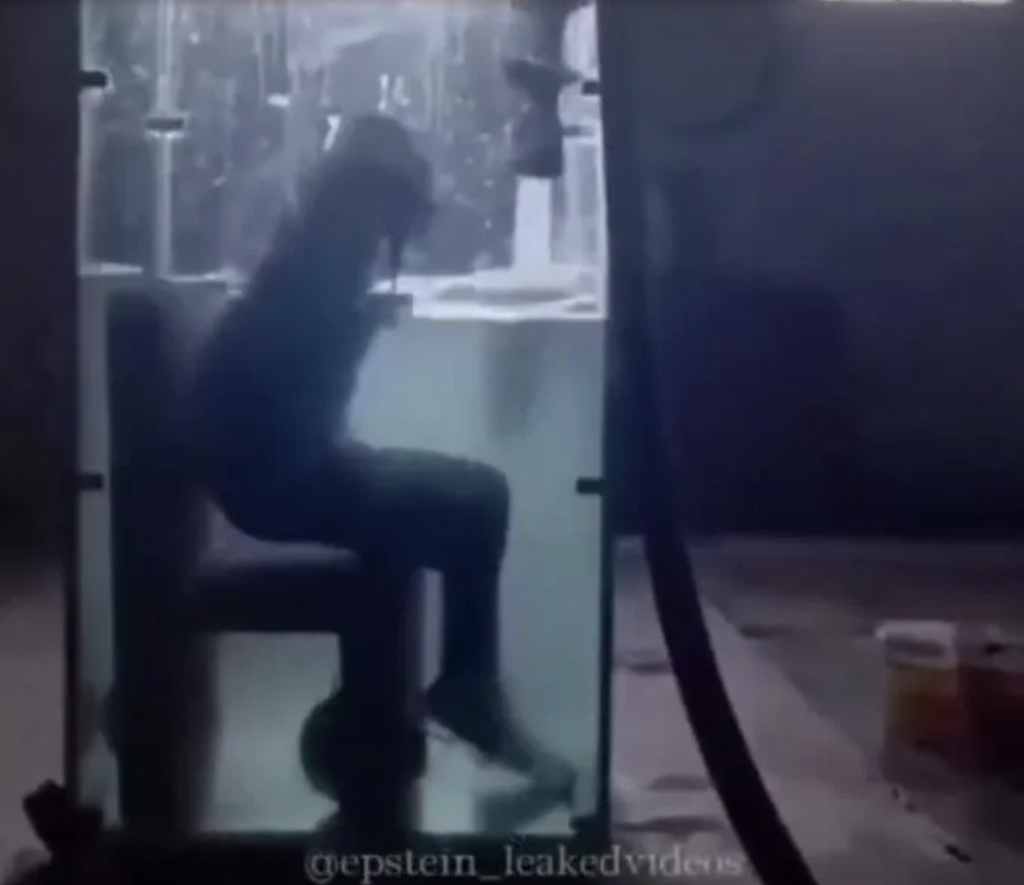
Fact Check: Viral Glass Water Tank Torture Video Is Not From Epstein Island
Snapshot
| Field | Details |
|---|---|
| Claim | A viral video showing a woman trapped inside a glass chamber filling with water was recorded on Jeffrey Epstein’s island |
| Verdict | False |
| Actual source | A scene from the 2016 Egyptian television series The Exit |
| Original title | Al Khuroog, also translated as The Exit |
| Episode | Final episode, commonly listed as Episode 30 |
| Scene location | Approximately 24 minutes and 55 seconds into the episode |
| Original upload date | July 5, 2016 |
| Production company | Aroma Studios |
| Viral circulation | February 2026, with renewed circulation in August 2026 |
| Epstein Files identifier | None |
| Connection to Epstein | No documented connection |
| Fact check status | Independently traced to a fictional television production |
The Claim
A disturbing video circulated across X, YouTube, and other social media platforms in 2026. It shows a frightened woman trapped inside a narrow glass chamber as water pours into the enclosure.
Posts sharing the video claimed it showed a woman being tortured on Jeffrey Epstein’s private island, Little Saint James. Some posts went further, describing the scene as evidence of an alleged “Satanic ritual” conducted on women at the property.
One widely shared post declared:
One of the most horrifying scenes recorded on Jeffrey Epstein’s island was a Satanic ritual performed on women at the site.
The post provided no document number, video identifier, chain of custody, law enforcement record, or link to an official government release.
The claim is false. The video is a fictional scene from an Egyptian television series released nearly ten years before the 2026 Epstein document publication.
Fact Check Verdict
The glass water tank video was not recorded on Jeffrey Epstein’s island.
The footage comes from the Egyptian crime drama Al Khuroog, translated as The Exit. The scene appears in the final episode of the series at approximately 24 minutes and 55 seconds.
Aroma Studios uploaded the episode to YouTube on July 5, 2016. The video therefore existed publicly for almost a decade before social media accounts began presenting it as material from the Epstein Files.
Neither the original production nor the scene has a documented connection to Jeffrey Epstein, Little Saint James, Great Saint James, the Federal Bureau of Investigation, or the Department of Justice.
Where the Video Actually Came From
The Exit was a 30 episode Egyptian crime series directed by Mohamed El Adl. It starred Dhafer L’Abidine and Dorra Zarrouk and followed investigators examining a series of murders.
The glass enclosure sequence was produced as part of the show’s fictional murder storyline.
| Detail | Verified information |
|---|---|
| Series | Al Khuroog |
| English title | The Exit |
| Country | Egypt |
| Genre | Crime drama |
| Director | Mohamed El Adl |
| Featured performers | Dhafer L’Abidine and Dorra Zarrouk |
| Episode | Final episode |
| Approximate timestamp | 24:55 |
| Original upload | July 5, 2016 |
| Production company | Aroma Studios |
| Epstein connection | None found |
The original episode uploaded by Aroma Studios contains the same room, glass enclosure, actress, water system, camera angles, and surrounding production set visible in the viral clip.
The matching scene establishes the video’s source through direct visual comparison. It is not merely similar footage. It is the same recorded television scene.
How the False Claim Spread
The video appears to have entered Epstein related social media circulation in February 2026, shortly after a major Department of Justice document release.
A YouTube account uploaded a clearer copy on February 12, 2026 under a title referring to the Epstein Files. However, the account itself asked viewers whether anyone knew where the video came from. That version did not include evidence connecting it to Epstein.
The clip spread more widely across X on February 13 and February 14.
It resurfaced on August 15, 2026 in a post by the account @smolfsmolf7. The account presented the scene as footage from Epstein’s island and described it as a ritual involving women.
The August version included a watermark reading:
@epstein_leakedvideos
Investigators could not identify a functioning account using that handle on X, YouTube, TikTok, Facebook, or Instagram. Earlier copies of the footage did not contain the watermark.
This indicates that the watermark was added after the video had already been published elsewhere. It created the appearance of an Epstein specific source without providing an actual source.
Timeline of the Video
| Date | Event |
|---|---|
| July 5, 2016 | Aroma Studios uploads the final episode of The Exit to YouTube |
| July 13, 2022 | A still from the scene appears in an unrelated Arabic fiction story on Wattpad |
| January 30, 2026 | The Department of Justice announces a large Epstein Files release |
| February 12, 2026 | A copy of the scene is uploaded to YouTube using an Epstein related title |
| February 13 and 14, 2026 | The video circulates widely on X without a verified source |
| August 15, 2026 | The video resurfaces with claims that it shows a ritual on Epstein’s island |
| August 18, 2026 | Lead Stories publishes an initial investigation finding no Epstein Files connection |
| August 19, 2026 | AFP identifies the footage as a scene from The Exit |
| August 19, 2026 | Lead Stories updates its article with the confirmed television source |
The Video Has No EFTA Number
Authentic materials released through the Department of Justice Epstein Files Library are generally associated with identifiable document or evidence numbers.
EpsteinWiki links public evidence records to Epstein Data using identifiers such as EFTA numbers whenever those identifiers are available.
No EFTA number has been produced for the glass water tank video.
The people circulating the clip did not provide:
- An EFTA identifier.
- A Department of Justice file number.
- An FBI evidence number.
- A court exhibit number.
- A chain of custody record.
- A link to the Department of Justice Epstein Files Library.
- Metadata connecting the footage to Epstein.
- A law enforcement report describing the video.
The absence of an EFTA number would not alone prove that a video is false. However, once the exact footage was located in a 2016 television episode, the claim became conclusively disproven.
Why the 2026 Document Release Created Confusion
On January 30, 2026, the Department of Justice announced the publication of more than three million additional pages under the Epstein Files Transparency Act.
The department said the larger production included more than 2,000 videos and 180,000 images. Combined with earlier releases, the total production included nearly 3.5 million pages.
The scale of the release created a difficult verification environment. Images, videos, court records, tips, duplicate records, and materials submitted by members of the public were discussed or circulated simultaneously.
The Department of Justice also warned that the production could include false or misleading material submitted to the FBI. Inclusion in an investigative file does not automatically establish that the material is authentic or that its allegations are true.
The glass tank video presented an additional problem. It was never shown to have been included in the government production at all.
Social media users appear to have taken an unrelated fictional scene and attached it to the public excitement surrounding the release.
How Investigators Identified the Original Scene
The verification process developed in several stages.
Reverse Image Searches
Lead Stories conducted reverse image searches using Google Lens, Yandex, Bing, and TinEye. The first searches found duplicate social media uploads but did not immediately identify the original source.
This is common when a video has been cropped, compressed, mirrored, captioned, or recorded from another screen.
A Clearer Copy
Investigators located a February 12, 2026 YouTube upload with a clearer and wider image. The copy showed additional buckets, more of the surrounding room, and details on the glass enclosure.
Importantly, this version did not contain the @epstein_leakedvideos watermark.
A 2022 Image
A reverse search using the clearer footage located a still image used in a 2022 Arabic language Wattpad story.
The image showed the same glass chamber from another angle. Matching details included the chamber supports, room windows, water hose, and industrial setting.
The 2022 appearance alone proved that the imagery was circulating several years before the 2026 Epstein Files release.
Identification by AFP
An Arabic language AFP fact check identified the footage as a scene from Al Khuroog.
AFP located the full episode published by Aroma Studios in 2016. The glass tank sequence begins at approximately 24 minutes and 55 seconds.
This discovery resolved the source question.
The Incorrect Claim About The Cell
Before the Egyptian television source was confirmed, an X Community Note claimed the video came from the 2000 psychological thriller The Cell.
That explanation was also incorrect.
The Cell contains a water chamber sequence, but its design differs from the chamber shown in the viral clip.
| Feature | Viral video | The Cell |
|---|---|---|
| Chamber size | Narrow, similar to a telephone booth | Larger room sized enclosure |
| Walls | Transparent glass enclosure | Combination of glass and tiled walls |
| Water source | Hose positioned above the chamber | Overhead sprinkler system |
| Surrounding room | Industrial room with buckets and upper windows | Different film set design |
| Actual match | The Exit | No |
The incorrect Community Note demonstrates why replacing one unsupported explanation with another is not enough. Verification requires locating the original source.
Evidence Assessment
| Evidence question | Finding |
|---|---|
| Does the video appear in a verified Epstein Files record? | No verified appearance found |
| Does it have an EFTA number? | No |
| Was it linked to an FBI evidence inventory? | No |
| Was it linked to Little Saint James through metadata? | No |
| Did credible reporting identify it as island footage? | No |
| Does the footage predate the 2026 release? | Yes |
| Has the original production been identified? | Yes |
| Does the original scene match the viral clip? | Yes |
| Is the footage fictional? | Yes |
| Final assessment | The Epstein island claim is false |
What the Fact Check Does Not Mean
Determining that this particular video is fictional does not erase the documented crimes committed by Jeffrey Epstein or the abuse reported by survivors.
Federal prosecutors charged Epstein in 2019 with sex trafficking of minors. Ghislaine Maxwell was later convicted of federal offenses connected to the recruitment and sexual abuse of minors.
Survivor testimony, police reports, court filings, financial records, property records, photographs, flight records, and authenticated communications provide substantial evidence concerning Epstein’s trafficking network.
Researchers do not need fictional footage to prove that Epstein abused girls and young women.
Sharing false material can harm legitimate research by allowing defenders of Epstein’s associates to portray the entire evidentiary record as unreliable. It can also redirect attention away from authenticated documents and survivor testimony.
Rejecting a false video protects the integrity of the investigation. It does not protect Epstein.
Why Provenance Matters
A frightening video is not evidence merely because someone adds the words “Epstein Files” to it.
Authentic digital evidence should include as much of the following information as possible:
- The original file or government record.
- A document, exhibit, or evidence identifier.
- The agency or court that released it.
- The date of publication.
- The original filename.
- Available metadata.
- An unedited copy.
- A documented chain of custody.
- Independent confirmation.
- A clear explanation of what the material proves and what it does not prove.
The glass tank video failed every basic provenance test before its fictional source was identified.
It had no government identifier, no authenticated origin, no location data, no chain of custody, and no credible reporting. Its Epstein themed watermark was added to a later copy.
Responsible Research Guidance
Researchers encountering alleged Epstein video evidence should search for an EFTA number or corresponding government file before sharing it.
Screenshots should be checked through multiple reverse image search services. Researchers should also search individual frames because one frame may have circulated online long before the edited video.
Watermarks should never be treated as proof of origin. A watermark can be added in seconds and may have been created specifically to mislead viewers.
Researchers should preserve the earliest known upload, compare different versions, and examine whether later copies were cropped or altered.
Most importantly, researchers should avoid describing disturbing media as evidence of trafficking, torture, murder, or ritual abuse without verified provenance. The emotional impact of a video does not establish its authenticity.
Unanswered Questions
- Who first removed the scene from the 2016 episode and presented it as Epstein related material?
- Who added the @epstein_leakedvideos watermark?
- Did the watermark imitate an account that never existed?
- Was the false attribution created deliberately or repeated from an earlier misunderstanding?
- How many accounts shared the video after its fictional origin was confirmed?
- Did monetized accounts profit from circulating the false claim?
- Why did an experimental artificial intelligence contributor incorrectly identify the scene as coming from The Cell?
- What verification tools should social media platforms apply to recycled television and film footage?
- How can researchers preserve genuine Epstein evidence without amplifying fabricated material?
Conclusion
The viral glass water tank video is not evidence from Jeffrey Epstein’s island or the Department of Justice Epstein Files.
It is a fictional scene from the Egyptian television series The Exit. The full episode was publicly uploaded by Aroma Studios on July 5, 2016.
The scene circulated for years before social media users connected it to Epstein. Later copies added an Epstein themed watermark and unsupported claims about torture and ritual abuse.
No EFTA number, government evidence record, law enforcement report, metadata, or authenticated chain of custody connects the footage to Epstein.
The verdict is clear: the video is real footage from a fictional television production, but the claim that it documents torture on Epstein’s island is false.
Sources
- Yahoo News, Fact Check: No Evidence Glass Water Tank Torture Video Was Linked to the Epstein Files
- Lead Stories, Glass Water Tank Torture Video Was From a 2016 Egyptian Television Series
- AFP Arabic Fact Check, Video Is From an Egyptian Television Series
- Aroma Studios, Final Episode of The Exit
- Department of Justice, Publication of 3.5 Million Epstein Files Pages
- San Diego State University, Guide to Navigating the Epstein Files