
Mark Filip
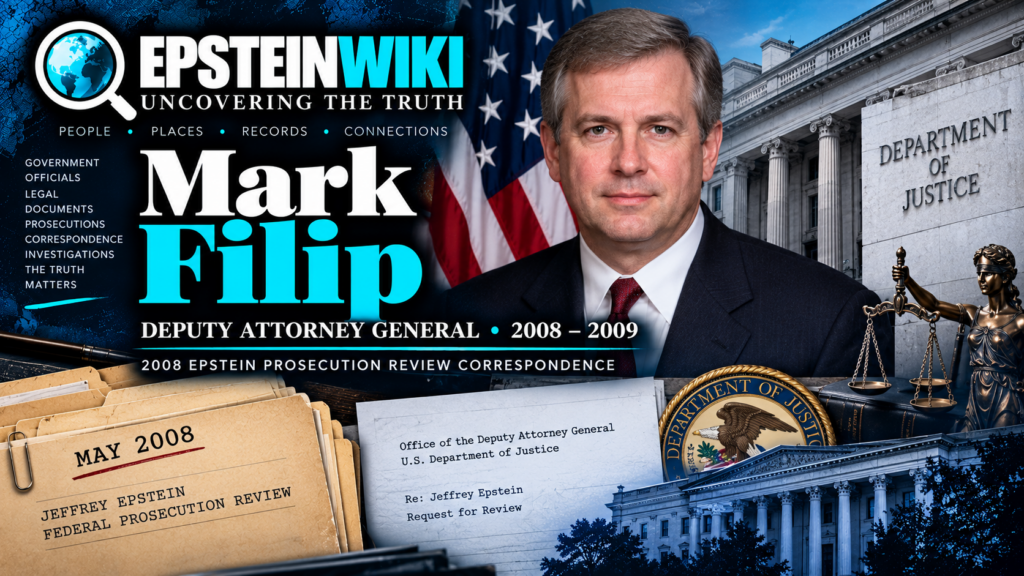
Snapshot
| Field | Details |
|---|---|
| Full name | Mark Robert Filip |
| Profession | Attorney, former federal judge, former United States Deputy Attorney General |
| Government position | 33rd Deputy Attorney General of the United States, serving during 2008 and 2009 |
| Relevant period | May through June 2008 |
| Documented Epstein connection | Received an appeal from Jeffrey Epstein’s attorneys requesting senior Justice Department intervention to stop federal involvement in Epstein’s criminal case. |
| Attorneys submitting the appeal | Kenneth W. Starr and Joe D. Whitley, with subsequent submissions involving Jay P. Lefkowitz and other defense attorneys. |
| Official managing the review | John Roth, Senior Associate Deputy Attorney General |
| Decision | On June 23, 2008, the Office of the Deputy Attorney General declined to intervene and maintained that federal prosecution was appropriate. |
| Original nonprosecution agreement | Signed September 24, 2007, before Filip became Deputy Attorney General. |
| Personal relationship with Epstein | No personal or social relationship established by the records reviewed. |
| Evidence status | Documented official involvement through defense letters, government correspondence, and the Justice Department Office of Professional Responsibility investigation. |
| Legal significance | Filip’s office reviewed and rejected the defense request for intervention. The record does not establish that he negotiated, signed, or approved the original nonprosecution agreement. |
Mark Robert Filip appears in the Jeffrey Epstein documentary record because Epstein’s legal team sought intervention from one of the highest offices in the United States Department of Justice during the final months of his 2008 Florida criminal proceedings.
As Deputy Attorney General, Filip was the department’s second-ranking official. His position gave his office authority to review complaints about federal prosecutorial decisions. Epstein’s defense attorneys used that channel after failing to persuade the Criminal Division that federal prosecution was inappropriate.
The correspondence reveals a significant attempt to influence the federal prosecution process. It also provides an important distinction: although Filip’s office considered Epstein’s arguments, it ultimately rejected the request for intervention.
The central evidence is preserved in the Justice Department Office of Professional Responsibility investigation, together with contemporaneous letters, emails, and government filings. These materials allow researchers to reconstruct what the defense requested, how the review proceeded, and what the department actually decided.
Key Takeaways
- Filip’s involvement began after the original agreement. The September 2007 federal nonprosecution agreement preceded his appointment as Deputy Attorney General in March 2008.
- Epstein’s lawyers appealed to Filip in May 2008. Kenneth Starr and Joe Whitley asked for intervention in what they argued was a matter properly handled by Florida authorities.
- The defense challenged federal jurisdiction. Its attorneys argued that federal child exploitation statutes were being applied improperly and accused prosecutors of misconduct.
- The appeal temporarily delayed enforcement of an existing deadline. John Roth directed the Florida prosecutors to postpone the deadline while the Deputy Attorney General’s office reviewed the submissions.
- Filip reviewed the written materials. According to the subsequent Justice Department investigation, he discussed the matter with Roth and rejected the defense’s central jurisdictional argument.
- The defense did not obtain the requested meeting or relief. Roth conducted a documentary review rather than an independent witness investigation.
- The June 23, 2008 decision rejected intervention. The department concluded that federal prosecution remained appropriate.
- The outcome did not resolve the failures affecting survivors. The federal nonprosecution agreement remained in place, and Epstein entered guilty pleas in Florida state court on June 30, 2008.
Who Is Mark Filip?
Mark Filip is an American attorney and former federal judge whose career included federal prosecution, private legal practice, judicial service, and senior leadership in the Department of Justice.
According to the Justice Department’s official biography, Filip previously served as an Assistant United States Attorney in Chicago, where he prosecuted criminal cases involving corruption, fraud, and other federal offenses.
Before becoming Deputy Attorney General, he served as a judge on the United States District Court for the Northern District of Illinois. The Federal Judicial Center confirms his federal judicial service from 2004 until March 2008.
Filip was sworn in as Deputy Attorney General on March 10, 2008. The position placed him directly beneath Attorney General Michael Mukasey in the Justice Department’s leadership structure.
The Deputy Attorney General supervises significant departmental operations and can become involved when disputes about federal prosecution decisions are elevated beyond an individual United States Attorney’s Office.
That institutional authority explains why Epstein’s lawyers sought his attention. Their letters were not routine correspondence. They were an attempt to obtain review from senior Justice Department leadership after earlier objections had failed.
The Epstein Investigation Before Filip Became Involved
The federal investigation into Jeffrey Epstein began after Palm Beach police investigated allegations involving the sexual exploitation of minors and referred the matter for federal consideration.
Federal prosecutors in the Southern District of Florida developed evidence supporting potential federal charges. Assistant United States Attorney A. Marie Villafaña prepared a proposed indictment containing approximately 60 counts in May 2007.
Rather than proceeding directly with that indictment, the United States Attorney’s Office negotiated an agreement under which Epstein would plead guilty to Florida state charges and satisfy additional conditions.
The resulting nonprosecution agreement, signed September 24, 2007, provided that the Southern District of Florida would not pursue the contemplated federal prosecution if the agreed conditions were fulfilled.
The agreement also extended protections to specified and potential coconspirators. Survivors were not consulted before the agreement was signed.
Filip was not Deputy Attorney General when that agreement was negotiated or executed. His documented involvement came later, when Epstein’s attorneys challenged federal involvement and sought review of the prosecution’s handling.
This chronology matters. A senior official who subsequently reviewed a dispute over an existing agreement should not automatically be described as its author or original approver.
The Defense Campaign to Stop Federal Prosecution
The Criminal Division Review
Before appealing to Filip, Epstein’s attorneys sought review by the Justice Department’s Criminal Division and its Child Exploitation and Obscenity Section, commonly called CEOS.
The defense argued that federal prosecution would improperly extend federal jurisdiction into matters traditionally prosecuted under state law.
It also raised accusations about the conduct of prosecutors, the investigation, and the terms of the agreement.
On May 15, 2008, CEOS Chief Andrew Oosterbaan communicated the Criminal Division’s assessment to Epstein’s defense.
According to the OPR report, the Criminal Division concluded that federal prosecution would not be improper or inappropriate and that United States Attorney Alexander Acosta could properly authorize it.
The review was limited. It did not independently reconsider every factual issue or adjudicate every allegation of prosecutorial misconduct.
Epstein’s lawyers considered that answer insufficient and sought review at a higher level.
The May 19, 2008 Letter to Filip
On May 19, 2008, attorneys Kenneth Starr of Kirkland & Ellis and Joe D. Whitley of Alston & Bird submitted a letter to Deputy Attorney General Mark Filip.
The attorneys asked him to reconsider federal involvement in Epstein’s case. Their principal argument was that the federal government was intervening in an area they believed belonged to state criminal law.
They also claimed that the Criminal Division had conducted an excessively narrow review, failing to evaluate important allegations about the prosecution and investigation.
The letter sought senior departmental intervention and requested an opportunity to meet with Filip.
The May 19 correspondence is significant because it establishes direct, documented access to the Office of the Deputy Attorney General.
It is equally important to distinguish advocacy from findings. The letter’s statements about prosecutorial misconduct represented the defense attorneys’ allegations, not established conclusions by the department or a court.
The May 27 Followup
Starr and Whitley sent another letter to Filip on May 27, 2008.
The followup letter pressed for urgent review before a June 2 deadline imposed by the Southern District of Florida for Epstein to comply with the existing agreement.
The lawyers portrayed the threatened federal prosecution as an inappropriate expansion of federal law. They also suggested that Epstein’s association with former President Bill Clinton had contributed to politically motivated scrutiny.
That political theory was presented by Epstein’s defense. It should not be treated as a verified explanation for the federal investigation.
The significance of the letter lies in how the defense attempted to combine jurisdictional arguments, misconduct accusations, and political implications to obtain intervention from senior Justice Department officials.
The Deadline Was Postponed
The May 27 letter highlighted the approaching June 2 deadline for compliance with the nonprosecution agreement.
Senior Associate Deputy Attorney General John Roth, who was handling the matter for Filip’s office, instructed the Southern District of Florida to withdraw the immediate deadline while the review proceeded.
On May 28, First Assistant United States Attorney Jeffrey Sloman informed Jay Lefkowitz that the deadline had been postponed pending completion of the Deputy Attorney General’s review.
The postponement gave Epstein’s lawyers additional time to pursue their objections.
However, a procedural delay is not the same thing as a favorable legal decision. The record shows that Roth permitted the review to proceed before the compliance deadline was enforced. It does not establish that Filip had decided to prevent prosecution or approve the defense’s arguments.
This distinction is essential when evaluating claims that senior Justice Department intervention protected Epstein from prosecution.
How Filip’s Office Conducted the Review
John Roth Managed the Process
Filip’s office assigned the matter to John Roth, an experienced federal prosecutor serving as Senior Associate Deputy Attorney General.
Roth received and examined written submissions from Epstein’s attorneys, the Southern District of Florida, and the Criminal Division.
According to the Office of Professional Responsibility report, Roth did not conduct an independent criminal investigation, interview witnesses, or meet with Epstein’s legal team.
He discussed the submissions with senior colleagues and Filip, who also reviewed the written materials.
The process was an administrative review of the defense’s appeal, not a replacement for the FBI’s investigation or a new prosecution evaluation based on independent interviews with survivors.
The Government’s Written Response
On June 3, 2008, Sloman provided the Deputy Attorney General’s office with a substantial government submission addressing the history of the investigation, negotiations, agreement, and defense allegations.
The government’s correspondence described the prosecution’s handling of the case and the background to Epstein’s continuing objections.
The submission included materials concerning the proposed federal prosecution and the existing agreement.
The existence of competing submissions matters because the Deputy Attorney General’s office was not relying exclusively on the defense’s account of events.
The June 20 Defense Submission
The defense continued submitting material while the review remained open.
On June 20, 2008, Kirkland & Ellis attorney Ami Sheth transmitted an extensive package to Roth on behalf of Epstein’s attorneys.
The routing correspondence identifies the submission and accompanying documents. The central principal submission argued against federal prosecution under child exploitation and trafficking statutes.
The defense challenged the application of federal laws including 18 U.S.C. Sections 1591, 2422(b), and 2423(b).
These statutes concern offenses including sex trafficking, enticement of minors, and travel for illicit sexual conduct.
Epstein’s legal team asserted that federal prosecutors lacked an adequate basis to pursue charges under those provisions.
Those arguments were legal advocacy by Epstein’s attorneys. The existence of the submission does not establish that the attorneys’ interpretation of federal law was correct.
The correspondence demonstrates that the defense was able to make repeated, detailed submissions to senior federal officials during the months preceding Epstein’s Florida guilty pleas.
What Filip Told Justice Department Investigators
The most revealing evidence about Filip’s personal involvement comes from his statements to the Justice Department Office of Professional Responsibility during its later investigation.
Filip told investigators that he had not heard of Epstein before receiving Starr’s letter.
He described the defense’s appeal as unpersuasive. According to OPR, he rejected the claim that there was no legitimate federal basis for prosecution and did not consider the accusation of political motivation credible.
Filip also explained that the defense wanted a meeting and relief from the existing prosecution process. His office did not grant either request.
That account establishes a meaningful limit on the defense’s access. Epstein’s lawyers successfully brought their arguments before the Deputy Attorney General’s office, but they did not obtain the intervention they sought.
Filip and Roth Understood the Agreement Differently
The OPR investigation also recorded an important difference between Filip and Roth concerning the status of the September 2007 agreement.
Roth said he had understood Epstein to have reneged on the agreement and treated it as effectively abandoned. He therefore did not undertake a review of its terms or attempt to ratify it afterward.
Filip, by contrast, understood that the agreement remained in effect and that Epstein was seeking to undermine the federal jurisdictional basis for it.
Despite that understanding, Filip did not believe the purpose of his office’s review was to reconsider every provision of the agreement or decide whether the negotiated punishment represented the fairest possible outcome.
The office focused on whether it should intervene in the prosecution dispute presented by the defense.
This distinction prevents an important historical mistake: Filip’s rejection of the defense appeal should not be represented as a comprehensive endorsement of the agreement’s original terms.
The June 23, 2008 Decision
On June 23, 2008, John Roth sent the department’s response to Epstein’s attorneys Kenneth Starr and Jay Lefkowitz.
The response stated that the Office of the Deputy Attorney General had completed its review and did not believe intervention was warranted.
Roth explained that United States Attorneys possess considerable discretion in deciding how federal cases should proceed.
The letter went further by stating that federal prosecution of Epstein was appropriate even if headquarters were to substitute its judgment for that of the local United States Attorney.
The subsequent government account of the review preserves that finding.
The outcome was a rejection of the central defense request. It was not a direction to stop the federal investigation, a finding that federal jurisdiction was unavailable, or a determination that the defense’s accusations had been proven.
Immediately afterward, federal prosecutors informed Epstein’s counsel that he had until June 30 to fulfill his obligations under the nonprosecution agreement.
The Attempt to Escalate Further
The Office of Professional Responsibility report also records that Roth alerted the Office of the Attorney General on June 26, 2008, that Epstein’s lawyers might attempt another appeal.
Roth urged the Attorney General’s office not to accept further calls from the defense team concerning the matter.
He later explained that he was concerned additional appeals could delay resolution of the case.
This event reinforces the documented outcome: the Deputy Attorney General’s office had completed its review and was not encouraging an additional round of defense negotiations.
What Happened After Filip’s Decision?
On June 30, 2008, Jeffrey Epstein entered guilty pleas in Florida state court.
He pleaded guilty to felony solicitation of prostitution and procurement of a minor to engage in prostitution.
The negotiated resolution produced an 18-month county jail sentence followed by community control, although Epstein ultimately served substantially less time in custody.
His later work release arrangements became another major source of public criticism and official scrutiny.
The connection between Filip and those outcomes must be described carefully.
His office’s refusal to intervene ended a defense appeal and cleared the way for enforcement of the existing agreement. It did not create the agreement, determine its original sentencing provisions, or independently authorize Epstein’s subsequent work release.
Those decisions involved other officials and institutions and require separate examination.
The Survivor Rights Question
One of the most important aspects of the Epstein case is the contrast between the extensive opportunities available to his defense team and the treatment of survivors during the federal investigation.
Epstein’s lawyers were able to submit written arguments, pursue internal departmental review, challenge prosecutors, and obtain temporary procedural accommodations.
Survivors, meanwhile, had not been informed or consulted before the original nonprosecution agreement was signed.
The Justice Department’s November 2020 executive summary concluded that the government’s treatment of victims lacked the forthrightness and sensitivity expected by the department.
The department also concluded that Alexander Acosta exercised poor judgment in resolving the investigation through the nonprosecution agreement and failing to ensure that victims were notified about the state plea hearing.
OPR did not find professional misconduct by the prosecutors who were subjects of its investigation. That conclusion did not erase the documented failures involving survivor notification and treatment.
For Filip’s role, the evidence supports a narrower conclusion. His office participated in a senior departmental review requested by the defense, but the available record does not establish that he personally directed the earlier concealment of the agreement or made the original victim notification decisions.
The larger institutional question remains important: why did Epstein’s attorneys receive multiple layers of review while survivors were not given a comparable opportunity to participate in decisions affecting their rights?
That disparity is part of the documented history. It should be examined without assigning unsupported personal responsibility to individual officials.
Documented Chronology
| Date | Documented Event | Source |
|---|---|---|
| September 24, 2007 | The Southern District of Florida signs the federal nonprosecution agreement with Epstein. | Agreement |
| March 10, 2008 | Mark Filip becomes Deputy Attorney General. | DOJ Biography |
| May 15, 2008 | The Criminal Division concludes that federal prosecution would not be improper or inappropriate. | OPR Report |
| May 19, 2008 | Kenneth Starr and Joe Whitley request review by Filip. | Defense Letter |
| May 27, 2008 | Starr and Whitley submit an urgent followup letter. | Followup Letter |
| May 28, 2008 | The compliance deadline is postponed while the Deputy Attorney General’s office reviews the matter. | OPR Report |
| June 3, 2008 | The Southern District of Florida provides its written account to the Deputy Attorney General’s office. | Government Correspondence |
| June 20, 2008 | A large defense submission is transmitted to Roth. | Routing Email |
| June 23, 2008 | Roth informs defense counsel that the Deputy Attorney General will not intervene and that federal prosecution remains appropriate. | OPR Report |
| June 26, 2008 | Roth warns the Office of the Attorney General about possible further defense appeals. | OPR Report |
| June 30, 2008 | Epstein enters guilty pleas in Florida state court. | DOJ Executive Summary |
| November 2020 | The Justice Department publishes the executive summary of its professional responsibility investigation. | DOJ Statement |
Evidence Appearances
The following records document the principal appearances and decisions concerning Filip’s involvement. They include contemporaneous communications, litigation records, and the subsequent official investigation.
A document’s inclusion does not mean that every assertion made within it was independently verified. Defense letters, government memoranda, and investigative findings have different evidentiary significance.
| Record or ID | Date | What It Shows | Source |
|---|---|---|---|
| EFTA00040089 | September 2007 | The original nonprosecution agreement, signed before Filip became Deputy Attorney General. | Evidence |
| EFTA00224786 | May 19, 2008 | Starr and Whitley’s written appeal to Filip seeking departmental intervention. | Evidence |
| EFTA00605382 | May 27, 2008 | Defense followup letter pressing for urgent review and raising claims of political motivation. | Evidence |
| EFTA00190318 | June 2008 | Government correspondence explaining the prosecution’s history and response to the defense appeal. | Evidence |
| EFTA00191148 | Filed June 2013 | Litigation inventory identifying defense and government communications, including letters addressed to Filip and Roth. | Evidence |
| EFTA00013783 | June 20, 2008 | Transmission and routing of the defense’s principal submission and related attachments. | Evidence |
| EFTA00013811 | June 2008 | Defense submission challenging the application of federal child exploitation and trafficking laws. | Evidence |
| EFTA00067500 | June 23, 2008 | Government email informing defense counsel that federal prosecution was appropriate and setting the final compliance deadline. | Evidence |
| EFTA00211273 | Government filing | Government account describing the Criminal Division review, Roth’s response, and the decision against intervention. | Evidence |
| EFTA00209306 | Litigation record | Privilege log documenting the government’s submission to the Deputy Attorney General and its associated records. | Evidence |
| EFTA02830776 | November 2020 | Full Office of Professional Responsibility report recounting the defense appeal, interviews with Filip and Roth, and departmental handling. | Evidence |
| DOJ-OGR-00002533 | November 2020 | Justice Department executive summary describing the appeal and the department’s refusal to intervene. | Evidence |
What the Evidence Does Not Establish
The documentary record supports a specific institutional role for Filip. It does not support expanding that role into allegations for which no corresponding evidence has been established.
- Negotiation of the original agreement: No record reviewed establishes that Filip participated in negotiating the September 2007 nonprosecution agreement.
- Original approval: His office’s June 2008 review should not be confused with approval of the agreement when it was first executed.
- Personal relationship: The evidence reviewed does not establish that Filip was a personal friend, social associate, employee, or business partner of Epstein.
- Direct payment or gifts: No payment, gift, or financial relationship between Epstein and Filip was established by the records examined for this article.
- Participation in abuse or trafficking: The reviewed records do not establish Filip’s involvement in Epstein’s criminal abuse or trafficking activities.
- Direction of survivor notification: No evidence examined establishes that Filip personally ordered the original failure to notify survivors about the agreement.
- Authorization of work release: Filip’s June 2008 review does not establish his involvement in the later county work release decision.
- Comprehensive factual review: The Deputy Attorney General’s office did not independently reinvestigate every witness account or conduct a new criminal investigation.
These limits do not minimize the institutional significance of the appeal. They identify what investigators can responsibly conclude from the available evidence.
Institutional Accountability and Unresolved Questions
The Filip correspondence demonstrates how Epstein’s legal team used senior departmental review procedures after negotiating an agreement that had already prevented an immediate federal indictment.
The defense had access to officials at multiple levels of the Justice Department. It submitted substantial legal arguments, challenged prosecutorial discretion, and obtained time for further consideration.
Yet the review ended with an unfavorable decision for Epstein’s attorneys. Filip’s office did not order the federal prosecutors to abandon their authority or accept the defense’s jurisdictional theory.
The unresolved accountability questions concern the limits of that review and the broader structure of the original agreement.
Why was the original federal case resolved through a state plea despite the proposed federal indictment? Why were survivors excluded from the original negotiations? Why did the agreement contain broad provisions concerning potential coconspirators? And why did later enforcement fail to produce the custodial conditions originally contemplated?
These questions cannot be answered solely through Filip’s correspondence because the decisive events involved different officials, agencies, and periods.
The released record also requires continued attention to the full set of attachments, duplicate correspondence, privilege logs, and related litigation exhibits. Documents that remain inaccessible or unreviewed cannot be treated as proof of an undisclosed relationship or decision.
The most defensible assessment is that Filip participated in an official appeal process that temporarily delayed the existing compliance deadline but ultimately rejected the defense’s request for intervention.
Related EpsteinWiki Investigations
The Mark Filip record connects to several other parts of EpsteinWiki’s research into the federal investigation, the nonprosecution agreement, and the attorneys who challenged the Justice Department’s handling of the case.
- Kenneth Starr, whose defense submissions sought intervention by senior Justice Department officials.
- Alice Fisher, who led the Criminal Division during an earlier stage of the defense’s internal appeal.
- Alexander Acosta, the United States Attorney overseeing the South Florida federal prosecution and original agreement.
- Operation Leap Year, the federal investigation preceding the negotiated resolution.
Conclusion
Mark Filip’s documented connection to Jeffrey Epstein is a matter of federal institutional review, not an established personal relationship.
In May 2008, Epstein’s attorneys sought relief from the Deputy Attorney General after failing to persuade other federal officials that prosecution was inappropriate. Their appeal challenged federal jurisdiction, alleged prosecutorial misconduct, and sought to stop continued federal involvement.
Filip’s office reviewed the submissions, permitted additional time while that review proceeded, and declined to intervene on June 23, 2008.
That decision matters. It contradicts any account suggesting that Filip accepted the defense’s central argument that federal prosecution lacked a legitimate basis.
It also does not resolve the separate failures that allowed Epstein to receive an unusually favorable outcome through the earlier nonprosecution agreement.
The documentary record establishes both facts: senior Justice Department officials rejected Epstein’s final appeal, while the original agreement remained in effect and the survivors continued to bear the consequences of decisions made without their participation.
Investigating that distinction is essential to understanding how powerful defendants navigate federal legal institutions and how those institutions can fail people whose rights they are supposed to protect.
Questions and Answers
Who was Mark Filip?
Mark Robert Filip was a federal judge, prosecutor, attorney, and the 33rd Deputy Attorney General of the United States. He served as Deputy Attorney General during 2008 and 2009.
What was his connection to Jeffrey Epstein?
Epstein’s lawyers appealed to Filip’s office in May 2008, asking senior Justice Department leadership to intervene in the federal prosecution dispute. Filip reviewed written submissions and discussed the matter with senior staff.
Did Mark Filip approve Epstein’s original nonprosecution agreement?
The available record does not establish that he negotiated or approved the original September 2007 agreement. His documented involvement came afterward, during the defense appeal in 2008.
Did Filip stop the federal prosecution?
No. His office declined the defense’s request for intervention and concluded that federal prosecution remained appropriate. Epstein subsequently fulfilled the state plea obligations under the existing agreement.
Did Filip personally meet with Epstein’s attorneys?
The Office of Professional Responsibility report records that the defense sought a meeting but did not receive one from Filip’s office as part of the appeal.
Did the defense appeal delay Epstein’s guilty plea?
Yes. The Deputy Attorney General’s review resulted in postponement of an existing June 2, 2008 compliance deadline. A new deadline was imposed after the June 23 decision.
Did Filip find that prosecutors committed misconduct?
The Deputy Attorney General’s office did not grant relief on the basis of the defense’s misconduct allegations. That determination should not be confused with the later Office of Professional Responsibility investigation into the overall handling of the case.
Was Filip involved in Epstein’s work release?
No involvement in the subsequent county work release decision was established in the records reviewed for this article.
Was Filip personally associated with Epstein?
The reviewed evidence does not establish a personal, financial, or social relationship. His documented connection arose through the official review requested by Epstein’s legal counsel.
Why does Filip belong in the EpsteinWiki?
His official role helps explain how Epstein’s defense sought intervention from senior Justice Department leadership, how that effort affected the prosecution timetable, and why the department ultimately refused the requested relief.
Sources
- United States Department of Justice, Office of Professional Responsibility, Investigation into the Epstein Case, November 2020.
- United States Department of Justice, Office of Professional Responsibility Executive Summary, November 2020.
- Department of Justice statement regarding the Epstein investigation, November 12, 2020.
- Kenneth Starr and Joe Whitley, May 19, 2008 letter to Deputy Attorney General Mark Filip.
- Kenneth Starr and Joe Whitley, May 27, 2008 supplemental letter.
- Southern District of Florida correspondence concerning the appeal to the Deputy Attorney General.
- Court filed correspondence inventory concerning defense lobbying and prosecutorial misconduct claims.
- June 20, 2008 email routing the defense submission to John Roth.
- Defense principal submission to the Office of the Deputy Attorney General.
- June 23, 2008 government communication concerning completion of the review.
- Government account of the Criminal Division and Deputy Attorney General reviews.
- Litigation privilege log identifying the government submission and related correspondence.
- Jeffrey Epstein federal nonprosecution agreement, September 2007.
- Epstein Data Wiki, Submission to the Deputy Attorney General.
- United States Department of Justice, historical biography of Deputy Attorney General Mark R. Filip.
- Federal Judicial Center, Mark R. Filip judicial biography.