
Operation Leap Year: The Federal Investigation of Jeffrey Epstein
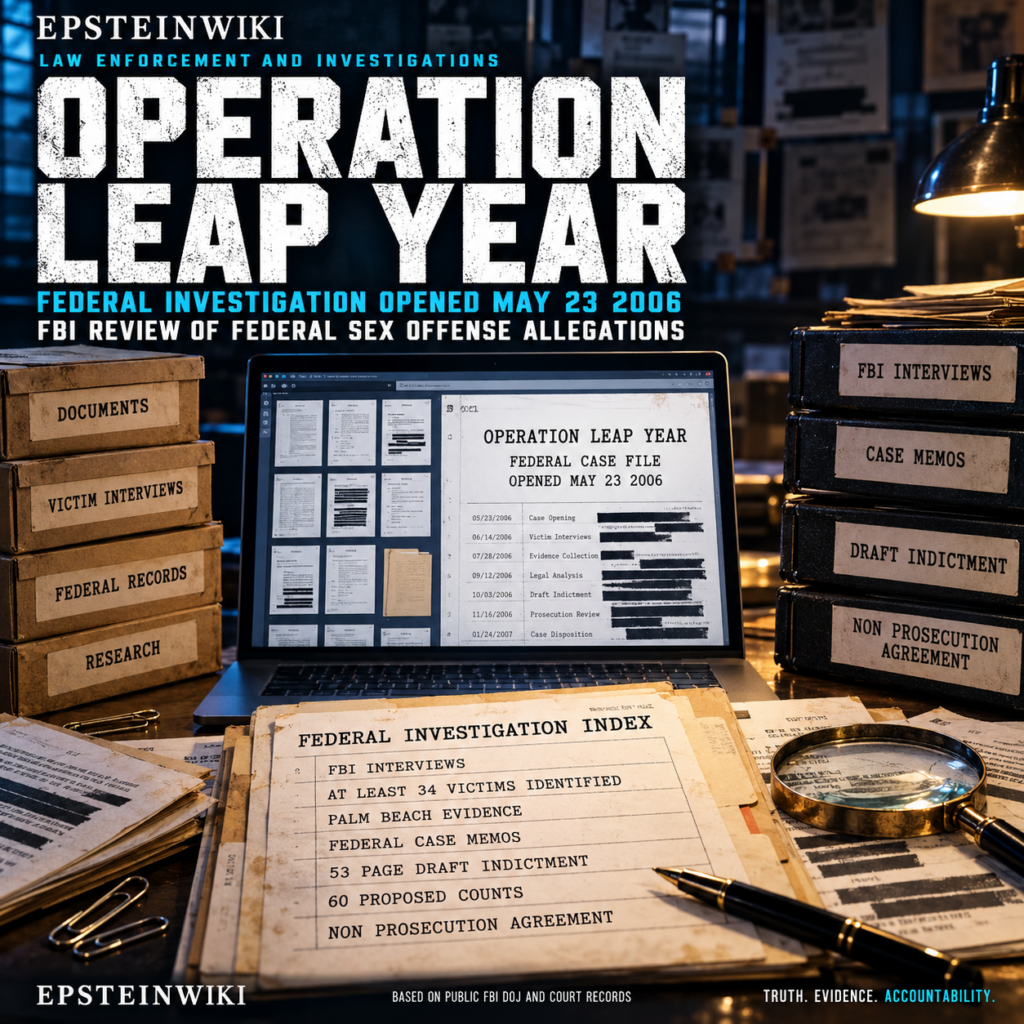
The FBI and U.S. Attorney’s Office investigation, the proposed federal case, and the records that followed.
Operation Leap Year was the federal investigation into Jeffrey Epstein that followed the Palm Beach police investigation. The records document grand jury activity, subpoenas, witness interviews, and repeated work on a proposed federal indictment. Prosecutors did not file that indictment. The investigation was resolved through a Florida plea and a federal nonprosecution agreement, while later records continued to track the FBI file and the handling of the case.
Snapshot
- Investigation: Operation Leap Year
- Subject: Jeffrey Epstein
- Lead federal office: U.S. Attorney’s Office for the Southern District of Florida
- USAO file opened: May 23, 2006
- FBI case opened: July 24, 2006, according to DOJ’s later review. An FBI case summary gives July 25, 2006.
- FBI file number: 31E MM 108062
- USAO investigation number: 2006R01181, also identified as OLY
- Grand jury subpoena series: OLY 01 through OLY 81
- Proposed federal indictment: A 60 count draft submitted for review in 2007
- Federal prosecution outcome: No federal indictment was returned. The matter was resolved through a Florida state plea and a federal nonprosecution agreement.
Key takeaways
- Operation Leap Year began as a federal investigation after Palm Beach police referred the Epstein matter to the FBI.
- DOJ says the name referred to approximately 29 girls identified by the state investigation at that point. This was an early figure, not a final count of survivors.
- Investigators pursued financial, corporate, travel, school, witness, and victim records.
- Prosecutors prepared a proposed 60 count indictment and scheduled a federal indictment for September 25, 2007. The agreement with Epstein was signed the day before.
- The FBI file continued to appear in court records and later status documents. The label “Pending Inactive” does not prove that active investigative work was underway.
Origins and opening of the investigation
The DOJ Office of Professional Responsibility report, EFTA02830776, says the Palm Beach Police Department began investigating Epstein in 2005 after the parents of a 14 year old girl reported that he had paid her for a massage. The investigation led police to allegations that Epstein used personal assistants to recruit girls for massages, some of which involved sexual activity.
The police chief and lead detective believed the state charge did not address the full scope of the alleged conduct. They referred the matter to the FBI in West Palm Beach for possible federal investigation.
Assistant U.S. Attorney A. Marie Villafaña opened the U.S. Attorney’s Office file on May 23, 2006, with supervisory approval and with U.S. Attorney Alexander Acosta’s knowledge. DOJ’s report says the name Operation Leap Year referred to the approximately 29 girls the state investigation had identified at that time.
The FBI opened its own case later. DOJ’s review gives July 24, 2006 as the FBI case opening date. A later FBI case summary lists July 25. The one day difference appears in the records and should remain visible rather than being silently resolved.
The 51 page federal investigation timeline, EFTA00224943, begins with a May 1, 2006 letter from Palm Beach Police Chief Michael Reiter to State Attorney Barry Krischer. Reiter urged the state office to file charges or recuse itself. The timeline later records Reiter’s referral of the matter to federal authorities.
Scope of the investigation
The timeline shows that investigators developed a case beyond reviewing the state prosecution. Early federal activity included subpoenas to banks, companies, aviation businesses, schools, and employment agencies. Investigators also requested Palm Beach Police Department records and conducted interviews with witnesses and employees.
The timeline identifies subpoenas involving Colonial Bank, Washington Mutual, Capital One, Chase, Palm Beach National Bank, Western Union, American Express, Bear Stearns, Hyperion Air, JEGE Inc., New York Strategy Group, and Dollar Rent A Car. It also records activity involving pilot Bill Hammond, pilot Larry Visoski, travel records, Royal Palm Beach Community High School, and the Dalton School.
A subpoena shows that investigators sought records. It does not establish that a recipient knew about or participated in Epstein’s crimes.
The FBI case agent declaration, EFTA01657747, describes hundreds of documents obtained through grand jury subpoenas, public records, and law enforcement databases. The declaration also confirms that FBI agents interviewed females believed to have been underage when Epstein sexually abused them, along with other people who might have relevant information. It does not give a total number of interviews or a complete date range.
Grand juries, subpoenas, and proposed presentation
The Operation Leap Year subpoena log, EFTA01702617, identifies a series running from OLY 01 through OLY 81. The log refers to one West Palm Beach grand jury, FGJ 05 02, and the records also include transcripts captioned for Federal Grand Jury 07 103. The names of subpoena recipients and descriptions of requested records are redacted in portions of the log. One early subpoena is marked “never served.”
The grand jury transcript record, EFTA01245169, is captioned “In Re: Operation Leap Year” and identifies testimony by an FBI case agent on February 27, 2007. The grand jury presentation outline, EFTA01731290, sets out a planned presentation organized around proposed charges, flights, telephone calls, meetings, and case agent testimony.
That outline is a plan, not proof that the entire presentation occurred. The records reviewed for this article show no federal indictment returned by a grand jury.
Epstein’s attorneys challenged the subpoena process. The government’s privilege log filing, EFTA00211385, lists a motion by Epstein to intervene in and quash grand jury subpoenas, an affidavit by attorney Roy Black, and the government’s response and cross motion to compel.
The proposed federal indictment
On May 1, 2007, Villafaña submitted a prosecution memorandum and proposed indictment for supervisory review. The May 2007 memorandum, EFTA02857524, sought approval for charges against Epstein, JEGE Inc., and Hyperion Air Inc. It described a proposed 60 count case and sought forfeiture of Epstein’s Palm Beach residence and two aircraft.
The memorandum summarized evidence and legal issues supporting proposed charges. DOJ’s later review says that the draft indictment concerned federal crimes related to sexual conduct with and trafficking of minors. It also reports a federal sentencing guideline range of 168 to 210 months.
The proposed charges were never filed in court. The appearance of a person or company in a draft charging document does not mean that the person or company was charged or found guilty.
The document based review of the proposed corporate charges examines JEGE and Hyperion Air in the draft. It links its analysis to the underlying prosecution records.
Negotiations and the nonprosecution agreement
The investigation timeline records sustained contact between prosecutors and Epstein’s attorneys, including motions challenging subpoenas, arguments about potential federal statutes, and requests for review by senior Justice Department officials. The timeline also records that the indictment package was scheduled for September 25, 2007.
The federal nonprosecution agreement was signed on September 24, 2007, one day before that scheduled indictment date. Under the agreement, federal prosecutors agreed not to prosecute Epstein in the Southern District of Florida if he met specified conditions connected to a Florida state plea.
The negotiated terms included state guilty pleas, a sentence recommendation, sex offender registration, and a mechanism for victims to seek monetary damages. The agreement also included language concerning potential co conspirators in the Southern District of Florida.
The Florida criminal case record documents Epstein’s later state plea. He pleaded guilty on June 30, 2008. The agreement and plea ended the planned federal prosecution without a federal trial.
The 2008 delay and victim notification
A January 29, 2008 email under the subject “Operation Leap Year” shows that the investigative team was still seeking a decision after the agreement had been signed. The email, EFTA01659971, has its sender, recipients, and signature redacted.
The writer said that they and a colleague were meeting seven victims that week and raised concern that the delay made victims harder to find. The email also discussed the unresolved subpoena for computer equipment, the cost of additional interviews in Australia and New York, and frustration among investigators. It quoted an unidentified person making a degrading comment about the victims’ ages. The identity of that speaker is redacted.
The email is important because it records internal concern about delay, evidence collection, and victim participation. It does not identify the writer or establish the views of every prosecutor involved.
The investigation timeline records multiple victim notification drafts and discussions after the agreement was signed. The chronology shows that the agreement was completed before identified victims were informed that the federal case had been resolved. DOJ’s later review concluded that victims were not treated with the forthrightness and sensitivity expected from the Department.
The 2008 plea, work release, and possible breaches
Epstein entered his Florida plea on June 30, 2008. The timeline records communications between federal prosecutors and the defense shortly before the hearing about whether the proposed state plea and sentence complied with the federal agreement. It also records that victims’ attorneys and Palm Beach Police Chief Michael Reiter were notified shortly before the plea hearing.
After the plea, Epstein received work release that allowed him to leave custody for substantial periods. The timeline documents research into Florida work release rules, concerns about his application, communications with the Palm Beach County Sheriff’s Office, and a December 11, 2008 letter describing inaccuracies and omissions in the work release file.
The timeline also records later questions about possible breaches of the agreement. The issues included delays in entering the plea, disputes over charges and sentence, positions taken in civil litigation, attorney payment disputes, work release representations, contact with a protected individual, and a proposed transfer of supervision to the U.S. Virgin Islands. These entries document concerns and legal positions. They do not establish that every alleged breach was proven in court.
In June 2009, prosecutors prepared a signed indictment package for possible presentation. The investigation timeline, EFTA00224943, records that package but does not show that a grand jury returned it. The federal government did not prosecute Epstein under that package.
Court ordered review of the FBI file
The Operation Leap Year file later became relevant in litigation under the Crime Victims’ Rights Act. In 2013, the court ordered production of responsive records and directed the government to submit documents withheld on privilege grounds for private judicial review.
The 2013 email chains, EFTA01657290 and EFTA01657289, document coordination over production of the FBI file and physical evidence for review by Judge Kenneth Marra. A later filing included the case agent’s declaration and a privilege log covering three boxes of U.S. Attorney’s Office materials.
The government’s opposition, EFTA01142189, described privacy interests, the potential exposure of cooperating witnesses, and sensitive investigative methods as reasons for withholding some FBI material.
In 2015, Judge Marra ruled on the privilege claims. The court order, EFTA01657752, records that the government had produced 1,357 pages to the petitioners and submitted nearly 15,000 pages to the court for private review. The court found that the petitioners had not met the required standard for disclosure of the grand jury material.
DOJ review and later FBI status records
DOJ’s Office of Professional Responsibility reviewed the Southern District of Florida’s handling of the case. Its executive summary found no professional misconduct by department attorneys. It concluded that victims were not treated with the forthrightness and sensitivity expected by the Department and that Acosta exercised poor judgment in resolving the federal investigation through the agreement and failing to ensure victim notification.
A 2013 FBI declaration stated that Operation Leap Year “remains an open case.” A 2025 FBI email later listed file 31E MM 108062 as “Pending Inactive.” The status email, EFTA01649099, and FBI case summary table, EFTA00163964, are records of those administrative statuses.
The statuses require careful interpretation. The FBI file number is distinct from the U.S. Attorney’s Office matter, which the timeline says was administratively closed in September 2010. “Pending Inactive” does not establish active investigative work, and the documents cited here do not explain every reason for the designation.
What the records establish and what they do not
The records establish that federal investigators pursued a substantial investigation, sought evidence from financial and corporate entities, interviewed witnesses and potential victims, used grand juries and subpoenas, and prepared a proposed federal indictment. They also establish that the proposed indictment was not filed and that the federal case was resolved through a state plea and nonprosecution agreement.
The records do not turn proposed charges into court findings. A subpoena does not prove misconduct by its recipient. A draft indictment does not prove that a grand jury returned charges. A case status label does not prove that agents were conducting active investigative work.
The EpsteinWiki investigation timeline article provides a document by document chronology. Its entries should be read alongside the underlying evidence, court filings, the agreement, and DOJ’s review.
Related EpsteinWiki articles
- EFTA00224943: Complete Epstein Investigation Timeline
- Federal Grand Jury Testimony EFTA00224005
- State of Florida v. Epstein
- Federal prosecutors and proposed charges against Epstein’s corporations
Questions for further research
- Which subpoena returns and interview records remain sealed or unavailable?
- What records explain the supervisors’ decision not to file the proposed 2007 indictment?
- What was the full evidentiary basis for the signed 2009 indictment package, and why was it not presented?
- What records explain the FBI file’s later “Pending Inactive” designation?
Sources
- Epstein investigation timeline, EFTA00224943
- DOJ Office of Professional Responsibility report, EFTA02830776
- Operation Leap Year grand jury subpoena log, EFTA01702617
- Grand jury transcript, EFTA01245169
- Grand jury presentation outline, EFTA01731290
- May 2007 prosecution memorandum, EFTA02857524
- January 2008 email, EFTA01659971
- FBI case agent declaration, EFTA01657747
- Privilege log filing, EFTA00211385
- FBI file production emails, EFTA01657290 and EFTA01657289
- Government opposition in the CVRA litigation, EFTA01142189
- Court order on privilege claims, EFTA01657752
- FBI case status email, EFTA01649099
- FBI case summary table, EFTA00163964
- DOJ Office of Professional Responsibility executive summary
- DOJ statement on the OPR findings
Keywords: