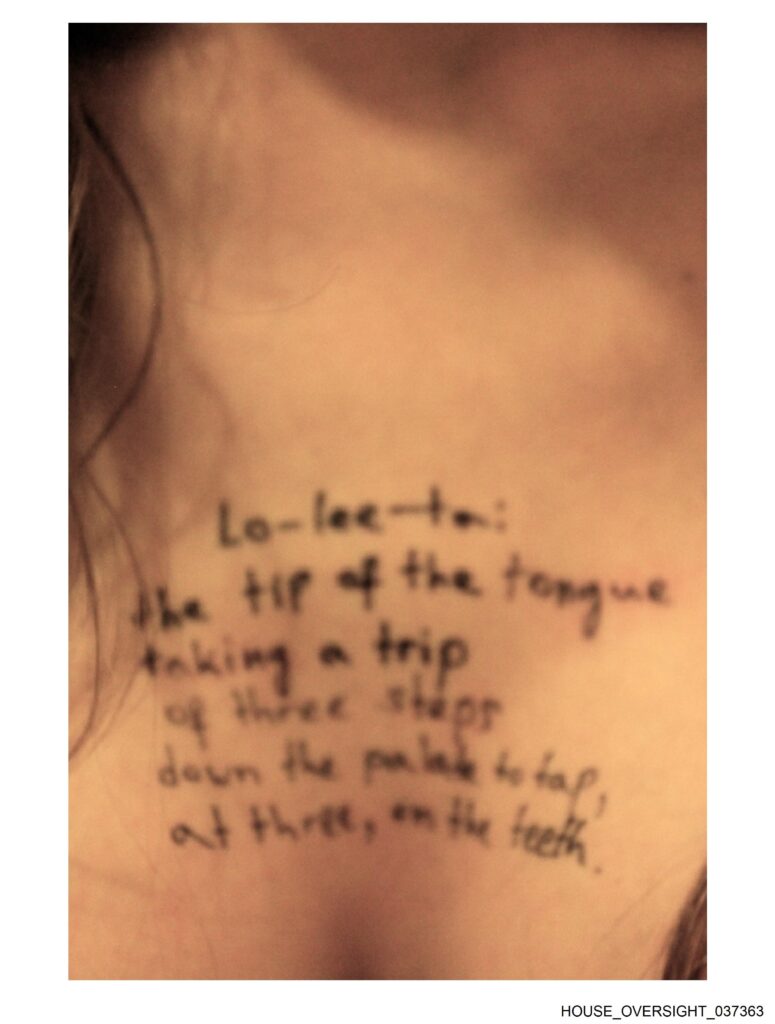
HOUSE OVERSIGHT 037363 Through 037368: Photographic Series of Handwritten Text on a Woman’s Body
Snapshot
| Field | Details |
|---|---|
| Record identifiers | HOUSE_OVERSIGHT_037363 through HOUSE_OVERSIGHT_037368 |
| Evidence type | Six photograph files |
| Producing party | Jeffrey Epstein estate |
| Public release | December 18, 2025 |
| Releasing body | Democratic members of the House Committee on Oversight and Government Reform |
| Direct evidence | Official December 18, 2025 release folder |
| Number of images | Six consecutively numbered files |
| Apparent subject | One unidentified person presented as a woman |
| Subject’s age | Not established by the released photographs |
| Photographer | Unknown |
| Person who wrote the text | Unknown |
| Date photographed | Unknown |
| Location | Unknown |
| Original filenames | Not disclosed in the public release |
| Original device or camera | Unknown |
| Embedded metadata | Not provided with the publicly indexed copies |
| Content warning | Sexualized photographic material, partial nudity, possible exploitation |
| Evidentiary significance | The files document a deliberately composed photographic sequence involving handwritten text on a person’s body, but the release supplies no reliable context about identity, consent, authorship, date, location, or purpose. |
The series should be treated as sensitive photographic evidence. The photographs are not reproduced here because doing so would add little evidentiary value while increasing the risk of further exposing an unidentified person.
What Is This Record?
HOUSE_OVERSIGHT_037363 through HOUSE_OVERSIGHT_037368 form a six-image sequence released among photographs produced to Congress by the Jeffrey Epstein estate.
The photographs show handwritten words or phrases placed on different parts of an unidentified person’s body. The images use close framing and appear visually connected through the subject, handwriting, lighting, and manner of presentation.
Those similarities support describing the files as a photographic series. They do not establish the order in which the photographs were taken, who arranged the session, or whether the public numbering preserves the original camera sequence.
The House Oversight Democrats’ release statement states that the Epstein estate supplied approximately 95,000 photographs without accompanying context. The committee said the images were presented as received and that it was continuing to analyze the larger production.
That disclosure is essential. These files have congressional release provenance, but they do not have a complete public evidentiary history.
Source and Provenance
The publicly documented chain begins with a production from the Jeffrey Epstein estate to the House Committee on Oversight and Government Reform.
On December 18, 2025, Oversight Democrats released an additional group of 70 photographs selected from approximately 95,000 images produced by the estate. The official statement says that the estate did not provide context for the images.
The known public path is therefore:
| Stage | What Is Established | What Remains Unknown |
|---|---|---|
| Creation | Someone created the photographs before the estate’s congressional production | Photographer, camera, date, location, purpose, and original custodian |
| Estate custody | The files were included in material produced by the Jeffrey Epstein estate | How the estate acquired, stored, or categorized the images |
| Congressional production | The House Oversight Committee received the larger photographic production | Original directory structure, file relationships, hashes, and extraction method |
| Public release | Oversight Democrats released selected images on December 18, 2025 | Whether the public copies retain complete native metadata |
| Secondary indexing | Archives and research projects indexed the files under House Oversight identifiers | Whether every archive preserves the files without recompression or conversion |
The congressional identifiers establish where the images appear in the public release. They do not identify the original photographer or establish that Jeffrey Epstein personally created, commissioned, viewed, or organized the photographs.
Researchers should preserve the distinction between material produced by Epstein’s estate and evidence proven to have been personally created or knowingly possessed by Epstein.
Evidence Appearance Table
| Record | Visible Content | Evidentiary Limits |
|---|---|---|
| HOUSE_OVERSIGHT_037363 | Close view of handwritten text on the upper torso or neck area | The wording, writer, subject, date, and location are not independently established |
| HOUSE_OVERSIGHT_037364 | Related photograph showing additional handwriting on the subject’s body | The public release provides no caption explaining the image or its relationship to the other frames |
| HOUSE_OVERSIGHT_037365 | Another close photograph of handwritten text on the body | No authoritative transcript of the writing accompanies the file |
| HOUSE_OVERSIGHT_037366 | Related frame from the same apparent photographic session | The sequence number does not prove photographic chronology |
| HOUSE_OVERSIGHT_037367 | Handwritten text appears across the upper back or shoulder area | The person who applied the writing and the circumstances of the photograph remain unknown |
| HOUSE_OVERSIGHT_037368 | Handwritten text runs vertically along the back | The final public identifier does not establish that this was the final photograph taken |
The photographs can be located by their identifiers in the official House release folder.
No transcription should be treated as authoritative unless researchers obtain a sufficiently clear source image and independently verify each word. Ambiguous handwriting can easily produce false quotations or misleading interpretations.
What Is Visible Across the Series?
The photographs share several apparent visual characteristics:
- Close framing places attention on the body and handwritten text rather than on a wider environment.
- The writing appears to be part of the photographic composition.
- Similar lighting and presentation connect the images visually.
- Different frames record writing on more than one area of the body.
- The surrounding location is not sufficiently documented to identify a specific Epstein property.
- The subject’s identity is not established by the congressional release.
- No public caption identifies the photographer.
- No public caption explains who wrote the text or why it was written.
The presentation appears deliberate rather than accidental. That observation concerns the composition of the photographs. It does not establish consent, coercion, commercial production, abuse, or criminal conduct.
The images also do not establish the subject’s age. Researchers should not describe the person as a minor or an adult without corroborating evidence.
The Handwritten Text
The writing is central to the series, but the public release does not provide an authoritative transcript or explanation.
A responsible analysis must separate three questions:
| Question | Current Answer |
|---|---|
| What writing is visibly present? | Multiple handwritten words or phrases appear on the subject’s body |
| What does the writing say? | A complete verified transcription has not been established |
| What does the writing mean? | The intended meaning and context remain unknown |
Even if individual words appear legible, their meaning cannot be determined without context. The writing could have been personal, performative, artistic, sexualized, commercial, coercive, or created for another purpose.
The photographs alone do not resolve those possibilities.
No wording should be attributed to Jeffrey Epstein, the subject, or another person without independent evidence linking that person to the writing.
Connection to Jeffrey Epstein
The verified connection is custodial and documentary.
The photographs were among files produced by Jeffrey Epstein’s estate to the House Oversight Committee. That makes them part of the congressional Epstein estate record.
The production does not, by itself, establish that:
- Epstein took the photographs.
- Epstein appears in the photographs.
- Epstein wrote the text.
- Epstein directed the session.
- Epstein knew the subject.
- Epstein stored the original files personally.
- The photographs were taken at an Epstein property.
- The images document a trafficking or recruitment event.
- The subject was a victim or survivor of Epstein’s abuse.
Those questions require corroborating evidence such as native metadata, directory records, communications, witness testimony, property identification, device records, or duplicate files recovered from a known source.
What the Photographs Establish
The public record supports several limited conclusions.
First, the House released six consecutively numbered photographs under identifiers HOUSE_OVERSIGHT_037363 through HOUSE_OVERSIGHT_037368.
Second, the files depict handwritten text placed on the body of an unidentified person presented as a woman.
Third, the visual similarities support treating the images as a connected photographic sequence.
Fourth, the photographs were included in a much larger production made by the Jeffrey Epstein estate to the House Oversight Committee.
Finally, the public production lacks the contextual information needed to identify the photographer, subject, writer, date, location, or purpose.
These are the strongest conclusions available without moving beyond the evidence.
What the Photographs Do Not Establish
The series does not independently prove:
- The subject’s identity.
- The subject’s age.
- Whether the subject consented to the writing or photography.
- Whether the subject experienced coercion or exploitation.
- Who wrote on the subject’s body.
- Who operated the camera.
- Who selected or retained the photographs.
- Whether Jeffrey Epstein was present.
- Whether Ghislaine Maxwell or another associate was involved.
- Whether the session occurred at an Epstein residence.
- Whether the images were created for private, artistic, sexual, or commercial purposes.
- Whether the public numbering reflects the original capture order.
- Whether additional photographs from the same session exist.
- Whether the files were edited, cropped, converted, or stripped of metadata before release.
- Whether the writing refers to another person or event.
- Whether a crime occurred.
Possession within an estate production is not the same as proof of creation, authorship, knowledge, or criminal responsibility.
Metadata and Technical Limitations
The publicly indexed copies do not provide enough technical information to reconstruct the files’ complete history.
Important missing fields include:
| Missing Information | Why It Matters |
|---|---|
| Original filename | Could reveal camera sequence, export history, or source folder |
| Creation timestamp | Could narrow the date of the session |
| Camera make and model | Could connect the photographs to a known device |
| GPS data | Could identify or exclude a property |
| File hash | Could confirm duplicates across evidence collections |
| Directory path | Could reveal how the files were organized |
| Editing history | Could show whether the images were cropped or converted |
| Account or device owner | Could help establish custody |
| Adjacent native files | Could supply context before or after the photographed sequence |
The House identifiers function as release labels. They should not be mistaken for original camera filenames.
A complete forensic review would require native files, cryptographic hashes, extraction records, and documentation showing how the estate located and produced the photographs.
Evidence Handling and Survivor Safety
This record requires a survivor-centered approach.
The subject has not been publicly identified through reliable evidence. The images should not be used for facial recognition, body identification, crowd speculation, or attempts to identify the person through physical characteristics.
Researchers should also avoid reposting uncensored copies. Reproduction can expose an unidentified person without adding meaningful public understanding.
Responsible publication should:
- Describe the evidence without displaying explicit portions of the photographs.
- Avoid guessing the subject’s identity or age.
- Avoid sensationalizing the writing.
- Avoid publishing unverified transcriptions.
- Preserve original record identifiers.
- Link to the official release rather than circulating altered copies.
- Distinguish observation from interpretation.
- Record any redactions, crops, or transformations in derivative copies.
- Treat the possibility of victimization seriously without declaring it as fact.
These safeguards support accountability while limiting further harm.
Why This Series Matters
The photographs matter because they illustrate the evidentiary difficulty created when images are released without captions, metadata, or custodial history.
Visually disturbing or sexualized material can generate strong assumptions. Those assumptions are not a substitute for provenance.
The series may eventually connect to other evidence, including communications about photography, household activity, recruitment, property records, storage devices, or witness testimony. At present, those connections have not been established from the six public files alone.
The record therefore has two forms of significance.
It documents the existence of a staged body-writing photographic sequence within the estate production. It also demonstrates why photographic evidence must be evaluated alongside metadata, testimony, and chain-of-custody records.
Relationship to Other Photographic Evidence
This series should be compared carefully with other photographic records, but visual similarity alone cannot establish a common creator or event.
Relevant EpsteinWiki records include:
- Photographic Images Depicting Sexualized Activity and Production Context, EFTA01645970
- Photographic Prints Depicting Jeffrey Epstein With Apparent Minors, EFTA00000520
- Photographs and Email Documenting a Meeting at Harvard, 046112, 046116, 046117, and H053765
- Epstein Data document search
Comparative research should focus on verifiable features such as matching backgrounds, furnishings, file metadata, original filenames, camera characteristics, known locations, and corroborating correspondence.
Researchers should not identify a subject through resemblance alone.
Reliability Assessment
| Evidentiary Issue | Assessment | Reason |
|---|---|---|
| Existence of the six public files | High confidence | The files have consecutive House Oversight identifiers and appear in the congressional release |
| Source of the congressional production | High confidence | The House identifies the Jeffrey Epstein estate as the producing party |
| General visible content | High confidence | Handwritten text on a person’s body is directly visible |
| Connection between the six images | Moderate to high confidence | Consecutive numbering and visual consistency indicate a related series |
| Exact transcription | Low confidence without original resolution | No authoritative transcript accompanies the release |
| Subject’s identity | Unknown | No verified identification is provided |
| Subject’s age | Unknown | The photographs do not establish age |
| Photographer | Unknown | No caption or metadata identifies the photographer |
| Writer of the text | Unknown | No released evidence identifies the writer |
| Date and location | Unknown | No reliable timestamp or location data is available |
| Consent or coercion | Unknown | A photograph cannot independently establish the surrounding circumstances |
| Epstein’s personal involvement | Unknown | Estate production alone does not prove creation, direction, or knowledge |
| Original capture order | Unknown | Congressional numbering may reflect production order rather than camera order |
Fact Check
| Claim | Status | Evidence |
|---|---|---|
| The record contains six photographs | Confirmed | The identifiers run consecutively from 037363 through 037368 |
| The photographs contain handwriting on a person’s body | Confirmed | The writing is visibly central to the images |
| The images came from a production by Jeffrey Epstein’s estate | Confirmed | The House release identifies the estate as the producing source |
| The House received approximately 95,000 photographs from the estate | Confirmed | The December 18, 2025 committee statement gives that figure |
| The estate supplied captions or context for the images | False | The committee expressly stated that the estate did not provide context |
| Jeffrey Epstein took the photographs | Unproven | No photographer is identified |
| Jeffrey Epstein wrote the text | Unproven | No writer is identified |
| The subject was an Epstein victim | Unproven | The released files do not identify the subject |
| The subject was a minor | Unproven | Age cannot be established from the photographs |
| The photographs were taken at an Epstein property | Unproven | No location is verified |
| The images prove coercion or exploitation | Unproven | The circumstances of their creation remain unknown |
| The numbering establishes the order in which the photographs were taken | Unproven | Release order and capture order are not necessarily the same |
| The public copies preserve complete native metadata | Unproven | Native metadata and forensic extraction records were not included |
Questions Still Unanswered
- Who is the unidentified subject?
- Was the subject an adult when the photographs were created?
- Who wrote the text on the subject’s body?
- Who operated the camera?
- When and where were the photographs taken?
- Did the subject consent to the writing, photography, storage, and later retention of the images?
- What do the handwritten words and phrases say in the original files?
- Was the writing created specifically for the photographic session?
- Did Jeffrey Epstein request, receive, view, organize, or retain the images personally?
- Were the photographs stored on a device or account associated with Epstein, an employee, an associate, or another person?
- What were the original filenames and directory paths?
- Do native versions contain EXIF timestamps, camera information, or GPS data?
- Are there additional images from the same session among the approximately 95,000 photographs?
- What appears immediately before HOUSE_OVERSIGHT_037363 and after HOUSE_OVERSIGHT_037368 in the original production?
- Do any emails, calendars, inventories, or witness accounts refer to a matching photographic session?
- Were the public copies cropped, converted, compressed, or otherwise modified?
- Are duplicate files present in FBI, Department of Justice, civil litigation, or estate collections?
- Did the estate provide a production log identifying the source device or custodian?
Until those questions are answered, the photographs should remain classified as significant but contextually unresolved evidence.
Sources
- House Oversight Democrats, December 18, 2025 statement and photographic release
- Official December 18, 2025 photograph folder
- Associated Press report on the December 18 photographic release
- Associated Press report on the initial release from the 95,000-photo estate production
- EpsteinWiki record for HOUSE OVERSIGHT 037363 through 037368
- Epstein Data searchable document archive