
Spencer T. Kuvin
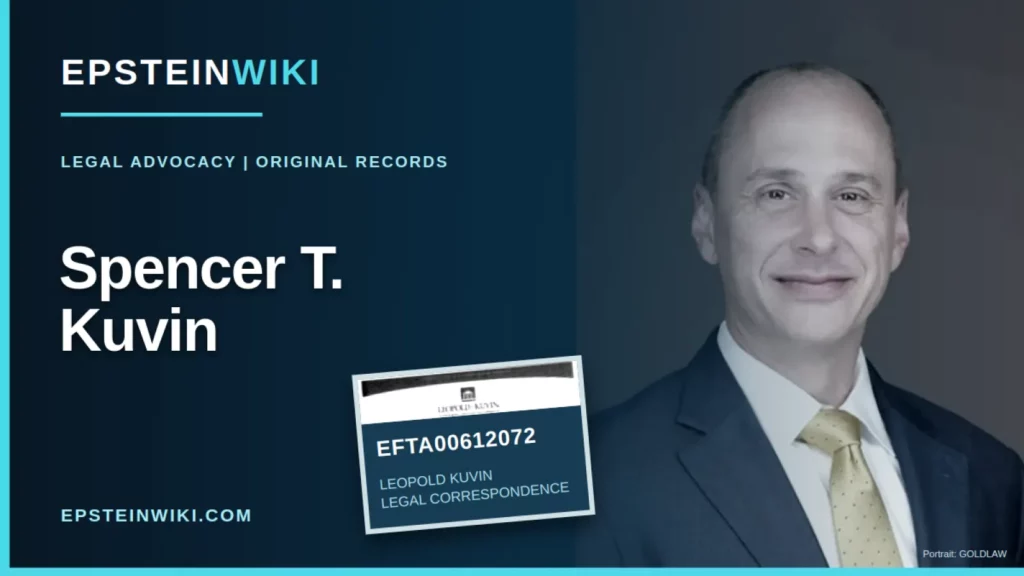
Snapshot
| Field | Documented Information |
|---|---|
| Full name | Spencer Todd Kuvin |
| Profession | Florida civil litigation attorney |
| Role in Epstein record | Counsel representing plaintiffs alleging abuse by Jeffrey Epstein in state and federal civil cases |
| Representative case | B.B. v. Epstein, Palm Beach County Circuit Court, No. 502008CA037319 |
| Key deposition | September 2, 2009 deposition of Epstein in B.B.’s civil case |
| Contested document | Florida Bar complaint form completed by Epstein against Kuvin, reflecting Epstein’s allegations rather than disciplinary findings |
| Court response | A state court denied Epstein’s motion for sanctions against Kuvin, while limiting distribution of deposition videos |
| Source limitation | The complaint, motion and order must be read as different forms of evidence |
Important Points and Key Takeaways
- Kuvin represented civil plaintiffs seeking to hold Epstein accountable, including the plaintiff known publicly in the litigation as B.B.
- A federal court service list names him as counsel in a related Jane Doe civil action, providing direct documentary confirmation of his role.
- Epstein’s Florida Bar complaint accused Kuvin of improper use of deposition footage. This was a litigant’s allegation, not proof that the Bar found misconduct.
- The state court denied Epstein’s motion for sanctions while imposing separate restrictions on circulation of videotaped depositions.
- Evidence of advocacy must not be misrepresented as knowledge of Epstein’s crimes by a lawyer representing people who alleged they were harmed.
Introduction
Attorney Spencer Todd Kuvin appears in the released Epstein records as counsel for people pursuing civil claims arising from allegations of sexual abuse. His work involved depositions and the difficult procedural question of how survivors could obtain testimony while protecting their privacy. The 2009 record also includes an unusually direct conflict: Epstein complained about Kuvin’s handling of videotaped deposition footage, and a Florida court ruled on a related sanctions request. Those distinct documents must not be collapsed into a one sided account.
Representation of Civil Plaintiffs
A 2009 federal service list identifies attorney Spencer Todd Kuvin and the firm Leopold Kuvin in the counsel roster for plaintiffs in related cases. That roster is strong evidence of his procedural role but does not itself describe every matter for which he was retained. The related Palm Beach Circuit Court case, B.B. v. Epstein, concerned a survivor proceeding under a protective pseudonym. Public records identify Kuvin as her attorney.
A separate compiled litigation report lists Kuvin as counsel in another civil action filed in 2010. Reports prepared by third parties are useful locating aids, but should not be elevated above docket sheets and signed pleadings when dates or party designations are disputed.
The September 2, 2009 Deposition
Epstein’s own complaint form states that Kuvin took his deposition on September 2, 2009, in B.B.’s case. That statement identifies the proceeding and the lawyer performing the examination. Epstein then alleged that Kuvin had embarrassed him and distributed video excerpts that received significant press attention.
These accusations were made by Epstein while defending civil litigation. The presence of an accusation under penalty of perjury is evidence that it was made; it is not a ruling that the attorney violated ethics rules or disobeyed a client’s wishes. The complaint’s assertions about survivor privacy should be examined against actual court orders and protections, not assumed to have been established.
Bar Complaint and Court’s Sanctions Order
The three page Florida Bar form claims improper publicity and cites specific rules of professional conduct. It also includes personal and professional accusations about the motives of Kuvin. These are Epstein’s stated positions, not neutral descriptions or an outcome of a disciplinary hearing.
The signed Florida state court order denied Epstein’s sanctions motion against Kuvin. Separately, the court set rules governing distribution of videotaped depositions within the parties, legal teams and experts, absent further court approval. Both parts matter: the denial does not imply that unlimited publication of every recording was appropriate, and the distribution rule does not convert a denied motion into a finding of misconduct.
Discovery Disputes Concerning Story Cowles
Michael Pike’s April 2010 declaration says he spoke with Kuvin and other plaintiffs’ lawyers who were attempting to depose Story Cowles. Pike’s declaration is Epstein side counsel’s description of those conversations; it cannot be treated as a judicial determination of what Cowles knew.
The dispute is important because plaintiffs sought testimony concerning Epstein’s associates and administrative activities during his sentence. The file also illustrates how counsel for witnesses, survivors and Epstein could disagree about discovery scope without a definitive finding that every requested deposition was justified or improper.
Procedural Significance and Survivor Protection
When reading survivor civil cases, the names of attorneys, court motions and protective orders can help reconstruct what evidence the plaintiffs could obtain, what limits the court imposed, and which issues remained unresolved. A published clip of a deposition is a different artifact from the underlying full sworn transcript, which is necessary to evaluate context.
The identities of people who have not publicly named themselves are not inferred from pseudonyms or incidental identifying material. The conclusions concern Kuvin’s verified role as counsel, the primary court record, and the distinction between accusations and rulings.
Chronology
| Date | Documented event |
|---|---|
| 2008 | Survivor civil cases against Epstein are filed in Palm Beach County and federal court. |
| May 1, 2009 | Federal service list identifies Kuvin in related case counsel. |
| September 2, 2009 | Kuvin takes Epstein’s deposition in B.B. v. Epstein according to the contemporaneous complaint. |
| 2009 | Epstein files a Florida Bar complaint and seeks sanctions regarding deposition publicity. |
| 2009 | Florida circuit court denies sanctions and regulates dissemination of video depositions. |
| April 2010 | Michael Pike files a sworn declaration discussing Kuvin’s attempt to obtain Cowles testimony. |
Evidence Appearances
Evidence identifiers link directly to the released document and are distinguished from background reporting, recollection and media accounts.
| Evidence identifier | Documented relevance |
|---|---|
| EFTA00213048 | Court service list identifying Kuvin and his related representation. |
| EFTA00586446 | Florida Bar complaint form prepared by Epstein, a party allegation. |
| EFTA00610663 | Florida circuit court order denying sanctions and imposing video circulation rules. |
| EFTA00611616 | Affidavit concerning discovery contacts with Kuvin and other attorneys. |
| EFTA01481978 | Compiled federal court filing summary listing Kuvin as counsel. |
| EFTA00222291 | Federal civil case document including service information. |
What Remains Unverified
- No cited material establishes that the Florida Bar adjudicated the complaint as a disciplinary violation.
- The state court denied the sanctions motion; the separate restriction on video dissemination does not reverse that denial.
- A plaintiff’s pseudonym must not be used to reverse engineer the survivor’s private identity.
- References to Kuvin in a service list do not establish his involvement in every related Epstein action.
- There is no allegation supported here that representing survivors meant Kuvin participated in Epstein’s wrongdoing.
Related EpsteinWiki Articles
- Doe No. 1 v. Epstein civil action
- Attorney Jack Scarola and survivor litigation
- Federal investigation and prosecution background
Sources
- Epstein Florida Bar complaint against Spencer Kuvin
- Florida circuit court sanctions order
- Federal service list identifying Spencer Kuvin
- Michael Pike declaration about Cowles discovery
- Federal court case summary
- Original federal civil case declaration packet
This article distinguishes allegations, correspondence, tentative plans, independent reporting, firsthand statements and judicial findings. Documentary references do not alone establish criminal behavior.