Congressional Letter Presses Barclays Over Jes Staley’s Relationship With Jeffrey Epstein
Snapshot
Document date: July 22, 2026
Public release date: July 23, 2026
Recipient: Nigel Higgins, Group Chairman of Barclays
Authors: Senator Elizabeth Warren, Representative Ro Khanna, and Representative Raja Krishnamoorthi
Primary subject: Barclays’ investigation of former chief executive Jes Staley and his relationship with Jeffrey Epstein
Response deadline: August 5, 2026
Document type: Congressional oversight letter
Status: The letter requests records and answers from Barclays. It does not announce a criminal charge or establish that Barclays committed a crime.
Read the complete congressional letter
What Happened
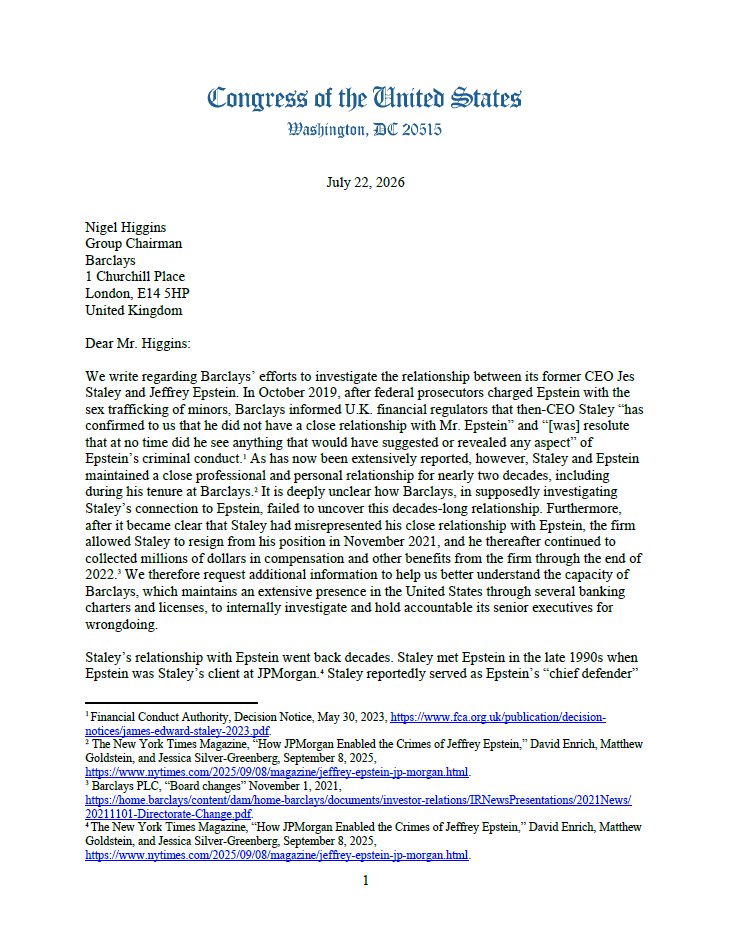
On July 22, 2026, Senator Elizabeth Warren and Representatives Ro Khanna and Raja Krishnamoorthi sent a detailed oversight letter to Barclays Group Chairman Nigel Higgins.
The lawmakers asked how Barclays investigated the relationship between its former chief executive, Jes Staley, and convicted sex offender Jeffrey Epstein.
Their central concern is simple. Barclays told British regulators in 2019 that Staley said he did not have a close relationship with Epstein. Later evidence documented extensive professional and personal contact between the two men.
The lawmakers want to know how Barclays could have investigated Staley’s Epstein relationship without discovering its length, frequency, and personal character.
The letter also asks why Barclays allowed Staley to resign in November 2021 and continue receiving compensation and benefits through the end of 2022.
Why Congress Is Examining Barclays
Barclays is a British bank, but it maintains an extensive presence in the United States. The congressional letter states that Barclays operates through several American banking charters and licenses. It also reports that Barclays US LLC holds approximately $200 billion in assets.
According to the lawmakers, access to American banking charters depends partly on the character and fitness of management. It also depends on a bank’s ability to operate safely and hold senior executives accountable.
This makes the Staley matter larger than one former executive. Congress is examining whether Barclays had effective systems for executive screening, internal investigations, regulatory disclosures, discipline, and corporate governance.
Read the congressional announcement from Representative Krishnamoorthi
What Barclays Told Regulators
The letter says that Barclays informed United Kingdom financial regulators in October 2019 that Staley had confirmed he did not have a close relationship with Epstein.
Barclays also reportedly relayed Staley’s assertion that he had never seen anything that suggested or revealed Epstein’s criminal conduct.
Those representations later became central to a British regulatory investigation.
The United Kingdom Financial Conduct Authority concluded that Staley had approved a misleading letter about his relationship with Epstein. The regulator found that Staley had acted recklessly and without integrity. It imposed a financial penalty and prohibited him from holding senior management or significant influence positions in the British financial services industry.
Read the Financial Conduct Authority decision notice
Staley disputed the regulator’s conclusions and challenged the decision. His denial of knowledge about Epstein’s criminal conduct must be distinguished from the regulatory finding that he misrepresented the closeness of their relationship.
The Relationship Documented by the Letter
The congressional letter describes a professional and personal relationship lasting nearly two decades.
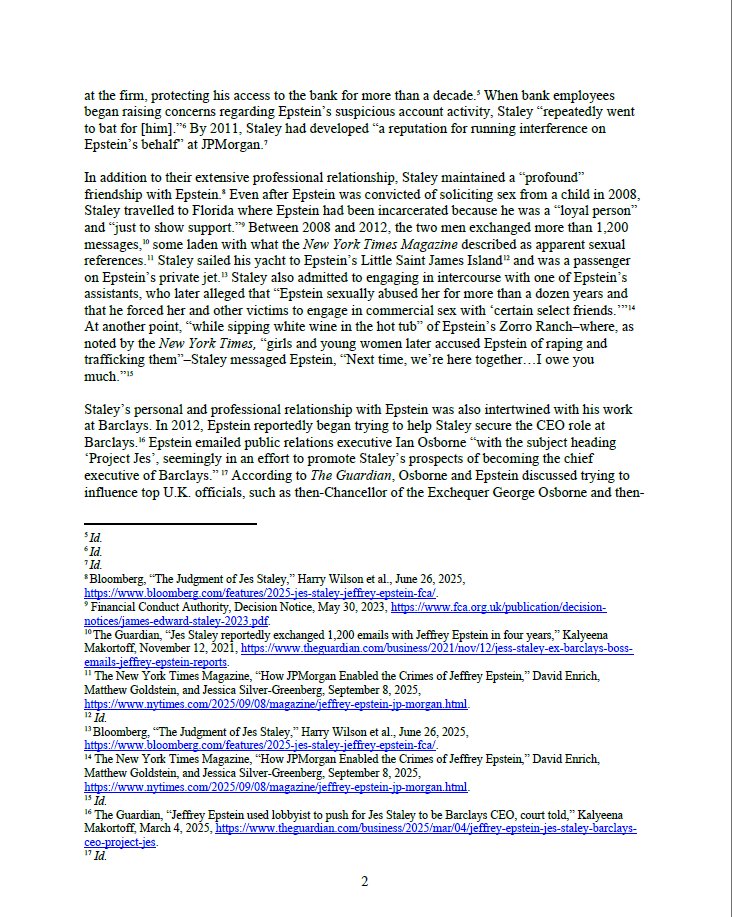
Staley met Epstein while working at JPMorgan, where Epstein was a client. The letter cites reporting that Staley became one of Epstein’s strongest defenders inside the bank as employees raised concerns about Epstein’s account activity.
Their contact continued after Epstein pleaded guilty in Florida in 2008 to state charges involving a minor.
The letter states that Staley visited Epstein while Epstein was incarcerated. It also says the men exchanged more than 1,200 messages between 2008 and 2012.
The correspondence reportedly included references to family, loyalty, friendship, women, and visits to Epstein’s properties. Staley also visited Little Saint James, Epstein’s private island in the United States Virgin Islands.
The quantity of communication does not independently prove that Staley knew about Epstein’s trafficking operation. However, it directly challenges the claim that the relationship was not close.
Evidence in the Epstein Files
Records preserved by Epstein Data provide direct evidence of continued contact between Staley and Epstein.
A July 2010 exchange includes Staley writing, “Say hi to Snow White,” after referencing a visit. Epstein responded by asking which character Staley wanted next. Staley answered, “Beauty and the Beast.”
An Epstein schedule records an appointment with Staley in October 2013. This was years after Epstein’s Florida conviction.
Another household record states that Staley would visit Epstein and asks whether the house had the white wine Staley preferred.
A January 2014 schedule lists Staley among the expected guests at a dinner with Epstein and several prominent figures.
Another schedule records Staley meeting Epstein in April 2013.
These records support the lawmakers’ contention that the relationship continued after Epstein became a convicted sex offender.
Project Jes and the Barclays Appointment
The congressional letter also examines whether Epstein and British financier Ian Osborne attempted to help Staley become chief executive of Barclays.
The reported effort was called “Project Jes.”
According to the letter, Epstein and Ian Osborne discussed efforts to influence British officials, including George Osborne and Mervyn King. Congress is asking whether Barclays directors communicated with Epstein, Ian Osborne, George Osborne, or Mervyn King about Staley’s candidacy.
A file preserved by Epstein Data contains correspondence connected to Osborne and Project Jes.
Congress is not merely asking whether Epstein privately supported Staley. It is asking whether anyone connected to Epstein contacted Barclays directors and whether those communications influenced the bank’s hiring process.
Questions Congress Sent to Barclays
The lawmakers asked Barclays what due diligence it conducted before appointing Staley chief executive in December 2015.
They requested the identities of anyone who recommended Staley for the position. They also requested communications sent to Barclays board members concerning his possible appointment between January 2012 and December 2015.
Congress asked whether Staley disclosed his Epstein relationship before accepting the position. If he did, Barclays must explain when the disclosure occurred, who received it, and how Staley characterized the relationship.
The letter asks whether board members questioned Staley about Epstein before hiring him. If no questions were asked, the lawmakers want Barclays to explain why.
Congress also requested any internal review of the hiring failures that permitted Barclays to appoint an executive with extensive personal and professional ties to a convicted sex offender.
The letter asks Barclays to identify everyone who wrote, reviewed, or approved its October 2019 disclosures to the Financial Conduct Authority.
The lawmakers also want Higgins to explain why he concluded in 2019 that Staley’s Epstein relationship did not require a board discussion.
Additional questions concern whether Staley or the United States Department of Justice ever notified Barclays that Staley was under federal investigation.
Congress requested communications concerning Staley’s 2021 resignation, his compensation, and any disciplinary measures considered by the board.
Finally, the lawmakers asked whether the Federal Reserve Board, Federal Deposit Insurance Corporation, or Office of the Comptroller of the Currency contacted Barclays after the release of additional records under the Epstein Files Transparency Act.
The Compensation Question
Staley resigned from Barclays in November 2021 after receiving the preliminary conclusions of the British regulatory investigation.
The congressional letter says he continued collecting millions of dollars in compensation and other benefits through the end of 2022.
The lawmakers are asking whether Barclays considered discipline beyond accepting his resignation. They also want the records governing his departure and compensation arrangements.
This question matters because resignation can allow an institution to avoid making a formal disciplinary finding. It may also preserve compensation or benefits that could have been challenged following a termination for misconduct.
Congress is therefore examining whether the departure protected Barclays, Staley, or both from greater accountability.
Allegations Found in Federal Records
Federal records contain serious allegations concerning Staley. These allegations require careful labeling because the appearance of an accusation in an investigative file does not prove that it occurred.
An October 2021 FBI record says an attorney representing the United States Virgin Islands reported that two women had accused Staley of violent rape. The document records the communication to the FBI. It does not establish that investigators substantiated the allegations.
Staley has denied sexual abuse allegations connected to Epstein. He has not been criminally charged in connection with Epstein’s trafficking operation.
The distinction is essential. The file proves that the allegations were reported to the FBI. It does not, by itself, prove the underlying accusations.
What the Letter Does Not Establish
The congressional letter does not prove that Barclays committed a criminal offense.
It does not prove that every allegation made against Staley is true.
It does not establish that Staley participated in Epstein’s trafficking operation.
It does not establish that every Barclays director knew about the full extent of the relationship.
Instead, the letter documents major inconsistencies and demands the records needed to determine what Barclays knew, when it knew it, and how it responded.
That distinction protects the accuracy of the historical record while preserving the seriousness of the questions Congress has raised.
Key Takeaways
Congress is investigating Barclays’ oversight: Three lawmakers want records showing how Barclays screened, investigated, and disciplined Jes Staley.
The relationship was not merely incidental: Regulatory findings, correspondence, schedules, and other records document years of professional and personal contact.
The contact continued after Epstein’s conviction: Epstein Data records place Staley in contact with Epstein years after the 2008 Florida case.
Project Jes requires further investigation: Congress is asking whether Epstein and Ian Osborne attempted to influence Staley’s selection as Barclays chief executive.
Barclays’ 2019 disclosure is under scrutiny: Lawmakers want to know who prepared and approved the representation that Staley did not have a close Epstein relationship.
Compensation remains a central issue: Congress is examining why Staley continued receiving substantial compensation after leaving Barclays.
The evidence must be labeled carefully: Investigative files document allegations, but an allegation recorded by the FBI is not automatically a proven fact.
The requested records could expose institutional failures: Barclays’ response may show whether the problem involved one executive or a broader breakdown in corporate governance.
Fact Check
The date, recipient, authors, deadline, and eight principal requests were verified against the complete congressional letter.
The description of the letter’s purpose was verified against Representative Krishnamoorthi’s official congressional announcement.
The British regulatory findings were checked against the Financial Conduct Authority decision notice.
The post conviction contacts were checked against direct Epstein Data files.
The sexual violence claims were labeled as allegations because the cited FBI record documents their transmission to law enforcement but does not prove them.
No criminal charge against Staley arising from Epstein’s trafficking operation was identified as of July 27, 2026.
Related EpsteinWiki Research
- Read EpsteinWiki research concerning Jes Staley
- Search EpsteinWiki for Barclays
- Search EpsteinWiki for JPMorgan
- Search EpsteinWiki for Little Saint James
- Search EpsteinWiki for congressional Epstein investigations
Sources
- Congressional letter to Barclays Group Chairman Nigel Higgins
- Representative Raja Krishnamoorthi congressional announcement
- Financial Conduct Authority decision notice concerning James Edward Staley
- The Guardian report on the congressional Barclays inquiry
- Reuters report on Jes Staley’s congressional appearance
- Epstein Data evidence file EFTA00090717
- Epstein Data evidence file EFTA01300650
- Epstein Data evidence file EFTA01815523
- Epstein Data evidence file EFTA01300651
- Epstein Data evidence file EFTA01766728
- Epstein Data evidence file EFTA00284793
- Epstein Data evidence file EFTA02075848
- Epstein Data evidence file EFTA00285006