
Jamie Joyce
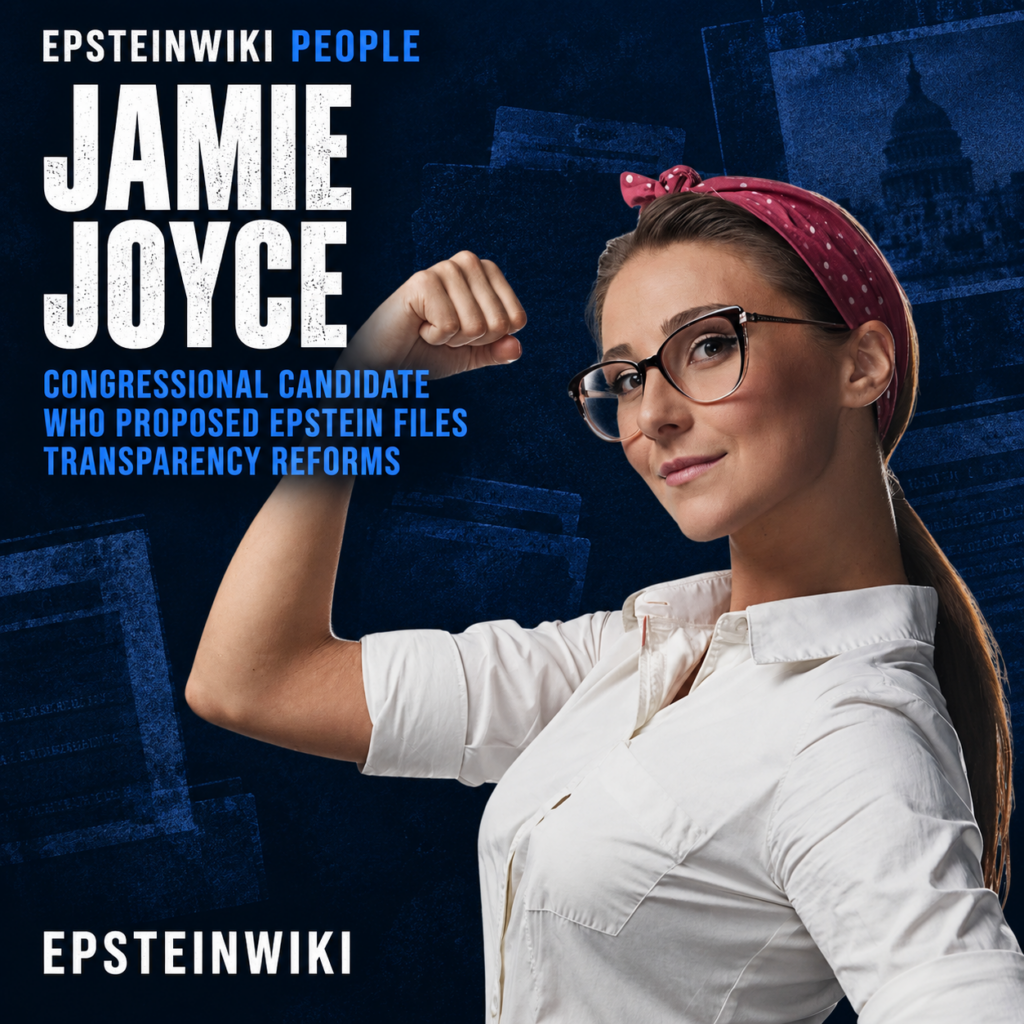
Snapshot
| Field | Verified information |
|---|---|
| Full name | Jamie Joyce |
| Political status | Democratic candidate for the U.S. House, California’s 12th Congressional District |
| Current office | None identified. Joyce is a candidate, not a sitting lawmaker. |
| 2026 election | Advanced from the June 2, 2026 top-two primary to face incumbent Representative Lateefah Simon in the November 3, 2026 general election |
| Professional role | Founder and executive director of the Society Library; former project lead associated with the Internet Archive’s Democracy’s Library initiative |
| Epstein-related activity | Authored a campaign policy draft called Title VII of the Mass Accountability in Democracy Act, or MAD Act, with the short title “Epstein Act Part II” |
| Legislative status | Campaign-authored proposal. It has not been introduced in Congress and has no official bill number, sponsor, committee referral, hearing, score, or vote. |
| Epstein network evidence | None identified. This page concerns public policy advocacy, not an alleged personal relationship with Jeffrey Epstein or his network. |
| Campaign finance snapshot | $31,247.25 in receipts and $22,446.95 in disbursements through June 30, 2026, according to the FEC |
| Fact-check date | September 8, 2026 |
Jamie Joyce is often described in her own campaign material as a civic technologist, nonprofit executive, and government-transparency advocate. She is running as a Democratic challenger in California’s 12th Congressional District. She is not currently a member of Congress and therefore cannot introduce, subpoena, vote on, or enact federal legislation in her own capacity.
Her Epstein proposal is nevertheless substantial. The posted text attempts to expand public disclosure, move redaction authority away from the Department of Justice, strengthen survivor privacy, protect whistleblowers, amend federal crime-victim law, and compel testimony from Ghislaine Maxwell. Some provisions respond to documented weaknesses in the federal disclosure process. Others raise serious questions about constitutional structure, prosecutorial integrity, classified information, cost, staffing, and the treatment of unverified material.
The proposal should be evaluated as a detailed campaign platform, not as enacted law, an introduced bill, or evidence about Joyce’s relationship to Epstein.
Why This Page Exists
Joyce has made Epstein-file disclosure a named part of her congressional campaign. Her campaign calls the proposal “Epstein Act Part II” and places it within a much larger draft titled the Mass Accountability in Democracy Act. The proposal is unusual in its breadth and detail, making it relevant to the public debate over what Congress should do after the Epstein Files Transparency Act of 2025.
That relevance needs careful boundaries.
- Joyce is a candidate advocating a policy response.
- No verified evidence reviewed for this article places Joyce in Epstein’s social, financial, travel, employment, or criminal network.
- A policy page is not a person-of-interest page.
- Criticism of her draft does not imply bad faith.
- Support for disclosure does not prove that every claim found in a released file is true.
EpsteinWiki’s evidence standard requires a distinction between records, allegations, verified facts, political messaging, and unresolved questions. That distinction is especially important here because the federal Epstein corpus contains genuine investigative records alongside duplicative material, raw tips, hearsay, and submissions the Justice Department has warned may be false.
Identity and Political Status
Joyce is the Democratic challenger who advanced from California’s June 2, 2026 top-two primary in the 12th Congressional District. The district includes Oakland, Berkeley, Alameda, Albany, Emeryville, Piedmont, San Leandro, and nearby East Bay communities.
The certified California primary results reported:
- Lateefah Simon: 153,190 votes, or 84.2 percent.
- Jamie Joyce: 28,372 votes, or 15.6 percent.
- Write-in candidate Stephen Slauson: 279 votes, or 0.2 percent.
Because California advances the two highest finishers regardless of party, Joyce qualified for the November 3, 2026 general election against Simon. Ballotpedia’s candidate profile identifies Joyce as a Democratic candidate and Simon as the incumbent.
Calling Joyce a “lawmaker” would be inaccurate as of this article’s fact-check date. A more precise description is congressional candidate, policy advocate, or proposed bill author. Her campaign may publish model legislation, but only a sitting member of Congress may introduce it as a federal bill.
Background and Career
Joyce describes herself as a Berkeley-based civic technologist and nonprofit executive. Her principal organization is the Society Library, a nonprofit project intended to map arguments, evidence, and competing perspectives in public debates.
Sources support several parts of that professional history:
- The Society Library identifies Joyce as its founder and executive director.
- The Internet Archive published work under her byline connected to Democracy’s Library, an initiative to improve public access to government documents.
- An Internet Archive project update described Democracy’s Library work in the United States.
- Foresight Institute describes Joyce as the Society Library’s founder and as having worked in international sustainable development.
- BallotReady lists Society Library, Internet Archive, LeafLets Kits, and IDEAS For Us among her professional roles.
- Joyce has also given a TED talk about using digital tools to organize competing arguments and information.
Her campaign biography contains a broader list of projects, invitations, advisory work, and volunteer activities. Those details should be understood as campaign-supplied unless supported by the organizations concerned. The independently verifiable through-line is her work on archives, civic information, and structured debate.
The 2026 Congressional Campaign
Joyce’s campaign presents her candidacy as a challenge to Democratic Party leadership and as part of a proposed “Just 12” group of candidates who would coordinate votes in Congress. That bloc is a campaign strategy, not an established congressional caucus.
The campaign’s main policy vehicle is the Mass Accountability in Democracy Act, described as an omnibus draft of more than 650 pages. Its subjects extend far beyond Epstein and include artificial intelligence, surveillance, immigration enforcement, campaign finance, elections, and government accountability.
Joyce’s Epstein proposal is Title VII of that larger package. The campaign says she presented it in Washington at the Trump and Epstein Reading Room. A campaign news release says survivors endorsed the proposal after that presentation. Because the release is campaign-authored, it establishes what the campaign reported, not an independent count of formal endorsements.
What Joyce Calls the “Epstein Plan”
The complete posted text appears as Title VII, Epstein Accountability and Public Disclosure. Its short title is “Epstein Act Part II.”
The document is a policy draft. It is not:
- A law.
- A bill introduced in either chamber of Congress.
- An official committee print.
- A measure with a Congressional Budget Office score.
- A proposal that has undergone hearings, markup, amendment, or a constitutional review published by Congress.
The MAD Act website states that large language models were used to standardize and formalize its legislative language. That disclosure does not by itself invalidate the work. It does increase the importance of line-by-line review by legislative counsel, survivor counsel, criminal-law specialists, national-security lawyers, archivists, records engineers, and appropriators before anyone treats the text as ready for introduction.
Not the Same as H.R. 9694
On July 15, 2026, Representative Thomas Massie introduced a separate federal bill officially titled the Epstein Files Transparency Act II, H.R. 9694, with Representatives Ro Khanna and Teresa Leger Fernandez as original cosponsors.
The two proposals should not be confused.
| Feature | Joyce campaign draft | H.R. 9694 |
|---|---|---|
| Name used | “Epstein Act Part II” | “Epstein Files Transparency Act II” |
| Author or sponsor | Jamie Joyce campaign | Rep. Thomas Massie, with original cosponsors Ro Khanna and Teresa Leger Fernandez |
| Official status | Unintroduced campaign proposal | Introduced in the House and referred to the Judiciary Committee |
| Scope | Broad disclosure system, NARA unit, survivor rights, whistleblowers, Maxwell testimony, hearings, and CVRA reform | Enforcement amendments to Public Law 119-38, including access and legal remedies |
| Legislative history | None | H.R. 9694, introduced July 15, 2026 |
Similar branding can easily mislead readers into believing Joyce wrote or sponsored the official bill. She did not. Her draft should be cited by its campaign title and linked to its campaign-hosted text.
What Title VII Would Do
Joyce’s proposal combines archival administration, congressional oversight, survivor privacy, whistleblower protection, criminal-procedure changes, and institutional investigation. Its principal components include:
- A new Federal Unit for Managing Epstein Documents within the National Archives and Records Administration.
- Transfer of unredacted responsive federal records to that unit.
- Centralized redaction and publication through the Government Publishing Office and GovInfo.
- Searchable text, metadata, cryptographic hashes, application programming interfaces, and bulk downloads.
- Repeated certifications by agencies that they have searched again for responsive records.
- Mandatory preservation obligations.
- Survivor-controlled privacy protections and a private enforcement right.
- Broad immunity and anti-retaliation rules for qualifying disclosers.
- A compelled congressional deposition of Ghislaine Maxwell under use and derivative-use immunity.
- A public congressional hearing.
- A required FBI explanatory report on investigative, prosecutorial, intelligence, and custodial questions.
- Amendments to the Crime Victims’ Rights Act.
- A judicial path to challenge or annul provisions of the 2007 federal non-prosecution agreement.
This breadth is the draft’s central strength and its central difficulty. It tries to address nearly every grievance surrounding the Epstein record in one title, but each subject operates under a different body of law and may require separate drafting, appropriations, safeguards, and judicial review.
Survivor Privacy Provisions
The proposal’s strongest design choices concern survivor privacy. It would make redaction of victim and survivor personally identifying information mandatory by default, rather than discretionary. A survivor could consent in writing to being identified and later revoke that consent. Sexually explicit or traumatic imagery would remain obscured.
The draft also proposes:
- A specialized unit for child sexual abuse material and other traumatic content.
- Pseudonymous access to courts for survivors seeking enforcement.
- A mechanism for survivors to challenge improper disclosure or withholding.
- Restrictions intended to prevent redaction from becoming a pretext for protecting officials or prominent third parties.
These provisions respond to a real failure mode: transparency can become another injury when victim names or intimate information are exposed. At the same time, implementation would need an authenticated, rapid, trauma-informed process for consent and revocation. A revocation cannot reliably erase copies already downloaded, mirrored, indexed, or reposted. The draft should therefore distinguish prospective correction from impossible promises of complete digital recall.
Survivor consultation should not be treated as a one-time endorsement. Survivors differ in what they want released, how they define safety, and whether they want public identification. A final bill would need continuing consultation, independent privacy auditing, and a clear remedy for accidental exposure.
Records, Agencies, and Private Entities
Joyce’s draft identifies 75 federal entities in 11 groups and attempts to impose a government-wide search duty. This is materially broader than a law focused on records held by the Department of Justice.
The proposal also names state, local, and private record holders. The distinction is important:
- Covered federal entities would face compulsory identification, preservation, transfer, certification, and reporting duties.
- State, local, and private entities would generally be requested to provide records voluntarily.
The voluntary language means the proposal could not guarantee a complete national archive. Private banks, lawyers, employers, service providers, media organizations, foreign entities, and state authorities may possess relevant material that Congress cannot acquire merely by asking. Subpoenas, litigation, privacy law, privilege, foreign law, record-retention practices, and destroyed or missing files would remain obstacles.
The broad federal list is valuable as a search map. A final bill would still need to define responsiveness narrowly enough to prevent irrelevant personal data from being swept into the archive and clearly enough to prevent agencies from interpreting the duty away.
The Proposed NARA Unit and Publication System
Title VII would place a new records unit inside the National Archives and Records Administration while making it independent of the Archivist and other executive appointees and directing it to report to congressional judiciary committees. The unit would become the central redaction and publication authority for Epstein records.
The draft’s technical requirements are unusually specific:
- SHA-256 hashes and manifests to reveal missing or changed files.
- Reconciliation logs connecting source records to public releases.
- Optical character recognition for searching scanned documents.
- Structured metadata.
- Bulk downloads and an application programming interface.
- Rolling releases rather than a single final dump.
- Repeated agency certifications and inventories.
These features could materially improve provenance and completeness. A cryptographic hash can show whether a published file later changed. A reconciliation log can show whether an identified record was released, withheld, duplicated, or transferred.
But a hash does not prove that a document’s contents are true. It proves integrity of a particular digital object from a defined point in time. The system should separately label origin, document type, authorship, date, evidentiary status, corroboration, hearsay, known disputes, and whether a document is an unverified public submission.
The staffing and schedule also deserve scrutiny. The draft begins with a core staff and contemplates expansion to roughly 175 personnel while requiring rapid identification and rolling transfer across a large federal universe. Five-business-day transfer expectations may be workable for a located digital file but not for every classified, privileged, sealed, legacy, offline, or poorly indexed record set. No public cost estimate accompanies the proposal, which authorizes such sums as may be necessary.
Deadlines and the 2028 Election
The draft sets October 15, 2028 as a final disclosure ceiling and explicitly links the timing to the November 2028 federal election.
The argument for that deadline is democratic: voters should receive information before choosing federal officials. The risk is equally clear. An election-linked deadline can create pressure for a massive late release, selective accusations, partisan framing, or insufficiently reviewed material immediately before voting.
A safer structure would include enforceable interim milestones, public inventories, regular audits, survivor review windows, and context notes. That would reduce the chance that the deadline becomes either an excuse for delay or a politically explosive document dump that the public cannot responsibly assess.
Whistleblower and Public Disclosure Provisions
The proposal offers sweeping protections to qualified disclosers. It attempts to override criminal, contractual, classification, nondisclosure, and records restrictions for people who release covered information in good faith, including some direct disclosures to the public.
Robust anti-retaliation protection is defensible when officials conceal unlawful conduct or defy a disclosure mandate. The draft’s breadth, however, creates risks:
- A discloser may incorrectly decide that a record is covered.
- Direct public release may expose survivor identities or child sexual abuse material before review.
- Intelligence sources, methods, foreign partners, witnesses, and active investigative steps may be compromised.
- Raw allegations about innocent people may be amplified without context.
- A presumption of good faith may complicate accountability for reckless handling.
- Public release may impair later prosecutions or contaminate witness testimony.
A mature bill would likely need protected channels, urgent external review, independent appeal, strict survivor safeguards, source-and-method review, and penalties for knowingly malicious disclosure. Whistleblower protection and controlled evidentiary handling do not have to be opposites.
Ghislaine Maxwell Deposition and Identity Verification
Title VII would compel a joint Judiciary Committee deposition of Ghislaine Maxwell and grant use and derivative-use immunity. It also calls for an inventory of existing evidence before questioning, filter procedures, and follow-up review.
Use and derivative-use immunity can compel testimony while preventing prosecutors from using the testimony or evidence derived from it against the witness. The rule is associated with the Supreme Court’s decision in Kastigar v. United States. In practice, a widely publicized immunized deposition can create a heavy burden on any future prosecution to prove that its evidence came from independent sources. A pre-deposition inventory and filter team can reduce that risk but cannot eliminate it.
Congress would also have to decide whether Maxwell’s testimony would be reliable, how false statements would be tested, what questions could affect pending litigation, and whether a public format would reward sensational or self-serving claims. Compelled testimony is evidence to evaluate, not truth by declaration.
The proposal further requires quarterly biometric identity verification of Maxwell, including fingerprints, photographs, forensic comparison, and a procedure to verify death. This responds to public suspicion about substitution or concealed custody status, but the draft cites no evidence that Maxwell’s identity has been substituted. Ordinary Bureau of Prisons custody records and established death-certification processes already exist. Repetitive special-master verification would add cost and judicial administration while potentially legitimizing an unsupported premise.
That provision should either be supported by specific evidence of a custody-integrity problem or removed in favor of ordinary, auditable custody reporting.
FBI Report and Congressional Hearing
The draft orders an extensive FBI report and a joint public Judiciary hearing. Topics include:
- The 2007 non-prosecution agreement.
- Epstein’s relationship, if any, with the FBI or other government entities.
- Possible foreign-intelligence relationships.
- Epstein’s death and custodial failures.
- Reported gaps in former U.S. Attorney Alexander Acosta’s email record.
- Maxwell’s detention and custody.
- Alleged intelligence relationships involving Robert Maxwell and Ghislaine Maxwell.
- Coded or concealed language in relevant records.
These are legitimate subjects for oversight when framed as questions. The report must not be drafted to presume disputed conclusions. For example, a requirement to determine whether an intelligence relationship existed is different from legislation stating that it did.
The hearing requirement could create public accountability, but Congress already possesses broad investigative and hearing authority. The recurring problem is not always absence of authority. It is enforcement when the executive branch resists, privilege is asserted, witnesses invoke constitutional rights, or members choose not to use available remedies.
Crime Victims’ Rights Act Reforms
The proposal would amend the federal Crime Victims’ Rights Act, or CVRA, to expand enforceable rights before criminal charges are filed. It would also create a freestanding enforcement mechanism and allow challenges connected to deferred-prosecution and non-prosecution agreements.
This responds directly to In re Wild, the litigation arising from the secret federal non-prosecution agreement negotiated with Epstein. The U.S. Court of Appeals for the Eleventh Circuit, sitting en banc, held that the existing CVRA did not authorize a freestanding civil action before federal criminal proceedings began.
Congress can amend a statute prospectively to change rights and remedies. Applying a new mechanism to the 2007 agreement is more difficult. Joyce’s draft directs a court to decide an annulment motion, accounts for reliance and constitutional interests, and says expired statutes of limitations are not revived. Those qualifications are important. Even so, any final language would need close analysis of finality, due process, prosecutorial agreements, third-party rights, and Article III limits.
The draft also proposes limited tolling for offenses by other people first revealed through Maxwell’s testimony while expressly declining to revive already expired periods. That caveat avoids the clearest ex post facto problem presented by retroactively reviving an expired criminal limitation period, but it does not resolve every notice, causation, or litigation question.
What Joyce Gets Right About Public Law 119-38
Congress enacted the Epstein Files Transparency Act, Public Law 119-38, on November 19, 2025. It required the attorney general to make publicly available, in a searchable and downloadable format, unclassified records in the possession of the Department of Justice relating to Epstein, Maxwell, flight logs, named individuals, entities, immunity agreements, internal charging decisions, destruction or concealment of records, and related matters.
Several of Joyce’s criticisms have a sound textual basis:
- The law places the principal duty on the attorney general and concerns records possessed by the Department of Justice. It does not create the same affirmative search-and-transfer system across all federal entities.
- Section 2(c)(1) says the attorney general “may withhold or redact” specified categories, including victim information. A mandatory survivor-privacy rule could reduce discretion and create a clearer duty.
- The law prohibits redactions based on embarrassment, reputational harm, or political sensitivity, but enforcement depends heavily on the Department of Justice’s own review and Congress’s oversight.
- The law does not create Joyce’s proposed independent archival unit, cryptographic reconciliation system, survivor cause of action, Maxwell deposition, or broad CVRA reform.
Joyce is also right that publication architecture matters. A million files without reliable inventories, stable identifiers, provenance, version history, and correction procedures can frustrate meaningful transparency.
Claims That Need More Precision
Some campaign formulations overstate the case or omit important qualifications.
Claim: the first law asked only one agency
The law is centered on Department of Justice holdings, but the department includes the FBI, U.S. Attorneys’ Offices, and other components. Calling it literally one office obscures that reach. The more accurate criticism is that the law did not impose an equivalent government-wide production duty on every federal entity that might hold responsive records.
Claim: the law did not reach classified records
Public Law 119-38 governs public release of unclassified material and allows withholding of properly classified information. It also directs the attorney general to declassify covered information to the maximum extent possible and, where information remains classified, to provide an unclassified summary when possible. The law did address declassification, but it did not require unconditional release of all classified information.
Claim: the word “may” caused the survivor-redaction failures
The word created discretion where a mandatory duty might have been safer. It is still too strong to attribute every disclosure failure to a single word. Review errors, inconsistent implementation, scale, document quality, contractor practices, and inadequate survivor consultation may also matter.
Claim: all Epstein records can be released
No responsible disclosure law can promise publication of every byte. Child sexual abuse material, privileged communications, survivor information, sealed material, protected intelligence, active-investigation details, and information about uninvolved people may require withholding, summarization, judicial review, or delayed release.
Claim: a government record proves its contents
It does not. A government file can faithfully preserve a false tip, an untested allegation, a mistaken identification, a duplicate, or adversarial disinformation. The archive’s authenticity and the truth of every statement inside it are separate questions.
Legal and Constitutional Questions
Joyce’s draft would require substantial legislative-counsel and constitutional review before introduction.
Control of an executive-branch unit
NARA is an independent federal agency within the executive branch, and the Archivist is appointed under federal law. The draft places a unit inside NARA while making it independent of executive appointees and exclusively answerable to congressional committees. That structure raises questions under the Appointments Clause, officer supervision, removal law, and separation of powers.
Congress may create offices and impose reporting duties. It cannot avoid constitutional appointment and supervision rules simply by labeling a unit independent.
Classification and national security
Congress has major authority to legislate regarding government information and national security, while the executive branch has long claimed substantial constitutional classification authority. A self-executing disclosure right that bypasses prior review could produce direct conflict over sources, methods, executive privilege, and foreign-government information.
Congressional contempt and enforcement
Congress has broad investigative authority, but enforcement against executive officials is often slow and contested. Declaring noncompliance punishable does not by itself solve referral, prosecution, privilege, or judicial-enforcement disputes.
Federal courts and standing
Congress can create statutory rights and causes of action, but federal plaintiffs must still satisfy Article III. The Constitution Annotated discussion of standing explains that Congress cannot remove the constitutional requirement of a concrete judicial controversy merely by declaring standing.
Final judgments and old agreements
Congress can change substantive and procedural law, but it cannot simply command courts to reopen final judgments in a manner that violates Article III. Joyce’s draft is more careful than a direct legislative cancellation because it assigns decisions to courts and acknowledges reliance interests. The exact application to the Epstein non-prosecution agreement would still be litigated.
These concerns do not prove the proposal is unconstitutional. They identify issues that need formal analysis, revised text, and probably severable provisions.
Evidence Quality and Disinformation Risks
The Justice Department said its January 30, 2026 production included nearly 3.5 million pages, more than 2,000 videos, and about 180,000 images after review by more than 500 people. In the same official release announcement, DOJ warned that the production could include fake or falsely submitted material because responsive public submissions were included.
Joyce’s draft is strong on file integrity but incomplete on claim integrity.
| Question | What the draft helps establish | What it does not establish |
|---|---|---|
| Is this the same digital file the archive published? | Hashes and manifests can help answer yes or no. | Whether the content is accurate. |
| Did an agency possess this record? | Custody metadata and transfer logs can document possession. | Whether the agency verified every allegation in it. |
| Was something omitted or altered? | Reconciliation logs and version history can expose gaps or changes. | Why the change occurred without additional records. |
| Is a named person implicated in wrongdoing? | The underlying record may show the person was named. | Naming alone does not prove knowledge, participation, or a crime. |
| Is a tip credible? | Provenance can identify when and where it entered the system. | Credibility requires corroboration, source assessment, and contrary evidence. |
A final bill should require labels for document type, provenance, verification status, known contradiction, authorship, date, chain of custody, and relationship to any court finding. It should also provide a visible correction process that preserves earlier versions instead of silently replacing them.
The campaign’s phrase “Epstein class” presents a related problem. It is not a defined legal category. Used loosely, it can collapse convicted offenders, alleged facilitators, employees, social contacts, witnesses, victims, people mentioned in address books, and complete strangers named in raw tips into one accusatory group. That is incompatible with careful evidence work.
Campaign Finance and Political Donations
The Federal Election Commission candidate record identifies Joyce as candidate H6CA12209 and her principal committee as Jamie Joyce for Congress, committee C00941476. The committee registered on March 2, 2026.
For the reporting period covering March 1 through June 30, 2026, the FEC summary reported:
| Item | Amount |
|---|---|
| Total receipts | $31,247.25 |
| Total individual contributions | $31,000.00 |
| Itemized individual contributions | $29,000.00 |
| Unitemized individual contributions | $2,000.00 |
| Contributions from party committees | $0.00 |
| Contributions from other political committees | $0.00 |
| Candidate contributions | $247.25 |
| Loans | $0.00 |
| Total disbursements | $22,446.95 |
| Operating expenditures | $22,246.95 |
| Refunds | $200.00 |
| Cash on hand | $8,800.30 |
| Debts and loans owed | $0.00 |
The $247.25 candidate-contribution entry is the verified political donation by Joyce to her own campaign in the available committee summary.
This article does not list personal donor names because the reviewed records did not provide a sufficiently reliable, complete identification set for publication here. It also does not claim Joyce has never made other political donations. A common name, changing employer information, addresses, refunds, earmarks, and filing amendments can create false matches. Any future donor analysis should link each claim to a specific FEC transaction and identify the donor by more than name alone.
The verified aggregate shows a small campaign funded overwhelmingly by individual contributions during the covered period, with no reported party-committee or other political-committee contributions.
Endorsements and Public Support
Joyce’s campaign reports that three Epstein survivors endorsed her after a Washington presentation. The campaign endorsement page names Jena-Lisa Jones and describes two others as Jane Does. A public event post identified Jena-Lisa Jones, Liz Stein, and Marijke Chartouni as survivors present at the event, but presence and formal endorsement are not the same fact.
The safest conclusion is therefore limited:
- The campaign publicly claims three survivor endorsements.
- The campaign publicly names one endorser and protects the identities of two others.
- Independent confirmation of the precise endorsement terms for all three was not located for this review.
- Unnamed survivors should not be identified through speculation or cross-matching.
Survivor support is politically and morally significant, but it does not substitute for legal review, cost analysis, operational testing, or broader survivor consultation.
Relationship to the Epstein Record
No verified source reviewed for this article connects Jamie Joyce personally to Jeffrey Epstein, Ghislaine Maxwell, Epstein’s aircraft, Epstein-controlled properties, Epstein’s companies, or the documented social and financial network around him.
No exact EFTA document identifier is listed because no qualifying direct record was verified. Fabricating an Evidence Appearance or treating a policy advocate as a network figure would violate EpsteinWiki’s evidence standards.
Network involvement rating: Not applicable. This article documents transparency advocacy and a proposed legal framework, not alleged personal involvement.
The distinction is substantive, not cosmetic. Public officials, candidates, journalists, lawyers, archivists, advocates, and survivors may become part of the history of the files without becoming part of Epstein’s network.
Evidence Appearances
No verified EFTA document appearance has been identified for Jamie Joyce. Accordingly, this article provides no EFTA link or identifier.
The absence of an Evidence Appearance does not weaken the policy relevance of her proposal. It means only that the reason for this page is Joyce’s public advocacy and campaign-authored legislative text, not documentary evidence placing her in Epstein’s network.
Timeline
| Date | Event | Evidence status |
|---|---|---|
| 2018 | Joyce’s professional profiles place the founding of Society Library around this period. | Supported by organizational and professional biographies. |
| 2022 to 2023 | Joyce worked on Democracy’s Library at the Internet Archive. | Supported by Internet Archive bylines and project material. |
| November 19, 2025 | The Epstein Files Transparency Act became Public Law 119-38. | Official federal law. |
| January 30, 2026 | DOJ announced publication of nearly 3.5 million responsive pages and warned that the production could include false public submissions. | Official DOJ statement. |
| March 2, 2026 | Jamie Joyce for Congress registered with the FEC. | Official FEC committee record. |
| June 2, 2026 | Joyce placed second in the CA-12 top-two primary and advanced to the general election. | Certified state election result. |
| June 5, 2026 | The MAD Act site identifies this as the update date for its full legislative text. | Campaign website. |
| June 2026 | Joyce’s campaign says she presented Title VII at the Trump and Epstein Reading Room in Washington. | Campaign-reported event. |
| July 15, 2026 | H.R. 9694, the separate Epstein Files Transparency Act II, was introduced in the House. | Official GovInfo bill record. |
| November 3, 2026 | Scheduled CA-12 general election between Joyce and Simon. | Official election calendar and candidate records. |
| October 15, 2028 | Final disclosure ceiling proposed in Joyce’s draft. | Proposed date only; not law. |
Evidence Assessment
Established
- Joyce is a Democratic candidate for Congress in CA-12 and advanced from the 2026 primary.
- She founded the Society Library and worked on Internet Archive government-document access projects.
- Her campaign published a detailed Title VII called “Epstein Act Part II.”
- The draft contains specific disclosure, archival, survivor-privacy, whistleblower, oversight, and crime-victim provisions.
- Her FEC committee reported $31,247.25 in receipts through June 30, 2026.
- A separate official bill, H.R. 9694, was introduced by Representative Thomas Massie in July 2026.
Campaign-reported or not independently complete
- The exact number and terms of survivor endorsements.
- Some biographical achievements listed only by the campaign.
- The practical readiness of the 650-plus-page MAD Act for formal introduction.
- Claims that the draft could be implemented within its proposed staffing, funding, and deadlines.
Not established
- That Joyce is a sitting lawmaker.
- That Title VII has been introduced in Congress.
- That Joyce authored or sponsored H.R. 9694.
- That every record released under an Epstein disclosure law is accurate.
- That Joyce has a personal connection to Epstein or his network.
- That quarterly biometric checks are justified by evidence of identity substitution.
Questions That Still Need Answers
- Will Joyce publish a line-by-line legal memorandum addressing the Appointments Clause, executive supervision, classification, standing, and finality?
- Has the draft been reviewed by the Office of Legislative Counsel or comparable nonpartisan legislative experts?
- Which survivor advocates and survivor attorneys reviewed the privacy, consent, revocation, and remedy provisions?
- How would the archive prevent irreversible republication after a survivor revokes identification consent?
- What is the estimated cost of the NARA unit, GPO infrastructure, special masters, litigation, agency searches, and ongoing privacy review?
- How would the government meet rapid transfer deadlines for classified, sealed, privileged, legacy, or poorly indexed records?
- What independent process would classify records as verified evidence, raw allegation, hearsay, duplicate, false submission, or disputed material?
- What safeguards would prevent whistleblower immunity from exposing survivors, compromising investigations, or publishing intelligence sources and methods?
- Why is Maxwell-specific quarterly biometric verification necessary, and what evidence supports that provision?
- How would prosecutors prove independent sources after a public immunized Maxwell deposition?
- Would Joyce separate the strongest archival and survivor-rights provisions from more speculative provisions so they can be considered independently?
- How would the plan obtain nonfederal and private records when cooperation is voluntary?
- Will the campaign define or retire the phrase “Epstein class” so that it cannot be used as guilt by association?
- Does Joyce support H.R. 9694, and how would she reconcile or combine it with her own proposal?
- Will the campaign publish revisions, author notes, expert comments, and machine-readable version history showing how the draft changes?
Sources
Primary government and legal sources
- California Secretary of State, June 2, 2026 Primary Election Statement of Vote
- Alameda County Registrar of Voters, official 2026 primary results
- Federal Election Commission, Jamie Joyce candidate record H6CA12209
- Federal Election Commission, Jamie Joyce for Congress committee C00941476
- Public Law 119-38, Epstein Files Transparency Act
- H.R. 9694, Epstein Files Transparency Act II
- S. 4977, REDACT Act
- H.R. 7857, No Escaping Justice Act of 2026
- Department of Justice, January 30, 2026 Epstein-files publication announcement
- Representatives Khanna and Massie request a special master, January 8, 2026
- National Archives, laws and authorities
- Constitution Annotated, Appointments Clause
- Constitution Annotated, congressional investigations
- Constitution Annotated, Article III standing
- In re Wild, Eleventh Circuit en banc decision
Joyce, campaign, and organizational sources
- Jamie Joyce campaign website
- Jamie Joyce campaign biography
- MAD Act website
- MAD Act Title VII, Epstein Accountability and Public Disclosure
- MAD Act Epstein fact sheet
- Campaign account of the Washington presentation
- Jamie Joyce campaign endorsements
- Society Library, about
- Internet Archive, Jamie Joyce author archive
- Internet Archive, Democracy’s Library U.S. project
Independent reference and reporting
- Ballotpedia, Jamie Joyce
- BallotReady, Jamie Joyce
- Associated Press, congressional access to unredacted Epstein files
- Associated Press, House committee subpoena of Attorney General Pam Bondi
- Associated Press, congressional lawsuit seeking Leon Black testimony
- Associated Press, privacy and potential co-conspirators in released records