
How To Prove a Government Document Existed Before It Disappeared
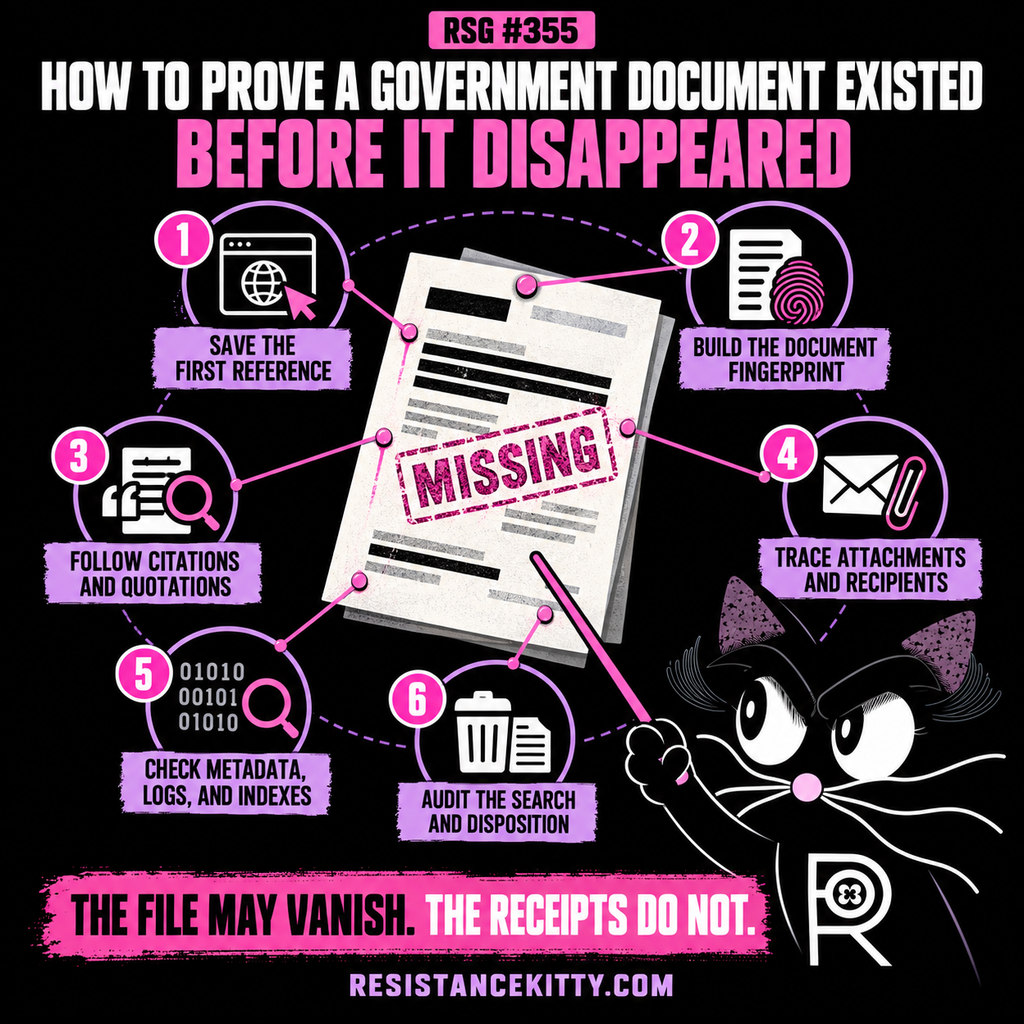
A government document can vanish from a public archive, disappear from a Freedom of Information Act production, or become mysteriously unfamiliar to the agency that once quoted it. That does not necessarily mean someone destroyed it. It does mean the document left traces, and those traces can be investigated.
Documents create administrative footprints. They are attached to emails, cited in memoranda, numbered, circulated, logged, and indexed. The original may be unavailable while its fingerprints remain elsewhere.
This Resistance Survival Guide explains how to prove that a government document existed, determine where it traveled, distinguish lawful disposition from unexplained disappearance, and request the records that can establish what happened next.
What Proof of Prior Existence Actually Means
Proving that a document existed is different from proving that an agency currently possesses it. It is also different from proving that the document was unlawfully destroyed.
A strong reconstruction establishes the document’s identity, creation date, originating office, recipients, subject, format, and last confirmed location.
The best evidence comes from several independent traces. One reference creates a lead. An attachment name, routing entry, page citation, and records index can establish a persuasive history.
Why Government Documents Leave Traces
Government work rarely occurs inside one pristine file. A memorandum may be attached to an email, discussed at a meeting, cited in a decision, and stored under a records schedule.
The National Archives rules on federal records explain that federal records cannot be legally destroyed without an approved records schedule. Unscheduled federal records must be treated as permanent until an authorized schedule applies.
If a record was lawfully destroyed, an applicable schedule should identify its authorized disposition. If it disappeared without authorization, the National Archives unauthorized disposition process requires agencies to notify the Archivist about actual or threatened unlawful removal, deletion, alteration, or destruction.
Step by Step Guide
Step One: Define the Missing Document
Write a precise description using the title, subject, author, office, recipients, date, page count, file type, document number, attachment name, case number, and quoted language.
Separate confirmed details from estimates. “A five page memorandum titled Final Review dated May 8” is evidence based. “The secret report they deleted” is a conclusion wearing a dramatic hat.
Step Two: Preserve the First Reference
Save the earliest record proving the document was mentioned, attached, transmitted, reviewed, or relied upon. Preserve its context, source, access date, file name, and identification numbers.
Do not crop away headers, Bates numbers, attachment lists, or nearby text. Context can establish who created the reference and what it described.
Step Three: Build the Document Fingerprint
Create a profile containing title variations, file names, subject lines, dates, authors, recipients, quotations, page citations, hash values, tracking numbers, and storage paths.
Search each feature separately and in combination. A missing memorandum may appear under an attachment name, draft title, revised date, or document number.
Step Four: Follow Citations and Quotations
Search memoranda, testimony, emails, minutes, court filings, audits, and congressional records for citations to the missing document.
Record the exact language attributed to it and the page or section cited. Multiple accurate quotations can help reconstruct portions of a document, but clearly label quoted fragments as excerpts rather than presenting them as the complete original.
Step Five: Find the Attachment Trail
Search emails for attached, enclosed, revised, final, draft, circulated, reviewed, and approved. Record attachment names, timestamps, message identifiers, recipients, and replies.
A federal court has recognized that a request for communications can encompass attachments connected to those emails. The DOJ summary of American Oversight v. GSA explains that an agency could not use an artificially narrow distinction between emails and their attachments to avoid a reasonable search.
Step Six: Search Every Recipient’s Records
An author may delete a file while recipients retain copies. Identify recipients, assistants, supervisors, counsel, records personnel, contractors, and partner agencies.
Request searches of their email accounts, archived mailboxes, shared drives, document systems, case files, mobile messages, and attachment repositories. One missing sender account should not become a ceremonial funeral for every copy.
Step Seven: Examine Metadata and System Logs
Request native files and metadata. Useful fields include creation time, modification time, author, file path, version number, message identifier, attachment name, and last access time.
Also seek audit logs showing uploads, downloads, edits, permission changes, exports, moves, and deletion events. A log entry may prove that a file existed even when the content is unavailable.
Step Eight: Compare Versions and Drafts
Search for draft, revised, clean, redline, final, final two, and the immortal bureaucratic classic, final final.
Compare surviving versions for matching language, metadata, page counts, comments, and revision history. A later version can establish lineage without proving every word in the missing draft.
Step Nine: Inspect Indexes and Numbering Gaps
Review indexes, evidence inventories, production logs, Bates sequences, folder lists, docket entries, and attachment tables.
A numbering gap does not prove deliberate removal. However, an index entry naming the document, combined with a gap at the expected location and later references to its contents, creates a much stronger evidentiary chain.
Step Ten: Identify the Governing Records Schedule
Determine whether the document was temporary, permanent, or unscheduled. Record the retention period, triggering event, responsible office, and permitted disposition.
Do not describe an absent record as unlawfully destroyed until you have checked the schedule. A document can be missing because it was transferred, lawfully disposed of, misfiled, preserved elsewhere, or never captured correctly.
Step Eleven: File a Focused Records Request
Request the document and evidence of its existence, including transmittal emails, routing slips, indexes, metadata, audit logs, version histories, transfer receipts, deletion logs, and preservation notices.
The FOIA request guide states that a federal request must reasonably describe the records sought. Give the agency the document fingerprint, likely custodians, systems, offices, dates, and related identifiers.
Step Twelve: Audit the Agency’s Search
Compare the response with every clear lead. Did the agency search the author but not recipients, email but not attachments, or ignore a named shared drive?
The DOJ summary of Shteynlyuger v. CMS discusses claims involving referenced attachments, documents mentioned inside produced emails, and potential text messages. The legal question remains whether the identified evidence created a sufficiently clear lead requiring another search.
Step Thirteen: Ask What Happened to the Record
If the agency confirms prior existence but cannot locate the document, request the schedule, disposition date, destruction authorization, transfer record, loss report, preservation notice, and any notice to the National Archives.
Use careful language. State that the evidence establishes prior existence and that the current location or disposition remains unexplained. That conclusion is stronger than shouting cover up before the filing cabinet has finished testifying.
Step Fourteen: Publish an Evidence Map
Present each trace chronologically. Identify the source, date, custodian, reference, what it proves, and what it does not prove.
Separate confirmed existence, confirmed transmission, confirmed receipt, later citation, last known custody, claimed disposition, and unresolved status. This keeps the investigation readable and prevents inference from slipping into the evidence column wearing a fake mustache.
Evidence That Carries the Most Weight
The strongest proof includes official indexes, transmission emails, native metadata, audit logs, page citations, routing sheets, version histories, receipts, and disposition records.
Screenshots and secondhand descriptions can support a lead, but preserve original government files whenever possible. Independent tools from MuckRock can help request and track public records, while the nonprofit Reporters Committee FOIA Wiki provides legal research on federal disclosure disputes.
Red Flags That Deserve Closer Review
Warning signs include an agency denying existence despite its own index, a missing attachment cited by several recipients, conflicting disposition dates, premature destruction, or a search that ignored an identified system.
Other concerns include unexplained numbering gaps, deletion after a preservation duty arose, a transfer without a receipt, and no identifiable records schedule.
None of these facts alone proves misconduct. Together, they may establish that the agency’s explanation is incomplete or that further review is justified.
Closing RK Thoughts
A missing document is not automatically a destroyed document, and a destroyed document is not automatically evidence of a conspiracy. Ask narrower questions. Did it exist? Who created it? Who received it? What governed its retention? What is the last verifiable trace?
Follow those questions patiently and the invisible document begins to acquire edges. Its title appears in an index. Its file name survives in an email. Its language appears in a later memorandum. Its deletion appears in a log. Its transfer appears on a receipt.
Resistance Kitty does not need the government to perform a séance for every missing PDF. She does expect it to explain why the ghosts still have document numbers.
Sources
- National Archives Scheduling Records
- National Archives Unauthorized Disposition of Federal Records
- National Archives Federal Records Management
- DOJ Guide to the Freedom of Information Act
- DOJ Freedom of Information Act Reference Guide
- FOIA.gov Request Guide
- American Oversight v. GSA Case Summary
- Shteynlyuger v. CMS Case Summary
- MuckRock
- Reporters Committee FOIA Wiki