
Andrew C. Lourie
Snapshot
| Field | Details |
|---|---|
| Full Name | Andrew C. Lourie |
| Profession | Attorney and former federal prosecutor |
| Relevant Government Position | Deputy Chief of the Criminal Division and Managing Assistant U.S. Attorney for the West Palm Beach office, Southern District of Florida |
| Relevant Period | 2006 through September 2007 |
| Epstein Connection | Supervised the federal investigation and participated in negotiations and revisions of Epstein’s non-prosecution agreement |
| Associated Officials | Alexander Acosta, A. Marie Villafaña, Jeffrey H. Sloman, Matthew Menchel, and Rolando Garcia |
| Defense Counsel | Jay Lefkowitz and other attorneys representing Jeffrey Epstein |
| Agreement Date | September 24, 2007 |
| Later Government Service | Principal Deputy Assistant Attorney General, Criminal Division, until February 2008 |
| DOJ Review | One of five former prosecutors examined by the Office of Professional Responsibility; no professional misconduct finding |
| Later Legal Practice | Private practice involving government enforcement defense and investigations, including work at Tein Malone |
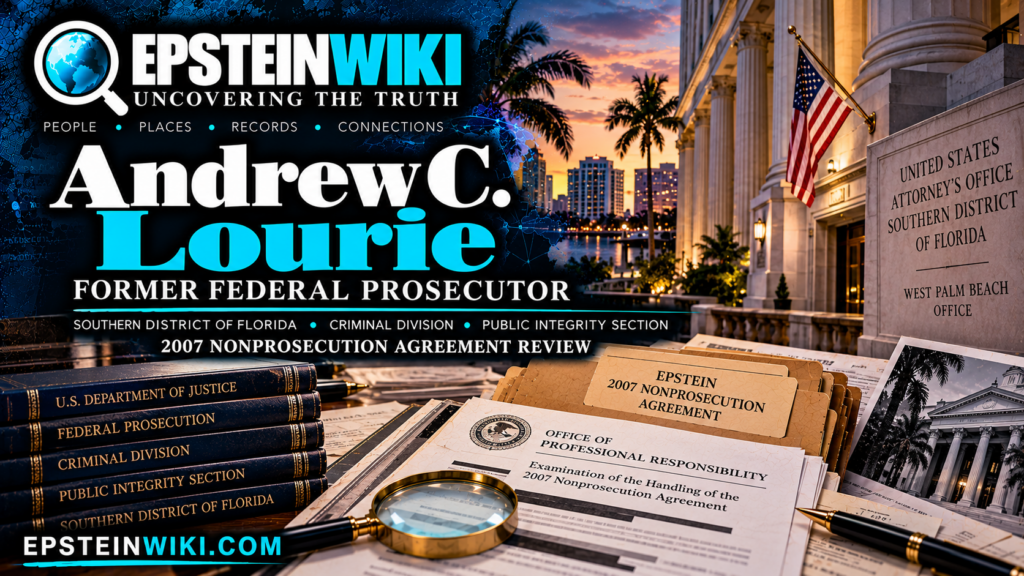
Andrew C. Lourie was one of the senior federal prosecutors responsible for supervising the original investigation of Jeffrey Epstein in the Southern District of Florida. He also participated directly in negotiating the controversial September 24, 2007 non-prosecution agreement that resolved the federal investigation through a proposed state court disposition.
His position matters because he was not merely copied on a document or consulted after the agreement had been completed. The Justice Department’s Office of Professional Responsibility identified Lourie as one of the prosecutors who negotiated the agreement and examined his decisions as part of its investigation into how the federal case was resolved.
The documentary record places Lourie in discussions about federal charges, Epstein’s possible sentence, sex offender registration, the terms of a state-based resolution, and the provision protecting potential co-conspirators from federal prosecution.
The same record also demonstrates that the negotiations took place while federal prosecutors had developed substantial evidence concerning Epstein’s sexual exploitation of minors.
The central question is how the government’s prosecutorial decisions evolved from investigating serious federal crimes to granting Epstein a non-prosecution agreement, and what responsibility rested with the officials involved.
The DOJ’s later review did not find that Lourie committed professional misconduct. That finding must be considered alongside the report’s criticism of the government’s overall handling of the case and its treatment of victims.
Key Takeaways
- Andrew Lourie supervised the West Palm Beach federal prosecutor’s office during important stages of the Epstein investigation.
- He was part of the supervisory team overseeing prosecutor A. Marie Villafaña and the developing federal case.
- Lourie participated in discussions with Epstein’s attorneys and in the negotiation of a possible federal plea agreement.
- He reviewed and revised draft agreements during September 2007.
- A privilege log and federal investigation timeline document communications involving Lourie, Acosta, Villafaña, and other officials during the final negotiations.
- The agreement included protection from federal prosecution for certain potential co-conspirators, a provision the DOJ later examined closely.
- OPR found insufficient evidence that the co-conspirator provision was intended to protect Epstein’s influential associates.
- Lourie transitioned into a senior Justice Department Criminal Division role while the agreement was being negotiated.
- The DOJ did not find professional misconduct by Lourie, but documented serious failures concerning victims’ access to information about the case.
Professional Background and Federal Career
Early federal prosecution work
Before joining the Southern District of Florida, Lourie served as an Assistant United States Attorney in New Jersey for approximately three years.
In 1994, he joined the U.S. Attorney’s Office for the Southern District of Florida.
According to the DOJ Office of Professional Responsibility report, Lourie spent approximately 13 years in that office.
His responsibilities included senior supervisory positions in the Criminal Division and management of the West Palm Beach branch office.
Public Integrity Section leadership
Lourie twice served temporary assignments as Acting Chief of the Justice Department Criminal Division’s Public Integrity Section.
The first assignment ran from September 2001 through September 2002. The second ran from February through July 2006.
The Public Integrity Section handles federal investigations and prosecutions involving public corruption.
Following his return to Florida in July 2006, Lourie resumed supervisory responsibilities that included the Epstein investigation.
Transition to Washington
In September 2007, while negotiations with Epstein’s defense lawyers were underway, Lourie transitioned to a senior position within the Department of Justice Criminal Division in Washington.
He served as Principal Deputy Assistant Attorney General and chief of staff to Assistant Attorney General Alice Fisher.
He left the Justice Department in February 2008 to enter private practice.
This chronology matters because Lourie’s move to Washington overlapped with the final negotiations of Epstein’s agreement. It does not establish that he personally supervised the agreement’s later implementation or the June 2008 state guilty plea.
Supervising the Federal Epstein Investigation
The West Palm Beach investigation
The Epstein investigation originated with Palm Beach police inquiries into allegations that Epstein paid underage girls for sexualized massages and abused them.
Federal investigators subsequently examined possible violations of federal child exploitation and trafficking laws.
Assistant U.S. Attorney A. Marie Villafaña played a central role in developing the federal case.
Lourie served as a senior supervisor within the office overseeing that work.
The DOJ professional responsibility investigation identifies him as part of the supervisory team that reviewed evidence, received updates, and participated in communications with defense counsel.
The proposed federal prosecution
By 2007, prosecutors had developed proposed federal charges against Epstein.
The government’s evidence included interviews with girls and young women who described sexual exploitation and payments associated with recruitment.
Internal communications reflected the seriousness of the allegations and the resources being devoted to the investigation.
Lourie forwarded a prosecution memorandum to Criminal Division Chief Matthew Menchel and described concerns about the earlier state grand jury process.
That communication is discussed in the DOJ’s subsequent review and provides evidence of the supervisory attention given to the case before the final agreement was negotiated.
The existence of a contemplated federal indictment does not mean a federal trial was guaranteed. Prosecutors still had to assess the available evidence, applicable statutes, trial risks, and possible resolutions.
Nevertheless, the developing federal case provides essential context for understanding the decision to pursue a non-prosecution agreement.
Negotiating the 2007 Resolution
Federal and state alternatives
During 2007, federal prosecutors and Epstein’s defense attorneys discussed possible resolutions that would avoid a contested federal trial.
These negotiations included proposed federal guilty pleas and a state-based resolution.
Epstein’s defense team sought terms that would substantially limit his exposure to federal prosecution.
The government considered potential custodial sentences, registration as a sex offender, restitution, and the scope of any agreement affecting additional individuals.
Lourie participated in the supervisory review of these proposals.
September 18, 2007 negotiations
A government investigation timeline preserved as EFTA00224943 identifies September 18 communications involving Lourie, Villafaña, Rolando Garcia, and Jay Lefkowitz.
The timeline records multiple draft plea agreements and communications about sentence terms.
It also describes a message from Villafaña concerning terms Lourie had negotiated with Lefkowitz.
These entries demonstrate that Lourie was directly involved in the negotiation process.
September 20, 2007 draft agreement
On September 20, Lourie and Acosta participated in revisions to a draft federal plea agreement.
The DOJ’s later review identifies this draft as containing language addressing the potential federal criminal liability of co-conspirators.
The draft did not become the final state-based resolution, but it is important because it helps trace how protection for other individuals developed during negotiations.
September 21 through September 24
The final days before the agreement involved repeated exchanges among Villafaña, Lourie, Acosta, Garcia, other government attorneys, and Epstein’s defense team.
A federal court privilege log, reproduced in EFTA01325051, identifies groups of emails concerning draft agreements, the factual basis for proposed charges, sex offender registration, and final revisions.
The log also identifies emails involving Lourie during September 24 and 25 concerning confidentiality provisions and defense requests about public disclosure of the agreement.
A privilege log establishes the existence, approximate dates, and reported subject matter of records. It does not establish the exact contents of documents withheld under privilege claims.
The September 24, 2007 Non-Prosecution Agreement
On September 24, 2007, the Southern District of Florida entered into a non-prosecution agreement with Epstein.
The agreement provided for the federal office to refrain from prosecuting specified conduct in exchange for Epstein’s compliance with conditions involving Florida state criminal proceedings.
The arrangement became controversial because it permitted resolution through state charges rather than the contemplated federal prosecution.
The agreement also contained language protecting potential co-conspirators from prosecution by the Southern District of Florida for conduct covered by the agreement.
That provision became one of the most closely scrutinized aspects of the agreement because it affected people other than Epstein himself.
Lourie’s participation in negotiating the agreement is documented. The extent of his individual responsibility for every provision must be assessed using the original drafts, correspondence, and findings of the DOJ investigation.
The Co-Conspirator Protection Provision
What the provision did
The final agreement extended protection from federal prosecution to specified potential co-conspirators and contained broader language that was not limited to the individuals specifically named.
The provision was significant because agreements resolving charges against one defendant do not automatically require the government to promise not to prosecute other people.
Its inclusion therefore raised questions about the scope of the government’s concessions and the reasoning behind them.
How the language developed
The DOJ Office of Professional Responsibility report traces the provision through draft agreements.
The report found that the language developed from narrower provisions requested by the defense into broader protection in the final agreement.
Lourie and Acosta reviewed a September 20 federal plea draft containing language concerning the criminal liability of co-conspirators.
When negotiations returned to a state-based resolution, Villafaña and the defense exchanged further revisions.
OPR found that the final co-conspirator language was revised by Villafaña.
What Lourie said about the provision
During the DOJ review, Lourie maintained that the provision could bind only the U.S. Attorney’s Office that entered into the agreement.
He also described the protection as limited by the agreement’s specified federal offenses and relevant period of conduct.
The report observed that the provision itself did not expressly repeat every limitation Lourie described, although other terms of the agreement addressed its scope.
Did prosecutors intend to protect influential associates?
OPR investigated whether Acosta, Lourie, or Villafaña included the provision to improperly protect Epstein’s politically connected, wealthy, or otherwise influential associates.
The investigation did not establish that motive.
OPR found relatively little contemporaneous discussion explaining why the broad language was adopted.
The report also observed that Lourie did not raise a substantive objection to the co-conspirator provision in the documented exchanges it reviewed.
These findings are important together. The record demonstrates a consequential provision and limited contemporaneous discussion of its implications. It does not demonstrate that Lourie knowingly attempted to shield particular influential individuals for improper reasons.
The Victims’ Rights Questions
Consultation before the agreement
The handling of survivors became a central issue in the later examination of the Epstein agreement.
The Crime Victims’ Rights Act provides protections for victims of federal crimes, including rights relating to fairness, respect, and participation in certain proceedings.
Federal prosecutors entered the September 2007 agreement without first fully informing the victims identified in the investigation of the impending resolution.
Survivors subsequently challenged the government’s conduct in federal litigation.
Lourie’s supervisory role
Because Lourie was involved in supervising the investigation and negotiating the agreement, the DOJ examined whether his conduct violated applicable professional obligations.
The report distinguished the government’s overall treatment of victims from whether a particular attorney intentionally or recklessly violated a clearly established professional standard.
That distinction matters because internal disciplinary findings and broader assessments of fairness are not identical.
The DOJ’s assessment
OPR concluded that the government’s handling of victims was not sufficiently forthright or sensitive.
It nevertheless did not find professional misconduct by Lourie or the other attorneys investigated under the standards it applied.
The report identified additional poor judgment by Acosta concerning the state plea resolution and failure to ensure that victims would be notified of the plea hearing.
The findings do not erase the harm experienced by survivors who were denied timely information about the disposition of the case.
The 2020 DOJ Office of Professional Responsibility Investigation
The Office of Professional Responsibility conducted an extensive investigation into the federal handling of Epstein’s case.
The inquiry included more than 60 interviews, reviews of documentary records, and submissions from prosecutors and people affected by the government’s decisions.
The five former federal attorneys examined were Alexander Acosta, Jeffrey Sloman, Matthew Menchel, Andrew Lourie, and A. Marie Villafaña.
Each provided an account of their responsibilities and involvement.
OPR examined the negotiation and execution of the agreement, potential favoritism, allegations of improper professional conduct, and the failure to communicate adequately with victims.
The investigation did not establish professional misconduct by the five attorneys.
That conclusion did not mean the department endorsed the decisions made in the case.
The report criticized significant aspects of the resolution and found that victims were not treated with the openness and sensitivity expected of federal prosecutors.
For Lourie, the report is the most important consolidated source because it reconstructs his actions, reviews his explanations, and evaluates the available contemporaneous correspondence.
Lourie’s Departure and Later Career
Lourie transitioned to the Justice Department’s Criminal Division leadership in September 2007 while the final Epstein agreement was being negotiated.
He subsequently left federal government service in February 2008.
His departure predates Epstein’s June 2008 Florida guilty pleas and the later disputes over whether Epstein complied with the agreement.
It would therefore be misleading to attribute all subsequent implementation decisions to Lourie solely because he helped negotiate the original arrangement.
After government service, he practiced law in private firms with a focus on regulatory enforcement, investigations, financial disputes, and white-collar defense.
His Tein Malone professional biography describes his experience in complex federal investigations and litigation.
Documented Timeline
| Date | Documented Event | Source |
|---|---|---|
| 1994 | Lourie joins the Southern District of Florida U.S. Attorney’s Office. | DOJ report |
| July 2006 | Lourie returns from a Justice Department detail to his Florida supervisory responsibilities. | DOJ report |
| 2006 to 2007 | Lourie participates in supervision of the federal Epstein investigation. | DOJ report |
| September 18, 2007 | Federal prosecutors and defense counsel exchange plea proposals and revised terms involving Lourie. | Investigation timeline |
| September 20, 2007 | Lourie and Acosta review a federal plea draft containing co-conspirator language. | DOJ report |
| September 21 to 24, 2007 | Final agreement negotiations involve Lourie, Villafaña, Acosta, Garcia, and other prosecutors. | Privilege log |
| September 24, 2007 | Epstein’s federal non-prosecution agreement is executed. | DOJ report |
| February 2008 | Lourie leaves the Justice Department for private legal practice. | Professional biography |
| November 2020 | The DOJ’s professional responsibility investigation documents Lourie’s role and finds no professional misconduct. | DOJ report |
Evidence Appearances
| Record or ID | Date | What It Shows | Source |
|---|---|---|---|
| EFTA02830776 | November 2020 | DOJ Office of Professional Responsibility report documenting Lourie’s career, supervisory role, participation in negotiations, and investigative findings. | Report |
| EFTA00224943 | Retrospective timeline of 2007 events | Federal investigation timeline identifying multiple communications involving Lourie during the September plea negotiations. | Timeline |
| EFTA01325051 | Filed June 23, 2015 | Federal court privilege log listing September 2007 communications among Lourie and other prosecutors about plea agreements and NPA revisions. | Court record |
| EFTA00020711 | Filed June 23, 2015 | Another indexed copy of a privilege log describing Lourie’s involvement in September 2007 internal government communications. | Court record |
| United States v. Maxwell, Document 293-1 | May 25, 2021 filing | Official court filing containing the DOJ professional responsibility report and its assessment of the co-conspirator provision. | DOJ court exhibit |
Limitations and Unresolved Questions
The DOJ report and federal court records establish substantial involvement by Lourie, but they do not answer every question concerning his individual decisions.
- What did Lourie recommend regarding the final proposed federal charges?
- Which specific changes did he personally make to the various draft plea agreements?
- What additional communications occurred between Lourie and Epstein’s defense lawyers?
- How extensively did Lourie examine the implications of the co-conspirator protection provision?
- What did he understand about the office’s obligations to consult with victims before the agreement was executed?
- How did his September 2007 transfer to Washington affect his involvement in the final negotiations?
- What additional government records remain unavailable because of privilege claims or restrictions?
Some government records are known through privilege logs rather than their complete text. A privilege log identifies documents and claimed protections but does not disclose every substantive communication.
For that reason, absence of a documented objection cannot always be treated as proof that an official endorsed every provision or understood all of its possible consequences.
Conclusion
Andrew C. Lourie occupied a significant supervisory position during the original federal Epstein investigation and participated in negotiating the September 2007 non-prosecution agreement.
The surviving record establishes that he was involved in the development of possible federal charges, discussions with defense counsel, revisions to proposed agreements, and the negotiations that culminated in the final arrangement.
The co-conspirator protection provision deserves particular attention because it expanded the agreement’s consequences beyond Epstein himself.
The DOJ’s later review found that the government adopted broad language without substantial documented consideration of its implications. However, investigators did not establish that Lourie or other prosecutors inserted the provision to improperly protect Epstein’s influential associates.
The same review identified serious problems in the government’s treatment of victims but did not find professional misconduct by Lourie under the standards applied.
For EpsteinWiki researchers, Lourie’s role is essential to reconstructing how the federal case moved from serious proposed charges to a non-prosecution agreement, who participated in that process, and what can be established about individual responsibility.
Questions and Answers
Who is Andrew C. Lourie?
Andrew C. Lourie is an attorney and former federal prosecutor who supervised the West Palm Beach branch of the U.S. Attorney’s Office for the Southern District of Florida during the original Epstein investigation.
Was Lourie involved in negotiating Epstein’s 2007 agreement?
Yes. The DOJ professional responsibility investigation identifies Lourie as a member of the supervisory team that negotiated the agreement and participated in communications with Epstein’s defense counsel.
Did Lourie personally sign the agreement?
The available record establishes Lourie’s involvement in negotiating and reviewing the agreement. His specific signature status should be determined from the original executed document rather than inferred from his supervisory role.
Did Lourie help develop the co-conspirator provision?
He participated in reviewing draft agreements that included language concerning co-conspirators. The DOJ report identifies Villafaña as the prosecutor who made the final revision to the broad provision.
Did the DOJ find that Lourie was protecting powerful Epstein associates?
No. OPR examined that possibility but found insufficient evidence that the provision resulted from an improper effort to protect Epstein’s political, celebrity, or other influential associates.
Did Lourie commit professional misconduct?
The DOJ’s Office of Professional Responsibility did not find professional misconduct by Lourie under the standards used in its investigation.
Was Lourie involved in the June 2008 state guilty plea?
Lourie had left the Justice Department in February 2008. His documented role concerns the earlier federal investigation and the negotiation of the September 2007 agreement.
Why is Lourie’s role important?
He was a senior supervisor involved in the transition from the contemplated federal prosecution to the negotiated resolution. His participation helps establish the chain of governmental decision-making.
What is the principal source concerning Lourie?
The DOJ’s November 2020 Office of Professional Responsibility investigation provides the most detailed consolidated account. Contemporaneous communications, privilege logs, and investigative timelines supplement that report.
Sources
- DOJ Office of Professional Responsibility, Epstein investigation report, November 2020.
- United States v. Maxwell, Document 293-1, official DOJ court exhibit containing the OPR report.
- EFTA00224943, federal Epstein investigation timeline and September 2007 negotiations.
- EFTA01325051, privilege log describing September 2007 communications involving Lourie.
- EFTA00020711, additional indexed copy of the privilege log.
- Tein Malone, Andrew C. Lourie professional biography.