
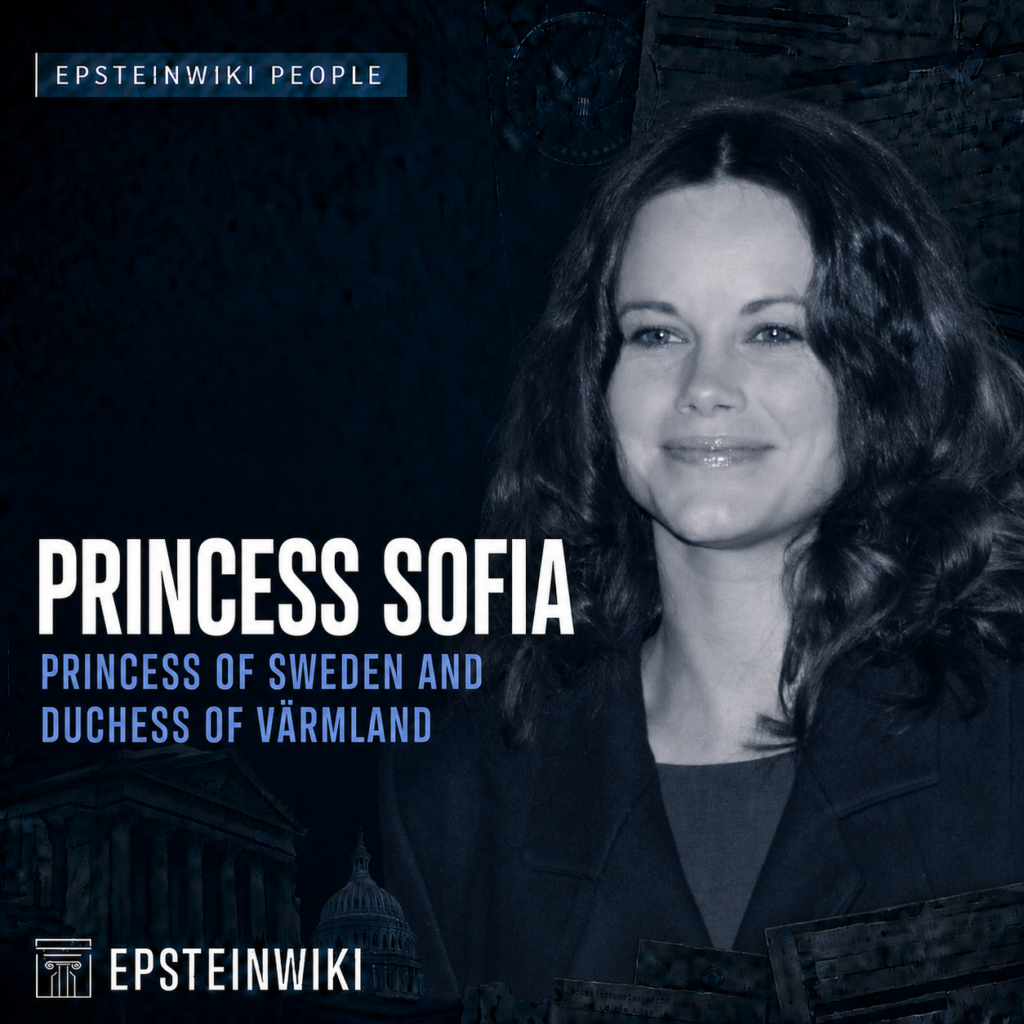
Princess Sofia of Sweden
Snapshot
Princess Sofia of Sweden, Duchess of Värmland, was born Sofia Kristina Hellqvist in 1984. She lived in New York as a young adult before marrying Prince Carl Philip of Sweden in 2015.
Released records and statements from the Swedish Royal Court establish that Sofia met Jeffrey Epstein on a few occasions around 2005. Swedish businesswoman Barbro Ehnbom facilitated the introduction after describing Sofia to Epstein as an aspiring actress who had recently arrived in New York.
The surviving correspondence shows Epstein offering to send Sofia a ticket to visit him in the Caribbean. The Royal Court states that she declined the invitation and never visited his island.
Sofia has said that her encounters with Epstein occurred in social settings, including a restaurant and a film related event. She publicly addressed the matter in February 2026, expressed sympathy for Epstein’s victims, and said she was grateful that the encounters went no further.
Later records require careful classification. Emails sent by Ehnbom between 2008 and 2017 included photographs and updates about Sofia’s life, relationship, engagement, marriage, and children. Those messages document what Ehnbom sent to Epstein. They do not establish that Sofia authorized the communications, knew about them, or maintained contact with Epstein.
A 2012 guest list identified “Sophia Hellqvist” as Epstein’s guest at a private presentation connected with Les Misérables. The Royal Court states that Sofia did not attend, was in Sweden on the date concerned, and does not know why her name appeared in the document.
No publicly identified survivor statement reviewed for this article accuses Sofia of participating in Epstein’s abuse. No available record establishes that she recruited women or girls, visited Epstein’s island, travelled on his aircraft, or continued communicating with him after the encounters around 2005.
As of September 2, 2026, Princess Sofia is not publicly known to have been charged with or convicted of an offense connected with Epstein.
Identity and Royal Position
Sofia Kristina Hellqvist was born at Danderyd Hospital on December 6, 1984. She grew up in Älvdalen and studied music at the upper secondary level.
Before entering the Swedish Royal Family, she worked as a model, appeared on Swedish reality television, and lived for a period in New York. Her official biography states that she studied accounting with an emphasis on business development and completed training as a yoga instructor.
Sofia later studied subjects involving global ethics, children’s rights, and youth communication. She also helped establish Project Playground, an organization working with children and young people in South Africa.
The Swedish Royal Court announced her engagement to Prince Carl Philip on June 27, 2014. The couple married in the Royal Chapel at Stockholm Palace on June 13, 2015.
She became Princess Sofia of Sweden and Duchess of Värmland. The couple have four children: Prince Alexander, Prince Gabriel, Prince Julian, and Princess Ines.
The Epstein encounters occurred approximately ten years before Sofia became a princess.
Sofia’s Move to New York
Sofia moved to New York during the middle of the 2000s.
She was part of a Swedish social environment that included models, students, entrepreneurs, and people pursuing careers in entertainment and business.
One of her influential contacts was Swedish American businesswoman Barbro Ehnbom. Eh
Princess Sofia of Sweden and Jeffrey Epstein
Snapshot
Princess Sofia of Sweden, Duchess of Värmland, was born Sofia Kristina Hellqvist in 1984. She lived in New York as a young adult before marrying Prince Carl Philip in 2015 and becoming a member of the Swedish Royal House.
Released records and Swedish reporting establish that Sofia was introduced to Jeffrey Epstein through Swedish American businesswoman Barbro Ehnbom around 2005.
In December 2005, Ehnbom sent Epstein a photograph of Sofia and described her as a recently arrived aspiring actress whom he might want to meet. Epstein responded by offering to send Sofia a ticket to visit him in the Caribbean. The Swedish Royal Court states that she declined the invitation.
The Royal Court has acknowledged that Sofia met Epstein on a few occasions around 2005. In February 2026, Sofia said the encounters occurred in social settings, including a restaurant and a film related event.
Later documents require a different interpretation. Ehnbom continued sending Epstein photographs and information about Sofia between 2008 and 2017. Those messages establish Ehnbom’s continuing interest in discussing Sofia with Epstein. They do not establish that Sofia participated in the correspondence or maintained contact with Epstein.
A 2012 guest list identified Sofia Hellqvist as Epstein’s guest at a private presentation connected with Les Misérables. The Royal Court states that Sofia did not attend, was in Sweden on the relevant date, and does not know why her name appeared in the document.
The available public record does not establish that Sofia visited Epstein’s Caribbean property, travelled on his aircraft, received financial support from him, participated in his abuse, or maintained a relationship with him after the meetings around 2005.
No publicly identified victim statement reviewed for this article accuses Sofia of sexual misconduct, trafficking, recruitment, or facilitating abuse.
As of September 2, 2026, Princess Sofia is not publicly known to have been charged with or convicted of an offense connected with Epstein.
Identity and Royal Position
Sofia Kristina Hellqvist was born at Danderyd Hospital on December 6, 1984. She grew up in Älvdalen and has two sisters.
Before joining the Royal House, Sofia worked as a model, appeared on Swedish reality television, studied in New York, trained as a yoga instructor, and participated in voluntary and charitable activities.
Her relationship with Prince Carl Philip became public in 2010. The couple announced their engagement on June 27, 2014, and married in the Royal Chapel in Stockholm on June 13, 2015.
She thereafter became Princess Sofia of Sweden and Duchess of Värmland.
Prince Carl Philip and Princess Sofia have four children: Prince Alexander, Prince Gabriel, Prince Julian, and Princess Ines.
The Epstein related encounters occurred approximately a decade before Sofia became a princess.
That chronology does not make the meetings irrelevant. It does mean that Epstein did not initially meet her as a representative of the Swedish monarchy.
Sofia’s Years in New York
Sofia moved to New York during her early twenties.
The official Royal Court biography states that she studied accounting with an emphasis on business development. She also worked and developed contacts within Swedish expatriate and professional circles.
One of those contacts was Barbro Ehnbom.
Ehnbom was a Swedish American businesswoman involved in finance, health care investment, and professional networking. She founded Barbro’s Best & Brightest, commonly abbreviated BBB, as a network promoting ambitious Swedish women.
Ehnbom also maintained a long relationship with Epstein. Released records document meetings, correspondence, events, photographs, and financial support involving Epstein and Ehnbom’s organizations.
The significance of the Sofia documents therefore extends beyond a chance encounter. They show a well connected intermediary presenting a young Swedish woman to Epstein and attempting to facilitate further contact.
That does not establish that Sofia knew the extent of Epstein’s conduct or understood the nature of Ehnbom’s wider relationship with him.
Barbro Ehnbom’s 2005 Introduction
The central introduction appears in EFTA01822952.
In December 2005, Ehnbom sent Epstein a photograph of Sofia. She described Sofia as an aspiring actress who had recently arrived in New York and as someone she had previously suggested Epstein might want to meet.
Epstein replied that he was in the Caribbean and offered to send Sofia a ticket if she wanted to visit for several days.
The exchange establishes that:
- Ehnbom deliberately brought Sofia to Epstein’s attention.
- A photograph accompanied the introduction.
- Ehnbom believed Epstein might be interested in meeting her.
- Epstein proposed bringing Sofia to the Caribbean.
- Epstein offered to pay for or arrange her travel.
The Swedish Royal Court states that Sofia did not accept the Caribbean invitation.
The document does not establish that Sofia wrote the email, saw Epstein’s response, requested a ticket, or travelled to an Epstein property.
The Caribbean Invitation
Epstein’s response is significant because his Caribbean property later became closely associated with allegations of sexual abuse and trafficking.
The retrospective significance of the location must nevertheless be separated from what Sofia could have known in December 2005.
Epstein had not yet entered his 2008 Florida guilty plea. The Palm Beach investigation was developing, but the complete record of his conduct was not publicly understood.
The invitation therefore documents a potential route into Epstein’s private environment. It does not establish that Sofia knew the purpose of the invitation or had knowledge of criminal activity.
According to the Royal Court, she declined.
No verified flight manifest reviewed for this article places Sofia aboard an Epstein aircraft. No authenticated travel record reviewed here places her on Little Saint James or another Epstein Caribbean property.
An offered ticket is not evidence of completed travel.
The Acknowledged Meetings
After the 2005 emails became public, the Swedish Royal Court confirmed that Sofia had been introduced to Epstein on a few occasions around that time.
The Court said the encounters occurred in social settings. Later clarification identified settings including a restaurant and a film premiere or screening.
In February 2026, Sofia addressed the matter publicly during an appearance in Stockholm. She said she had met Epstein socially on a limited number of occasions while in her twenties and expressed sympathy for his victims.
Her statement is summarized in People’s report on her public response.
Sofia characterized the encounters as brief and expressed relief that the association did not continue.
These acknowledgments independently support the conclusion that at least some meetings occurred. They do not establish the precise number, complete guest lists, duration, or substance of every encounter.
Sofia’s Friend Camilla
Released correspondence also refers to a friend named Camilla who accompanied Sofia during at least part of the New York contact.
In a 2006 exchange reported by Dagens Nyheter and summarized in later international reporting, Epstein’s assistant asked Ehnbom what had happened with Camilla and referred to an open offer of a ticket to New York.
Ehnbom responded that Epstein might have meant Sofia, whom she described as the dark haired woman who had brought her friend Camilla.
The exchange is important because it indicates that Sofia did not necessarily meet Epstein alone.
It also shows some confusion within Epstein’s office over which woman was the subject of the travel offer.
The correspondence should not be treated as a verbatim account from Sofia or Camilla. It records a discussion between Ehnbom and Epstein’s assistant.
Acting School and Visa References
The same 2006 correspondence contains references to acting school and immigration or visa difficulties.
Epstein’s assistant indicated that Epstein had offered Sofia and Camilla assistance connected with film education. Ehnbom’s response suggested that visa questions had arisen.
The Swedish Royal Court later rejected claims that Sofia depended on Epstein for acting education, immigration assistance, or professional advancement.
The Court stated that Sofia did not attend acting school through Epstein and had never been in a position of dependence on him. The clarification was reported by Dagens Nyheter and People.
The available records establish that offers or possible assistance were discussed.
They do not establish that Sofia accepted the offers, obtained a visa through Epstein, attended a program he financed, or entered a continuing professional arrangement with him.
The 2008 Birthday Photograph
Swedish reporting identified a January 2008 birthday message sent to Epstein by Ehnbom.
The message reportedly included a photograph of Ehnbom, Sofia, and two other women. The attachment was described with a filename referring to Swedish women, while the accompanying greeting referred to BBB.
The timing attracted attention because it occurred after the acknowledged meetings around 2005.
However, the evidentiary distinction is essential.
The released material shows that Ehnbom sent the photograph to Epstein. It does not by itself establish that Sofia selected the photograph, approved its transmission, knew Epstein would receive it, or communicated with him in 2008.
The Royal Court’s statement that Sofia had no continuing contact with Epstein is not disproved merely because a third party later sent him her photograph.
Evidence of what Ehnbom did must not automatically be attributed to Sofia.
The 2010 “Our Sofia” Messages
Ehnbom continued discussing Sofia with Epstein in 2010.
In EFTA02431162, Ehnbom referred to Sofia as a shared friend while describing extensive Swedish press coverage of Sofia’s relationship with Prince Carl Philip.
The phrase suggests that Ehnbom believed Epstein would recognize the reference.
It does not prove that Sofia considered Epstein a friend or remained in contact with him.
Another record, EFTA00775965, contains a photograph of Sofia during a trip to Africa. Ehnbom reminded Epstein who Sofia was and referred to the possibility that she would become a princess while Swedish journalists were looking for her.
This email establishes that:
- Ehnbom was following Sofia’s relationship with Prince Carl Philip.
- Ehnbom possessed or obtained a photograph from Sofia’s African trip.
- Ehnbom believed Epstein would remember Sofia.
- Ehnbom chose to update Epstein about her.
It does not establish that Sofia sent the message, knew it was being sent, or communicated with Epstein in 2010.
Marcus Forss’s 2010 Message
Ehnbom’s son Marcus Forss also mentioned Sofia in correspondence with Epstein.
In EFTA02411543, Forss discussed media criticism of Sofia following reports of her relationship with the Swedish prince. He wrote that his mother was defending Sofia and added that he thought Epstein had met her.
The message corroborates the broader social connection between Sofia, Ehnbom, and Epstein.
Forss’s wording is nevertheless qualified. He said he thought Epstein had met Sofia.
The document therefore should not be represented as an eyewitness account of every meeting. The Royal Court’s later confirmation provides the stronger evidence that meetings occurred.
The Swedish American Life Science Summit
Ehnbom chaired the Swedish American Life Science Summit, an organization connecting Swedish and American figures in science, finance, medicine, and business.
Sofia and Prince Carl Philip attended a summit luncheon before their marriage.
In EFTA01987534, Ehnbom forwarded Epstein material concerning their arrival and referred to Sofia as almost a princess.
The document establishes that Ehnbom continued sending Epstein updates about Sofia’s public life.
It does not establish that Sofia attended the luncheon to meet Epstein, that Epstein was present, or that Sofia knew the material was forwarded to him.
Participation in an Ehnbom event cannot automatically be interpreted as participation in Epstein’s network.
The 2012 Les Misérables Guest List
One of the most important disputed records is EFTA01915181.
The document concerns a private New York presentation associated with Les Misérables in December 2012. The guest material listed “Sophia Hellqvist” alongside Epstein, apparently identifying her as his personal guest.
If taken at face value, the entry would suggest contact seven years after the acknowledged 2005 meetings and four years after Epstein’s Florida conviction.
The Swedish Royal Court directly disputed that interpretation.
In a statement reported by SVT, the Court said:
- Sofia did not attend the presentation.
- She was in Sweden on the relevant date.
- She does not know how her name entered the document.
A guest list can establish that an organizer expected, proposed, or recorded a person as attending. It does not conclusively prove physical attendance.
Without corroborating photographs, access records, travel documents, eyewitness accounts, or communications from Sofia, the 2012 listing should be described as disputed.
The Difference Between an Invitation and Attendance
Several documents in the Epstein archive record proposed guests who did not ultimately attend.
Schedules changed. Assistants copied names from preliminary plans. Hosts sometimes listed companions before receiving confirmation.
The Sofia guest list therefore supports the conclusion that someone associated her name with Epstein’s invitation.
It does not override evidence that she was elsewhere if the Royal Court’s location statement is accurate.
Responsible treatment of the record requires presenting both sides:
- The document lists Sofia as Epstein’s guest.
- The Royal Court states that the listing was incorrect.
- No independent attendance evidence reviewed for this article resolves the contradiction.
It would be misleading either to conceal the guest list or to present it as conclusive proof of attendance.
Engagement Updates Sent to Epstein
Sofia and Prince Carl Philip announced their engagement on June 27, 2014.
On the same date, Ehnbom forwarded the news to Epstein. EFTA01923241 contains her enthusiastic message that Sofia would marry the prince and become a princess.
The timing shows that Ehnbom regarded Sofia’s engagement as news worth sharing with Epstein.
Again, the sender was Ehnbom.
The document does not establish that Sofia asked Ehnbom to contact Epstein, that Sofia participated in the email, or that Epstein communicated with Sofia about the engagement.
Updates After the Royal Wedding
Sofia married Prince Carl Philip in 2015.
Ehnbom continued corresponding with Epstein after the marriage. In EFTA02384151, she mentioned the birth of Sofia’s second son in 2017 while discussing her own plans to meet Epstein.
Duplicate or related versions appear in EFTA01020316 and EFTA01021462.
These records establish that Ehnbom continued supplying Epstein with royal family news.
They do not establish that Princess Sofia maintained contact with Epstein after becoming a royal.
A recurring problem in interpreting the Epstein archive is the tendency to collapse a correspondent, the subject of the correspondence, and the recipient into a single relationship. They are not the same.
Barbro Ehnbom’s Role
Ehnbom is central to the documentary record.
She introduced Sofia, transmitted photographs, discussed offers, forwarded news, and continued mentioning her for more than a decade.
Independent researchers have examined whether Ehnbom’s professional networks also functioned as channels through which Epstein obtained introductions to young Swedish women.
The investigation Barbro Ehnbom and the Swedish Recruitment Pipeline argues that Ehnbom repeatedly presented women to Epstein through photographs, social gatherings, and professional networks.
That is an investigative characterization rather than a judicial finding.
The publicly released records nevertheless justify close scrutiny of Ehnbom’s methods. They show that she introduced women to Epstein, sent photographs, organized gatherings, maintained a long relationship with him, and received financial support connected with her activities.
Sofia’s appearance in those records illustrates how a legitimate professional or social network could create access to someone whose criminal conduct was not fully understood by the women being introduced.
The documents do not establish that every BBB participant met Epstein or knew of his conduct.
Epstein’s Financial Relationship With Ehnbom
Released records indicate that Epstein provided money connected with Ehnbom’s organizations and events.
That financial relationship matters because it helps explain why Ehnbom repeatedly supplied Epstein with introductions, photographs, professional contacts, and updates.
It does not establish that Sofia received Epstein’s money.
No released financial record reviewed for this article identifies a payment from Epstein to Sofia. No verified record reviewed here shows Epstein paying her tuition, rent, acting expenses, royal activities, charitable work, or travel.
The distinction between funding an intermediary’s organization and funding every person within that organization is fundamental.
Sofia’s February 2026 Statement
Princess Sofia addressed the controversy publicly on February 10, 2026.
She said that she had encountered Epstein in a limited number of social settings during her twenties. She expressed gratitude that the contact went no further and directed her thoughts toward Epstein’s victims.
The statement followed renewed attention generated by the release of the 2010 photograph and the disputed 2012 guest list.
Her response was narrower than a complete documentary chronology. It addressed her own recollection of the meetings and denied a meaningful continuing relationship.
The statement does not explain why Ehnbom continued sending Epstein photographs and personal updates.
However, Ehnbom’s unilateral messages are not evidence that Sofia knew about them.
Timing Before Epstein’s Conviction
The acknowledged Sofia meetings occurred around 2005.
Epstein pleaded guilty in Florida in 2008 to offenses involving prostitution, including procuring a person under eighteen. He later faced federal sex trafficking charges in 2019.
The 2005 chronology is relevant because Sofia met him before his conviction and before the complete public exposure of his conduct.
This does not mean that Epstein’s behavior before 2008 was harmless. Investigators and survivors established that abuse had already occurred.
It means that the public information available to a young social acquaintance in 2005 was different from the information available after his conviction.
The presently released evidence does not establish what Ehnbom told Sofia about Epstein or what Sofia independently knew.
No Identified Victim Allegation Against Sofia
No publicly released victim statement reviewed for this article accuses Princess Sofia of:
- Sexual assault
- Recruiting girls or women
- Arranging massages
- Procuring sexual partners
- Transporting a trafficking victim
- Concealing abuse
- Receiving proceeds from trafficking
- Participating in Epstein’s household operations
- Visiting a property where abuse occurred
- Interfering with an investigation
Her name appears in correspondence, photographs, reporting, and a disputed guest list.
That is materially different from appearing in victim testimony as an alleged participant in misconduct.
No Evidence of Island Travel
The 2005 email shows that Epstein invited Sofia to the Caribbean.
The Royal Court says she declined.
No authenticated passenger manifest reviewed for this article places her on an Epstein aircraft. No released schedule reviewed here records her arrival on Little Saint James. No photograph reviewed here places her on the island.
The invitation is important because it shows Epstein attempting to bring her into a private setting.
It should not be converted into a completed trip without travel evidence.
No Evidence of Direct Correspondence
The principal released messages were written by:
- Barbro Ehnbom
- Jeffrey Epstein
- Epstein’s assistants
- Marcus Forss
The public records reviewed for this article do not contain a verified direct email between Sofia and Epstein.
This does not prove that no direct communication ever occurred. The Royal Court acknowledges social meetings.
It does mean that later email references to Sofia should not be described as emails from Sofia.
A person can be the subject of correspondence without being a correspondent.
Public Reporting and Royal Scrutiny
The Sofia connection received sustained attention after reporting by Dagens Nyheter in December 2025 and the larger federal document releases in 2026.
International outlets often emphasized the fact that another European royal figure appeared in Epstein related records.
Comparisons with Andrew Mountbatten Windsor can be misleading.
Andrew maintained a documented personal relationship with Epstein after Epstein’s conviction, visited his properties, travelled with him, and was accused of sexual misconduct by Virginia Giuffre. Andrew denied the allegations and settled Giuffre’s civil case without admitting liability.
The public Sofia record is materially different. It concerns a young woman introduced socially before Epstein’s conviction, an invitation she says she declined, a small number of acknowledged meetings, later third party updates, and a disputed guest list.
Royal status does not remove the need for scrutiny. It also does not justify merging factually different relationships.
What the Evidence Establishes
The available evidence establishes that:
- Sofia Hellqvist lived and studied in New York as a young adult.
- Barbro Ehnbom introduced Sofia to Epstein around 2005.
- Ehnbom sent Epstein a photograph and described Sofia as someone he might want to meet.
- Epstein offered to send Sofia a ticket to visit him in the Caribbean.
- The Swedish Royal Court states that Sofia declined the invitation.
- Sofia met Epstein on a few occasions around 2005.
- Sofia says the encounters occurred in social settings, including a restaurant and a film related event.
- A friend named Camilla accompanied Sofia during at least part of the social contact described in the correspondence.
- Epstein or his office discussed film education and possible travel or visa assistance involving Sofia and Camilla.
- The Royal Court states that Sofia did not depend on Epstein for education, immigration assistance, or professional advancement.
- Ehnbom sent Epstein a photograph that included Sofia in 2008.
- Ehnbom continued sending Epstein photographs and information about Sofia in 2010.
- Ehnbom forwarded material concerning Sofia and Prince Carl Philip’s public appearances.
- A 2012 guest list identified Sofia as Epstein’s guest at a private Les Misérables presentation.
- The Royal Court states that Sofia did not attend and was in Sweden.
- Ehnbom informed Epstein of Sofia’s engagement in 2014.
- Ehnbom continued sending Epstein royal family updates through at least 2017.
- Later messages about Sofia were written by Ehnbom rather than Sofia.
- Sofia publicly addressed the encounters in February 2026.
- No publicly identified victim statement reviewed here accuses Sofia of participating in Epstein’s abuse.
What the Evidence Does Not Establish
The available evidence does not establish that:
- Sofia accepted Epstein’s Caribbean invitation.
- Sofia visited Little Saint James.
- Sofia travelled on Epstein’s aircraft.
- Sofia received money from Epstein.
- Epstein obtained a visa for Sofia.
- Epstein paid for Sofia’s education.
- Sofia attended an acting school through Epstein.
- Sofia knew about Epstein’s sexual abuse in 2005.
- Sofia understood the complete nature of Ehnbom’s relationship with Epstein.
- Sofia authorized Ehnbom to send every photograph.
- Sofia knew that Ehnbom continued discussing her with Epstein.
- Sofia communicated directly with Epstein in 2008, 2010, 2012, 2014, or 2017.
- Sofia attended the disputed 2012 presentation.
- A name on a preliminary guest list proves physical attendance.
- Sofia recruited women for Epstein.
- Sofia facilitated sexual activity or trafficking.
- Sofia committed a criminal offense connected with Epstein.
- Sofia was accused of wrongdoing by an identified Epstein survivor.
- Membership in Ehnbom’s social orbit establishes knowledge of Ehnbom’s complete activities.
- Becoming a princess transformed earlier third party correspondence into royal participation.
Investigative Assessment
The strongest evidence concerning Princess Sofia is the acknowledged social contact around 2005.
Ehnbom deliberately presented Sofia to Epstein. Epstein responded with a private Caribbean invitation and later appears to have offered professional or travel assistance. Sofia met him socially on a few occasions but, according to the Royal Court, declined the Caribbean trip and did not enter a dependent relationship with him.
The later records are significant primarily as evidence about Ehnbom.
They show Ehnbom continuing to send Epstein photographs, relationship news, engagement information, and royal family updates long after Sofia’s acknowledged encounters ended.
Those messages may demonstrate that Ehnbom used Sofia’s growing public prominence to sustain her own rapport with Epstein. They do not prove that Sofia participated in that process.
The 2012 guest list is the principal unresolved contradiction. It identifies Sofia as Epstein’s guest after his conviction, while the Royal Court states that she was in Sweden and did not attend. Without independent corroboration, the listing should remain disputed.
The defensible classification is that Princess Sofia was a young social acquaintance introduced to Epstein by Barbro Ehnbom before his conviction. The public evidence supports scrutiny of how the introduction occurred, but it does not support characterizing Sofia as an Epstein recruiter, facilitator, trafficking participant, or continuing associate.
Key Takeaways
- Barbro Ehnbom introduced Sofia Hellqvist to Epstein around 2005.
- Epstein offered to send Sofia to the Caribbean.
- The Royal Court says Sofia declined.
- Sofia acknowledges meeting Epstein in a few social settings.
- The meetings occurred before Epstein’s 2008 conviction and before Sofia became a princess.
- Correspondence references Sofia and her friend Camilla in connection with acting education and visa questions.
- The Royal Court says Sofia did not depend on Epstein for professional or immigration assistance.
- Ehnbom continued sending Epstein photographs and news about Sofia.
- Those later messages were not written by Sofia.
- A 2012 guest list identified Sofia as Epstein’s guest.
- The Royal Court says she did not attend and was in Sweden.
- No verified flight record reviewed here places Sofia aboard Epstein’s aircraft.
- No verified travel record reviewed here places her on Epstein’s island.
- No publicly identified victim statement reviewed here accuses Sofia of misconduct.
- The evidence warrants examination of Ehnbom’s introduction network but does not establish criminal conduct by Sofia.
Related EpsteinWiki Articles
- Jeffrey Epstein
- Ghislaine Maxwell
- Barbro Ehnbom
- Recruitment and Logistics
- Andrew Mountbatten Windsor
- Queen Mette Marit of Norway
- Witness Statements and Depositions Litigation
- Epstein’s Black Book
- Post Conviction Activities
- How to Read an Epstein Document
Primary Royal and Government Sources
- Official Royal Court biography of Princess Sofia
- Official Royal Court biography of Prince Carl Philip
- Swedish Royal House membership information
- United States Department of Justice Epstein Library
- SVT report containing the Royal Court’s response to the 2012 guest list
- SVT report on the 2010 photograph and 2012 listing
Primary Epstein Data Evidence
- EFTA01822952 contains Ehnbom’s December 2005 introduction of Sofia and Epstein’s Caribbean invitation.
- EFTA00775965 contains Ehnbom’s 2010 message sending Epstein a photograph of Sofia in Africa.
- EFTA02411543 contains Marcus Forss’s message stating that he thought Epstein had met Sofia.
- EFTA02431162 contains Ehnbom’s 2010 reference to Sofia and press coverage of her relationship with Prince Carl Philip.
- EFTA01987534 contains Ehnbom’s message concerning Sofia and Prince Carl Philip at a Swedish American Life Science Summit luncheon.
- EFTA01915181 contains the disputed 2012 guest list identifying “Sophia Hellqvist” alongside Epstein.
- EFTA01923241 contains Ehnbom’s June 2014 message concerning Sofia’s engagement.
- EFTA02384151 contains Ehnbom’s 2017 update concerning the birth of Sofia’s second son.
- EFTA01020316 contains a related version of the 2017 correspondence.
- EFTA01021462 contains another related version of the 2017 correspondence.
Reporting and Sleuth Sources
- Dagens Nyheter investigation of Sofia’s meetings with Epstein
- Dagens Nyheter report on the Royal Court’s dependency clarification
- People report on the Royal Court’s original confirmation
- People report on the Royal Court’s second statement
- People report on Sofia’s February 2026 statement
- Svenska Dagbladet report on the acknowledged meetings
- Svenska Dagbladet report on the later document release
- Anadolu report on the 2010 photograph
- Sofia Hellqvist EFTA document index
- Epstein Exposed investigation of Ehnbom’s network
These research indexes provide useful document connections and investigative interpretations. Their conclusions should be checked against the underlying EFTA records and official responses.