
Fact Check: Fake Epstein and Maxwell “Consent” Email
Snapshot
| Verdict | FAKE attribution. The screenshot is not authenticated correspondence from Jeffrey Epstein and Ghislaine Maxwell. Its own date is inconsistent, and the purported dialogue closely reworks an unrelated religious narration. |
|---|---|
| Claim examined | An image labeled “Consent” purports to show Maxwell asking Epstein whether silence constitutes consent, with Epstein allegedly responding, “their silence means their consent.” |
| Claimed date | June 9, 2008. Both visible date lines mislabel the day as Tuesday. June 9 was a Monday. |
| Text provenance | Sahih al-Bukhari 6946 contains an earlier narration about consent to marriage and silence. The screenshot changes wording, people, and context. |
| Evidence identifier | None displayed. The image includes no EFTA number, original email file, court exhibit, complete address headers, or authenticated source URL. |
| Finding limits | This checks the specific pictured email and its attribution, not the whole Epstein evidence collection. The screenshot’s maker and first posting have not been established. |
| Reviewed | October 15, 2026. Verdict may be revisited if an authentic original with independently verifiable provenance is produced. |
Introduction: The Viral Claim
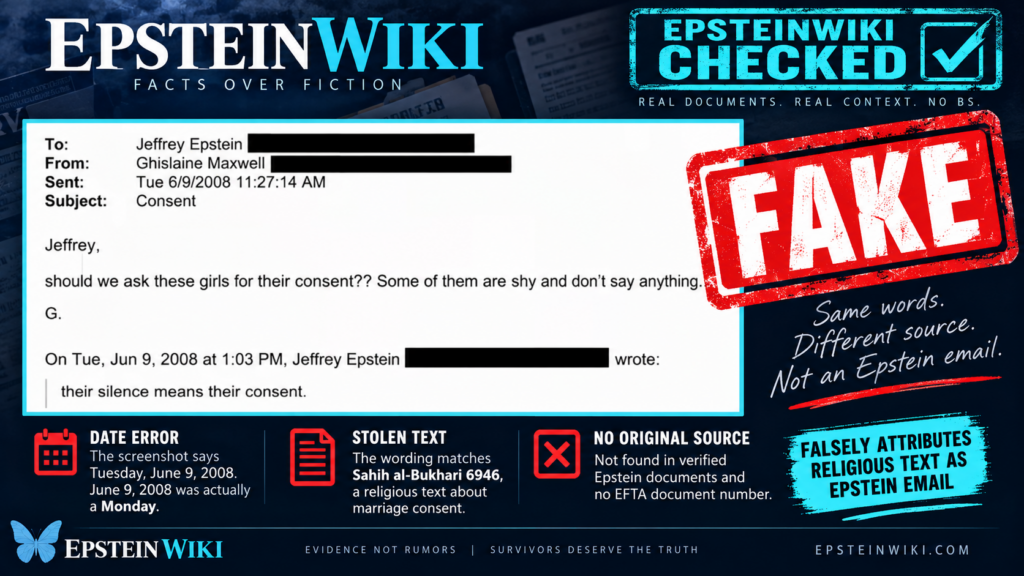
The image circulating online is formatted to resemble a redacted email. It identifies Jeffrey Epstein as the recipient, Ghislaine Maxwell as the sender, and “Consent” as the subject. It prints a supposed June 9, 2008 exchange in which Maxwell asks whether girls who remain quiet should be asked for consent. Beneath that message, it attributes the words “their silence means their consent” to Epstein.
The screenshot’s apparent specificity gives it the feel of a released exhibit: names, black redaction bars, second-level timestamps, and quoted reply formatting. Those details can be imitated. A credible evidence item requires a verifiable source, not merely a familiar PDF aesthetic. This check examines the supplied screenshot as an image. We were not given an original .eml file, a court exhibit, or a DOJ document number.
Key Takeaways
- The calendar contradicts both email dates. June 9, 2008 was Monday, but the screenshot calls it Tuesday twice.
- The dialogue closely tracks Sahih al-Bukhari 6946. The original narration concerns a woman’s consent to marriage, not an exchange between Epstein and Maxwell.
- No traceable evidence identifier accompanies the claim. This screenshot does not show an EFTA number, original file, complete headers, or a release location that could authenticate it.
- A circulating copy is not a source document. Sharing the screenshot proves its circulation, not its authenticity.
- The verdict applies to the email attribution. It does not erase documented trafficking offenses, survivor testimony, or genuine Epstein correspondence.
Finding One: The Date Fails a Basic Calendar Check
The June 2008 calendar shows that June 9, 2008 was a Monday. Yet the image says “Tue 6/9/2008 11:27:14 AM” at the top. The quoted message repeats the same mismatch, introducing Epstein’s alleged earlier note with “On Tue, Jun 9, 2008.” Tuesday that week was June 10.
A wrong weekday can appear in a manually copied message or a poorly converted record. Alone, it does not mathematically prove a document never existed. Here, however, the mistake occurs in both portions of an image presented as an intact 2008 email conversation, materially weakening its reliability.
Finding Two: The Apparent Reply Comes Before the Quoted Message
The image timestamps Maxwell’s supposed response at 11:27:14 AM and Epstein’s quoted original at 1:03 PM on the same date. Read as a single local timeline, the supposed response precedes the message it quotes by about 96 minutes.
This point is supporting evidence, not a conclusive test. Real email clients can display sender and recipient times in different time zones, and a forwarded chain may carry imperfect metadata. The screenshot does not provide the unredacted raw headers needed to test that explanation.
Finding Three: The Wording Has an Identifiable Earlier Source
Sahih al-Bukhari 6946 records a narration attributed to Aisha in which she asks Muhammad whether women should be consulted about marriage. She describes a shy woman remaining quiet, and the response is rendered in the English translation as “Her silence means her consent.” The section itself is headed as addressing marriage under coercion. That is the context of the source text.
The viral screenshot uses the same underlying question, hesitation about women or girls remaining silent, and answer. It changes the people, pluralizes the response, removes the marriage context, and frames the exchange as Epstein and Maxwell discussing unspecified girls. The screenshot is therefore not an independent original quotation merely because the names are different.
This comparison establishes a strong alternative textual source and an apparent adaptation. It does not establish who created the screenshot or what the original maker intended. The religious narration also should not be presented as proof of what any particular present-day Muslim believes about sexual consent.
Finding Four: No Authentic Original Has Been Supplied
The Justice Department’s Epstein Library offers a public starting point for checking released records, but the supplied screenshot does not cite an EFTA Bates stamp, dataset, PDF, page, case docket, or original mailbox export. We also did not identify a matching authenticated record from targeted public searches for the distinctive wording and date. A search miss is not proof of universal absence: the DOJ itself cautions that parts of its archive may not be fully searchable or may contain unreliable extracted text.
The black bars at the top cover purported address information, leaving no visible way to authenticate the named accounts. The “To,” “From,” “Sent,” and “Subject” labels are not a substitute for full technical headers or a documented chain of custody. The screenshot can be reproduced, but it cannot presently be traced back to an actual 2008 message.
How the Misattribution Circulated
A publicly shared Cam Higby video is an example of rhetoric built around initially attributing a statement about silence and consent to Epstein, then revealing a religious source. A separate social media posting reproduces the purported Epstein and Maxwell email wording. These examples help explain the way the claim was presented and recirculated, but they do not establish the image’s creator, earliest upload, or an unbroken provenance trail between particular posts.
We therefore do not claim to have found the original fabricator. We can identify what the screenshot claims, what contradicts its metadata, and why its wording is not reliable evidence of an Epstein email.
What Would Change This Verdict?
A genuine document would need a stable, independently retrievable original: for example, an identified DOJ or House release item, an EFTA number with the precise page, or a properly sourced court exhibit containing the same communication. Ideally it would also preserve full date and time zone headers, the original message body, and a clear account of how the record was obtained.
Merely reposting a cropped image, pointing to an unrelated Epstein release, or offering a document number that does not contain this exchange would not authenticate the claim. If matching source evidence emerges, EpsteinWiki should correct the entry and document exactly what changed.
Evidence Appearances and Verification Limits
| Item | What can be verified | What it cannot prove |
|---|---|---|
| Submitted screenshot | Names, subject, purported quote, dates and redactions are visible. | No authentic mailbox origin, EFTA identifier or original document is shown. |
| June 2008 calendar | June 9 was Monday, not Tuesday. | A date error by itself does not identify the editor. |
| Sahih al-Bukhari 6946 | The question, shyness and silence motif, and answer are substantially parallel to an earlier narration. | It does not identify who produced the fake email image. |
| DOJ public search | Official location to test proposed EFTA documents if one is supplied. | A text search cannot exclude every unindexed or inaccessible record. |
Conclusion: EpsteinWiki’s Verdict
FAKE attribution. The pictured “Consent” message should not be quoted, cited, or indexed as authentic Epstein and Maxwell correspondence. Its dates are inconsistent, its key language is closely adapted from an earlier unrelated source, and no verifiable original has been presented. The conclusion is about this supposed email. It is not a substitute for the real trial record, the released evidence, or the testimony of survivors.
Survivors deserve investigators who can tell the difference between a document and a screenshot wearing a document costume. EpsteinWiki will not turn viral outrage into a Bates number. The receipts have to be real.
Sources and Review References
- Sahih al-Bukhari 6946, translated narration, the earlier religious text whose structure is echoed in the screenshot.
- June 2008 dated calendar, confirming the correct weekday for June 9.
- U.S. Department of Justice, Search Full Epstein Library, the official release-search portal and its cautions about search limitations.
- Public post reproducing the disputed image text, an example of online circulation, not documentary authentication.
- Cam Higby public video example, circulation context illustrating the misattribution and rhetorical reveal, not established image authorship.
- EpsteinWiki’s separate redaction fact check, a related explanation of why screenshots and genuine underlying records must be evaluated separately.