
J. Epstein & Co.: Offices, Employees, Clients, and Financial Operations

| Snapshot | What the reviewed records establish |
|---|---|
| Subject | J. Epstein & Co., the business name used in company records, office testimony and later correspondence. |
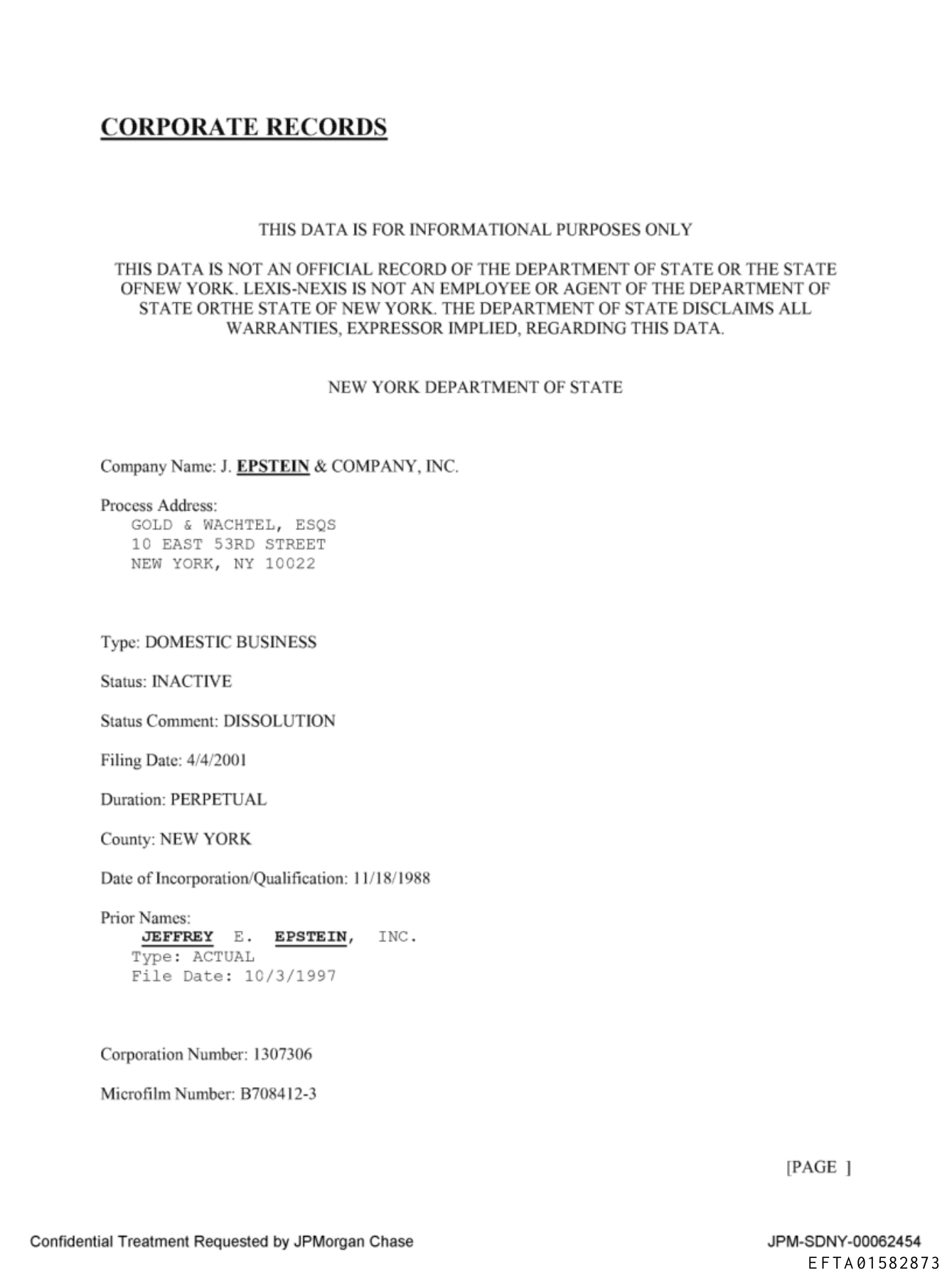
| Corporate identity | A historical Lexis-Nexis extract identifies J. Epstein & Company, Inc., New York corporation 1307306. Commercial sources do not agree on an incorporation date. |
| Office and work | A former employee described administrative, legal and accounting work at 457 Madison Avenue in Manhattan during approximately 1996–2002. |
| Clients and finances | The sources distinguish an acknowledged personal advisory relationship, bank-file biographical claims and proposed transactions. They do not supply a complete corporate client list or audited company accounts. |
| Scope | A document-led company history. The evidence appearances below identify the precise records and pages reviewed; this is not a complete search of every occurrence in the released files. |
J. Epstein & Co. is a useful starting point for examining Jeffrey Epstein’s earlier business, but the documents require several different questions to be kept separate: what a corporation was called, where people worked, whose money Epstein advised on, and which transactions actually occurred. The 2007 response to corporate subpoenas and the later Deutsche Bank biographical account describe different aspects of that history. Neither substitutes for the company’s complete filing and client records.
Key Takeaways
- Commercial records identify a New York corporation, while a separate D&B listing supplies a different incorporation date. The discrepancy is unresolved.
- In 2007, counsel said the company had executed a dissolution certificate in December 2000. Historical database extracts list a dissolution event in April 2001. Execution and filing are different events.
- Office testimony supports administrative, legal and accounting functions, but does not establish investment strategy, revenue, assets under management or a client roster.
- Wexner acknowledged employing Epstein to manage his personal finances. That statement does not identify the corporate contracting party.
- Later bank mail and email display names continued to use J. Epstein & Co. Their presence does not establish continued corporate existence or a completed investment.
The Company Name and the Corporate Record
The Lexis-Nexis corporate extract gives the name J. Epstein & Company, Inc., identifies New York corporation 1307306, and lists November 18, 1988 as its incorporation or qualification date. It records Jeffrey E. Epstein, Inc. as a prior name and an inactive status associated with an April 4, 2001 dissolution filing. Its disclaimer expressly says the information is not an official state record.
A separate Westlaw extract dated April 25, 2007 displays the same corporate identifier, name and November 18, 1988 filing date on PDF pages 14–15. Its amendment index lists a 1997 name change and a 2001 dissolution, but also contains earlier entries that the extract does not explain. These are historical database records, not a current corporate-status certificate.
The Dun & Bradstreet listing instead gives 1982 as the year started and October 18, 1982 as incorporation. It uses the shorter name J Epstein & Co Inc and classifies the business as investment consulting. It does not provide the matching New York corporation number. The available records therefore do not establish whether that date refers to the same legal entity, a predecessor business or a database error. Founding a business and incorporating a particular company are also different events.
In his December 21, 2025 public-records research essay, Thomas Volscho also distinguishes corporation 1307306 from a similarly named 1982 company, identified as 798890. He reports speaking with the latter’s attorney, who recalled a different founder. That reported interview and second-company identification have not been independently verified here; they are relevant research leads rather than a substitute for the underlying registry records.
| Record or event | Exact point supported | Important limit |
|---|---|---|
| D&B, one page | Business start 1982; incorporation October 18, 1982; 457 Madison Avenue. | A commercial business listing, including estimates. No matching state identifier. |
| Lexis-Nexis, one page | Entity 1307306; November 18, 1988 incorporation/qualification; April 4, 2001 dissolution filing. | An informational extract, expressly not the official state record. |
| Westlaw, PDF 14–15 | Same entity number; October 3, 1997 name-change entry; April 4, 2001 dissolution entry. | Also lists 1992 dissolution-by-proclamation and 1993 erroneous-entry items without explaining their relationship. |
| Lefcourt letter, June 12, 2007 | Reported December 2000 execution of a dissolution certificate. | Certificate absent; filing and effective date unproved. |
What the 2007 Response Said
In his signed June 12, 2007 response, Lefcourt distinguished J. Epstein & Co. from three other subpoena recipients: the foundation, Epstein Interests and Financial Trust. He said a dissolution certificate executed in December 2000 meant the company had no responsive documents.
The PDF contains only a letter and production inventory. It lists corporate schedules for the other entities, but none for J. Epstein & Co.; those enclosures, the subpoenas and the certificate are absent. Its assertions about unavailable records and an unresolved search are counsel’s representations, not a ruling that the production was complete.
Office, Employees and Administrative Work
Cimberly Espinosa testified that she joined J. Epstein & Co. as a legal assistant in late 1996, then assisted Maxwell until roughly summer or fall 2002. She worked mainly at 457 Madison Avenue and recalled lawyers Jeff Schantz and Darren Indyke and accounting staff Harry Beller and Eric Gany.
Her duties included filing, messages and arrangements for Maxwell. She described others handling Epstein’s money and business affairs but did not know the lawyers’ exact functions. She named no clients. On cross-examination she confirmed she had not worked from Epstein’s homes or visited Palm Beach. These were office observations, not a complete company workforce or client roster.
Clients and the Financial-Management Claim
The December 19, 2014 Deutsche Bank due-diligence email, forwarded in January 2015, describes a 1982 founding and a 1996 change to the Financial Trust name. It says the firm managed assets for clients with net worth above one billion. That is a bank-file biographical account, not an attached client register or formation instrument. The passage does not name a J. Epstein & Co. client, quantify assets entrusted to the firm or say it accepted only such clients.
A March 2018 KYC confirmation chain repeats a similar history with approximate dates. The bank sent the information to Richard Kahn, who confirmed the attached information was correct. No message in that chain is authored by Epstein. The package concerns Southern Financial’s banking relationship; its references to proposed products and banking arrangements cannot be reassigned to J. Epstein & Co.’s historical client services.
There is firmer first-person evidence of a personal advisory relationship. In his February 18, 2026 statement submitted to the House Oversight Committee, Leslie Wexner said he formally hired Epstein to manage his personal finances and gave him power of attorney. Wexner also denied knowledge of or participation in Epstein’s crimes and said the power of attorney was revoked in September 2007. This is Wexner’s account. It does not name J. Epstein & Co. as the contracting party or provide a fee agreement, so it cannot by itself establish a corporate client roster.
A client’s net worth, the assets actually managed, the adviser’s revenue and the adviser’s own wealth are different measures. None can be substituted for another. The documents reviewed here do not support a company revenue total, an assets-under-management figure, a complete list of paying clients or a claim that every correspondent was a client.
Financial Proposals Versus Completed Transactions
The FBI report of Epstein’s May 8, 2002 interview illustrates the distinction. Epstein described considering a $15 million bridge loan connected to a proposed Winstar acquisition. The report lists proposed interest, a fee and equity compensation, but also records his statement that he called the deal off after questioning the collateral documents. It does not establish that the money was advanced or the compensation paid, and it does not identify J. Epstein & Co. as the lender. The PDF contains two copies of the same four-page report, not two independent interviews.
Similarly, the October 29, 2013 financing discussion and November 1 follow-up headed Culver Studios concern a potential property investment. Michael Gargano and Anthony Barrett discussed financing and operational issues with Epstein; Epstein said he needed to think, and Gargano later asked whether he still wanted to proceed. The correspondence includes a display name referring to J. Epstein & Company, but supplies no corporate mandate or completed purchase. It should not be used to say the company acquired or operated the studio.
Bank Correspondence and Legal Continuity
Three JPMorgan checking-account cover pages for October 1–31, 2008, November 1–28, 2008 and November 29–December 31, 2008 are addressed to Epstein Interests, care of J Epstein & Co Inc, at the Villard House on 457 Madison Avenue. The care-of line is the relevant fact. It shows continued correspondence using the name, not that the corporation was the account’s legal owner or remained active in the corporate registry. Each released item reviewed here is page 1 of a longer statement; this comparison does not review its transaction-detail pages.
The bank biographies’ asserted transition to Financial Trust also requires care. A 2013 Financial Strategy Group banking application says Epstein opened Financial Trust in the Virgin Islands in 1999 after bringing an earlier consulting business there. That earlier firm is unnamed, and the package is an application for a proposed different company. It neither resolves the J. Epstein & Co. filing history nor establishes an approved bank. Detailed Financial Trust and Southern Trust material is covered in the existing Financial Trust / Southern Trust records article.
Civil-Case Index Entries
Two commercial civil-action extracts place versions of the company name in New York County Supreme Court litigation. One lists J. Epstein & Co. among the defendants in a contract action brought by Dickerson & Reilly, with an April 2, 1993 request for judicial intervention and September 16, 1998 disposition. The other entry lists J. Epstein & Company and Epstein as plaintiffs against 457 Madison Avenue Corp., with an August 30, 1995 request for judicial intervention and April 24, 1997 disposition. Both are index summaries. Neither supplies the pleadings, judgment, settlement terms or who prevailed. A request for judicial intervention is not necessarily the action’s commencement date.
Evidence Appearances
| Evidence identifier | Pages | What was checked |
|---|---|---|
| EFTA01582873 | 1 | Lexis-Nexis corporation 1307306 record; JPM-SDNY-00062454. |
| EFTA01332942 | 14–15; Bates EFTA01332955–EFTA01332956 | Complete two-page Westlaw extract within a 45-page bundle. Other bundle material is outside this review. |
| EFTA01582866 | 1 | D&B business listing; JPM-SDNY-00062446. |
| EFTA00223868 | 1–3; Bates EFTA00223868–EFTA00223870 | Lefcourt response letter and production inventory; enclosures absent. |
| DOJ-OGR-00013860 / Maxwell Document 761 | PDF 32–92; printed 2327–2387 | Espinosa’s complete testimony, including cross-examination. Office/role passages principally PDF 34–46. |
| EFTA01418996 | 1–3; biography on 2 | December 2014 EDD message, forwarded January 2015; Bates EFTA01418997 for biography. |
| EFTA01422087 | 1–6; confirmation 2, biography 3 | March 2018 Kahn confirmation chain; referenced attachments absent. |
| EFTA00128666 | 1–8; first copy 1–4 | One FD-302 reproduced twice; cancellation account at Bates EFTA00128669. |
| EFTA01488292 | 1 | October 2008 bank cover page; JPM-SDNY-00009950. |
| EFTA01488304 | 1 | November 2008 bank cover page; JPM-SDNY-00009962. |
| EFTA01488311 | 1 | Late-November–December 2008 bank cover page; JPM-SDNY-00009970. |
| EFTA01949992 | 1–4 | October 29, 2013 proposal chain; company display name on 1, Epstein’s response on 3. |
| EFTA01950382 | 1–2 | November 1, 2013 Culver Studios follow-up; decision still requested. |
| EFTA01582884 | 1 | Contract-action index 1044121993; JPM-SDNY-00062465. |
| EFTA01582886 | 1 | Real-property-action index 1213851995; JPM-SDNY-00062467. |
| EFTA00606417 | 1–22; relevant biography 18 | FSG application; EFTA00606434 contains the limited FTC history. |
What Remains Unresolved
- The official incorporation and name-change instruments reconciling the 1982 business listing with corporation 1307306’s 1988 date.
- The actual dissolution certificate referenced in 2007 and its filing history. Later use of the name does not answer that question.
- Entity-specific employment records, executed client contracts, fee invoices, audited accounts and evidence identifying the legal party to proposed investments.
- The missing attachments, statement-detail pages and transaction outcomes noted above.
This article examines the identified records rather than claiming that every company-name occurrence has been located. A person’s office role or business contact does not, by itself, establish knowledge of or participation in criminal conduct.
Sources
- Lexis-Nexis corporate-record extract: EFTA01582873, p. 1.
- Westlaw corporate-record extract dated April 25, 2007: EFTA01332942, PDF pp. 14–15.
- Dun & Bradstreet business listing: EFTA01582866, p. 1.
- Gerald Lefcourt response dated June 12, 2007: EFTA00223868, pp. 1–3.
- Deutsche Bank EDD email, December 19, 2014: EFTA01418996, pp. 1–3.
- Deutsche Bank and Richard Kahn KYC chain, March 2018: EFTA01422087, pp. 1–6.
- FBI FD-302 recording the May 8, 2002 interview: EFTA00128666, pp. 1–4; duplicate pp. 5–8.
- JPMorgan October 2008 statement cover: EFTA01488292, p. 1.
- JPMorgan November 2008 statement cover: EFTA01488304, p. 1.
- JPMorgan late-November–December 2008 statement cover: EFTA01488311, p. 1.
- October 29, 2013 correspondence: EFTA01949992, pp. 1–4.
- Culver Studios correspondence, November 1, 2013: EFTA01950382, pp. 1–2.
- New York County civil-action index extract: EFTA01582884, p. 1.
- New York County civil-action index extract: EFTA01582886, p. 1.
- Financial Strategy Group application package: EFTA00606417, biography p. 18; court Document 186-44, p. 19.
- Thomas Volscho, I. Investigating Epstein using Public Records, December 21, 2025. Original research account; reported attorney interview not independently verified.
- Maxwell trial transcript, Volume 11: testimony December 16, 2021; Document 761 filed August 10, 2022; Espinosa at printed pp. 2327–2387, PDF pp. 32–92.
- Statement of Leslie H. Wexner submitted to the House Oversight Committee, February 18, 2026, pp. 1–3, published by the Wexner Foundation.