
James R.S. Hatt: FBI Testimony, Jeffrey Epstein, the Maxwell Family and the Latvian Telecommunications Money Trail
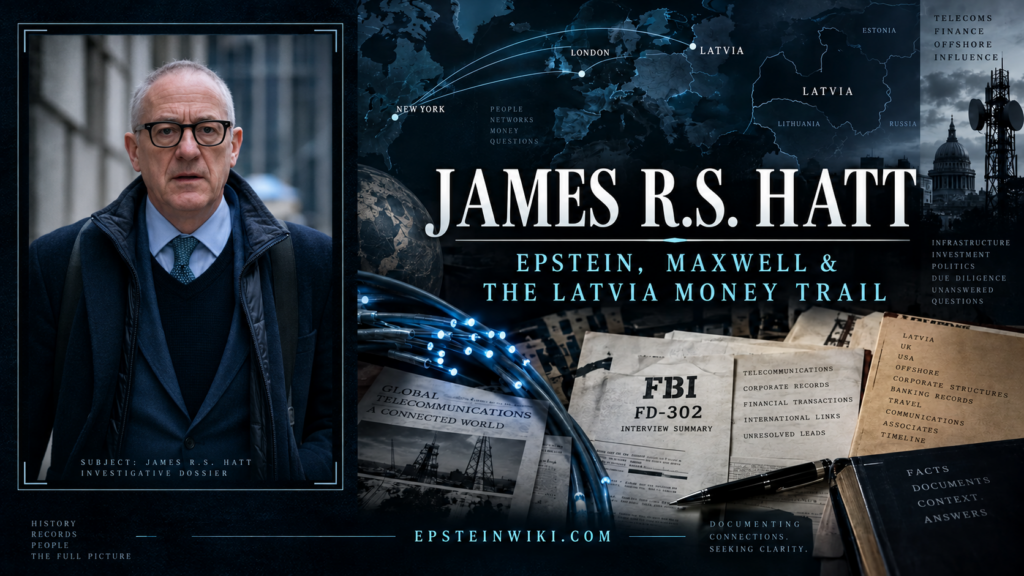
Snapshot
| Category | Information |
|---|---|
| Full Name | James R.S. Hatt |
| Professional Background | British telecommunications executive and qualified English barrister, according to his FBI account |
| Documented Companies | Cable & Wireless, PLD Telekom, Metromedia International Telecommunications |
| Geographic Connections | United Kingdom, United States, Russia, Latvia, and other international telecommunications markets |
| FBI Interview | November 30, 2020 |
| Attorney Proffer | November 11, 2020 |
| FBI Case Number | 50D-NY-3027571, Serial 627 |
| Primary Evidence | EFTA01246379 through EFTA01246385 |
| Principal Individuals | Jeffrey Epstein, Kevin Maxwell, Ghislaine Maxwell, Robert Maxwell, Grigory Luchansky |
| Additional Leads | John William Mancony, Ognyan Doynov, Anthony McFarland, Lord David Young, and other individuals requiring identity verification |
| Primary Investigative Issues | Alleged financial intermediaries, Maxwell family assets, Latvian telecommunications transactions, and alleged sexual procurement |
| Evidence Status | Documented witness statements, independently corroborated business background, unverified Epstein financial transaction allegations |
| Criminal Responsibility | The reviewed evidence does not establish criminal wrongdoing by Hatt |
Overview
James R.S. Hatt occupies an unusual place in the documentary history of Jeffrey Epstein and the Maxwell family. Unlike many figures whose names appear in address books, social correspondence, or flight records, Hatt provided federal investigators with an extended account of alleged financial relationships involving Jeffrey Epstein, Kevin Maxwell, Ghislaine Maxwell, and international telecommunications interests.
In November 2020, Hatt spoke with investigators working on the Ghislaine Maxwell case. His account included alleged financial arrangements in Latvia, connections involving Eastern European businessman Grigory Luchansky, and statements attributed to Kevin Maxwell suggesting that Epstein had a relationship with members of the Maxwell family before Robert Maxwell died in 1991.
Hatt also alleged that Ghislaine Maxwell offered to arrange sexual partners for him, including minors. His account raises serious questions about what members of the Maxwell family knew, how certain international financial relationships operated, and whether supporting documents exist outside the material publicly released.
The distinction between allegations and corroborated facts is essential. Hatt’s interview is a record of what he told investigators. It does not independently demonstrate that every financial transaction, conversation, or alleged sexual offer occurred.
Several elements of his professional history can be independently verified through corporate filings. Official Latvian records also establish that significant telecommunications privatization projects and procurement disputes occurred during the period he described. However, no banking evidence reviewed for this article establishes that Epstein controlled the specific money route alleged by Hatt.
The Federal Investigation Records
November 11, 2020: The Attorney Proffer
The first identified federal record is EFTA01246379, the November 11, 2020 attorney-call record. It summarizes information offered by attorneys David Schertler and Paola Pinto on behalf of James Hatt.
The attorneys indicated that their client wished to assist investigators in the Ghislaine Maxwell investigation.
The two-page record describes Hatt’s asserted knowledge of Maxwell family financial arrangements, Eastern European business associates, telecommunications privatization, and alleged sexual exploitation.
Individuals named in this record include Kevin Maxwell, Ghislaine Maxwell, Jeffrey Epstein, Grigory Luchansky, Ognyan Doynov, and several additional people identified as possible sources of information.
Because the document summarizes an attorney’s communication, it should be treated as a preliminary proffer. It is not a sworn deposition, a verbatim transcript, or a finding that the underlying allegations were corroborated.
November 30, 2020: The FBI Interview
The second central document is EFTA01246381, the five-page FBI interview of James Hatt. It was conducted by video conference on November 30, 2020.
The interview was attended by federal and law enforcement personnel whose names are redacted in the public copy. Hatt’s attorneys were also present.
The FBI document carries file number 50D-NY-3027571, Serial 627.
Its drafting date is July 21, 2021, while its entry date is September 14, 2021. Neither date indicates an additional interview.
The five pages carry the following production identifiers:
- EFTA01246381
- EFTA01246382
- EFTA01246383
- EFTA01246384
- EFTA01246385
The same five pages also bear earlier EFTA production stamps numbered EFTA_00092367 through EFTA_00092371. These identifiers refer to another numbering of the interview material and should not be counted as five separate witness interviews.
The FBI report is a narrative interview summary, commonly called an FD-302. It is not a verbatim transcript and expressly states that it does not contain FBI conclusions or recommendations.
James Hatt’s Professional Background
Hatt told federal investigators that he qualified as an English barrister before pursuing an international telecommunications career.
He described working for Cable & Wireless PLC during a period when telecommunications markets were changing rapidly throughout the former Soviet Union and Eastern Europe.
The Metromedia International Group proxy statement independently identifies Hatt as a senior telecommunications executive with substantial responsibilities across Europe and other international markets.
The company disclosed that he served in business development at Cable & Wireless from 1988 through January 1995, including responsibilities involving the Commonwealth of Independent States, the Baltic region, Scandinavia, and other territories.
He subsequently became a director of PLD Telekom in June 1994, chief executive officer in January 1995, and chairman in June 1995.
In September 1999, following Metromedia’s acquisition of PLD Telekom, Hatt became president and chief executive of Metromedia International Telecommunications.
These corporate records establish that Hatt was professionally positioned to know participants in major international telecommunications ventures. They do not independently confirm his Epstein allegations.
The Soviet Union and Early Telecommunications Business
Hatt described traveling to Moscow in 1988 while working for Cable & Wireless. His assignment involved evaluating international telecommunications opportunities during the transformation of Soviet markets.
The commercial environment involved Western equipment suppliers, state-owned telecommunications systems, foreign investors, and politically connected business intermediaries.
Hatt’s account places his work within this environment and describes relationships involving Alcatel, Lord David Young, and individuals developing business in Russia and the Baltic states.
Understanding this setting matters because major privatization and infrastructure projects could involve multiple categories of payments, including investments, equipment purchases, management contracts, consulting fees, and commissions.
Those categories should not be treated as interchangeable. A corporate investment is not automatically an equipment payment, and an equipment procurement commission is not automatically evidence of an improper financial transfer.
Hatt’s Introduction to Kevin and Ghislaine Maxwell
Hatt told investigators that he was introduced to Kevin and Ghislaine Maxwell in London during 1993.
He attributed the introduction to John William Mancony, whose surname is also rendered Manconi in some reporting.
Hatt described Mancony as a Canadian business contact associated with Alcatel.
According to the interview, the introduction occurred at a residence in Chelsea, London.
Hatt said Kevin Maxwell maintained business relationships inherited or developed through the wider international contacts of Robert Maxwell.
He described these relationships as particularly important for dealings with Grigory Luchansky, who operated within international business networks involving former Soviet territories.
The released FBI interview does not establish that Epstein attended this first meeting.
Grigory Luchansky and Nordex
Grigory Luchansky, also known through alternative transliterations including Grigori Loutchansky, is a central individual in Hatt’s account.
Hatt described Luchansky as an important business figure whose relationships were valuable in developing telecommunications opportunities.
The November 2020 interview associates him with a Vienna-based enterprise described in passages as Novex or Nordex.
Those spelling variations require documentary resolution. A researcher cannot automatically assume that every similarly named entity is the same registered company or that every reference describes the same transaction.
The investigation must distinguish the individual businessman, the legal entities associated with him, and the particular contracts allegedly under negotiation.
Independent reporting by Maureen Tkacik in The American Prospect provides additional background on Luchansky, Nordex, the Maxwell family, and the connections described in Hatt’s records.
That reporting is a secondary investigative source. Its discussion of the FBI material does not constitute a separate witness corroboration of Hatt’s underlying allegations.
Ognyan Doynov and Other Business Intermediaries
The November 11 attorney proffer identifies Ognyan Doynov in connection with Kevin Maxwell, Grigory Luchansky, and the alleged Latvian privatization activity.
Independent reporting places Doynov in the wider circle of business relationships associated with Nordex and the Maxwell family.
However, the released attorney-call notes do not establish the exact legal entity he represented, the contractual authority he possessed, or any identified payment made to him in the alleged Epstein transaction.
Any financial attribution requires original registration records, contracts, payment instructions, or contemporaneous correspondence.
Other names appearing in the federal materials include Gerald Ronson, John Manton, and Anthony McFarland. Their appearance in the record should be treated as a lead requiring identification and corroboration, not as proof of participation in an offense.
The Alleged Financial Arrangement in Latvia
One of the most consequential sections of Hatt’s FBI interview concerns a proposed financial arrangement associated with telecommunications development in Latvia.
In the original FBI interview, Hatt described a situation in which funds apparently needed to be supplied or presented through two different sources.
His account referred to Alcatel, Kevin Maxwell, Grigory Luchansky, and Jeffrey Epstein.
Hatt also mentioned an individual identified only as Gary in relation to a shareholder issue. The public record does not reliably establish Gary’s full name or whether the reference concerns one of the other people named in the interview.
According to Hatt, Epstein’s financial network in New York was discussed as a means of moving funds associated with the transaction.
The report describes a proposed movement of money through Epstein-related arrangements and ultimately toward Latvian accounts.
However, it does not provide the account numbers, dates, payment amounts, financial institutions, contractual purposes, or final beneficiaries necessary to reconstruct a verified money trail.
Hatt described attending discussions about money, but also stated that Kevin Maxwell sometimes asked him to leave while Kevin and Ghislaine spoke privately.
That distinction limits the scope of what Hatt could personally observe.
The released evidence establishes that Hatt made these claims. It does not establish that Epstein received the funds, that the transfers occurred, or that a money laundering offense was committed.
The Official Latvian Telecommunications Privatization
Latvia’s telecommunications modernization history is independently documented in government and parliamentary records.
The Latvian Cabinet decision of December 21, 1993 approved Tilts Communications, a consortium associated with Cable & Wireless and Telecom Finland, following an international telecommunications competition.
Latvia subsequently entered an agreement concerning Lattelekom under which the Latvian state retained 51 percent of the company while Tilts Communications held 49 percent.
The government agreement was concluded on January 11, 1994.
This privatization became the subject of extensive political and parliamentary controversy concerning management arrangements, pricing, equipment procurement, and contractual responsibilities.
The official history overlaps with the professional environment and period described by Hatt.
Nevertheless, no original record reviewed here demonstrates that his alleged Alcatel, Maxwell, Nordex, and Epstein transaction was the same legal transaction as the Tilts Communications privatization.
That relationship remains to be established.
The Parliamentary Investigation of Lattelekom
On April 20, 2000, Latvia’s official publication Latvijas Vēstnesis published the parliamentary investigation concerning Tilts Communications and Lattelekom.
The committee criticized various provisions of the 1994 agreement, questioned the allocation of management authority, and raised concerns about procurement and the financial consequences for Latvia.
The committee recommended that materials be submitted to prosecutorial authorities for further examination of contractual and financial questions.
These findings are important because they provide independent, contemporaneous governmental scrutiny of the telecommunications project rather than merely retrospective reporting.
However, the parliamentary report should not be described as an investigation that established Epstein’s involvement. The identified findings concern the Latvian telecommunications arrangements themselves.
The $7.29 Million Procurement Commission Finding
The Latvian parliamentary report records approximately $7.29 million in agency fees paid to Tilts Communications during 1994 through 1997.
Those fees related to equipment procurement arrangements and contractual provisions permitting certain commissions.
Parliamentary investigators questioned whether the necessary commercial justifications had been adequately demonstrated, including whether claimed equipment discounts supported the payments.
The report also discussed a contractual fee arrangement connected to equipment purchasing and broader concerns about the consortium’s financial incentives.
This establishes a documented historical procurement controversy.
It does not establish that the $7.29 million was paid to Epstein, Nordex, Kevin Maxwell, or any other person named in Hatt’s interview.
To test the potential relationship, researchers would need the underlying payment ledger, equipment invoices, adviser contracts, and bank remittance records.
Alcatel Equipment and Procurement
Alcatel appears in both Hatt’s account and the history of Latvia’s telecommunications modernization.
Official Latvian records describe installation of Alcatel telephone exchanges, while the parliamentary investigation also discussed technical problems affecting Alcatel payphones.
The parliamentary material describes additional expenses arising from equipment problems and the replacement of some installations.
These records establish Alcatel’s commercial connection to the modernization program.
They do not identify Epstein as an equipment supplier, agent, recipient of commissions, or financial intermediary.
The remaining question is whether the particular Alcatel transaction described by Hatt can be identified among the original supply agreements or whether it concerned another project.
The HanzaTel Consortium
The Latvian government tender decision also identifies HanzaTel as another participant in the international bidding process.
Its existence creates a separate avenue for reviewing contemporary commercial proposals, equipment suppliers, financial advisers, and alternative structures considered by the Latvian government.
HanzaTel should not be linked to Epstein, Maxwell, or Nordex without documentary evidence.
Did Kevin Maxwell Know Epstein Before 1991?
Hatt’s account raises a significant chronological question about the origins of Jeffrey Epstein’s association with the Maxwell family.
According to the FBI summary, Hatt said Kevin Maxwell knew Epstein around 1988 through 1990 while living in New York.
Hatt further attributed to Kevin a statement that Robert Maxwell had instructed him to meet Epstein.
The account also states that Robert Maxwell did not personally meet Epstein.
This distinction matters because it describes an alleged indirect financial relationship rather than evidence of personal meetings between Robert Maxwell and Epstein.
Hatt did not establish through firsthand observation that the original introduction occurred.
The allegation therefore requires corroboration through contemporaneous correspondence, diaries, banking documents, appointment records, or independently authenticated testimony.
The dates are particularly important because Robert Maxwell died in November 1991.
Competing Accounts of the Maxwell Introduction
The chronology described by Hatt conflicts with other public accounts of how Ghislaine Maxwell became acquainted with Epstein.
Ghislaine has described an introduction through a separate social connection and disputed claims involving a prior business relationship between her father and Epstein.
Kevin Maxwell has also challenged allegations concerning Maxwell family financial arrangements with Epstein.
These competing accounts should be presented together.
A denial does not automatically disprove Hatt’s account, but the presence of an FBI interview does not establish that his version is correct.
Contemporaneous independent records are required to resolve the disagreement.
The New York Daily News and Maxwell Family Finances
Hatt’s interview associates alleged Epstein-held funds with the wider Maxwell family financial crisis and the New York Daily News.
Following Robert Maxwell’s death, the family’s business empire faced extensive financial investigations, insolvency proceedings, and litigation.
Hatt claimed that Epstein had been entrusted with money and that Kevin Maxwell subsequently sought access to funds while dealing with financial restrictions.
The allegation is particularly significant because it suggests that Epstein’s possible financial relationship with the Maxwell family may have existed independently of his later personal relationship with Ghislaine.
In The American Prospect’s February 2026 investigation, Maureen Tkacik examined Hatt’s account alongside the newspaper’s ownership history and the financial circumstances surrounding the Maxwell empire.
The reporting raises questions worthy of further documentary examination.
However, neither the known Maxwell pension scandal nor Hatt’s interview independently establishes an identifiable transfer of newspaper assets to Epstein.
The necessary evidence would include corporate ledgers, bank account statements, insolvency filings, trustee records, and contemporaneous correspondence.
Ghislaine Maxwell’s Alleged Role in Business Communications
Hatt described Ghislaine Maxwell as participating in meetings and communications involving Kevin Maxwell.
He said she traveled between New York and London and, on some occasions, acted as a contact through whom information or instructions were conveyed.
According to Hatt, Kevin was concerned about telephone surveillance and preferred certain conversations to take place in person.
Hatt’s account suggests that Ghislaine was involved in some discussions concerning Luchansky and business arrangements.
The released record does not establish her formal corporate authority, signatory rights, control of bank accounts, or receipt of particular payments.
Her involvement in the meetings described by Hatt therefore remains a witness claim requiring independent corroboration.
The September 1995 Sexual Procurement Allegation
Hatt told investigators that Ghislaine Maxwell offered to arrange sexual partners for him during a September 1995 lunch on New York’s Upper East Side.
He alleged that the proposed partners included adults and minors.
The FBI summary identifies Kevin Maxwell as present and also refers to another woman named Lucy Clive.
Hatt stated that he declined the offer.
He further alleged that similar offers occurred on multiple occasions.
The records document a serious allegation, but the interview does not include an independently verified reservation record, contemporaneous communication, supporting witness statement, or evidence that any minor was supplied in connection with the described encounter.
Hatt also disclosed that he had experienced sexual abuse during childhood. This sensitive information should be handled respectfully, without treating his personal history as proof or disproof of the allegation.
Anthony McFarland and Additional Procurement Allegations
The attorney proffer refers to Anthony McFarland, with a variant spelling of MacFarland, in connection with allegations concerning young people and businessmen from Russia or Latvia.
The public record does not establish the individual’s full identity, an exact transaction, or independent witness corroboration.
Because serious allegations are involved, no unrelated person sharing a similar name should be associated with them without reliable identification.
General Ivanov and Allegations Involving Ukraine
The attorney proffer also references an individual described as General Ivanov in connection with statements allegedly made by Kevin Maxwell.
The allegations concern young people allegedly brought from Ukraine into Russia and possible sexual exploitation.
The record provides insufficient information to establish a reliable identity, identify potential victims, or corroborate the specific events.
These statements must remain classified as unverified allegations rather than documented trafficking findings.
Jan Stenbeck and the Swedish Telecommunications Reference
Hatt also described claims involving a Swedish businessman operating in media and telecommunications.
The American Prospect investigation identifies Jan Stenbeck in this context and discusses allegations attributed to Hatt concerning women from Russia.
Crucially, that investigation states that it found no evidence that the associated media company had been accused of the alleged trafficking conduct.
That limitation must accompany any discussion of Stenbeck or companies connected to him.
The allegation remains insufficiently corroborated for a finding of criminal conduct.
Telemund, Fiber-Optic Transactions, and Nigeria
The final page of Hatt’s FBI interview discusses his later contact with Kevin Maxwell.
Hatt described a New York business called Telemund, transactions involving fiber-optic cable, and a request involving the disposal of assets in Nigeria.
The records suggest that business contact between Hatt and Kevin Maxwell continued well beyond the original Latvian discussions.
However, the legal identity of Telemund, its historical ownership, and the particular Nigerian assets have not been established through the source records reviewed.
The reported request concerning Nigeria is a witness recollection and should not be characterized as proof of concealment, unlawful asset transfers, or trafficking.
Metromedia and Hatt’s Subsequent Business Dispute
Hatt’s executive career is independently documented in Metromedia’s corporate disclosures.
These records identify his senior positions, employment terms, and involvement in the group’s international telecommunications operations.
The company disclosed an earlier PLD employment agreement with a $390,000 annual base salary and a proposed Metromedia agreement with a $425,000 base salary.
It also disclosed a 1999 grant involving 500,000 stock options.
These are historical corporate compensation figures, not evidence of Epstein-related payments.
In 2001, Forbes reported on a severance lawsuit involving Hatt and Metromedia. The article also discussed questions Hatt raised concerning management fees associated with business interests connected to John Kluge and Stuart Subotnick.
That lawsuit represents a distinct corporate dispute.
It does not establish financial misconduct by the executives involved or a link to Epstein.
The original complaint, docket, exhibits, and disposition remain useful records for reconstructing Hatt’s later corporate history.
Political, Royal, and Social Connections Mentioned in the Interview
Hatt’s FBI interview includes descriptions of possible introductions, meetings, and social events involving prominent individuals.
Those named include Bill Clinton, Sarah Ferguson, and then Prince Charles.
One proposed meeting involving Bill Clinton is specifically described as not having occurred.
Other references concern reported social access and events involving Luchansky’s wider network.
These statements do not establish criminal involvement, knowledge of abuse, or participation in improper financial transactions by the individuals mentioned.
Any particular meeting must be independently verified before inclusion in a documented relationship chronology.
Contradictions and Chronology Problems
Several inconsistencies in Hatt’s account require additional attention.
The New York Timeline
The FBI summary describes Hatt moving to New York in 1996, while other passages refer to meetings in New York during approximately 1993 or 1994.
Another passage describes September 1995 as his first New York encounter with Ghislaine Maxwell.
These statements may reflect inaccuracies in dates, distinctions between travel and residence, or compression in the interview summary.
They should not be resolved through speculation.
Nordex and Novex
The record contains different spellings of what may be company names associated with Luchansky.
The correct legal identities should be confirmed using corporate filings and contemporaneous records.
The Unidentified Gary
Hatt’s account describes a person identified only as Gary in the context of a shareholder problem.
No verified surname or company role has been established.
Disputed Maxwell Chronology
The alleged early financial relationship between Kevin Maxwell and Epstein conflicts with other descriptions of when the Maxwell family’s Epstein connections began.
Contemporaneous records rather than retrospective recollections are required to establish a reliable chronology.
Witness Knowledge Versus Secondhand Statements
Hatt described firsthand attendance at some meetings but attributed several significant claims to information Kevin Maxwell allegedly provided.
Repeated publication of those claims does not convert them into independently established facts.
Epstein Data Wiki and Cross-Reference Review
The Epstein Data Wiki is an additional research resource for checking people, relationships, document references, and related investigations.
A targeted public search did not establish a separately indexed James Hatt profile in that wiki. However, this does not prove that the site’s complete corpus lacks references to Hatt, his associates, or relevant financial records.
The spelling variations of Hatt’s associated individuals and companies make broader document searches necessary.
Relevant search terms include James Hatt, James R.S. Hatt, Kevin Maxwell, Grigory Luchansky, Grigori Loutchansky, Nordex, Novex, John William Mancony, Ognyan Doynov, Alcatel, PLD Telekom, and Lattelekom.
Any additional evidence found through this process should be linked to its exact document identifier. No new EFTA reference should be presented as verified without inspecting the underlying record.
Independent Investigative Reporting
The American Prospect Investigation
In February 2026, Maureen Tkacik published an investigation examining Jeffrey Epstein, the New York Daily News, the Maxwell family, and James Hatt’s FBI account.
The article provides an important independent journalistic treatment of Hatt’s allegations, places them within the financial history of the Maxwell family, and identifies historical business relationships requiring closer review.
Its interpretation should be distinguished from the original federal records and from independently authenticated financial evidence.
EpsteinWiki’s Existing Document Analysis
The existing EpsteinWiki analysis of EFTA01246381 documents the interview dates, page identifiers, witness allegations, and limitations of the FD-302.
This investigation expands that source-level entry into a broader biographical and financial examination. The document article and this investigation should remain distinct but linked.
Watch Our Sleuths Investigate
EpsteinWiki’s established independent sleuth contributors remain a priority for cross-reference research.
Targeted public searches did not confirm an original James Hatt investigation or a directly relevant YouTube video from the contributors examined during this revision.
Accordingly, no article or video is attributed to a sleuth without a verified, directly matching publication link.
This section should be updated when original contributor reporting can be confirmed and traced to specific evidence documents.
Evidence Register
| Evidence | Description | Status |
|---|---|---|
| EFTA01246379 | Attorney proffer, November 11, 2020, first page | Federal record |
| EFTA01246380 | Attorney proffer, second page | Federal record |
| EFTA01246381 | Hatt FBI interview, page 1 | Federal record |
| EFTA01246382 | Hatt FBI interview, page 2 | Federal record |
| EFTA01246383 | Hatt FBI interview, page 3 | Federal record |
| EFTA01246384 | Hatt FBI interview, page 4 | Federal record |
| EFTA01246385 | Hatt FBI interview, page 5 | Federal record |
| Metromedia filings | Employment and corporate background | Independent corroboration |
| Latvian Cabinet decision | 1993 telecommunications tender | Official government record |
| Latvian parliamentary report | Lattelekom contracts and procurement fees | Official parliamentary findings |
| Banking transactions | Alleged Epstein-related transfers to Latvia | Not independently established |
Outstanding Questions for Investigators
Was the Alleged Latvian Money Route Ever Used?
The released records contain no complete transaction history. Identifying the underlying contracts and payments remains the central financial question.
Who Was Gary?
The individual’s identity and relationship to the alleged shareholder issue remain unresolved.
What Were the Exact Roles of Nordex and Alcatel?
Original corporate records, supplier agreements, and related payment documentation are required before a particular transaction can be attributed to either company.
Did Maxwell Family Funds Reach Epstein Before 1991?
Contemporaneous bank statements, correspondence, and insolvency records are required to test Hatt’s account of an early financial relationship.
Did the FBI Pursue Hatt’s Leads?
No complete follow-up investigative disposition has been established from the released records reviewed for this article.
Potential supplemental FBI interviews, exhibits, financial analysis, and investigative correspondence remain important missing records.
Can the Sexual Procurement Allegations Be Independently Corroborated?
The alleged September 1995 encounter and other claims require reliable witness or documentary corroboration. Any potentially identifying victim information must remain protected.
Evidence Preservation and Investigative Standards
A federal referral should distinguish original evidence from analytical conclusions.
Each source document should be preserved with its original filename, source location, acquisition time, cryptographic hash, and page-level reference.
Claims should be classified according to whether they represent direct observations, statements attributed to another person, contemporary documentary records, or retrospective journalistic interpretations.
Apparent contradictions should remain visible rather than being edited out.
Corporate names should be matched using historical registration records and legal identities, not merely similar spellings.
Financial transactions should not be described as proven money laundering unless the underlying transfers and legally relevant facts are substantiated.
These procedures provide a basis for an auditable investigative referral but do not guarantee admissibility or substitute for official law enforcement evidence collection.
Conclusion
James R.S. Hatt’s account deserves continued scrutiny because it connects several investigative questions that otherwise appear in separate parts of the Epstein record.
He described a possible financial relationship between Jeffrey Epstein and the Maxwell family before Robert Maxwell’s death, an alleged payment arrangement associated with telecommunications business in Latvia, and meetings in which Ghislaine Maxwell allegedly played a role in communications between business participants.
He also reported alleged sexual procurement offers that raise separate questions requiring careful, survivor-centered investigation.
Independent records support his professional background and demonstrate that significant telecommunications privatization and procurement disputes occurred in Latvia during the relevant period.
However, those records do not yet prove that the alleged Epstein financial transfers occurred or that the questioned Latvian commissions were connected to the individuals identified in Hatt’s account.
The value of this investigation lies in identifying specific, testable claims and the original records needed to evaluate them.
Until those missing financial, corporate, and witness records are produced, the allegations should remain identified as allegations. The existing documentary evidence warrants continued investigation, not an unsupported conclusion of criminal liability.
Sources
- U.S. Department of Justice, November 11, 2020 James Hatt attorney proffer, EFTA01246379 through EFTA01246380.
- Federal Bureau of Investigation, November 30, 2020 interview of James Hatt, EFTA01246381 through EFTA01246385.
- EpsteinWiki, source-level analysis of the James Hatt FBI interview.
- Epstein Data Wiki, research directory and cross-reference resource. No directly matching Hatt article was confirmed during the targeted review.
- Metromedia International Group, 2000 proxy statement and executive disclosures.
- Latvian Cabinet, December 21, 1993 decision concerning the telecommunications modernization tender.
- Latvian parliamentary investigation, April 2000, concerning Tilts Communications and Lattelekom.
- Maureen Tkacik, The American Prospect, February 26, 2026, investigation involving Epstein, Maxwell family finances and the New York Daily News.
- Forbes, May 2001, reporting concerning Metromedia and James Hatt’s corporate dispute.
- United States Department of Justice, Epstein Library search.