
Howard Rubenstein: Jeffrey Epstein’s Crisis Publicist and the Machinery of Reputation Defense
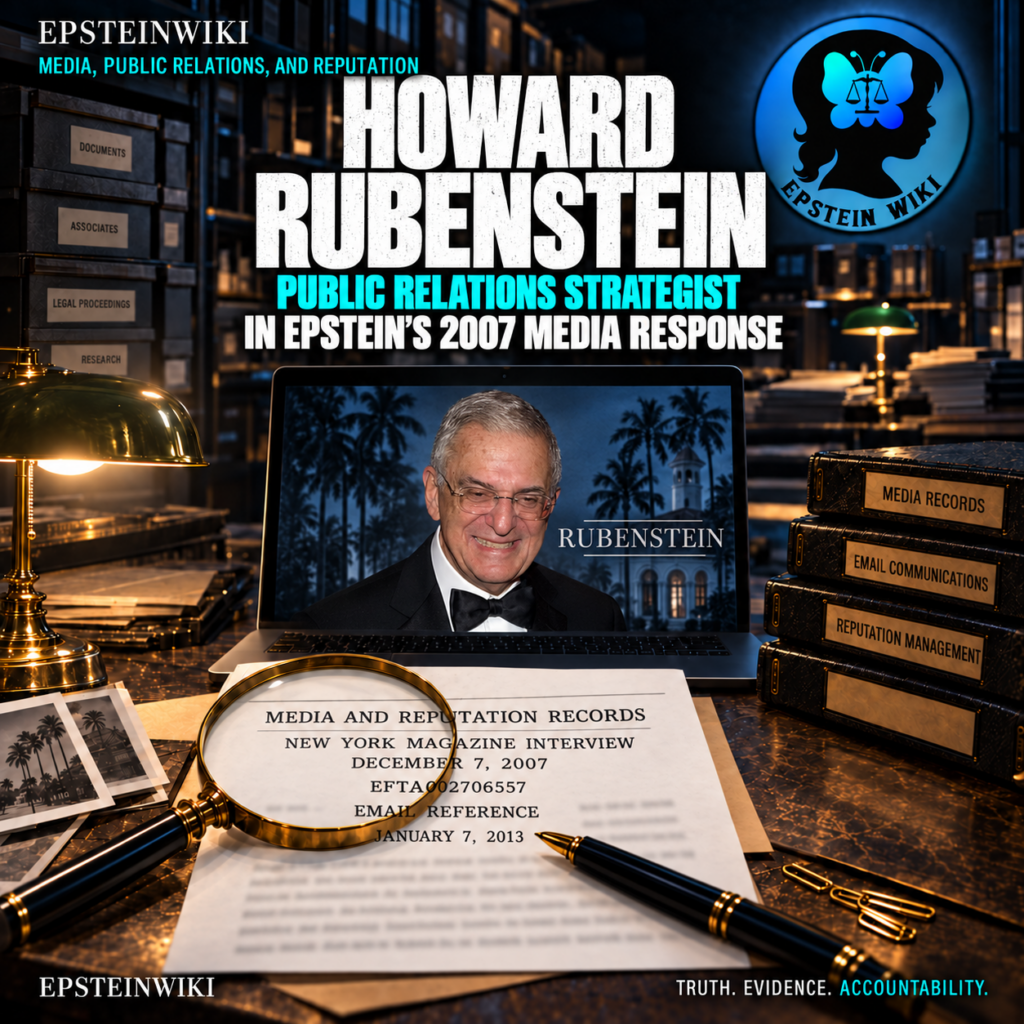
Snapshot
| Field | Detail |
|---|---|
| Full name | Howard Joseph Rubenstein |
| Born | February 3, 1932, Brooklyn, New York |
| Died | December 29, 2020, Manhattan, New York, age 88 |
| Profession | Public relations executive and lawyer |
| Firm | Rubenstein Associates, later known as Rubenstein Communications |
| Epstein connection | Paid publicist and spokesman during the Palm Beach criminal case, plea negotiations, guilty plea, and incarceration period |
| Confirmed service period | Publicly documented by August 2006 and continuing into 2009; Rubenstein wrote on October 9, 2009, that his firm was “no longer working for Jeffrey” |
| Confirmed payments | Eight payments of $25,000 from Epstein accounts to Rubenstein Associates between October 2007 and June 2008, totaling $200,000 |
| Most consequential documented conduct | Managed press access and messaging, commented on the expected plea, attacked survivor Maximilia Cordero’s credibility, denied an Epstein business relationship with Jean-Luc Brunel and MC2, and relayed information involving Epstein and JPMorgan |
| Criminal status | No criminal charge or adjudicated finding of participation in Epstein’s sexual abuse or trafficking |
| Evidentiary caution | Several serious claims about Rubenstein appear in civil pleadings and witness disclosures. Those filings show what litigants alleged, not what a court proved |
Howard Rubenstein was one of New York’s most influential public relations executives. He became Jeffrey Epstein’s paid crisis publicist while Epstein faced a criminal investigation involving the sexual abuse of minors. The surviving record does not place Rubenstein inside Epstein’s sexual abuse operation. It does show that he helped Epstein manage the public consequences of that operation: he fielded reporters, arranged or supervised access, helped frame Epstein’s image, issued denials, commented on the anticipated plea, and publicly attacked the credibility and motives of a woman who said Epstein had abused her when she was sixteen.
The relationship was commercial, not merely social. A court filing based on JPMorgan records identifies eight $25,000 payments from Epstein-controlled accounts to Rubenstein Associates between October 2007 and June 2008. The total was $200,000. An October 2009 email from Rubenstein states that his firm was no longer working for Epstein, confirming both a prior engagement and its termination by that date.
The central accountability question is therefore not whether Rubenstein committed Epstein’s crimes. The available evidence does not establish that. The question is how an elite reputation professional used access, media relationships, and strategic language to defend a wealthy client accused of exploiting girls, and how that work affected survivors’ ability to be heard and believed.
Key Findings
| Finding | Evidence level | Basis |
|---|---|---|
| Rubenstein was Epstein’s publicist and spokesman | Confirmed | Contemporary news coverage, correspondence, court records, and Rubenstein’s own email |
| Epstein paid Rubenstein Associates at least $200,000 in eight equal installments | Confirmed by records summarized in a filed court exhibit | JPMorgan account records cited in EFTA02815839, with underlying payment directives and statements |
| Rubenstein participated directly in shaping press coverage | Confirmed | New York magazine’s reporter met Epstein in Rubenstein’s office with Rubenstein present; documents show controlled comments during plea negotiations |
| Rubenstein publicly attacked Maximilia Cordero’s credibility | Confirmed | The published article and the New York appellate decision quote him calling the information “shocking” and describing Epstein as a target of “money-seeking lawyers and their women” |
| Rubenstein denied that Epstein had a business relationship with Jean-Luc Brunel or MC2 | Confirmed as a public statement | Contemporary New York Post report preserved in multiple records |
| That denial conflicted with evidence that Epstein supported MC2 financially | Strong documentary conflict | A $1 million standby letter of credit in Epstein’s name supported an MC2-related loan, according to JPMorgan litigation records |
| The US Virgin Islands alleged that Rubenstein “lied for Epstein” | Confirmed as an allegation, not a finding | USVI filings including EFTA02813393 |
| JPMorgan disputed the USVI’s inference | Confirmed | JPMorgan’s response, EFTA02814855, challenged the proposed inference and admissibility |
| Federal prosecutors noticed that Rubenstein represented both Epstein and the New York Post | Confirmed | June 2008 internal prosecution email in EFTA00013882, EFTA00180159, and EFTA00214426 |
| Civil plaintiffs identified Rubenstein as a possible witness with relevant knowledge | Confirmed as litigants’ position | Witness lists and interrogatory responses, including EFTA00725731, EFTA00725932, and EFTA02760798 |
| A reviewed deposition transcript for Rubenstein has not been located | Not found in the reviewed corpus | One scheduled deposition was expressly canceled in EFTA02770453 |
| Rubenstein traveled on Epstein’s aircraft or visited Epstein’s island | Not established | No reviewed flight record or reliable source places him on an Epstein aircraft or at Little Saint James |
Identity and Name Disambiguation
This article concerns Howard Joseph Rubenstein, the New York public relations executive who founded Rubenstein Associates in 1954. It does not concern David Rubenstein, the Carlyle Group cofounder; Dr. Howard Rubenstein, a former Alabama mayor; or other people with the same surname.
Rubenstein earned a bachelor’s degree from the University of Pennsylvania and a law degree from St. John’s University. Although trained and admitted as a lawyer, he did not appear in the Epstein matter as criminal defense counsel. The records identify him as Epstein’s publicist, spokesman, or public relations representative. Epstein’s legal defense was handled by attorneys including Gerald Lefcourt and other members of what the press called his defense team.
That distinction matters. Rubenstein’s role was not to file motions or negotiate in court under his own name. His role was to shape the information environment around the case.
Career, Influence, and Institutional Reach
Rubenstein began his firm in 1954 at his parents’ kitchen table in Brooklyn. Over the following decades, he built a practice deeply embedded in New York’s business, political, cultural, real estate, sports, and media establishments. His firm represented or advised clients that included News Corp, the New York Yankees, Columbia University, the Metropolitan Opera, the New York Philharmonic, the Archdiocese of New York, major property developers, and prominent public figures.
The firm’s own history describes work involving strategic counsel, issues management, corporate reputation, media relations, and narrative construction. Rubenstein’s influence came from the combination of long-standing personal relationships and his ability to move between institutions that ordinarily appear separate: private clients, newspapers, elected officials, civic groups, cultural organizations, and corporate leaders.
This background is directly relevant to the Epstein engagement. Epstein did not retain an unknown press agent. He hired a practitioner whose value rested on credibility with reporters, access to editors and publishers, discretion, and an unusually dense New York network. When Rubenstein spoke on Epstein’s behalf, he spoke with the institutional authority accumulated over more than five decades.
Nothing about Rubenstein’s work for unrelated clients makes those clients responsible for Epstein. The significance is structural: Epstein purchased access to an elite reputation-defense system at the moment survivors and law enforcement were trying to make his conduct public.
Documented Relationship with Jeffrey Epstein
The public record establishes an active professional relationship, but it does not disclose the original engagement letter, its complete scope, or every employee assigned to the account.
By August 9, 2006, the New York Post described Rubenstein as Epstein’s spokesman while reporting on the expanding legal and public relations team assembled after the Palm Beach investigation became public. Rubenstein declined comment. The preserved report appears in EFTA00723522.
By November 2006, Rubenstein was also carrying information between Epstein and JPMorgan personnel. An internal JPMorgan email said Rubenstein had called Barry Berger, relayed that Epstein considered Berger “brilliant,” and discussed whether Epstein was currently a private-bank client. The record, EFTA02816319, does not show that Rubenstein controlled any banking decision. It does show that his role could extend beyond answering reporters and into relationship management around Epstein.
During 2007 and 2008, the record becomes much denser. Rubenstein commented on Epstein’s anticipated plea, sat in on a major magazine interview, responded to the civil allegations of Maximilia Cordero, denied an Epstein business relationship with MC2, and received recurring payments from Epstein accounts.
On October 9, 2009, Rubenstein forwarded a New York Daily News request to Epstein attorney Darren Indyke and wrote: “Since we are no longer working for Jeffrey, I’m forwarding this Daily News request to you so you can handle it as you see fit.” That message appears in HOUSE_OVERSIGHT_030999 and duplicate productions. It establishes that the engagement had ended by that date. It does not establish the exact termination date or reason.
Timeline
| Date | Event | Significance |
|---|---|---|
| August 9, 2006 | Rubenstein identified publicly as Epstein’s spokesman | Earliest reviewed public confirmation of the engagement |
| November 15, 2006 | JPMorgan email records a call from Rubenstein relaying Epstein’s view of a banker and discussing client status | Shows relationship-management activity beyond reactive press work |
| September 6, 2007 | Rubenstein declines comment on Epstein’s hiring of Ken Starr | Confirms continuing press role during criminal defense escalation |
| October 6, 2007 | Rubenstein tells the New York Post that Epstein had no business relationship with Jean-Luc Brunel or MC2 | Later challenged by documentary evidence of Epstein’s financial support for MC2 |
| October 15, 2007 | First identified $25,000 payment in the eight-payment series | Start of the confirmed payment sequence |
| October 23, 2007 | New York Post quotes Rubenstein attacking Maximilia Cordero’s credibility and motives | Direct example of survivor-directed reputation defense |
| November 8, 2007 | Epstein’s lawyers describe Rubenstein’s authorized Palm Beach Daily News comment about resolution and no trial | Shows controlled messaging around the secret non-prosecution agreement |
| December 7, 2007 | New York magazine publishes its account of interviewing Epstein in Rubenstein’s office | Direct observation of Rubenstein participating in image framing |
| June 3, 2008 | Federal prosecutor flags Rubenstein’s simultaneous role for Epstein and the New York Post | Documents government concern about overlapping representation |
| June 27, 2008 | Eighth identified $25,000 payment | Confirmed total reaches $200,000 |
| June 25, 2009 | Palm Beach Daily News reports that Rubenstein confirmed Epstein as the principal investor in a failed Bear Stearns fund | Continued spokesman activity after Epstein’s conviction and during incarceration |
| October 9, 2009 | Rubenstein writes that the firm is no longer working for Epstein | Latest clear boundary marker for the engagement |
| January 2012 | A noticed Rubenstein deposition is canceled | No testimony should be inferred from the witness notices alone |
| January 2013 | A correspondent asks Epstein about Rubenstein because Epstein had worked with him “in the past” | Later corroboration that the engagement was understood as historical |
| 2023 | USVI and JPMorgan litigate the meaning of Rubenstein’s MC2 denial | The conflict enters a major bank-liability case but is not adjudicated at trial |
Crisis Communications During the Palm Beach Case
Epstein’s public relations problem was inseparable from his legal problem. Police had identified multiple girls, some underage, who described a recurring pattern of paid massages that became sexual. Epstein’s lawyers were seeking a resolution that would minimize both punishment and public exposure. A crisis publicist could not determine the legal outcome, but could influence how reporters, potential witnesses, business contacts, and the broader public interpreted the case.
The surviving materials show several recurring techniques:
| Technique | Documented example | Likely communications purpose |
|---|---|---|
| Controlled silence | “No comment” responses about defense-team developments | Avoid creating discoverable or contradictory public statements while keeping a recognized spokesman in place |
| Resolution framing | Confirmation that the matter was resolved and would not go to trial | Present the anticipated agreement as settled and orderly before its terms were publicly examined |
| Character and status framing | Hosting or supervising a magazine interview centered on Epstein’s intellect, friends, and lifestyle | Shift attention from survivors and conduct to personality, power, and exceptionalism |
| Accuser discrediting | Statements about Maximilia Cordero and “money-seeking lawyers” | Recast an abuse allegation as opportunism |
| Categorical denial | Statement that Epstein had no business relationship with Brunel or MC2 | Distance Epstein from a modeling-agency relationship drawing scrutiny |
| Relationship management | Contact with JPMorgan personnel on Epstein’s behalf | Reinforce Epstein’s standing with an important institution |
These functions do not require a publicist to prove a client innocent. They can work by narrowing what becomes news, supplying alternative frames, attacking a claimant’s motive, and using the publicist’s own credibility as a buffer.
Messaging Around the Secret Non-Prosecution Agreement
The federal non-prosecution agreement negotiated in South Florida was signed in September 2007 but kept from survivors while federal prosecutors and Epstein’s lawyers worked toward a state resolution. A November 8, 2007 letter from Kirkland & Ellis attorney Jay Lefkowitz discussed press coverage and represented that the only recent comment to the media had been Rubenstein’s confirmation to the Palm Beach Daily News that the matter had been resolved and would not go to trial.
The letter said the comment was authorized after concern arose that prosecutors might think Epstein would not honor the agreement. Copies appear in EFTA00013698, EFTA00176105, EFTA00176798, EFTA00189922, EFTA00214863, EFTA00214866, EFTA00230208, EFTA01659907, and EFTA01729176.
This evidence is important but should not be overstated. It does not show that Rubenstein negotiated or drafted the non-prosecution agreement. It does show that he delivered a carefully authorized public message during the negotiation and implementation of an agreement whose secrecy later became central to survivors’ legal challenge.
Rubenstein also declined comment as Epstein expanded his legal team. Reports concerning Ken Starr and plea negotiations survive in EFTA01480564, EFTA01481462, EFTA00726264, EFTA00745900, EFTA00762962, EFTA00762976, HOUSE_OVERSIGHT_021770, HOUSE_OVERSIGHT_021781, HOUSE_OVERSIGHT_021800, and HOUSE_OVERSIGHT_030305.
Confirmed Payments from Epstein Accounts
A statement of facts filed by the US Virgin Islands in its litigation against JPMorgan summarized eight payments from Epstein’s accounts to Rubenstein Associates Inc. Each was for $25,000.
| Date | Payee | Amount | Supporting record |
|---|---|---|---|
| October 15, 2007 | Rubenstein Associates Inc. | $25,000 | Payment series summarized in EFTA02815839 |
| October 23, 2007 | Rubenstein Associates Inc. | $25,000 | Payment series summarized in EFTA02815839 |
| November 30, 2007 | Rubenstein Associates Inc. | $25,000 | EFTA01579088 |
| December 21, 2007 | Rubenstein Associates Inc. | $25,000 | EFTA01589667 |
| January 23, 2008 | Rubenstein Associates Inc. | $25,000 | EFTA01579926 |
| March 27, 2008 | Rubenstein Associates Inc. | $25,000 | EFTA01579619 |
| June 5, 2008 | Rubenstein Associates Inc. | $25,000 | EFTA01579492 |
| June 27, 2008 | Rubenstein Associates Inc. | $25,000 | EFTA01579462 |
| Total | $200,000 | Eight payments |
The payment pattern is consistent with a retainer or recurring professional-services arrangement, but no reviewed engagement agreement specifies billing terms. Calling it a monthly retainer would therefore be an inference, not a confirmed fact. The irregular gaps also caution against assuming a strict monthly schedule.
Additional directives, duplicate productions, and account-statement pages appear in EFTA01580167, EFTA01587781, EFTA01588394, EFTA01588443, EFTA01588682, EFTA01589238, EFTA01482886, EFTA01482893, EFTA01482902, EFTA01482920, EFTA01482942, EFTA01482944, EFTA01527025, EFTA01527036, EFTA01527047, EFTA01527065, and EFTA01527094.
The $200,000 figure is a documented minimum for the identified period, not necessarily the lifetime total paid to Rubenstein or his firm. Payments before October 2007, after June 2008, through another entity, or by another payer would not be captured by this table unless separately identified.
The New York Magazine Interview and Image Construction
Philip Weiss’s December 7, 2007 New York magazine profile, “The Fantasist,” offers a rare direct observation of Rubenstein at work with Epstein. Epstein came to Rubenstein’s office for the meeting, and Rubenstein sat with him as Weiss described the intended story.
When Weiss said the magazine was interested in the agony of Epstein’s ordeal, Rubenstein wrote “AGONY” in capital letters on his pad. The moment does not prove that Rubenstein dictated the article. It does show him identifying an emotionally useful frame in real time while supervising an encounter between his client and a journalist.
The profile placed Epstein’s criminal exposure beside extensive material about his charm, wealth, scientists, financiers, famous contacts, homes, and cultivated mystery. Epstein also supplied the reporter with contact information for prominent friends and associates. The resulting article was not favorable in any simple sense, but the meeting demonstrates the strategy of presenting Epstein as a fascinating, exceptional figure rather than allowing the record to remain centered on girls who described exploitation.
Copies or related productions appear in EFTA00190013, EFTA00188312, EFTA02729219, EFTA02855546, EFTA02856277, DOJ-OGR-00031309, and DOJ-OGR-00032040.
Maximilia Cordero and the Attack on a Survivor’s Credibility
In October 2007, Maximilia Cordero filed a civil action alleging that Epstein had sexually exploited her when she was sixteen and had used promises of help with a modeling career. Days later, the New York Post published a story outing her as transgender, describing purported social-media material, and using degrading language to question her character and credibility.
The New York Appellate Division later reproduced the relevant article in its decision in Ava v. NYP Holdings. According to the court’s quotation, Epstein’s spokesman Howard Rubenstein called the information about Cordero “shocking,” said her claims of victimization should not be believed, and described Epstein as an easy target for “money-seeking lawyers and their women.”
Those were not neutral procedural comments. They attacked the accuser’s credibility and motive while Epstein was facing evidence that multiple girls had described a similar massage-to-sex pattern. Rubenstein’s formulation treated a woman alleging abuse as an extension of supposedly greedy lawyers, and it deployed stigmatizing information unrelated to whether Epstein had abused her.
Cordero later alleged that the Post and Rubenstein participated in a coordinated smear campaign intended to destroy her reputation and deter other women from suing Epstein or pursuing criminal complaints. Courthouse News reported the allegation and her demand for $100 million. That characterization was Cordero’s claim in litigation, not a judicial finding.
The appellate court ultimately dismissed the remaining libel theory addressed on appeal. Its decision concerned whether the Post’s publication was actionable under defamation law. It did not decide whether Epstein abused Cordero, did not vindicate the ethics of outing and degrading an accuser, and did not make a finding that Rubenstein and the Post conspired.
The distinction between legal outcome and historical significance is essential. A dismissed defamation claim does not erase the documented fact that Epstein’s paid spokesman publicly attacked an accuser’s credibility in the pages of another Rubenstein client’s newspaper.
The New York Post Overlap
Rubenstein Associates represented News Corp or the New York Post while Rubenstein also represented Epstein. The overlap became visible inside the federal prosecution.
In a June 3, 2008 internal email, an Assistant United States Attorney suggested adding the point that “Epstein’s publicist, Howard Rubenstein, is also the publicist for The New York Post where the article quoting Lefcourt’s letter appeared.” The email survives in EFTA00013882, EFTA00180159, and EFTA00214426.
The prosecutor’s observation establishes awareness of a potential conflict or credibility issue. It does not prove that Rubenstein controlled the Post’s newsroom, ordered coverage, suppressed a story, or coordinated editorial decisions. News organizations distinguish business and editorial functions, and the surviving record does not show the internal decision-making behind the articles.
The overlap nonetheless matters because the Post published coverage damaging to a woman suing Epstein and quoted Rubenstein’s attack without, according to Cordero’s complaint, disclosing that he also worked for the newspaper. A reader evaluating his statement would reasonably consider that relationship relevant.
Jean-Luc Brunel, MC2, and the Disputed Denial
On October 6, 2007, the New York Post reported questions about Epstein’s relationship with modeling executive Jean-Luc Brunel and the agency MC2. Rubenstein told the newspaper that Epstein had no business relationship with Brunel or MC2.
The statement is preserved in EFTA00599855, EFTA01480951, EFTA01482103, EFTA01122242, EFTA02811291, and HOUSE_OVERSIGHT_011944.
Records later produced in the JPMorgan litigation showed that the bank had extended a $1 million standby letter of credit in Epstein’s name to support a loan connected to MC2 and that the facility was renewed. That is concrete evidence of a financial relationship between Epstein and the modeling business, even if the precise legal characterization of Epstein’s interest or control requires the underlying agreements.
The denial and the banking records cannot be reconciled by simply repeating both without analysis. At minimum, Rubenstein’s categorical phrase “no business relationship” was materially incomplete when compared with the documented credit support. The unresolved issue is what Rubenstein knew when he made the statement and what definition of “business relationship” he or Epstein was using.
The US Virgin Islands Allegation and JPMorgan’s Response
In its 2023 litigation against JPMorgan, the US Virgin Islands cited the MC2 denial as part of its broader argument that Epstein and people around him concealed relevant relationships. One filing stated that Rubenstein had “lied for Epstein.” That language appears in the government’s advocacy, including EFTA02813393, and related filings EFTA02809392, EFTA02809437, EFTA02812502, EFTA02815793, and EFTA02815839.
“Lied for Epstein” is therefore an allegation made by a litigant. It is not a criminal charge, a judicial finding, or a fact established after trial.
JPMorgan’s response, EFTA02814855, did not dispute the quoted newspaper statement’s existence. The bank disputed the USVI’s proposed inference, including its relevance to whether JPMorgan knew or recklessly disregarded sex trafficking, and raised evidentiary objections.
The case settled before trial. JPMorgan agreed to pay the US Virgin Islands $75 million, with portions designated for charitable organizations and legal fees, without a trial verdict establishing the contested allegations. Consequently, the most accurate conclusion is narrow: Rubenstein issued a denial that conflicts with documented financial support Epstein supplied to MC2; the USVI alleged deliberate falsehood; JPMorgan disputed the inference; and no court decided Rubenstein’s state of mind.
Connection to JPMorgan Personnel
An internal JPMorgan email dated November 15, 2006 records that Rubenstein called Barry Berger, relayed Epstein’s praise of Berger, and said or discussed that Epstein was not then a client of the private bank. The message is EFTA02816319.
The email is a small but revealing example of professional intermediation. Rubenstein was using his own relationship with a banker to carry Epstein’s assessment and clarify Epstein’s status. It supports the conclusion that the engagement included reputation and relationship management, not only responses to crime reporters.
The message does not show that Rubenstein introduced Epstein to JPMorgan originally, influenced compliance decisions, knew about suspicious cash activity, or participated in bank transactions. Those claims would go beyond the record.
Continued Spokesman Work After Epstein’s Guilty Plea
Epstein pleaded guilty in Florida state court on June 30, 2008, to solicitation of prostitution and procurement of a person under eighteen for prostitution. He served a jail sentence under unusually permissive work-release conditions and was required to register as a sex offender.
Rubenstein’s role did not necessarily end at the plea. On June 25, 2009, the Palm Beach Daily News reported that he confirmed Epstein was the “Major Investor No. 1” described in a criminal case involving former Bear Stearns fund managers and that Epstein had lost approximately $57 million in the funds. Copies or related reproductions appear in EFTA00191264, EFTA00259898, EFTA00605710, EFTA01199183, EFTA02754707, and HOUSE_OVERSIGHT_013422.
This confirms that Rubenstein continued to speak for Epstein during or near the end of Epstein’s incarceration. By October 9, 2009, however, he said the firm was no longer working for Epstein.
Civil Litigation, Witness Lists, and the Uncompleted Deposition
Plaintiffs in Epstein-related civil litigation identified Rubenstein as a person who might possess relevant information. The evidentiary meaning of those filings must be handled carefully.
A plaintiff’s witness list named Howard Rubenstein in EFTA00725731. Interrogatory responses in EFTA00725932 and EFTA00727684 included him among numerous people alleged to have knowledge concerning Epstein’s finances and his sexual interest in minor girls. Other witness lists described potential knowledge of Epstein’s conduct, including EFTA02760798.
These are litigation assertions. A person can be placed on a witness list because counsel hopes to explore what that person knew, because the person made public statements, because the person handled relevant communications, or because discovery might lead to admissible evidence. Listing Rubenstein does not prove that he actually knew of sexual abuse before it became public.
Filings in litigation involving attorney Bradley Edwards and Scott Rothstein show attempts or plans to depose Rubenstein and disputes over the timing or relevance of discovery. Relevant records include EFTA00613622, EFTA00592983, EFTA01111284, and EFTA02770197.
A January 2012 notice canceled a scheduled New York deposition of Howard Rubenstein. See EFTA02770453. No reviewed transcript establishes that the canceled examination was later taken. The public record therefore contains questions counsel wanted to ask, but not Rubenstein’s sworn answers.
End of the Engagement and Later References
The clearest termination evidence is Rubenstein’s October 9, 2009 email to Darren Indyke. He forwarded a Daily News inquiry and stated that his firm was no longer working for Epstein. Duplicate or related productions include HOUSE_OVERSIGHT_030999, HOUSE_OVERSIGHT_031002, HOUSE_OVERSIGHT_031005, HOUSE_OVERSIGHT_031008, and HOUSE_OVERSIGHT_031099.
In January 2013, a correspondent asked Epstein for thoughts about Rubenstein because Epstein had worked with him “in the past.” The request and reply survive in EFTA00559204, EFTA00952155, EFTA01908395, EFTA02388933, EFTA02565040, and EFTA02706557. Epstein’s reply referred to Steven Rubenstein running the firm. The exchange corroborates that the Howard Rubenstein engagement was considered past by 2013. It does not establish a continuing business relationship.
A March 2011 email from publicist Peggy Siegal discussing a search for crisis communications help also mentioned hearing that Howard Rubenstein was ill. That message, EFTA02021585, is hearsay and does not show a renewed engagement.
Evidence Map
| Evidence cluster | What it establishes | What it does not establish |
|---|---|---|
| Contemporary press reports | Rubenstein was an authorized spokesman and made specific statements | The full private instructions behind each statement |
| Payment directives and bank statements | At least $200,000 moved from Epstein accounts to Rubenstein Associates in the identified period | The complete lifetime fee, invoice descriptions, or every staff member involved |
| New York magazine observation | Rubenstein hosted and participated in a strategic interview | Editorial control over the published article |
| Cordero decision and reporting | Rubenstein publicly attacked an accuser’s credibility; Cordero alleged a smear campaign | A judicial finding of conspiracy or liability by Rubenstein |
| MC2 records | Rubenstein denied a business relationship; Epstein supplied major credit support to MC2 | Rubenstein’s personal knowledge or intent when speaking |
| Prosecutor email | Federal attorneys noticed overlapping representation of Epstein and the Post | Proof that Rubenstein controlled Post coverage |
| Civil witness disclosures | Plaintiffs believed he could have relevant evidence | Proof that he possessed all knowledge attributed to him |
| Deposition cancellation | At least one scheduled examination did not proceed as noticed | That he was never questioned in any other setting |
| 2009 termination email | His firm had stopped working for Epstein by October 9, 2009 | The exact end date or reason |
Complete Document Inventory
The following inventory consolidates the unique document identifiers returned by exact-name and firm-name searches reviewed for this article. Duplicate productions are retained because they can contain different redactions, pagination, metadata, or surrounding pages. Inclusion means the document was returned by the search or formed part of a relevant production. It does not mean every page contains substantive evidence about Rubenstein. OCR can miss names, produce false positives, and change as the public corpus is updated.
What the Record Establishes
The record establishes that Rubenstein accepted a paid assignment to protect and manage Epstein’s reputation after allegations involving underage girls were public. He functioned as an authorized spokesman through critical stages of the Palm Beach matter. He participated in an interview designed in part around Epstein’s image and emotional framing. He delivered controlled messaging about the expected legal resolution. He publicly attacked Maximilia Cordero’s credibility and motives. He denied an Epstein business relationship with Brunel and MC2 even though banking records document substantial financial support from Epstein to MC2. He maintained enough access to Epstein and Epstein’s advisers to relay information to reporters and bankers. His firm received at least $200,000 in the documented eight-payment sequence.
The record also establishes that prosecutors and civil litigants regarded Rubenstein’s role as potentially significant. Prosecutors noticed the overlap between his representation of Epstein and the New York Post. Civil plaintiffs listed him as a potential witness and sought discovery. None of that alone proves foreknowledge of Epstein’s abuse, but it demonstrates that he was not a peripheral name accidentally captured in an address book.
What the Record Does Not Establish
No reviewed evidence establishes that Rubenstein sexually abused anyone, recruited girls, arranged massages, participated in trafficking, handled Epstein’s cash withdrawals, or knowingly facilitated sexual offenses. He was not charged in connection with Epstein’s crimes.
No reviewed flight log establishes that he traveled on Epstein’s aircraft. No reviewed reliable source places him at Little Saint James, Great Saint James, Zorro Ranch, or Epstein’s Palm Beach home for social purposes. The New York magazine meeting occurred at Rubenstein’s office.
No reviewed evidence proves that Rubenstein knew the full truth of the survivors’ accounts before they became public. A plaintiff’s interrogatory response identifying him as someone believed to have knowledge is not a substitute for testimony or corroboration.
No reviewed evidence proves that Rubenstein directed New York Post editors or reporters. His firm’s representation of the newspaper and Epstein created an apparent conflict and was noted by prosecutors, but editorial control cannot be inferred from the overlap alone.
No court found that Rubenstein knowingly lied about MC2. The denial conflicts with financial records, and the USVI alleged that he lied, but his knowledge and intent were never adjudicated.
No complete fee agreement has been located. The documented $200,000 is a minimum confirmed amount for a defined period, not a proven lifetime total.
Accountability Assessment
Rubenstein’s documented conduct belongs in the history of Epstein’s enabling environment even without evidence that he participated in the underlying sexual crimes. Reputation defense can change the cost of speaking for survivors and the cost of continued association for institutions. It can make a serial abuser appear embattled rather than dangerous, exceptional rather than predatory, and surrounded by opportunists rather than confronted by people reporting harm.
The strongest basis for criticism is not that Rubenstein answered press calls. It is the content and context of his work. He attacked Cordero’s credibility in terms that invoked greed and gendered contempt. He issued a categorical MC2 denial contradicted by Epstein’s documented credit support. He helped frame Epstein’s image while a highly favorable and secret legal resolution was being implemented. He did so from a position of extraordinary credibility in the same media ecosystem that published damaging coverage of an accuser.
Professional service does not automatically equal complicity in a client’s crimes. It does create responsibility for the public statements made, the tactics chosen, and the foreseeable effect of using institutional power against people alleging abuse.
Survivor-Centered Significance
Epstein’s survivors faced more than a wealthy defendant and a large legal team. They faced a communications apparatus capable of reframing allegations as extortion, identifying vulnerabilities in an accuser’s life, and mobilizing the status of respected intermediaries.
The Cordero episode shows the human consequence. Her gender identity, alleged social-media activity, mental-health history, and personal life were used to shift attention away from the central question of whether Epstein exploited her as a minor. Rubenstein’s quoted response contributed directly to that shift. Whatever the ultimate disposition of her defamation claim, the public message was clear: challenging Epstein could expose an accuser to humiliation and disbelief.
An accurate account should neither erase Rubenstein’s role nor inflate it beyond the evidence. He was not Epstein’s only defender, and the public record does not make him a participant in the abuse. He was, however, a paid and influential professional who helped construct Epstein’s public defense at a time when survivors were struggling to have the underlying conduct recognized.
Fact-Check and Methodology
This article distinguishes five evidence levels:
| Label | Meaning |
|---|---|
| Confirmed | Supported by a primary document, court decision, direct statement, bank record, or multiple contemporaneous sources |
| Reported | Published by a named news organization but not independently established by the underlying record reviewed here |
| Alleged | Asserted in a complaint, brief, interrogatory response, or other adversarial filing |
| Inference | A reasoned interpretation of confirmed facts that the document does not state expressly |
| Not established | No reliable supporting evidence was located in the reviewed material |
The document audit combined exact searches for “Howard Rubenstein” and “Rubenstein Associates,” review of duplicate productions, court decisions, contemporaneous reporting, firm biographical material, and later JPMorgan litigation filings. The consolidated search set contained 129 unique document identifiers as of September 21, 2026. That number should not be mistaken for 129 independent events. Many are duplicate productions, bank-statement pages, repeated exhibits, or contextual hits.
Exhaustiveness is bounded by the public record. OCR is imperfect, some documents are redacted, some productions contain only excerpts, and new releases may add evidence. The inventory is exhaustive for the identified search set and cited evidence reviewed for this version, not a claim that no undisclosed document exists.
Questions for Further Research
- Who first referred Epstein to Rubenstein Associates, and when was the firm retained?
- Does an engagement letter, invoice set, time record, or account memo survive that defines the firm’s scope of work?
- Were the eight $25,000 payments the entire fee or one segment of a larger payment history?
- Which Rubenstein Associates employees worked on the Epstein account?
- What information did Epstein or his lawyers provide to Rubenstein about the age of the girls and the evidence gathered by Palm Beach police?
- Who drafted the statements attributed to Rubenstein, including the Cordero response and the MC2 denial?
- What due diligence, if any, did the firm conduct before attacking an accuser’s credibility?
- Did Rubenstein know about Epstein’s $1 million credit support for MC2 when he denied a business relationship?
- What internal conflict process governed the firm’s simultaneous work for Epstein and News Corp or the New York Post?
- Did the Post disclose Rubenstein’s dual role to editors, reporters, or readers before publishing his comments?
- Was the canceled 2012 deposition ever rescheduled, and do any notes, recordings, affidavits, or informal interviews exist?
- Why did Rubenstein Associates stop working for Epstein in 2009?
- Did the firm retain or later destroy Epstein-related files under an ordinary records policy?
- Are additional payments hidden by alternate payors, entities, descriptions, or non-searchable scans?
- Did Rubenstein or his staff communicate with victims, witnesses, investigators, or prosecutors outside the records now public?
Related EpsteinWiki Pages
- Jeffrey Epstein
- Maximilia Cordero
- Jean-Luc Brunel
- MC2 Model Management
- Gerald Lefcourt
- Jay Lefkowitz
- Ken Starr
- Darren Indyke
- Peggy Siegal
- New York Post
- News Corp
- JPMorgan Chase
- Epstein Non-Prosecution Agreement
- Palm Beach Police Investigation
- US Virgin Islands v. JPMorgan Chase
Source List
- Rubenstein Communications, “Howard J. Rubenstein,” official founder biography: https://howardjrubenstein.com/
- Rubenstein Communications, official firm site and practice description: https://rubenstein.com/
- Charlie Rose, “Howard Rubenstein,” July 15, 2004: https://charlierose.com/videos/1383
- Philip Weiss, “The Fantasist,” New York magazine, December 7, 2007: https://nymag.com/news/features/41826/
- Ava v. NYP Holdings, Inc., 64 A.D.3d 407, New York Appellate Division, First Department, July 2, 2009: https://www.nycourts.gov/reporter/3dseries/2009/2009_05611.htm
- Courthouse News Service, “Alleged Sex Assault Victim Demands $100 Million From New York Post”: https://www.courthousenews.com/alleged-sex-assault-victim-demands-100-million-from-new-york-post/
- New York Post, “Gender-Bend Shocker,” October 23, 2007: https://nypost.com/2007/10/23/gender-bend-shocker/
- New York Post, “S(he) Has a History,” October 24, 2007: https://nypost.com/2007/10/24/she-has-a-history/
- New York Post, “Billionaire Gave Teen a ‘Licking’: Suit,” October 25, 2007: https://nypost.com/2007/10/25/billionaire-gave-teen-a-licking-suit/
- Variety, “Howard Rubenstein, PR Strategist and Spokesman for Moguls, Dies at 88,” December 30, 2020: https://variety.com/2020/biz/news/howard-rubenstein-dead-88-pr-fim-1234876584/
- The Hollywood Reporter, “Howard J. Rubenstein, Public Relations Guru to New York’s Rich and Famous, Dies at 88,” December 29, 2020: https://www.hollywoodreporter.com/lifestyle/lifestyle-news/howard-j-rubenstein-public-relations-guru-to-new-yorks-rich-and-famous-dies-at-88-4110329/
- The Hollywood Reporter, “Inside Jeffrey Epstein’s Spin Machine: How Hollywood’s Top PR Kingpins Defended Him,” February 24, 2026: https://www.hollywoodreporter.com/business/business-news/jeffrey-epstein-top-hollywood-crisis-communications-experts-reputation-management-firms-1236513028/
- Public Relations Society of America, “In Memoriam: Howard J. Rubenstein,” January 4, 2021: https://prsay.prsa.org/2021/01/04/in-memoriam-howard-j-rubenstein/
- U.S. Department of Justice, Epstein Library: https://www.justice.gov/epstein
- Epstein Data document corpus and direct document viewers: https://epstein-data.com/
- Primary EFTA and House Oversight records linked throughout the article, especially EFTA02815839, EFTA02813393, EFTA02814855, EFTA00013882, EFTA02816319, EFTA02770453, and HOUSE_OVERSIGHT_030999.