
Jay Clayton
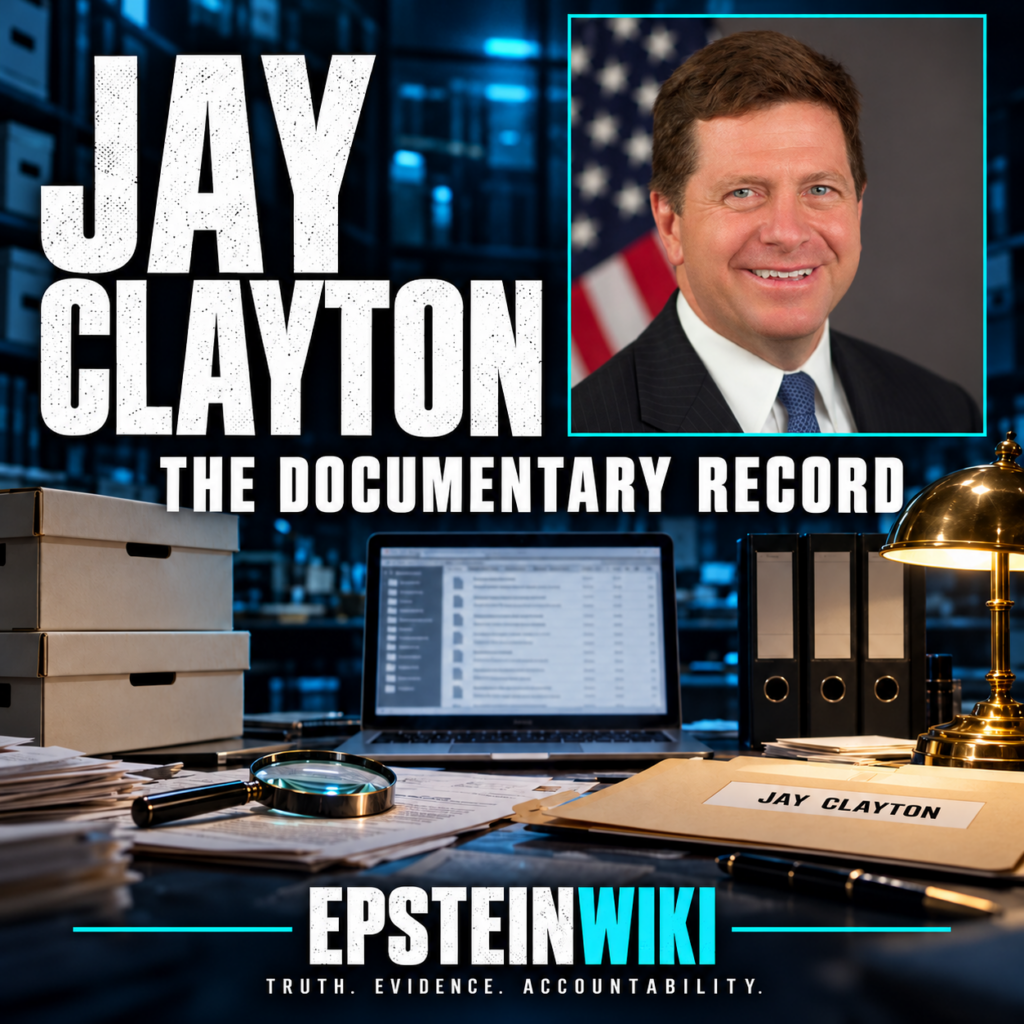
Snapshot
| Field | Documented information |
|---|---|
| Name | Jay Clayton |
| Principal Epstein-related role | U.S. attorney responsible for SDNY submissions on grand jury disclosure, protected discovery and victim-privacy review in 2025 and 2026 |
| SDNY service examined here | April 22, 2025 to July 29, 2026 |
| Earlier proposed appointment | June 2020 announcement of an intended nomination; distinct from his actual 2025 service |
| Current office | Director of National Intelligence, sworn in August 3, 2026 |
| Earlier positions relevant to context | SEC chairman; Apollo Global Management non-executive chairman; Sullivan & Cromwell lawyer |
| Principal court cases | United States v. Epstein, No. 19-cr-490; United States v. Maxwell, No. 20-cr-330 |
| Key signed records | July 29 and August 2025 unsealing submissions; November 24 motion; December 19 and January 30 certifications; February 2 corrective letter |
| Critical distinction | The court’s certification requirement covered Maxwell protected discovery; Clayton’s declarations specified designated Maxwell grand jury and discovery records, not every DOJ file |
| Evidentiary status | Government advocacy, sworn declarations, judicial rulings and congressional testimony must be read separately |
Jay Clayton’s signed July 29, 2025 memorandum places him directly in the litigation over public access to the Epstein and Maxwell grand jury records. His later sworn declarations and corrective correspondence document a more consequential responsibility: describing and certifying the review intended to protect victims before records were released under the Epstein Files Transparency Act.
The December 9, 2025 court order made the SDNY U.S. attorney personally accountable for a specified category of protected discovery. That responsibility, the qualifications in Clayton’s certifications, the subsequent acknowledgment of disclosure errors, and the court’s limits on its own authority are central to understanding his role.
Clayton’s appearance in this record is primarily that of a government official, legal advocate and certifying officer. It does not establish participation in Epstein’s crimes. His separate Apollo board service is relevant institutional background, but requires its own chronology and cannot substitute for evidence of personal dealings with Epstein.
Important Points
- Clayton was proposed for the SDNY position in June 2020, but his documented service in this article began in April 2025. He should not be credited with bringing Epstein’s 2019 indictment or conducting Maxwell’s 2021 trial.
- He signed substantive unsealing submissions with Attorney General Pamela Bondi and Deputy Attorney General Todd Blanche named alongside him. These are stronger evidence of his role than an undifferentiated appearance of his name in a file search.
- In August 2025, the courts rejected the initial grand jury disclosure requests. Public interest alone did not satisfy the legal standards applied in those decisions.
- Congress’s November 2025 enactment changed the legal basis for disclosure. The December ruling applied the new statute and modified protective restrictions while retaining victim-privacy safeguards.
- The December order required a personal sworn certification for discovery covered by the Maxwell protective order. It expressly excluded other DOJ holdings from that certification requirement.
- Clayton’s December 19 and January 30 declarations identified particular Maxwell grand jury and discovery materials. The January declaration qualified its assurance by reference to his knowledge and the described review process.
- The February 2, 2026 letter acknowledged that thousands of documents and media had been taken down after potential victim-identifying information was released, including through technical or human error. It also described corrective procedures.
- A January 21 ruling rejected a congressional request for a monitor within Maxwell’s criminal case. It did not decide that DOJ had fully complied with the disclosure statute.
- In July 2026 testimony, Clayton distinguished the Southern District materials from the wider release and accepted responsibility for the Southern District documents.
- Clayton left SDNY on July 29, 2026. His present office is Director of National Intelligence, not U.S. attorney.
Evidence Appearances
| Record | Date | Clayton’s documented role | Meaning and limit |
|---|---|---|---|
| DOJ proposed-nomination announcement | June 19, 2020 | Named as intended nominee | Announcement of a proposed appointment, not proof of service in 2020 |
| SDNY commencement statement | April 22, 2025 | Serving U.S. attorney | Distinct from the earlier proposal |
| Epstein Document 66, DOJ-OGR-00000746 through 00000755 | July 29, 2025 | Electronic signature on joint unsealing memorandum | Government’s legal argument and factual representations, not judicial findings |
| Epstein Document 70, DOJ-OGR-00000761 through 00000764 | Dated August 4; filed August 5, 2025 | Signed response to both district judges | Clarifies grand jury dates, transcript scope, exhibits and victim notice |
| Maxwell Document 808, DOJ-OGR-00015131 through 00015132 | August 8, 2025 | Signed request adding grand jury exhibits | Requests disclosure subject to redactions and further notification; does not authorize release itself |
| Maxwell Document 809, DOJ-OGR-00015133 through 00015163 | August 11, 2025 | Government submissions assessed by court | Judicial denial of the first Maxwell unsealing request |
| Maxwell Document 810 | November 24, 2025 | Signed motion invoking new statute | Renewed legal basis; distinguishes grand jury secrecy from discovery restrictions |
| Maxwell Document 820 | December 9, 2025 | Officeholder assigned personal certification duty | Court order limited to protected discovery, with explicit scope restriction |
| Maxwell Document 823 | December 19, 2025 | Signed letter and sworn declaration | Describes process and certifies designated Maxwell materials; final declaration is on page 5 |
| Maxwell Document 826 | January 5, 2026 | Signed production and review update | Dated workload estimates and revised procedures, not a completed-production finding |
| Maxwell Documents 840 and 844 | January 16 and 21, 2026 | Signed opposition followed by judicial ruling | Requested monitor rejected in criminal case; broader statutory compliance left unresolved |
| Maxwell Document 846 | January 30, 2026 | Signed letter and sworn declaration | Knowledge-qualified certification on page 4; expressly designated records |
| Maxwell Document 848 | February 2, 2026 | Signed response concerning privacy failures | Government acknowledgment and corrective commitments, not independent verification that every error was fixed |
| Senator Heinrich’s hearing transcript | July 15, 2026 | Responds about certification and New Mexico records | Official account of an adversarial hearing exchange, not a judicial determination |
The 2020 Proposal and Actual 2025 Appointment
Attorney General William Barr’s June 19, 2020 announcement said President Donald Trump intended to nominate Clayton, then SEC chairman, to succeed Geoffrey Berman. Its wording concerns an intended nomination. It should not be rewritten as a statement that Clayton took control of the office that year.
Clayton’s April 22, 2025 statement records his actual arrival as U.S. attorney and thanks Acting U.S. Attorney Matthew Podolsky. His August 18 statement on court appointment records the continuation of that service.
The timing matters in the Epstein record. The original New York prosecution, Epstein’s death in custody, Maxwell’s indictment and her trial all predated Clayton’s 2025 tenure. His relevant responsibilities concerned the office’s later litigation, disclosure process and review of existing investigative material. A signature on a 2025 filing does not retrospectively establish personal involvement in decisions made in 2019 or 2021.
Apollo Background and Its Evidentiary Limits
Apollo’s March 22, 2021 announcement states that Clayton, already its lead independent director, became non-executive chairman as Marc Rowan became CEO. The company said that Rowan and Clayton succeeded founder Leon Black in those respective roles.
That succession followed Dechert’s January 2021 report to Apollo’s conflicts committee on Black’s relationship with Epstein. The report described $158 million in payments for work performed during 2012 through 2017. It said it found no evidence that Black or Apollo personnel participated in Epstein’s criminal activities, and distinguished Black’s personal arrangements from Apollo’s business. These were conclusions of a company-commissioned legal review, not a criminal judgment.
Clayton’s later board position is a documented institutional connection to Apollo. It does not establish that he made Black’s payments, retained Epstein, participated in the earlier relationship or controlled the Dechert investigation. Nor does a board appointment alone establish an improper conflict in a later government decision. A specific claim about recusal, personal financial interest or intervention requires evidence directed to that issue.
The Butterfly Bureau’s June 15, 2026 roundup identified the Apollo succession as a reason Clayton’s intelligence nomination attracted scrutiny. Its discussion is useful as contemporary commentary; the corporate announcement and original legal report establish the underlying facts.
July 2025: Arguing for Grand Jury Disclosure
The July 29 memorandum, Epstein Document 66, responded to orders from Judges Richard Berman and Paul Engelmayer. Clayton’s electronic signature appears on its final page, below the names of Bondi and Blanche. The memorandum addressed the discretionary factors identified in In re Craig for extraordinary disclosure outside the usual grand jury secrecy rules.
The government emphasized public interest, its own support for disclosure, the passage of time, Epstein’s death and the fact that some information had already emerged at Maxwell’s trial. It proposed redactions for victims and other personal information. It also acknowledged that government support could not itself confer permission to disclose.
The filing distinguished the witnesses before the grand juries from the people whose experiences those witnesses summarized. It identified one FBI agent as the Epstein grand jury witness and an FBI agent and NYPD detective as the Maxwell grand jury witnesses. Victims’ accounts had been conveyed through law enforcement testimony. The transcripts were therefore not a complete collection of firsthand survivor testimony or the entire investigative file.
On notice, the government said relevant counsel had reviewed the transcripts before filing and that it had by then notified all but one victim referenced in them, after unsuccessful efforts to reach that person. The filing did not identify Clayton as the person who personally performed each review or notification. It also did not resolve the court’s concern about the absence of notice before the initial motion.
August 2025: Clarifying Scope, Then Losing the Motion
Clayton’s August 4 letter, filed as Epstein Document 70 on August 5, clarified that the pending request then concerned transcripts only. It asked for time to address grand jury exhibits and to compare their contents with publicly available trial and civil records.
The letter gave the Epstein grand jury dates as June 18 and July 2, 2019, and the Maxwell dates as June 29 and July 8, 2020, and March 29, 2021. It said much of the Maxwell transcript information, apart from certain identities, was already public. It also argued that dismissal of Epstein’s case following his death did not eliminate the court’s authority over the sealed grand jury records. That was the government’s jurisdictional argument, not a reopened prosecution.
The August 8 letter, Maxwell Document 808, added a request to unseal the exhibits. It asked the judges to await an August 14 notification update before releasing exhibits, if otherwise inclined to authorize disclosure. Its footnote acknowledged that anonymized civil complaints could not always be attributed confidently to particular victims. That qualification is a reason to preserve pseudonyms, not an invitation to infer identities.
Engelmayer’s August 11 decision, Document 809, denied the Maxwell request. He found the ordinary Rule 6(e) exceptions inapplicable and rejected reliance on special circumstances. Having examined the actual materials, he concluded that they would add almost nothing significant to the public trial record and would not reveal the broad new information the government had suggested.
The later December opinion recounts that Berman separately denied the parallel Epstein motion on August 20. The Maxwell denial addressed those grand jury materials. It did not find that every DOJ record about Epstein was already public or that no other investigative record could be significant.
November 2025: An Investigative Assignment and a New Statute
The minority views in House Report 119-469 reproduce President Trump’s November 14 call for investigation of Epstein’s relationships with Bill Clinton, Larry Summers, Reid Hoffman, JPMorgan and others, followed by Bondi’s announcement that she had asked Clayton to lead the work. This is evidence of an announced assignment. The report’s partisan assessment of its motives is not a court finding, and the announcement does not establish criminal conduct by the people or institutions named.
A separate legal development changed disclosure litigation. Congress enacted the Epstein Files Transparency Act on November 19, 2025. Clayton’s signed November 24 motion, Document 810, asked for an expedited ruling permitting release of grand jury transcripts and exhibits and modification of protective orders restricting disclosure of discovery.
The motion argued that the new statute supplied authority that had been absent during the earlier dispute. Its request was still subject to victim-related redactions. The investigative assignment and the statutory production process should be kept separate: an announced inquiry into particular relationships is not the same act as publishing records under a disclosure law.
December 9: Disclosure Authorized With Personal Accountability
Document 820, issued December 9, held that the new Act covered the Maxwell grand jury materials and overrode Rule 6(e) in this limited statutory setting. It also modified the protective order to permit publication required by the Act while retaining protection for victim-identifying information and private victim files.
The ruling did not merely accept DOJ’s assurances. Engelmayer criticized the department for failing to notify victims before both its July and November applications. He required the SDNY U.S. attorney personally to file a sworn certification before release of discovery covered by the protective order. The required review had to include SDNY attorneys.
The court explained why it selected that official: he had signed the motion, his office possessed experience with the prosecution and its discovery, and assigning responsibility would give victims an identifiable office for concerns. The order expressed confidence in the office’s professionals while demanding a concrete accountability mechanism.
The scope limitation is explicit in footnote 13. The certification requirement applied only to discovery covered by the protective order, not all Epstein-related documents possessed elsewhere by DOJ or obtained outside that discovery. The order also required the department to distinguish Maxwell grand jury materials from protected discovery when publishing them. These categories are essential when comparing later certifications with reported disclosure failures.
December 19 and January 5: The Described Review Process
Clayton’s December 19 letter and declaration, Document 823, described a victim-identification file, consultation with counsel, initial departmental review and additional SDNY review. It said records thought still to contain protected information would be separated for further work before release.
The letter described precautions extending beyond names, including identifying context, family connections and photographs. It also acknowledged technical error, human error, incomplete knowledge and the risk that individually innocuous facts could identify someone when combined. Describing those risks did not eliminate the duty to protect victims.
The signed sworn declaration on page 5 specified Maxwell grand jury materials marked GM_GJ_SDNY and protected discovery carrying the SDNY_GM_ Bates prefix. It stated that they had undergone rigorous review and that no released records had been identified through that review as containing the protected victim information described in the statute. It should not be paraphrased as a certification of every file held by every DOJ component.
The January 5 update, Document 826, reported approximately 12,285 documents comprising 125,575 pages posted at that point, with more than two million potentially responsive documents in various stages of review. These were dated government estimates; documents and pages were expressly different units.
The update described more than 400 departmental lawyers expected to contribute, including over 125 SDNY lawyers, alongside FBI analysts. It proposed classification by document type, prioritization, duplicate handling, targeted review and quality-control searches. It also acknowledged that information victims believed should have been redacted had already been posted. The record therefore contains evidence of known review problems before the larger January 30 release.
January 2026: The Dispute Over Independent Oversight
Clayton’s January 16 letter, Document 840, opposed Representatives Ro Khanna and Thomas Massie’s request to participate as amici and seek a special master or independent monitor. The government argued that they were trying to introduce a new civil disclosure dispute into a largely concluded criminal prosecution. It also advanced broader arguments concerning standing and the absence of a private cause of action.
Engelmayer’s January 21 opinion, Document 844, denied the requested participation for two reasons: the criminal case did not authorize general supervision of DOJ’s compliance with the Act, and the proposed amicus role improperly introduced new issues and relief.
The court nevertheless recognized legitimate concerns about compliance. It did not reach the government’s broader arguments about a separate lawsuit, and its denial was without prejudice to such litigation. It also noted Congress’s independent oversight tools. Accordingly, the result was a procedural victory for the government in that case, not a judicial certification that all withholding, redaction or delay was lawful.
January 30: What Clayton Actually Certified
The January 30 filing, Document 846, stated that the department intended to publish identified materials that day with specified exceptions. Clayton submitted it as U.S. attorney in response to the courts’ orders. The letter described more than 500 attorneys and reviewers contributing to the broader work, including over 200 SDNY lawyers and other personnel.
Its final page contains the signed sworn declaration. The declaration identifies the same two categories of designated Maxwell material: GM_GJ_SDNY grand jury records and SDNY_GM_ protected discovery. Clayton confirmed, to the best of his knowledge and consistent with the described procedures, that the records had been rigorously reviewed and that none had been identified through that review as containing the specified protected victim information.
Three distinctions matter. First, he personally signed a sworn assurance, rather than merely appearing on an office letterhead. Second, the assurance referred to the review and his knowledge, with qualifications that should not be deleted when summarizing it. Third, its designated categories do not cover every item in the overall DOJ release. Determining whether a specific wrongly disclosed record contradicted the certification requires identifying that record’s category and version.
The accompanying letter also said some documents remained temporarily withheld while the government awaited further guidance from relevant courts. It was not a judicial finding that the production was complete.
February 2: Acknowledged Errors and Corrective Measures
The February 2 letter, Document 848, bears Clayton’s electronic signature beneath Bondi and Blanche’s names. Responding to victim counsel and the courts, it said the department had taken down several thousand documents and media that might inadvertently contain victim-identifying information, including because of technical or human error.
The department described immediate removal of flagged records while concerns were assessed, followed by reposting with additional redactions, ideally within 24 to 36 hours. It said the same Bates number would be retained. It also described independent searches and database re-indexing to remove identifying information from searchable metadata, not just visible document pages.
These were the department’s representations about its corrective work. They are not independent proof that every disclosure was repaired, and removal from an official website cannot establish that copies elsewhere ceased to exist. The letter is nevertheless a direct acknowledgment that the production process had exposed information requiring further protection.
The chronology is important: court-imposed review, sworn certifications, a large release, victim complaints and subsequent corrective action. That sequence supports scrutiny of the process. It does not by itself establish knowing falsity, contempt or criminal misconduct by Clayton, and the cited materials contain no such adjudication against him.
Continued Court Restrictions on Publication
The December 22, 2025 order in Maxwell’s collateral case required review and redaction of her pro se Section 2255 filings after the government reported that they identified protected victims. It required future amended submissions and exhibits to be filed under seal pending review. Public release of other Epstein records did not itself remove those filing restrictions.
The February 24, 2026 order and attached February 23 government letter show both protection and limits. The court allowed victim-information redactions consistent with the specified statutory provisions but denied any broader requested redactions that had not been justified. The attached letter was signed by Deputy U.S. Attorney Sean Buckley under Clayton’s office heading; it should not be described as Clayton’s personal signature.
These decisions illustrate that disclosure, privacy protection and access to court filings remained distinct questions. The collateral motion was later denied in an order filed August 25, 2026, after Clayton had left SDNY. Publication of additional files did not itself overturn Maxwell’s conviction.
July Testimony and Departure From SDNY
The official July 15, 2026 hearing excerpt published by Senator Martin Heinrich records questioning during Clayton’s intelligence nomination. Heinrich pressed him about victim-information disclosures and responsibility for certification. Clayton answered that the court required certification of a subset of materials, then accepted responsibility for the Southern District documents: “For the Southern District documents, it was me.”
The same exchange addressed New Mexico’s request for unredacted evidence concerning Zorro Ranch. Clayton said the records were subject to protections, including a court order, and that his team was seeking dialogue toward an accommodation consistent with those restrictions. His answer is evidence of his stated position and intended discussions, not proof that the requested material was subsequently transferred.
DOJ’s July 29 succession announcement states that Clayton resigned effective that day and Jamie McDonald was sworn in as U.S. attorney. ODNI’s August 3 release records Clayton’s swearing-in as the ninth Director of National Intelligence. References to him as SDNY U.S. attorney are therefore historical when discussing the filings above.
Chronology
| Date | Documented event |
|---|---|
| June 19, 2020 | Barr announces an intended Clayton nomination for SDNY |
| March 22, 2021 | Apollo names Clayton non-executive chairman |
| April 22, 2025 | Clayton issues commencement statement as SDNY U.S. attorney |
| July 29, 2025 | Signs memorandum supporting grand jury disclosure |
| August 4 to 8, 2025 | Clarifies transcript scope and then requests disclosure of exhibits |
| August 11 and 20, 2025 | Initial Maxwell and Epstein disclosure motions denied |
| August 18, 2025 | Issues statement concerning continued service by court appointment |
| November 14, 2025 | Bondi announces Clayton’s assignment to lead further Epstein-related investigation |
| November 19 and 24, 2025 | Disclosure Act enacted; government files renewed motion |
| December 9, 2025 | Court permits statutory disclosure and imposes personal certification for protected discovery |
| December 19, 2025 | Clayton files process description and sworn certification |
| January 5, 2026 | Reports incomplete review and revised procedures |
| January 16 and 21, 2026 | Opposes independent-monitor request; court denies participation in criminal case |
| January 30, 2026 | Files further sworn certification tied to designated Maxwell records |
| February 2, 2026 | Signs letter acknowledging takedowns and describing corrective procedures |
| February 24, 2026 | Court permits justified victim redactions but rejects unsupported additional redactions |
| July 15, 2026 | Answers Senate questions on disclosure and state access to evidence |
| July 29, 2026 | Resigns from SDNY; McDonald succeeds him |
| August 3, 2026 | Sworn in as Director of National Intelligence |
Related Articles
- Jeffrey Epstein: The underlying investigations and prosecutions.
- Ghislaine Maxwell: The criminal case, discovery and later proceedings.
- Leon Black: Black’s separately documented relationship with Epstein.
- Apollo Global Management: Corporate context for Clayton’s board service.
Source List
- DOJ, June 19, 2020 proposed-nomination announcement.
- DOJ, April 22, 2025 commencement statement and August 18 court-appointment statement.
- Apollo, March 22, 2021 leadership announcement and Dechert report filed with the SEC, January 22, 2021.
- Epstein Document 66, July 29, 2025, Document 70, filed August 5, and Maxwell Document 808, August 8: Original DOJ-produced court records in readable PDF mirrors. The DOJ’s Document 66 copy supplies the official production route.
- Maxwell Document 809, August 11, 2025: Initial unsealing denial.
- House Report 119-469, minority views, page 34: Reproduced November 14 investigative-assignment announcement, distinguished from the report’s political interpretation.
- Maxwell Document 810, November 24, 2025 and Document 820, December 9: Motion and resulting order.
- Document 823, December 19, 2025, Document 826, January 5, 2026, and Document 846, January 30: Review procedures and certifications.
- Document 840, January 16, 2026 and Document 844, January 21: Opposition to independent oversight and limited judicial disposition.
- Document 848, February 2, 2026: Privacy complaints, takedowns and revised procedures.
- Maxwell v. United States, No. 25-cv-10468, Document 4, Document 7, and Document 10: Publication restrictions, redaction ruling and collateral disposition.
- Senator Heinrich, July 15, 2026 hearing exchange.
- DOJ, July 29, 2026 succession announcement and ODNI, August 3 swearing-in announcement, cross-checked against its current leadership page.
- The Butterfly Bureau, June 15, 2026 roundup: Secondary commentary used only for its account of public scrutiny.