
Michael Jackson

Snapshot
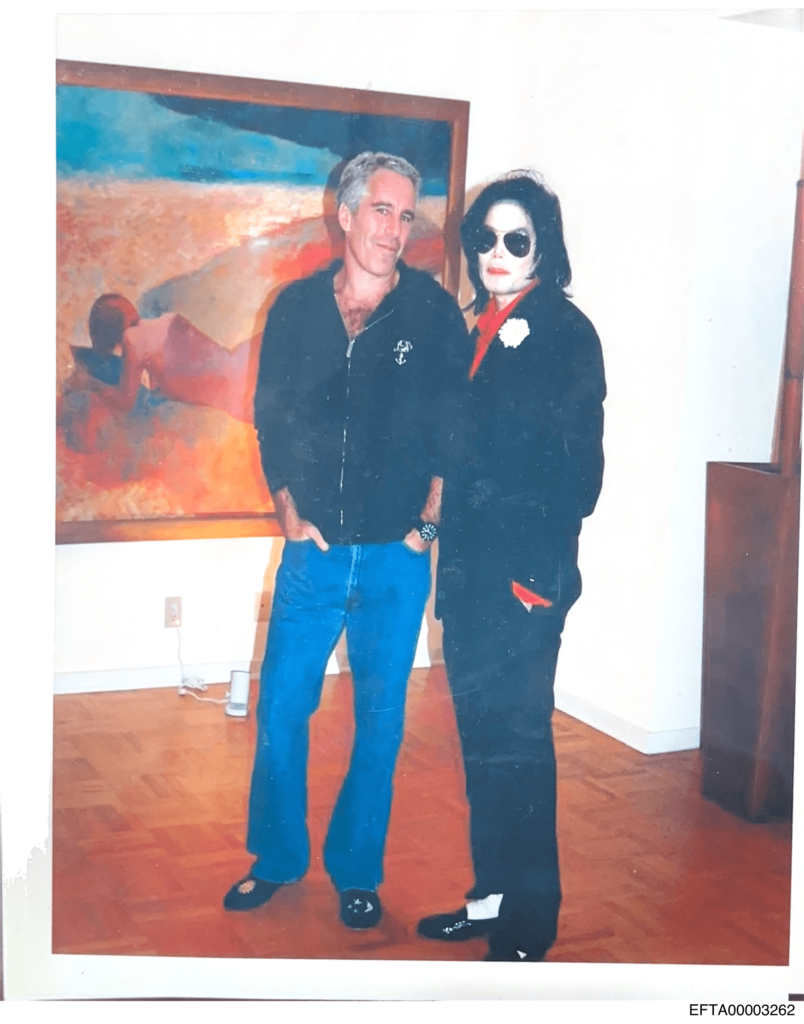
Michael Jackson was an American singer, songwriter, dancer, and recording artist whose image appears in records released from the Jeffrey Epstein investigation. The strongest direct Epstein connection currently available is a photograph showing Jackson standing beside Epstein. The photograph appears in EFTA00003256, a Justice Department image collection released in December 2025.
A separate FBI interview summary, EFTA02857840, records a survivor saying that she spoke with Michael Jackson by telephone during one of her many visits to Epstein’s Palm Beach residence. The released summary does not describe the subject of the call, say who initiated it, allege misconduct by Jackson, or establish that Jackson knew the caller was a minor or an Epstein victim.
Another released image, EFTA00003367, shows Jackson with Bill Clinton, Diana Ross, and three children whose faces were redacted. That photograph did not document a private Epstein gathering. Comparison with the publicly available original established that it came from a 2002 Democratic Party fundraiser at the Apollo Theater. The children were Jackson’s children Prince and Paris and Diana Ross’s son Evan Ross.
No reliable evidence reviewed for this article establishes that Jackson participated in Epstein’s trafficking operation, visited Little Saint James, flew on Epstein’s aircraft, received trafficked victims, or knew about Epstein’s crimes. Jackson’s separate history of child sexual abuse allegations must be reported accurately, but it must not be merged with the Epstein record without evidence.
Michael Jackson died on June 25, 2009. He cannot respond to the later release of the Epstein materials. His estate has continued to deny the sexual abuse allegations made against him.
Key Takeaways
- A Justice Department photograph collection contains an image of Michael Jackson standing beside Jeffrey Epstein.
- The released photograph has no confirmed date, location, photographer, caption, or chain of events establishing why the two men were together.
- A former Jackson bodyguard later said the encounter probably occurred while Jackson was viewing properties in Palm Beach. That is a post release recollection, not a contemporaneous record, and parts of the explanation remain unverified.
- An FBI survivor interview says the survivor spoke with Michael Jackson by telephone during a visit to Epstein’s Palm Beach home. The summary provides no allegation of misconduct by Jackson and almost no context for the call.
- A second released Jackson photograph came from a public 2002 political fundraiser. Epstein is not shown in it, and the children hidden by government redactions were the performers’ own children.
- No verified public flight record reviewed for this page places Jackson aboard an Epstein aircraft.
- No released criminal charge, civil complaint, survivor allegation, or government finding reviewed for this page identifies Jackson as a participant in Epstein’s trafficking crimes.
- Jackson faced serious child sexual abuse allegations unrelated to Epstein. He denied them, settled one civil claim without admitting wrongdoing, and was acquitted of every charge in his 2005 criminal trial. Later civil allegations remain disputed and unresolved.
- The existence of separate allegations against Jackson does not convert an Epstein photograph into proof of a shared criminal enterprise.
Who Was Michael Jackson?
Michael Joseph Jackson was born on August 29, 1958, in Gary, Indiana. He became famous as a child performer with the Jackson 5 and later developed one of the most commercially successful solo careers in popular music. His albums included Off the Wall, Thriller, Bad, Dangerous, and HIStory.
Jackson’s global fame gave him access to presidents, business leaders, entertainers, philanthropists, and wealthy private circles. It also meant that photographs of him circulated widely among collectors, journalists, fans, political organizations, and other public figures.
That context matters when evaluating files recovered from Epstein’s properties. A photograph in Epstein’s possession can document a meeting. It can also be a press image, a copy of a public photograph, a gift, or an image obtained through another person. Investigators must determine what the image itself proves before assigning meaning to its presence in an evidence collection.
Jackson died in Los Angeles in 2009 from acute propofol intoxication. His physician, Conrad Murray, was later convicted of involuntary manslaughter. Jackson’s death occurred before Epstein’s 2019 federal arrest and before the public release of the photographs discussed here.
The Direct Photograph With Jeffrey Epstein
What the Image Shows
EFTA00003256 is a Justice Department photograph collection. One image shows Jackson and Epstein standing next to each other in a room with a wood floor and white walls. A large painting of a reclining woman hangs behind them.
Jackson wears a dark suit, red shirt, sunglasses, and a white flower on his lapel. Epstein wears jeans and a dark zippered top. Both men face the camera.
The image establishes that Jackson and Epstein were physically present together for at least one photograph. It does not establish the length of the encounter, the purpose of the meeting, who arranged it, whether anyone else was present, or what either man knew about the other.
What the Released File Does Not Supply
The released record does not provide:
- A verified date
- A verified location
- The photographer’s identity
- A contemporaneous caption
- A calendar entry for the meeting
- Travel records connecting Jackson to the encounter
- Correspondence arranging the meeting
- A financial transaction between Jackson and Epstein
- Evidence of a continuing relationship
- Evidence of criminal conduct in the room
The absence of this context is not proof that the meeting was innocent or suspicious. It means the photograph should be classified as documented contact with an unresolved context.
The Palm Beach Property Viewing Explanation
After the photograph was released, former Jackson bodyguard Matt Fiddes told reporters that he believed the image was taken while Jackson was looking at homes in Palm Beach between December 2003 and January 2004. Fiddes said Jackson viewed many properties during that period and that people frequently asked to take pictures with him.
Fiddes also said he did not remember Epstein and that Jackson’s party did not know who Epstein was. This account provides a possible explanation, but it has not been confirmed by a dated real estate record, appointment book, property listing, or other contemporaneous document.
The claim that Epstein’s Palm Beach residence was being offered for sale during the visit also requires caution. Epstein continued owning the property for many years. His estate did not sell it until after his death. A property viewing may still have occurred for another reason, but the released record does not resolve that issue.
The responsible conclusion is therefore limited: the photograph is authentic evidence of an encounter, while the house hunting explanation remains an attributed recollection rather than an established fact.
The Survivor’s Telephone Contact
What EFTA02857840 Records
EFTA02857840 is a four page FBI interview record involving a survivor who said Epstein began abusing her when she was 14. The survivor described visiting Epstein’s Palm Beach residence more than 100 times over several years.
The interview summary states that she spoke with Michael Jackson by telephone during one of those visits.
This is a direct mention in a survivor interview and should not be omitted. It must also be reported within the limits of the document.
What the Telephone Reference Does Not Establish
The released summary does not say:
- Whether Epstein placed the call
- Whether Jackson called Epstein
- Whether the call was on speakerphone
- How long the call lasted
- What Jackson and the survivor discussed
- Whether Jackson knew the survivor’s age
- Whether Jackson knew she was being abused
- Whether Jackson ever met her in person
- Whether the call occurred near the date of the Jackson and Epstein photograph
- Whether Jackson participated in any criminal act
The survivor did not accuse Jackson of abusing her in the released summary. The reference establishes a telephone interaction within Epstein’s environment, not knowledge or participation in Epstein’s crimes.
The context is still significant. Epstein repeatedly used telephone calls with famous people to impress girls and young women, demonstrate access, and create an image of safety and legitimacy. Other survivor records describe Epstein placing prominent people on speakerphone for that purpose. That broader pattern may explain why a celebrity call mattered to the survivor’s recollection. It does not establish that the celebrity understood how Epstein was using the contact.
The Clinton and Diana Ross Photograph
The Released Image
EFTA00003367 contains a photograph showing Michael Jackson, former President Bill Clinton, Diana Ross, and three people whose faces were obscured in the government release.
Early coverage sometimes described the setting as an aircraft or treated the redactions as evidence that unidentified Epstein victims were present. That framing was incorrect.
The Verified Public Context
The original unredacted photograph was already available through commercial photo archives. It shows Jackson’s children Prince and Paris and Diana Ross’s son Evan Ross. The photograph was connected to the Democratic Party’s “A Night at the Apollo” voter registration fundraiser at the Apollo Theater in New York on April 24, 2002.
Jackson and Ross performed at the event. Clinton attended. Public event photographs show the same clothing, people, and setting. Epstein is not visible in the image, and the released file does not establish that he attended the fundraiser.
The photograph appears to have entered the Epstein evidence collection because a copy existed among material seized or collected by investigators. That custody fact does not transform the public event into an Epstein gathering.
Why the Redactions Caused Harm
Redacting the faces of known celebrity children without supplying the photograph’s public context invited unnecessary speculation. Some social media accounts circulated the image as if the hidden faces belonged to unidentified victims.
This is an example of why redaction cannot be treated as a guilt marker. A black box may protect a survivor, a child, a witness, a family member, a private person, or someone already identifiable in a public photograph. Researchers must locate the original image before assigning an identity or narrative.
Contact Book Reporting
News organizations reported that a version of Epstein’s contact material included an entry for Michael Jackson with multiple telephone numbers. A contact entry can show that Epstein or his staff possessed contact information. It does not establish who supplied the information, whether the number remained current, whether Jackson knew it was stored, or whether the two men communicated regularly.
An address book is not a client list. It includes employees, service providers, acquaintances, public figures, businesses, lawyers, medical personnel, household contacts, and people Epstein may have wanted to reach.
The contact reporting is consistent with the photograph and survivor telephone reference showing that a communication channel may have existed. It does not establish a close friendship or criminal relationship.
Flight Records and Property Claims
No reliable published passenger manifest reviewed for this article places Michael Jackson on Epstein’s private aircraft. The public flight logs are incomplete, and the absence of a name from those records cannot prove that a person never traveled with Epstein. It does mean that claims Jackson flew to Little Saint James or traveled throughout Epstein’s network require evidence that has not been produced.
No verified record reviewed for this article places Jackson on Little Saint James, at Zorro Ranch, in Epstein’s Paris residence, or in Epstein’s Manhattan townhouse.
The direct photograph may have been taken at the Palm Beach residence, but the released file does not identify the setting. Researchers should not assign a property solely from interior appearance unless architectural details, metadata, other photographs, or witness testimony confirm it.
Separate Sexual Abuse Allegations and Legal History
Michael Jackson’s separate legal history is relevant because online posts frequently use it to turn limited Epstein evidence into a claim of shared criminal activity. The histories must be distinguished.
The 1993 Allegation and Civil Settlement
In 1993, a boy accused Jackson of sexual abuse. Jackson denied the allegation. A civil claim was settled in 1994 for a substantial payment. The written agreement stated that the settlement was not an admission of wrongdoing.
The civil settlement did not legally prevent a criminal investigation. Prosecutors did not file criminal charges from that investigation.
A settlement is not a finding of liability or innocence. It resolves a civil dispute under negotiated terms.
The 2005 Criminal Trial
Jackson was prosecuted in Santa Barbara County, California, on charges involving another boy. The case included allegations of molestation, providing alcohol to a minor, and conspiracy.
On June 13, 2005, a jury found Jackson not guilty on all ten charged counts. Jurors also rejected the lesser alcohol related offenses submitted for consideration. Jackson was therefore acquitted of every criminal allegation tried in that case.
An acquittal means the prosecution did not prove the charges beyond a reasonable doubt. It must be reported as the legal result.
Later Civil Allegations
Wade Robson and James Safechuck have alleged that Jackson sexually abused them as children. Jackson’s companies and estate deny the allegations. Their civil cases against MJJ Productions and MJJ Ventures were revived after earlier dismissals and later consolidated. As of August 2026, the civil trial is scheduled for February 14, 2028.
In February 2026, four members of the Cascio family filed another civil lawsuit alleging that Jackson abused and trafficked them when they were children. Jackson’s estate rejected the claims and characterized the lawsuit as financially motivated. Those allegations remain unresolved.
These claims concern Jackson’s own conduct and companies. No public filing reviewed for this article connects the alleged conduct to Epstein or Maxwell.
Why the Separation Matters
It is possible to report serious allegations against Jackson accurately while also refusing to manufacture an Epstein connection. The photograph and telephone reference deserve scrutiny. They do not erase the requirement to prove the elements of any broader claim.
Misinformation and Unsupported Claims
Claim: Jackson Was on Epstein’s Island
No verified evidence reviewed for this article supports that claim.
Claim: The Redacted Children Were Epstein Victims
False. The unredacted public event photograph identifies them as Jackson’s children and Diana Ross’s son.
Claim: The Photograph Proves Jackson Was an Epstein Client
Unsupported. The image proves an encounter, not the purpose or nature of a relationship.
Claim: Jackson Regularly Flew on Epstein’s Aircraft
No verified public passenger record reviewed for this article supports that claim.
Claim: Macaulay Culkin Said Jackson Saved Him From Epstein
False. That quotation was fabricated and circulated after the photograph release. Culkin did not make the claimed statement.
Claim: The Survivor Accused Jackson of Abusing Her
Unsupported by EFTA02857840. The interview summary mentions a telephone conversation but does not attribute abuse or trafficking conduct to Jackson.
Claim: Jackson’s Separate Allegations Prove the Epstein Meeting Was Criminal
False reasoning. Evidence from one matter cannot fill evidentiary gaps in another. Each allegation requires its own sources, context, and legal status.
What the Evidence Establishes
The public record establishes that:
- Michael Jackson and Jeffrey Epstein were photographed together.
- The direct photograph appears in EFTA00003256.
- The released file does not provide a verified date or location for that photograph.
- A survivor told the FBI that she spoke with Michael Jackson by telephone during a visit to Epstein’s Palm Beach residence.
- The telephone reference appears in EFTA02857840.
- The survivor interview does not accuse Jackson of abuse or state that he knew about Epstein’s crimes.
- A second Jackson image in EFTA00003367 came from a public political fundraiser and did not document an Epstein gathering.
- Jackson faced separate child sexual abuse allegations during his life and after his death.
- Jackson denied the allegations made during his life.
- He was acquitted of every charge in his 2005 criminal trial.
- Later civil allegations against his companies remain contested and unresolved.
What the Evidence Does Not Establish
The public record reviewed for this article does not establish that:
- Jackson participated in Epstein’s trafficking operation.
- Jackson knew that Epstein was abusing girls.
- Jackson received a trafficked person from Epstein.
- Jackson visited Little Saint James.
- Jackson flew on Epstein’s aircraft.
- Jackson maintained a long term friendship or business relationship with Epstein.
- The direct photograph was taken at a specific Epstein property.
- The telephone call involved abuse, recruitment, or a minor’s age.
- The redacted people in the Clinton and Ross photograph were Epstein victims.
- Jackson’s independent legal history was connected to Epstein or Maxwell.
Evidence Classification
Documented Contact
The direct photograph qualifies as documented in person contact.
Survivor Report
The telephone conversation qualifies as a survivor reported interaction recorded by the FBI. The interaction is documented through the interview summary, while its purpose and content remain unknown.
Public Photograph in Investigative Custody
The Clinton and Ross photograph qualifies as a public event image found within investigative material. Its presence establishes custody, not Epstein’s attendance.
Unsupported Claims
Claims involving island travel, Epstein aircraft travel, client activity, trafficking participation, or criminal collaboration remain unsupported by the reviewed evidence.
Legal Status
Jackson was never charged with an offense connected to Epstein. His 2005 acquittal concerned a separate criminal case. Later civil claims against Jackson related companies remain unresolved.
Evidence Index
- EFTA00003256: Justice Department photograph collection containing the direct image of Michael Jackson and Jeffrey Epstein.
- EFTA00003367: Photograph collection containing the redacted public image of Jackson, Bill Clinton, Diana Ross, and their children.
- EFTA02857840: FBI survivor interview summary mentioning a telephone conversation with Michael Jackson during a Palm Beach visit.
Related EpsteinWiki Pages
- Jeffrey Epstein
- Ghislaine Maxwell
- Epstein Palm Beach Residence
- Epstein Flight Logs
- Epstein Black Book
- Fact Checking and Verification Resources
- Handling Sensitive Material
- Ethical Rules for Naming Public Figures
- Disinformation Handling Guide
Sources
Primary Evidence
- EFTA00003256 direct photograph collection
- EFTA00003367 public event photograph collection
- EFTA02857840 FBI survivor interview summary
- United States Department of Justice Epstein Library
Photograph Context and Verification
- Reuters overview of the December 2025 file release
- Reuters image record for the Clinton, Jackson, and Ross photograph
- The Guardian report on the released celebrity photographs
- The Guardian report on the over redacted public photograph
- RTVE verification of the public Apollo Theater photograph
- Report containing the former bodyguard’s property viewing explanation
- Business Insider report on the released contact book
Independent Legal History
- Associated Press report on Jackson’s 2005 acquittal
- CBS report on the 1994 civil settlement language
- Current report on the February 2028 Robson and Safechuck trial date
- Report on the 2026 Cascio family civil allegations and the estate’s denial
Editorial Note
This page documents Michael Jackson’s verified appearances in the Epstein record without converting proximity into guilt. The direct photograph and survivor telephone reference are important evidence. Neither record establishes that Jackson participated in or knew about Epstein’s crimes.
Jackson’s separate sexual abuse allegations are included because they materially affect how the Epstein photographs are interpreted online. They remain a separate evidentiary and legal history. The 2005 acquittal, unresolved civil claims, denials, and absence of an established Epstein connection are all reported together.
This article should be updated if a dated calendar entry, original photograph metadata, travel record, witness statement, financial record, or additional survivor account supplies new context.
Last reviewed: August 24, 2026.