
Patty Murray
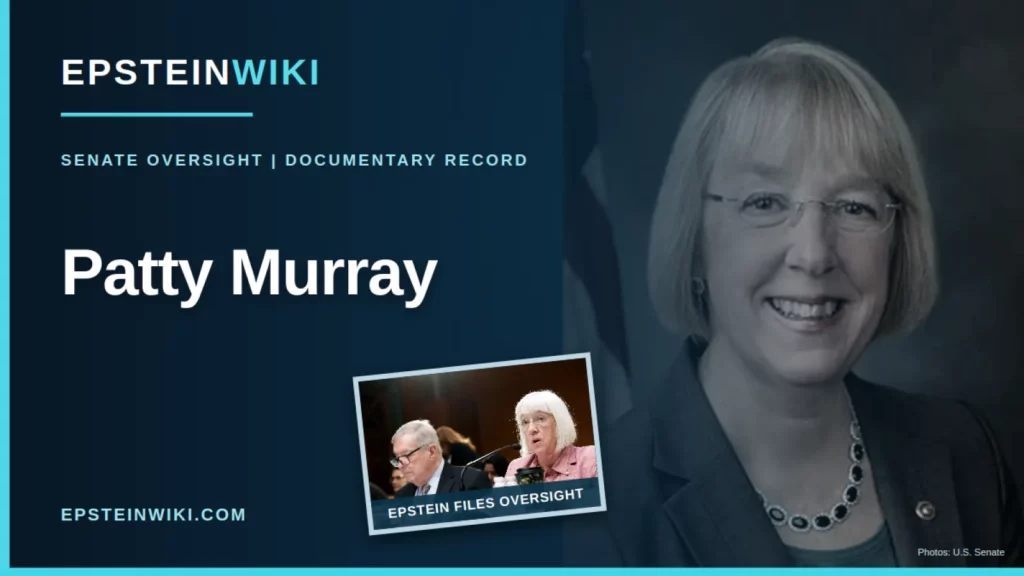
Snapshot
| Field | Documented information |
|---|---|
| Name | Patty Murray, U.S. senator from Washington. |
| Documented role | Congressional oversight of the Justice Department’s handling of Epstein’s case and later records disclosures. |
| 2018 and 2019 actions | Signed oversight letters with Tim Kaine and questioned Labor Secretary Alexander Acosta. |
| DOJ intake record | Workflow 4241026, received and assigned to the Office of Professional Responsibility (OPR) on April 15, 2019. |
| Later actions | Signed a November 2025 disclosure-law letter and a July 2026 survivor-meeting request with Chris Van Hollen. |
| Evidence limit | These records document public oversight. A request, an internal referral, a response, and a completed action are different forms of evidence. |
Introduction
Patty Murray appears in the Epstein record through formal congressional oversight. Her letters asked how the Justice Department handled the earlier federal investigation and the 2007 nonprosecution agreement, and whether the public would receive the findings of its internal review. The released April 2019 package also shows how DOJ received and routed a congressional inquiry. April letter and DOJ control sheet.
This profile follows selected official actions from December 2018 through July 2026, with research checked through October 18, 2026. It includes responses and later developments where they change the meaning of an earlier request. The reviewed records concern government accountability; they do not establish a private social, travel, or business relationship between Murray and Epstein.
Key Takeaways
- Murray and Kaine’s April 12, 2019 letter sought public release of OPR findings. The two EFTA packages are versions of the same communication.
- DOJ’s receipt, referral and internal due date establish administrative handling. They do not show that a substantive answer was sent.
- A May 2019 hearing records both Murray’s criticism and Acosta’s response.
- OPR’s 2020 findings must be distinguished from the senators’ earlier concerns and requests.
- Later signed letters concern the 2025 disclosure law and access for survivors in 2026. Subsequent events matter when assessing those requests.
Public Role and the December 2018 Request
Murray’s official biography identifies her as Washington’s senior senator. The dated 2018 and 2019 releases identify her as the senior Democrat on the Senate Health, Education, Labor, and Pensions Committee, known as HELP. Her July 2026 letter identifies her as vice chair of the Appropriations Committee. Those titles describe the roles she held at the relevant times.
On December 6, 2018, Murray and Kaine led a request by 16 senators asking DOJ Inspector General Michael Horowitz to investigate decisions surrounding the Epstein agreement. The letter cited the Miami Herald’s reporting as a reason for renewed scrutiny. It asked about immunity provisions, approval authority, victim notification, and whether the agreement addressed confinement or work release. Signed letter, pages 1 to 3.
The questions were requests for an investigation, rather than findings that each suspected failure had occurred. Murray’s February 7, 2019 statement then called for OPR’s review to be conducted by career ethics officials, to remain nonpartisan, and to provide results to Congress. The statement reported that the Inspector General had declined the earlier request on jurisdictional grounds.
April 12 Letter and DOJ Routing
Murray and Kaine signed a two-page letter dated April 12, 2019 asking OPR to publish all findings once its investigation was complete. They argued that Congress, survivors, and the public needed an account of how federal prosecutors had handled the matter. The request concerned disclosure of an investigation’s results; it did not establish those results in advance. Letter, PDF pages 2 and 3; EFTA00175154 and EFTA00175155.
The DOJ Executive Secretariat control sheet records receipt and assignment on April 15, 2019 under workflow 4241026. It assigned the response to OPR, directed preparation for an Assistant Attorney General for Legislative Affairs signature, and noted an information copy to the Deputy Attorney General’s office. Its April 30 date is an internal due date, not proof that a reply was sent. Control sheet, PDF page 1; EFTA00175153.
The accompanying email chain documents transmission and routing. EFTA00175153 and EFTA00175160 each contain five pages of the same package, with different redactions. They should be counted as two released versions, not two separate letters. Staff contact details are unnecessary to explain the oversight action and are not reproduced.
The May 2019 Hearing and Acosta’s Response
At a Senate appropriations hearing on May 2, 2019, Murray asked Acosta why the agreement was not stronger. She also asked about independent review and whether its results should be released to Congress. The official hearing record preserves the exchange on pages 17 and 18. Hearing transcript.
Acosta defended the federal office’s intervention as producing a stronger state outcome than the one it had initially expected. He distinguished an 18-month sentence from the 13 months served. When Murray pressed for disclosure of the OPR investigation, he said release was a DOJ decision governed by its protocols. Those are Acosta’s responses to the questions, not a conclusion that his account resolves the controversy. Acosta’s responses, page 18.
The July 2019 Followup
Murray and Kaine’s next letter is dated July 9, 2019. The HELP Committee published it on July 10. The senators asked for a progress report, an expected timetable, and a commitment to disclose OPR’s findings. They referred to the new New York prosecution and listed its indictment and July 8 bail memorandum as enclosures. Signed two-page followup.
The senators said they had not received an update on the investigation’s progress or expected completion. That describes their position at that time. The allegations cited in their letter are not converted here into findings about every person or event mentioned in the prosecution papers. The linked two-page scan lists the enclosures but does not itself contain them.
Murray also called for Acosta’s resignation on July 9. This was her political response to the handling of the case, separate from the legal conclusions OPR would later reach.
What the Later OPR Review Found
The November 2020 official OPR executive summary supplies an outcome that the 2019 letters could only request. Under its disciplinary framework, OPR found that the five subjects of its investigation did not commit professional misconduct in developing, negotiating, or approving the agreement. It nevertheless concluded that Acosta exercised poor judgment in resolving the federal investigation through that agreement. Executive summary, printed pages ix and x; PDF pages 10 and 11.
OPR also criticized the government’s treatment of victims. It concluded that they were not treated with the openness and sensitivity expected of the Department. The report distinguished that criticism and poor judgment from its narrower professional-misconduct test. Executive summary, printed page xi; PDF page 12.
These findings should not be described either as proof of every criticism in the senators’ letters or as approval of every aspect of the handling of the case. The records reviewed do not establish that Murray’s request alone caused the review or its publication. The fuller released report is separately indexed as EFTA02830776.
Later Disclosure and Survivor Access Efforts
Murray signed a November 18, 2025 letter urging Senate Majority Leader John Thune to bring H.R. 4405, the Epstein Files Transparency Act, forward promptly and pass it without amendment. The request appears on the first two pages; her signature appears on page 4. Signed Senate letter.
The measure became Public Law 119-38 on November 19, 2025. Its disclosure requirement includes exceptions for victims’ identifying information and other protected material. Supporting disclosure does not eliminate those privacy protections, and passage of a law does not by itself prove complete compliance. Enacted law, section 2, PDF pages 2 and 3.
On May 19, 2026, Murray questioned Acting Attorney General Todd Blanche about survivor privacy in the releases and asked him to meet with survivors. In the exchange published by her office, Blanche acknowledged mistakes, described efforts to remove and correct affected records, and said releasing a victim’s name improperly represented a Department failure. Murray continued pressing for an explicit apology. Blanche also agreed to outreach facilitated by Murray. The published responses matter as well as the questions.
On July 14, Murray and Chris Van Hollen signed a followup saying promised outreach and substantive scheduling responses had not arrived. They asked for confirmation of a meeting date by July 28. That was the senators’ report of the situation as of July 14. Signed one-page letter.
CBS/AP reported that Blanche met with survivors on July 16, 2026. The later report updates the earlier complaint about delay. The reviewed material does not establish Murray’s sole responsibility for arranging it or resolve every concern raised by survivors.
Chronology
- December 6, 2018: Murray and other senators request an Inspector General investigation.
- February 7, 2019: Murray calls for a career-led, nonpartisan OPR review and disclosure.
- April 12 and 15, 2019: The joint letter is dated April 12; DOJ logs receipt and assignment April 15.
- May 2, 2019: Murray questions Acosta at a Senate hearing.
- July 9 and 10, 2019: The followup is dated July 9 and published July 10.
- November 2020: OPR’s executive summary distinguishes misconduct findings from poor judgment and victim-treatment failures.
- November 18 and 19, 2025: Murray signs the Senate disclosure-letter request; the Act becomes law the next day.
- May 19, 2026: Murray questions Blanche about privacy and survivor outreach.
- July 14, 2026: Murray and Van Hollen seek a confirmed meeting date.
Evidence Appearances
- EFTA00175153: five-page DOJ package. Control sheet on page 1, letter on pages 2 and 3, transmission chain on pages 4 and 5. Inspected archived PDF.
- EFTA00175160: five-page version of the same package, ending at EFTA00175164. Inspected archived PDF. Different redactions do not make a separate oversight action.
- May 2, 2019 Senate appropriations hearing: pages 17 and 18 identify Murray’s questions and Acosta’s answers. The hearing date appears on page 1.
- July 9, 2019 Murray and Kaine letter: page 1 gives the date and purpose; page 2 contains the requested response and both signatures.
- EFTA02830776: fuller OPR review, distinct from the lawmakers’ correspondence. Public mirror of the court-filed report. The findings summarized here are checked against the official executive summary.
- November 18, 2025 Senate letter: request on pages 1 and 2; Murray’s signature on page 4. A legislative request, not evidence that she authored the bill.
- July 14, 2026 Murray and Van Hollen letter: one page, both signatures, retrospective account of the May hearing and a July 28 response request.
Limitations and Open Questions
An intake sheet proves that a document was logged and assigned. It does not prove a satisfactory response, completion by an internal deadline, or acceptance of the sender’s arguments. The reviewed April package contains no substantive DOJ reply to the senators.
The letters and hearing questions express oversight concerns. Agency findings, a witness’s response, a statute, and later reporting serve different purposes and should be labeled accordingly. The 2019 correspondence’s references to court proceedings are historical context; this profile does not attempt a complete account of later litigation over victims’ rights.
The April EFTA copies were inspected through public Internet Archive captures of DOJ files. Their present-day byte identity with the official repository was not established. The 2026 exchange was checked in the official published extract, not against the full audiovisual recording. The research is a bounded review of selected records, not every Murray mention or every congressional action. No private staff contacts or protected survivor identities are reproduced.
Related EpsteinWiki Articles
Conclusion
Murray’s documented role is congressional oversight: asking for an investigation, requesting public findings, questioning officials, supporting disclosure legislation, and seeking access for survivors. The record is strongest when those actions are paired with the actual replies and later outcomes. Administrative routing and repeated copies should never be mistaken for additional letters or completed government action.
Questions and Answers
Why does Murray’s name appear in the released records?
The April 2019 records contain a congressional letter and DOJ’s handling of it. They document oversight of the government’s work on the Epstein matter.
Are EFTA00175153 and EFTA00175160 two different requests?
No. Both contain the April 12 letter, the same workflow, and accompanying transmission material. They are differently redacted versions of one package.
Does the April 30 due date prove DOJ answered?
No. It is an internal date on the control sheet. A response document or other evidence of delivery would be needed.
Did OPR adopt every concern raised by the senators?
No. Its summary found no professional misconduct under its disciplinary framework, while criticizing Acosta’s judgment and the treatment of victims. Those conclusions should be described together.
What does the July 2026 followup establish?
The July 14 letter describes a delay as of that date. See the reported meeting above. That report does not establish whether the particular outreach requested in the letter was fulfilled.
Sources
- Murray, Kaine and other senators to Inspector General Michael Horowitz, December 6, 2018. Three-page signed Senate PDF; questions on pages 1 and 2, signatures on pages 2 and 3.
- Murray statement on the OPR investigation, February 7, 2019. Official HELP Committee release.
- April 12, 2019 letter and DOJ control sheet, EFTA00175153 through EFTA00175157. Five-page archived DOJ PDF.
- Duplicate April package, EFTA00175160 through EFTA00175164. Five-page archived DOJ PDF with differing redactions.
- Official April 12, 2019 Senate announcement and letter text.
- Senate appropriations hearing, May 2, 2019, fiscal year 2020 Labor Department request. Official GovInfo transcript, pages 17 and 18.
- Murray and Kaine to OPR, July 9, 2019. Two-page signed Senate PDF.
- HELP Committee announcement publishing the followup, July 10, 2019.
- Murray’s call for Acosta’s resignation, July 9, 2019. Official statement.
- DOJ OPR executive summary, November 2020. Printed pages ix through xi, PDF pages 10 through 12, for findings and limits.
- Senators to Majority Leader Thune, November 18, 2025. Request on pages 1 and 2; Murray signature on page 4.
- Epstein Files Transparency Act, Public Law 119-38, November 19, 2025. Section 2, 139 Stat. 656 and 657.
- Murray’s office, published May 19, 2026 hearing exchange with Todd Blanche. The Epstein Files section includes both questions and responses.
- Murray and Van Hollen to Todd Blanche, July 14, 2026. Signed one-page Senate PDF.
- CBS/AP meeting report.
- Murray’s official Senate biography. Professional identity checked October 18, 2026.
- Epstein Data congressional correspondence index. Retained finding aid; its summaries are not substitutes for the underlying records.