Tab 7: Palm Beach Police Department Interview Transcript Concerning Jeffrey Epstein (December 2005)
Tab 7 preserves a sworn Palm Beach Police Department interview with a 17 year old who described being taken to Jeffrey Epstein’s Palm Beach residence in December 2004, when she said she was 16. She testified that she expected to provide a massage for money but was not warned that Epstein would remove his clothing, ask her to undress, touch her sexually, or penetrate her with his fingers.
The interview was conducted on December 13, 2005 by Detectives Joseph Recarey and Dawson. The survivor’s mother authorized the interview. A later certificate signed by court reporter Sandra Rossi states that the transcript is a true and complete record of the tape as she heard it. The certification authenticates the transcription process. It does not independently prove every event described by the survivor.
Snapshot
Evidence range: HOUSE_OVERSIGHT_012345 through HOUSE_OVERSIGHT_012351
Tab: Tab 7
Document type: Certified transcript of a sworn taped police interview
Interview date: December 13, 2005
Certification date: January 30, 2007
Agency: Palm Beach Police Department
Interviewers: Detective Joseph Recarey and Detective Dawson
Interviewee: An unnamed 17 year old survivor whose identifying information is redacted
Incident described: A visit to Epstein’s Palm Beach residence in December 2004, when the survivor said she was 16
Strongest evidence: The survivor gave a detailed firsthand account of being recruited for a paid massage, taken upstairs, sexually touched, digitally penetrated after displaying hesitation and backing away, and paid afterward.
Central limitation: Epstein did not introduce himself to the survivor. The excerpt does not include a photographic identification, independent forensic evidence, or the complete investigative file used to corroborate her account.
Key Takeaways
- The correct identifiers are
HOUSE_OVERSIGHT_012345throughHOUSE_OVERSIGHT_012351. - The interview took place on December 13, 2005 and ended at 5:25 p.m.
- The interviewee was 17 when questioned and said she was 16 during the December 2004 incident.
- Her mother authorized detectives to interview her.
- Detective Recarey administered an oath before she gave her account.
- The survivor said she was told she could make money but was not told sexual contact would occur.
- She described a female escort taking her upstairs and explaining the expected massage routine.
- She testified that Epstein sexually touched and penetrated her while she was frightened, hesitant, and attempting to move away.
- She said she received $200 and was offered an additional $100 in connection with a requested return visit.
- She reported attending only once and said no one from the residence later called her.
- Court reporter Sandra Rossi certified the transcript on January 30, 2007.
Identifier Correction
The seven released pages are indexed as HOUSE_OVERSIGHT_012345 through HOUSE_OVERSIGHT_012351. They should not be cited as EFTA012345 through EFTA012351.
The full production identifier matters because similarly numbered pages exist in other Epstein document series. A citation without the HOUSE_OVERSIGHT prefix can direct researchers to unrelated evidence.
Document Overview
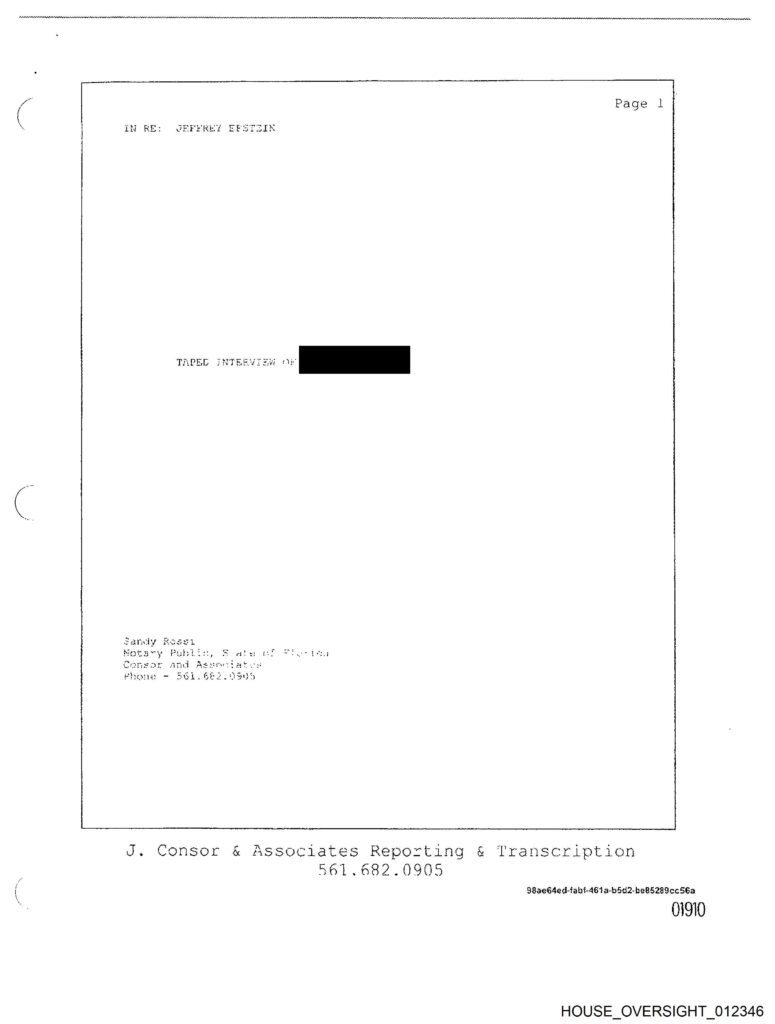
HOUSE_OVERSIGHT_012345 is the Tab 7 cover. HOUSE_OVERSIGHT_012346 is the interview title page. Although the title is degraded by the scan and OCR, it identifies the matter as concerning Jeffrey Epstein and the record as a taped interview.
The body of the interview appears on transcript pages 2 through 17. HOUSE_OVERSIGHT_012351 contains transcript page 18, which is the court reporter’s certificate.
The scans also carry earlier page numbers 01910 through 01915 and a recurring electronic identifier. These markings show an earlier production or transcription layer. They are not dates and do not independently identify the filing in which Tab 7 was assembled.
Interview Opening and Safeguards
At the beginning of the December 13, 2005 interview, Detective Recarey identified himself and Detective Dawson as members of the Palm Beach Police Department. He asked the interviewee to state and spell her name, provide her date of birth, and state her age. The identifying answers are redacted, but the transcript preserves her answer that she was 17.
Recarey stated that he had spoken with her mother and obtained authorization to interview her. He explained that police were investigating a man named Jeffrey who lived in Palm Beach and believed the survivor had information about his residence or a visit to his home.
Before asking for her account, Recarey administered an oath. The survivor answered that she would tell the truth. This makes the statement sworn testimony in an investigative setting, although it was not courtroom testimony and was not subject to cross examination.
The excerpt does not show whether a victim advocate, attorney, counselor, or other support person was present. It also does not reproduce a complete explanation of confidentiality, recording, or the possible uses of her statement.
Recruitment for the Massage
The survivor described being approached by another girl who said she knew a way to make money. The survivor also recalled a threat that she would be physically attacked if she told anyone. Because names and parts of the exchange are redacted or inaudible, the precise timing and speaker associated with every part of the threat cannot be reconstructed confidently.
She said the visit occurred shortly before Christmas in December 2004. When detectives asked her age at the time, she answered that she thought she was 16.
Before they arrived, she was told that the man might ask her to remove her shirt. She nevertheless understood the opportunity as a paid massage. Nothing in her account indicates that she agreed in advance to sexual touching or penetration.
The distinction is central. Agreeing to enter a residence, provide a massage, or receive payment is not agreement to sexual contact. Her age, the limited information supplied before the visit, and the conduct she later described must remain separate from any claim of informed consent.
Entry Into the Palm Beach Residence
The survivor described entering through a side gate and knocking at a rear door. A woman asked her name and why she was there. The survivor believed the woman might have been a maid because she handled towels and carried them upstairs, but she was uncertain and could not provide a reliable identification.
Food was available, and the survivor waited for several minutes. She recalled another girl leaving before she went upstairs. She also described two women who appeared to her to look like models. One had long blonde hair.
According to the survivor, the blonde woman told her she could go upstairs and escorted her there. While walking upstairs, the woman explained that lotions would be present and that the man might remain on the telephone for a while.
These details are relevant because they describe an organized arrival and handoff process. They do not identify the women, establish what either woman knew about later sexual conduct, or prove that the girl seen leaving had the same experience.
Description of the Upstairs Room
The survivor described passing through a kitchen and living room before reaching a staircase. She recalled an upstairs room that resembled a bathroom but did not contain a toilet. It was cold, contained a large sauna, had a place to wash hands, and held the table where the massage occurred.
Physical descriptions can help investigators compare independent accounts and determine whether a witness had firsthand familiarity with a location. The excerpt does not include photographs, a diagram, a search warrant inventory, or an officer’s confirmation of the room’s features.
Her ability to describe the route and room supports that she recalled being inside a specific residence. It does not by itself identify every person she encountered or prove the sexual conduct that followed.
The Survivor’s Account of Sexual Assault
On transcript pages 6 through 9, the survivor described the man dimming the lights while speaking on the telephone. She said he directed her to begin with his feet, then massage his calves, legs, back, stomach, and chest.
She testified that he asked her to remove her shirt and pants. He then removed his towel and was naked. She said he asked sexual questions, repeatedly commented on her appearance, and directed her to touch his nipples.
The survivor stated that he unsnapped her bra, touched her breasts and thighs, moved her underwear aside, and touched her genital area while masturbating. She testified that he told her he would not penetrate her but then inserted his fingers.
She described backing away, shaking her head, expressing hesitation, and feeling frightened. She said she wanted the experience to be over. According to her account, he apologized after she moved away but continued touching her externally while masturbating until he ejaculated.
This account describes sexual conduct imposed on a 16 year old who communicated fear, hesitation, withdrawal, and a desire for the encounter to stop. It should not be reframed as a consensual paid sexual service merely because the visit began as a massage or money was provided afterward.
Payment and Requested Return Visit
The survivor testified that $200 was left for the massage and that an additional $100 was connected to the man’s request to see her again. She did not describe the extra money as changing her lack of consent to the sexual touching that had already occurred.
She said she visited only once. When asked whether anyone from the house called her afterward, she answered no. She also said she had no formal massage training.
Payment is evidence of the structure surrounding the visit. It does not erase the age difference, the failure to disclose the expected conduct, or the survivor’s description of resisting sexual contact.
Disclosure After Leaving the Room
On transcript pages 10 through 13, the survivor said she was distressed when she left the room but initially did not say anything. When the person who brought her asked what happened, the survivor disclosed the sexual touching.
According to the survivor, the other person minimized the event, said something similar had happened to another friend, emphasized that the survivor had received $200, and suggested they go shopping. The survivor rejected that response and pointed out that the other person did not know what the experience felt like.
This exchange is important because it describes normalization after the fact. The survivor’s distress was met with a focus on payment rather than safety. Her account also suggests that the person who brought her may have known of at least one earlier incident, but that statement requires corroboration.
The record does not establish what the referring person had been told before the visit, whether she witnessed any conduct upstairs, or whether she later confirmed or denied the survivor’s account.
Other Reports and School Rumors
The survivor said she had heard about another girl and about a rumor circulating at school concerning a similar incident. She explained that she had not discussed her own experience because she did not want other people to know.
These statements help explain how potential witnesses and survivors could come to police attention. They also show why rumor must remain separate from firsthand testimony. The survivor’s account of her own experience is firsthand. Statements about what may have happened to others are leads unless confirmed by those people or independent evidence.
The transcript does not identify every other person clearly, establish that each rumor was accurate, or show whether police followed every lead.
Questions About Identity
Near the end of the interview, the survivor said the man had not introduced himself. She indicated that she did not recognize the name detectives were using from the encounter itself. She nevertheless described the residence, the route upstairs, the room, the women she observed, and the conduct of the man inside.
This limitation should be reported directly. The excerpt does not contain a photographic lineup, in person identification, address confirmation, property record, or another identification procedure. Other investigative records may connect the described residence and person to Epstein, but Tab 7 alone does not reproduce that corroboration.
Researchers should not overstate the point in either direction. The absence of a self introduction does not disprove the encounter. It means the identification process must be established through evidence beyond this transcript.
Police Response to the Survivor
Detective Recarey told the survivor that what the man did was wrong and said he wanted to reassure her. At the close of the interview, he acknowledged that discussing the experience was difficult and thanked her for speaking with police.
Those statements matter because they placed responsibility on the adult rather than the minor. They stand in contrast to victim blaming language preserved in some other investigative interviews.
The transcript also contains highly specific questioning about the man’s body and sexual conduct. Such detail can be necessary for charging decisions and identification, but it can also be distressing. The excerpt does not show what preparation, breaks, emotional support, or follow up care were offered to the survivor.
Interview Conclusion and Certification
Detective Recarey concluded the interview at 5:25 p.m. on December 13, 2005. The final page is a certificate signed by Sandra Rossi, a court reporter in Florida.
Rossi certified that she was authorized to stenographically report the proceedings and that the transcript was a true and complete record of the tape as she listened to it. The certificate is dated January 30, 2007.
This distinguishes Tab 7 from an uncertified draft. It supports the transcript’s authenticity as a rendering of the available recording. It does not certify that every statement made during the interview was factually true, and it does not resolve portions marked inaudible.
How the Interview Fits the Wider Investigation
The Department of Justice Office of Professional Responsibility executive summary confirms that Palm Beach police began investigating Epstein in 2005 after the parents of a 14 year old reported that Epstein paid her for a massage. Investigators learned that personal assistants recruited girls and that massages frequently led to sexual activity.
Tab 7 records the same basic structure through a survivor’s firsthand account. She described recruitment through another young person, a controlled entry process, an escort upstairs, a staged massage environment, escalating sexual conduct, payment, and a request to return.
Palm Beach police later referred the case to the FBI because the police chief and lead detective believed the state charge did not reflect the full scope of Epstein’s conduct. This interview is therefore one part of the evidentiary record underlying a much larger state and federal investigation.
Page Guide
| Evidence page | Contents |
|---|---|
| HOUSE_OVERSIGHT_012345 | Tab 7 cover |
| HOUSE_OVERSIGHT_012346 | Interview title page, transcript page 1 |
| HOUSE_OVERSIGHT_012347 | Transcript pages 2 through 5, interview opening, age, oath, recruitment, arrival at residence |
| HOUSE_OVERSIGHT_012348 | Transcript pages 6 through 9, upstairs room, massage, sexual contact, fear, resistance, payment |
| HOUSE_OVERSIGHT_012349 | Transcript pages 10 through 13, further detail, post incident disclosure, reassurance by police |
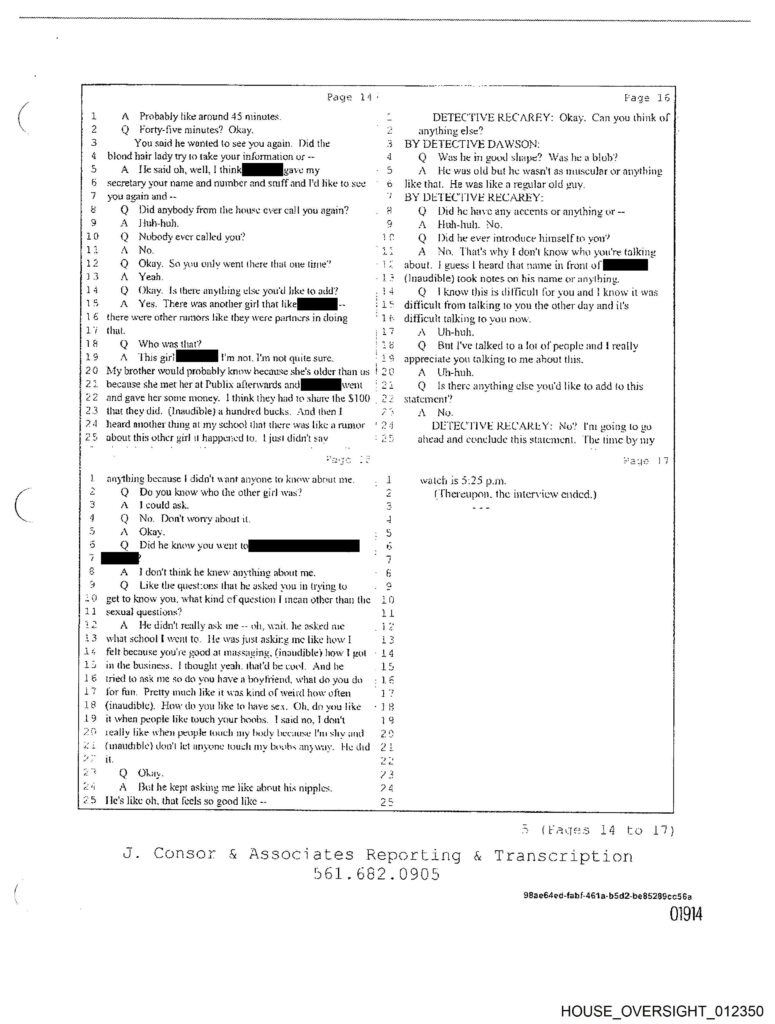
| HOUSE_OVERSIGHT_012350 | Transcript pages 14 through 17, one visit, no later call, other reports, identity questions, conclusion |
| HOUSE_OVERSIGHT_012351 | Transcript page 18, court reporter certificate dated January 30, 2007 |
What the Record Establishes
The released pages establish that:
- Palm Beach police conducted a taped interview on December 13, 2005.
- Detectives Recarey and Dawson participated.
- The interviewee was 17 and had parental authorization to speak with police.
- Recarey placed the survivor under oath.
- She said the incident occurred in December 2004, when she was 16.
- She described being recruited for a paid massage at a Palm Beach residence associated in the investigation with Jeffrey Epstein.
- She described being escorted upstairs by a woman with long blonde hair.
- She testified that the man removed his clothing, directed her to undress, touched her sexually, and penetrated her with his fingers.
- She described fear, hesitation, backing away, and shaking her head no.
- She said she received $200 and was offered an additional $100 in connection with returning.
- She said she visited only once and received no later call from the residence.
- The interview concluded at 5:25 p.m.
- Sandra Rossi certified the transcript on January 30, 2007.
What the Record Does Not Establish
The released pages do not establish that:
- the survivor knew the man’s identity before entering the residence;
- the excerpt contains the identification procedure linking the man to Epstein;
- every woman or girl observed at the residence experienced sexual contact;
- the survivor knew the identity or role of every woman present;
- every rumor about another student was accurate;
- the person who arranged the visit independently admitted advance knowledge of the assault;
- the extra $100 was accepted as agreement to return;
- every inaudible or redacted passage can be reconstructed;
- the certificate proves the truth of every statement rather than the accuracy of the transcript as a record of the tape;
- Tab 7 contains the entire investigative file or all corroborating evidence.
Reliability and Limitations
The interview is a contemporaneous sworn account recorded roughly one year after the incident described. The survivor supplied sensory and spatial details, described her own actions and emotional response, and distinguished what she experienced from rumors concerning others.
The transcript was certified by a court reporter. That strengthens confidence that it reflects the tape she reviewed. However, several passages remain inaudible or degraded, and the scan’s OCR contains substantial errors.
The survivor did not say that the man introduced himself as Jeffrey Epstein. Identification therefore depends on surrounding investigative evidence that is not reproduced in Tab 7. The interview also contains secondhand claims about other people that require separate corroboration.
The survivor’s name, date of birth, school, and other identifying information are redacted. Those redactions should be preserved. They must not be reverse engineered through age, school rumors, family information, or social relationships.
Fact Check
Claim: The evidence is numbered EFTA012345 through EFTA012351.
Finding: Incorrect identifier. The indexed pages are HOUSE_OVERSIGHT_012345 through HOUSE_OVERSIGHT_012351.
Claim: The interview occurred in December 2004.
Finding: Incorrect. The interview occurred on December 13, 2005. The survivor said the incident occurred in December 2004.
Claim: The interviewee was 17 during the alleged assault.
Finding: Incorrect. She was 17 when interviewed and said she was 16 during the incident.
Claim: Her mother authorized the police interview.
Finding: Supported. Detective Recarey stated that he had spoken with her mother and received authorization.
Claim: The survivor consented because she agreed to provide a massage.
Finding: False and unsupported. She described agreeing to a massage, not sexual contact. She testified that she was frightened, hesitant, moved away, and shook her head no.
Claim: The survivor identified the man by name during the encounter.
Finding: Not supported. She said he did not introduce himself. The excerpt does not reproduce a separate identification procedure.
Claim: The transcript is certified.
Finding: Supported. Court reporter Sandra Rossi certified on January 30, 2007 that it was a true and complete record of the tape as she heard it.
Claim: Certification proves every allegation was true.
Finding: Incorrect. Certification addresses the transcript’s relationship to the tape, not independent proof of the underlying events.
Questions Still Unanswered
- What evidence did police use to connect the residence and unidentified man described by the survivor to Jeffrey Epstein?
- Did the survivor later complete a photographic or in person identification?
- Who escorted the survivor upstairs?
- Who asked the survivor’s name and purpose at the rear entrance?
- Who arranged the visit, and what did that person know before bringing the survivor?
- Was the reported threat investigated as intimidation or witness interference?
- Did police locate and interview the girl seen leaving before the survivor went upstairs?
- Were the school rumors corroborated through separate witness statements?
- What payment, appointment, telephone, driver, or message records corroborate the December 2004 visit?
- Was a victim advocate or other support professional present or offered?
- Why was the tape transcribed and certified more than a year after the interview?
- Which larger investigative or litigation file originally contained Tab 7?
Important Epstein Data Evidence Files
- Tab 7 cover, HOUSE_OVERSIGHT_012345
- Interview title page, HOUSE_OVERSIGHT_012346
- Interview opening and recruitment account, HOUSE_OVERSIGHT_012347
- Account of the upstairs room and sexual assault, HOUSE_OVERSIGHT_012348
- Post incident disclosure and police reassurance, HOUSE_OVERSIGHT_012349
- Final questioning and interview conclusion, HOUSE_OVERSIGHT_012350
- Court reporter certificate, HOUSE_OVERSIGHT_012351
- Palm Beach Police probable cause affidavit, HOUSE_OVERSIGHT_018894
- Probable cause affidavit discussion of former household employees, HOUSE_OVERSIGHT_018914
- Probable cause affidavit conclusion and telephone analysis, HOUSE_OVERSIGHT_018915
Related EpsteinWiki Pages
- Jeffrey Epstein
- Palm Beach Police Department
- Detective Joseph Recarey
- Palm Beach Police Department Probable Cause Affidavit
- Law Enforcement Interview Transcripts
- House Oversight Committee Evidence Files
Source List
- Tab 7 complete evidence range beginning with HOUSE_OVERSIGHT_012345
- Court reporter certification, HOUSE_OVERSIGHT_012351
- Department of Justice Office of Professional Responsibility Executive Summary
- House Oversight Committee release of additional Epstein estate documents
Exact identifier, quotation, interviewer, and court reporter searches did not locate a relevant article from an EpsteinWiki sleuth Substack. No unrelated Substack source has been added simply to populate the source list.