Sworn Statement Taken in the Jeffrey Epstein Investigation
Tab 5 contains a ten minute sworn statement taken by Jeffrey Epstein’s defense attorneys on March 21, 2008. The witness described a single paid visit to Epstein’s Palm Beach residence. She denied sexual contact with Epstein and repeatedly agreed with defense counsel’s characterization of the visit as voluntary and consensual.
The statement is not a police or prosecution interview. Jack Goldberger and Lilly Ann Sanchez identified themselves as attorneys representing Epstein. Their questions repeatedly suggested the desired answer, emphasized that no one persuaded the witness to engage in sexual activity, and sought agreement that Epstein would respect a refusal.
The statement nevertheless contains evidence that complicates its defense purpose. The witness said she needed money, understood that she had to convince Epstein or those around him that she was over 18, and believed girls working around Epstein were telling recruits to lie about their ages. She also stated that Epstein wanted and created the arrangement while having girls perform the work of bringing in more business.
Snapshot
Evidence range: HOUSE_OVERSIGHT_012255 through HOUSE_OVERSIGHT_012280
Tab: Tab 5
Document type: Sworn statement arranged and conducted by Epstein’s defense attorneys
Statement date: March 21, 2008
Statement time: 12:05 p.m. through 12:15 p.m.
Location: 250 Australian Avenue South, Suite 1400, West Palm Beach, Florida
Questioning attorney: Jack A. Goldberger
Also present: Lilly Ann Sanchez
Reported by: Judith F. Consor, Florida professional reporter and notary public
Transcript length: 19 substantive pages plus notary and reporter certifications
Strongest defense evidence: The witness denied that Epstein sexually touched her, masturbated in front of her, threatened her, supplied drugs or alcohol, or asked her to have sex.
Strongest investigative evidence: The witness agreed that she needed to present herself as over 18 and stated that Epstein created the system while girls working around him brought in the business.
Central limitation: Epstein’s own attorneys conducted an extremely brief and highly leading examination without visible participation by police, prosecutors, or independent counsel for the witness.
Key Takeaways
- The correct identifiers are
HOUSE_OVERSIGHT_012255throughHOUSE_OVERSIGHT_012280. - Tab 5 contains a sworn statement taken on March 21, 2008.
- Epstein’s defense attorneys, not law enforcement officers, conducted the questioning.
- The witness appeared voluntarily and was placed under oath.
- She described one visit to Epstein’s Palm Beach residence for a paid massage.
- She denied sexual contact, threats, drugs, alcohol, masturbation, travel with Epstein, or later contact from his organization.
- She said she went because she needed money after funds were removed from her bank account.
- Goldberger asked her to agree that it was important to convince Epstein she was over 18, and she agreed.
- She said girls involved in bringing recruits told people to lie about their ages so the business and payments would continue.
- She stated that Epstein wanted and set up the arrangement even though girls performed much of the recruitment work.
- The transcript was certified by Judith Consor on March 22, 2008.
- The final four production pages contain little or no substantive text.
Identifier Correction
The evidence is indexed as HOUSE_OVERSIGHT_012255 through HOUSE_OVERSIGHT_012280. These pages should not be cited as EFTA012255 through EFTA012280.
The production prefix is essential because the Epstein Data archive includes several numbering systems. Similar numbers under the EFTA series refer to different evidence.
Document Structure
HOUSE_OVERSIGHT_012255 is a cover marked TAB 5. HOUSE_OVERSIGHT_012256 is the title page. It identifies the matter as concerning Jeffrey Epstein and dates the statement to Friday, March 21, 2008.
HOUSE_OVERSIGHT_012257 lists Jack Goldberger as appearing on behalf of the defendant and identifies Lilly Ann Sanchez as also present. Goldberger later stated on the record that both attorneys represented Epstein in matters under investigation in Palm Beach County.
The sworn statement occupies transcript pages 3 through 19. Transcript page 20 contains the notary certificate. Transcript page 21 contains the court reporter’s certificate. Production pages 012277 through 012280 correspond to transcript pages 22 through 25 and contain no meaningful interview text.
Timing Within the Epstein Case
The statement was taken after the September 24, 2007 federal nonprosecution agreement but before Epstein entered his state guilty pleas on June 30, 2008. That timing is important.
The Department of Justice Office of Professional Responsibility executive summary states that Epstein’s defense team continued seeking changes to the negotiated resolution for months after the agreement was signed. The defense also argued that the matter should remain under state control and that federal intervention was unnecessary.
Tab 5 therefore appears within an active defense effort to collect evidence favorable to Epstein while the ultimate state resolution remained unsettled. The transcript does not identify the precise filing, negotiation, or evidentiary submission for which the statement was obtained.
The Witness and Privacy
The released transcript redacts much of the witness’s personal information, including her birth date, home address, and the names of several people connected to the visit. One later certification page appears to contain a name, creating an inconsistency within the production.
Because the statement concerns a person who was allegedly under 18 when she visited Epstein, this article refers to her only as the witness. It does not use surviving personal details to reconstruct her identity or the identities of other possible survivors and recruiters.
The record indicates that the witness lived with family and a young child at the time of the statement. Those facts are not relevant enough to justify repeating additional personal information.
Who Conducted the Statement
Jack Goldberger conducted nearly all of the questioning. Lilly Sanchez was present and occasionally reminded him of a question. Both were identified as Epstein’s attorneys.
No police officer, FBI agent, state prosecutor, federal prosecutor, victim advocate, or attorney representing the witness is identified as present. The witness said she came voluntarily.
Judith Consor administered the oath and transcribed the proceeding. The presence of a court reporter and the administration of an oath make the statement formal, but they do not make the questioning neutral or convert defense counsel into government investigators.
A Highly Leading Examination
The transcript is dominated by leading questions. Goldberger frequently supplied the conclusion he wanted the witness to confirm. He asked whether the visit was entirely voluntary and consensual, whether no one persuaded or enticed her to engage in sexual activity, whether Epstein would absolutely respect a refusal, and whether the atmosphere made clear that she could say no.
He also framed answers before the witness supplied them. For example, he said he assumed Epstein never threatened her and suggested that she had described Epstein as a nice man. The witness generally agreed with those formulations.
Leading questions are not automatically invalid. They can clarify a record and are common when an attorney interviews a cooperative witness. They matter here because the statement was created by the subject’s defense team and lasted only ten minutes.
The structure makes the transcript evidence of what the witness affirmed under defense questioning. It is not an independent investigative interview designed to explore all possible interpretations, contradictions, trauma responses, or corroborating evidence.
What the Witness Was Told Before the Visit
On transcript pages 5 and 6, the witness said she had heard about Epstein before visiting his residence. She described being told that girls were arranging for other girls to provide massages.
She said the visit was presented as a short massage with no physical contact beyond the massage itself. She recalled that the payment would be either $100 or $200 for approximately half an hour but was uncertain because time had passed.
The witness also said she was told Epstein might ask whether she wanted to do something else and that she could say yes or no. She denied being told that she had to engage in sexual activity.
This distinction should be preserved. Being warned that an adult might make an unspecified request does not provide complete advance disclosure of what may occur. It also does not resolve whether an underage person can legally consent to the conduct at issue.
The Single Visit to Epstein’s Residence
The witness said she visited Epstein’s house once. One person brought her to another location, and another person drove her to the residence while additional people followed. Names are redacted.
She described the purpose as earning money through a massage. The witness said she wore jeans and a tee shirt and had not been instructed to dress in a particular way.
According to her statement, Epstein told her in the room that she could refuse anything she did not want to do. She described the encounter as voluntary and said she did not feel afraid or threatened.
The transcript’s poor OCR and extensive redactions obscure portions describing the massage itself. Clear passages later establish that the witness denied genital touching, masturbation, penetration, oral sex, or other sexual contact.
Denials of Sexual Conduct
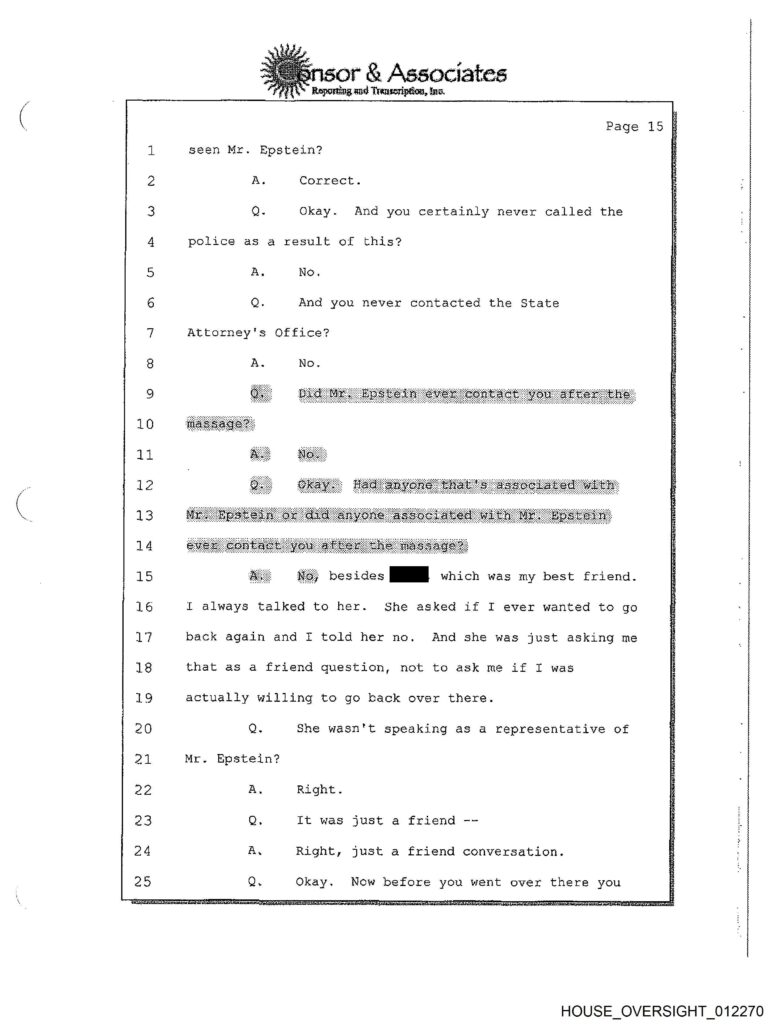
On transcript pages 12 through 14, Goldberger asked a rapid series of questions about sexual conduct. The witness denied that Epstein touched her private parts. After one question, the participants went off the record for an unidentified discussion and then resumed.
The witness denied that Epstein touched his penis, masturbated in front of her, asked her to touch him, had sex with her, engaged in oral sex, or penetrated her with his fingers.
She also denied that Epstein threatened her, provided drugs, or offered alcohol. She said she was not afraid and described him as nice in connection with her own experience.
These denials are direct evidence about the witness’s account of her single visit. They do not establish what occurred during visits involving other people.
Money and Economic Pressure
The witness testified that she needed money because a boyfriend had removed funds from her bank account. She said the account was short by approximately $200.
Her description indicates that she received $300, deposited $200 to cover the shortage, and gave approximately $100 to the person who transported or referred her. This appears to differ from the standard payment amount she initially recalled, which she described as either $100 or $200.
Goldberger asked whether her debt made it important to convince Epstein that she was over 18 because she wanted the job. The witness answered yes.
That exchange is central. It connects economic need to age misrepresentation and establishes that the witness was not simply discussing an ordinary adult massage appointment. Her eligibility depended on presenting herself as legally older than she was.
Age Misrepresentation
The statement does not clearly preserve the witness’s exact age at the time of the visit because identifying information and several surrounding lines are redacted or degraded. It does, however, contain Goldberger’s direct proposition that she needed to convince Epstein she was over 18, followed by her agreement.
The witness said the girls who were bringing in recruits told people to lie. She connected those instructions to maintaining the business and ensuring that referral payments continued.
This is evidence that age was an operational concern within the recruitment system. It does not establish that every young woman lied, that fake identification was shown, or that Epstein reasonably relied on any representation.
An adult cannot establish lack of knowledge simply by pointing to a minor’s false statement. Investigators would need to examine what Epstein knew from appearance, conversation, school status, repeated exposure to teenagers, staff communications, records, warnings, and the conduct of recruiters.
The Witness’s Statements About the Recruitment System
The most consequential section appears on transcript pages 17 and 18. The witness said she believed the girls working around Epstein were doing the recruiting and telling others to lie so they could bring in business and receive payment.
She also referred to Epstein transporting girls and renting cars for them. The statement does not identify every trip or rental and does not establish how she learned all of those details.
Most importantly, the witness said, in substance, that the arrangement was what Epstein wanted and what he set up. She then said he had the girls doing the work for him, which placed them at greater risk of getting into trouble for bringing in the business.
That statement undermines a simple defense theory that recruitment was created independently by young women around Epstein. Even while assigning substantial responsibility to recruiters, the witness identified Epstein as the person who desired and established the system.
Recruitment, Responsibility, and Power
The witness’s statement illustrates how a recruitment system can shift visible risk downward. Young women performed the direct work of approaching peers, arranging transportation, and passing along instructions. Epstein remained the adult client, source of payment, and beneficiary of the system.
The fact that a young person recruited another person can be relevant to accountability. It does not erase the adult’s role in creating financial incentives, requesting new participants, or accepting underage recruits.
The witness’s statement that girls were more likely to get in trouble than Epstein is particularly revealing. It describes a structure in which intermediaries were exposed while the wealthy adult at the center remained insulated.
Travel and Rental Cars
The witness denied ever traveling with Epstein or leaving Florida to meet him. She said she had heard that other girls traveled.
Near the end of the statement, she referred to Epstein transporting girls and renting cars for them. These claims were not explored in detail. Goldberger did not ask for dates, locations, vehicle records, payment records, or names that would allow the statements to be tested.
The travel and rental comments are therefore investigative leads. They should be compared with flight logs, passenger records, rental agreements, driver records, calendars, and testimony from the people directly involved.
No Police Complaint by This Witness
The witness said she did not call police or contact the State Attorney’s Office after her visit. She also said she did not return to Epstein’s residence.
Goldberger used the absence of a complaint within a broader series of questions portraying the encounter as harmless. Failure to report, however, does not independently prove that no exploitation occurred. People may not recognize conduct as unlawful, may fear consequences, may minimize it, or may simply choose not to involve authorities.
In this particular statement, the witness expressly denied sexual contact and said she did not feel threatened. Both facts should be reported. They should not be generalized to other witnesses or survivors.
Epstein Described as Nice
The witness said Epstein was a nice man in her experience. She added that she was not trying to defend everything he may have done and acknowledged that he may have been wrong in other parts of the case.
Her distinction is important. She did not claim to know that every allegation against Epstein was false. She limited her favorable description to her own single interaction.
A person can experience an alleged offender as polite, generous, or nonthreatening while others experience abuse. Favorable character evidence from one encounter does not disprove specific allegations from other witnesses.
Off the Record Discussion
During the questioning about whether Epstein touched the witness’s private areas, Goldberger requested that the participants go off the record. The transcript notes that a discussion occurred and then resumed.
The contents of that discussion are not preserved. It is not possible to determine whether the pause concerned wording, privacy, legal advice, the witness’s comfort, or another subject.
The missing exchange is a limitation because it occurred at a sensitive point in the questioning. Researchers should note the gap without speculating about what was said.
Conclusion of the Statement
Goldberger concluded by asking the witness to confirm that he had not coerced her, that he wanted the truth, and that she had answered truthfully. She agreed.
The statement ended at 12:15 p.m., only ten minutes after it began. The short duration is striking given the breadth of subjects covered, including age, sexual conduct, transportation, travel, threats, drugs, consent, recruitment, and who designed the system.
The witness’s willingness to appear and answer under oath is evidence of cooperation. The brevity and leading structure still limit how much the statement can establish.
Certification
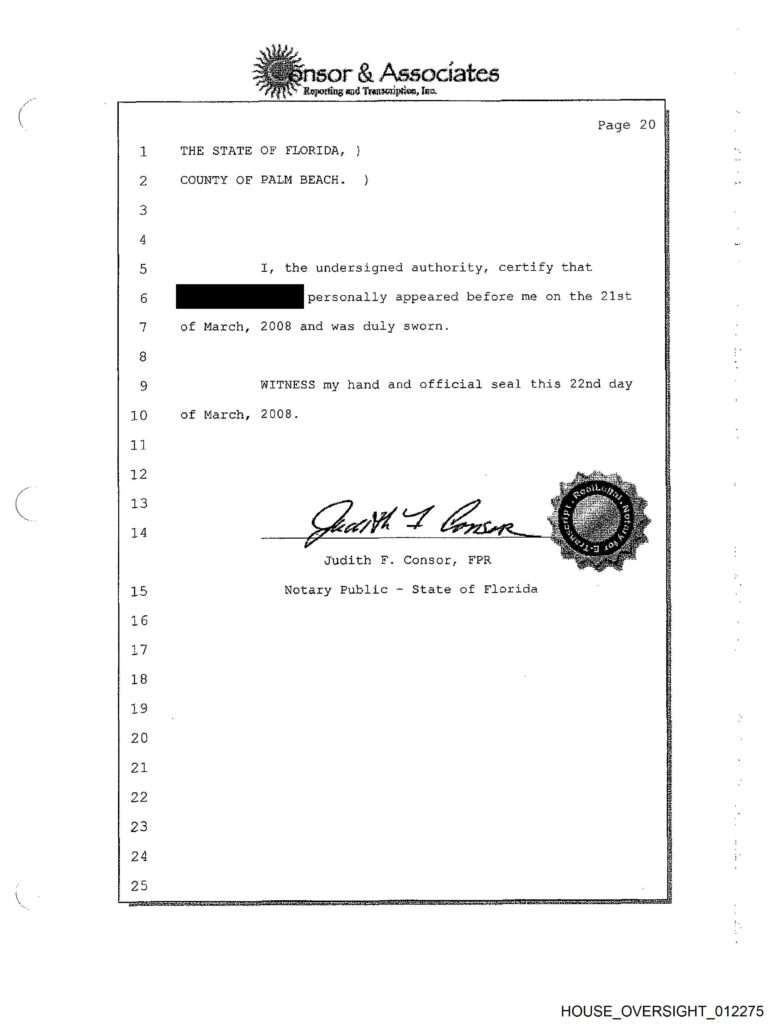
HOUSE_OVERSIGHT_012275 contains the notary certification that the witness personally appeared and was duly sworn on March 21, 2008. The notary signed the certificate on March 22.
HOUSE_OVERSIGHT_012276 contains Judith Consor’s court reporter certificate. She certified that she stenographically reported the sworn statement and that transcript pages 1 through 19 were a true and correct transcription of her notes.
The certificate also states that no transcript review was requested and that Consor was not an attorney, relative, employee, or financially interested party connected to the action.
Certification establishes the transcript’s relationship to the reporter’s notes. It does not establish that every answer was accurate or that the questioning was neutral.
Evidentiary Value
Tab 5 has evidentiary value in both directions. For the defense, it records a witness denying sexual conduct, threats, intoxication, travel, and coercion during her single visit.
For investigators, it records an apparent minor describing financial pressure, the need to appear over 18, instructions from recruiters to lie about age, transportation and rental cars, and a system she said Epstein wanted and created.
The statement also shows how Epstein’s attorneys gathered sworn testimony during the period between the nonprosecution agreement and his state guilty pleas. Its format reveals the defense theory as much as it reveals the witness’s memory.
Page Guide
| Evidence range | Contents |
|---|---|
| HOUSE_OVERSIGHT_012255 | Tab 5 cover |
| HOUSE_OVERSIGHT_012256 | Title page, statement date, time, location, and reporter |
| HOUSE_OVERSIGHT_012257 | Appearances for Epstein’s defense |
| HOUSE_OVERSIGHT_012258 through 012261 | Oath, voluntary appearance, personal background, introduction to Epstein and massage offer |
| HOUSE_OVERSIGHT_012262 through 012266 | Advance information, possible additional requests, consent focused questioning, one visit and no travel |
| HOUSE_OVERSIGHT_012267 through 012270 | Denials of sexual conduct, threats, drugs, alcohol, fear, and police complaints |
| HOUSE_OVERSIGHT_012271 through 012273 | Debt, payment, age misrepresentation, recruiter instructions, and witness’s statement about Epstein setting up the system |
| HOUSE_OVERSIGHT_012274 | Noncoercion questions and conclusion at 12:15 p.m. |
| HOUSE_OVERSIGHT_012275 | Notary certification |
| HOUSE_OVERSIGHT_012276 | Court reporter certificate |
| HOUSE_OVERSIGHT_012277 through 012280 | Largely blank final transcript and production pages |
What the Record Establishes
The released pages establish that:
- Epstein’s defense attorneys took a sworn statement on March 21, 2008;
- the witness appeared voluntarily and was placed under oath;
- the statement lasted ten minutes;
- the witness said she visited Epstein’s residence once for a paid massage;
- she denied sexual contact, threats, fear, drugs, alcohol, and travel with Epstein;
- she described the visit as voluntary and consensual;
- she connected economic need to her decision to accept the massage work;
- she agreed that she needed to convince Epstein or those around him that she was over 18;
- she said girls recruiting for Epstein instructed people to lie about age;
- she referred to travel and rental cars involving other girls;
- she stated that the system was what Epstein wanted and what he set up;
- she described young women performing the direct recruitment work;
- Judith Consor certified the transcript on March 22, 2008.
What the Record Does Not Establish
The released pages do not establish that:
- law enforcement conducted or participated in the statement;
- the witness had independent legal representation;
- the visit was ordinary commercial massage work merely because sexual contact was denied;
- the witness was legally capable of consenting to every possible request;
- Epstein reasonably believed every person was over 18;
- every recruiter instructed minors to lie;
- every person who visited Epstein experienced the same conduct as this witness;
- no abuse occurred because this witness did not contact police;
- all travel and rental car claims were based on firsthand knowledge;
- the off the record discussion can be reconstructed;
- the statement was reviewed and corrected by the witness;
- the sworn answers establish the truth of allegations involving other people.
Reliability and Limitations
The statement was given under oath, transcribed by a court reporter, and certified. Those features support its authenticity as a record of what was said.
The witness spoke from personal knowledge about her own visit, payment, reasons for attending, and lack of further contact. Her statements about other girls, travel, rental cars, and the wider recruitment system may include secondhand information.
The questioning was conducted entirely by Epstein’s defense team and was strongly leading. No adversarial or neutral interviewer tested the answers. The statement lasted only ten minutes and included an off the record discussion at a sensitive point.
OCR quality is poor on several pages. Some pages contain large blocks of unreadable or redacted text. Researchers should consult the scans before quoting any unclear language.
The transcript was not reviewed by the witness. The reporter’s certificate expressly says that review was not requested.
Fact Check
Claim: The range is EFTA012255 through EFTA012280.
Finding: Incorrect identifier. The pages use HOUSE_OVERSIGHT_012255 through HOUSE_OVERSIGHT_012280.
Claim: Police or FBI agents took the sworn statement.
Finding: Incorrect. Epstein’s defense attorneys conducted the examination.
Claim: The witness accused Epstein of sexually assaulting her.
Finding: Incorrect. She denied sexual touching, masturbation, penetration, threats, drugs, and alcohol during her visit.
Claim: The statement proves Epstein never abused anyone.
Finding: False. The witness described only her own single visit and acknowledged that Epstein may have been wrong in other parts of the case.
Claim: The witness was over 18 during the visit.
Finding: Not supported. She agreed that she needed to convince Epstein she was over 18, which indicates that age was disputed and that she was apparently under 18.
Claim: Young women created the recruitment system without Epstein.
Finding: Contradicted by the witness’s own statement. She said the arrangement was what Epstein wanted and what he set up, while girls performed the work of bringing in recruits.
Claim: The witness was independently represented.
Finding: Not established. The transcript identifies counsel for Epstein but no attorney for the witness.
Claim: The statement was certified.
Finding: Supported. Judith Consor certified the transcript on March 22, 2008.
Claim: The witness reviewed the completed transcript.
Finding: Incorrect. The reporter’s certificate says transcript review was not requested.
Questions Still Unanswered
- Why did Epstein’s defense attorneys seek this statement in March 2008?
- Was the transcript submitted to prosecutors, a court, or another decision maker?
- Did the witness have an attorney or victim advocate who was not listed in the appearances?
- What was discussed during the off the record conference?
- What was the witness’s exact age when she visited Epstein?
- Who told the witness to represent herself as over 18?
- Did Epstein or anyone in his household request or inspect identification?
- Who received the approximately $100 the witness said she paid after the visit?
- What records corroborate the $300 payment and the witness’s bank account explanation?
- Who arranged transportation to Epstein’s residence?
- What was the basis for the witness’s knowledge about travel and rental cars?
- What did she mean when she said Epstein wanted and set up the system?
- Were the recruiters themselves minors when Epstein began paying or directing them?
- Did investigators compare this statement with telephone, payment, appointment, and travel records?
- Why was transcript review not requested?
- Why do later pages appear to disclose information that earlier pages redact?
- Which parent filing or evidentiary submission organized the statement as Tab 5?
Important Epstein Data Evidence Files
- Tab 5 cover, HOUSE_OVERSIGHT_012255
- Sworn statement title page, HOUSE_OVERSIGHT_012256
- Defense appearances, HOUSE_OVERSIGHT_012257
- Oath and opening questions, HOUSE_OVERSIGHT_012258
- Description of the massage arrangement, HOUSE_OVERSIGHT_012260
- Questions about advance sexual persuasion, HOUSE_OVERSIGHT_012263
- Defense consent framing, HOUSE_OVERSIGHT_012266
- Denials of sexual conduct, HOUSE_OVERSIGHT_012268
- Denials of threats, drugs, and alcohol, HOUSE_OVERSIGHT_012269
- Economic pressure and age representation, HOUSE_OVERSIGHT_012272
- Witness’s description of Epstein’s role in the recruitment system, HOUSE_OVERSIGHT_012273
- Statement conclusion, HOUSE_OVERSIGHT_012274
- Notary certificate, HOUSE_OVERSIGHT_012275
- Court reporter certificate, HOUSE_OVERSIGHT_012276
Related EpsteinWiki Pages
- Jeffrey Epstein
- Jack Goldberger
- Lilly Ann Sanchez
- State of Florida v. Jeffrey Epstein
- Epstein Nonprosecution Agreement
- Palm Beach Police Department Investigation
- Sworn Statements and Interview Transcripts
- House Oversight Committee Evidence Files
Source List
- Tab 5 evidence range beginning with HOUSE_OVERSIGHT_012255
- Statement conclusion, HOUSE_OVERSIGHT_012274
- Court reporter certification, HOUSE_OVERSIGHT_012276
- Department of Justice Office of Professional Responsibility Executive Summary
- House Oversight Committee release of additional Epstein estate documents
Exact identifier, witness name, attorney name, and quotation searches did not locate a directly relevant EpsteinWiki sleuth Substack article. No unrelated Substack source has been inserted merely to populate the source list.