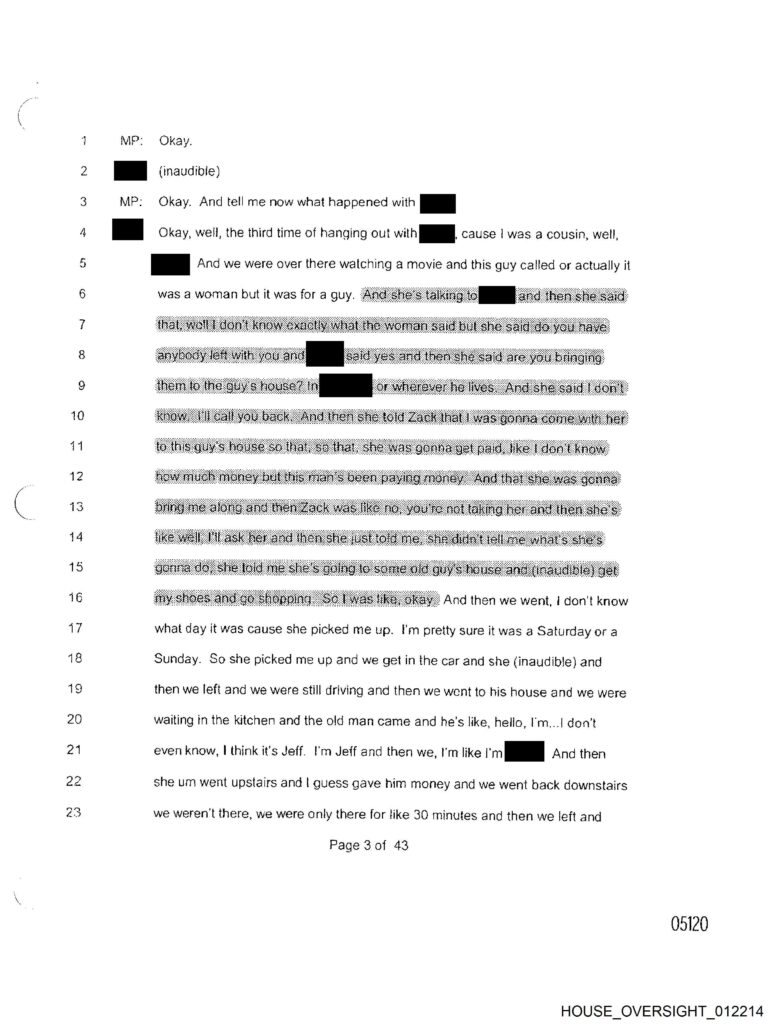
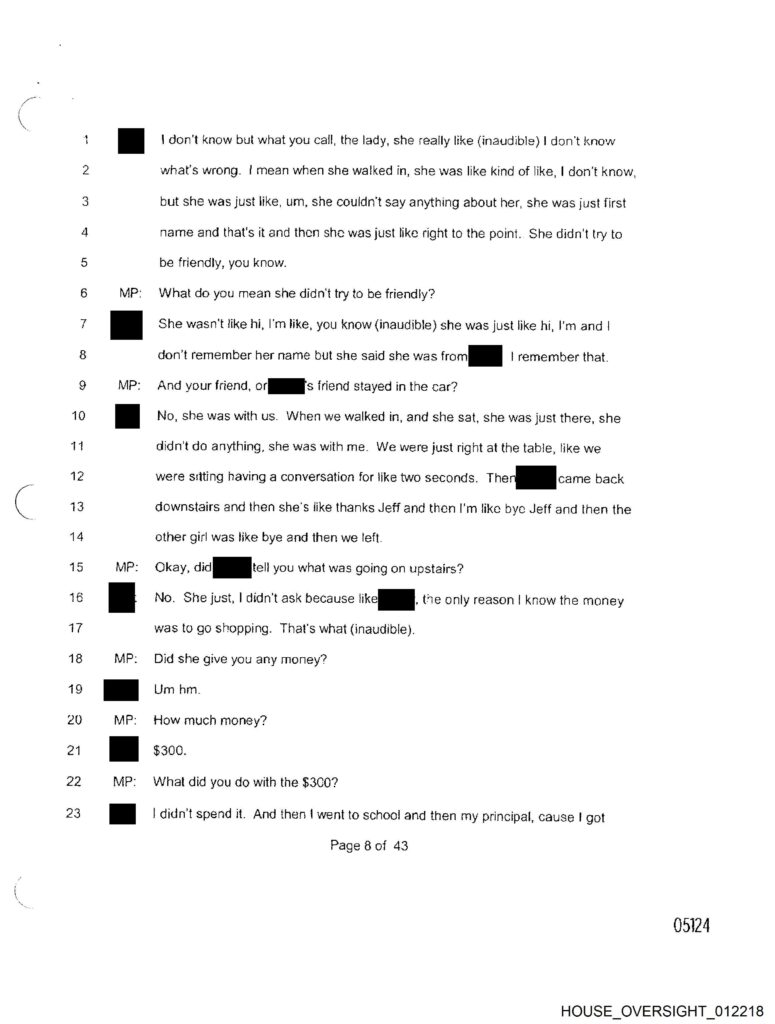
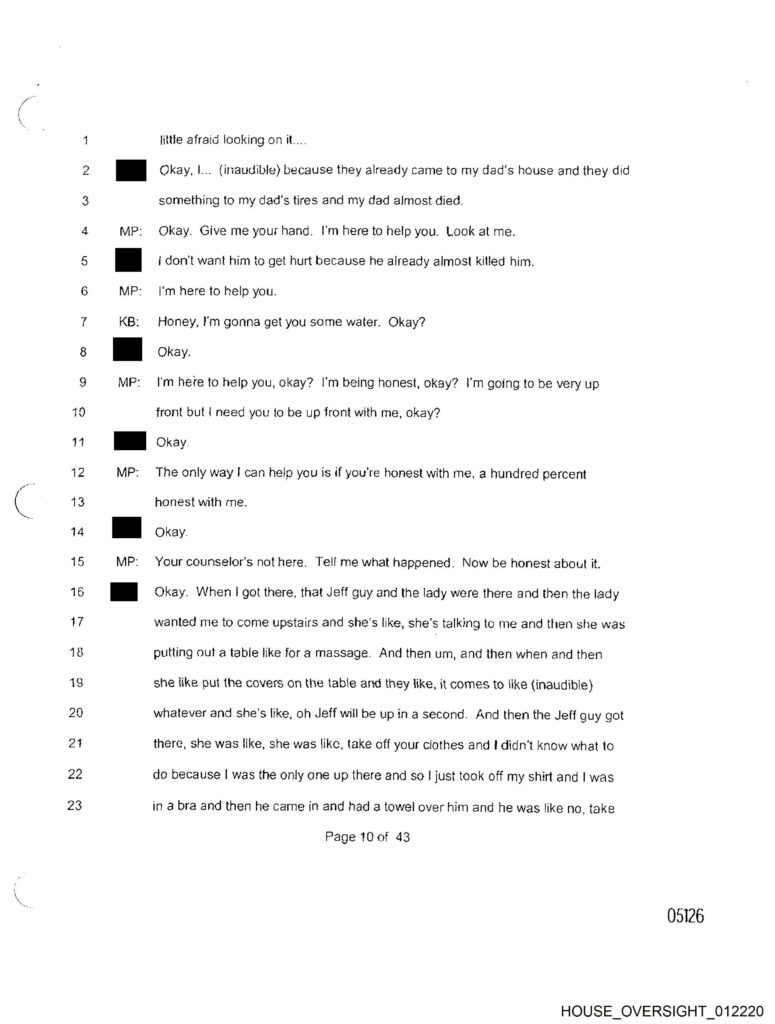
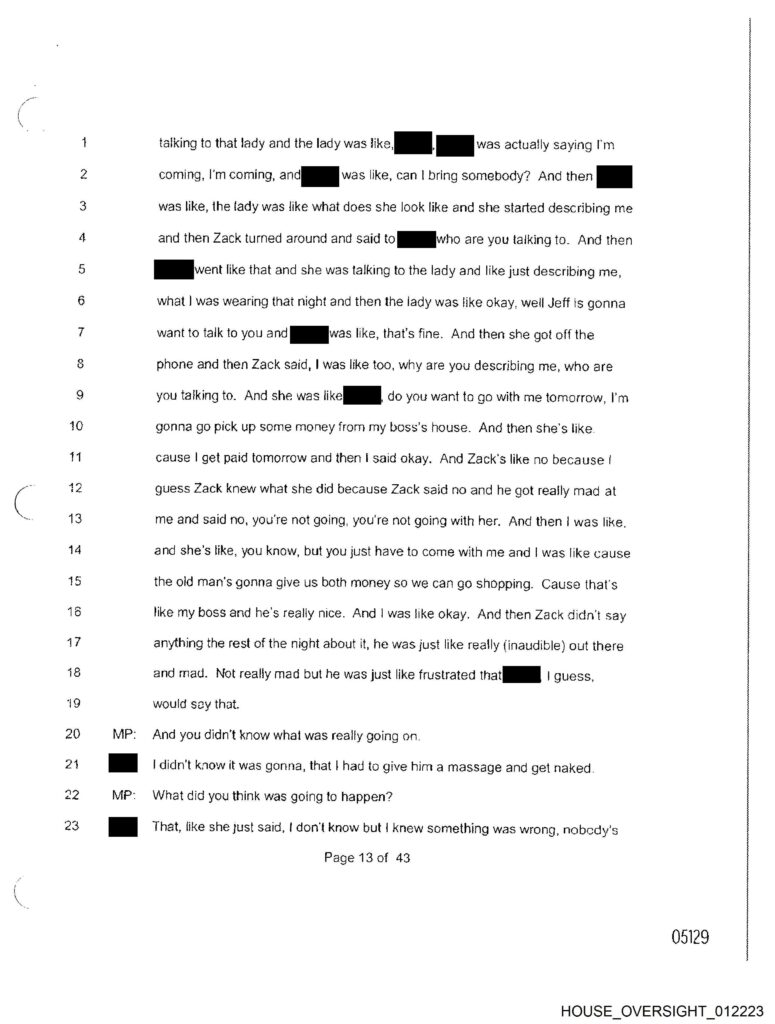
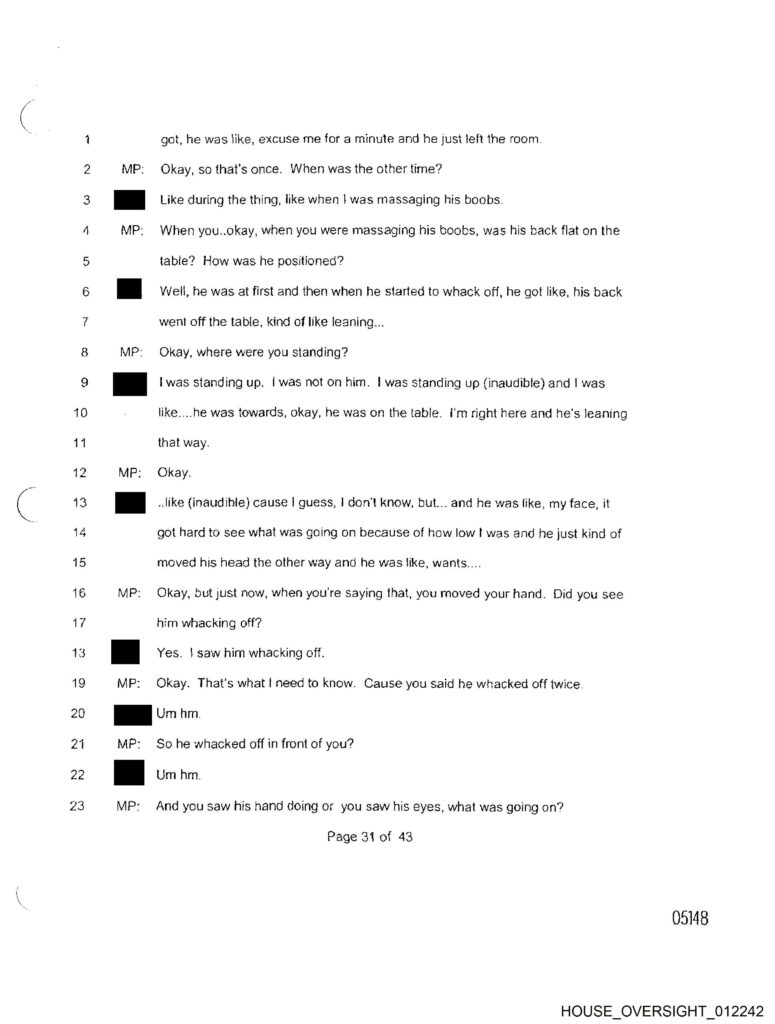
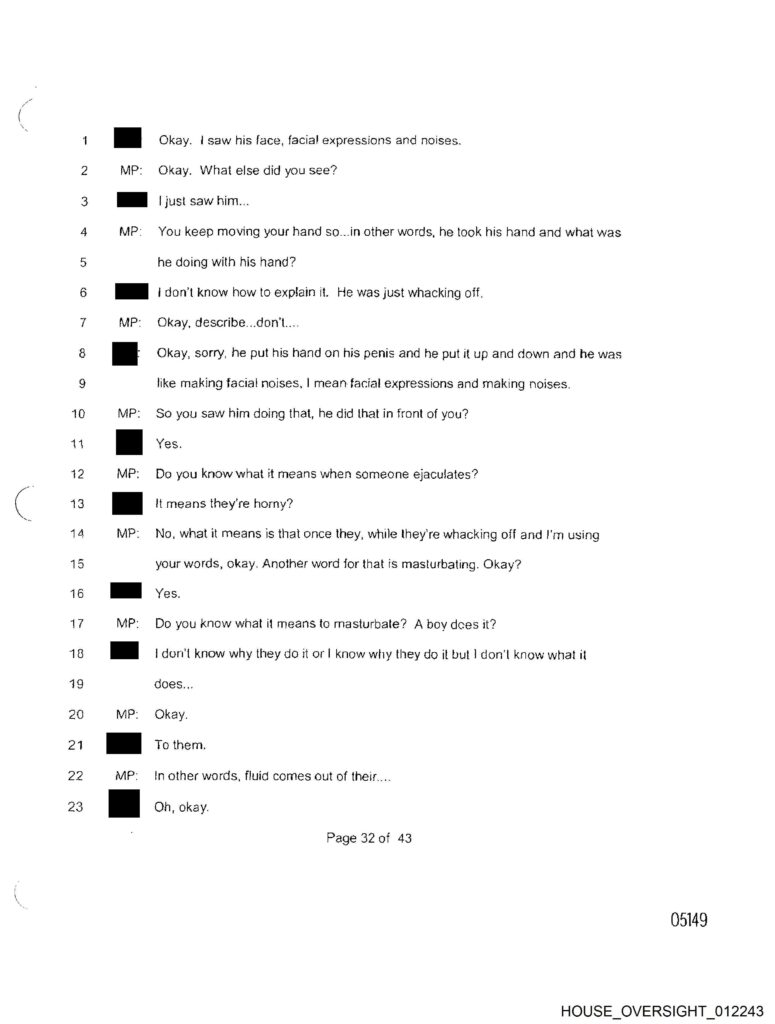
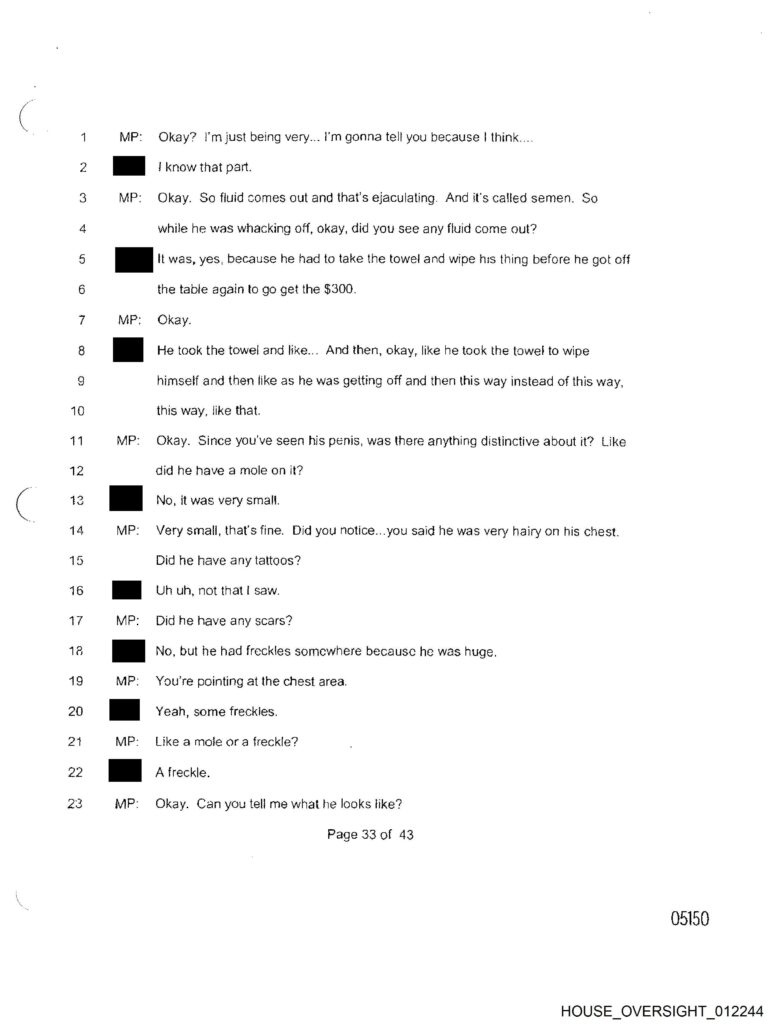
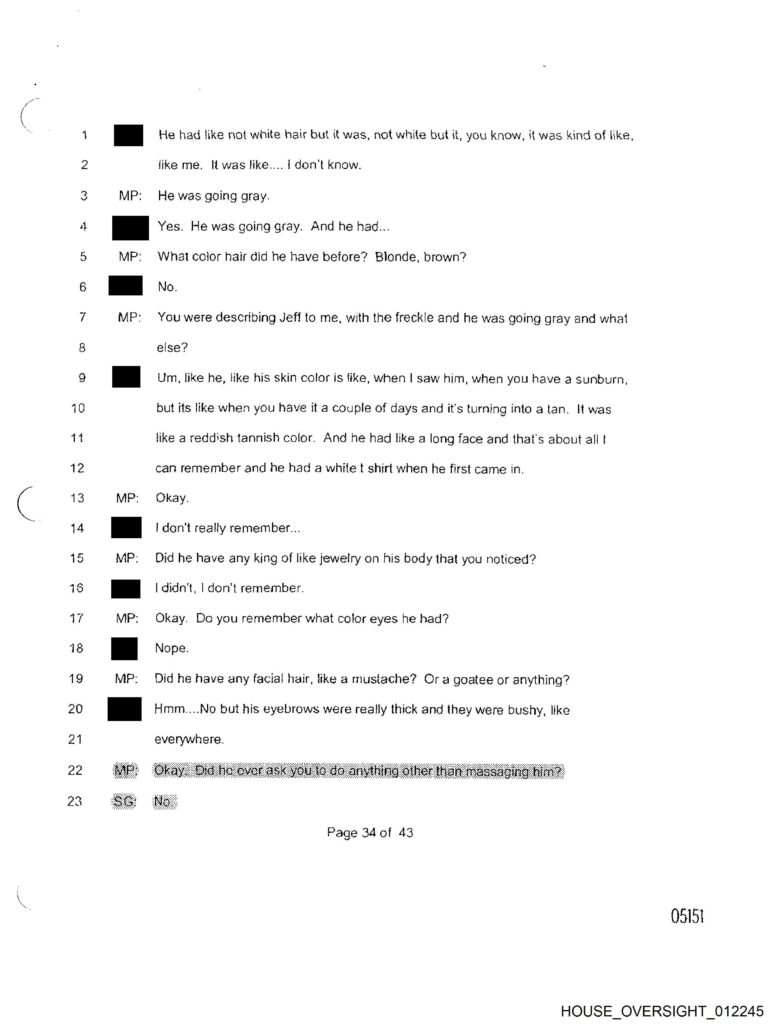
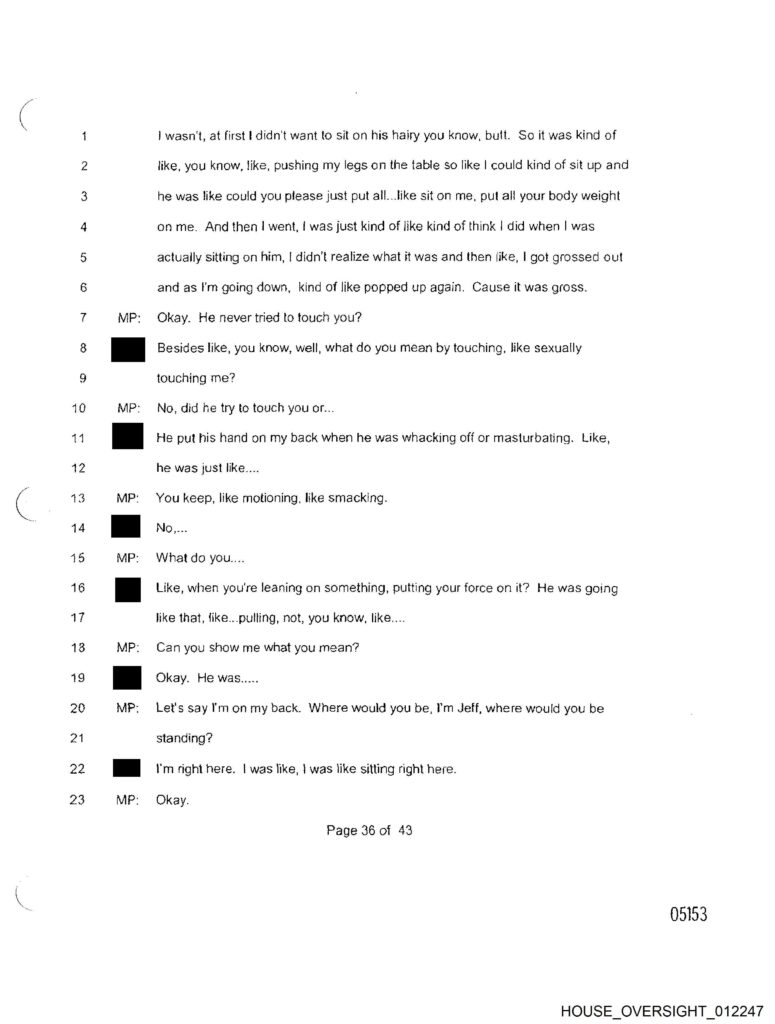
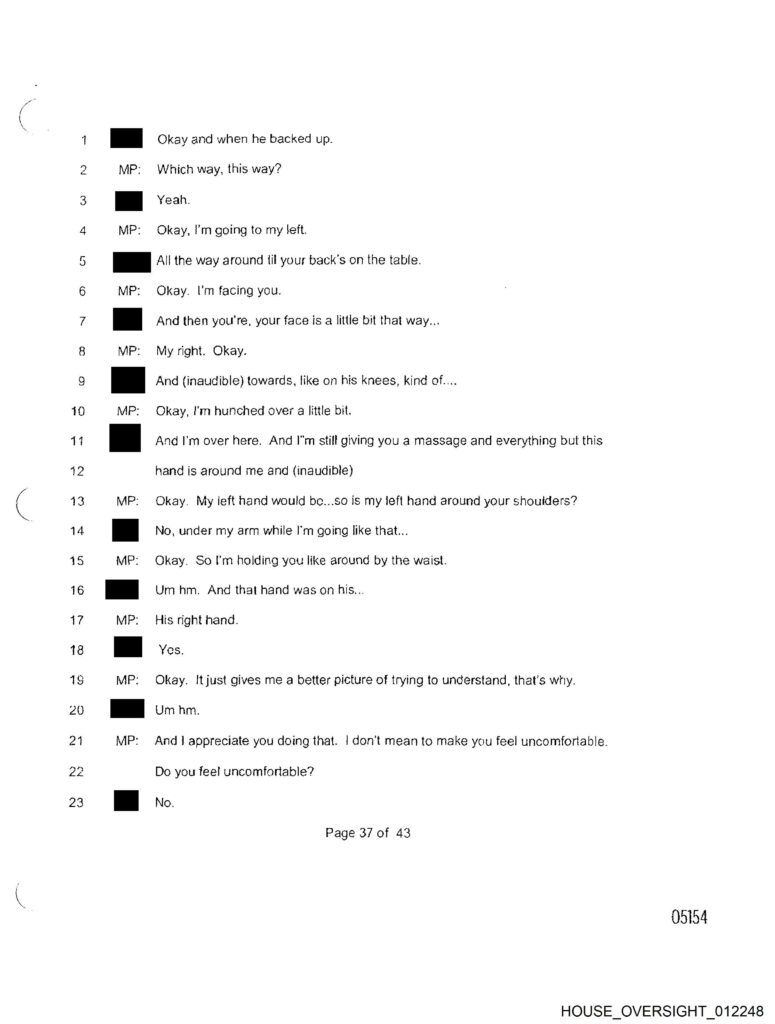
EFTA 012211 to 012254: Law Enforcement Interview Transcript Involving Alleged Sexual Exploitation
Snapshot
EFTA 012211 through 012254 contains forty four consecutive pages from the federal trial transcript in United States v. Ghislaine Maxwell, No. 1:20-cr-00330. The pages correspond to House production numbers DOJ OGR 00012211 through DOJ OGR 00012254 and transcript pages 191 through 234 of Document 745, filed in the Southern District of New York on August 10, 2022.
Despite the descriptive title used for this EpsteinWiki entry, the record is not a verbatim law enforcement interview transcript. It is sworn courtroom testimony that discusses a survivor’s meetings with prosecutors and investigators. The sequence includes the redirect examination of a survivor identified as Jane, courtroom arguments about prior statements and corroboration, and the beginning of direct examination of a witness identified as Matt.
The pages document Jane’s explanation that disclosing abuse during her first government meetings was emotionally difficult. They also record her testimony about meeting Jeffrey Epstein and Ghislaine Maxwell at summer camp, the sexual abuse she said began when she was fourteen, Maxwell’s alleged instructions during sexual encounters, her reasons for seeking closure, and her lack of a financial stake in Maxwell’s criminal trial. Matt later described statements Jane allegedly made years before the federal investigation about Epstein, money provided to her family, massages, a woman whose presence made her feel more comfortable, and experiences that began when she was fourteen.
The page range ends during Matt’s testimony. It is therefore a partial transcript excerpt and should not be treated as the complete testimony of either witness.
Document Identification
Evidence range: EFTA 012211 through EFTA 012254
House production range: DOJ OGR 00012211 through DOJ OGR 00012254
Federal case: United States v. Ghislaine Maxwell
Docket number: 1:20-cr-00330
Court: United States District Court for the Southern District of New York
Docket document: Document 745
Transcript pages: 191 through 234 of 264
Filed: August 10, 2022
Primary witnesses in this range: Jane and Matt, both pseudonyms
Document type: Official federal trial transcript excerpt
Evidence classification: Sworn testimony, attorney argument, evidentiary rulings, and courtroom procedure
The first page is available through EFTA00012211, and the final page in the selected sequence is available through EFTA00012254.
Classification Correction
The phrase “law enforcement interview transcript” can create the false impression that these pages reproduce an FBI interview, prosecutor interview, or Form 302. They do not.
Jane testified in court about meetings she had with the government before trial. Defense counsel had questioned her about notes from those meetings and differences in the details she disclosed over time. On redirect, prosecutors asked Jane to explain how the interviews occurred, why early disclosures were difficult, and why she revealed more information as she became more comfortable with the people interviewing her.
Later pages contain testimony from Matt about statements Jane allegedly made to him before or around the time the Epstein investigation became public. The prosecution offered portions of that testimony to respond to defense attacks on Jane’s credibility. The judge repeatedly limited the questions, required a proper evidentiary foundation, and instructed the jury to disregard certain answers.
The accurate description is therefore: trial testimony concerning government interviews, prior disclosures, alleged sexual exploitation, and corroboration.
Jane’s Testimony About Government Interviews
Notes and interview records
At EFTA00012211, Jane testified that she did not take notes during her meetings with the government. She said she did not know who took the notes and had not been given an opportunity to review meeting notes or reports for accuracy. She also testified that she had not seen the notes shown to her during cross examination before that questioning.
This distinction matters. An investigator’s notes are not automatically the witness’s adopted statement. Jane’s testimony indicates that she did not prepare, approve, or verify the notes discussed by defense counsel.
Difficulty disclosing abuse
Jane described her early meetings as extremely difficult. She said she was sitting with strangers and revealing secrets she had carried throughout her life. At EFTA00012212, she testified that she could not initially share every detail because doing so was emotionally difficult on every level.
Jane said disclosure became easier as she became familiar with the people in the room and began to trust them. She also said later meetings involved fewer people, which made the process more comfortable.
The testimony provides context for why a survivor’s account may develop in detail across multiple interviews. It does not prove that every later statement was accurate. It does show that the witness gave a sworn explanation for the disclosure pattern that defense counsel had challenged.
Follow up meetings and additional details
Jane testified that prosecutors sometimes asked about additional details during later meetings and that every topic was not discussed at every session. This is important when comparing interview notes. The absence of a detail from one meeting does not establish that the witness denied it, especially when the topic was not discussed or the notes were not reviewed by the witness.
The transcript does not include the complete notes from each government meeting. A reliable comparison would require the full interview chronology, all available notes, the questions asked, the people present, and any recordings or witness adopted statements.
Interview Conditions and Trauma Context
Jane’s testimony describes a gradual disclosure process rather than a single complete interview. She explained that shame, secrecy, emotional distress, and unfamiliar interview participants affected what she could initially discuss.
The government reduced the number of people attending later meetings. Jane understood that this was done to make her more comfortable, and she testified that the change helped.
These pages are significant for survivor centered analysis because they show the practical difference between an investigative interview and a simple factual questionnaire. A person recounting childhood sexual abuse may disclose information over time, particularly when discussing conduct that was normalized by trusted adults or concealed for years.
This context should not be used to immunize testimony from scrutiny. It should be used to evaluate supposed inconsistencies fairly and in light of the actual interview process.
Response to Defense Credibility Challenges
Much of Jane’s redirect examination addressed topics raised by Maxwell’s defense during cross examination.
International travel
At EFTA00012215, Jane clarified that international trips she took while in high school were family travel and had nothing to do with Epstein or Maxwell.
Conversation with a reporter
Jane testified about a telephone conversation with a reporter concerning what had happened to her. At EFTA00012218, she explained that the conversation occurred while she was in her car and that she tried to avoid providing extensive detail because she feared public identification.
Childhood home and finances
The defense questioned Jane about her childhood living arrangements, family circumstances, and school applications. On redirect, she clarified the timing of moves between residences and said her family concealed difficulties occurring inside the home.
At EFTA00012221, Jane testified that favorable recommendation letters from teachers did not mean the writers knew what was happening within her family.
School and camp applications
The prosecution used application records to address Jane’s age, grade, height, and weight during the relevant summers. At EFTA00012222, Jane testified that she was approximately five feet two inches tall, weighed about ninety pounds, and was in seventh grade during one summer camp application period.
The defense objected when the prosecutor misstated a document date. The prosecutor revised the question. This exchange is a useful reminder that attorney questions are not evidence and that corrections appearing in the transcript must be preserved.
Acting career
Defense questioning had also raised Jane’s work as an actor. At EFTA00012224, the prosecutor asked whether she understood the difference between acting on television and testifying in court. Jane answered that acting was not real, while court testimony was real and truthful. She denied that she was acting during her testimony.
Her answer was testimony offered to the jury. It was not a separate judicial finding that every statement she made was true.
Alleged Recruitment at Summer Camp
At EFTA00012225, Jane testified that she spent eight weeks at summer camp during the summer of 1994. She was thirteen during part of that period and turned fourteen during the summer.
Jane said she had a strong memory of meeting Maxwell and Epstein at the camp because the encounter marked the beginning of events that changed her life. Earlier trial testimony described the location as Interlochen, an arts camp in Michigan.
The application evidence was used to establish Jane’s age and physical vulnerability during the period at issue. The selected pages do not reproduce the applications themselves because some exhibits were admitted under seal to protect identifying information.
Testimony Concerning Sexual Abuse
At EFTA00012226, Jane testified that she was fourteen when she first engaged in sexual contact with Epstein. She described being directed to masturbate him.
When the prosecutor asked who instructed her during incidents in which Epstein sexually abused her, Jane answered on the next page that the first person was Ghislaine Maxwell. At EFTA00012227, Jane explained that this memory stood out because it marked a change in what she had viewed as a fun and casual relationship with Maxwell. She described being unclothed with Epstein and Maxwell and referred to multiple significant first experiences during the period when she was fourteen, fifteen, and sixteen.
These statements were allegations presented through sworn testimony at Maxwell’s criminal trial. They were subject to cross examination, objections, and the jury’s evaluation. Maxwell denied the charges but was later convicted on five federal counts relating to the recruitment, grooming, transportation, and sexual exploitation of minors.
The page sequence should not be summarized as proof that every alleged incident occurred exactly as described. Its evidentiary significance comes from its place within the full trial record and the verdict reached after the jury heard the complete case.
Survivor Compensation and Financial Motive
Defense counsel questioned Jane about an award she had received from the Epstein Victims’ Compensation Program. The prosecution returned to that subject during redirect.
At EFTA00012228, Jane became emotional while explaining that she wished she had never needed compensation because she wished the abuse had never happened. She described compensation as an imperfect legal remedy for pain, suffering, and personal expenses incurred while trying to recover.
Jane testified that she had no financial stake in the outcome of Maxwell’s criminal trial.
The distinction is important. Receipt of compensation is relevant information that defense counsel may use when exploring credibility or motive. It does not automatically discredit testimony, and an award from a compensation program is not a payment contingent on a criminal conviction.
Evidentiary Dispute Over Prior Statements
After Jane’s redirect testimony, the court addressed whether the government could call Matt to testify about statements Jane made before her government interviews.
The discussion begins within this range at EFTA00012230. Maxwell’s attorneys argued that the proposed testimony did not precisely match Jane’s trial testimony and could introduce statements beyond the proper scope of corroboration. Prosecutors argued that defense attacks on Jane’s credibility permitted evidence of prior consistent statements and related background.
At EFTA00012234, the court required the prosecutor to use controlled questions and warned that testimony implying the presence of other underage girls could exceed what had been established in Jane’s earlier statement to Matt.
The court allowed some testimony responding to subjects raised during cross examination, including Jane’s childhood financial circumstances and statements she made before the federal investigation. The judge did not authorize Matt to repeat everything Jane had ever told him.
These rulings are essential when interpreting the later pages. A transcript preserves answers that a jury was instructed to disregard. The appearance of a statement on the page does not mean the court admitted it for every purpose.
Privacy Protections for Jane and Matt
At EFTA00012238, the court allowed the next witness to testify as Matt in order to protect Jane’s identity. The judge also instructed courtroom sketch artists not to draw an exact likeness of him.
At EFTA00012239, Matt confirmed that he was using a pseudonym to protect the person he would discuss. His driver’s license was admitted under seal as Government Exhibit 17. A separate birth certificate identifying Jane was also handled under seal.
The use of a pseudonym does not reduce the legal status of sworn testimony. It protects identifying information from public disclosure. EpsteinWiki should preserve both pseudonyms and should not attempt to reverse identify either witness from employment, relationship, school, family, or biographical clues in the record.
Matt’s Relationship With Jane
Matt testified that he was Jane’s former romantic partner and remained her friend. At EFTA00012243, he said their romantic relationship lasted approximately from 2006 through 2014 and that they lived together from 2007 through 2014. He also said they worked on the same television program.
The government offered this history to establish that Matt knew Jane well and had conversations with her before the federal investigation and before Maxwell’s criminal trial.
This foundation does not make Matt an eyewitness to the alleged childhood abuse. His testimony concerned what Jane told him, what he observed about her circumstances, and when those conversations occurred.
Prior Disclosures About Epstein
Matt testified that Jane had spoken about a godfather or uncle type figure who helped her family pay bills. At EFTA00012249, he said these conversations began around 2006 or 2007 and occurred more than once. He identified the person Jane had named as Jeffrey Epstein.
Matt said the subject changed around 2009 after the FBI contacted Jane and Epstein’s identity became public. At EFTA00012250, he described Jane telling him that the person she had previously called a godfather was Epstein.
At EFTA00012251, Matt testified that Jane did not give him a detailed description of everything that happened. When one answer exceeded the permitted question, the judge sustained an objection and directed the jury to disregard it.
At EFTA00012252, Matt said Jane told him she had been required to do things she did not want to do and that the money was not free. He testified that she used the word “massage,” but did not describe the conduct in detail.
At EFTA00012253, Matt said Jane told him the conduct began when she was fourteen and that she had met Epstein at a camp.
This testimony was offered as corroboration of earlier disclosures. It remains secondhand as to the underlying abuse because Matt did not claim to have witnessed the alleged incidents.
The Woman Whose Presence Created Comfort
The final pages address whether Jane had told Matt about a woman being present at Epstein’s house.
At EFTA00012254, Matt testified that Jane said the presence of a woman made her feel more comfortable about visiting the house. When Matt added that Jane had mentioned other girls, defense counsel objected. The judge sustained the objection and instructed the jury to disregard that statement.
Matt then testified that Jane had discussed the woman with him around 2009. He did not say that Jane had used the exact words that the woman told her everything was acceptable. He said only that Jane conveyed that having a woman present made her feel more comfortable.
The page ends while the prosecutor is continuing this line of questioning. The selected range therefore does not contain the complete examination or the defense cross examination of Matt.
Grooming and Normalization Evidence
The testimony is relevant to the prosecution’s grooming theory. Jane described meeting Maxwell and Epstein in a setting associated with education and philanthropy. Epstein later supplied money and opportunities, while Maxwell allegedly acted as a trusted adult woman who made the environment appear safer and normalized increasingly sexual conduct.
Matt’s testimony supported the proposition that Jane had described Epstein as a benefactor before publicly describing him as an abuser. His account of the unnamed woman’s reassuring presence also paralleled Jane’s testimony concerning Maxwell’s role.
This interpretation should be stated as the prosecution’s theory supported by trial evidence and the later verdict. It should not be expanded into claims that the selected pages do not contain.
Evidentiary Value
The selected pages have several forms of evidentiary value.
- They preserve Jane’s sworn explanation of how she disclosed information during government meetings.
- They distinguish investigative notes from statements reviewed or adopted by the witness.
- They document age, grade, and physical information connected to Jane’s camp attendance.
- They record allegations that sexual abuse began when Jane was fourteen and that Maxwell gave instructions during sexual conduct involving Epstein.
- They show how the court handled compensation evidence and claims of financial motive.
- They preserve judicial limits on prior consistent statements, hearsay, leading questions, and testimony outside the scope of cross examination.
- They record Matt’s account of Jane’s earlier disclosures about Epstein, financial assistance, unwanted conduct, massages, her age, and the camp setting.
- They demonstrate the court’s active protection of survivor identity through pseudonyms, sealed exhibits, and restrictions on courtroom sketches.
Evidentiary Limits
The range has important limitations.
- It is not the full trial transcript.
- It begins during Jane’s redirect examination and omits most of her direct and cross examination.
- It ends during Matt’s direct examination.
- It does not contain the actual government interview notes discussed in court.
- It does not establish who prepared each interview note or whether every note was complete.
- Matt was not an eyewitness to the alleged abuse.
- Some exhibits were sealed to protect identity and are not reproduced in the page range.
- Some answers were stricken or followed by an instruction that the jury disregard them.
- Attorney questions and arguments are not evidence.
- The August 10, 2022 filing date is not the date on which the testimony occurred. It reflects the later filing of the transcript on the federal docket.
Survivor Centered Reading
The transcript contains explicit descriptions of childhood sexual abuse. Summaries should avoid unnecessary graphic repetition while preserving the conduct necessary to understand the evidence.
Jane’s testimony about shame, delayed detail, and difficulty speaking with investigators should not be reduced to a credibility slogan. The pages show that the court permitted both adversarial testing and contextual explanation. Defense counsel challenged her account, while prosecutors were allowed to ask why different meetings contained different levels of detail.
Her pseudonym must be preserved. The same rule applies to Matt. Public clues about careers, relationships, family, and school attendance should not be assembled to expose a protected identity.
What the Record Establishes
The record establishes that Jane testified under oath about meetings with government personnel and explained why she disclosed more information over time.
It establishes that she had not reviewed or adopted the interview notes used during cross examination.
It establishes that Jane testified she met Epstein and Maxwell at summer camp, was fourteen when the sexual abuse began, and received instructions from Maxwell during sexual conduct involving Epstein.
It establishes that Jane received compensation through the Epstein Victims’ Compensation Program and testified that she had no financial stake in Maxwell’s criminal trial.
It establishes that the court permitted a pseudonymous witness called Matt to provide limited corroborating testimony about earlier statements Jane made to him.
It establishes that the judge sustained several objections, restricted some testimony, and instructed the jury to disregard at least two statements within the selected range.
What the Record Does Not Establish
The pages do not reproduce a complete FBI or prosecutor interview.
They do not contain every statement Jane made to investigators.
They do not prove that every investigative note was accurate or inaccurate.
They do not make Matt an eyewitness to the abuse.
They do not authorize public identification of either pseudonymous witness.
They do not establish that every statement printed in the transcript was admitted for the jury’s consideration.
They do not contain the complete trial evidence against Maxwell.
They do not support accusations against people merely because their names appear elsewhere in the broader production.
Fact Check
Claim: EFTA 012211 through 012254 is a law enforcement interview transcript
Finding: Misleading. It is an official federal trial transcript excerpt that discusses government interviews and prior disclosures.
Claim: Jane reviewed and approved the government’s interview notes
Finding: False based on this excerpt. Jane testified that she did not take the notes and did not review them for accuracy.
Claim: Jane testified that abuse began when she was fourteen
Finding: Verified. She gave that testimony during redirect, and Matt later testified that she had told him the conduct began at fourteen.
Claim: Jane identified Maxwell as the first person who instructed her during abusive encounters
Finding: Verified as sworn testimony. The statement appears in the transcript and was presented to the jury.
Claim: Compensation depended on Maxwell being convicted
Finding: Not supported. Jane testified that she had no financial stake in the trial’s outcome.
Claim: Matt witnessed Epstein or Maxwell abuse Jane
Finding: False. Matt testified about Jane’s prior statements and their relationship. He did not claim to have witnessed the childhood conduct.
Claim: Every statement on these pages was admitted as evidence
Finding: False. The judge sustained objections and instructed the jury to disregard specific answers.
Questions Still Unanswered
- Who attended each of Jane’s government interviews?
- Who prepared the notes used during cross examination?
- Were any interviews recorded in audio or video form?
- Which interview notes were contemporaneous, and which were later summaries?
- Did investigators provide Jane an opportunity to correct any written summary after the meetings discussed here?
- What additional testimony did Matt provide after EFTA 012254?
- How did defense counsel address Matt’s account during cross examination?
- Which portions of Matt’s testimony were admitted as prior consistent statements, and for what evidentiary purpose?
- Which sealed exhibits remain unavailable, and can redacted versions be released without exposing survivor identities?
- Are the underlying interview notes included elsewhere in the House Oversight or EFTA productions?
Related EpsteinWiki Pages
- Maxwell Criminal Trial: United States v. Ghislaine Maxwell
- Jane: Survivor Witness in the Maxwell Trial
- Jane Doe: The Interlochen Survivor
- Epstein Victims’ Compensation Program
- Deposition Transcript Index
- Exhibits Index
- House Oversight Committee Epstein Records
- Survivor Interview and Testimony Standards
- Ghislaine Noelle Marion Maxwell
- Jeffrey Epstein’s Grooming Methods
Source List
- EFTA00012211, first page in the selected range
- EFTA00012212, Jane on difficulty disclosing information
- EFTA00012215, clarification about international travel
- EFTA00012221, family circumstances and school recommendations
- EFTA00012222, camp application age and physical information
- EFTA00012224, testimony concerning acting and truthfulness
- EFTA00012225, summer camp and meeting Epstein and Maxwell
- EFTA00012226, testimony concerning abuse at age fourteen
- EFTA00012227, testimony concerning Maxwell’s alleged instructions
- EFTA00012228, compensation and lack of financial stake
- EFTA00012230, evidentiary discussion concerning prior statements
- EFTA00012234, judicial limits on corroborating testimony
- EFTA00012238, privacy protections and introduction of Matt
- EFTA00012243, Matt’s relationship with Jane
- EFTA00012249, earlier statements identifying Epstein
- EFTA00012252, statements concerning unwanted conduct and massages
- EFTA00012253, age and camp location
- EFTA00012254, testimony about the presence of a woman
- United States v. Maxwell federal docket
- House Oversight Committee release of DOJ records
- United States Department of Justice sentencing announcement