Exhibits 3 to 5: Handwritten Notes, Contact Lists, and Deposition Excerpts Referencing Jeffrey Epstein and Ghislaine Maxwell
The records labeled Exhibits 3, 4, and 5 preserve three connected forms of evidence from the Epstein and Maxwell record. They include handwritten telephone messages, household and residence contact sheets, and selected sworn testimony from Tony Figueroa concerning Jeffrey Epstein’s attempts to locate Virginia Giuffre after she traveled to Thailand.
Read together, the pages show how routine communications and household administration can provide context for testimony about control, access, travel, and pursuit. They must still be interpreted carefully. A contact entry does not establish wrongdoing, poor handwriting cannot be treated as verified text, and an excerpted deposition does not provide a witness’s complete testimony.
Snapshot
Evidence range: HOUSE_OVERSIGHT_014224 through HOUSE_OVERSIGHT_014285
Evidence type: Handwritten notes, telephone message slips, household contact records, residence records, and deposition excerpts
Principal people: Jeffrey Epstein, Ghislaine Maxwell, Virginia Giuffre, and Tony Figueroa
Litigation context: Virginia Giuffre v. Ghislaine Maxwell, case 15-cv-07433-RWS, United States District Court for the Southern District of New York
Strongest evidence: Tony Figueroa testified that Epstein repeatedly contacted him while trying to locate Giuffre and that Epstein appeared urgent and upset.
Central limitation: Most handwritten pages have poor OCR, the contact lists do not prove misconduct, and Exhibit 5 reproduces only selected pages from Figueroa’s deposition.
Key Takeaways
- The correct evidence identifiers are
HOUSE_OVERSIGHT_014224throughHOUSE_OVERSIGHT_014285, not EFTA identifiers. - Exhibit 3 contains fifty pages of handwritten notes and telephone message records after its cover.
- Exhibit 4 contains emergency, household, staff, pilot, vehicle, and residence information connected to Epstein and Maxwell properties.
- Exhibit 5 contains selected pages from Tony Figueroa’s June 28, 2016 videotaped deposition.
- Figueroa testified that Epstein called him while trying to locate Virginia Giuffre after her travel to Thailand.
- Figueroa described Epstein as urgent, upset, and actively trying to find her.
- The testimony is a sworn recollection. The excerpt does not independently prove Epstein’s motive or reproduce the complete deposition.
- Names on message slips and contact sheets do not establish knowledge of or participation in Epstein’s crimes.
Identifier Correction
The correct indexed range is HOUSE_OVERSIGHT_014224 through HOUSE_OVERSIGHT_014285. The informal label “EFTA 014224 through 014285” does not match the identifiers shown on these pages in Epstein Data.
This distinction matters because document prefixes are part of provenance. An identically numbered page in another production series is not the same record. Researchers should cite the full HOUSE_OVERSIGHT identifier for each page rather than converting it into an EFTA identifier.
Document Range and Exhibit Boundaries
The sequence contains three exhibit covers and three bodies of evidence:
| Range | Contents |
|---|---|
| HOUSE_OVERSIGHT_014224 | Exhibit 3 cover |
| HOUSE_OVERSIGHT_014225 | Full page handwritten note |
| HOUSE_OVERSIGHT_014226 through 014274 | Handwritten telephone and message records |
| HOUSE_OVERSIGHT_014275 | Exhibit 4 cover |
| HOUSE_OVERSIGHT_014276 through 014277 | Handwritten contact or household records |
| HOUSE_OVERSIGHT_014278 | Typed emergency contact sheet |
| HOUSE_OVERSIGHT_014279 | Typed New York and Palm Beach household contact sheet |
| HOUSE_OVERSIGHT_014280 | Typed residence and staff contact sheet |
| HOUSE_OVERSIGHT_014281 through 014282 | Handwritten operational notes |
| HOUSE_OVERSIGHT_014283 | Exhibit 5 cover |
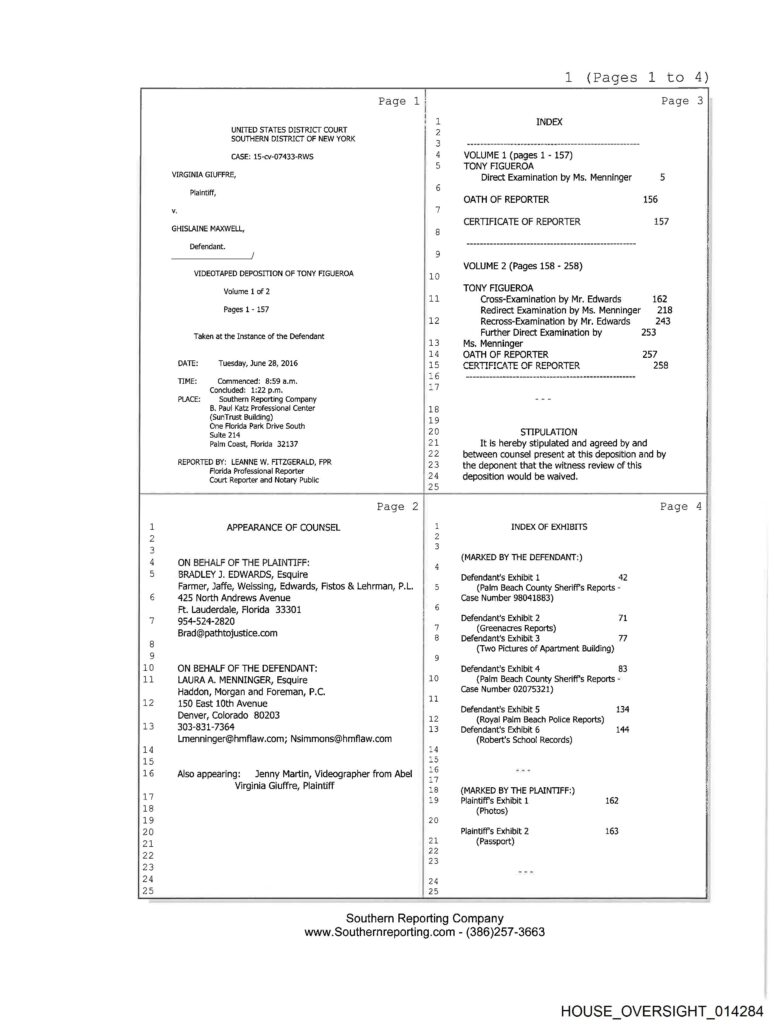
| HOUSE_OVERSIGHT_014284 | Figueroa deposition caption, appearances, and index, transcript pages 1 through 4 |
| HOUSE_OVERSIGHT_014285 | Figueroa deposition testimony, transcript pages 57 through 60 |
The page sequence alone does not explain who originally assembled Exhibits 3 and 4, when each underlying page was created, or the precise proceeding in which all three covers were marked. Those questions require the parent filing or production metadata.
Exhibit 3: Telephone Message Records
Exhibit 3 begins with a cover page. The next page is a full page handwritten note bearing Epstein’s name at the bottom. From HOUSE_OVERSIGHT_014226 onward, most pages contain several preprinted telephone message forms completed by hand.
The forms include fields for the intended recipient, date, time, caller, telephone or mobile number, message, and signature. They also include common routing options such as “Please Call,” “Will Call Again,” “Rush,” “Returned Your Call,” and “Special Attention.” Some slips appear to be directed to Epstein, some to Maxwell, and others cannot be read with enough certainty to attribute safely.
The visible dates appear to cluster largely in 2004 and 2005. The scans do not establish that the slips are arranged in exact chronological order. Earlier production markings also appear on a number of pages. Examples include SA and GIUFFRE prefixes followed by page numbers. Those markings show that at least some pages passed through earlier document production or labeling systems, but the exhibit does not define the SA prefix or provide a complete chain of custody.
What the Message Slips Show
Taken together, the slips document an organized process for receiving, recording, and forwarding calls. They are evidence of communications infrastructure. They may help researchers test who was attempting to reach Epstein or Maxwell, when a call was logged, whether a return call was requested, and which staff member may have recorded the message.
Their strongest value comes from cross checking. A dated slip can be compared with telephone records, calendars, flight logs, visitor records, appointment books, financial records, and testimony. Repeated names or recurring types of requests may reveal patterns that a single page cannot establish on its own.
The slips should not be treated as proof that a call was returned, that the message was accurate, or that the person named personally placed the call. They also do not establish misconduct by a caller. A receptionist or household employee could have written a name incorrectly, summarized a message imprecisely, or recorded information supplied by someone else.
Handwriting and OCR Limits
The handwriting is frequently faint, compressed, crossed out, or partly obscured by the layout of multiple slips on one scan. Automated text recognition is unreliable across much of the exhibit. Names, dates, numbers, and short messages are especially vulnerable to false readings.
For that reason, this article does not publish a purported line by line transcription. A responsible transcription project would require inspection of each original resolution image, independent review by more than one reader, uncertainty markers for disputed characters, and separation of human transcription from automated OCR.
Where the handwriting cannot be read confidently, the correct conclusion is that the text is unclear. Context should not be used to manufacture a name or message. A possible match is a research lead, not a verified identification.
Privacy and Personal Data
Many message slips contain personal telephone numbers. Exhibit 4 also includes household, mobile, emergency, and staff contact information. The fact that numbers appear in a public evidence release does not make republication necessary for understanding the record.
This article therefore describes the document fields and relevant relationships without reproducing personal numbers. Researchers who need to authenticate a particular number can inspect the linked source page. Survivor names, pseudonyms, and redactions should remain protected, and no one should use partial contact data to reverse identify a survivor or private person.
Exhibit 4: Household and Property Contacts
Exhibit 4 shifts from incoming messages to household operations. Its pages combine handwritten notes with typed reference sheets. Several pages display the date February 11, 2015 and the marking Public Records Request No. 16-268, with page numbers 2282 through 2288.
Those markings are evidence of a public records production layer. They are not necessarily the creation date of every underlying contact list. A typed sheet may have existed before it was stamped or released in response to the request.
The handwritten pages at the beginning and end of the exhibit are difficult to read. They appear operational in character, but unclear words should not be converted into definite claims about deliveries, keys, repairs, or named individuals without a verified transcription.
Palm Beach Emergency and Household Sheet
HOUSE_OVERSIGHT_014278 is a typed emergency reference sheet. It lists emergency services, an alarm system, Palm Beach fire rescue, Good Samaritan Hospital, police, Island Animal Hospital, a neighboring house manager, and contact entries for Ghislaine Maxwell and another person. The document is practical household information, not a narrative report.
HOUSE_OVERSIGHT_014279 lists the East 65th Street residence in New York and the El Brillo Way residence in Palm Beach. Maxwell is listed in connection with both properties. Epstein is listed with the Palm Beach property. The page also identifies household managers, staff, pilots Larry Visoski and David Rodgers, and vehicles associated with the household.
Some staff names are difficult to resolve from the scan and OCR. This article uses only names that can be read with reasonable confidence and does not treat inclusion on the page as evidence of wrongdoing. Staff records can be significant because employees may have observed household routines, visitors, transportation, maintenance, or scheduling, but each person’s knowledge must be established separately.
Multi Property Residence Network
HOUSE_OVERSIGHT_014280 is headed “Residences.” It connects Epstein and Maxwell to a set of properties and staff contacts across several jurisdictions:
- Zorro Ranch in Stanley, New Mexico
- Little St. James in the United States Virgin Islands
- an apartment on Avenue Foch in Paris
- a property on Kinnerton Street in London
The page lists Epstein and Maxwell under the ranch and Little St. James entries. It also includes staff contacts for those properties and identifies staff associated with the Paris and London residences. Brice and Karen Gordon appear in the ranch section. Miles and Cathy Alexander appear in the Little St. James section. Kathie Orchard appears in the London section. Some other names are not sufficiently clear to publish as certain.
This page is useful as a compact map of household administration. It suggests that contact information for geographically dispersed properties was gathered in one operational document. It does not establish who owned each property on the date the list was prepared, who was present at any particular time, or whether every listed staff relationship was current.
Operational Value of the Contact Records
Household contact records can connect evidence that otherwise appears isolated. A residence list can be compared with flight logs, immigration records, telephone data, maintenance invoices, payroll material, shipping records, and witness testimony. Pilot and staff entries may identify people who can authenticate travel or household routines.
The documents also show the administrative scale of the residences. Emergency contacts, house managers, vehicles, pilots, and staff were organized across multiple locations. That fact is relevant to understanding how access, transportation, scheduling, and communications could be coordinated.
The limits remain important. Administrative proximity is not criminal complicity. Employment at a property, inclusion on a contact sheet, or availability in an emergency does not establish knowledge of abuse. Any claim about a listed person must rest on additional evidence specific to that person.
Exhibit 5: Tony Figueroa Deposition
Exhibit 5 contains selected pages from the videotaped deposition of Tony Figueroa in Virginia Giuffre v. Ghislaine Maxwell, case 15-cv-07433-RWS in the United States District Court for the Southern District of New York. The caption and index identify the deposition as Volume 1 of 2, taken at Maxwell’s instance on Tuesday, June 28, 2016.
The deposition began at 8:59 a.m. and concluded at 1:22 p.m. at Southern Reporting Company in Palm Coast, Florida. Bradley J. Edwards appeared for Giuffre. Laura A. Menninger appeared for Maxwell. Giuffre was also present. The index states that Menninger’s direct examination of Figueroa began on transcript page 5.
The exhibit does not reproduce the full deposition. It provides transcript pages 1 through 4 and then jumps to pages 57 through 60. Any interpretation must respect that gap and avoid presenting four selected testimony pages as the witness’s complete account.
Epstein’s Calls Seeking Virginia Giuffre
On transcript pages 57 through 60, Figueroa testified that he was living at his parents’ house when Giuffre left. He said that the main conversations he later had with Epstein concerned Epstein asking where Virginia was and asserting that Figueroa knew her location.
Figueroa testified that he told Epstein he did not know where she was and that Epstein was the person who had sent her away. According to Figueroa, Epstein called his cell phone. Figueroa described Epstein as trying to find Giuffre and used the phrase “hunting her down.”
When asked about Epstein’s tone, Figueroa stopped short of calling it desperate. He described a sense of urgency and said Epstein seemed upset and intent on finding her. When asked whether Epstein explained why he was trying to locate her, Figueroa answered no.
This is sworn testimony about Figueroa’s memory of the calls. The excerpt does not include telephone records confirming the number, time, or frequency of the calls. It also does not independently establish Epstein’s purpose.
Thailand and Telephone Bill Testimony
Figueroa testified that he used his parents’ landline to make expensive calls to Thailand. He said his parents were initially unconcerned because he told them Epstein had money and would pay the bill. According to Figueroa, the bill was not paid, and he no longer had a place to live.
He also said he understood that Epstein had paid for Giuffre’s trip to Thailand. When asked whether she had previously been to Thailand, he answered that she had not, as far as he knew. He did not claim to know what Epstein thought after contact with Giuffre stopped.
Figueroa testified that Giuffre left him a note saying she was not coming back. He said she did not tell him during the telephone calls that she was ending their relationship. The excerpt then moves to a question about a rehabilitation program involving Philip and Ms. Roberts. The scan does not preserve a complete answer to that new line of questioning, so none should be inferred.
Survivor Centered Reading
The most important human fact in these pages is that the testimony concerns a survivor’s movement and an effort by a powerful adult to locate her. Figueroa’s description conveys urgency and pursuit. It should be reported accurately without sensationalizing Giuffre’s circumstances or treating her location as a puzzle for public speculation.
The excerpt should also not be used to transfer responsibility onto Giuffre for the financial or housing consequences Figueroa described. Those were consequences he connected to telephone costs and his expectation that Epstein would pay. Giuffre’s decision to leave, her communications, and her safety must be understood within the larger record of alleged exploitation and control, not as an obligation to remain available to Epstein or others.
Researchers should use the name Virginia Giuffre because she spoke publicly under that name. The record’s references to family members do not justify exposing private information about people who are not public figures.
Chain of Custody and Provenance
The present sequence carries HOUSE_OVERSIGHT page identifiers and was made accessible among documents released by the House Committee on Oversight and Government Reform. The Committee stated on November 12, 2025 that it had released an additional 20,000 pages received from Jeffrey Epstein’s estate. The direct evidence links in this article point to the Epstein Data index for page level review.
Within the scans, other markings point to earlier stages. Exhibit 3 pages carry earlier production identifiers, including GIUFFRE and SA stamps. Exhibit 4 pages carry a 2015 date and a Palm Beach public records request number. Exhibit 5 reproduces a 2016 federal civil deposition.
These layers should not be collapsed. The date of a deposition is not the date Congress released its scan. The date stamped on a public records response is not necessarily the date a contact list was first created. A production number identifies a page within a document set, not the truth of every statement on that page.
Evidentiary Value
The three exhibits complement one another without proving the same thing.
- Exhibit 3 documents message handling and potential communication leads.
- Exhibit 4 maps household administration, staff, emergency contacts, vehicles, pilots, and properties.
- Exhibit 5 records selected sworn testimony about Epstein’s attempt to locate Giuffre after her travel to Thailand.
Together, they show how routine administrative records can provide context for testimony. Message and contact systems help identify who controlled communications and who may have observed operations. Testimony supplies a firsthand account that can guide searches for corroborating telephone, travel, or financial records.
Their value is strongest when used as an index to further evidence. A contact sheet can identify a custodian or witness. A message slip can supply a date. A deposition can identify an event and the participant’s recollection. Corroboration can then determine whether those pieces fit.
Evidentiary Limits
The record has significant limits:
- Most handwritten pages have poor OCR and require manual verification.
- The exhibit does not identify the author of every note or message slip.
- A recorded message does not prove that a call occurred exactly as summarized or that it was returned.
- A contact list does not prove current employment, presence, knowledge, or misconduct.
- The residence sheet does not by itself prove legal ownership on a particular date.
- The Figueroa deposition is excerpted and omits pages 5 through 56 and everything after page 60.
- The excerpt records testimony, not independent confirmation of the calls, trip payment, or Epstein’s motive.
- The sequence does not provide a complete parent filing or exhibit list explaining why Exhibits 3, 4, and 5 were grouped.
These limitations do not make the exhibits unimportant. They define the questions the evidence can answer and prevent claims that outrun the pages.
What the Record Establishes
The pages directly establish that:
- the sequence contains three separately labeled exhibits;
- Exhibit 3 includes a large body of handwritten message records associated with communications directed to Epstein, Maxwell, or their household operations;
- Exhibit 4 includes emergency, household, vehicle, pilot, staff, and residence information spanning Palm Beach, New York, New Mexico, the United States Virgin Islands, Paris, and London;
- Exhibit 5 reproduces selected pages of Tony Figueroa’s June 28, 2016 videotaped deposition in Giuffre v. Maxwell;
- Figueroa testified that Epstein called him seeking Giuffre’s location;
- Figueroa described Epstein’s tone as urgent and upset and said Epstein was trying to find her;
- Figueroa testified that he understood Epstein paid for Giuffre’s trip to Thailand;
- Figueroa testified that Giuffre left a note saying she would not return.
What the Record Does Not Establish
The pages do not establish that:
- every OCR transcription is accurate;
- every person named on a slip personally made the recorded call;
- every message was delivered or returned;
- any person committed wrongdoing merely because a name or number appears;
- every staff listing was current when the page was produced;
- Epstein’s calls had a particular motive beyond the pursuit described by Figueroa;
- the selected deposition pages represent Figueroa’s complete testimony;
- the House release itself authenticated every underlying statement as true;
- the exhibit covers, without the parent filing, fully explain the records’ original litigation context.
Fact Check
Claim: The range is EFTA 014224 through 014285.
Finding: Incorrect identifier. The indexed pages use HOUSE_OVERSIGHT_014224 through HOUSE_OVERSIGHT_014285.
Claim: All 62 pages are handwritten notes.
Finding: Incorrect. The range includes exhibit covers, handwritten message forms, typed household contact sheets, and deposition transcript excerpts.
Claim: Exhibit 3 contains fifty pages of message material after its cover.
Finding: Supported. The exhibit cover is page 014224, followed by pages 014225 through 014274.
Claim: Exhibit 4 links Epstein and Maxwell to a multi property household contact system.
Finding: Supported with qualification. The typed sheets list them alongside residences, staff, pilots, vehicles, and emergency contacts. The list does not independently establish ownership, presence, or wrongdoing on any specific date.
Claim: Tony Figueroa testified that Epstein was urgently trying to find Virginia Giuffre.
Finding: Supported as testimony. Figueroa described Epstein’s tone as urgent and upset and testified that Epstein was trying to locate her. The excerpt does not independently verify the calls or establish Epstein’s motive.
Claim: The exhibit contains Figueroa’s complete deposition.
Finding: Incorrect. It contains transcript pages 1 through 4 and 57 through 60 from Volume 1.
Claim: A person listed in these records was involved in Epstein’s crimes.
Finding: Not supported without additional evidence. Inclusion in an address book, staff list, emergency sheet, or message record is not proof of knowledge or participation.
Questions Still Unanswered
- What parent filing, hearing, or production formally marked these materials as Exhibits 3, 4, and 5?
- Who created and maintained the message slips in Exhibit 3?
- Can the original resolution scans support a reliable, independently reviewed transcription of the handwriting?
- What does the
SAproduction prefix mean, and which custodian produced those pages? - When were the contact sheets in Exhibit 4 first created and last updated?
- Which listed staff relationships were active during the dates relevant to the underlying litigation?
- Are telephone records available to corroborate the calls Figueroa described?
- Are financial records available to corroborate who paid for Giuffre’s Thailand travel?
- What testimony appears immediately before page 57 and after page 60 of Figueroa’s deposition?
- Why were these particular excerpts selected, and what argument were they intended to support?
Important Epstein Data Evidence Files
- HOUSE_OVERSIGHT_014224: Exhibit 3 cover
- HOUSE_OVERSIGHT_014225: Full page handwritten note
- HOUSE_OVERSIGHT_014226: Beginning of the telephone message slips
- HOUSE_OVERSIGHT_014274: Final page of Exhibit 3
- HOUSE_OVERSIGHT_014275: Exhibit 4 cover
- HOUSE_OVERSIGHT_014278: Emergency contact sheet
- HOUSE_OVERSIGHT_014279: New York and Palm Beach household contact sheet
- HOUSE_OVERSIGHT_014280: Residence and staff contact sheet
- HOUSE_OVERSIGHT_014283: Exhibit 5 cover
- HOUSE_OVERSIGHT_014284: Tony Figueroa deposition caption, appearances, and index
- HOUSE_OVERSIGHT_014285: Tony Figueroa deposition transcript pages 57 through 60
Source List
- Exhibit 3 cover, HOUSE_OVERSIGHT_014224
- Exhibit 3 first handwritten page, HOUSE_OVERSIGHT_014225
- Exhibit 3 message slips begin, HOUSE_OVERSIGHT_014226
- Exhibit 3 final page, HOUSE_OVERSIGHT_014274
- Exhibit 4 cover, HOUSE_OVERSIGHT_014275
- Emergency contact sheet, HOUSE_OVERSIGHT_014278
- New York and Palm Beach household sheet, HOUSE_OVERSIGHT_014279
- Residences sheet, HOUSE_OVERSIGHT_014280
- Exhibit 4 final handwritten page, HOUSE_OVERSIGHT_014282
- Exhibit 5 cover, HOUSE_OVERSIGHT_014283
- Tony Figueroa deposition caption and index, HOUSE_OVERSIGHT_014284
- Tony Figueroa deposition pages 57 through 60, HOUSE_OVERSIGHT_014285
- Giuffre v. Maxwell docket
- House Oversight Committee release of additional Epstein estate documents
- Associated Press report on the completed unsealing of records from Giuffre v. Maxwell
No relevant sleuth Substack article was located by exact page identifier, exhibit description, Tony Figueroa deposition, or message slip search. No Substack source has therefore been added merely to fill a source category.