Exhibit 11: Videotaped Deposition of Jeffrey Epstein Transcript Excerpt, March 17, 2010
Snapshot
Exhibit: Exhibit 11
Document type: Excerpt from the transcript of Jeffrey Epstein’s videotaped deposition
Deposition date: March 17, 2010
Time shown on caption page: 10:17 a.m. through 1:27 p.m.
Location: 303 Banyan Boulevard, Suite 400, West Palm Beach, Florida
Court: Circuit Court of the Fifteenth Judicial Circuit in and for Palm Beach County, Florida
Case: Jeffrey Epstein v. Scott Rothstein, Bradley J. Edwards, and L.M.
Case number: 502009CA040800XXXXMBAG
Examining attorney in the excerpt: Mr. Scarola
Attorney making objections: Mr. Pike
Court reporter: Sandra W. Townsend, FPR
House Oversight range: HOUSE_OVERSIGHT_014306 through HOUSE_OVERSIGHT_014309
Transcript pages reproduced: Caption page and transcript pages 89 and 90
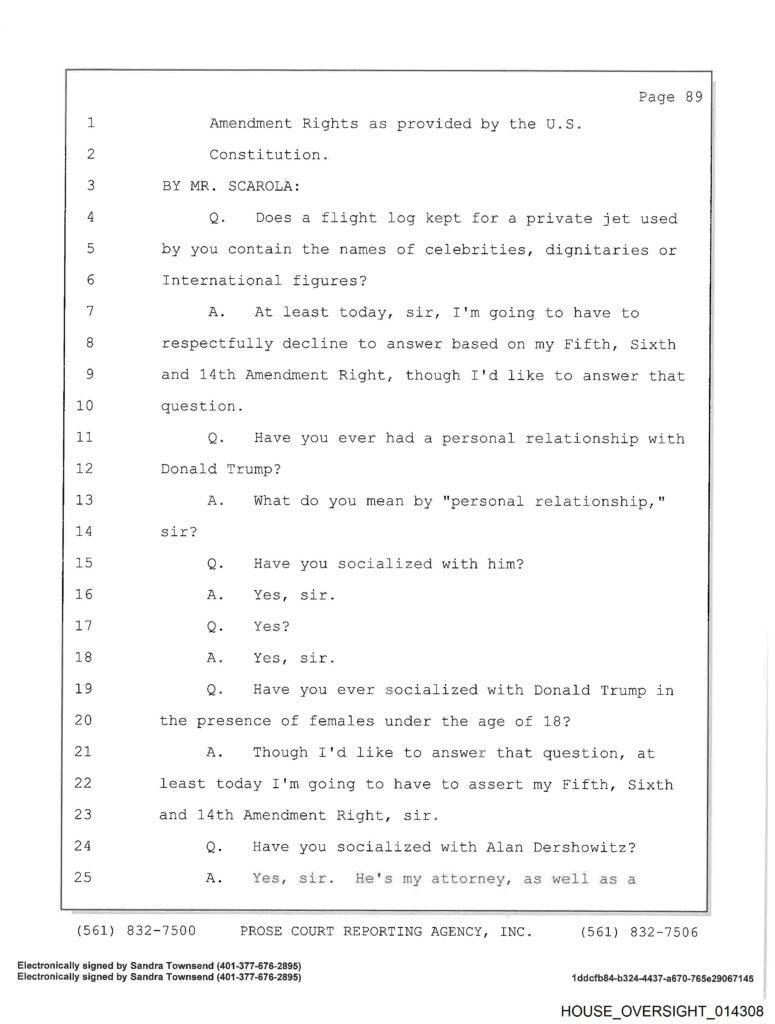
Key evidence: Epstein admitted that he had socialized with Donald Trump. He then invoked his Fifth, Sixth, and Fourteenth Amendment rights rather than answer whether he had socialized with Trump in the presence of females under eighteen. Epstein also admitted socializing with Alan Dershowitz and identified Dershowitz as both his attorney and friend. He invoked constitutional rights when asked whether he had socialized with Dershowitz in the presence of females under eighteen.
Critical limitation: The questions about females under eighteen were not answered. A question is not evidence, and invocation of constitutional rights is not itself proof that the conduct described in the question occurred.
Document Identification
HOUSE_OVERSIGHT_014306 through HOUSE_OVERSIGHT_014309 contain four released images associated with Exhibit 11.
The first image is an exhibit cover marked “EXHIBIT 11.” The second is the caption page for the videotaped deposition of Jeffrey Epstein taken on Wednesday, March 17, 2010. The final two images reproduce transcript pages 89 and 90.
The caption identifies Epstein as the plaintiff and Scott Rothstein, Bradley J. Edwards, and L.M. as defendants. The released excerpt does not contain the complaint, counterclaims, exhibit list, notice of deposition, or an order explaining the purpose for which Exhibit 11 was later offered.
The four pages therefore establish the identity and content of the excerpt, but they do not supply the complete procedural history of the exhibit.
Composition of Exhibit 11
The released exhibit contains:
- An Exhibit 11 cover page.
- The deposition caption and certification information.
- Transcript page 89, beginning in the middle of Epstein’s assertion of constitutional rights and continuing through questions about private aircraft logs, Donald Trump, and Alan Dershowitz.
- Transcript page 90, continuing the Dershowitz questioning and beginning questions about Tommy Mottola.
The excerpt does not begin at the start of a topic. Page 89 opens with the final words of an answer that began on page 88. Page 90 ends while counsel is still asking a question about the lawsuit. Any description of what came immediately before or after this excerpt requires additional transcript pages.
Although the caption calls this a videotaped deposition, the House Oversight range contains transcript images, not the video recording itself.
Litigation Context
The deposition was taken in a Palm Beach County civil case filed by Epstein against Scott Rothstein, attorney Bradley J. Edwards, and a person identified by the initials L.M. Public reporting describes Epstein’s complaint as alleging racketeering and fraud connected to Rothstein’s law firm and Epstein related civil claims. The excerpt itself does not state the causes of action.
Bradley Edwards represented survivors of Epstein’s abuse. Rothstein was a lawyer whose financial fraud later resulted in a federal conviction. L.M. is identified only by initials in the caption and should not be reverse identified from this excerpt.
Epstein’s response on page 90 shows that he viewed questions about his social relationships as connected to his claims against Edwards and Edwards’s firm. He accused Edwards of bringing unrelated people into the dispute to damage Epstein’s friendships. That was Epstein’s characterization during his own deposition, not a judicial finding.
The civil litigation continued for years in various forms. Public accounts report that litigation between Epstein and Edwards was resolved in December 2018 as trial was about to begin, with Epstein issuing an apology to Edwards. That later resolution does not alter the content of the March 2010 testimony.
Questions About Private Aircraft Logs
Transcript page 89 begins with the conclusion of an earlier constitutional assertion. Mr. Scarola then asked whether a flight log kept for a private jet used by Epstein contained the names of celebrities, dignitaries, or international figures.
Epstein declined to answer. He invoked the Fifth, Sixth, and Fourteenth Amendments while adding that he would like to answer the question.
The excerpt does not identify a particular aircraft, flight log, date range, passenger, or trip. It also does not show whether a flight log was marked as an exhibit or placed before Epstein. The question suggests that flight records were a subject of examination, but it does not authenticate any log or establish who traveled aboard an Epstein aircraft.
Epstein’s Admission About Donald Trump
Mr. Scarola asked Epstein whether he had ever had a personal relationship with Donald Trump. Epstein asked what counsel meant by “personal relationship.” Counsel clarified by asking whether Epstein had socialized with Trump.
Epstein answered, “Yes, sir.” Counsel repeated the answer as a confirmation, and Epstein again answered, “Yes, sir.”
This is a direct sworn admission that Epstein and Trump had socialized. It is more specific than merely appearing in the same directory, photograph, event list, or third party account. It establishes personal social contact as acknowledged by Epstein himself.
The excerpt does not establish when the socializing occurred, how often it occurred, where it occurred, who else was present, or whether it involved any unlawful conduct.
The Unanswered Question About Trump and Minors
Counsel next asked whether Epstein had ever socialized with Donald Trump in the presence of females under eighteen.
Epstein did not answer yes or no. He invoked his Fifth, Sixth, and Fourteenth Amendment rights and said that he would like to answer the question.
The accurate conclusion is narrow:
- Epstein admitted socializing with Trump.
- Epstein was specifically asked whether that socializing ever occurred in the presence of females under eighteen.
- Epstein declined to answer the question by asserting constitutional rights.
The excerpt does not prove that Trump socialized with Epstein in the presence of minors. It also does not prove that Trump knew of, witnessed, or participated in Epstein’s crimes. The question contains a proposition posed by counsel, but the witness did not adopt it.
At the same time, Epstein’s refusal is part of the evidentiary record and should not be erased. The correct treatment is to report both the refusal and its limits.
Epstein’s Admission About Alan Dershowitz
Mr. Scarola asked Epstein whether he had socialized with Alan Dershowitz. Epstein answered yes and stated, “He’s my attorney, as well as a friend.”
This answer establishes two relationships acknowledged by Epstein under oath: an attorney client relationship and a friendship. Dershowitz’s work as an Epstein attorney is independently documented, but Exhibit 11 is valuable because it records Epstein’s own description of the relationship.
The excerpt does not define the duration, closeness, or full scope of their friendship. It also does not show what legal matters Dershowitz handled or disclose any privileged attorney client communications.
The Unanswered Question About Dershowitz and Minors
Transcript page 90 begins with counsel asking whether Epstein had ever socialized with Dershowitz in the presence of females under eighteen. Mr. Pike objected to the form of the question.
Epstein again invoked his Fifth, Sixth, and Fourteenth Amendment rights rather than answer yes or no.
This establishes that the question was asked and that Epstein refused to provide a substantive answer. It does not establish that Dershowitz was present with minors, knew of abuse, or committed misconduct. No allegation against Dershowitz is adjudicated within these four pages.
The objection also matters. Mr. Pike preserved a form objection before Epstein answered. The excerpt does not show a court ruling on that objection or an instruction barring the question.
Questions About Tommy Mottola
Counsel next asked whether Epstein had ever socialized with Tommy Mottola. Epstein did not provide a direct yes or no answer in the released excerpt.
Instead, Epstein objected to the direction of the questioning. He said people with no connection to the case were being brought into it to imperil his relationships with social friends. He presented this as an example of why he had sued Edwards and Edwards’s firm.
Mr. Pike also objected to the form of the question. Counsel then asked Epstein who had brought those names into the lawsuit. After another form objection and a clarification concerning which lawsuit counsel meant, page 90 ends mid question.
The excerpt therefore does not establish whether Epstein socialized with Mottola. Epstein’s general reference to “social friends” should not be converted into a clear admission about every person named in the preceding questions.
Meaning of Epstein’s Constitutional Assertions
The Fifth Amendment protects against compelled self incrimination and can be invoked in civil proceedings when an answer could create a reasonable danger of criminal exposure. An invocation is a legal refusal to answer. It is not a guilty plea, confession, or factual admission.
In some civil proceedings, a court or fact finder may be permitted to consider an adverse inference from a party’s invocation when other evidence is present. Whether such an inference is allowed depends on the legal setting, the evidence, and the court’s rulings. Exhibit 11 does not include any ruling drawing an adverse inference from Epstein’s refusals.
Epstein repeatedly invoked the Sixth and Fourteenth Amendments alongside the Fifth. The Sixth Amendment principally protects rights associated with criminal prosecutions. The Fourteenth Amendment applies constitutional protections, including due process, within state proceedings. The excerpt contains no legal argument explaining why Epstein cited all three amendments or any judicial ruling defining the scope of those assertions.
The safest description is therefore the literal one: Epstein invoked the Fifth, Sixth, and Fourteenth Amendments and declined to answer.
Evidentiary Value
Exhibit 11 has several distinct forms of evidentiary value.
First, it contains Epstein’s sworn admission that he socialized with Donald Trump. This is direct testimony from Epstein, not hearsay attributed to an unnamed source.
Second, it contains Epstein’s sworn admission that he socialized with Alan Dershowitz and considered Dershowitz both his attorney and friend.
Third, it documents that Epstein was directly questioned about whether those relationships involved social settings where females under eighteen were present. He refused to answer both questions.
Fourth, it shows counsel exploring Epstein’s private aircraft logs and relationships with prominent people during civil discovery.
Fifth, Epstein’s response concerning social friends offers insight into his litigation position. He portrayed the questions as an attempt by Edwards to damage his relationships and used that contention to defend the purpose of his lawsuit.
Evidentiary Limits
The range is only four images and contains two substantive transcript pages. It does not provide:
- Transcript page 88, where the opening constitutional assertion began.
- Transcript page 91, which would complete the final question and show the next answer.
- The remaining pages of the deposition.
- The videotape referenced in the caption.
- The complaint, answers, counterclaims, or operative pleadings.
- Documents shown to Epstein during this part of the examination.
- A flight log or testimony authenticating one.
- A judicial ruling concerning the form objections.
- A ruling concerning any civil inference from Epstein’s refusal to answer.
- Testimony from Trump, Dershowitz, or Mottola.
The excerpt should not be used to claim that any person named in a question committed a crime. Association with Epstein, standing alone, is not proof of knowledge or participation in his abuse.
Page by Page Guide
| Bates page | Content |
|---|---|
| HOUSE_OVERSIGHT_014306 | Exhibit 11 cover page |
| HOUSE_OVERSIGHT_014307 | Deposition caption, case number, date, location, time, and court reporter |
| HOUSE_OVERSIGHT_014308 | Transcript page 89, including aircraft log questions, Epstein’s admission that he socialized with Trump, refusal to answer the underage presence question, and admission that he socialized with Dershowitz |
| HOUSE_OVERSIGHT_014309 | Transcript page 90, including Epstein’s refusal to answer the Dershowitz underage presence question and incomplete questioning about Tommy Mottola |
What the Record Establishes
The released pages establish that:
- Jeffrey Epstein gave a videotaped deposition on March 17, 2010 in Palm Beach County civil case 502009CA040800XXXXMBAG.
- Epstein was the plaintiff against Scott Rothstein, Bradley J. Edwards, and L.M.
- Epstein admitted under oath that he had socialized with Donald Trump.
- Epstein invoked constitutional rights rather than answer whether he had socialized with Trump in the presence of females under eighteen.
- Epstein admitted under oath that he had socialized with Alan Dershowitz.
- Epstein identified Dershowitz as his attorney and friend.
- Epstein invoked constitutional rights rather than answer whether he had socialized with Dershowitz in the presence of females under eighteen.
- Epstein complained that questions naming people outside the case threatened his relationships with social friends.
- The excerpt ends before the questioning about Tommy Mottola is completed.
What the Record Does Not Establish
The released pages do not establish that:
- Trump or Dershowitz socialized with Epstein in the presence of minors.
- Trump, Dershowitz, or Mottola knew about or participated in Epstein’s abuse.
- Any person named in the excerpt appeared in a particular flight log.
- Epstein admitted the factual premise of any question he refused to answer.
- Epstein’s constitutional assertions were admissions of guilt.
- A judge drew an adverse inference from the refusals.
- Epstein answered the question about whether he socialized with Mottola.
- Exhibit 11 contains the complete deposition or the associated video.
Fact Check
Claim: Exhibit 11 contains the complete March 17, 2010 deposition
False. The released exhibit contains a cover, caption page, and transcript pages 89 and 90. It is an excerpt.
Claim: Epstein admitted that he socialized with Donald Trump
Verified. On HOUSE_OVERSIGHT_014308, Epstein twice answered yes after counsel clarified that “personal relationship” meant socializing.
Claim: Epstein admitted socializing with Trump in the presence of minors
False. He invoked constitutional rights and did not answer that question.
Claim: Epstein identified Alan Dershowitz as his attorney and friend
Verified. The statement appears at the end of transcript page 89 and continues onto page 90.
Claim: Epstein admitted socializing with Dershowitz in the presence of minors
False. He invoked constitutional rights and did not provide a substantive answer.
Claim: Epstein admitted socializing with Tommy Mottola
Not established by this excerpt. Epstein responded with a complaint about the questioning rather than a direct answer, and the page ends before the exchange is completed.
Claim: Invoking the Fifth Amendment proves guilt
False. The privilege permits a witness to decline an answer that could create a danger of self incrimination. The invocation is not itself a confession or proof that the premise of the question is true.
Claim: The House range includes the videotape
False. The caption describes a videotaped deposition, but the four released pages are document images of a transcript excerpt.
Questions Still Unanswered
- What testimony appears on transcript pages 88 and 91?
- Where is the complete March 17, 2010 deposition transcript?
- Is the complete videotape publicly available and authenticated?
- What specific flight log was counsel referencing?
- Were any flight records shown to Epstein during the deposition?
- What factual basis did counsel have for asking the questions about females under eighteen?
- Did the court permit any adverse inference from Epstein’s constitutional assertions?
- For what later filing, hearing, or proceeding was this excerpt marked as Exhibit 11?
- What answer followed the unfinished question at the bottom of page 90?
- Which pleadings explain Epstein’s claim that Edwards was trying to damage his social relationships?
Related EpsteinWiki Pages
- Jeffrey Epstein
- Donald Trump
- Alan Dershowitz
- Tommy Mottola
- Bradley J. Edwards
- Scott Rothstein
- Epstein v. Rothstein, Edwards, and L.M.
- Jeffrey Epstein Deposition Transcript Index
- Exhibits Index
- Jeffrey Epstein Flight Logs and Manifests
- House Oversight Committee Epstein Records
- Survivor Interview and Testimony Standards
Source List
- HOUSE_OVERSIGHT_014306, Exhibit 11 cover
- HOUSE_OVERSIGHT_014307, deposition caption page
- HOUSE_OVERSIGHT_014308, transcript page 89
- HOUSE_OVERSIGHT_014309, transcript page 90
- House Oversight Committee release of additional Epstein estate documents
- Jeffrey Epstein motion concerning the exhibit list in the related Florida litigation
- Civil trial report on the later settlement involving Epstein and Bradley Edwards
- McCarthy v. Arndstein, Fifth Amendment privilege in civil proceedings
- Baxter v. Palmigiano, civil inferences and the Fifth Amendment
- National Archives transcript of the Bill of Rights
SEO
Meta description: Analysis of Exhibit 11, HOUSE OVERSIGHT 014306 through 014309, containing Jeffrey Epstein’s March 17, 2010 deposition admissions about socializing with Donald Trump and Alan Dershowitz and his refusal to answer questions involving females under eighteen.
Keywords: HOUSE OVERSIGHT 014306, HOUSE OVERSIGHT 014309, Exhibit 11 Jeffrey Epstein deposition, Jeffrey Epstein March 17 2010, Epstein Donald Trump deposition, Epstein Alan Dershowitz friend attorney, Bradley Edwards deposition, Scott Rothstein, Epstein flight logs, Palm Beach County Epstein case, EpsteinWiki