
Kenneth A. Marra
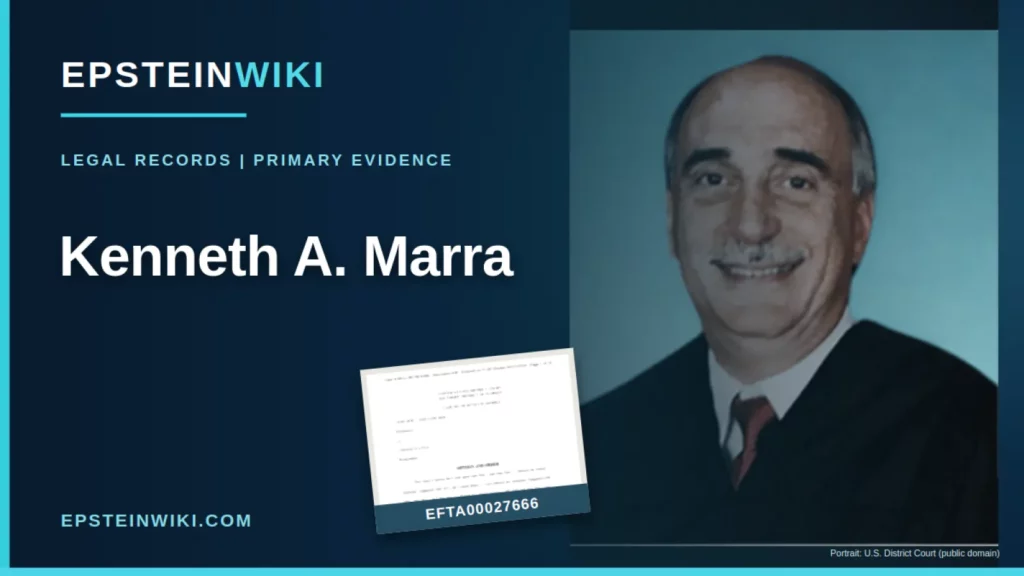
Snapshot
| Field | Documented Information |
|---|---|
| Full name | Kenneth A. Marra |
| Profession | Federal judge |
| Court | United States District Court for the Southern District of Florida |
| Principal Epstein proceeding | Jane Doe No. 1 and Jane Doe No. 2 v. United States, Case No. 9:08-cv-80736 |
| Legal issue | Whether federal prosecutors violated survivors’ rights under the Crime Victims’ Rights Act while negotiating Jeffrey Epstein’s secret 2007 nonprosecution agreement |
| Significant ruling | February 21, 2019 finding that federal prosecutors violated the petitioners’ statutory right to confer |
| Remedies decision | September 16, 2019 order denying remaining requested relief as moot and closing the case following Epstein’s death |
| Appellate outcome | April 15, 2021 Eleventh Circuit en banc decision holding that the Crime Victims’ Rights Act did not authorize the petitioners’ freestanding civil enforcement action |
| Related matters | Federal civil litigation, discovery disputes, confidentiality issues and procedural rulings involving Epstein and associated parties |
| Evidence | Federal judicial opinions, original petitions, docket filings and released Epstein records |
| Critical distinction | Marra’s 2019 finding concerning the right to confer must be read alongside the subsequent appellate decision limiting judicial enforcement of those rights before federal charges are filed. |
| Personal Epstein relationship | The cited record establishes a judicial role, not a personal relationship with Epstein. |
Introduction
United States District Judge Kenneth A. Marra played a central role in one of the most consequential legal challenges arising from Jeffrey Epstein’s secret 2007 federal nonprosecution agreement. For more than a decade, survivors challenged the conduct of federal prosecutors who negotiated an agreement with Epstein without first consulting them about the decision.
The case placed an extraordinary question before the federal courts. Could prosecutors negotiate an agreement that effectively ended a federal investigation, conceal that agreement from victims and then argue that the victims lacked an enforceable right to challenge the process?
On February 21, 2019, Marra ruled that the government had violated the petitioners’ rights under the federal Crime Victims’ Rights Act. The ruling documented failures to confer with victims and conduct that misled them about whether federal prosecution remained possible.
That finding was significant for survivors seeking accountability. However, the litigation did not end with the February ruling. Epstein’s death in August 2019 affected the remedies the court could provide, and a subsequent 2021 appellate decision rejected the use of a freestanding civil action to enforce the asserted statutory rights before a federal criminal proceeding existed.
Understanding Marra’s role requires examining the complete procedural history, including what he found, what he declined to decide, what remedies were denied and how the Eleventh Circuit later interpreted the governing law.
Marra was a judge deciding disputes arising from Epstein’s federal legal history. His appearance in the Epstein files does not itself establish any personal association with Epstein or participation in the underlying abuse.
Key Takeaways
- Judge Kenneth A. Marra presided over the federal litigation challenging the government’s handling of Epstein’s 2007 nonprosecution agreement.
- The original action began in July 2008 and continued for more than a decade.
- On February 21, 2019, Marra found that federal prosecutors violated the petitioners’ right to confer under the Crime Victims’ Rights Act.
- The court documented that prosecutors withheld information about the agreement while victims were seeking answers concerning the investigation.
- Marra did not rule that every aspect of the government’s original decision not to prosecute Epstein was independently unlawful.
- After Epstein died in federal custody on August 10, 2019, Marra denied the remaining requested remedies and closed the case.
- On April 15, 2021, the Eleventh Circuit sitting en banc held that the statute did not authorize the petitioners to pursue their claims through a standalone civil enforcement action.
- The 2021 appellate decision did not constitute a factual finding that prosecutors had adequately informed the victims or treated them fairly.
- Marra also issued procedural rulings concerning additional petitioners, disputed allegations and related civil litigation.
- The cited evidence establishes Marra’s judicial involvement, not a personal relationship with Epstein.
Kenneth Marra’s Judicial Role in the Epstein Litigation
Kenneth A. Marra served as a United States District Judge in the Southern District of Florida, the federal judicial district encompassing Palm Beach.
His Epstein-related work centered on litigation challenging the actions of the United States Attorney’s Office for the Southern District of Florida, which negotiated the 2007 nonprosecution agreement.
The agreement was negotiated while federal prosecutors were investigating allegations that Epstein sexually abused and exploited underage girls.
Epstein’s lawyers negotiated with federal prosecutors, and an agreement was reached in September 2007. The agreement was not disclosed to the victims at the time.
Rather than filing federal charges against Epstein, the prosecution proceeded through Florida state court. Epstein later entered guilty pleas to state offenses in June 2008.
Marra was not the prosecutor who negotiated the agreement. He was the federal judge assigned to consider the subsequent victims’ rights challenge.
That distinction matters because judicial rulings, prosecutorial decisions and defense advocacy are separate actions performed by different legal participants.
The Crime Victims’ Rights Act and the Secret Agreement
What Is the Crime Victims’ Rights Act?
The Crime Victims’ Rights Act, commonly called the CVRA, is a federal law codified at 18 U.S.C. Section 3771.
It establishes rights for people harmed by federal crimes, including rights concerning notice, participation, fairness and communication with federal prosecutors.
One particularly important provision recognizes a victim’s reasonable right to confer with the attorney for the government in the case.
The Epstein litigation raised a fundamental question about when those rights attach and how victims may enforce them.
The July 2008 Petition
The July 7, 2008 petition initiated the federal victims’ rights litigation.
The petitioners, proceeding under Jane Doe designations, alleged that the federal government had violated their rights by negotiating and implementing the nonprosecution agreement without providing the consultation and notice required by federal law.
The case was assigned to Judge Marra in the Southern District of Florida.
The petition was not a criminal prosecution of Epstein. It was a civil proceeding seeking judicial enforcement of asserted statutory rights against the United States.
Why the Timing of the Agreement Mattered
The government negotiated the agreement before filing federal criminal charges against Epstein.
That timing became central to the dispute because prosecutors argued that certain rights under the statute did not become judicially enforceable before a federal criminal proceeding commenced.
The petitioners maintained that the statute protected victims during the investigative period and that prosecutors could not avoid those protections simply by resolving a case before charges were filed.
Marra and the appellate courts subsequently addressed different aspects of that legal disagreement.
The Long Discovery Battle
The litigation involved extensive disputes over correspondence between federal prosecutors and Epstein’s defense attorneys.
Survivors sought access to materials showing how the agreement was negotiated, what prosecutors communicated to Epstein’s representatives and what the government told victims during the same period.
The government and Epstein’s attorneys resisted the disclosure of certain materials, raising legal objections that included confidentiality and privilege.
The litigation included attempts to obtain correspondence relevant to the negotiation and execution of the nonprosecution agreement.
Epstein’s Participation in the Litigation
Epstein intervened in aspects of the proceeding concerning discovery of communications between federal prosecutors and his defense team.
His participation as an intervenor did not convert the case into a criminal prosecution.
The underlying action remained a dispute concerning victims’ statutory rights and the legal obligations of federal prosecutors.
The 2014 Appellate Discovery Ruling
In Doe No. 1 v. United States, 749 F.3d 999 (11th Cir. 2014), the Eleventh Circuit addressed appellate issues arising from the discovery proceedings.
The appellate court affirmed the discovery order requiring disclosure of government correspondence with Epstein’s defense counsel.
The decision was important because the communications were directly relevant to reconstructing how the federal agreement had been negotiated.
Discovery of correspondence does not mean that every statement within the correspondence was independently verified as true. It means that the material was subject to production for purposes of the litigation.
April 2015: Additional Petitioners and Disputed Allegations
In April 2015, Marra addressed motions seeking to add petitioners and allegations to the existing federal action.
The April 2015 ruling concerned procedural questions, including whether additional claims and allegations were sufficiently relevant to the specific victims’ rights dispute.
The court struck certain allegations concerning third parties from filings in the proceeding.
What Striking Allegations Means
Under federal civil procedure, a court may strike material that is legally immaterial, impertinent or otherwise inappropriate to the issues being litigated.
That procedural decision is not necessarily a determination that the underlying allegations are false.
Nor does the inclusion of an allegation in a court filing establish that the alleged conduct occurred.
The distinction is especially important when the allegations concern sexual abuse, unidentified survivors or individuals who were not parties to the particular proceeding.
Why the 2015 Ruling Matters
Marra’s 2015 decision illustrates the difference between the subject of a legal action and the broader factual history surrounding it.
The CVRA proceeding concerned the government’s obligations to victims during the federal investigation and agreement process.
Other allegations might be relevant to separate civil or criminal proceedings without being appropriate for adjudication in this particular action.
The ruling therefore must not be presented as a comprehensive determination of the truth or falsity of all allegations discussed in the filings.
February 21, 2019: Marra Finds a Violation of Victims’ Rights
The most consequential ruling associated with Marra’s Epstein proceedings came on February 21, 2019.
In Document 435, the February 2019 opinion, Marra granted partial summary judgment in favor of the petitioners.
Summary judgment is a decision made without a trial when the court determines that the applicable legal standard permits judgment on a claim based on the record before it.
The Right to Confer
Marra found that federal prosecutors had violated the petitioners’ right to confer under the Crime Victims’ Rights Act.
The ruling examined the government’s negotiations with Epstein’s attorneys and its communications with victims.
Marra concluded that prosecutors had failed to provide the required consultation before resolving the federal investigation through the secret agreement.
Concealment and Misleading Communications
The court’s findings went beyond a simple failure to schedule a meeting.
Marra examined how federal prosecutors withheld the existence of the agreement while victims sought information about the investigation.
The ruling found that government communications had left victims believing that federal prosecution remained possible even after prosecutors had entered into the agreement.
This conduct was significant because it affected the victims’ ability to exercise the rights they were attempting to assert.
What the Court Did Not Decide
Marra expressly distinguished the failure to confer from the underlying decision not to prosecute Epstein federally.
He did not hold that the government’s decision concerning the original federal charges was necessarily improper simply because the victims’ procedural rights had been violated.
The distinction is crucial. A finding that prosecutors violated a statutory right does not automatically establish that every related prosecutorial decision was legally invalid.
Why the Ruling Was Significant
The ruling created a detailed judicial account of how the federal government handled communications with victims during negotiations with Epstein’s defense attorneys.
It also established a basis for the petitioners to seek remedies for the violations identified by the district court.
However, the availability of a remedy remained a separate legal issue.
The Remedies Question
Following the February 2019 ruling, the parties submitted arguments concerning what relief the court could provide.
The May 2019 petitioners’ filing addressed possible procedures and remedies for the identified violations.
The petitioners sought meaningful relief addressing the government’s conduct and their exclusion from the agreement process.
The issues included whether the court could order further proceedings, require additional government action or address the legal consequences of the nonprosecution agreement.
Why a Violation Does Not Automatically Produce a Remedy
Courts distinguish between determining that a legal right was violated and determining what relief the law authorizes.
Even when a court finds a violation, statutory limits, jurisdictional requirements and subsequent events may restrict the remedies available.
That distinction became particularly important after Epstein’s federal arrest and death in 2019.
Epstein’s 2019 Federal Arrest and Death
In July 2019, federal prosecutors in the Southern District of New York brought new criminal charges against Epstein.
The indictment alleged federal sex trafficking offenses involving minors. An indictment is a formal accusation, not a conviction.
On August 10, 2019, Epstein died in federal custody before his criminal case went to trial.
His death changed the legal circumstances surrounding the victims’ rights litigation pending before Marra.
Some requested remedies had depended on the possibility of further prosecution or participation in proceedings involving Epstein.
The parties and the court consequently had to address whether meaningful judicial relief remained available.
September 16, 2019: The Case Is Closed
In his September 16, 2019 opinion, Marra addressed the remaining requests for relief following Epstein’s death.
The court concluded that the requested remedies could no longer be granted in the circumstances presented.
It denied the remaining motions as moot and closed the case.
A matter becomes moot when developments mean that the court can no longer provide the effective relief necessary to resolve the dispute.
Attorney’s Fees and Additional Relief
The court also rejected the petitioners’ request for attorney’s fees.
The denial of fees should not be confused with a factual determination that prosecutors had adequately consulted victims.
It concerned the legal requirements governing the requested relief.
The Court Recognizes the Litigation’s Broader Importance
Marra acknowledged the significance of the prolonged litigation and its effect on public understanding of the government’s handling of Epstein.
He observed that rulings made during the proceedings might have played some role in renewed federal attention to Epstein.
That observation was not a determination that the CVRA litigation alone caused the 2019 federal indictment.
The closing order ended the district court proceedings, but it did not end the legal debate over the statute’s reach and enforceability.
The 2021 Eleventh Circuit Decision Changes the Legal Picture
The subsequent appellate history is essential to understanding Marra’s rulings accurately.
On April 15, 2021, the United States Court of Appeals for the Eleventh Circuit issued its en banc decision in In re Courtney Wild, No. 19-13843.
An en banc decision is issued by the court acting through a larger group of judges rather than its usual three-judge panel.
The Question Before the Court
The appellate court considered whether the Crime Victims’ Rights Act authorized victims to pursue judicial enforcement of their rights through a freestanding civil action when federal prosecutors had not filed criminal charges.
The case concerned the same secret agreement that had been examined in Marra’s proceedings.
The Majority’s Holding
The Eleventh Circuit majority held that the statute did not authorize the petitioners’ standalone civil enforcement action in the absence of a preexisting federal criminal proceeding.
Because federal prosecutors had not charged Epstein before entering the 2007 agreement, the majority concluded that the petitioners could not obtain the requested judicial enforcement through that separate civil action.
The decision addressed the availability of a judicial remedy under the statute. It did not establish that prosecutors had, as a factual matter, properly consulted the victims.
The Court Leaves a Distinct Question Open
The en banc majority did not definitively resolve whether certain victims’ rights could attach during the period before formal federal charges.
Instead, it concluded that the statute did not provide the judicial enforcement mechanism the petitioners had attempted to use.
This distinction is essential when describing the relationship between the district court’s findings and the appellate outcome.
The Dissenting Perspectives
The appellate decision included dissenting opinions that disagreed with the majority’s interpretation of the statute and its enforcement provisions.
Those opinions discussed the consequences of allowing the government to avoid judicial review of certain victims’ rights claims by resolving investigations without filing charges.
The dissenting analysis is part of the legal record but is not the controlling holding of the court.
How the 2021 Decision Affects Marra’s 2019 Finding
Marra’s February 2019 ruling remains an important historical document explaining his assessment of the government’s actions and the evidence before the district court.
However, it cannot be presented as the final controlling interpretation of the CVRA’s authorization for freestanding judicial enforcement before federal charges are filed.
The 2021 appellate majority rejected that enforcement theory.
The complete account must therefore include both the district court’s finding concerning victims’ rights and the later appellate decision restricting the available legal mechanism.
Related Florida Civil Proceedings
Marra’s name also appears in federal records associated with related Epstein civil litigation.
These matters included disputes involving settlements, discovery and procedural orders.
For example, a July 2010 order documents the dismissal of a related civil action following settlement.
The court dismissed that case with prejudice and treated pending motions as moot.
A dismissal with prejudice generally prevents the same claim from being brought again in that action.
It does not automatically establish that the defendant admitted every allegation or that the court independently resolved every factual dispute.
When examining records bearing Marra’s name, investigators should identify the particular case number, parties and ruling before treating the document as evidence concerning the CVRA action.
Documented Chronology
| Date | Documented Event | Source |
|---|---|---|
| September 2007 | Federal prosecutors negotiate a nonprosecution agreement with Epstein without first consulting the victims who later challenged the agreement. | Appellate history |
| July 7, 2008 | Victims’ rights petition is filed in the Southern District of Florida. | EFTA00215606 |
| July 2010 | Related civil proceedings conclude through settlement and dismissal. | EFTA00310529 |
| 2011 | District court addresses whether CVRA rights can apply before formal federal charges. | Appellate discussion |
| 2014 | Eleventh Circuit addresses discovery involving communications between federal prosecutors and Epstein’s lawyers. | Doe No. 1 v. United States, 749 F.3d 999 |
| April 2015 | Marra addresses motions concerning additional petitioners and allegations deemed immaterial to the pending procedural action. | DOJ-OGR-00003725 |
| February 21, 2019 | Marra grants partial summary judgment, finding a violation of the petitioners’ right to confer. | EFTA00027666 |
| May 2019 | Petitioners present arguments concerning possible remedies. | EFTA00027776 |
| July 2019 | Federal prosecutors in New York bring criminal charges against Epstein. | Federal criminal proceedings |
| August 10, 2019 | Epstein dies in federal custody before trial. | Federal court history |
| September 16, 2019 | Marra denies remaining relief and closes the civil action. | EFTA02758614 |
| April 15, 2021 | Eleventh Circuit en banc majority holds that the CVRA does not authorize the petitioners’ freestanding civil enforcement action. | In re Courtney Wild |
Evidence Appearances and Document Register
The following register identifies major documents associated with Marra’s Epstein proceedings. Judicial opinions, petitions and appellate records have different evidentiary roles. A petition records what a party alleges, while a judicial opinion records what the court decided.
| Record or ID | Date | What It Shows | Source |
|---|---|---|---|
| EFTA00215606 | July 7, 2008 | Original petition alleging violations of rights under the Crime Victims’ Rights Act. | View record |
| EFTA00310529 | July 2010 | Related civil litigation dismissal following settlement. | View record |
| DOJ-OGR-00003725 | April 2015 | Ruling involving motions to add petitioners and disputed allegations. | View record |
| EFTA00027666 | February 21, 2019 | District court ruling finding that federal prosecutors violated the petitioners’ right to confer. | View record |
| EFTA00027776 | May 2019 | Petitioners’ arguments concerning potential remedies. | View record |
| EFTA02758614 | September 16, 2019 | District court order denying remaining relief and closing the action. | View record |
| EFTA00074599 | April 15, 2021 | Archived text associated with the Eleventh Circuit en banc decision. | View record |
| In re Courtney Wild, No. 19-13843 | April 15, 2021 | Published en banc opinion addressing the absence of a statutory right to pursue standalone judicial enforcement before federal charges. | Read opinion |
What the Evidence Establishes
The Government Failed to Confer
Marra’s February 2019 decision documented a failure by federal prosecutors to confer with the petitioners concerning the nonprosecution agreement.
The decision also examined how prosecutors communicated with victims during and after negotiations.
The District Court Found a Statutory Violation
Marra concluded that the government had violated the petitioners’ rights under his interpretation of the Crime Victims’ Rights Act.
That ruling was later affected by appellate litigation concerning whether the statute permitted the proceeding to be brought in the first place.
The Appellate Court Restricted Enforcement
In April 2021, the Eleventh Circuit en banc majority held that the statute did not authorize the freestanding civil judicial enforcement action pursued by the petitioners.
The majority’s legal conclusion was not a factual endorsement of the government’s communications with the victims.
Marra’s Decisions Were Judicial Acts
The records establish that Marra issued decisions and managed proceedings involving Epstein-related litigation.
They do not establish that he was Epstein’s personal attorney, business associate or participant in the offenses under investigation.
Important Limitations and Unresolved Questions
Did the February 2019 Decision Invalidate the Nonprosecution Agreement?
No. Marra’s February 2019 ruling identified a violation of the right to confer but did not immediately invalidate the entire agreement or decide that every part of the original charging decision was unlawful.
Did the September 2019 Decision Erase the Earlier Finding?
The September order denied the remaining requested remedies and closed the proceeding. It did not declare that the government had adequately consulted victims.
The subsequent appellate ruling must nevertheless be considered when describing the legal effect of the district court’s analysis.
Did the Appellate Court Find That Prosecutors Had Acted Properly?
No. The Eleventh Circuit resolved the enforceability question under the statute. It did not make a factual finding that victims had received appropriate notice and consultation.
Were All Allegations Concerning Third Parties Decided?
No. The procedural rulings in the CVRA litigation did not adjudicate every allegation against people named in the filings.
Striking allegations as immaterial to the case is not equivalent to determining that they were false.
Did Marra Cause the 2019 Federal Prosecution?
The litigation contributed to public and legal scrutiny of the government’s handling of Epstein. However, the record does not establish that Marra’s rulings alone caused the Southern District of New York to bring its 2019 charges.
What Does the Case Reveal About Victims’ Rights?
The case exposed a significant legal conflict between the rights Congress recognized for crime victims and the mechanisms available to enforce those rights before prosecutors file criminal charges.
The different district court and appellate rulings illustrate that recognizing a statutory right and obtaining judicial relief are legally distinct matters.
Conclusion
Judge Kenneth A. Marra’s role in the Jeffrey Epstein litigation is important because his rulings documented the federal government’s handling of victims during negotiations over the secret 2007 nonprosecution agreement.
His February 21, 2019 decision found that federal prosecutors had violated the petitioners’ right to confer, after years of litigation that exposed communications between prosecutors, defense attorneys and victims.
For survivors who had spent years seeking answers, the ruling provided a judicial account of the government’s failure to involve them in a consequential prosecutorial decision.
But the complete legal history is more complicated than the February ruling alone. Epstein’s death altered the available remedies, Marra closed the action in September 2019, and the Eleventh Circuit’s April 2021 en banc decision held that the statute did not authorize the standalone enforcement proceeding.
That appellate ruling limits how the earlier district court decision may be described as a statement of controlling law. It does not, however, turn the government’s documented lack of consultation into evidence of appropriate treatment.
Marra’s place in the Epstein documentary record is therefore judicial rather than personal. His significance lies in the orders he issued, the evidence examined by his court and the legal questions those proceedings brought into public view.
The record also demonstrates a lasting issue in federal criminal justice: procedural rights may be recognized in legislation, yet questions of timing, jurisdiction and available remedies can determine whether victims are able to enforce those rights in court.
Questions and Answers
Who is Kenneth A. Marra?
Kenneth A. Marra is a federal judge who served on the United States District Court for the Southern District of Florida and presided over litigation concerning Jeffrey Epstein’s federal nonprosecution agreement.
Why does Kenneth Marra appear in the Epstein files?
His name appears on judicial orders, opinions and related court documents from federal proceedings involving Epstein and victims seeking enforcement of their statutory rights.
What was the main Epstein case before Marra?
The principal proceeding was Jane Doe No. 1 and Jane Doe No. 2 v. United States, Case No. 9:08-cv-80736, involving claims under the federal Crime Victims’ Rights Act.
What did Marra decide in February 2019?
He found that federal prosecutors had violated the petitioners’ right to confer in connection with the secret nonprosecution agreement.
Did Marra rule that the entire nonprosecution agreement was unlawful?
His February 2019 ruling identified violations of victims’ procedural rights. It did not declare every aspect of the government’s charging decision unlawful or immediately invalidate the agreement.
What happened after Epstein died?
Marra considered the remaining requests for relief and closed the action on September 16, 2019, finding the remaining requested remedies unavailable in the circumstances.
What did the Eleventh Circuit decide in 2021?
The en banc majority held that the Crime Victims’ Rights Act did not authorize the petitioners’ freestanding civil enforcement action when federal prosecutors had not commenced a criminal proceeding against Epstein before entering the agreement.
Did the appellate court find that prosecutors had treated victims fairly?
No. The majority resolved a legal question concerning judicial enforcement rather than making an affirmative factual finding that prosecutors had provided appropriate consultation.
Did Marra dismiss allegations concerning third parties?
He struck certain allegations from the CVRA proceedings on procedural grounds. That action did not constitute a determination of the truth or falsity of every underlying allegation.
Was Kenneth Marra Jeffrey Epstein’s lawyer?
No. Marra was a federal judge. He did not represent Epstein as a defense attorney in the proceedings described here.
Is there evidence that Marra had a personal relationship with Epstein?
The cited records establish a judicial connection through litigation, not a personal relationship.
Why is Marra’s judicial record important to Epstein survivors?
His decisions document how the government’s agreement with Epstein was negotiated and how victims’ attempts to exercise their statutory rights were handled. The subsequent appellate rulings also reveal the legal barriers victims encountered when seeking judicial enforcement.
Related EpsteinWiki Articles
- Operation Leap Year: The Federal Investigation of Jeffrey Epstein
- Jane Doe No. 2 and Epstein’s Florida Civil Litigation
- Gerald Lefcourt
Sources
- EFTA00215606. Original July 7, 2008 victims’ rights petition.
- EFTA00027666. February 21, 2019 district court opinion concerning the right to confer.
- EFTA00027776. May 2019 filing concerning possible remedies.
- EFTA02758614. September 16, 2019 final order addressing remedies and closing the case.
- DOJ-OGR-00003725. April 2015 ruling concerning additional petitioners and disputed allegations.
- EFTA00310529. July 2010 related civil proceedings and dismissal.
- EFTA00074599. Archived materials associated with the Eleventh Circuit decision.
- In re Courtney Wild, No. 19-13843. April 15, 2021 Eleventh Circuit en banc opinion.
- In re Courtney Wild, 2020 panel opinion. Earlier appellate opinion subsequently vacated when rehearing en banc was granted.