
Gerald Lefcourt
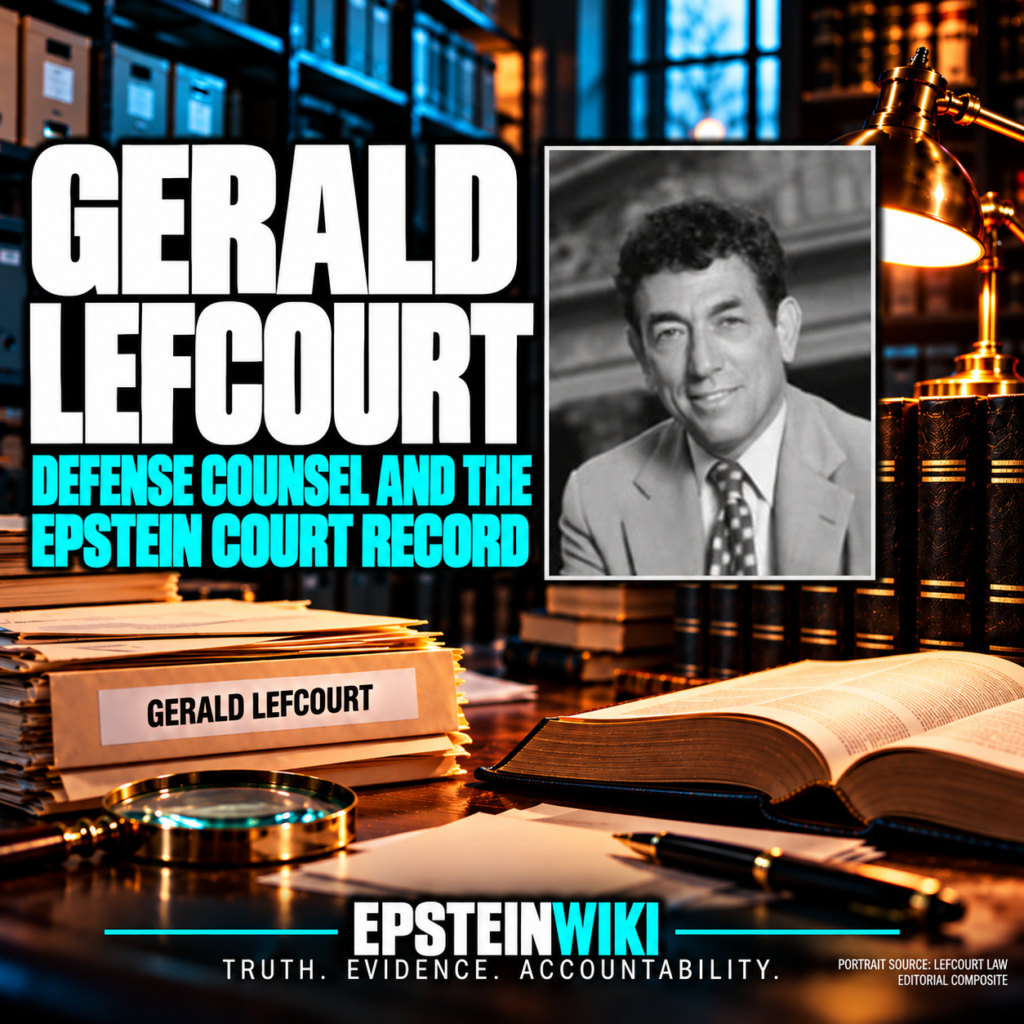
Snapshot
| Field | Documented information |
|---|---|
| Public identity | Gerald B. Lefcourt, New York criminal defense lawyer and former president of the National Association of Criminal Defense Lawyers |
| Epstein role | Represented Jeffrey Epstein during the Palm Beach investigation and the federal investigation that produced the 2007 nonprosecution agreement |
| Directly documented work | Meetings with prosecutors, written legal arguments, responses to corporate subpoenas, sentence negotiations and execution of the agreement and its addendum |
| Agreement signature | September 24, 2007, as counsel to Jeffrey Epstein |
| Addendum signature | October 29, 2007 |
| Financial records | Legal expense accounting and correspondence acknowledging a client credit |
| Later public position | In August 2019, defended a broad interpretation of the agreement’s protection for potential coconspirators |
| Essential distinction | The record establishes legal representation and participation in the negotiated resolution. Those facts do not establish participation in Epstein’s sexual abuse or trafficking |
| Last checked | October 6, 2026 |
Gerald Lefcourt’s signed NPA counterpart is direct evidence of his formal role in the resolution that ended the Southern District of Florida’s investigation without federal charges against Jeffrey Epstein. Lefcourt also appears in the contemporaneous negotiations described by the Justice Department’s Office of Professional Responsibility, known as OPR. His documented involvement extended from challenges to prosecution and witness credibility to proposals concerning imprisonment and the agreement’s implementation.
The OPR meeting chronology identifies several meetings in which Lefcourt participated and others in which he did not. This distinction matters because Epstein retained many lawyers. A letter written by Jay Lefkowitz, a presentation led by Alan Dershowitz or a decision made by Alexander Acosta should not automatically be attributed to Lefcourt.
Important Points
- Lefcourt was an advocate for Epstein. He had no prosecutorial authority to approve immunity, file government charges or decide what victims would be told.
- OPR places him in the state defense effort and records his initial contact with federal prosecutor A. Marie Villafaña in August 2006.
- He and Lilly Ann Sanchez made presentations to federal prosecutors in February 2007. He later joined meetings in June, July, September and December.
- After a September 2007 meeting that he did not attend, Lefcourt proposed 15 months in jail followed by 15 months of home confinement. The eventual resolution called for 18 months in county jail and 12 months of community control.
- His signature appears on the September 2007 agreement and the October 2007 addendum concerning the procedure for selecting a victims’ attorney representative.
- Payments and billing correspondence establish a professional financial relationship. They require separate analysis from allegations of criminal participation.
- The legal aftermath includes the survivors’ rights litigation and the rejection of Ghislaine Maxwell’s effort to use the agreement to defeat her prosecution in New York.
Professional Background
The National Association of Criminal Defense Lawyers biography identifies Lefcourt as a lawyer whose practice has principally concerned criminal law and complex civil litigation. It lists clients ranging from political activists to business figures and entertainers. It also describes more than 20 years of service as the New York State Assembly Speaker’s designee to the state Commission on Judicial Nomination.
NACDL’s past presidents roster confirms that he led the organization in 1997 and 1998. His professional prominence explains why accounts of Epstein’s defense frequently place him among nationally recognized lawyers. It does not establish how much influence he personally exercised over a particular prosecutor or decision.
Lefcourt’s 1998 congressional testimony identifies him as a 1967 graduate of Brooklyn Law School and the head of a New York law firm. These professional records provide a firmer basis for his background than the unsourced biographical fragments often repeated alongside Epstein document searches.
The State Investigation and Witness Credibility Campaign
OPR’s account of the Palm Beach investigation places Lefcourt alongside Jack Goldberger in efforts to persuade State Attorney Barry Krischer and prosecutor Lanna Belohlavek not to prosecute Epstein. The report says their efforts centered largely on attacking the credibility of the young witnesses. That is a documented description of the defense strategy, rather than a finding that the witnesses were unreliable.
The report’s defense team history explains that Epstein added lawyers as different investigative bodies became involved. Roy Black was retained at the outset of the state investigation. Lefcourt began representing Epstein during that state phase, before the federal negotiations that later became the main focus of public scrutiny.
The report’s discussion of registration requirements identifies a 2006 Lefcourt letter showing that the defense had researched the consequences of Florida sex offender registration. OPR contrasted that preparation with the absence of comparable research it could locate on the federal government’s side. The observation bears on the imbalance in preparation. It does not establish that Lefcourt independently selected every charge or factual admission used in the eventual state plea.
Entry Into the Federal Investigation
The federal chronology records Lefcourt’s initial contact with Villafaña in August 2006. Investigators were interviewing employees and seeking business records. Epstein’s lawyers therefore became involved while the federal evidence gathering was still underway.
Sanchez’s November 15, 2006 representation letter identified herself and Lefcourt as Epstein’s counsel and asked that communications concerning Epstein be directed to them. Villafaña sought documents previously supplied to state authorities and computer equipment removed from Epstein’s house before the police search. The existence of that request does not establish that Lefcourt removed equipment or knew why it had been removed.
The correspondence preceding the February meeting also records disagreement inside the United States Attorney’s Office. Villafaña wanted documents before hearing another defense presentation. Her supervisor, Andrew Lourie, considered meetings useful for understanding defense theories and agreed to hear Sanchez and Lefcourt. The differing views are part of the institutional history of the case.
The February 2007 Presentations
The February 1, 2007 meeting brought Sanchez and Lefcourt together with Lourie and Villafaña. The defense supplied a 25 page letter, material from the state investigation and information intended to impeach witnesses. Its positions included objections to federal jurisdiction, challenges to evidence that Epstein knew the girls were minors and the contention that the state investigation should preclude or discourage federal intervention.
The defense’s reliance on the Petite policy concerned the Justice Department’s policy governing successive prosecutions. It was a defense argument about federal action, not a judicial ruling that the federal investigation was barred. Villafaña told OPR that neither she nor Lourie was persuaded at that meeting.
The February 20 follow up meeting included the delivery of recordings of state interviews, with transcripts supplied afterward. The records show an effort to shape prosecutors’ understanding of the witnesses and evidence. Descriptions of children as willing participants, or attacks based on their histories, remain the defense’s framing and should not be adopted as explanations excusing adult sexual exploitation.
Corporate Subpoenas and the Financial Investigation
The June 2007 subpoena correspondence contains Lefcourt’s June 12 response concerning subpoenas dated May 31 to J. Epstein Virgin Islands Foundation, J. Epstein & Co., Epstein Interests and Financial Trust Company. The letter is an identifiable example of his firm handling the production of corporate information during the federal investigation.
Villafaña’s June 14 reply thanked Lefcourt for the response, noted that the search for some requested records was continuing and asked for certifications from the corporations’ records custodians. The distinction between producing records and certifying a complete response matters. The exchange does not itself establish that every requested record was produced or that the businesses committed financial crimes.
Kait Justice’s examination of the 2007 emails drew attention to these corporate requests and to the progression from investigation to negotiation. The underlying letters support the existence of financial records inquiries. Claims about the motive for every subpoena, or about what a particular official remembered years later, require additional evidence beyond the fact that a subpoena existed.
Bloomberg’s financial investigation reporting identified Lefcourt among lawyers challenging the expanded inquiry. He declined comment.
The June Meeting and July Legal Submission
Lefcourt’s June 25, 2007 letter preceded a meeting with senior federal prosecutors. OPR describes the submission as 19 pages and records objections to applying the proposed federal statutes, challenges to the police investigation and arguments that the matter belonged in state court.
The June 26 meeting included Lefcourt, Sanchez, Black and Dershowitz on the defense side, and senior prosecutors, Villafaña and FBI personnel on the government side. OPR identifies Dershowitz as the lead presenter. Investigators were concerned that the discussion might disclose information about the federal case while giving the defense another opportunity to argue against prosecution.
The July 6, 2007 defense letter followed that meeting. The 23 page submission bears the names of Lefcourt and Dershowitz. It argued for a narrow interpretation of 18 U.S.C. § 2422(b), challenged its application to Epstein and presented philanthropic activity as a reason for leniency. These are the lawyers’ submissions on behalf of their client.
The letter’s linguistic argument cited Steven Pinker’s analysis of the relationship between the use of interstate communications and persuasion or enticement. Its later pages asserted that Epstein helped conceive the Clinton Global Initiative. The document establishes that counsel made that claim. It does not independently establish an institutional founding role or validate the letter’s portrayal of Epstein’s character.
The later federal review process confirms that defense submissions continued after the agreement. The fact that prosecutors negotiated a resolution does not mean a court accepted the defense’s statutory arguments or that federal authorities found the reported abuse lawful.
The July 31 Proposal and the September Counteroffer
The July 31, 2007 meeting included Lefcourt, Sanchez and Black. Prosecutors presented a proposed resolution through state charges and a sentencing calculation indicating a potential federal range of 188 to 235 months. That calculation was part of the negotiation. It was not a sentence imposed by a judge or a prediction that a particular trial outcome was guaranteed.
The defense response to the proposal included objections to sex offender registration and concerns about Epstein’s safety in prison. The lawyers suggested home confinement or community control. OPR attributes those positions to the defense attorneys at the meeting; it does not identify Lefcourt as the speaker for every point.
Lefcourt’s September counteroffer followed the September 7 meeting attended by other defense lawyers. OPR expressly states that he was not present at that meeting. He subsequently spoke with Acosta and Lourie and proposed 15 months in jail followed by 15 months of home confinement. Villafaña regarded the proposal as a reasonable counteroffer relative to the government’s starting position while describing the resulting sentence as very low.
The revised government proposal called for 20 months in jail and 10 months of home confinement. It also contemplated a minimum period of actual custody after credit for good behavior. These changing terms show that the eventual 18 month jail sentence did not arise from a single unchanging offer.
Draft Agreements and the September 12 State Meeting
The September 11 revised agreement email is addressed to Gerald Lefcourt, copies Acosta and identifies an attached revised agreement. It places Lefcourt within the direct circulation of proposed terms. OPR separately explains that Acosta reviewed a draft and that an amendment concerning Epstein’s obligations to arrange compliance with Florida authorities was sent to defense counsel.
The September 12 meeting with state prosecutors included Lefcourt, Lefkowitz and Goldberger, alongside federal prosecutors, Krischer and Belohlavek. OPR found no evidence that the state office had been involved in the federal negotiations before this meeting. The available record indicated that the government made further concessions as the proposed state resolution was discussed.
The September 17 correspondence records Villafaña sending Lefkowitz a version of the agreement previously supplied to Lefcourt. Prosecutors were still discussing possible federal charges if an agreement was not reached. Sending a draft while preparing an indictment is evidence of parallel negotiating and prosecutorial options, rather than proof that one participant secretly controlled all of the others.
The Signed Nonprosecution Agreement
The signed counterpart reproduced in the Supreme Court record gives Lefcourt’s date as September 24, 2007 and identifies him as counsel to Jeffrey Epstein. Separate counterparts carry the signatures of Epstein and Sanchez. The record should be read as a set of signature pages, rather than assuming that every copy carries every signature.
The agreement’s text sets out the exchange: Epstein would comply with a state disposition and specified obligations, while the federal office would forgo prosecution covered by the agreement. The document also addressed potential coconspirators and civil compensation. Its language became the subject of prolonged litigation.
OPR’s account of the final terms identifies the principal obligations and concessions:
- Epstein would plead guilty to the pending Florida solicitation charge and an additional offense requiring sex offender registration.
- The parties would recommend consecutive terms of 12 months and six months in county jail, followed by 12 months of community control.
- The agreement provided a mechanism intended to facilitate civil claims by identified victims.
- The government agreed to forgo specified federal prosecution and included protection for named and unnamed potential coconspirators.
- Victims were not consulted about the agreement before it was executed.
The final agreement and its surrounding correspondence document a negotiated outcome approved by the federal prosecution office. Lefcourt’s participation is substantial and specific. Responsibility for the exercise of federal prosecutorial discretion remained with government officials.
The October Addendum and Victims’ Counsel
Lefcourt’s addendum signature is dated October 29, 2007. The additional terms concerned an independent third party’s role in selecting an attorney representative for identified victims, objections to that selection and the extent of Epstein’s obligation to pay the representative’s fees. The addendum changed the implementation of the civil compensation provisions.
OPR’s account of the addendum negotiations identifies Jeffrey Sloman and Lefkowitz as the principal participants in resolving the dispute over the attorney selection mechanism. Epstein, Lefcourt and Sanchez signed the resulting document. At Villafaña’s request, Sloman signed for the prosecution office. A signatory’s approval of the final instrument is distinct from proof that the signatory personally negotiated every clause.
The dispute about the attorney representative also illustrates the limits of describing the NPA simply as a promise to compensate victims. Selection of counsel, payment of counsel and access to contested litigation were issues negotiated between the government and the defense. The survivors’ own interests were not interchangeable with those of the officials or lawyers negotiating the arrangement.
Attempts to Reopen the Resolution
Acosta’s November 2007 response to the defense named Lefcourt among the lawyers who had been able to review and object to the agreement before it was adopted. The prosecution office complained that members of the team were raising collateral challenges after extensive negotiations. Acosta indicated that Epstein could reject the arrangement and face prosecution.
The December 14, 2007 meeting included Lefcourt, Starr, Dershowitz and Martin Weinberg. Acosta, Sloman, Villafaña, another senior prosecutor and FBI leadership attended for the government. The defense again challenged federal jurisdiction and sought renewed review. It also contended that the state offense selected for the plea did not apply to the facts.
The OPR executive summary describes further defense appeals to senior Justice Department officials before the Deputy Attorney General’s office declined to intervene on June 23, 2008. Epstein pleaded guilty in state court on June 30. The nine month interval between the agreement and the plea included continuing efforts to improve or undo the negotiated terms.
Victim Notification and the Later Rights Litigation
The September 2007 confidentiality discussions show officials and defense counsel addressing what would be disclosed after the NPA. OPR attributes particular requests for confidentiality to Lefkowitz and particular government responses to Acosta and Villafaña. Lefcourt’s signature on the agreement does not establish that he authored each of those communications.
The OPR review of victim notification states that victims were neither informed nor consulted before the agreement was signed. Subsequent government communications led victims to believe federal prosecution remained possible. The exclusion of survivors from a decision resolving the investigation became the central issue in the Crime Victims’ Rights Act litigation.
The Eleventh Circuit’s 2021 en banc decision must be read alongside Judge Kenneth Marra’s 2019 ruling that the government violated victims’ rights. The appellate majority held that the statute did not authorize the freestanding civil action brought before an underlying federal criminal proceeding. Its decision denied the requested judicial remedy. It did not establish that the survivors had not been abused or that the government’s treatment of them was satisfactory.
The majority’s limited holding and the dissents are important when describing the legal aftermath. A statement that the NPA was simply declared unlawful without mentioning subsequent proceedings leaves out a consequential part of the record. Conversely, the procedural defeat does not erase the documented secrecy or the survivors’ exclusion.
What OPR Concluded and What It Did Not Decide
OPR’s November 2020 conclusions found that Acosta exercised poor judgment in resolving the federal investigation through the NPA and that victims were not treated with the forthrightness and sensitivity expected of the Department. The office did not find professional misconduct under the standards it applied to the federal lawyers under investigation.
The report’s examination of access to prosecutors distinguished the defense team’s substantial opportunities to present its case from proof of improper influence. OPR investigated the conduct of Justice Department personnel. It was not a disciplinary adjudication of Lefcourt’s representation or a criminal investigation establishing his participation in Epstein’s offenses.
The Butterfly Bureau’s account of the Florida deal places Lefcourt within the wider defense and institutional history. Its discussion of unequal access is consistent with the documented contrast between repeated defense presentations and the exclusion of victims before the agreement. The primary records remain necessary to identify each participant’s own actions.
The report’s criticism of the state resolution included the unforeseen consequences of relying on state charges, sentencing and registration systems to satisfy federal objectives. Lefcourt’s earlier registration research is relevant to that comparison. The failure of government officials to anticipate an outcome does not prove an undisclosed agreement between those officials and defense counsel.
Legal Expense Accounting
The legal expense schedule includes a row for Gerald B. Lefcourt, P.C. on the page stamped EFTA00727860. The schedule distinguishes original bills, reallocations, fees written off or returned, revised bills, payments and outstanding balances. Those categories should be preserved when describing the scale of the legal relationship.
The underlying accounting page supports treating the entry as Epstein’s accounting for a law firm. It is not a finding that every dollar represented Lefcourt’s personal income, that every item concerned the criminal case or that every billed service was improper. A ledger also cannot, by itself, establish a lawyer’s knowledge of abuse.
Heather Ashley’s reporting on the defense expenses used the ledger while examining Stephanie Thacker’s work. That reporting provides a useful route into the financial records. The ledger’s own categories remain necessary for checking any simplified statement about what each lawyer was paid.
Correspondence About a Client Credit
The May 14, 2009 client credit email preserves a message from Sheryl E. Reich of Gerald B. Lefcourt, P.C. to Harry Beller. Reich wrote that she expected a further $50,000 to be wired by Friday against Epstein’s credit with the firm and that $28,373.54 would remain afterward. The same message appears in EFTA00749571.
The duplicate email record confirms that this was correspondence about an expected payment and a remaining credit. It does not independently verify that the wire settled, identify the final amount ultimately repaid or establish a judicial finding of overbilling. The two copies preserve the same underlying communication and should not be counted as two separate payments.
Lefcourt’s Public Position After Epstein’s Death
Associated Press reporting in August 2019 recorded Lefcourt’s view that the NPA should protect alleged coconspirators for conduct within its covered period. He said his recommendation and signature had rested on a broad understanding of the criminal liability being resolved. That was the position of a negotiating defense lawyer, rather than a binding judicial interpretation.
The Second Circuit opinion reproduced in Maxwell’s Supreme Court appendix rejected Maxwell’s argument that the Florida agreement barred her New York prosecution. The court applied the rule that an agreement normally binds the United States Attorney’s Office that entered it unless a broader restriction affirmatively appears. It found no basis to extend the NPA as Maxwell requested.
The Supreme Court docket records the denial of Maxwell’s petition on October 6, 2025. Denial of review left the lower court judgment in place without a new Supreme Court merits opinion. The later litigation demonstrates why a lawyer’s statement that an agreement resolved all exposure cannot substitute for the courts’ interpretation of the agreement.
Evidence Appearances
- EFTA00013680: The nonprosecution agreement text. Lefcourt’s dated signature is separately corroborated by the agreement counterparts reproduced in the Supreme Court appendix.
- EFTA01338175: Collection containing the June 12, 2007 subpoena response and the June 14 government reply. Relevant pages are 2 and 23.
- EFTA01660165: July 6, 2007 letter signed in the names of Lefcourt and Dershowitz, presenting legal and mitigation arguments.
- EFTA00215318: September 11, 2007 email addressed to Lefcourt concerning a revised agreement and copying Acosta.
- EFTA00727857: Five page legal expense record. Page 4 carries the Lefcourt firm row and the page stamp EFTA00727860.
- EFTA00749564: May 14, 2009 correspondence preserving Reich’s account of an expected refund and remaining client credit.
- EFTA00749571: Another copy of the same credit correspondence, rather than a separate payment.
- EFTA00013359: OPR executive summary, useful for the agreement’s chronology and the scope of the federal professional responsibility review.
Evidence Timeline
- 2006: Lefcourt participated in the state defense and researched registration consequences.
- August 2006: OPR records his initial contact with Villafaña during the federal investigation.
- November 15, 2006: Sanchez identified herself and Lefcourt as Epstein’s federal counsel.
- February 1 and February 20, 2007: Lefcourt and Sanchez met federal prosecutors and supplied defense material.
- June 12, 2007: Lefcourt responded to corporate subpoenas.
- June 26, 2007: He joined the defense presentation to senior prosecutors and FBI personnel.
- July 6, 2007: The detailed statutory and mitigation submission followed.
- July 31, 2007: He attended the meeting at which prosecutors presented a state resolution proposal.
- September 2007: He advanced a sentencing counteroffer, received draft terms and attended the September 12 meeting with state prosecutors.
- September 24, 2007: He signed the NPA counterpart as Epstein’s counsel.
- October 29, 2007: He signed the addendum concerning victims’ counsel.
- December 14, 2007: He joined renewed defense presentations to Acosta and other federal officials.
- June 30, 2008: Epstein entered the state guilty plea implementing the resolution.
- May 14, 2009: Reich’s email addressed Epstein’s client credit at the firm.
- August 2019: Lefcourt publicly defended a broad understanding of the NPA’s protection.
- November 2020: OPR issued its review of the federal resolution and treatment of victims.
- April 15, 2021: The Eleventh Circuit denied the freestanding CVRA remedy in its en banc decision.
- October 6, 2025: The Supreme Court declined review of Maxwell’s NPA challenge.
What the Record Establishes
The contemporaneous meetings and documented submissions establish that Lefcourt was a recurring participant in Epstein’s defense, rather than someone connected solely by a name in an address book. His counteroffer and signatures connect him directly to the negotiated resolution. His role can be evaluated through the positions he advanced and the agreements he approved.
The agreement’s institutional history also requires a clear allocation of responsibility. Defense lawyers could propose terms, challenge evidence and seek review. Federal officials controlled the decision to relinquish the federal case, while state authorities controlled the state plea and the later administration of custody. Criticism of the outcome is strongest when it identifies the specific acts of each participant.
The professional correspondence and financial records establish additional dealings between Epstein’s representatives and Lefcourt’s firm. They do not establish that Lefcourt recruited victims, participated in trafficking or personally committed sexual abuse. No such conclusion follows merely from representation, payment, a signature or the presence of his name in released files.
Related EpsteinWiki Articles
- The 2007 Nonprosecution Agreement: The agreement and its terms.
- Alan Morton Dershowitz: A separate member of Epstein’s legal team.
- Barry Krischer: The original state charging decisions.
- Alexander Acosta’s testimony: Later explanations of the federal resolution.
- Stephanie Thacker’s defense letter and judicial nomination: Related legal advocacy and expense records.
Sources
- NACDL biography of Gerald Lefcourt: Professional background.
- NACDL past presidents: Presidency in 1997 and 1998.
- Lefcourt’s April 1998 congressional testimony: Education and professional identification.
- DOJ Office of Professional Responsibility report filed in United States v. Maxwell as document 293 attachment 1: Full report text, including the state investigation, meetings, negotiations and findings. The linked archive reproduces the filed document; its separate automated summary is not the report.
- DOJ OPR executive summary: November 2020 findings and scope.
- Maxwell Supreme Court petition and appendix: NPA, signed counterparts, addendum and lower court opinions. The petition’s arguments are distinct from the judicial opinions reproduced with it.
- EFTA00013680: NPA text.
- EFTA01338175: June 2007 corporate subpoena correspondence.
- EFTA01660165: July 6, 2007 defense letter.
- EFTA00215318: Revised agreement email to Lefcourt.
- EFTA00727857: Legal expense schedule.
- Public PDF copy of EFTA00727857: The five page accounting record.
- EFTA00749564 and EFTA00749571: Copies of the May 14, 2009 client credit correspondence.
- In re Wild, en banc opinion, April 15, 2021: Scope of the CVRA judicial remedy.
- Supreme Court docket 24 1073: Maxwell’s petition denied October 6, 2025.
- Associated Press report republished by WHDH, August 14, 2019: Lefcourt’s public position concerning the NPA.
- Bloomberg reporting on the financial investigation: Defense challenges and Lefcourt’s response to a request for comment.
- The Butterfly Bureau on the Florida agreement: Broader account of defense access, institutional decisions and survivor exclusion.
- Kait Justice on the 2007 negotiation emails: Independent analysis used to identify relevant correspondence.
- Heather Ashley on Stephanie Thacker and the defense expenses: Independent reporting pointing to the legal expense record.