
Alexander Acosta and the Deal That Stopped a Federal Epstein Prosecution
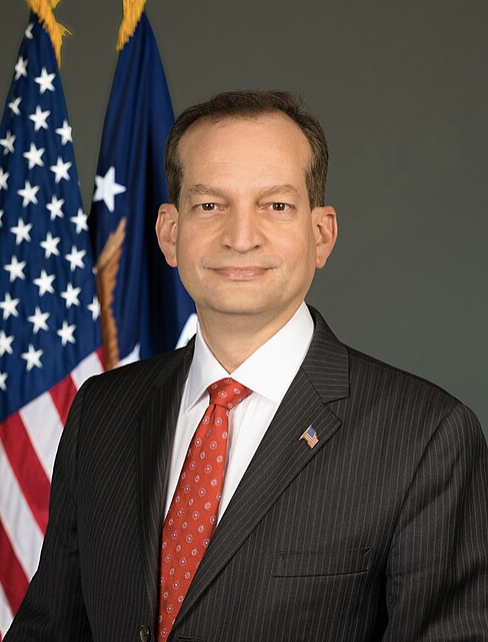
Credit / Attribution: U.S. Department of Labor
License: Public domain
Source: Wikimedia Commons – Alexander Acosta
The United States attorney who approved Jeffrey Epstein’s secret nonprosecution agreement later called it a strategy for securing jail time. The Justice Department called it poor judgment.
Jeffrey Epstein’s federal case in South Florida did not disappear because prosecutors found nothing.
Federal investigators examined possible crimes involving the enticement of minors, interstate travel, conspiracy, and sex trafficking. An assistant United States attorney prepared a proposed indictment containing dozens of counts. Epstein responded with an extraordinary defense team that negotiated locally, escalated disputes to senior Justice Department officials, attacked prosecutors, and pressed for a resolution outside federal court.
Rene Alexander Acosta was the United States attorney with the authority to decide what happened next.
Acosta approved a secret nonprosecution agreement that ended the federal investigation in favor of a state plea. It suspended the federal grand jury process. It protected Epstein from federal prosecution in South Florida for the investigated conduct. It promised that federal charges would not be brought against named and unnamed potential coconspirators. It anticipated that the agreement would remain outside the public record. Survivors were not consulted before it was executed.
Epstein ultimately served approximately thirteen months in the Palm Beach County jail while receiving unusually permissive work release. He was allowed to leave custody for as long as twelve hours a day, six days a week.
Acosta has consistently defended his decision as an imperfect effort to guarantee incarceration, sex offender registration, and a path to compensation. The Justice Department’s Office of Professional Responsibility found no professional misconduct or evidence that wealth, status, associations, or other improper factors influenced him. It nevertheless concluded that Acosta exercised poor judgment and used a flawed mechanism to satisfy the federal interest.
That distinction is essential. Acosta was not found guilty of corruption. He was the senior official who approved a secret agreement that stopped a federal prosecution and excluded survivors from the process.
Snapshot
Full name: Rene Alexander Acosta
Known professionally as: R. Alexander Acosta or Alex Acosta
Role during the Epstein investigation: United States Attorney for the Southern District of Florida
Term as United States attorney: June 2005 through June 2009
Documented action: Approved the decision to resolve the federal Epstein investigation through a nonprosecution agreement
Important signature distinction: Assistant United States Attorney A. Marie Villafaña signed the September 24, 2007 agreement. Acosta approved the resolution and accepted responsibility for the decision, but he did not personally sign the agreement.
Agreement’s effect: Deferred federal prosecution to a Florida state case, suspended the federal grand jury investigation, protected Epstein from federal prosecution in South Florida for the investigated conduct, and promised no federal charges against named and unnamed potential coconspirators
Survivor impact: Survivors were not consulted before the agreement was executed and later received communications that left them believing the federal investigation remained active
Justice Department finding: Poor judgment, but no professional misconduct and no evidence that Acosta acted because of improper considerations
Political consequence: Resigned as United States Secretary of Labor in July 2019 after renewed scrutiny of the agreement
Current documented roles: Newsmax director, lead independent director, audit committee chair, strategic consultant through Acosta Group, LLC, and director of several private nonprofit organizations
EpsteinWiki involvement level: 4 of 5, documented decision making authority in an outcome that materially protected Epstein. This scale measures documented connection and function, not criminal guilt.
Series classification: Government official and prosecutorial decision maker in the EpsteinWiki Enablers series
Who is Alexander Acosta?
Acosta was born in Miami in 1969 and is the son of Cuban immigrants. He earned degrees from Harvard College and Harvard Law School, then clerked for Samuel Alito when Alito served on the United States Court of Appeals for the Third Circuit.
Acosta held four presidentially appointed positions that required Senate confirmation. He served on the National Labor Relations Board, led the Justice Department’s Civil Rights Division, served as United States attorney for the Southern District of Florida, and later became Secretary of Labor under President Donald Trump.
After leaving the United States attorney’s office, Acosta served as dean of the Florida International University College of Law from 2009 until 2017. He also chaired U.S. Century Bank before joining the Trump administration.
His career was built around institutional trust. He was a prosecutor, civil rights official, legal educator, bank chairman, Cabinet secretary, and later corporate director. That stature is one reason his decision in the Epstein case matters. This was not an unreviewed concession by a junior lawyer. It was a resolution approved under the authority of the chief federal prosecutor for South Florida.
The federal investigation was real and substantial
The Palm Beach Police Department began investigating Epstein in 2005 after the family of a fourteen year old girl reported that she had been paid for a massage that became sexual. Investigators identified a recurring recruitment system in which girls were paid for massages and offered money to recruit other girls.
EFTA01249021 documents evidence connected to massage recruitment. EFTA00081180 is a court record describing allegations involving underage girls and the recruitment structure.
Palm Beach police believed stronger charges were warranted than the state grand jury initially returned. The matter eventually reached the FBI and Acosta’s office.
The federal investigation timeline shows active work on a proposed federal resolution during September 2007. The investigation considered possible conspiracy, enticement, interstate travel, and sex trafficking offenses.
The agreement itself states that the FBI and the United States Attorney’s Office investigated possible federal crimes from approximately 2001 through September 2007. The possible offenses included conspiracy to entice minors, travel for illicit sexual conduct, enticement of minors, and sex trafficking of minors.
Assistant United States Attorney A. Marie Villafaña prepared a proposed indictment containing dozens of counts. Public accounts commonly describe it as a fifty three page or sixty count draft. Acosta later emphasized that a draft indictment is not the same as an approved indictment. He testified that it had not completed every level of supervisory review.
That qualification is valid. A proposed indictment does not prove that every charge would have been authorized, filed, or sustained at trial. It does establish that federal prosecutors had developed a serious potential case rather than merely reviewing a minor state solicitation offense.
Epstein assembled an army of lawyers
Epstein’s defense team included Ken Starr, Jay Lefkowitz, Alan Dershowitz, Roy Black, Gerald Lefcourt, Jack Goldberger, Lilly Ann Sanchez, and other prominent attorneys.
The team challenged the government’s jurisdiction, evidence, legal theories, and prosecutors. It sought a resolution through state court, pressed for home confinement, disputed proposed terms, and appealed disagreements to senior Justice Department officials in Washington.
Starr and Lefkowitz correspondence documents advocacy by the defense team. Additional Justice Department correspondence shows that disputes reached officials outside the Southern District of Florida.
A record concerning Starr’s contact with Criminal Division leader Alice Fisher documents access to Main Justice. That contact is not proof that Fisher ordered Acosta to protect Epstein. It shows that Epstein could purchase lawyers capable of moving a local prosecution into the highest levels of the Justice Department.
The defense also attacked the prosecutors handling the case. Lawyers accused Villafaña and others of bias, bad faith, and misconduct, and sought their removal. The Washington Post later described complaints sent to Acosta’s superiors and the Justice Department’s Office of Professional Responsibility.
EFTA01302111 is an unsigned pressure document that refers to “Alex,” Lilly Sanchez, Ken Starr, Alan Dershowitz, and federal statutes associated with sex trafficking and civil remedies. Because the authorship and context are incomplete, it should be treated as evidence of a pressure narrative, not as a verified statement by Acosta.
Acosta described Epstein’s lawyers as an army. Alan Dershowitz later said the defense had out lawyered the government. Neither phrase changes the legal responsibility. Defense lawyers were permitted to advocate aggressively. The decision to accept the agreement remained with the government.
Acosta made the pivotal decision
The Justice Department’s Office of Professional Responsibility identified Acosta’s choice as the pivotal decision in the matter.
Acosta approved resolving the federal investigation through a state plea and a federal nonprosecution agreement. Villafaña negotiated significant details and signed the final document for the government, but she did so within the authority of Acosta’s office.
In his 2025 congressional testimony, Acosta accepted responsibility for approving both the initial term sheet and the final agreement. He said the ultimate decision was his.
This is why it is inaccurate to describe Acosta as merely someone whose name appeared above the prosecutors. It is also inaccurate to say he personally drafted or signed every term. The documented allocation of responsibility is more precise:
- Federal agents and prosecutors developed the investigation.
- Villafaña served as the lead line prosecutor and drafted a proposed indictment.
- Epstein’s defense team negotiated and escalated aggressively.
- Supervisors and Justice Department personnel reviewed aspects of the matter.
- Acosta approved the final prosecutorial choice to use the nonprosecution agreement.
What the agreement gave Epstein
The September 24, 2007 agreement deferred federal prosecution in favor of Florida state proceedings.
Epstein agreed to plead guilty to two state offenses, including one involving a minor. The agreement contemplated eighteen months in county jail, followed by twelve months of community control. It required sex offender registration and created a process through which identified victims could seek compensation.
In return, the federal government made extraordinary commitments.
First, it agreed not to prosecute Epstein in the Southern District of Florida for the listed offenses, other offenses investigated jointly by the FBI and the United States attorney’s office, or offenses arising from the federal grand jury investigation, provided he fulfilled the agreement.
Second, it suspended the grand jury investigation and held pending subpoenas in abeyance.
Third, it anticipated that the agreement would not become part of any public record. If a disclosure demand arose, the government agreed to notify Epstein before producing it.
Fourth, it promised not to institute criminal charges against any potential coconspirators, specifically naming Sarah Kellen, Adriana Ross, Lesley Groff, and Nadia Marcinkova. The phrase “including but not limited to” extended the language beyond those four people.
The complete agreement provides the controlling text. A second Justice Department production provides another accessible copy.
The agreement did not contain an admission that any named person was guilty. A promise not to prosecute a potential coconspirator is not a criminal conviction or factual finding. Its importance is structural. The government surrendered the ability to bring certain charges in South Florida before testing the evidence publicly.
Survivors were kept outside the room
The government negotiated extensively with Epstein’s lawyers while giving survivors little meaningful information about the resolution.
The agreement contemplated that a victim list would be provided to Epstein’s attorneys after execution and sentencing. Survivors were not invited to review or challenge the agreement before the government committed itself.
After the agreement was signed, federal communications continued to ask survivors for patience and left them with the impression that the investigation remained ongoing.
In February 2019, United States District Judge Kenneth Marra ruled that the government violated the Crime Victims’ Rights Act by failing to confer with victims before entering the agreement. He also found that government communications misled victims into believing federal prosecution remained possible.
Judge Marra’s opinion carefully limited its holding. The court did not rule that Acosta’s substantive decision not to prosecute was itself unlawful. It ruled that the victims’ statutory rights to notice, fairness, and participation had been violated under the facts presented.
The later appellate history is equally important. In 2021, the en banc Eleventh Circuit held that the Crime Victims’ Rights Act did not create a private right allowing a victim to initiate a freestanding civil action when no federal criminal proceeding existed. The Supreme Court declined review in 2022.
The en banc decision in In re Wild restricted the legal remedy. It did not establish that survivors were consulted. They were not.
The procedural result exposed a devastating loophole. Because the government used an agreement that prevented federal charges from being filed, the appellate court concluded that survivors could not enforce Crime Victims’ Rights Act protections through a separate lawsuit.
The work release outcome
Epstein pleaded guilty in Florida state court in June 2008. He served approximately thirteen months in the Palm Beach County jail.
The county sheriff’s office approved work release that allowed Epstein to leave the jail for up to twelve hours a day, six days a week. He traveled to an office rather than remaining continuously confined.
Acosta has repeatedly said this was not the outcome his office expected. He testified in 2025 that federal prosecutors had received assurances that Epstein would not receive work release and that his office objected after learning about it.
This defense separates the federal agreement from the county’s implementation. The sheriff, not Acosta, administered the jail and approved work release.
The limitation is that Acosta chose to rely on the state and local system. The Office of Professional Responsibility later concluded that his understanding of that system was too imperfect to justify resolving the federal interest through the agreement.
Acosta cannot fairly be described as the official who personally granted work release. He can fairly be held responsible for approving a structure that transferred control of Epstein’s confinement to local authorities.
The breakfast meeting
Acosta met Jay Lefkowitz for breakfast at a Marriott in West Palm Beach in October 2007.
The meeting became one of the most controversial details in the story because a sitting United States attorney met privately with a lawyer for the investigation’s target outside the prosecutor’s office.
Chronology matters. The agreement had already been signed on September 24. The breakfast therefore did not create the original deal.
The Office of Professional Responsibility found no evidence that the breakfast led to the agreement or another significant decision that benefited Epstein. It still viewed the setting as questionable because such meetings can create an appearance of unequal access.
The proper conclusion is not that the breakfast secretly produced the agreement. The proper conclusion is that Epstein’s defense team received personal access to the chief federal prosecutor even after securing a highly favorable resolution.
The intelligence allegation
A widely repeated story claims that Acosta told Trump transition officials that he backed away because Epstein belonged to intelligence.
The claim originated in reporting attributed to an unnamed source. It has never been supported by a recording, contemporaneous memorandum, sworn witness statement, or direct statement from Acosta.
Acosta denied the claim during his 2025 congressional testimony. He said no one from the CIA, NSA, State Department, domestic intelligence community, foreign intelligence service, or any other authority instructed him not to prosecute Epstein. He denied saying that Epstein belonged to intelligence.
This dossier does not treat the intelligence statement as established fact. It is a significant allegation that Acosta has denied under formal questioning.
The absence of proof for that statement does not make the agreement unproblematic. The documented agreement, secrecy, survivor exclusion, and broad coconspirator language require no intelligence theory to be understood.
Acosta’s 2017 confirmation
Donald Trump nominated Acosta for Secretary of Labor in February 2017 after Andrew Puzder withdrew.
The Epstein agreement was already public enough to be raised during the confirmation process. Material submitted to the Senate described the proposed indictment, the secret agreement, and criticism of the outcome. Dershowitz defended Acosta by saying he had wanted to prosecute but that Epstein’s lawyers persuaded the office that the federal case faced evidentiary problems.
The Senate confirmed Acosta by a vote of 60 to 38. He took office on April 28, 2017.
His confirmation did not constitute an official review clearing the Epstein decision. It shows that senators knew at least part of the controversy and nevertheless approved his Cabinet appointment.
The 2019 press conference and resignation
Julie K. Brown’s Perversion of Justice investigation for the Miami Herald returned the agreement to national attention in late 2018. The reporting reconstructed the survivor accounts, police work, federal negotiations, unusual agreement, and work release conditions.
After federal prosecutors in New York arrested Epstein in July 2019, Acosta held a press conference defending his earlier decision.
He argued that Palm Beach state prosecutors had been prepared to allow Epstein to avoid jail and sex offender registration. Acosta said federal intervention secured incarceration, registration, and a route to compensation. He emphasized trial risks, contested evidence, and the possibility that Epstein might otherwise have escaped punishment entirely.
The defense deserves to be stated accurately. A guaranteed guilty plea has value, especially when prosecutors believe trial may retraumatize survivors or end in acquittal.
The criticism is that Acosta framed the options too narrowly. Federal investigators had developed substantial evidence and a proposed indictment. The final agreement went beyond guaranteeing a state plea. It included secrecy, grand jury suspension, and protection for potential coconspirators.
Acosta announced his resignation as Labor secretary on July 12, 2019, effective July 19. He said the controversy had become a distraction from the Labor Department. Trump said he had not demanded the resignation.
What the Justice Department found
The Office of Professional Responsibility reviewed hundreds of thousands of Justice Department records and conducted more than sixty interviews.
The Justice Department’s official statement says the investigation did not find professional misconduct by Department attorneys.
It did find that survivors were not treated with the forthrightness and sensitivity expected by the Department. It concluded that Acosta exercised poor judgment in choosing the nonprosecution agreement and in failing to ensure that Florida would notify federally identified victims about the state plea hearing.
The official OPR executive summary found no evidence that Acosta’s decision was influenced by Epstein’s wealth, status, associations, or other impermissible considerations.
The report described Acosta’s view of federalism as too expansive, his view of the federal interest as too narrow, and his understanding of the state system as too imperfect. It called the agreement a flawed mechanism for satisfying the federal interest that prompted the investigation.
The OPR production preserved in the Epstein files connects the Department’s internal review directly to the public evidence archive.
The finding cannot honestly be reduced to either “Acosta was cleared” or “Acosta was found corrupt.” Neither is accurate.
OPR found no professional misconduct or improper influence. It also found that the chief prosecutor made a pivotal decision reflecting poor judgment and that survivors were treated below Department expectations.
Acosta’s 2025 congressional testimony
Acosta voluntarily appeared for a transcribed interview before the House Committee on Oversight and Government Reform on September 19, 2025. The Committee released the transcript on October 17.
The Committee’s official release provides the transcript and related records.
Acosta testified that he approved the initial term sheet and final agreement. He defended the resolution as an effort to secure jail, registration, and compensation while avoiding the risk of losing at trial.
He acknowledged that survivors did not receive the forthright treatment they deserved. He described the state resolution as poor judgment in hindsight because of the work release result.
He did not independently remember how the broad coconspirator language originated. He testified that he did not know whether Maxwell or the four women named in the agreement were interviewed. He also lacked personal knowledge of whether every relevant employee, financial record, flight record, computer item, or travel lead was fully investigated.
Acosta denied being pressured by Trump, Clinton, intelligence officials, members of the royal family, or other prominent outsiders. He testified that he never met Epstein and did not speak with Trump about the case before becoming Labor secretary.
His testimony is evidence of Acosta’s sworn account. It is not independent proof that every conclusion he offered was correct. Where he said he did not know or did not recall, the transcript records a gap rather than resolving it.
Separate complaints and accountability concerns
The Epstein agreement is not the only controversy in Acosta’s public record.
While Acosta led the Justice Department’s Civil Rights Division, Bradley Schlozman served as a senior official beneath him. A later joint investigation by the Justice Department Inspector General and Office of Professional Responsibility found that Schlozman improperly considered political and ideological affiliations in career hiring and personnel actions.
The official investigation found misconduct by Schlozman. It also concluded that Acosta and another senior manager failed to supervise him sufficiently despite warning signs.
This was not a finding that Acosta personally used illegal political tests to select career attorneys. It was an institutional oversight finding against his leadership.
Acosta also drew criticism for a 2004 letter concerning proposed challenges to voter registrations in Ohio. Civil rights organizations argued that the letter supported a voter caging strategy likely to burden minority voters. Acosta defended the legal position as an interpretation of the Voting Rights Act. The dispute was raised extensively during his 2017 confirmation hearing.
The Senate confirmation record contains both criticism and defenses of Acosta’s Civil Rights Division record. Statements submitted by advocacy organizations are evidence of criticism, not adjudicated findings.
No reliable source reviewed for this dossier established that Acosta was criminally charged over the Epstein agreement, the Civil Rights Division hiring problems, or the Ohio voting dispute. No court found that he accepted a bribe or knowingly protected an intelligence operation.
Financial interests and current positions
Acosta’s 2017 ethics disclosures presented a relatively straightforward financial profile for a Cabinet nominee.
He reported earning approximately $380,000 from Florida International University and $170,000 from U.S. Century Bank during the preceding year. His ethics agreement required him to leave both positions. Reporting at the time said he could forfeit a bank bonus valued between $50,000 and $150,000 and unvested warrants if confirmed.
Those figures are relevant financial disclosures. They are not evidence of an Epstein payment or conflict involving the nonprosecution agreement. The bank roles began years after the agreement.
Acosta later formed Acosta Group, LLC and worked as a strategic consultant. SEC filings identify him as a director of Job Creators Network, Salient Publications, Inc., and State Leadership Foundation.
In March 2025, Acosta joined the Newsmax board when the company completed its initial public offering.
Newsmax’s 2026 proxy statement filed with the SEC identifies Acosta as lead independent director and chair of the audit committee. It reported $64,694 in cash fees and $168,760 in option award value for 2025, totaling $233,454. As of December 31, 2025, he held options to purchase 27,500 shares, including 10,000 that were vested.
These are company reported compensation values, not estimates of his personal net worth. No reliable public source reviewed here establishes Acosta’s complete present assets, debts, income, or net worth.
What the evidence proves
- Acosta was the United States attorney with final authority over the Southern District of Florida’s resolution of the federal Epstein investigation.
- He approved the term sheet and final nonprosecution agreement.
- Villafaña signed the agreement for the government. Acosta did not personally sign it.
- Federal prosecutors had investigated possible crimes involving minors and developed a proposed indictment containing dozens of counts.
- Epstein’s defense team negotiated aggressively and escalated disputes to senior Justice Department officials.
- The agreement deferred federal prosecution to the state, suspended the federal grand jury process, anticipated secrecy, and protected named and unnamed potential coconspirators.
- Survivors were not consulted before the agreement was executed.
- A district court found that the government violated survivors’ rights, although the en banc Eleventh Circuit later held that the statute did not permit the freestanding action through which relief was sought.
- Local authorities granted Epstein work release. Acosta did not personally approve the work release.
- The Office of Professional Responsibility found poor judgment but no professional misconduct or improper influence.
- Acosta resigned as Labor secretary after renewed scrutiny of the agreement.
- Acosta currently holds documented corporate and nonprofit positions, including compensated service on the Newsmax board.
What the evidence does not prove
- It does not prove that Acosta accepted a bribe.
- It does not prove that Epstein or his lawyers paid Acosta.
- It does not prove that intelligence officials instructed Acosta to end the prosecution.
- It does not prove that Trump, Clinton, a foreign government, or a royal family member directed the agreement.
- It does not prove that Acosta personally drafted every clause.
- It does not prove that Villafaña alone decided to abandon federal charges.
- It does not prove that every person protected as a potential coconspirator committed a crime.
- It does not prove that Acosta personally granted Epstein work release.
- It does not prove that the breakfast with Lefkowitz created the agreement, because the agreement had already been signed.
- It does not prove that Acosta committed professional misconduct. The official review reached the opposite conclusion while criticizing his judgment.
What is still missing
- A complete unredacted record of every supervisory discussion preceding Acosta’s approval.
- A definitive drafting history for the coconspirator protection language.
- Complete records showing what Main Justice officials were asked to do and how they responded.
- A full accounting of investigative steps involving Maxwell and the four women named in the agreement.
- Complete records of possible travel, aircraft, financial, computer, and employee evidence available before the agreement.
- Contemporaneous documentation of every assurance concerning confinement and work release.
- A complete explanation for why survivor consultation was excluded while defense negotiations continued.
- Independent evidence supporting or disproving the reported intelligence statement beyond Acosta’s denial.
- Any nonpublic bar complaint, ethics complaint, or personnel record that did not result in a published action.
- Acosta’s complete current financial holdings and private consulting client list.
Evidence assessment
Alexander Acosta belongs at involvement level 4 of 5 because he exercised documented decision making authority over an outcome that materially protected Epstein and potential coconspirators.
The level does not allege criminal guilt. It reflects function, authority, and consequence.
Acosta inherited a difficult prosecution. Some survivors had vulnerabilities that Epstein’s lawyers were prepared to exploit at trial. Federal jurisdiction presented questions. A guaranteed state conviction, incarceration, registration, and compensation had legitimate prosecutorial value.
But the agreement went much further than securing those results. It removed the federal case from public adjudication, suspended the grand jury, hid the resolution from survivors, and extended protection to potential coconspirators. The state system then produced confinement far more permissive than Acosta says he expected.
The most accurate verdict comes from the documented record itself. Acosta was not proven corrupt. He made the pivotal decision that transformed a developed federal investigation into a secret agreement. The Justice Department found that decision was within his authority, uninfluenced by proven improper factors, and an exercise of poor judgment.
For survivors, the institutional message was unmistakable. Epstein’s lawyers received meetings, negotiation, escalation, and advance notice. The girls and young women harmed by Epstein did not receive a meaningful voice before their federal case was traded away.
That asymmetry is the heart of the sweetheart deal.
Related EpsteinWiki pages
The Enablers Behind Jeffrey Epstein’s Florida Deal maps the full network of prosecutors, defense lawyers, Justice Department officials, and later reputation defenders.
Alexander Acosta’s 2025 congressional transcript provides a detailed guide to his testimony.
The 2007 Nonprosecution Agreement contains the agreement and its central provisions.
This dossier should replace or substantially expand the shorter general Acosta profile while preserving the separate transcript article as a document specific page.
Sources
- Nonprosecution agreement, Justice Department production: https://epstein-data.com/EFTA00040089
- Nonprosecution agreement, House and Justice Department production: https://epstein-data.com/DOJ-OGR-00000290
- Federal investigation and agreement timeline: https://epstein-data.com/EFTA00224943
- Massage recruitment evidence: https://epstein-data.com/EFTA01249021
- Court record describing recruitment allegations: https://epstein-data.com/EFTA00081180
- Starr and Lefkowitz correspondence: https://epstein-data.com/EFTA00176111
- Justice Department correspondence concerning the agreement: https://epstein-data.com/EFTA00013783
- Record concerning Starr’s contact with Alice Fisher: https://epstein-data.com/EFTA00230208
- Unsigned pressure document referencing “Alex” and Epstein defense lawyers: https://epstein-data.com/EFTA01302111
- OPR related production: https://epstein-data.com/DOJ-OGR-00003177
- Maxwell petition appendix containing NPA and OPR material: https://epstein-data.com/DOJ-OGR-00000034
- Maxwell motion arguing that the NPA barred her prosecution: https://epstein-data.com/DOJ-OGR-00002573
- Government opposition explaining the geographic limits of the agreement: https://epstein-data.com/DOJ-OGR-00002935
- Justice Department Office of Professional Responsibility executive summary: https://www.justice.gov/opr/page/file/1336471
- Justice Department statement summarizing OPR findings: https://www.justice.gov/archives/opa/pr/statement-doj-office-professional-responsibility-report-jeffrey-epstein-2006-2008
- House Oversight Committee release of Acosta transcript: https://oversight.house.gov/release/oversight-committee-releases-acosta-transcript/
- House Oversight Committee announcement of Acosta interview: https://oversight.house.gov/release/chairman-comer-provides-update-on-review-of-the-federal-governments-investigation-of-epstein-and-maxwell/
- Doe v. United States, February 21, 2019 district court opinion: https://law.justia.com/cases/federal/district-courts/florida/flsdce/9%3A2008cv80736/317867/435/
- In re Wild, 994 F.3d 1244, Eleventh Circuit en banc opinion: https://law.justia.com/cases/federal/appellate-courts/ca11/19-13843/19-13843-2021-04-15.html
- Senate confirmation hearing for Alexander Acosta: https://www.congress.gov/115/chrg/shrg24848/CHRG-115shrg24848.htm
- Justice Department Inspector General report concerning Civil Rights Division personnel actions: https://oig.justice.gov/reports/investigation-allegations-politicized-hiring-and-other-improper-personnel-actions-civil
- Newsmax 2026 proxy statement filed with the Securities and Exchange Commission: https://www.sec.gov/Archives/edgar/data/2026478/000202647826000033/nmax-20260327.htm
- Newsmax SEC announcement of Acosta board service: https://www.sec.gov/Archives/edgar/data/2026478/000121390025053483/ea0245399ex99-1_newsmax.htm
- Washington Post, “The pressure on a prosecutor”: https://www.washingtonpost.com/investigations/the-pressure-on-a-prosecutor-how-epsteins-wealth-and-power-steered-acosta-toward-lenient-deal/2019/07/12/2a7bdd08-a421-11e9-bd56-eac6bb02d01d_story.html
- Washington Post, Acosta’s 2025 congressional testimony: https://www.washingtonpost.com/politics/2025/09/19/epstein-acosta-plea-agreement-congress/
- Guardian, Acosta resignation and defense of the agreement: https://www.theguardian.com/us-news/2019/jul/12/alex-acosta-resigns-trump-jeffrey-epstein-plea-deal-latest-news
- Washington Post, Acosta’s 2017 ethics and financial disclosures: https://www.washingtonpost.com/news/get-there/wp/2017/03/09/labor-nominee-alex-acosta-lays-out-uncomplicated-financial-situation-ahead-of-next-weeks-confirmation-hearing/