
Barry Josephson: Hollywood Access, Loans, Casting, and Jeffrey Epstein
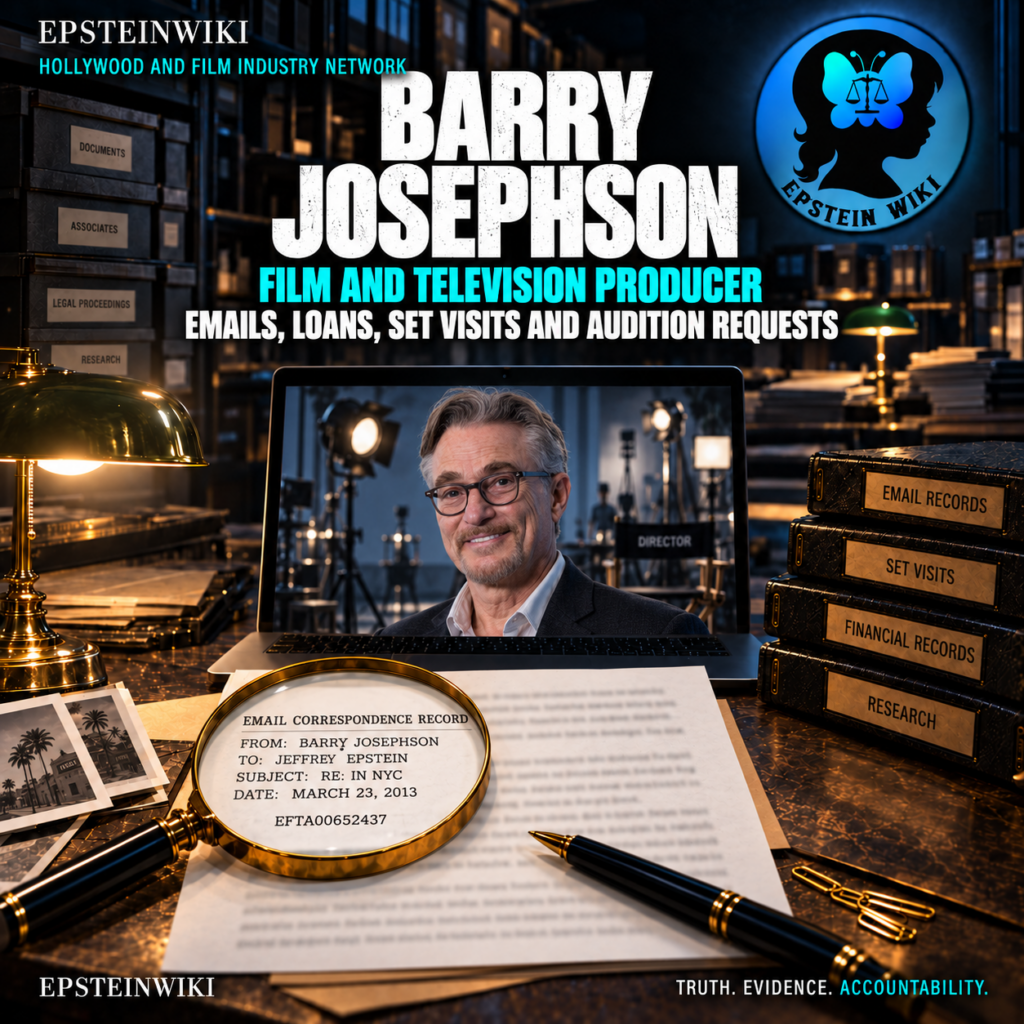
Snapshot
Barry Josephson is a veteran Hollywood producer and former Columbia Pictures executive whose credits include Bones, Enchanted, Men in Black, and Air Force One. Released Jeffrey Epstein records document a relationship that lasted for years after Epstein became a registered sex offender.
The record is not limited to a name in an address book. It includes meetings, social plans, two episodes of financial help totaling $335,000, discussion of actresses and casting, efforts involving young women in Epstein’s circle, a visit to a television set, and a major business proposal. An independent database review by Epstein researcher R. Howard Stone found 1,013 distinct EFTA documents connected to Josephson after expanded full text searching.
The most troubling material concerns access. Epstein asked Josephson about women for an assistant position, actresses for a flight to Los Angeles, and acting opportunities for women close to him. Josephson sometimes responded, facilitated contact, or offered access to a casting environment. Those facts deserve scrutiny because Epstein had already pleaded guilty in Florida in 2008 to offenses involving a minor.
The released material does not establish that Josephson participated in Epstein’s sexual abuse, knew the full nature of Epstein’s conduct, recruited victims, or committed a crime. It does establish a sustained personal and professional relationship that continued long after Epstein’s conviction. That distinction is central to any responsible reading of the record.
Who Is Barry Josephson?
Barry Josephson is an American film and television producer. His company biography describes a career that moved from talent management into senior studio leadership and independent production. He served as president of production at Columbia Pictures and Sony Pictures Entertainment. His studio era included films such as Men in Black, Air Force One, The Fifth Element, Bad Boys, The Professional, and The Craft.
Josephson later produced film and television projects through Josephson Entertainment. His best known television credit is the long running Fox series Bones. His film credits include Enchanted, Disenchanted, The Ladykillers, Hide and Seek, Life as We Know It, and Dirty Grandpa. His official biography says films associated with his production career have earned more than $1 billion.
That professional position matters to the Epstein record. Josephson had access to studios, casting offices, sets, agents, performers, and financiers. Epstein repeatedly sought introductions and access from prominent people. In Josephson, he had a contact who could open doors in the entertainment industry.
The Relationship in the Released Files
R. Howard Stone’s investigation initially found ten redacted text fragments across nine EFTA records. Those records included a tentative appointment, contact information, an escrow reference, and evidence that Epstein monitored a Google Alert for Josephson.
That first count understated the relationship. A later full text review found 1,013 distinct EFTA documents associated with Josephson. The expanded record shows recurring scheduling and correspondence from at least 2011 through 2018. Epstein’s email metadata also records 44 messages between Josephson and Epstein assistant Lesley Groff from June 2015 through June 2018.
One calendar record lists a tentative 3 p.m. appointment with Josephson. Other entries place him in an active social and professional schedule that included dinners, office meetings, and contact around Epstein’s other prominent associates. This pattern is inconsistent with a single accidental appearance or a merely archival contact.
The surviving correspondence also uses the language of friendship. After Epstein helped with a tax obligation, Josephson expressed intense gratitude. Reporting on the released emails describes him telling Epstein that there was nothing he would not do for him and thanking him for saving him. Those statements do not prove criminal knowledge. They do show personal closeness and a sense of obligation.
Primary records: EFTA01764399, EFTA01952774
A Relationship That Continued After Epstein’s Conviction
Timing is one of the most important facts in this case.
Epstein pleaded guilty in Florida in 2008 to state charges that included procuring a minor for prostitution. He served jail time and registered as a sex offender. The documented Josephson correspondence begins years after that public case and continues through at least June 2018.
This does not prove what Josephson personally knew at each point. It does remove any assumption that the relationship belonged only to Epstein’s earlier, less publicly understood social life. The loans, casting discussions, set visit, business proposal, dinners, and scheduling all occurred after the conviction.
Josephson later said he had believed Epstein’s denials and had not known the truth about him. He also said that he never flew on Epstein’s plane and never saw Epstein with minors. Those are relevant denials, but they do not erase the documented duration of the friendship.
The Assistant Search and the Objectifying Recommendation
In 2011, Epstein asked Josephson whether he knew an impressive woman who might work as an assistant. Reporting based on the released emails says Josephson recommended a young woman and described her in overtly sexual and objectifying terms. He also presented her as discreet and willing to do what was asked.
The language is important because it combined a job referral with comments about the woman’s body and compliance. Epstein was already a convicted sex offender. Even if Josephson intended the exchange as crude banter or an ordinary employment recommendation, the context makes the message troubling.
The evidence does not establish that the recommended woman was a minor. It also does not establish that Josephson knew Epstein intended to exploit her. A careful account should not make either leap. What the record does establish is that Josephson helped identify a young woman for Epstein while framing her in sexualized terms.
Katherine Khaut, the Assistant Candidate
Another 2011 exchange concerns a woman identified as Katherine Khaut. Epstein staff described her as an assistant candidate and referred to her as “Barry Josephson’s girl.” Epstein responded that staff should ask her to come that day.
This is more than a passing mention. It shows Josephson functioning as a source of a prospective female employee for Epstein. The surviving records do not show what happened after the proposed interview. They do not prove employment, abuse, or knowledge of abuse.
The appropriate conclusion is narrower. Josephson’s relationship with Epstein included helping place a woman into Epstein’s immediate employment orbit after Epstein’s conviction.
Primary records: EFTA02537492, EFTA00436660
Actresses for Epstein’s Jet
In February 2013, Epstein asked Josephson whether he knew actresses who might want to travel to Los Angeles on his private jet with a group of entertainment industry people. Josephson replied that he would check.
On its face, an invitation to a flight is not evidence of abuse. Private flights involving producers and performers can have legitimate professional or social purposes. The significance comes from the identity of the person making the request, his prior conviction, and the broader pattern of seeking access to young women through powerful contacts.
The released exchange documents willingness to help Epstein identify actresses for a private flight. It does not identify the women, establish their ages, show whether anyone accepted, or prove that a flight took place because of Josephson’s response.
“Casting Girls” and the Office Invitation
During the same period, Josephson told Epstein that he was casting women for a pilot and said Epstein could stop by his office. The friendly invitation placed Epstein near an active casting process.
That is a significant access point. Casting offices are spaces where aspiring performers may feel pressure to impress powerful decision makers. Epstein’s presence in such a setting would have carried risks that an ordinary visitor would not present.
Still, the available message does not prove that Epstein attended, met an actress there, or used the invitation to recruit anyone. The strongest defensible finding is that Josephson offered Epstein access to his office while casting was under way.
This distinction matters. The email is evidence of an offered opportunity. It is not evidence that the opportunity became a crime.
Celina Dubin and the Audition Dispute
The files also connect Josephson to an audition involving Celina Dubin, the daughter of Glenn and Eva Andersson Dubin and Epstein’s goddaughter.
Reporting on the emails says Epstein became unhappy after an audition did not produce the desired result. Josephson explained that auditions were difficult and that even his own influence did not guarantee a role. He apologized, offered a gentler follow up audition, and offered to speak with Eva Dubin.
The exchange illustrates Epstein attempting to convert a personal relationship into an acting opportunity for someone close to him. It also shows a boundary. Josephson did not simply place the person into a role. He explained the limits of his influence and the normal uncertainty of casting.
The episode supports two conclusions at once. Josephson was willing to arrange entertainment access for Epstein’s circle, but he was not able or willing to guarantee the casting result Epstein wanted.
The Edge Set Visit
Released photographs and correspondence place Epstein and Josephson together on the set of Edge, a western television project filmed in New Mexico. A production call sheet appears in EFTA01197359.
The images reportedly show Epstein near Josephson and within the production environment. Josephson later said Epstein visited his sets twice. A set visit may be social and entirely lawful. It nevertheless confirms that Josephson brought Epstein into a working entertainment space rather than keeping the relationship at a distant or purely private level.
The public record does not establish that the women visible in released set photographs were victims, minors, or brought there by Josephson. Redactions and missing context make those claims impossible to support. The defensible point is that Epstein received access to an active production through his relationship with Josephson.
The $120,000 Loan
In 2011, Epstein lent Josephson $120,000. Reporting on the released records says the loan was repaid.
A personal loan of that size is evidence of trust and financial dependence beyond a casual Hollywood acquaintance. It gave Epstein a creditor relationship with a producer who could offer industry access. The repayment matters because it prevents the transaction from being mischaracterized as a proven gift or permanent payoff.
No released record cited here establishes that the loan purchased a specific favor. There is also no public evidence that the transaction was illegal. Its significance is relational. Epstein was willing to provide substantial private liquidity, and Josephson was willing to accept it.
The $215,000 Tax Assistance
In 2013, Epstein helped Josephson cover a tax obligation of roughly $215,000. Josephson reportedly described expected income and promised quick repayment with interest. Reporting says this money was also repaid.
The correspondence surrounding the transaction is emotionally revealing. Josephson thanked Epstein in unusually strong terms and described himself as overwhelmed by Epstein’s friendship. That gratitude suggests Epstein’s assistance arrived at a moment of real financial pressure.
Taken together, the two episodes total $335,000 in documented financial help. Repayment reduces the basis for calling the money a gift, but it does not make the relationship trivial. Epstein had become a source of emergency financing for a powerful Hollywood producer.
The evidence does not show that Epstein invested in a Josephson production through either transaction. It does not establish bribery, coercion, or a direct exchange for access. It shows substantial personal financial entanglement.
The $325 Million Animation Proposal
One of the most substantial business records is a 49 page proposal dated December 11, 2014. The document sought financing for a new animation company associated with Josephson.
The proposal contemplated $175 million in equity to launch the first three or four films and a $150 million debt facility. Total planned sources were $325 million. The company envisioned six animated features and included extensive material about Josephson’s career and production record.
The document’s presence in Epstein’s files shows that Epstein or his office received and retained a major financing proposal connected to Josephson. It does not prove that Epstein funded the company, promised to fund it, or introduced an investor. No investment should be inferred without a transaction record.
The proposal is still important because it demonstrates that the relationship included serious capital seeking, not only dinners and social messages.
Primary record: EFTA00596077
The Sterling West Escrow Reference
An email connected to Josephson contains a reference to Sterling West Escrow. R. Howard Stone flagged the record as a possible indication of a real estate transaction.
The reference appears in EFTA01756725. By itself, it does not reveal the property, parties, amount, or purpose. It is therefore evidence of a lead, not evidence of an undisclosed real estate deal between Epstein and Josephson.
This is a useful example of how an investigative database should be read. A company name can justify further research. It cannot carry a conclusion that the underlying document does not support.
A Proposed Film About Men Accused by Women
In 2015, Josephson reportedly offered to help Epstein develop a film about men who said women had falsely accused them. The concept was framed as a perspective that the news media did not adequately cover.
The timing makes the proposal notable. Epstein had already been convicted, and allegations about his conduct were public. A project centered on accused men could have aligned with his interest in portraying himself as unfairly targeted.
The available evidence does not show that a film was made, financed, or formally developed. It also does not prove that Josephson intended to rehabilitate Epstein personally. The exchange does show that he was willing to engage with a theme that closely served Epstein’s preferred public narrative.
Woody Allen, Soon Yi Previn, and a Jon Stewart Mention
Josephson also appeared within Epstein’s social circle around Woody Allen and Soon Yi Previn. Calendar material documents dinners at Epstein’s Manhattan residence in 2016 and 2017. In one exchange, Epstein declined when asked whether Soon Yi could receive Josephson’s contact information.
Another 2015 email discussed a possible project about Woody Allen. Josephson and Epstein considered a format that might include a biographical segment hosted or narrated by someone such as Jon Stewart. Stewart later explained that his name had merely appeared in a pitch and that he had no involvement with Epstein.
This is an important boundary. A person mentioned as a hypothetical presenter is not thereby part of the relationship under investigation. The document illuminates Josephson and Epstein’s project discussions. It does not implicate Stewart.
Primary record concerning contact information: EFTA00317504
The Katherine Langford Search
On July 8, 2017, Josephson sent Epstein a Google search link for actress Katherine Langford, then 20 years old and newly prominent for 13 Reasons Why.
The direct record is EFTA02643545. Its meaning is not fully explained by the surviving context. Entertainment professionals routinely exchange information about actors. The link could have concerned ordinary casting or industry discussion.
At the same time, the recipient was a convicted sex offender who had previously asked Josephson about young women, actresses, and casting access. That context makes the message relevant without making it proof of improper intent.
The responsible conclusion is that Josephson sent Epstein information about a young actress. The record does not show contact between Epstein and Langford, and nothing reviewed for this article suggests that she knew him.
What Josephson Said After the Emails Became Public
After the correspondence received press attention, Josephson acknowledged socializing with Epstein and said Epstein had visited two sets. He denied traveling on Epstein’s private plane and denied ever seeing Epstein with minors.
Josephson said his crude language in the emails was juvenile and shameful. He also said his greatest regret was believing Epstein’s denials and apologized to people harmed by Epstein.
Earlier reporting quoted Josephson as saying he knew nothing about Epstein and distanced himself as he learned more. The released correspondence complicates that phrasing because it documents friendship and contact through 2018. It does not, however, independently establish what facts Epstein disclosed to him or what Josephson privately understood.
His response therefore contains both an acknowledgment and a denial. He acknowledges the relationship, the set visits, and inappropriate language. He denies knowledge of minors and participation in the most incriminating parts of Epstein’s world.
The Enchanted Bookstore Claim
Online discussion has focused on a storefront sign reading “Epstein’s Books” in the 2007 film Enchanted, which Josephson produced. Some posts imply that the sign was a deliberate tribute to Jeffrey Epstein.
There is no reliable evidence for that claim. A representative for Josephson said he had no role in selecting the storefront name. No production record reviewed here connects the sign to Jeffrey Epstein.
The visual coincidence may be striking, but coincidence is not documentation. It should not be presented as evidence of the relationship.
Evidence Timeline
| Date | Documented event | Evidentiary weight |
|---|---|---|
| 2011 | Josephson helped identify women for an Epstein assistant search | Directly relevant to access, but no proof of exploitation |
| March 2011 | Katherine Khaut was proposed as an assistant candidate | Primary EFTA records |
| 2011 | Epstein lent Josephson $120,000 | Substantial personal financial tie, reportedly repaid |
| February 2013 | Epstein asked about actresses for a flight to Los Angeles | Direct correspondence, no proof anyone traveled |
| 2013 | Josephson invited Epstein to his office during casting | Offered access, no proof Epstein attended |
| 2013 | Epstein helped with a $215,000 tax obligation | Substantial financial tie, reportedly repaid |
| December 2014 | A $325 million animation proposal entered Epstein’s files | Serious business solicitation, no proof of investment |
| 2015 | Epstein visited the Edge production environment | Set access confirmed by records and photographs |
| 2015 | Josephson discussed a film about men who said they were falsely accused | Proposal reported, no proof of production |
| August 2015 | Josephson and Epstein discussed a Woody Allen project | Project discussion, with Jon Stewart mentioned only hypothetically |
| 2016 and 2017 | Social scheduling included dinners with Woody Allen and Soon Yi Previn | Evidence of a continuing social circle |
| July 2017 | Josephson sent a Katherine Langford search link | Direct record, purpose uncertain |
| June 2018 | Contact through Lesley Groff continued | Confirms relationship endured into 2018 |
What the Evidence Establishes
The released material supports several firm findings.
- Josephson and Epstein maintained a sustained relationship after Epstein’s 2008 conviction.
- Epstein provided Josephson with $335,000 in two episodes of financial assistance. Reporting says both amounts were repaid.
- Josephson helped identify or connect women to Epstein, including an assistant candidate.
- Josephson entertained Epstein’s request for actresses who might join a flight to Los Angeles.
- Josephson invited Epstein into a professional environment while casting was taking place.
- Josephson helped arrange auditions or access for people in Epstein’s circle.
- Epstein visited a production set associated with Josephson.
- Josephson sent Epstein a major animation financing proposal.
- The relationship included dinners, appointments, personal gratitude, and regular coordination through Epstein’s staff.
These findings are more substantial than a contact book entry. They show reciprocal value. Epstein provided money and connections. Josephson provided friendship, entertainment access, industry knowledge, and opportunities to make introductions.
What the Evidence Does Not Establish
The same record requires clear limits.
- It does not establish that Josephson participated in sexual abuse or trafficking.
- It does not establish that he knowingly recruited victims.
- It does not establish that women discussed in the emails were minors.
- It does not show that anyone accepted the proposed flight invitation.
- It does not prove Epstein attended the casting session at Josephson’s office.
- It does not prove that the two loans purchased a favor.
- It does not prove Epstein funded the proposed animation company.
- It does not connect Katherine Langford to Epstein beyond a search link sent by Josephson.
- It does not support the claim that the Enchanted storefront sign was a deliberate Epstein reference.
- It does not establish that Jon Stewart participated in the proposed Woody Allen project or had a relationship with Epstein.
This boundary is not a courtesy to a powerful person. It is the difference between evidence and accusation.
Investigative Assessment
R. Howard Stone classified Josephson as a critical research priority. That assessment is justified by the combination of duration, financial ties, industry access, and conversations involving young women.
The most important pattern is reciprocal access. Epstein helped Josephson during moments of financial need and received serious business proposals. Josephson, in turn, fielded requests involving assistants, actresses, auditions, and production spaces. The record shows a friendship in which money and Hollywood access moved through the same channel.
That pattern is not proof of a criminal agreement. It is a strong reason to investigate further. In Epstein’s network, introductions and access were often more important than formal titles. Josephson occupied a position that could connect Epstein to aspiring performers and professional settings that carried prestige.
The unresolved question is knowledge. The emails show that Josephson knew Epstein well enough to borrow large sums, ask for business help, host him on sets, and communicate for years. They do not reveal exactly what Epstein told him about the criminal case or what Josephson believed. Josephson says he accepted Epstein’s denials. The continued friendship after a public conviction makes that explanation a legitimate subject for scrutiny, but it does not by itself disprove it.
Primary EFTA Evidence
- EFTA01764399: tentative appointment with Barry Josephson
- EFTA01756725: Sterling West Escrow reference
- EFTA01952774: Josephson contact information
- EFTA02537492: Katherine Khaut assistant candidate material
- EFTA00436660: related Katherine Khaut record
- EFTA00317504: social circle and contact request involving Soon Yi Previn
- EFTA00596077: 2014 animation company proposal
- EFTA01197359: Edge production call sheet
- EFTA02643545: Katherine Langford Google search link
Sources
- R. Howard Stone, Names Nobody Had Looked Up Yet
- Epstein Data mirror of the R. Howard Stone investigation
- Epstein Data communication pairs
- Yirah transcript of EFTA00596077
- The Daily Beast investigation into Josephson’s Epstein correspondence
- Variety report on Josephson’s relationship with Epstein
- The Sun report on set visits, loans, and Josephson’s response
- Entertainment Weekly on the Jon Stewart mention
- Josephson Entertainment biography
Questions That Remain
- When did Josephson first meet Epstein, and who introduced them?
- What did Epstein tell Josephson about his 2008 conviction and the allegations behind it?
- Who was the woman Josephson described in sexualized terms for the assistant role, and did she ever meet or work for Epstein?
- What happened after Katherine Khaut was invited to interview?
- Did Josephson contact any actresses about Epstein’s proposed flight to Los Angeles?
- Did Epstein visit Josephson’s office while casting was under way?
- Which women in Epstein’s circle received auditions, set access, or introductions through Josephson?
- What were the complete terms and repayment records for the $120,000 loan and the $215,000 tax assistance?
- Did Epstein or anyone he introduced perform due diligence on the animation proposal or discuss financing it?
- What transaction, if any, was associated with the Sterling West Escrow reference?
- What was the full purpose of the 2017 Katherine Langford link?
- Why did contact continue through 2018, and what finally ended the relationship?
- Are there additional photographs, visitor logs, call sheets, or casting records that identify who attended the Edge set visits?
- Did Josephson ever warn colleagues, performers, or employees about Epstein’s conviction?
- Were Josephson’s loans and business proposals disclosed to his accountants, companies, or production partners at the time?