
Christopher “Chip” Anderson
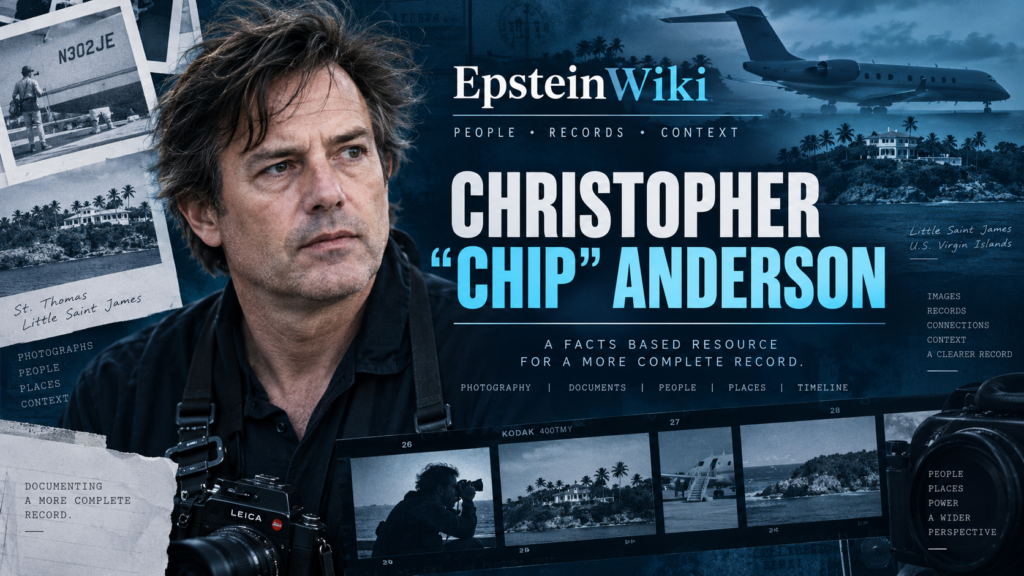
Snapshot
| Category | Documented Information |
|---|---|
| Full Name | Christopher Anderson |
| Also Identified As | Chris Anderson. The nickname Chip has not been independently verified. |
| Born | 1970, Kelowna, British Columbia, Canada |
| Profession | Photojournalist and portrait photographer |
| Professional Associations | Magnum Photos, New York Magazine, Vanity Fair and other editorial publications |
| Epstein Connection | Professional photographic transactions and a commissioned 2015 portrait assignment |
| Documented Correspondence | March and November 2015 |
| Principal Evidence | EFTA00336162 |
| Additional Evidence | EFTA01787789, EFTA02081792, EFTA02083357, EFTA02084509, EFTA00350429 and related correspondence copies |
| Associated Individuals | Jeffrey Epstein, Lesley Groff, Jody Quon, Michael Wolff and Merwin Dela Cruz |
| Related Photograph Subject | Robert Redford, March 2015 transaction |
| Reported Payment | $20,000 for Epstein portrait rights following publication, according to Anderson |
| Principal Dispute | Ownership and delivery of portraits from an unpublished New York Magazine assignment |
| Reported Intimidation | Anderson alleges Epstein sent Merwin to pressure him into surrendering the photographs |
| Photographs Recovered | Disclosed publicly in January 2026 and discussed in connection with Anderson’s book Index |
| Survivor Status | No identification as a survivor of Epstein’s sexual abuse or sex trafficking |
| Criminal Allegations | No substantiated allegation of Anderson’s involvement in Epstein’s sexual crimes identified |
| Research Classification | Photographer, documentary witness and professional correspondent |
Christopher Anderson is an internationally recognized photographer whose professional relationship with Jeffrey Epstein included photographic transactions, an unpublished New York Magazine portrait assignment and a dispute over control of the resulting photographs.
Anderson’s photographs are historically significant because they document Epstein inside his Manhattan residence in 2015. Some images capture furnishings, office spaces, displayed photographs and a printed communication that later attracted public interest.
On November 3, 2015, Epstein’s assistant Lesley Groff forwarded an email exchange in which Anderson declined to release the photographs until New York Magazine independently confirmed that its proposed article had been canceled.
In January 2026, Anderson publicly alleged that Epstein had used intimidation to obtain the photographs. He subsequently discussed the encounter with journalists, describing the atmosphere inside the residence and explaining how he recovered copies of the images.
These records provide a documented example of a conflict over editorial photographs involving Epstein. They do not establish that Anderson participated in Epstein’s crimes.
Identity and Professional Background
Christopher Anderson was born in 1970 in Kelowna, British Columbia, and grew up in Abilene, Texas.
He became internationally known for documentary photography, including his coverage of Haitian migrants aboard a vessel attempting to reach the United States.
That work received the Robert Capa Gold Medal in 2000.
Anderson subsequently photographed conflict zones, political events, public figures and cultural subjects. His work has appeared in major editorial publications, and he was a member of Magnum Photos from 2005 through 2023.
He served as photographer in residence at New York Magazine from 2011 to 2014.
By 2015, Anderson was an established editorial photographer with experience photographing prominent individuals.
His Epstein assignment formed part of that professional activity.
No verified evidence reviewed for this article establishes that Anderson held an employment position within Epstein’s organization or served as a personal photographer on an ongoing basis.
How Christopher Anderson Became Connected to Epstein
The documentary record establishes two principal groups of activity involving Anderson and Epstein during 2015.
The first concerns a March photographic transaction involving a Robert Redford print and related ownership documentation.
The second concerns Anderson’s assignment to photograph Epstein for a proposed New York Magazine article written by journalist Michael Wolff.
The two matters should not be automatically treated as one transaction. They involved different photographic materials and distinct communications.
Both, however, demonstrate that Epstein’s office was directly communicating with Anderson about photographic ownership and delivery.
February 2015: Planning the New York Magazine Profile
Correspondence reconstructed by independent Epstein researcher Ellie Leonard documents communications between Michael Wolff and Jeffrey Epstein concerning the proposed magazine profile.
The Wolff correspondence reconstruction includes February 2015 messages about arranging photographs, scheduling a session and addressing Epstein’s concerns about image control.
On February 24, Wolff emphasized the importance of photography to the article and discussed scheduling options.
On February 26, the correspondence addressed Epstein’s concerns about the photographs and the possibility of purchasing rights to them.
Editorial Control and Photographic Approval
The discussions are important because they show that disagreements about photography emerged before the November 2015 dispute.
Epstein sought control over how photographs could be used, while the magazine retained an editorial interest in the assignment.
The correspondence does not establish that Epstein obtained advance editorial approval of the photographs.
Nor does it independently establish the complete contractual relationship among the magazine, Anderson and Epstein.
March 2015: Robert Redford Photograph Transaction
The DOJ documentary record contains numerous overlapping email chains involving Christopher Anderson, Lesley Groff and the delivery of a Robert Redford photograph.
These records describe a photographic transaction, payment arrangements, the production or delivery of a print and an accompanying acknowledgment concerning ownership rights.
The records establish an earlier professional interaction between Anderson and Epstein’s office.
Payment and Delivery Arrangements
Correspondence dated March 2 through March 5, 2015, documents difficulties delivering a check to Anderson’s Brooklyn studio.
Some messages describe an incorrectly addressed payment and attempts to arrange more reliable delivery.
Epstein’s office coordinated messengers and staff to complete the exchange.
The correspondence indicates that the Robert Redford photograph and an ownership acknowledgment were to be delivered to Epstein’s Manhattan residence.
However, these records should not be interpreted as establishing that Robert Redford personally communicated with Epstein or authorized the transaction. A photograph depicting a person does not prove that the subject participated in its sale.
Lesley Groff’s Administrative Role
Lesley Groff appears repeatedly as the person coordinating communications with Anderson.
Her messages address payment, delivery problems, collection arrangements and the destination for photographic materials.
These communications establish her administrative role in the transaction.
Merwin Dela Cruz and Courier Arrangements
One of the March correspondence records identifies Merwin Dela Cruz among personnel involved in coordinating a check delivery and photographic exchange.
This is relevant because Anderson later publicly identified a man called Merwin as the person Epstein sent to his studio during the dispute over the unpublished portraits.
Although the overlapping name strengthens the investigative connection, the March courier activity is not itself evidence of intimidation.
The March transaction and November dispute must remain chronologically and evidentially distinct.
The March 2015 Email Evidence Cluster
Numerous EFTA records contain overlapping or substantially repeated versions of the March photographic correspondence.
These records should be grouped by the underlying email chain rather than counted as separate transactions.
| EFTA Identifier | Documented Subject | Research Assessment |
|---|---|---|
| EFTA01787789 | March correspondence concerning payment, print delivery and ownership acknowledgment | Extended transaction chain |
| EFTA02081792 | Photographic payment and delivery logistics | Overlapping correspondence |
| EFTA02081834 | March payment and ownership acknowledgment | Overlapping correspondence |
| EFTA02083142 | Payment and delivery coordination | Overlapping correspondence |
| EFTA02083153 | Check and photograph exchange | Overlapping correspondence |
| EFTA02083174 | Print production and transaction logistics | Overlapping correspondence |
| EFTA02083255 | Payment and delivery arrangements | Overlapping correspondence |
| EFTA02083357 | Lesley Groff and Christopher Anderson email chain | Substantive March correspondence |
| EFTA02083395 | Payment complications and messenger instructions | Overlapping correspondence |
| EFTA02083465 | Courier pickup and print delivery | Overlapping correspondence |
| EFTA02083611 | Payment correction and staff coordination | Overlapping correspondence |
| EFTA02083807 | Delivery to Epstein’s Manhattan residence | Overlapping correspondence |
| EFTA02084426 | Photograph and written acknowledgment | Overlapping correspondence |
| EFTA02084509 | Merwin Dela Cruz and staff courier coordination | Significant staff reference |
| EFTA00350429 | Extended March correspondence | Potentially useful consolidated record |
| EFTA00351742 through EFTA00351761 | Multiple copies of the payment and delivery correspondence | Requires page-level deduplication |
| EFTA00644715 | Additional payment and print-delivery correspondence | Overlapping record |
Although the number of EFTA identifiers is substantial, the records chiefly concern one underlying photographic transaction and its administrative complications.
Repetition within the federal record should not be misrepresented as evidence of numerous separate photographic purchases.
The 2015 Jeffrey Epstein Portrait Session
Anderson was commissioned by New York Magazine to photograph Jeffrey Epstein for a proposed profile by Michael Wolff.
In later interviews, Anderson explained that he knew Epstein as a wealthy and powerful individual connected with influential figures.
He said that he had not researched Epstein’s criminal history before accepting the assignment.
The Manhattan Residence
The session took place inside Epstein’s Manhattan townhouse.
Anderson photographed Epstein and elements of the surrounding interiors, including office spaces, decorative objects and materials visible on desks.
One image shows a stuffed tiger.
These environmental photographs are significant because they document physical aspects of Epstein’s private residence during 2015.
The Unidentified Young Woman
In interviews published during 2026, Anderson recalled that a young woman with an Eastern European accent opened the door.
He also described seeing her handling a massage table in a room near Epstein’s office.
These observations are part of Anderson’s firsthand account.
The woman’s identity, age, employment status and circumstances have not been established through the reviewed evidence.
There is no evidentiary basis to identify her as a survivor, employee or trafficking victim solely from Anderson’s description.
Her privacy should be protected unless a reliable public source establishes that identification is appropriate.
The Proposed $20,000 Photographic Rights Arrangement
Anderson stated that Epstein offered $20,000 to acquire ownership of the portraits after the magazine published its article.
According to Anderson, New York Magazine had permitted the proposed arrangement.
Anderson described receiving a personal check from Epstein.
He also said that the agreement did not entitle Epstein to receive the photographs before publication.
These details are attributed to Anderson’s firsthand account and should not be confused with the separate March transaction involving the Robert Redford photograph.
What the Arrangement Would Have Meant
The distinction between purchasing photographs after publication and demanding them before publication is central to understanding the dispute.
Anderson maintained that his assignment remained subject to the magazine’s original editorial agreement.
The complete signed licensing and assignment documents have not been independently established in the reviewed records.
The Cancellation of the New York Magazine Story
Anderson later stated that Epstein withdrew his cooperation with the proposed article and began demanding possession of the photographs.
The circumstances surrounding the article’s cancellation remain important because they determine whether the original editorial agreement had terminated and who was entitled to the images.
The published documentary record directly establishes that, by November 3, Epstein’s assistant was telling Anderson that the magazine story had been canceled.
Anderson did not accept the assistant’s statement as sufficient confirmation.
November 3, 2015: The Critical Email Evidence
EFTA00336162 is a one-page federal document containing a forwarded email chain between Christopher Anderson and Lesley Groff.
Its subject identifies Anderson’s need for New York Magazine to confirm the cancellation.
In the correspondence, Groff requested that Anderson provide Epstein’s photographs through a hard drive and Dropbox.
Anderson replied that he remained bound by the original magazine agreement until New York Magazine itself confirmed that the story had been canceled.
Groff forwarded Anderson’s response to Epstein and sought further direction.
What This Document Establishes
The correspondence directly establishes that Epstein’s office was seeking possession of the images before Anderson considered his editorial obligations resolved.
It also establishes that Anderson explicitly asserted the magazine’s continuing contractual authority.
The document does not independently establish whether a final licensing agreement had been signed, whether the magazine later sent the requested confirmation, or when the images were ultimately transferred.
What the Email Does Not Establish
The November 3 email does not independently document the alleged intimidation visit.
That allegation is supported by Anderson’s later public account, not by the wording of EFTA00336162 itself.
Anderson’s Allegation of Intimidation
In January 2026, Anderson publicly described an intimidating encounter involving a man he identified as Merwin.
He said that Epstein sent Merwin to his studio to pressure him into relinquishing the photographs.
Anderson described the visitor as physically imposing and wearing a dark coat and leather gloves.
He stated that the encounter succeeded in making him feel intimidated.
He also said that Merwin returned to collect a hard drive containing the photographs after the magazine assignment was canceled.
Distinguishing Evidence From Allegation
Anderson’s account is firsthand testimony about his experience.
The March correspondence separately establishes that a person named Merwin Dela Cruz worked within Epstein’s administrative and courier network.
However, the independently reviewed November 3 email does not describe Merwin’s studio visit or establish that a criminal threat occurred.
The precise dates of the alleged visits, any contemporary records documenting them and the legal terms of the hard-drive transfer remain to be established.
The Recovered Epstein Photographs
In January 2026, Anderson disclosed that he had recovered copies of the 2015 photographs from an old hard drive.
He published a selection of images and recounted the circumstances in which they had originally been taken.
The photographs include portraits of Epstein and interior views of his residence.
They are important primary visual evidence of the property’s appearance in 2015, although any interpretation of objects visible in an image requires careful contextual verification.
The Stuffed Tiger
One photograph documents a taxidermied tiger within an office or residential interior.
This is a directly observable physical detail in the published image.
The photograph does not establish the animal’s origin, acquisition date or ownership records.
Displayed Photographs and Personal Objects
Other images show framed photographs and materials displayed within the property.
Such details may assist investigators in identifying people, objects and the arrangement of rooms.
However, a photograph of a person displayed in Epstein’s home does not establish that the depicted person visited the residence or had a criminal relationship with Epstein.
The Printed Email Concerning Andrew and Sarah Ferguson
One of the recovered photographs includes a printed email visible on a desk.
Reporting on the image describes correspondence apparently concerning an unpaid amount of approximately $60,000 associated with Andrew Mountbatten-Windsor, formerly Prince Andrew, and Sarah Ferguson.
The message reportedly references administrative communications concerning a payment obligation.
The image’s importance lies in the possibility that it preserves a contemporaneous document within Epstein’s office.
However, an incidental photograph of a printed communication does not establish that the document’s contents are true, that a payment was made, or that the photographer understood its significance when taking the picture.
Evidence Authentication Questions
Any documentary analysis should compare the visible text with the corresponding original email, establish its date and sender, verify the identity of named individuals and determine whether a complete message thread survives.
Without that comparison, the photograph should be described as documenting a printed communication rather than independently proving the underlying financial claim.
January 2026: Public Disclosure
On January 6, 2026, Anderson publicly recounted his 2015 Epstein encounter alongside previously unpublished images.
His account attracted media attention because it combined original photographs with a description of Epstein’s efforts to control their ownership.
The PetaPixel report summarized Anderson’s account and reproduced important details about the assignment and disputed photo transfer.
The contemporaneous Mediaite report likewise documented the allegations.
These reports establish that Anderson made the allegations publicly. They do not independently prove every event described.
April 2026: Anderson’s Extended Interview
On April 9, 2026, the Guardian published an interview with Anderson about his career, the Epstein photographs and his book Index.
Anderson again described the encounter as intimidating and discussed the pressure surrounding the photographs.
He also recalled the young woman at Epstein’s residence and the massage table.
The interview provides important additional context because Anderson explained the experience in his own words, rather than through another person’s interpretation of the photographs.
July 2026: Additional Firsthand Details
In a July 24, 2026 interview with El País, Anderson revisited his experience photographing Epstein.
He discussed the atmosphere Epstein created and his recollection of the young woman who opened the door.
He also described his broader career and the publication of Index.
The interview reinforces the public record of Anderson’s account but should not be treated as an independent witness to events only Anderson describes.
Christopher Anderson’s Book Index
Anderson’s 2026 photography collection Index includes photographs spanning approximately three decades of his career.
The Epstein portraits form part of this wider body of work.
Their publication is significant because material from an unpublished 2015 editorial assignment became publicly available more than a decade after the photographs were taken.
The images provide visual historical evidence while also raising questions about original licensing, custody and archival provenance.
Chain of Custody and Ownership of the Images
The available record indicates several important stages in the photographic materials’ history.
First, Anderson created the images during the 2015 assignment.
Second, Epstein sought to obtain ownership rights subject to an arrangement described by Anderson.
Third, the proposed magazine article was canceled or represented as canceled.
Fourth, Epstein’s office requested digital delivery, and Anderson initially required direct confirmation from the magazine.
Fifth, Anderson later reported surrendering a hard drive after an intimidating encounter.
Finally, he rediscovered copies on an older hard drive and publicly disclosed photographs in 2026.
Outstanding Chain of Custody Evidence
A complete photographic evidence audit would require the original image files, creation metadata, camera information, licensing agreement, hard-drive transfer documentation and any contemporary acknowledgment of receipt.
These materials would help distinguish the photographs’ creation history from the later circulation of digital copies.
Network of Documented Individuals
| Individual | Connection | Evidence Limit |
|---|---|---|
| Jeffrey Epstein | Photography client and portrait subject | Professional relationship documented; no criminal collaboration established |
| Lesley Groff | Direct correspondence about payment, delivery and portrait files | Administrative role established by emails |
| Jody Quon | New York Magazine editorial figure copied on November 2015 correspondence | Full contractual role requires editorial records |
| Michael Wolff | Writer of proposed Epstein profile | Separate reporting and email record |
| Merwin Dela Cruz | March courier correspondence; later identified by Anderson in intimidation account | Studio conduct described by Anderson, not established by March emails |
| Robert Redford | Subject of photograph in March 2015 transaction | No direct personal involvement established |
| Andrew Mountbatten-Windsor | Named in reported content of photographed printed communication | Underlying financial claim requires original-document verification |
| Sarah Ferguson | Named in reported content of photographed printed communication | Underlying financial claim requires original-document verification |
| Unidentified young woman | Observed by Anderson inside the residence | Identity and circumstances unknown; privacy protection required |
Chronology of Documented Events
| Date | Event | Source Type |
|---|---|---|
| February 2015 | Wolff and Epstein discuss photography for proposed profile | Correspondence reconstruction |
| March 2 through 5, 2015 | Robert Redford photograph payment and delivery discussions | Multiple EFTA records |
| March 2015 | Additional photograph transaction correspondence | Extended email threads |
| 2015, precise date unresolved | Anderson photographs Epstein at Manhattan residence | Photographs and firsthand account |
| 2015, precise date unresolved | Epstein reportedly offers $20,000 for portrait rights after publication | Anderson’s account |
| November 3, 2015 | Groff asks Anderson to deliver photographs; Anderson requests magazine confirmation | EFTA00336162 |
| 2015, precise date unresolved | Anderson says Merwin visited his studio and collected photographs | Firsthand allegation |
| January 6, 2026 | Anderson publicly discloses experience and recovered images | Public statement |
| April 9, 2026 | Guardian publishes extended interview | Firsthand interview |
| July 24, 2026 | El País publishes further interview | Firsthand interview |
Evidence Appearances and Verification Register
The following register organizes identified EFTA appearances by the underlying transaction. The March records contain repeated copies of the same correspondence and must be deduplicated before a total number of distinct communications can be established.
| Evidence | Subject | Verification Assessment |
|---|---|---|
| EFTA00336162 | November 3, 2015 magazine cancellation and photograph delivery dispute | Full extracted email text independently inspected |
| EFTA01787789 | March photographic transaction | Indexed extended email chain |
| EFTA02081792 | March payment and delivery | Indexed record |
| EFTA02081834 | Photograph ownership and delivery | Indexed record |
| EFTA02083142 | Payment coordination | Indexed duplicate or overlapping chain |
| EFTA02083153 | Photograph and acknowledgment exchange | Indexed overlapping record |
| EFTA02083174 | Production and shipping | Indexed overlapping record |
| EFTA02083255 | Payment and Manhattan delivery | Indexed overlapping record |
| EFTA02083357 | Groff and Anderson correspondence | Indexed substantive record |
| EFTA02083395 | Check delivery complications | Indexed overlapping record |
| EFTA02083465 | Courier pickup coordination | Indexed overlapping record |
| EFTA02083611 | Incorrect check address and payment resolution | Indexed overlapping record |
| EFTA02083807 | Transaction delivery records | Indexed overlapping record |
| EFTA02084426 | Photograph ownership acknowledgment | Indexed overlapping record |
| EFTA02084509 | Staff coordination including Merwin | Indexed substantive record |
| EFTA00350429 | Extended March transaction correspondence | Indexed record |
| EFTA00351742, 00351743, 00351745, 00351747, 00351749, 00351751, 00351755, 00351759 and 00351761 | Repeated transaction correspondence | Individual EFTA appearances indexed; deduplication required |
| EFTA00644715 | Payment and photographic delivery | Indexed additional copy |
Is Christopher Anderson an Epstein Survivor?
Christopher Anderson has publicly described what he perceived as intimidation by Jeffrey Epstein and his associates in connection with his photography assignment.
He has not been identified in the reviewed evidence as a survivor of Epstein’s sexual abuse or sex trafficking.
These are distinct categories of potential harm.
Anderson’s account of intimidation deserves accurate reporting without assigning him a survivor classification he has not publicly claimed.
Likewise, performing professional photography work for Epstein does not establish participation in Epstein’s criminal activities.
Outstanding Investigative Questions
When Exactly Did the Portrait Session Occur?
The precise date of the Epstein portrait session should be established through assignment records, image metadata and correspondence.
What Were the Original Contractual Terms?
The proposed $20,000 rights arrangement requires comparison with contracts, payment documentation and editorial communications.
Was the Original $20,000 Check Preserved?
Anderson has described receiving and cashing Epstein’s check. The original payment record would help authenticate the transaction.
When Did Merwin Visit the Studio?
Contemporaneous messages, courier records, studio calendars or other witness accounts might establish the dates and circumstances of the reported visits.
What Happened to the Original Digital Files?
The full history of hard-drive custody, duplication and later discovery remains relevant to photographic authentication.
Can the Printed Email Be Matched to an Original?
The communication concerning Andrew and Sarah Ferguson should be compared with the original email record rather than interpreted solely from the photograph.
Who Was the Young Woman Anderson Encountered?
Anderson’s account establishes his observation of an unidentified young woman and massage equipment. Her identity and circumstances remain unverified and should be protected from speculative identification.
How Many Unique DOJ Communications Exist?
The numerous March 2015 EFTA records must be deduplicated at the message level to identify the number of original communications, rather than counting every repeated copy as a new transaction.
Assessment of the Documentary Record
Christopher Anderson’s significance to the Epstein investigation rests on two complementary forms of evidence: contemporaneous documentary correspondence and photographic testimony.
The March 2015 email records document an earlier photographic transaction involving payments, delivery arrangements and ownership documentation.
The November 3 email establishes an active dispute over the release of unpublished editorial photographs.
Anderson’s later public statements add his firsthand account of the portrait session, Epstein’s reported attempt to purchase rights to the images, pressure to surrender them and the eventual recovery of surviving copies.
The photographs also offer historically valuable visual documentation of Epstein’s Manhattan residence.
However, the records must be interpreted with care. Professional contact with Epstein does not establish criminal association. Anderson’s allegations concerning intimidation must be attributed to him, while the original correspondence can independently establish the specific communications it contains.
The central research priorities are authentication of the recovered images, full reconstruction of the original magazine assignment, examination of the relevant payment and transfer records, and reconciliation of all EFTA copies.
Sources
- Epstein Data document search. EFTA00336162, November 3, 2015 email regarding the canceled New York Magazine story and photograph delivery.
- Epstein Data document search. EFTA01787789, EFTA02081792, EFTA02083357, EFTA02084509 and additional March 2015 photograph transaction records.
- Ellie Leonard’s correspondence reconstruction. Michael Wolff’s communications with Epstein concerning the proposed profile and photography.
- PetaPixel reporting. Anderson’s January 2026 public account and recovered photographs.
- Guardian interview, April 9, 2026. Anderson’s firsthand account of photographing Epstein, the dispute and his recovered images.
- El País interview, July 24, 2026. Additional statements concerning the 2015 photographic session.
- Vanity Fair profile. Anderson’s career, Index and previously unpublished Epstein photographs.
Evidence integrity note: EFTA00336162 has been checked against its extracted text. The larger March 2015 cluster has been reconstructed from document indexes and requires final page-level deduplication. The source search links are not substitutes for verified individual EFTA document URLs.