
Elizabeth “Liz” Stein: Epstein Survivor, Court Records and the Fight for Accountability
Snapshot
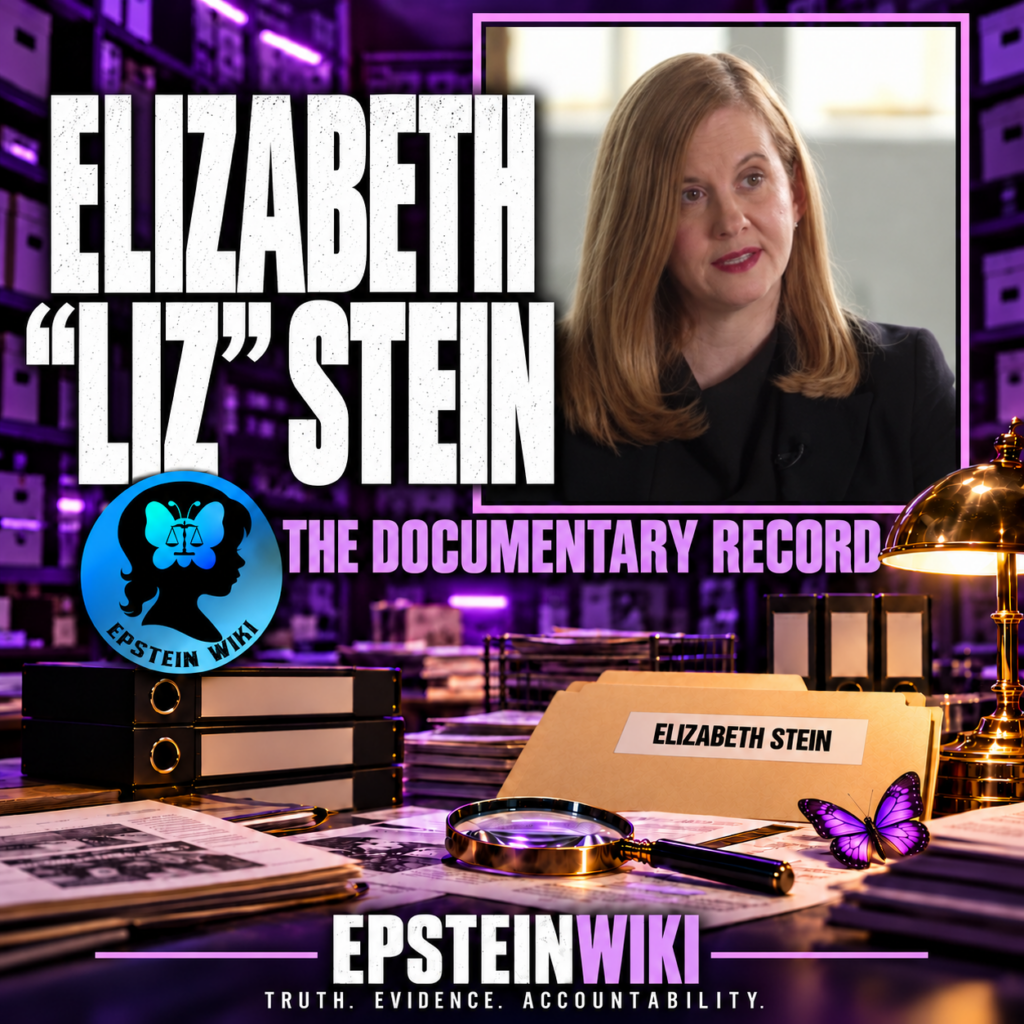
Elizabeth “Liz” Stein is a publicly identified Epstein survivor, human trafficking specialist and survivor advocate. Her public record includes a victim impact statement in Ghislaine Maxwell’s criminal case, a civil lawsuit against Maxwell and Epstein’s estate, and advocacy for records disclosure that protects survivors. worldwithoutexploitation.org
- Public name: Elizabeth Stein, also known as Liz Stein.
- Connection to the case: She alleges that Maxwell introduced her to Epstein while she worked in New York’s fashion retail industry.
- Age at introduction: She has described being 21.
- Alleged period of abuse: Approximately three years during the 1990s.
- Criminal court record: United States v. Maxwell, including ECF 675, attachment 3.
- Civil court record: Stein v. Indyke and others, New York County Supreme Court, index 952299/2023.
- Advocacy affiliation: World Without Exploitation STAND Fellow.
- Principal issues: Accountability, survivor privacy, institutional responsibility and meaningful access to evidence.
Important Points
- Stein’s allegations include sexual assault, coercion and trafficking by Epstein and Maxwell.
- She was an adult when she says the abuse began. Her account broadens the public discussion beyond the abuse of minors.
- She submitted a written statement before Maxwell’s sentencing. A court order also permitted her to speak.
- Permission to address a sentencing court does not mean a jury separately decided every allegation in her account.
- Her civil complaint was filed on November 22, 2023. Later reporting confirmed a compensated settlement without admissions of wrongdoing.
- Two public versions identify different hotels for the first encounter. The discrepancy remains unresolved in the sources examined here.
- She supports disclosure and investigation while opposing pressure on survivors to publish names themselves.
- In 2026, she publicly described failures to redact her information from released records.
- Her advocacy extends beyond interviews to public education and the physical display of released documents.
Who Is Elizabeth Stein?
World Without Exploitation’s biography identifies Stein as a human trafficking specialist and survivor advocate. It describes previous work as a survivor mentor and child policy associate.
Her listed affiliations include the Philadelphia Anti Trafficking Coalition, Pennsylvania Anti Human Trafficking Awareness Work Group, National Council of Juvenile and Family Court Judges Survivor Leader Board, and Sex Trade Survivor Caucus.
These roles place her work at the intersection of personal experience, public education and policy. Her stated approach treats trafficking as a problem sustained by institutions and unequal power, as well as individual offenders.
From Fashion Student to Epstein’s Orbit
Stein’s 2022 victim impact statement says she arrived in New York in 1991, aged 18, to attend the Fashion Institute of Technology. An internship led to employment at Henri Bendel.
She says she met Maxwell while serving her at the store. A routine offer to deliver purchases became the introduction to Epstein and, in her account, the first assault.
Scripps News’ interview describes her as 21 at the time. This distinction matters: moving to New York at 18 and meeting Epstein at 21 are separate events.
Her account begins with work and professional ambition. It does not begin with a knowingly accepted role in a trafficking operation.
Maxwell’s Alleged Role
The civil complaint places Maxwell at the center of Stein’s allegations. Stein describes a relationship presented as friendship and opportunity that became a means of accessing and controlling her.
Inside Edition’s reporting on the complaint describes alleged assaults, pressure surrounding employment, and an abortion that Stein alleged Maxwell arranged and insisted upon.
These allegations concern active participation. They should be attributed to Stein and her complaint. Maxwell’s conviction in the broader criminal case does not automatically convert every allegation in a separate lawsuit into an adjudicated fact.
Employment, Status and Alleged Leverage
Stein’s account of the employment pressure says she declined a full time position that would have interrupted her degree. Maxwell allegedly reacted angrily and claimed that she and Epstein had arranged the opportunity.
Stein says Maxwell later found her at Bloomingdale’s in fall 1995. A Florida trip extended beyond the planned return, costing her job and increasing her vulnerability.
The complaint reporting also describes references to Les Wexner and his business connections. Such references explain the influence Stein says was invoked. They do not establish that Wexner authorized her recruitment, arranged an assault or knew of the alleged abuse.
The Hotel Discrepancy
The 2022 sentencing statement identifies the Pierre Hotel as the destination for the delivery that led to meeting Epstein.
The later Scripps interview identifies the St. Regis. Reporting on the civil complaint also uses St. Regis.
The published record therefore contains a discrepancy about the location of the first encounter. The available material does not resolve it.
A careful account preserves both versions. It neither silently selects one nor treats the inconsistency alone as proof that the entire account is true or false.
Alleged Assaults, Pregnancy and Coercion
Inside Edition’s examination of the lawsuit describes allegations of repeated abuse and trafficking over three years, including an assault involving Epstein, Maxwell and another man.
It also reports Stein’s allegation that Maxwell pressured her to terminate a pregnancy and arranged a doctor.
The written impact statement independently mentions a pregnancy, uncertainty about paternity, threats and attempts to escape.
The record does not establish the pregnancy’s paternity. Epstein must not be identified as the confirmed father. The statement and later complaint also differ in how much detail they give about the abortion.
These are serious allegations. Their inclusion in a verified complaint or court filing establishes that they were formally made, rather than independently proving every underlying event.
The Long Aftermath
Stein’s impact statement describes moving to Philadelphia in 1997, repeated hospitalizations, chronic pain, disrupted ambitions and eventual rehabilitation.
Her account presents recovery as a lengthy process, affecting education, employment, relationships and physical mobility. It is her description of her experience, rather than a substitute for independently examined medical records.
Scripps News’ interview adds an important part of that aftermath: Stein says she did not understand her experience as trafficking until Epstein’s 2019 arrest. She had instead interpreted it through shame and misplaced self blame.
Delayed understanding is central to her public account. She distinguishes experiencing abuse from later finding the language to describe what happened.
Observing Maxwell’s Trial
Stein’s sentencing statement says she regularly traveled from Philadelphia to observe Maxwell’s trial in November and December 2021. She says she remained anonymous in the courtroom until revealing her identity the day before the verdict.
This account identifies her as a courtroom observer. The sources examined do not establish that she was a prosecution witness whose individual allegations were presented for the jury to decide.
That distinction preserves the significance of her participation without overstating the trial record.
The Dispute Over Her Sentencing Participation
The June 2022 motion papers sought permission for Stein and Sarah Ransome to speak at sentencing.
The dispute involved the legal scope of victim participation in a criminal proceeding. It must not be recast as a judicial finding that Stein fabricated her account.
Judge Alison Nathan’s June 27 order accepted written statements from eight people, including Stein. The court also rejected the defendant’s requests to redact those statements and allowed Stein, Ransome and Teresa Helm to deliver shortened oral statements.
The order exercised the court’s discretion. It documents that Stein’s statement was received and that she was permitted to be heard. It does not separately adjudicate every allegation she described. Epstein Archive
Evidence Appearances and Document Identifiers
The following references identify specific public records. Court docket numbers, production page stamps and EFTA identifiers are different systems.
- ECF 666: June 21, 2022 request concerning Stein and Ransome’s participation.
- ECF 675: June 25, 2022 motion papers concerning oral statements.
- ECF 675, attachment 1: Counsel’s declaration concerning submission of statements.
- ECF 675, attachment 3: Stein’s five page victim impact statement. Production stamps run from DOJ OGR 00010720 through DOJ OGR 00010724.
- ECF 678: Government filing addressing the requested oral statements.
- ECF 686: June 27, 2022 sentencing participation order. Production stamps are DOJ OGR 00010751 and DOJ OGR 00010752.
- NYSCEF document 1, index 952299/2023: November 22, 2023 summons and verified complaint.
- NYSCEF document 5: Stipulation extending the estate representatives’ response deadline to March 26, 2024.
Epstein Data’s document search provides a route into the released evidence collection. Its survivor interview collection also includes public interviews involving Stein.
An equivalent EFTA identifier for the court records listed above has not been verified here. The verified docket and production identifiers are retained rather than replaced with guessed evidence links.
The 2023 Civil Lawsuit
The verified complaint was filed in New York County Supreme Court on November 22, 2023, under index 952299/2023.
The defendants included Maxwell and Darren K. Indyke and Richard D. Kahn in their capacities as executors of Epstein’s estate. Their representative capacity matters. Listing them as estate defendants does not mean Stein accused them personally of committing the assaults described in the complaint.
The pleading sought civil relief for allegations including sexual battery, assault, gross negligence and intentional infliction of emotional distress.
The January 2024 stipulation extended the estate representatives’ deadline to answer or move against the complaint. This procedural agreement did not determine the truth of the allegations.
What the Settlement Establishes
CBS Philadelphia’s December 2025 report confirms that Stein received settlement compensation without admissions by Maxwell or the estate. CBS Philadelphia
The report does not supply the settlement amount or establish a trial verdict.
A settlement resolves litigation on agreed terms. It should not be described as a criminal conviction, an admission of guilt or a judicial rejection of the survivor’s account.
EpsteinWiki’s litigation index provides broader context for claims involving Epstein’s estate and associated entities.
Why She Rejects the Simple “Client List” Narrative
Stein’s September 4, 2025 WBUR interview addressed proposals for survivors to publicly name alleged abusers.
She warned that this could expose survivors to further danger. She supported comparing accounts and helping investigators identify common evidence, while insisting that investigation remained the government’s responsibility.
Her position must be read in context. It was not opposition to records disclosure. Nor was it a claim that no additional offenders existed. Here & Now
A contact list, flight record, email exchange and allegation each answer different questions. Treating them all as a single list of proven offenders obscures what the evidence actually establishes.
Disclosure as a Step Toward Accountability
WBUR’s November 19, 2025 interview recorded Stein’s response to Congress voting to release records. She welcomed the development but emphasized that justice required accountability for those involved in the crimes.
Her focus extended to people who allegedly received or enabled exploitation, rather than stopping at Epstein and Maxwell.
Disclosure can make investigation and public scrutiny possible. Publication alone does not establish that an investigative lead was pursued, that witnesses were interviewed or that an offender was prosecuted.
That distinction explains why Stein’s campaign continued after the legislation advanced.
Survivor Privacy and the 2026 Releases
Stein’s February 3, 2026 CNN interview described inconsistent redactions. She said one document concealed her name 25 times but exposed it four times.
CNN’s interview also included Deputy Attorney General Todd Blanche acknowledging release mistakes and describing removal of material after complaints.
Stein characterized the exposure as dangerous and rejected the suggestion that the records’ volume made it acceptable. Transcripts
Her public identification does not amount to consent to publish every private detail. A survivor can speak publicly while still expecting protection for addresses, personal correspondence and information about other survivors.
Congressional and Public Advocacy in 2026
Representative Teresa Leger Fernández’s February 23 announcement named Stein among the guests invited to Washington for the day of the State of the Union.
The announcement establishes an invitation and advocacy purpose. It should not be expanded into an unsupported claim about precisely where Stein sat or which event she ultimately attended.
World Without Exploitation describes her continued education and policy work around the Epstein Files Transparency Act.
EpsteinWiki’s World Without Exploitation article supplies related context on the organization and survivor advocacy.
Bringing the Files Into Public View
Stein’s September 8, 2026 CNN interview featured her alongside David Garrett of the Institute for Primary Facts. They discussed a traveling reading room that displayed released records in physical binders.
Stein explained that seeing the material in person made its scale more tangible. She also said released records exposed identifying details about her. Transcripts
The September 10 Katie Phang podcast featured Stein and Dani Bensky discussing the Redacted Reading Room in Dallas.
This work links public education to her demand for further investigation. The exhibit’s existence and her participation are documented. Statements about what particular records prove still require examination of those records.
Sleuth Coverage and Interview Context
Edith J. Kohn’s August 31, 2026 review examines the March 9 episode of On with Kara Swisher featuring Stein, Jess Michaels and Dani Bensky.
Kohn considers the interview useful with reservations. She highlights the survivors’ accounts of legal and personal consequences while criticizing aspects of the interview format. podcast review
The episode transcript documents Swisher’s disclosure that Reid Hoffman helped initiate the connection leading to the booking. Swisher said the survivors were unaware of that connection and Hoffman had no influence over the interview.
That disclosure belongs to the production context. It does not establish that Stein endorsed Hoffman or that he controlled her advocacy.
The review is commentary. The interview is evidence of what participants said. Neither replaces the underlying court documents.
Chronology
- 1991: Stein says she moved to New York to attend FIT.
- During her studies: She began working at Henri Bendel.
- During her senior year: She says Maxwell introduced her to Epstein.
- Fall 1995: Her statement describes renewed contact at Bloomingdale’s.
- 1997: She says she moved to Philadelphia.
- 2019 and 2020: Epstein’s and Maxwell’s arrests became important milestones in her ability to disclose the abuse.
- November and December 2021: She observed Maxwell’s trial.
- June 25, 2022: Her written impact statement was filed.
- June 27, 2022: The sentencing court permitted an oral statement.
- November 22, 2023: Her civil lawsuit was filed.
- January 2024: Estate representatives obtained additional time to respond.
- September 2025: She advocated on Capitol Hill and discussed investigation and survivor safety in interviews.
- November 2025: She publicly welcomed the congressional vote on disclosure.
- December 2025: Reporting confirmed a compensated civil settlement.
- February 2026: She described failures to redact her information.
- March 2026: She participated in the Kara Swisher survivor interview.
- September 2026: She discussed the traveling reading room and public access to released records.
What Remains Unresolved
- The conflicting hotel identifications have not been reconciled.
- The public sources examined do not establish every alleged assault independently.
- The pregnancy’s paternity is not established.
- The settlement amount and complete terms are not supplied by the reporting cited here.
- A verified EFTA cross reference for her impact statement has not been established.
- Her concern that investigative leads remain unpursued is an attributed assessment, rather than proof of the status of every investigation.
- Public advocacy appearances do not establish criminal conduct by a third party.
- Missing search results do not demonstrate that a document was deliberately withheld.
Key Takeaways
- Stein’s story begins with professional ambition. Her account describes an ordinary retail interaction becoming a route into exploitation.
- Maxwell’s alleged role was active. Stein describes friendship, opportunity and pressure operating together.
- The court record is substantial but specific. Her statement, participation order and civil complaint are identifiable public documents.
- Different legal outcomes mean different things. Sentencing participation, a civil pleading and a settlement must not be collapsed into one finding.
- Disclosure and privacy are compatible demands. Her campaign seeks evidence and accountability while protecting survivors.
- The work continued after publication. Her 2026 advocacy focused on redaction failures, investigative follow through and public understanding.
- Accuracy strengthens the survivor record. Preserving discrepancies and evidentiary limits prevents sensational claims from overtaking what the sources actually show.
Source List
- World Without Exploitation: Elizabeth Stein biography.
- Victim impact statement: ECF 675, attachment 3.
- Motion concerning sentencing participation: ECF 675.
- Counsel’s declaration: ECF 675, attachment 1.
- Government filing: ECF 678.
- June 27, 2022 sentencing order: ECF 686.
- November 22, 2023 verified civil complaint.
- January 2024 response deadline stipulation.
- Inside Edition: reporting on Stein’s civil allegations.
- Scripps News: Stein’s account and advocacy.
- CBS Philadelphia: settlement confirmation.
- WBUR: September 4, 2025 interview.
- WBUR: November 19, 2025 interview.
- CNN: February 3, 2026 interview.
- Representative Leger Fernández: February 23, 2026 announcement.
- On with Kara Swisher: March 9, 2026 transcript.
- Edith J. Kohn: survivor interview review.
- CNN: September 8, 2026 reading room interview.
- Katie Phang: September 10, 2026 reading room discussion.
- Epstein Data: evidence search for Elizabeth Stein.
- Epstein Data: survivor interviews.