
Julia Molchanova
Snapshot
- Full name: Julia Molchanova
- Alternate rendering: Yulia Molchanova, a transliteration used by some secondary sources
- Born: Approximately 1988 or 1989, based on her reported age of 37 in September 2026
- Nationality and background: Born in Russia; studied design before moving to New York
- Connection to Jeffrey Epstein: Survivor who says Epstein groomed, sexually abused, coerced, controlled, and financially exploited her from 2011 until she broke contact in 2019
- Public legal role: Lead plaintiff, originally identified as Jane Doe, in Doe v. Bank of America, N.A., No. 1:25-cv-08520, Southern District of New York
- Associated entity: JSC Interiors LLC, a New York company formed in her name in 2014 and administered by members of Epstein’s financial staff
- Public identification: September 5, 2026, in an interview with The Wall Street Journal
- Legal outcome: The Bank of America class action ended in a court approved $72.5 million settlement. The bank denied wrongdoing and made no admission of liability.
- EpsteinWiki involvement level: Not applicable. Molchanova is documented as a survivor and civil plaintiff, not an associate to be rated on the Epstein Network Levels of Involvement Scale.
- Article status: Survivor profile and financial infrastructure investigation
- Fact checked through: September 8, 2026
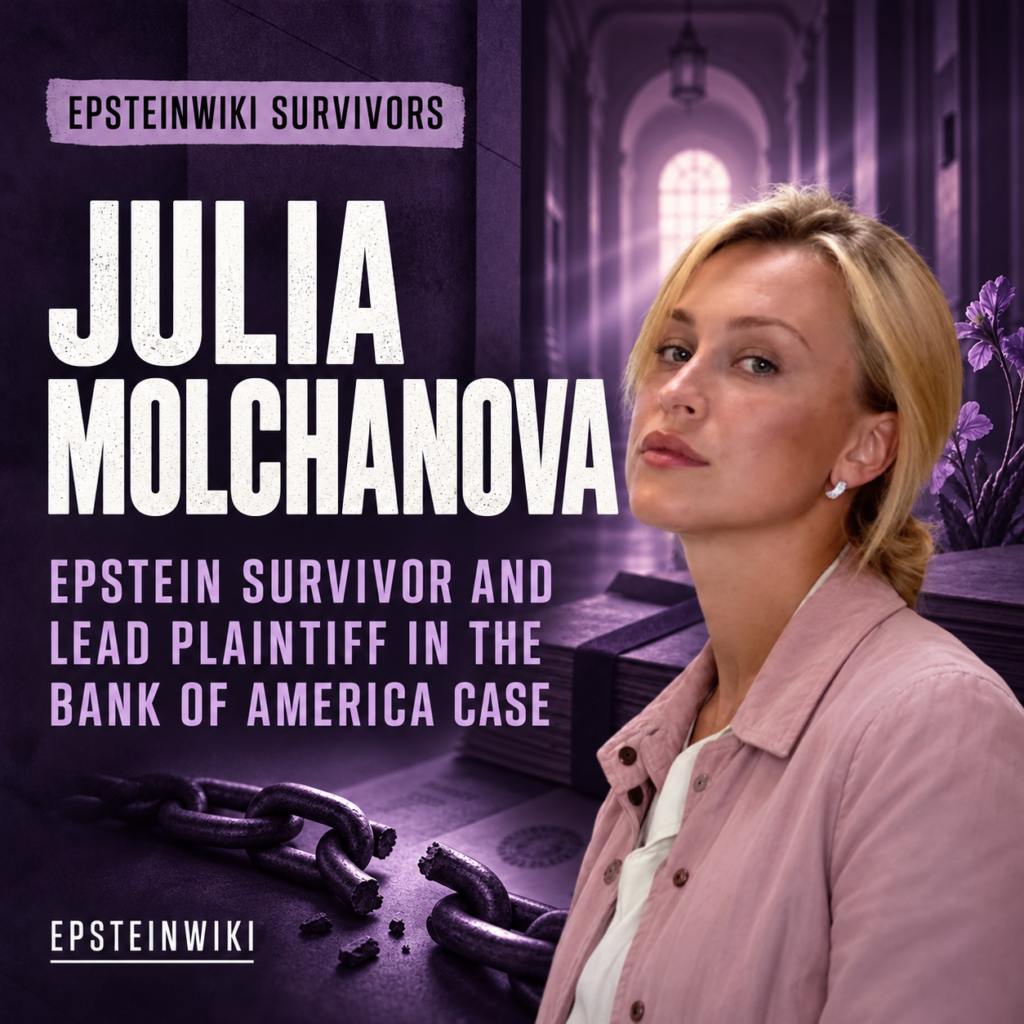
Photo
Molchanova publicly revealed her identity in 2026. The Wall Street Journal profile includes photographs by Moriah Ratner, but those photographs are copyrighted and should not be copied to EpsteinWiki without permission.
EpsteinWiki should publish a photograph of Molchanova only if she provides it, expressly consents to its use, or the site confirms a compatible license. A generated likeness, archival guess, or image taken from a private social media account would be inappropriate for a survivor profile.
Overview
Julia Molchanova is a Russian born designer and Jeffrey Epstein survivor who publicly identified herself in September 2026. She said Epstein approached her in New York in December 2011, when she was 22, spoke little English, and hoped to pursue fashion design. According to Molchanova, Epstein used promises of education, career access, money, housing, and immigration stability to build dependence. She alleges that he sexually abused her, imposed rules over her appearance and personal life, isolated her, and embedded her in financial arrangements she did not understand.
Her story is unusually important to the documentary record because it connects survivor testimony to an identifiable corporate entity, JSC Interiors LLC, and to bank records, internal emails, account opening documents, employment records, and purchasing activity. Those records independently establish that JSC Interiors existed and operated inside Epstein’s administrative system. They do not establish that Molchanova understood, directed, or benefited from every transaction conducted in the company’s name.
Molchanova was also the lead pseudonymous plaintiff in a 2025 proposed class action against Bank of America. The complaint alleged that the bank ignored warning signs and provided financial services that facilitated Epstein’s trafficking venture. Bank of America denied those allegations. In August 2026, Judge Jed S. Rakoff gave final approval to a $72.5 million class settlement without an admission of wrongdoing.
This page treats Molchanova primarily as a survivor and witness. It does not treat payments, housing, nominal company ownership, an arranged marriage, or placement in Epstein connected jobs as evidence that she was a willing participant in his crimes.
Identity Verification and Public Disclosure
For years, Molchanova’s name was not publicly connected to the Bank of America lawsuit. The complaint proceeded under the name Jane Doe, a standard protection in litigation involving sexual abuse and trafficking. On September 5, 2026, Molchanova identified herself to The Wall Street Journal as the lead plaintiff.
Her disclosure connects three bodies of evidence that had previously been partly separated:
- Her first person account of grooming, abuse, coercive control, and escape
- The allegations pleaded by Jane Doe in the Bank of America litigation
- Public records concerning JSC Interiors LLC and its use by Epstein’s legal, accounting, banking, and household staff
Secondary sources sometimes render her first name as Yulia. EpsteinWiki uses Julia because that is the English spelling used in her public interview and current major reporting.
Only biographical information that Molchanova has chosen to disclose publicly is included here. Her present address, family information, private contact details, immigration identifiers, medical records, and the identity of any person who has not publicly identified herself are excluded.
Early Life and Meeting Jeffrey Epstein
Molchanova was born in Russia and was studying design when she visited New York in December 2011. She was 22 and spoke limited English.
She told The Wall Street Journal that Epstein approached her outside Barneys on Madison Avenue. He complimented her eyes and pointed out his nearby East 71st Street townhouse. A young Russian speaking woman translated. Epstein invited Molchanova to breakfast the next day and asked about her ambitions.
When Molchanova said she wanted a career in fashion design, Epstein offered to help her attend the Fashion Institute of Technology in New York. Molchanova later described that promise as the means by which he drew her in. After she returned to Russia, Epstein paid for sewing courses that appeared to advance the promised educational plan.
In January 2012, Epstein invited her back to New York and placed her in an apartment with other young women. Molchanova alleges that he first sexually abused her during that visit. She says he presented sexual compliance and personal transformation as requirements for succeeding and assimilating in the United States.
The Fashion Institute of Technology opportunity did not materialize. In response to the 2026 reporting, an FIT spokesperson said the institution was continuing to investigate references to the school.
Grooming Through Education, Work, and Dependency
Molchanova’s account describes a pattern in which legitimate aspirations were used to create dependency. The initial promise concerned education. Later promises concerned design work, internships, housing, immigration stability, and a company supposedly created for her career.
The pattern she describes included:
- Selecting a young visitor with limited English and limited local support
- Offering access to an elite school and professional contacts
- Paying for training and travel
- Providing housing and a variable monthly allowance
- Recasting dependence as generosity that required gratitude and compliance
- Placing the survivor in jobs or internships selected through Epstein’s contacts
- Creating accounts and a company in her name while Epstein’s staff retained practical control
- Using immigration insecurity and personal isolation to increase leverage
Molchanova said she received less than $3,000 a month, with the amount changing. A payment to a survivor does not by itself show employment, consent, or participation in wrongdoing. In a coercive relationship, money and housing can operate as instruments of control.
Alleged Abuse and Coercive Control
Molchanova alleges that Epstein repeatedly sexually abused her between 2011 and 2019. The 2025 civil complaint described forced sexual acts occurring at least 100 times. That number is an allegation in civil pleadings, not a criminal finding concerning each event.
She has also described a broader system of coercive control. According to her public account, Epstein dictated or monitored her clothing, hair, weight, medical care, spending, and social contacts. He demanded frequent expressions of gratitude and expected women around him to appear cheerful and accommodating.
Molchanova described the environment as “like a cult.” She said Epstein expected dependent women to introduce other women to him. She states that she refused to recruit anyone and that his treatment of her became harsher as a result. She recalls being isolated in a room for extended periods on some occasions.
Molchanova has publicly discussed severe psychological harm and periods of suicidal thinking. EpsteinWiki includes that fact only because she disclosed it herself and because it helps explain the effects of coercive control. This page omits unnecessary intimate or graphic detail.
Epstein died in 2019 before Molchanova’s allegations could be tried against him. Her account is nevertheless supported in important respects by documents showing financial dependency, nominal company ownership, staff control of JSC Interiors, and her 2019 efforts to obtain records and separate herself from the entity.
Paris Incident and Deepening Dependence
Molchanova told the Journal that a boyfriend assaulted her in Paris in February 2012. She contacted Epstein, who helped her leave and paid for travel back to Russia. The assistance reinforced his presentation of himself as a protector and increased her dependence on him.
This episode is relevant because grooming relationships often combine harm, rescue, rewards, and fear. Epstein’s assistance after an unrelated assault does not negate Molchanova’s allegations against him. Nor does accepting emergency help establish consent to later abuse.
Arranged Marriage and Immigration Vulnerability
Documents reviewed by the Journal reportedly show that Epstein arranged for Molchanova and another woman to marry around 2013 as an immigration strategy. In 2017, one of Epstein’s lawyers filed paperwork to dissolve the marriage.
The public record described in current reporting does not establish every person who proposed, prepared, approved, or understood the arrangement. Molchanova’s account places it within a system in which Epstein controlled housing, money, work, legal assistance, and immigration stability.
EpsteinWiki does not identify the other woman here. Marriage and immigration records can expose survivors or third parties who have not chosen public identification. Any future update should rely on a court record or first person disclosure and should explain why publication serves a clear public interest.
JSC Interiors LLC
JSC Interiors LLC was organized in New York in November 2014. Molchanova says Epstein presented it as a design business that would support her career. She recalls performing only limited design related tasks, including arranging flowers.
The corporate and banking evidence tells a more complicated story. According to allegations in the Government of the United States Virgin Islands’ second amended complaint against JPMorgan Chase, the company listed a survivor identified as JSC as its sole owner, while the operating agreement named Richard Kahn as initial manager with broad authority, including authority over bank accounts. The complaint alleged that one account was funded entirely from Epstein’s personal accounts and that the company’s payroll included two people whose roles were described inconsistently in testimony.
Publicly released records show Epstein’s staff using JSC Interiors for bank accounts, employment verification, fabric and household purchases, and a nearly $40,000 Hermès furniture order. The company used 9 East 71st Street, Epstein’s Manhattan townhouse, as an address in multiple records.
Molchanova says she did not understand the company’s full purpose and did not know about many transactions. The operational records are consistent with her claim that other people exercised practical control. They do not resolve whether she knew about any particular purchase, received any particular payment, or signed any particular document.
The company is therefore best understood as a documented node in Epstein’s financial and household infrastructure, not as evidence that Molchanova independently operated a conventional interior design business.
Richard Kahn and Darren Indyke
Richard Kahn was Epstein’s longtime accountant and financial administrator. Darren Indyke was Epstein’s longtime lawyer and later a coexecutor of his estate.
Records connect both men to JSC Interiors. An internal November 2014 email shows Kahn forwarding a message from Indyke concerning the company. Other records show Kahn involved in account administration and purchasing decisions.
Attorneys for Kahn and Indyke told the Journal that Molchanova never informed them she was being abused or trafficked. Their statement said she appeared to be an assistant working through an LLC created for interior design, and that they saw no reason to refuse services she requested. The statement also said they had no knowledge of Epstein arranging her marriage or of anyone using cards in her name. Both men have denied facilitating or knowing about Epstein’s criminal activity.
Those denials are important contrary evidence. They do not erase the administrative records, but the records alone do not establish what Kahn or Indyke knew about Molchanova’s abuse at the time.
Bank Accounts, Credit, and Financial Identity
Molchanova says she opened a Bank of America account in 2013 at Kahn’s direction and that rent money was transmitted through the account. She alleges that Epstein and his staff used accounts and entities associated with her to support his broader system.
In early 2019, a credit monitoring application showed her cards and spending she did not recognize. In March 2019, she emailed Kahn to ask why unrequested cards appeared in her credit history. She also requested tax returns and asked to be removed from JSC Interiors. Kahn responded that she could retain another professional and said entity records would be provided.
On April 4, 2019, Molchanova wrote to Epstein that she did not understand the entity created in her name and wanted a normal life. Epstein invited her to Palm Beach. She did not go. She later said she feared she might be harmed if she did.
The current public record does not provide a complete, independently audited ledger of every account or card associated with Molchanova. It also does not establish the total amount that passed through those accounts, who initiated every transaction, or which signatures and authorizations were genuine. Those are central unanswered questions.
Career Placements and Public Image
Epstein attempted to place Molchanova in professional settings through his contacts. A May 2015 email reported by the Journal involved Faith Kates of Next Management discussing Molchanova’s reluctance to work at a desk and lack of office experience. Epstein reacted angrily toward Molchanova.
Next Management told the Journal that it had no business relationship with Epstein and that senior executives did not know the nature of Kates’s personal relationship with him. Kates retired in late 2025 and did not respond to the Journal’s request for comment.
In 2016, Epstein placed Molchanova in an internship with publicist Peggy Siegal. Molchanova said the work was unsuitable because of her limited English. Siegal did not respond to the Journal’s 2026 request. In earlier public statements, Siegal said she had not known about Epstein’s conduct and regretted associating with him.
A tabloid published photographs of Molchanova with Epstein in 2016. She says the exposure intensified her distress. A photograph of a survivor beside an abuser records proximity, not consent or complicity.
Chronology
- December 2011: Molchanova, age 22, meets Epstein near Barneys on Madison Avenue while visiting New York.
- Late 2011: Epstein offers to help her enter the Fashion Institute of Technology and pays for sewing courses in Russia.
- January 2012: Epstein invites her back to New York. Molchanova alleges the sexual abuse begins during this period.
- February 2012: After an assault by a boyfriend in Paris, Epstein helps her leave and pays for travel to Russia, increasing her dependence on him.
- 2012 onward: Molchanova moves to New York. The promised FIT education does not materialize.
- Approximately 2013: Epstein reportedly arranges a marriage involving Molchanova and another woman as an immigration tactic.
- 2013: Molchanova says she opens a Bank of America account at Richard Kahn’s direction.
- November 2014: JSC Interiors LLC is formed in New York in Molchanova’s name.
- December 2014: Deutsche Bank internal records document opening accounts for JSC Interiors.
- May 2015: Emails concerning a proposed work placement at Next Management show Epstein pressuring Molchanova about office work.
- 2015: Molchanova says Kahn’s assistant told her Epstein was placing her on the payroll of a company she did not understand.
- 2016: Epstein arranges an internship for Molchanova with Peggy Siegal.
- August 2016: Epstein’s staff discusses using JSC Interiors for a $39,114 Hermès furniture purchase.
- 2016: Tabloid photographs publicly associate Molchanova with Epstein.
- 2017: Legal paperwork is filed to dissolve the arranged marriage.
- 2017 and 2018: Records show continued employment and purchasing activity in the name of JSC Interiors.
- Early 2019: Molchanova discovers credit cards and spending she does not recognize.
- March and April 2019: She asks Kahn for records, asks to leave JSC Interiors, and tells Epstein she wants an independent life.
- July 6, 2019: Epstein is arrested on federal sex trafficking charges.
- July 2019: Deutsche Bank correspondence states that accounts associated with JSC Interiors were closed.
- October 15, 2025: Jane Doe files proposed class actions against Bank of America and BNY Mellon.
- March 2026: Bank of America agrees to a $72.5 million settlement, subject to court approval.
- April 2, 2026: Judge Rakoff grants preliminary approval.
- August 27 and 28, 2026: The court grants final approval and enters judgment.
- September 5, 2026: Molchanova publicly identifies herself as the lead Jane Doe plaintiff.
Evidence Appearances
The entries below concern JSC Interiors, the entity publicly connected to Molchanova. A document mentioning the entity is not automatically evidence about Molchanova’s personal knowledge or conduct. Epstein Data is a discovery and viewing tool. Its analytical summaries can contain errors, so the cited page image or original PDF should control.
EFTA01400774: Formation period communication
- Evidence type: Internal email dated November 13, 2014
- Appearance: Richard Kahn forwards a privileged and confidential message from Darren Indyke concerning JSC Interiors.
- What it establishes: Kahn and Indyke were communicating about JSC Interiors during the company’s formation period.
- What it does not establish: The visible page does not reveal the substance of the referenced Section V, Molchanova’s knowledge, or whether either man knew of abuse.
- Direct record: EFTA01400774
EFTA01405748: New account assignment
- Evidence type: Deutsche Bank internal case assignment dated December 2, 2014
- Appearance: JSC Interiors is identified in a new account opening workflow.
- What it establishes: Bank personnel were processing JSC Interiors as a new client or account relationship.
- What it does not establish: It does not show who supplied every document, who had beneficial control, or whether Molchanova understood the account structure.
- Direct record: EFTA01405748
EFTA01360494: Account opening status
- Evidence type: Internal bank email dated December 2, 2014
- Appearance: The correspondence states that the JSC Interiors account had not yet opened.
- What it establishes: Account opening remained in progress on that date.
- What it does not establish: It does not identify the final controlling signer or establish Molchanova’s participation in later transactions.
- Direct record: EFTA01360494
EFTA01471704: Accounts opened
- Evidence type: Deutsche Bank internal email dated December 4, 2014
- Appearance: The message reports that both JSC Interiors accounts had been opened.
- What it establishes: JSC Interiors had two bank accounts in the Deutsche Bank relationship by December 4, 2014.
- What it does not establish: Opening accounts in an entity bearing a survivor’s initials does not prove that the survivor directed or knowingly used them.
- Direct record: EFTA01471704
EFTA01456139 and EFTA01456142: Account profiles
- Evidence type: Deutsche Bank account detail records
- Appearance: The records list JSC Interiors checking and money market accounts.
- What they establish: The entity maintained more than one account type within the bank relationship.
- What they do not establish: The profile pages alone do not provide a complete transaction history, source of funds, or proof of Molchanova’s control.
- Direct records: EFTA01456139 and EFTA01456142
EFTA01282080: Know your customer file
- Evidence type: Deutsche Bank customer due diligence and account opening material
- Appearance: The file identifies Richard Kahn as manager with broad authority, describes the account as supporting an interior design company, projects substantial annual receipts and profit, and identifies one employee.
- What it establishes: The bank was given a formal business purpose and financial profile for JSC Interiors while Kahn held extensive managerial authority.
- What it does not establish: Forecasts in a customer profile do not prove that the company earned the projected revenue, operated independently, or that Molchanova supplied or understood the information.
- Direct record: EFTA01282080
EFTA00665654: Hermès furniture order
- Evidence type: Email from Richard Kahn to Epstein dated August 25, 2016
- Appearance: Kahn describes a Hermès furniture order totaling $36,900 plus $2,214 delivery to St. Thomas, for a total of $39,114. He says the purchase must be made through designer entity JSC Interiors to receive a discount and asks whether to use a JSC check or Epstein’s card.
- What it establishes: Epstein and Kahn discussed using JSC Interiors as the purchasing entity for expensive furniture destined for St. Thomas.
- What it does not establish: It does not show that Molchanova selected the furniture, authorized the transaction, received it, or knew that her company name was being used.
- Direct record: EFTA00665654
EFTA00665626: Payment method discussion
- Evidence type: Related email in the furniture thread
- Appearance: Kahn asks whether the purchase should be made through JSC Interiors or paid with Epstein’s card.
- What it establishes: The payment choice was being discussed between Epstein and his accountant.
- What it does not establish: It does not show a payment instruction from Molchanova.
- Direct record: EFTA00665626
EFTA00804288: Hermès check
- Evidence type: Check image dated August 26, 2016
- Appearance: A JSC Interiors check for $39,114 is payable to Hermès.
- What it establishes: The furniture discussion was followed by a payment bearing JSC Interiors’ name.
- What it does not establish: The check alone does not prove Molchanova’s knowledge, handwriting, authorization, or receipt of any benefit.
- Direct record: EFTA00804288
EFTA01228977: Employment verification
- Evidence type: Employment verification memorandum dated December 29, 2017
- Appearance: JSC Interiors is described as employing a redacted person who was traveling to the United Kingdom and expected to return to work in January 2018.
- What it establishes: The company was used to represent at least one person as an employee.
- What it does not establish: Redaction prevents confident identification of the employee, and the record does not show what work was actually performed.
- Direct record: EFTA01228977
EFTA00546990, EFTA00546999, and EFTA00547014: Fabric orders
- Evidence type: 2018 purchasing correspondence
- Appearance: Epstein staff, including household personnel, communicate about fabric orders using JSC Interiors.
- What they establish: The entity continued to be used for interior related purchases after its formation.
- What they do not establish: They do not show that Molchanova managed the correspondence or approved the orders.
- Direct records: EFTA00546990, EFTA00546999, and EFTA00547014
EFTA00548783: Sitram purchase
- Evidence type: October 2018 purchase record
- Appearance: A $254.50 Sitram USA purchase lists JSC Interiors and 9 East 71st Street, with Karyna Shuliak in the billing or shipping information.
- What it establishes: JSC Interiors’ name and Epstein’s townhouse address were used in an ordinary household purchase involving another member of his staff.
- What it does not establish: It does not place Molchanova in the transaction or prove who ultimately received the goods.
- Direct record: EFTA00548783
EFTA01348240: $10,000 check
- Evidence type: Check record
- Appearance: A $10,000 JSC Interiors check includes care of Richard Kahn.
- What it establishes: Kahn’s administrative role was attached to a substantial JSC Interiors payment.
- What it does not establish: Without the complete payment context, it does not establish purpose, ultimate beneficiary, or Molchanova’s knowledge.
- Direct record: EFTA01348240
EFTA00076491: Estate entity schedule
- Evidence type: Filing in the Estate of Jeffrey E. Epstein
- Appearance: JSC Interiors appears on an estate entity list as wholly owned by the decedent.
- What it establishes: The estate treated JSC Interiors as an Epstein owned entity, despite earlier records or agreements reportedly placing nominal ownership in a survivor’s name.
- What it does not establish: The entry does not explain when or how ownership changed, whether the earlier structure was accurate, or what Molchanova was told.
- Direct record: EFTA00076491
EFTA00075562: Estate accounting and liquidation
- Evidence type: Epstein estate quarterly accounting
- Appearance: The accounting lists JSC Interiors as fully Epstein owned, gives it a value of $35,668, and records liquidation on December 12, 2019.
- What it establishes: After Epstein’s death, the estate treated the entity as his asset and reported that it was liquidated.
- What it does not establish: It does not reconcile that treatment with earlier nominal ownership records or explain what notice, records, or protection Molchanova received.
- Direct record: EFTA00075562
EFTA01426655: Closure of accounts
- Evidence type: Deutsche Bank email dated July 12, 2019
- Appearance: Bank correspondence states that all accounts associated with JSC Interiors were closed and the prospect status was changed to inactive.
- What it establishes: The bank relationship was shut down shortly after Epstein’s July 2019 arrest.
- What it does not establish: The timing alone does not prove why each account was closed or who initiated every closure request.
- Direct record: EFTA01426655
The Bank of America Class Action
On October 15, 2025, a plaintiff identified as Jane Doe filed Doe v. Bank of America, N.A. in the Southern District of New York. Molchanova revealed in 2026 that she was that plaintiff.
The complaint alleged that Bank of America knowingly benefited from and provided financial services to an Epstein sex trafficking venture. It alleged that the bank processed rent, payroll, account, and company activity involving Doe even though Epstein’s 2008 conviction and the transaction patterns created warning signs. The complaint further alleged that the bank did not make timely suspicious activity reports that could have alerted authorities.
These were civil allegations. Bank of America denied facilitating sex trafficking and sought dismissal. Judge Jed S. Rakoff allowed material claims to proceed, after which the parties reached a settlement.
Bank of America agreed to pay $72.5 million. Judge Rakoff granted preliminary approval on April 2, 2026, and final approval in late August 2026. The settlement class covered women sexually abused or trafficked by Epstein or by people connected to his venture during the period defined by the settlement. Reporting indicated that approximately 60 to 75 women were expected to submit claims.
The settlement is not a trial verdict and contains no admission that Bank of America committed the alleged conduct. It is nevertheless a major legal outcome obtained through a case Molchanova initiated under a pseudonym.
The controlling public case information is:
- Court: United States District Court for the Southern District of New York
- Case: Doe v. Bank of America, N.A.
- Docket: 1:25-cv-08520
- Judge: Jed S. Rakoff
- Final judgment: Document 165, signed August 28, 2026
- Settlement amount: $72,500,000
The BNY Mellon Case
Molchanova, under the Jane Doe pseudonym, also filed a separate proposed class action against Bank of New York Mellon. That complaint alleged that BNY Mellon processed approximately $378 million in payments to women trafficked by Epstein and provided financial services connected to MC2, the modeling business associated with Jean Luc Brunel.
BNY Mellon denied wrongdoing and sought dismissal. The Bank of America settlement does not establish liability by BNY Mellon and does not resolve factual disputes in the separate case. Any update to this page should track the BNY docket independently rather than treating the cases as interchangeable.
Escape and Break With Epstein
Molchanova’s break with Epstein developed over time. The credit activity she discovered in early 2019 prompted direct questions about cards, taxes, and JSC Interiors. Her March and April messages show an effort to obtain records and separate her identity from the entity.
Epstein responded by inviting her to Palm Beach. Molchanova refused to go. She also did not return calls from people in Epstein’s circle who urged her to contact him. She later explained that she feared for her safety.
Epstein was arrested in July 2019. Molchanova’s decision to confront him preceded that arrest and should not be described as a response to his public collapse. Her account indicates that she had begun trying to leave while he still held substantial money, access, and influence.
Public Disclosure and Advocacy
Molchanova remained publicly anonymous during the Bank of America litigation and through the settlement process. She identified herself only after the court approved the settlement.
She told the Journal that the litigation was grueling and required disclosure of deeply private information. She nevertheless believes that bringing the case may protect other survivors. As of September 2026, she was developing a fashion brand and planned to advocate for victims of crime.
Her decision to disclose her name does not waive all privacy. Public identification is not permission to publish private addresses, immigration numbers, medical detail, family information, or images taken from nonpublic accounts.
What the Evidence Establishes
Taken together, the current public record establishes that:
- Molchanova has publicly identified herself as an Epstein survivor and as the lead Jane Doe plaintiff in the Bank of America case.
- She met Epstein in late 2011 when she was 22 and seeking a design career.
- Her account describes education and career promises that developed into sexual abuse, coercive control, financial dependence, and isolation.
- JSC Interiors LLC was formed in New York in 2014 in circumstances connected to Molchanova.
- Kahn and Indyke communicated about the company during its formation period.
- Deutsche Bank opened multiple accounts for JSC Interiors.
- Epstein and his staff used JSC Interiors for household purchases, employment representations, and a substantial furniture order.
- Records show Kahn and other Epstein staff exercising practical administrative or transactional roles involving the entity.
- An Epstein estate filing later described JSC Interiors as wholly owned by Epstein.
- Molchanova challenged unexplained financial activity and sought separation from the company before Epstein’s July 2019 arrest.
- Her Bank of America case resulted in a $72.5 million settlement for a survivor class, without an admission of wrongdoing by the bank.
What the Evidence Does Not Establish
The present record does not establish that:
- Molchanova recruited women for Epstein. She says she refused to do so.
- She knowingly participated in Epstein’s crimes.
- Nominal ownership of JSC Interiors meant she exercised practical control over its accounts or purchases.
- She authorized every credit card, bank transaction, payroll entry, order, or tax filing associated with her identity.
- Every payment she received was compensation for ordinary employment.
- Kahn or Indyke knew at the time that Epstein was abusing Molchanova. They deny such knowledge.
- Bank of America admitted liability. It did not.
- Settlement approval is the same as a trial verdict on every allegation.
- Every person who appears in JSC Interiors correspondence knew of abuse or trafficking.
- The publicly available documents provide a complete ledger of the company or of Molchanova’s financial identity.
Institutional and Investigative Significance
Molchanova’s account provides a concrete example of how an Epstein controlled environment could blur the boundaries between assistance, employment, dependency, and financial administration.
The significance of JSC Interiors is not merely that a company existed. It is that the company’s nominal association with a survivor appears alongside operational control by Epstein’s accountant, communications involving Epstein’s lawyer, bank accounts, purchases for Epstein properties, and later estate treatment of the entity as Epstein owned.
That structure raises questions for several institutions:
- Banks: Who was treated as the customer and beneficial owner? Who had signing authority? What transaction monitoring occurred?
- Lawyers and accountants: What information was given to Molchanova, in what language, and what independent advice was offered?
- Employers and professional contacts: Were career placements genuine opportunities, or were they used to reinforce dependence and Epstein’s image as a benefactor?
- Immigration professionals: Who prepared and explained the reported marriage arrangement, and did anyone assess coercion?
- Investigators: When did authorities first identify accounts or entities placed in survivors’ names?
The case also shows why a survivor’s receipt of money or presence in business records must be interpreted in context. Financial dependence can be evidence of control rather than partnership.
Sleuth Findings and Independent Corroboration
Independent researcher Heather Ashley’s survey of Epstein’s financial entities identified JSC Interiors in several records, including a $10,000 check care of Richard Kahn, an invoice using 9 East 71st Street, and an estate filing describing the company as wholly owned by Epstein. These findings help locate relevant primary documents, but the documents themselves remain the evidence.
Epstein Data, operated by R. Howard Stone, indexes hundreds of JSC Interiors appearances across email, financial, court, and FBI datasets. That volume is useful for discovery but should not be reported as hundreds of separate events. Duplicate pages, repeated attachments, OCR variants, and related email chains can inflate counts.
The most reliable method is to group related records by transaction or event, inspect the underlying page, and distinguish the entity from Molchanova personally. This article follows that method.
Reliability and Limitations
This profile draws from four evidence classes:
- Molchanova’s public first person interview
- Federal court filings and orders
- EFTA documents and bank records involving JSC Interiors
- Independent reporting and document indexes used to locate primary material
Each class has limits. First person testimony is central evidence but does not answer every corporate or banking question. Civil complaints state allegations and advocacy positions, not adjudicated facts. A settlement ends claims without deciding all disputed facts. Bank emails and checks prove particular administrative events but may not reveal the full purpose or surrounding instructions. OCR can misread names, dates, amounts, and redactions.
Some records use initials or redact survivor names. EpsteinWiki does not reverse those redactions solely because Molchanova has identified herself in one lawsuit. A connection should be made only when a reliable public source has made it or the underlying record provides sufficient contextual proof.
Fact Check
- Claim: Molchanova was an Epstein associate or co-conspirator. Unsupported. The public record identifies her as a survivor and civil plaintiff.
- Claim: She owned and controlled JSC Interiors in the ordinary business sense. Misleading. Some formation documents reportedly named a survivor as owner, while records show Epstein’s staff exercising practical control and an estate filing later called the entity Epstein owned.
- Claim: A JSC Interiors payment proves Molchanova authorized it. False as a general inference. Authorization must be established transaction by transaction.
- Claim: Molchanova publicly accused Kahn and Indyke of knowing about her abuse. The current reporting focuses on their administrative roles. Their attorneys say she did not tell them she was being abused and they did not know of Epstein’s criminal conduct.
- Claim: Bank of America was found liable at trial. False. The case settled, and the bank denied wrongdoing.
- Claim: Molchanova publicly identified herself before the litigation. False. She proceeded as Jane Doe and disclosed her identity in September 2026.
- Claim: The alternate spelling Yulia refers to a different person. No evidence supports that. It is a transliteration variant used in secondary reporting.
Related People and Organizations
- Jeffrey Epstein, convicted sex offender whom Molchanova accuses of grooming, abuse, coercive control, and financial exploitation
- Richard Kahn, Epstein’s accountant and a documented manager or administrator connected to JSC Interiors
- Darren Indyke, Epstein’s lawyer who helped form JSC Interiors according to current reporting
- Bank of America, defendant in Molchanova’s class action and party to the $72.5 million settlement
- Bank of New York Mellon, defendant in a separate civil action filed under the Jane Doe pseudonym
- Deutsche Bank, the bank reflected in multiple JSC Interiors account records
- Fashion Institute of Technology, the school Epstein allegedly promised to help Molchanova attend
- Next Management and Faith Kates, connected to a proposed work placement
- Peggy Siegal, publicist who provided an internship arranged through Epstein
- Karyna Shuliak, Epstein staff member appearing in JSC Interiors purchasing records
- JSC Interiors LLC, the nominal design company at the center of the financial evidence
Questions That Still Need Answers
- Who drafted the JSC Interiors operating agreement, and what explanation was given to Molchanova?
- Was the agreement translated into Russian or explained by independent counsel?
- Who was identified to each bank as the beneficial owner of JSC Interiors?
- Who had signature authority over each JSC Interiors account?
- Did any signature purporting to be Molchanova’s appear on account, card, tax, or purchase documents?
- Which JSC Interiors accounts were funded directly or indirectly by Epstein or his entities?
- What was the full transaction history of each account?
- Who received payroll payments from JSC Interiors, and what work was claimed?
- Why did descriptions of a second employee reportedly vary between interior designer and dentist?
- Who authorized the $39,114 Hermès purchase?
- Where was the Hermès furniture ultimately delivered and installed?
- Which purchases were for Epstein’s properties rather than for any work Molchanova performed?
- Who opened credit cards associated with Molchanova’s identity?
- What spending did Molchanova discover in 2019, and who initiated it?
- Were suspicious activity reports filed concerning JSC Interiors before Epstein’s death?
- When did Bank of America first identify Epstein or his staff as connected to Molchanova’s accounts?
- What customer due diligence did Deutsche Bank perform for JSC Interiors?
- Why did the Epstein estate describe JSC Interiors as wholly owned by Epstein?
- Did ownership formally transfer, or did the estate characterize practical control as ownership?
- What tax returns were filed for Molchanova and JSC Interiors, and who prepared and approved them?
- Did Molchanova incur tax, credit, immigration, or other liability because of activity she did not authorize?
- Were all such liabilities corrected?
- Who proposed and arranged the reported marriage?
- What legal and immigration advice did each woman receive?
- Were any lawyers or officials alerted to possible coercion?
- What role did Epstein’s staff play in ending the marriage?
- Did FIT receive an application, donation inquiry, or communication concerning Molchanova?
- What did professional contacts understand about Epstein’s control over her work placements?
- Which law enforcement agencies reviewed JSC Interiors before or after Epstein’s 2019 arrest?
- Are there unredacted corporate, bank, or investigative records that can answer these questions without exposing other survivors?
Sources
First person reporting
- Khadeeja Safdar, How One Woman Was Caught in Epstein’s ‘Cult’ and Escaped, The Wall Street Journal, September 5, 2026.
- Meduza, At 22, Russian design student Julia Molchanova met Jeffrey Epstein by chance on the street, September 7, 2026. Secondary summary of the Journal investigation.
Court records and legal reporting
- Doe v. Bank of America, N.A., docket 1:25-cv-08520, United States District Court for the Southern District of New York.
- Order and Final Judgment, Document 165, signed August 28, 2026.
- Reuters, Bank of America, BNY sued over alleged financial ties to Jeffrey Epstein, October 15, 2025.
- Reuters, Bank of America agrees to pay $72.5 million to settle Epstein accusers’ lawsuit, March 27, 2026.
- Reuters, Bank of America’s $72.5 million settlement wins preliminary approval, April 2, 2026.
- Reuters, Court approves Bank of America’s $72.5 million settlement with Epstein accusers, August 27, 2026.
- Associated Press, Lawyers say up to 75 women expected to benefit from Bank of America settlement, April 2026.
- Courthouse News Service, Judge approves Bank of America’s $72 million settlement with Epstein victims, August 27, 2026.
- Second Amended Complaint in Government of the United States Virgin Islands v. JPMorgan Chase Bank, N.A., No. 1:22-cv-10904, Document 119-1, filed April 12, 2023, especially paragraphs 90 through 93.
Primary document collections and independent research
- JSC Interiors LLC entity page, Epstein Data.
- United States Department of Justice Epstein Library, official source collection.
- Heather Ashley, Epstein’s Financial Web: An Extensive Report on His Many Companies, independent research index. Individual claims should be checked against the linked source records.
- KPMG, International Peace Institute Forensic Review, December 18, 2020.
- Direct EFTA records listed individually in the Evidence Appearances section above.