
Morgan Fairchild
Snapshot
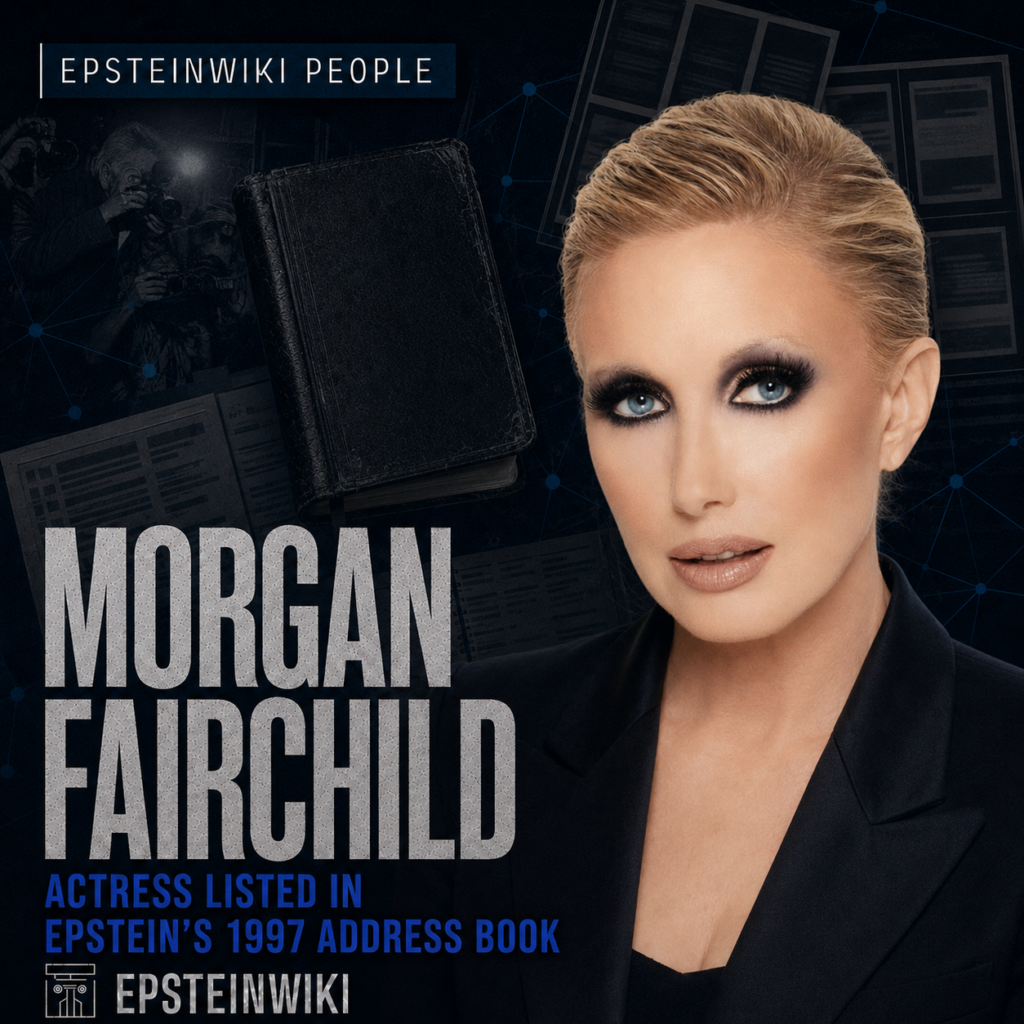
Morgan Fairchild is an American actress known for Search for Tomorrow, Dallas, Flamingo Road, Falcon Crest, Murphy Brown, and Friends.
Fairchild’s connection to Jeffrey Epstein is supported by three different categories of evidence:
- Maria Farmer recalled seeing Fairchild in Epstein’s office when Farmer interviewed for a job in the mid-1990s.
- Fairchild’s spokesperson confirmed that she once visited Epstein’s office to see a painting, while describing the encounter as lasting less than twenty minutes.
- An address book apparently maintained by Epstein in 1997 contained Fairchild’s residential addresses and four telephone numbers.
Other sources make broader claims. Journalist Edward Jay Epstein recalled Fairchild as one of the adult women who spent time around Jeffrey Epstein but said she was not really his girlfriend. A biographical manuscript preserved in House Oversight records claimed that Epstein dated Fairchild. That dating claim has not been independently corroborated, and Fairchild has not publicly confirmed it.
No reviewed record accuses Fairchild of participating in Epstein’s crimes. No verified flight record reviewed for this article identifies her as a passenger on Epstein’s aircraft.
The evidence establishes a limited social connection and at least one visit to Epstein’s office. It does not establish criminal conduct, participation in trafficking, or the romantic relationship asserted in the manuscript.
Who Morgan Fairchild Is
Morgan Fairchild was born Patsy Ann McClenny in Dallas, Texas, on February 3, 1950.
She became nationally known through daytime and prime-time television. Her prominent roles included Jennifer Pace on Search for Tomorrow, the original Jenna Wade on Dallas, Constance Carlyle on Flamingo Road, Racine on Paper Dolls, and Jordan Roberts on Falcon Crest.
Fairchild later received an Emmy nomination for a guest appearance on Murphy Brown and played Nora Bing, the mother of Chandler Bing, on Friends.
Her official biography and a SAG-AFTRA profile also document her work on AIDS education, environmental issues, women’s rights, and entertainment industry governance.
Fairchild’s fame during the 1980s made her a widely recognized symbol of television glamour. That public image appears to have influenced how Epstein spoke about her and how a later manuscript portrayed their purported relationship.
Maria Farmer’s Firsthand Account
The strongest public evidence placing Fairchild in Epstein’s company comes from artist and survivor Maria Farmer.
Farmer met Epstein through the New York Academy of Art and subsequently interviewed for work with him. In a 2026 Vanity Fair interview with Epstein survivors, Farmer recalled:
“When I interviewed for a job with him, the actress Morgan Fairchild was sitting in his office on the radiator. She said nothing to me.”
Farmer’s statement is a firsthand identification. She described seeing Fairchild in Epstein’s office rather than learning about the encounter from another person.
The account does not accuse Fairchild of saying or doing anything improper. Farmer specifically recalled that Fairchild said nothing to her.
Farmer’s initial contact with Epstein occurred in the mid-1990s. Her account therefore places the encounter during the period when Epstein was cultivating relationships in New York’s art, entertainment, financial, and social circles.
The statement is significant because it supplies context for Fairchild’s appearance in Epstein’s later address book. The entry was not necessarily based on information gathered without her knowledge or copied from a public directory. Farmer’s account and Fairchild’s subsequent response establish that Fairchild actually visited Epstein’s office on at least one occasion.
Fairchild’s Explanation of the Office Visit
Fairchild’s spokesperson responded directly to Farmer’s recollection.
The spokesperson told Vanity Fair:
“Epstein once invited Morgan to come to the office and see a painting. She agreed to stop by. There were other people around. She went, saw the art, and left. Less than 20 minutes and no radiator.”
The response confirms several important facts:
- Epstein invited Fairchild to his office.
- Fairchild accepted the invitation.
- The visit concerned a painting.
- Other people were present.
- Fairchild’s representative characterized the visit as lasting less than twenty minutes.
The spokesperson disputed Farmer’s recollection that Fairchild was sitting on a radiator, but did not dispute that Fairchild was present in the office.
The disagreement concerns a peripheral physical detail rather than the central fact of the encounter. Both accounts place Fairchild inside Epstein’s office during a brief visit involving art.
Nothing in either account establishes that Fairchild knew about Epstein’s sexual abuse or trafficking activities. Farmer herself has described how Epstein initially presented himself as cultured, charming, knowledgeable about art, and interested in supporting her career.
Edward Jay Epstein’s Recollection
Journalist Edward Jay Epstein, who was not related to Jeffrey Epstein, recalled Morgan Fairchild as one of the adult women within Jeffrey Epstein’s social orbit.
In a 2019 Daily Beast interview, Edward Jay Epstein identified former Miss Sweden Eva Andersson and Morgan Fairchild as examples of attractive adult women who spent time around Epstein.
He then qualified the description:
“None of them were really girlfriends of his, but they hung around him.”
This is a retrospective recollection from a person who acknowledged socializing with Epstein. It is not a contemporaneous diary, photograph, or sworn deposition.
The statement nevertheless supports the conclusion that Fairchild’s appearance in Epstein’s records reflected some degree of actual social contact. It also cuts against treating the separate manuscript claim that Fairchild dated Epstein as an established fact.
Edward Jay Epstein described Jeffrey Epstein as dishonest and claimed that many of his stories were unreliable. His comments should therefore be evaluated as a witness’s personal recollection rather than a definitive account of every relationship in Epstein’s life.
The 1997 Address Book Entry
A second address book apparently associated with Epstein contains a detailed entry for Morgan Fairchild.
Business Insider’s investigation of the address book reported that it carried a handwritten date of October 1997 and contained 375 entries identifying 349 people.
Fairchild’s entry reportedly included:
- A New York City residential address
- A Los Angeles residential address
- Four telephone numbers
- Two numbers identified as home numbers
The level of detail is more substantial than a name appearing alone. It indicates that Epstein’s records contained information that would have allowed someone in his office to contact Fairchild in multiple locations.
The book’s provenance requires qualification.
According to the investigation, Denise Ondayko found it on Fifth Avenue during the 1990s and retained it for more than two decades. She sold it through eBay in 2020 to Chris Helali, who later allowed journalists to examine it.
The book was not recovered directly from Epstein’s residence through a documented law enforcement search. Its apparent authenticity instead rests on its internal contents, detailed Epstein property information, the accuracy of entries checked by journalists, and acknowledgments from multiple people listed in it that they encountered Epstein during the relevant period.
Fairchild’s manager did not respond to Business Insider’s requests for comment in 2021. That nonresponse should not be treated as a denial or an admission. Fairchild’s spokesperson later confirmed the office visit when responding to Farmer’s account.
What an Address Book Entry Proves
An address book is a contact record.
It can establish that its owner or the owner’s staff possessed information attributed to a particular person. Depending on the entry, it may also show how the person was categorized and which addresses or numbers were available.
An entry does not, without additional evidence, prove:
- How Epstein obtained the information
- How often the person communicated with him
- Whether the listed information was current
- Whether the person visited Epstein’s homes
- Whether the person travelled with Epstein
- Whether the person knew about his crimes
- Whether a romantic or financial relationship existed
In Fairchild’s case, the address book should not be analyzed in isolation. Farmer’s sighting, Fairchild’s confirmation of a brief office visit, and Edward Jay Epstein’s recollection supply independent evidence that she crossed paths with Jeffrey Epstein.
Those sources establish social contact. They still do not establish criminal involvement.
The Manuscript Claim That Fairchild Dated Epstein
A biographical manuscript preserved in records released through the House Oversight process makes a stronger claim.
HOUSE_OVERSIGHT_023631 states that Epstein was dating Morgan Fairchild and identifies her through her television work on Dallas and Falcon Crest.
The same or substantially similar language appears in HOUSE_OVERSIGHT_022707, HOUSE_OVERSIGHT_022894, and a longer manuscript copy indexed by Factba.se.
These appearances should not be counted as several independent witnesses confirming the same fact. They appear to be copies or portions of the same narrative.
The document is written in the style of a magazine profile or book manuscript. It is not a sworn statement from Fairchild, a contemporaneous public announcement, a diary entry, or a court finding.
The records preserve the existence of the dating claim. They do not independently prove that the claimed relationship occurred.
Why the Dating Claim Remains Uncorroborated
Several evidentiary problems prevent the dating statement from being treated as established fact.
First, the manuscript does not identify the source for the claim. It may have been based on Epstein’s account, the writer’s own reporting, social gossip, or another unidentified source.
Second, Epstein repeatedly exaggerated his access to prominent people. Even acquaintances who defended him in some respects described him as unreliable and prone to false or inflated claims.
Third, Fairchild has not publicly confirmed a romantic relationship with Epstein. Her spokesperson’s available explanation addresses a brief visit to see a painting, not a dating relationship.
Fourth, Edward Jay Epstein recalled Fairchild as someone who spent time in Jeffrey Epstein’s orbit but specifically said that the women he identified were not really Epstein’s girlfriends.
Fifth, repeated copies of one manuscript do not provide independent corroboration. Documentary duplication can make a single assertion appear more widely supported than it actually is.
The most defensible formulation is therefore that a manuscript associated with the released Epstein records claimed Fairchild dated Epstein, while the available public evidence confirms social contact but does not establish the claimed romantic relationship.
Epstein’s “Ideal Woman” Comment
A separate account concerns Epstein’s apparent fascination with Fairchild’s public image.
In 2019, journalist Vanessa Grigoriadis reported in Vanity Fair that Epstein kept a photograph of Fairchild in his Upper East Side home and called her his “ideal woman.”
This account is revealing primarily about Epstein.
Keeping a celebrity’s photograph or describing that person as an ideal does not prove a personal relationship. It can reflect admiration, fantasy, social aspiration, image construction, or an attempt to impress visitors.
In Fairchild’s case, other evidence establishes that she had at least briefly visited Epstein’s office. The photograph nevertheless cannot be used by itself to prove that she dated him or reciprocated his interest.
No authenticated photograph showing Fairchild and Epstein together was located among the reviewed primary records. Online claims that such a photograph exists should not be repeated as fact without a verifiable image, date, location, and provenance.
No Verified Flight Log Entry Located
A review of the publicly searchable flight records did not locate Morgan Fairchild as an identified passenger.
The consolidated Epstein flight database reviewed for this article combines private aircraft logs, customs records, commercial bookings, and other released travel material. A search of its identified passenger records produced no Fairchild entry.
The underlying Maxwell trial flight log exhibit is available as EFTA02846460.
This absence must be described precisely.
It means that no Fairchild passenger entry was located in the flight records reviewed. It does not prove that she never travelled on any aircraft connected with Epstein. Surviving logs are incomplete, some passenger names were recorded through initials, and records do not exist for every movement of every aircraft.
The available evidence supports an office visit and social contact. It does not currently support a documented trip aboard Epstein’s aircraft.
No Allegation of Misconduct
No survivor statement, criminal charge, civil complaint, sworn deposition, or government finding reviewed for this article accuses Morgan Fairchild of participating in Epstein’s sexual abuse or trafficking operation.
Maria Farmer’s account places Fairchild in Epstein’s office but attributes no statement or action to her.
Fairchild was not identified in the reviewed materials as:
- An Epstein employee
- A recruiter
- A household manager
- A financial intermediary
- A participant in sexual abuse
- A defendant in Epstein-related litigation
- A witness who concealed evidence
- A passenger on a documented Epstein flight
A person’s presence in Epstein’s office or address book is relevant to reconstructing his social network. It is not evidence of criminal responsibility.
Fairchild’s Later Public Commentary
Fairchild has maintained an active social media presence and has shared reporting about Epstein, survivors, and political responses to the document releases.
Her later public commentary does not erase her documented encounter with Epstein. Nor does that encounter demonstrate that her later statements were misleading.
People who crossed paths with Epstein before his crimes became widely known could later criticize him, support disclosure, or amplify survivor accounts. Those facts are not inherently contradictory.
The historically important question is what the evidence shows about the original relationship. In Fairchild’s case, it shows limited but real social contact and leaves the claimed romantic relationship unresolved.
Evidence Timeline
| Period | Evidence | What It Supports |
|---|---|---|
| Late 1980s or early 1990s | Edward Jay Epstein recalled Fairchild among adult women around Jeffrey Epstein | Social association, but not necessarily a romantic relationship |
| Mid-1990s | Maria Farmer saw Fairchild in Epstein’s office | Firsthand evidence of Fairchild’s presence |
| Mid-1990s | Fairchild’s spokesperson confirmed a brief visit to see a painting | Direct acknowledgment of one encounter |
| October 1997 | Apparent Epstein address book contained detailed Fairchild contact information | Epstein or his staff possessed multiple ways to contact her |
| Early 2000s | Epstein reportedly kept Fairchild’s photograph and called her his ideal woman | Epstein’s expressed interest or idealization |
| October 2016 record set | Epstein-related correspondence circulated a manuscript claiming they dated | Establishes that the claim existed, not that it was true |
| 2019 | Edward Jay Epstein said Fairchild was around Epstein but was not really his girlfriend | Qualified recollection conflicting with a categorical dating claim |
| 2026 | Fairchild’s spokesperson publicly explained the office visit | Confirms limited contact while describing it as brief and art-related |
What the Evidence Establishes
The available evidence establishes that:
- Morgan Fairchild visited Jeffrey Epstein’s office at least once.
- Epstein invited her to see a painting.
- Fairchild’s spokesperson described the visit as lasting less than twenty minutes.
- Maria Farmer recalled seeing Fairchild during her job interview with Epstein.
- An apparent 1997 Epstein address book contained detailed contact information for Fairchild.
- Edward Jay Epstein recalled Fairchild as one of the adult women who spent time in Jeffrey Epstein’s social orbit.
- Epstein reportedly kept a photograph of Fairchild and called her his ideal woman.
- A biographical manuscript preserved in released records claimed that Epstein dated Fairchild.
- Multiple surviving copies of the manuscript repeat the same claim.
What the Evidence Does Not Establish
The available evidence does not establish that:
- Fairchild knew about Epstein’s sexual abuse or trafficking.
- Fairchild participated in any criminal activity.
- Fairchild recruited anyone for Epstein.
- Fairchild worked for Epstein or managed any of his properties.
- Fairchild travelled on Epstein’s aircraft.
- Fairchild visited Little Saint James, Zorro Ranch, Palm Beach, or Epstein’s other residences.
- The manuscript’s dating claim was supplied or confirmed by Fairchild.
- Multiple copies of the manuscript represent independent corroboration.
- Epstein’s description of Fairchild as his ideal woman was reciprocated.
- An address book entry proves a close relationship.
- The office visit lasted longer than the brief encounter described by Fairchild’s spokesperson.
- Fairchild has been accused by a survivor of misconduct.
Investigative Assessment
Morgan Fairchild’s connection to Epstein is stronger than a name appearing incidentally in a document but substantially weaker than evidence of a close associate, employee, passenger, or participant in his criminal operation.
Three independent strands support actual contact:
- Maria Farmer’s firsthand sighting
- Fairchild’s acknowledgment of a brief office visit
- Epstein’s possession of detailed contact information
Edward Jay Epstein’s recollection provides additional evidence that Fairchild moved within part of Jeffrey Epstein’s adult social circle.
The manuscript’s dating claim should receive less evidentiary weight. Its underlying source is unclear, it is not sworn testimony, and it conflicts with Edward Jay Epstein’s description of Fairchild as someone who spent time around Epstein without really being his girlfriend.
Epstein’s reported display of Fairchild’s photograph is evidence of his interest in her image. It is not reliable evidence of her feelings or conduct.
The responsible conclusion is that Fairchild knew or encountered Epstein socially during the 1990s and visited his office on one confirmed occasion. The public record does not establish that she participated in his crimes, travelled on his aircraft, or maintained the romantic relationship claimed in the manuscript.
Key Takeaways
- Morgan Fairchild’s name is supported by more than an address book entry.
- Maria Farmer personally recalled seeing her in Epstein’s office.
- Fairchild’s spokesperson confirmed a brief visit to view a painting.
- The spokesperson said other people were present and that Fairchild left within twenty minutes.
- Epstein’s apparent 1997 address book contained multiple addresses and telephone numbers for Fairchild.
- Edward Jay Epstein remembered Fairchild in Jeffrey Epstein’s social orbit but said she was not really his girlfriend.
- A released manuscript claimed that Fairchild dated Epstein, but the claim remains uncorroborated.
- Repeated copies of the same manuscript are not independent confirmation.
- Epstein reportedly called Fairchild his ideal woman and displayed her photograph.
- No verified Fairchild passenger entry was located in the flight records reviewed.
- No reviewed survivor statement or court record accuses Fairchild of wrongdoing.
- The evidence supports limited social contact, not criminal involvement.
Related EpsteinWiki Articles
- Jeffrey Epstein
- Ghislaine Maxwell
- Maria Farmer
- Maria Farmer Whistleblower Filings
- FBI 1996 Epstein Complaint by Maria Farmer
- Flight Logs Evidence Files
- Epstein Flight Logs Filed Exhibits
- Epstein Flight Logs Passenger List
- The Epstein List
- How to Read an Epstein Document
Primary Records and Sources
- HOUSE_OVERSIGHT_023631 contains manuscript language claiming that Epstein dated Morgan Fairchild. It preserves the claim but does not independently substantiate it.
- HOUSE_OVERSIGHT_022707 contains substantially similar manuscript language. It should be treated as another copy or version of the same assertion rather than independent corroboration.
- HOUSE_OVERSIGHT_022894 reproduces the dating claim within the released House records.
- House Oversight manuscript copy provides a longer version of the narrative in which the Fairchild claim appeared.
- Vanity Fair survivor interviews contain Maria Farmer’s firsthand account and Fairchild’s spokesperson’s response confirming the brief office visit.
- Business Insider investigation of Epstein’s 1997 address book documents Fairchild’s entry, the listed contact information, and the book’s unusual provenance.
- News From The States investigation of the 1997 address book supplies additional reporting about the book’s history and Fairchild’s inclusion.
- Daily Beast interview with Edward Jay Epstein contains his recollection that Fairchild spent time around Jeffrey Epstein but was not really his girlfriend.
- Vanity Fair profile of Epstein’s relationships and social conduct reports that Epstein displayed a photograph of Fairchild and called her his ideal woman.
- EFTA02846460 contains the flight log exhibit released from United States v. Maxwell.
- Consolidated Epstein flight database provides a searchable compilation of private aircraft logs, customs records, commercial bookings, and related travel evidence. No Fairchild passenger entry was located in the reviewed database.
- Morgan Fairchild’s official biography provides career and advocacy information.
- SAG-AFTRA profile of Morgan Fairchild documents her acting career, union service, and public advocacy.